





























































Article Contents:
- Why wall finishing requires a system, not a set of techniques
- Izhevsk: a climate that dictates material requirements
- Wall visual hierarchy: how it is built
- Hierarchy levels
- Slatted panels: which work best in Izhevsk residential interiors
- Solid oak: durability and living texture
- MDF with film coating: stability as the main advantage
- MDF for painting: monochrome solutions with polyurethane decor
- Thermowood: for high humidity areas
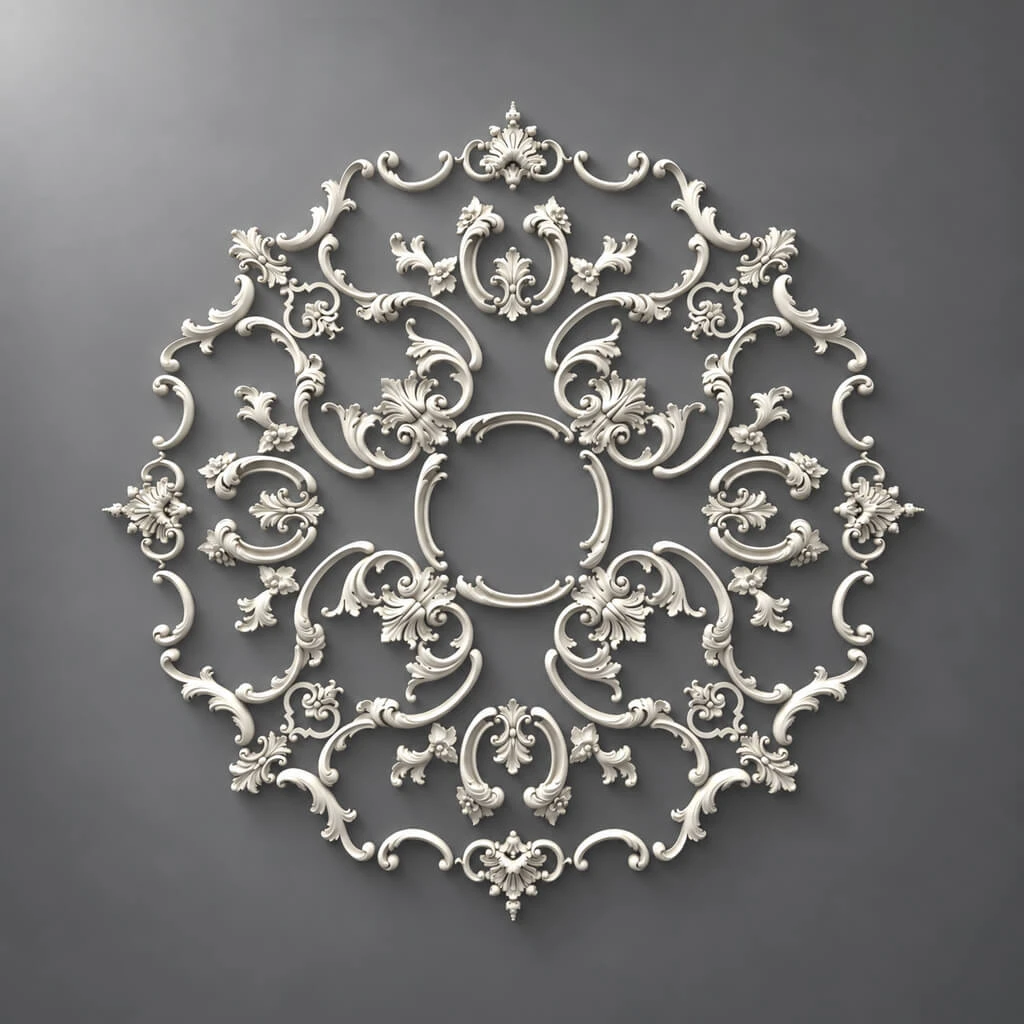
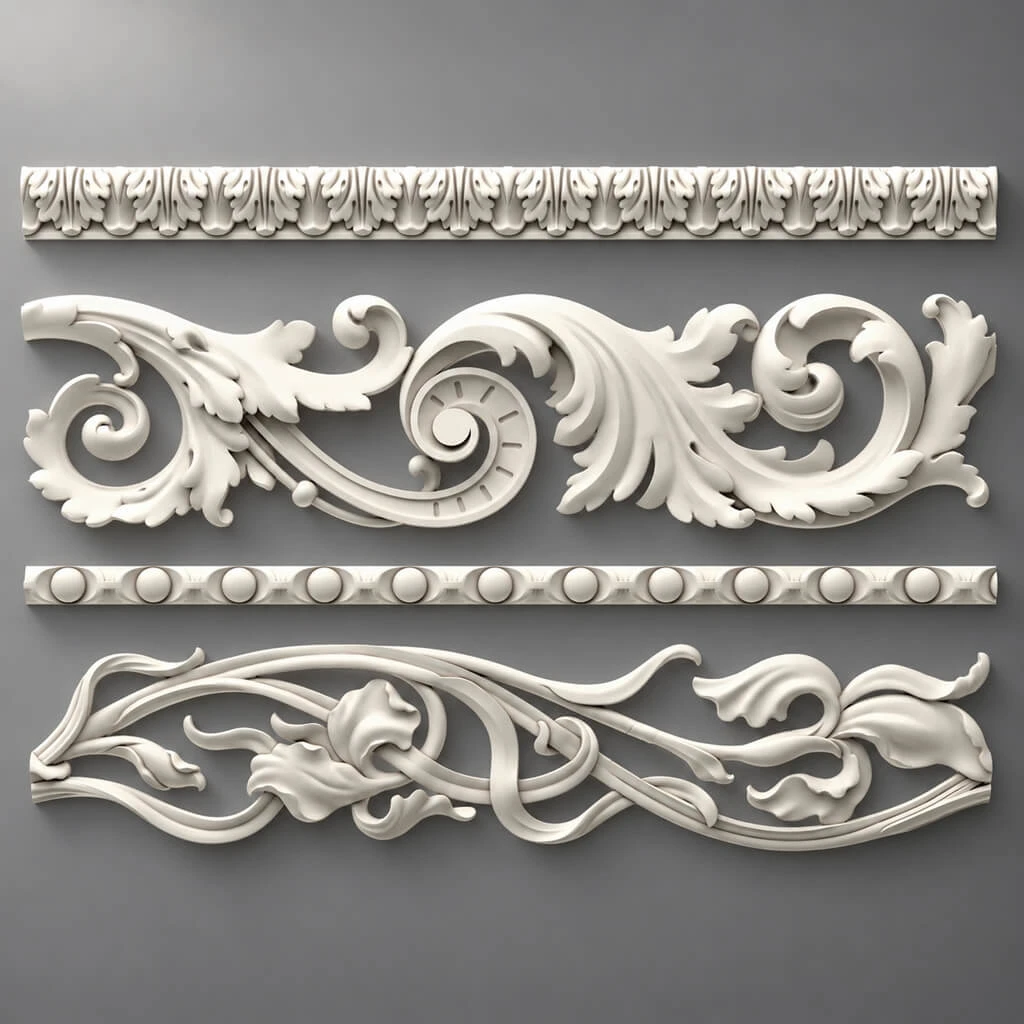
- Polyurethane wall decor: what exactly and where
- Cornice: horizontal perimeter finishing
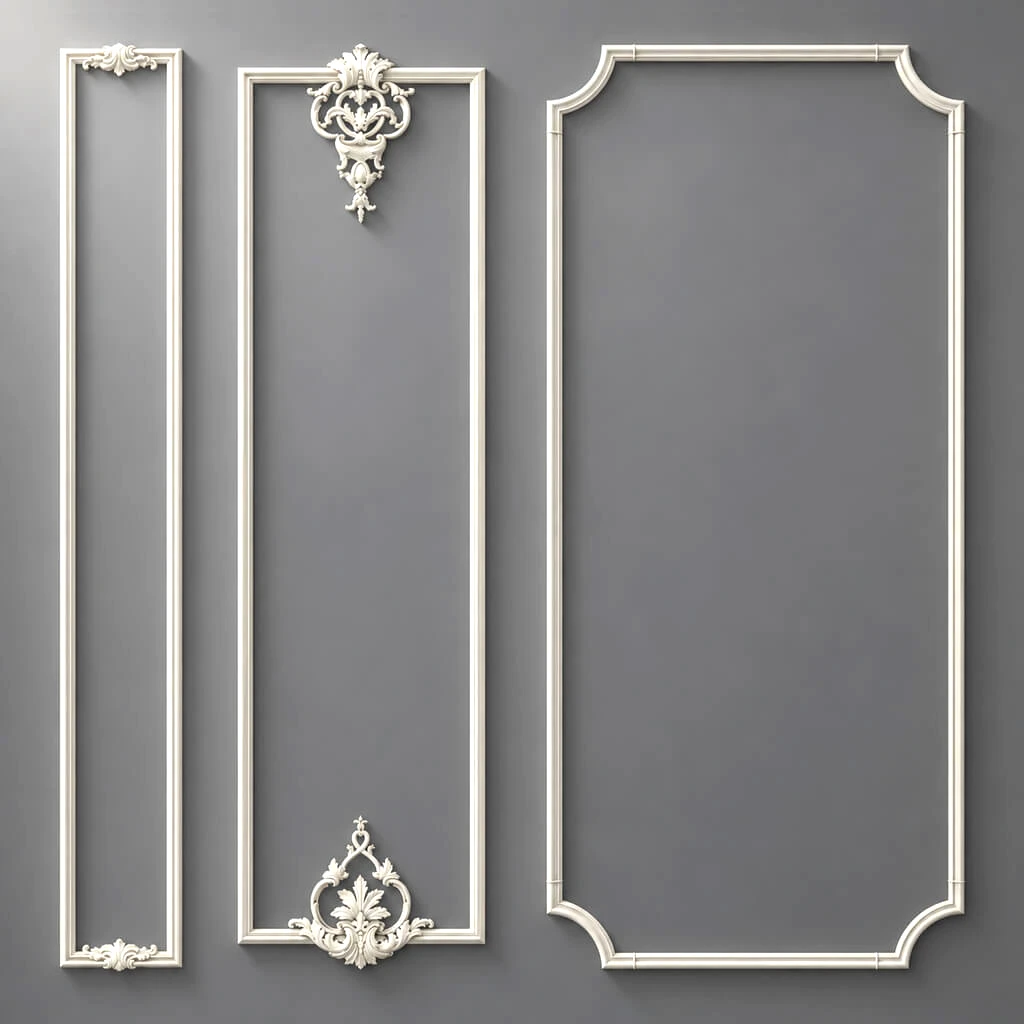
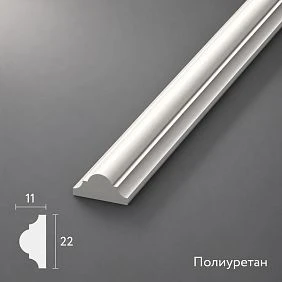
- Moldings: frame geometry on walls
- Overlay decorative elements: point accent
- Architraves: doorway design as an architectural technique
- How to combine vertical rhythm of slats and polyurethane decor relief
- First principle: one language of forms
- Second principle: tonal affinity
- Third principle: scale correspondence
- Principle four: horizontal surface division
- Where slatted panels and polyurethane decor work especially convincingly
- Living room: hierarchy through contrast
- Bedroom: silence is more important than expressiveness
- Hallway and corridor: spatial magic of verticals
- Study: concentration through order
- Children's room: lightness through color and scale
- Slatted panel formats: complete navigator
- Size range: how to choose slat width for a room
- Installation of slatted panels in an Izhevsk apartment: what not to miss
- Wall mistakes where there's too much going on at once
- First mistake: 'more means richer'
- Second mistake: slatted panels and active wallpaper simultaneously
- Third mistake: overlay elements that don't fit the theme
- Fourth mistake: installation without samples
- Fifth mistake: ignoring extensions
- Style combinations: quick reference table
- Reveals and non-standard areas
- STAVROS: a manufacturer where the system is thought out in advance
- FAQ: Answers to Popular Questions
There's a concept rarely used in renovation discussions, yet it distinguishes professional results from amateur ones—visual hierarchy. It's not about 'pretty' or 'rich.' It's about where the eye goes when entering a room. What it sees first, what second, and what it doesn't notice at all because it works as a background.
In an interior without hierarchy, everything screams at once. A bright rug, bold wallpaper, slatted paneling on two walls at the same time, polyurethane decor with a pattern all around the perimeter. The eye darts around, the brain gets tired — and the space feels overloaded, even if each individual element was chosen with taste.
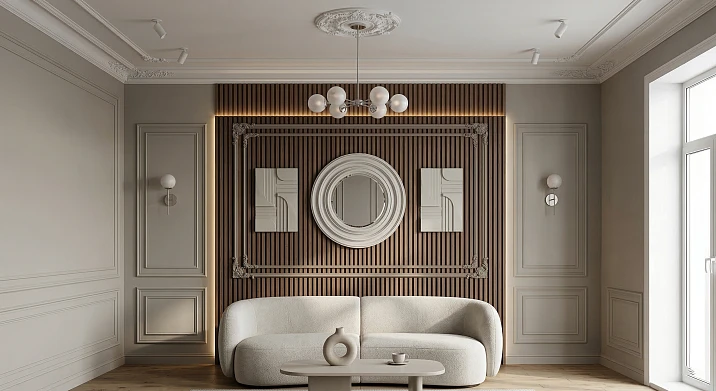
In an interior with hierarchy, there is one main element — everything else works for it.Slatted wall panelson an accent wall and a delicatePolyurethane wall decoraround the perimeter — these are not two competing solutions. This is a system where one element sets the theme and the other frames it. This is exactly what this article is about.
And before we get to specifics: Izhevsk is a city with a harsh continental climate. Winters are cold and long, central heating is on in apartments, the air becomes very dry — humidity is 12–18% with a norm of 40–60%. This is an important detail that changes the requirements for the material. Here you can't just take the first slat you find. Here you need to understand what will happen to the wood in the conditions of an Izhevsk winter — and choose consciously.
Why wall finishing requires a system, not a set of techniques
Imagine two living rooms. In the first — slatted paneling on one wall, a strict geometric cornice around the perimeter, neutral walls. That's it. Three elements — and the space reads as unified, architecturally whole.
In the second — slatted paneling on two walls, ornamental overlays all around the perimeter of the walls, moldings with rich relief, a bright accent color on the third wall. A lot. Expensive. But unsettling.
What distinguishes the first from the second? A system. In the first case, each element occupies its place in the hierarchy: slats — accent, cornice — finishing, neutral walls — background. In the second case, there is no hierarchy — there is competition.
This is not a matter of taste. It's a matter of how perception works. The eye always looks for a focal point — something to rest on. If there are three or four such points, it either wanders confusedly or ignores everything at once. Neither creates the feeling for which the renovation was undertaken.
That's whyWall finishing with slatted panelsandDecorative elements for the wall made of polyurethaneshould be selected together, in one logic — as a system, not as two independent solutions.

Izhevsk: a climate that dictates material requirements
Let's get into specifics. Izhevsk is an industrial city with a sharply continental climate. In winter, temperatures drop to −25–30°C, and the heating season lasts almost half a year. In apartments with central heating, air humidity drops to critical levels — 12–18%. For comparison: comfortable humidity for humans is 40–60%, for natural wood it's 8–12% in equilibrium state.
What does this mean for slatted panels? Solid wood delivered with a production moisture content of 12–14% will actively dry out in an Izhevsk apartment in winter, striving for an equilibrium moisture content of 7–9%. The drying process is accompanied by a reduction in size across the grain. If no thermal gap is left between the slats and the coating poorly seals the ends — deformations, cracks, and coating delamination will appear after the first heating season.
This is not a scare story. This is technology. Properly treated solid wood with an oil finish, sealed ends, and acclimatization before installation works perfectly in the Izhevsk climate for years. Improperly treated — it falls apart in one season.
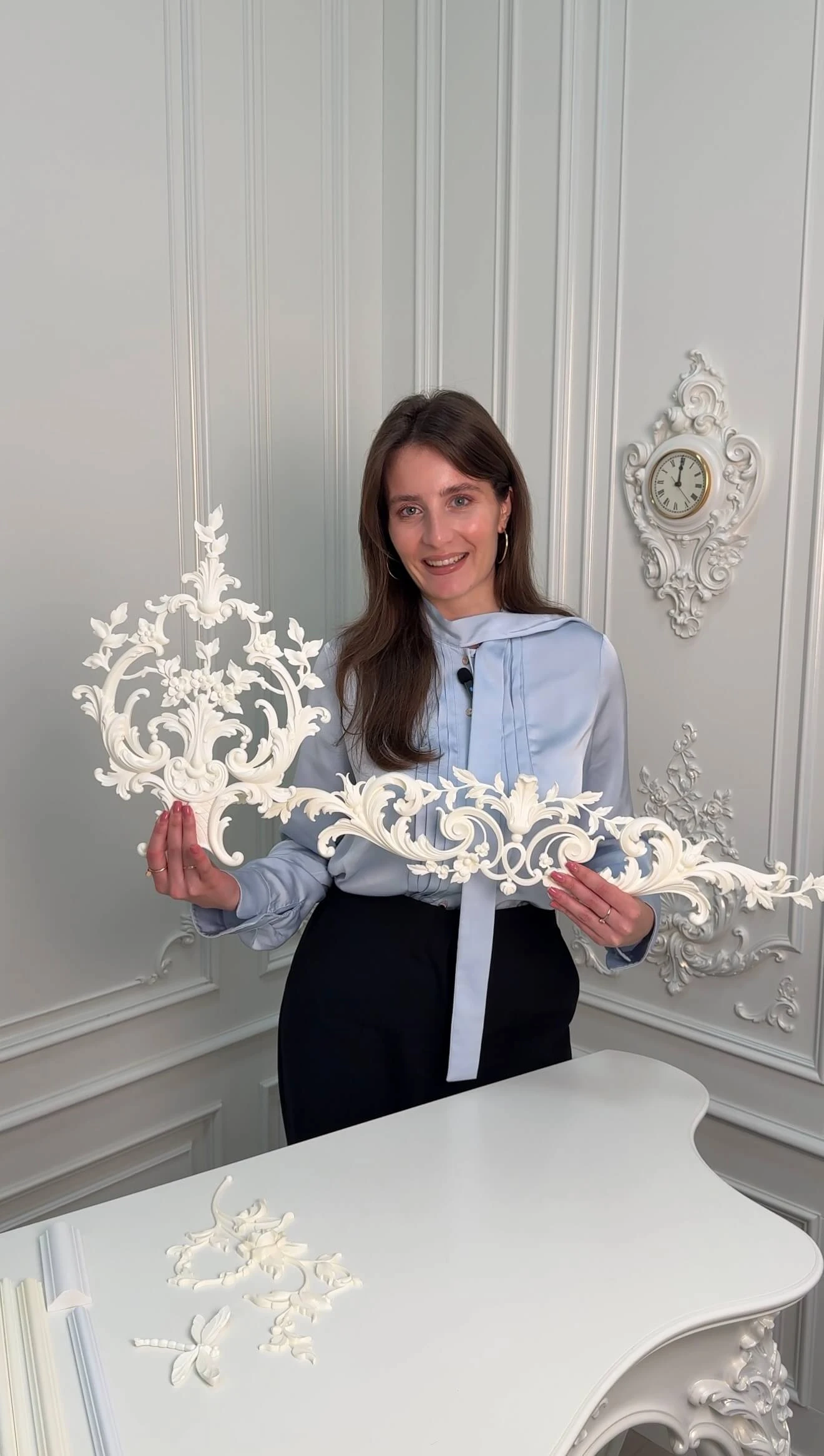
Polyurethane wall decor is absolutely neutral to climate in this regard: polyurethane does not react to dryness, temperature fluctuations, or humidity variations. This makes it the optimal material for wall and ceiling decorative elements precisely in Izhevsk conditions.
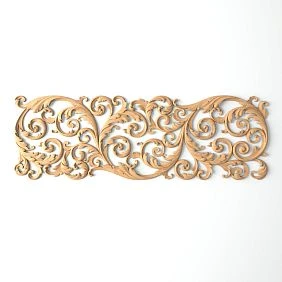
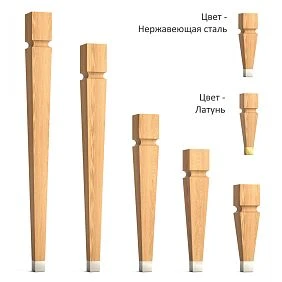
Our factory also produces:

Wall visual hierarchy: how it's built
Before talking about specific materials, we need to understand the tool. Wall visual hierarchy is the distribution of decorative 'weights' among elements so that the eye moves along the intended route.
Get Consultation
Hierarchy levels
First level — accent. One element that catches the eye first. This could be a slatted panel on one wall, a large ceiling rosette, a bright piece of art, a non-standard color zone. There should be only one accent per room.
The second level is structure. Elements that organize space without claiming dominance: cornices, moldings, baseboards, horizontal profiles. They are perceived as 'the proper order of things,' not as independent decor.
The third level is background. Neutral surfaces that enhance the accent through contrast. Smooth plaster, solid-color wallpaper, white ceiling — everything that does not demand attention, but precisely for that reason makes the accent brighter.
Slatted panels in interior design— the first level.polyurethane wall decorin the form of cornices and moldings — the second. The remaining walls and ceiling — the third.
When all three levels are arranged correctly — the interior 'breathes.' When the first level occupies three walls instead of one — it suffocates.
Slatted panels: which ones work better in a residential interior in Izhevsk
Solid oak: durability and living texture
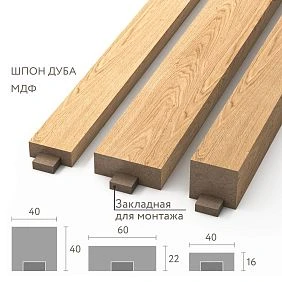
Wooden slat panelsmade of solid oak — the most prestigious and durable option with proper treatment. Oak is dense, reacts slowly to humidity changes compared to coniferous species. The texture — expressive, living, with a characteristic 'radiant' pattern on the tangential cut.
For Izhevsk: oil finish with wax is mandatory. It allows the wood to 'breathe' without a cracking lacquer film. Treating the ends and the back side—no exceptions. Acclimatization indoors—at least 7–10 days with heating on in winter.
solid oak slatted panel— is an investment in durability. If the treatment and installation conditions are observed, it will last for decades, preserving tonality and geometry.
MDF with film coating: stability as the main advantage
MDF Slatted Wall PanelMore stable than solid wood in humidity fluctuations — the film coating seals the surface, the board practically does not react to humidity changes within the working range. Decors: oak, ash, walnut, concrete, fabric, solid colors. For an Izhevsk apartment — this is a versatile working option for most living spaces.
The only critical requirement: sealed edges. Cheap MDF has open edges — in the low humidity of an Izhevsk apartment, they can develop micro-cracks around the perimeter. Always clarify this parameter with the supplier.
MDF for painting: monochrome solutions with polyurethane decor
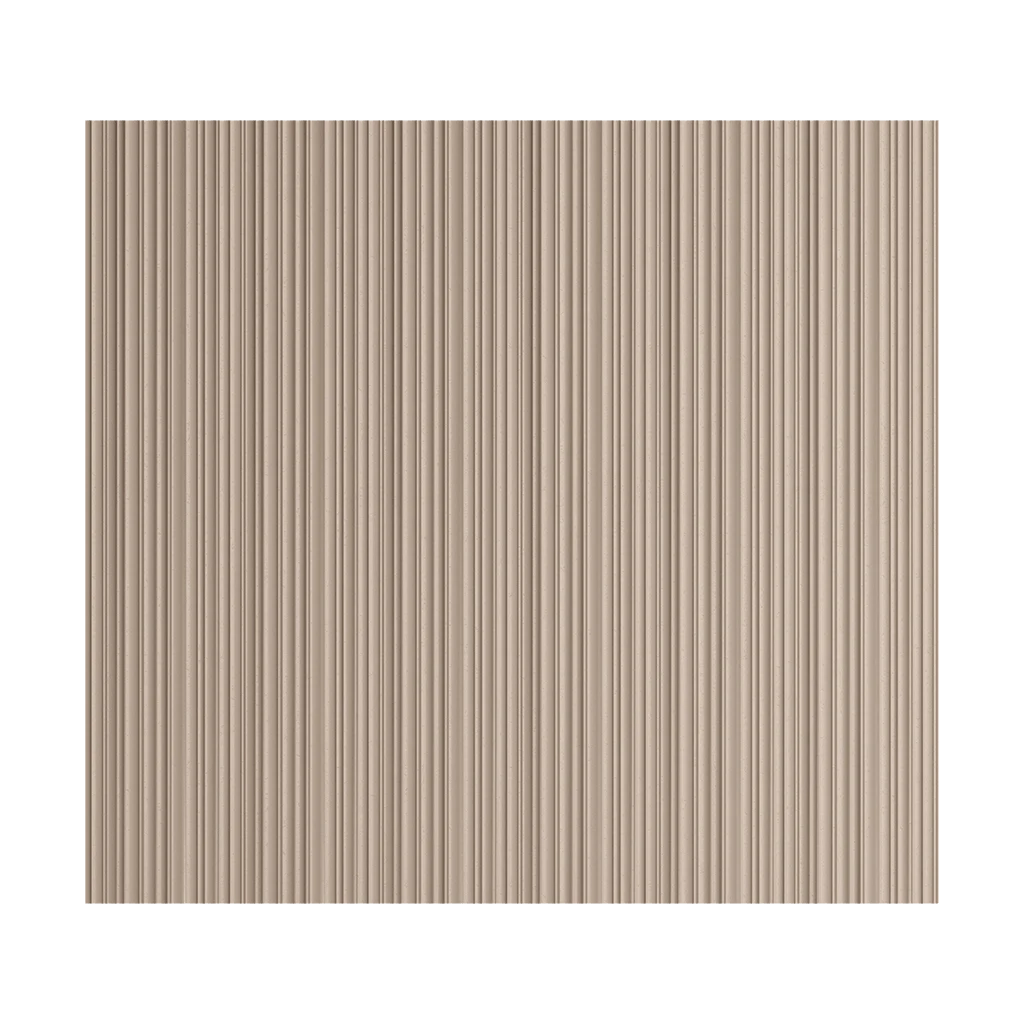
paintable slatted wall panels— profiles without a decorative layer, ready for painting. The main advantage: battens and polyurethane decor are painted in the same tone, creating a monochrome architectural surface. There is relief — but it is tonal, not color. This is one of the most sophisticated modern techniques: the surface is active, but not loud.
In such a solutionpolyurethane wall decorit ceases to be 'molding' in the usual sense — it becomes part of a single architectural shell that works through form, not color.
Thermowood: for areas with high humidity
Thermally treated wood — natural wood whose cells lost the ability to actively absorb moisture during heat treatment. Characteristic dark chocolate tone, matte surface. For bathrooms, kitchens, balconies — the best choice in Izhevsk conditions with their humidity fluctuations between summer and the winter heating season.
Polyurethane wall decor: what exactly and where
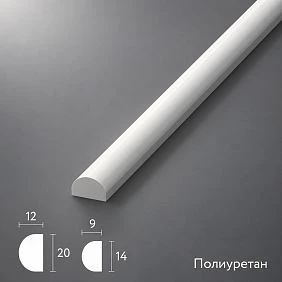
Polyurethane wall decor— this is not a single product category. It is a comprehensive system of wall and ceiling elements, each designed to solve a specific architectural task. Let's break them down by purpose.
Cornice: a horizontal finish for the perimeter
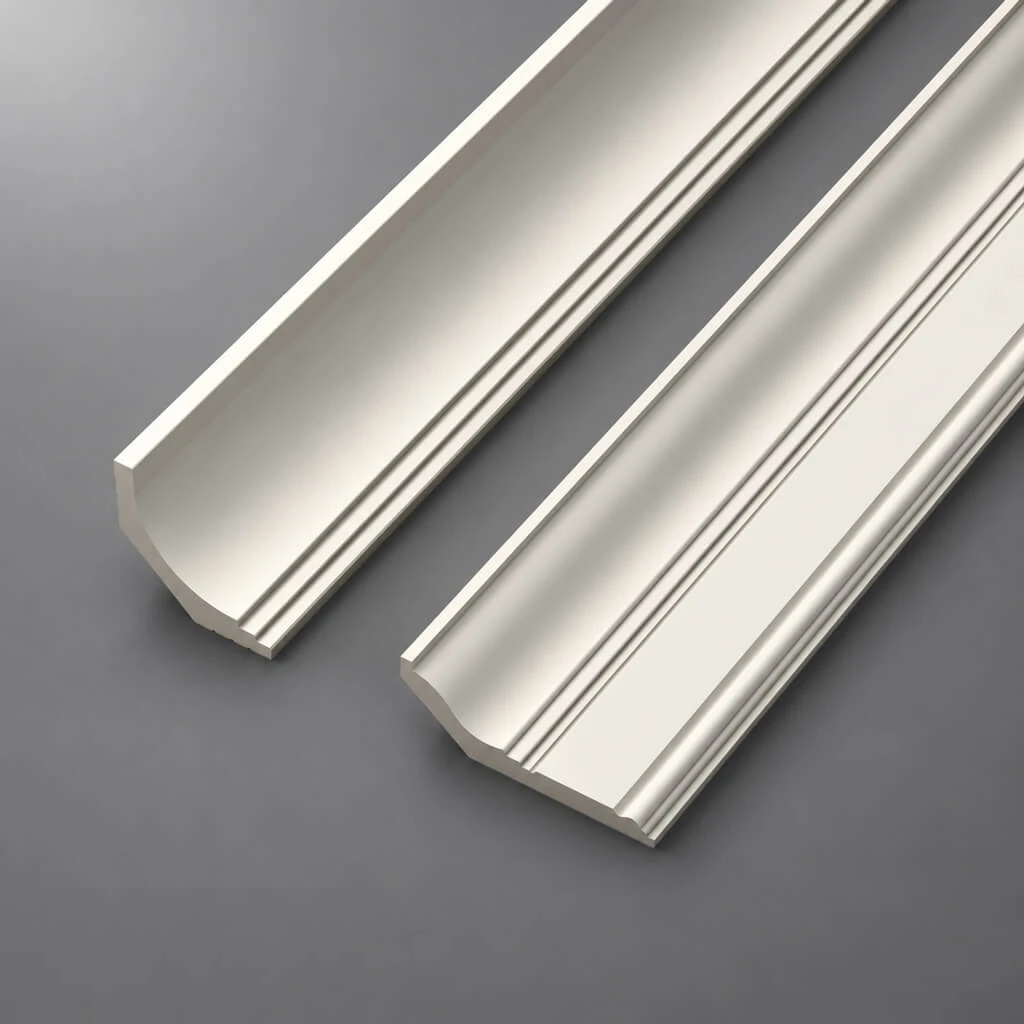
A ceiling cornice conceals the joint between the wall and ceiling—an architecturally problematic area where cracks inevitably appear due to building settlement and temperature fluctuations. The cornice transforms this zone from a 'problem' into an 'architectural element.'
Simultaneously, the cornice creates a horizontal support line along the entire perimeter of the room. It is this line that completes the vertical rhythm of the slats—without it, the slats 'disappear' into the ceiling, losing clarity and completeness.
Cornice size for an Izhevsk apartment: with a standard ceiling height of 2.5–2.7 m—cornice height 80–105 mm. With a 3 m ceiling—up to 120 mm.
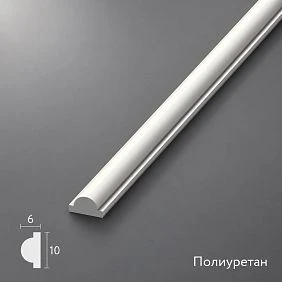
Moldings: frame geometry on walls
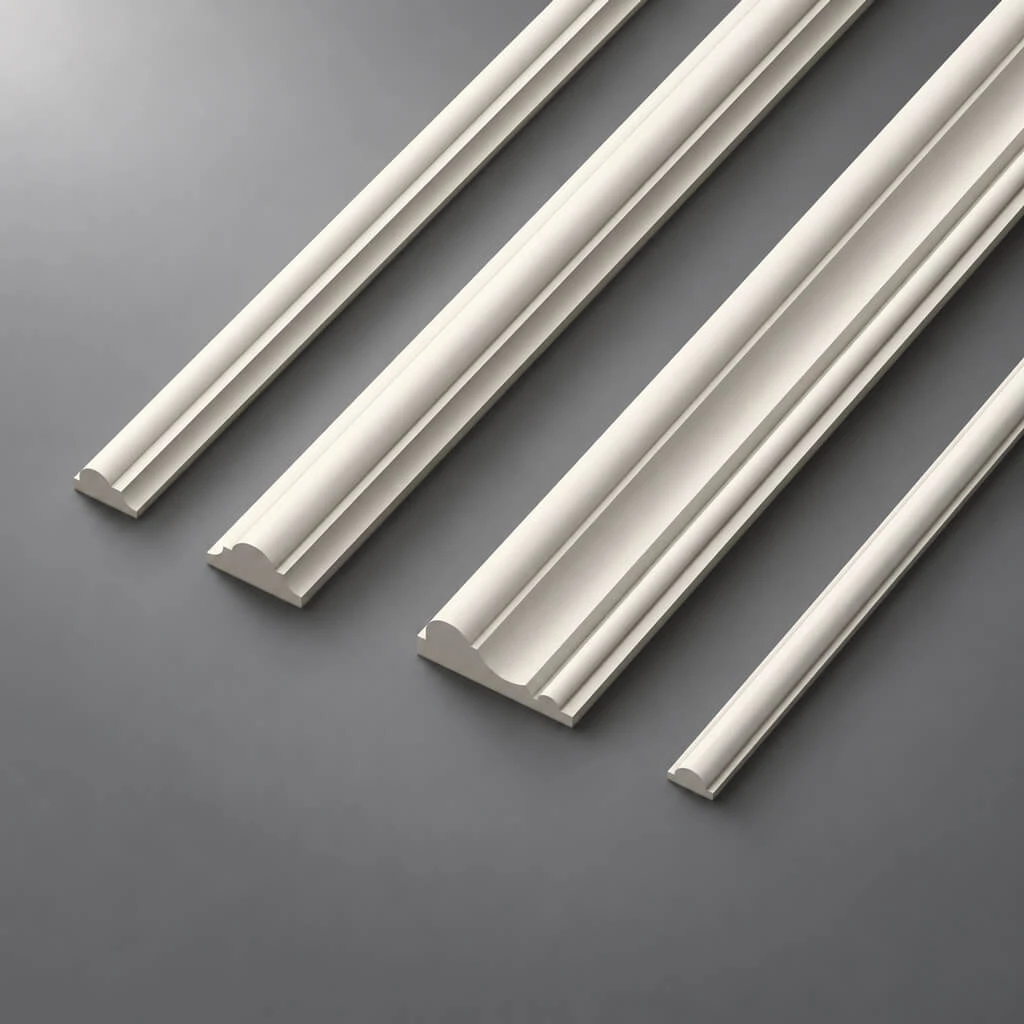
Wall moldings create a system of rectangular frames on the surface—a 'paneled' structure that gives the wall depth and geometric order. In modern interiors, this is not classical decor, but architectural geometry.
In combination with slatted panels, moldings function within a two-level wall scheme:
-
The lower part (up to 80–100 cm from the floor)—Slatted wall panelas a horizontal divider.
-
The upper part is a neutral wall with molding frames.
-
The horizontal profile separates the zones.
This two-level scheme is one of the most versatile and durable solutions in modern interiors. It creates richness without overload and never goes out of style.
Overlay decorative elements: a pinpoint accent
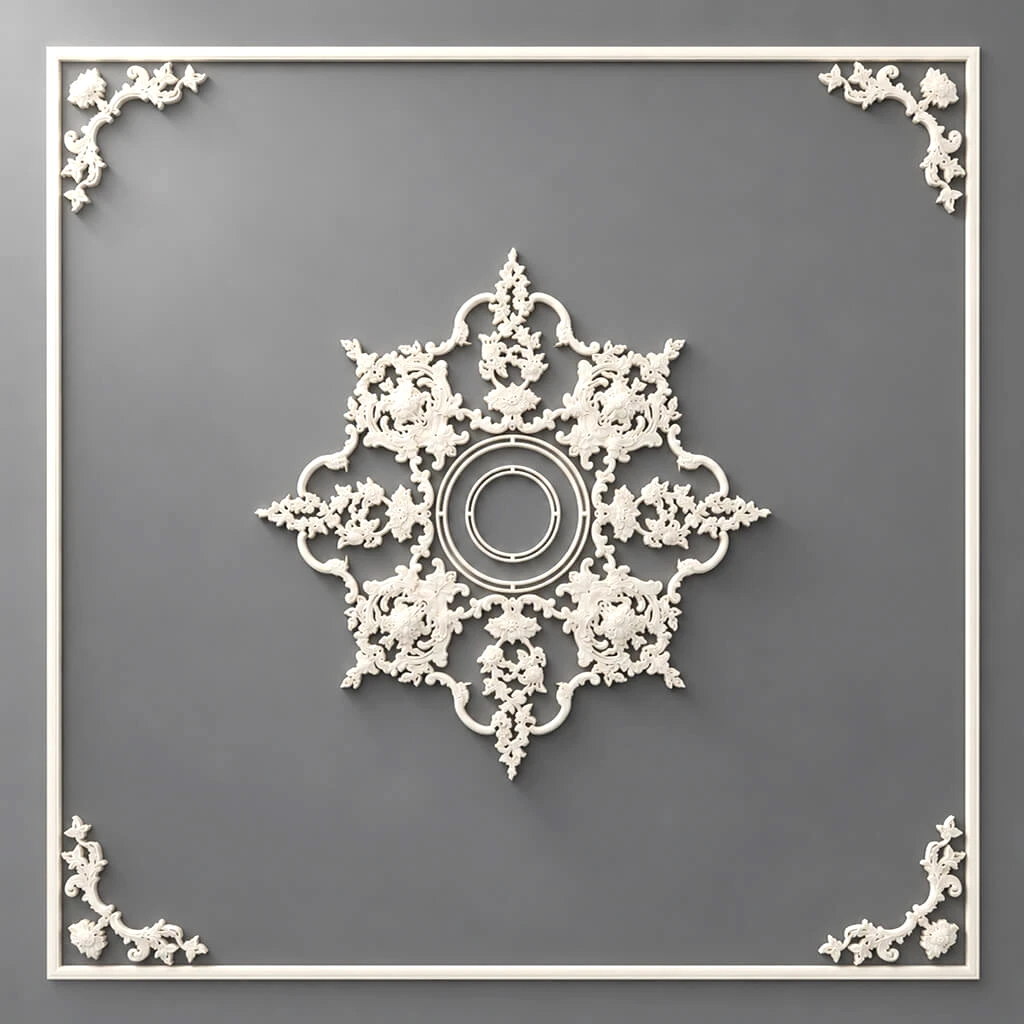
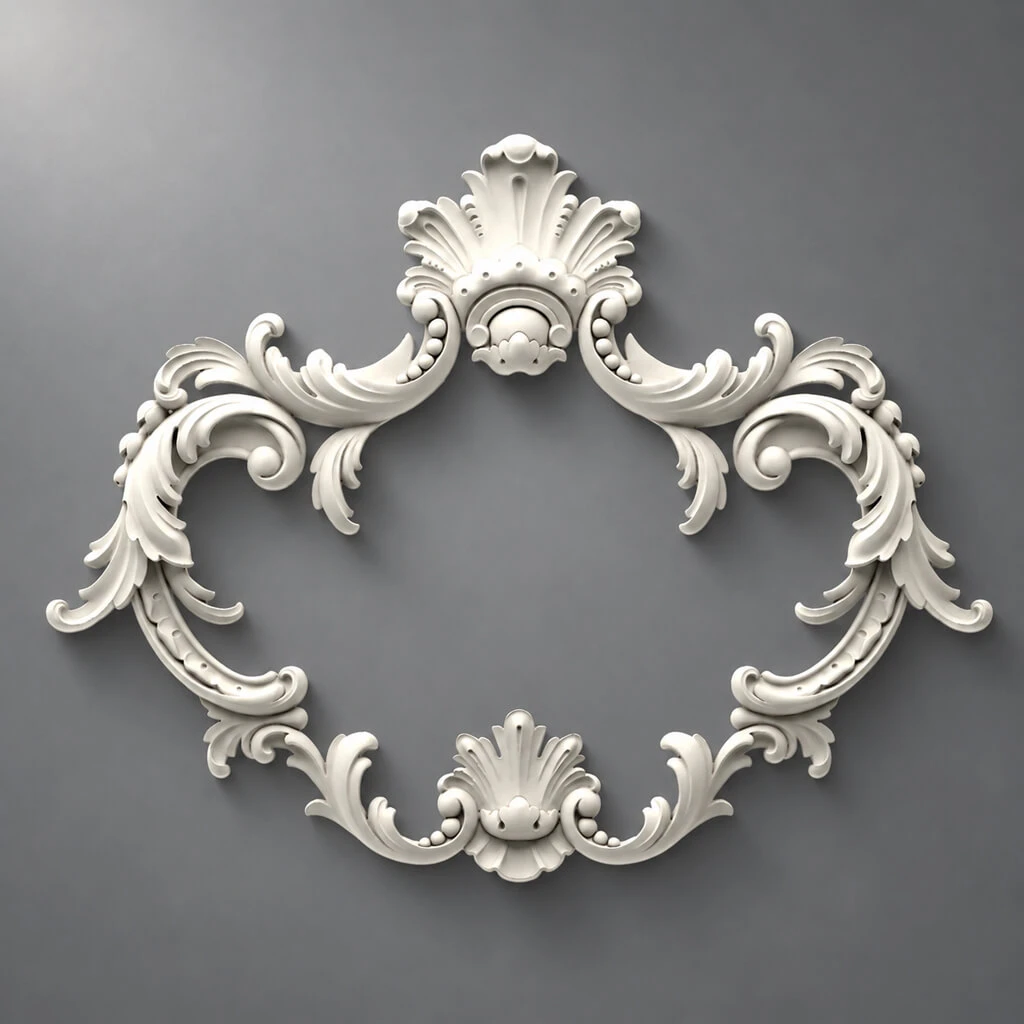
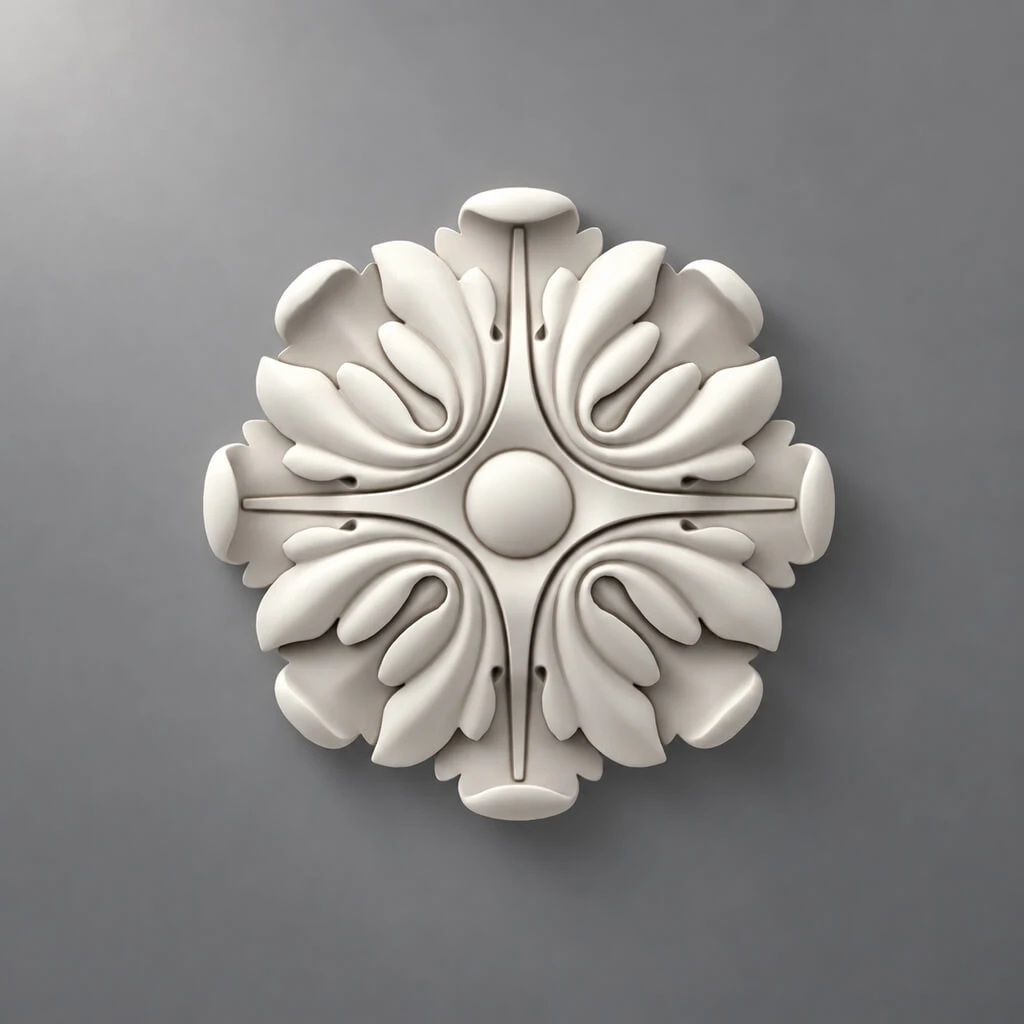
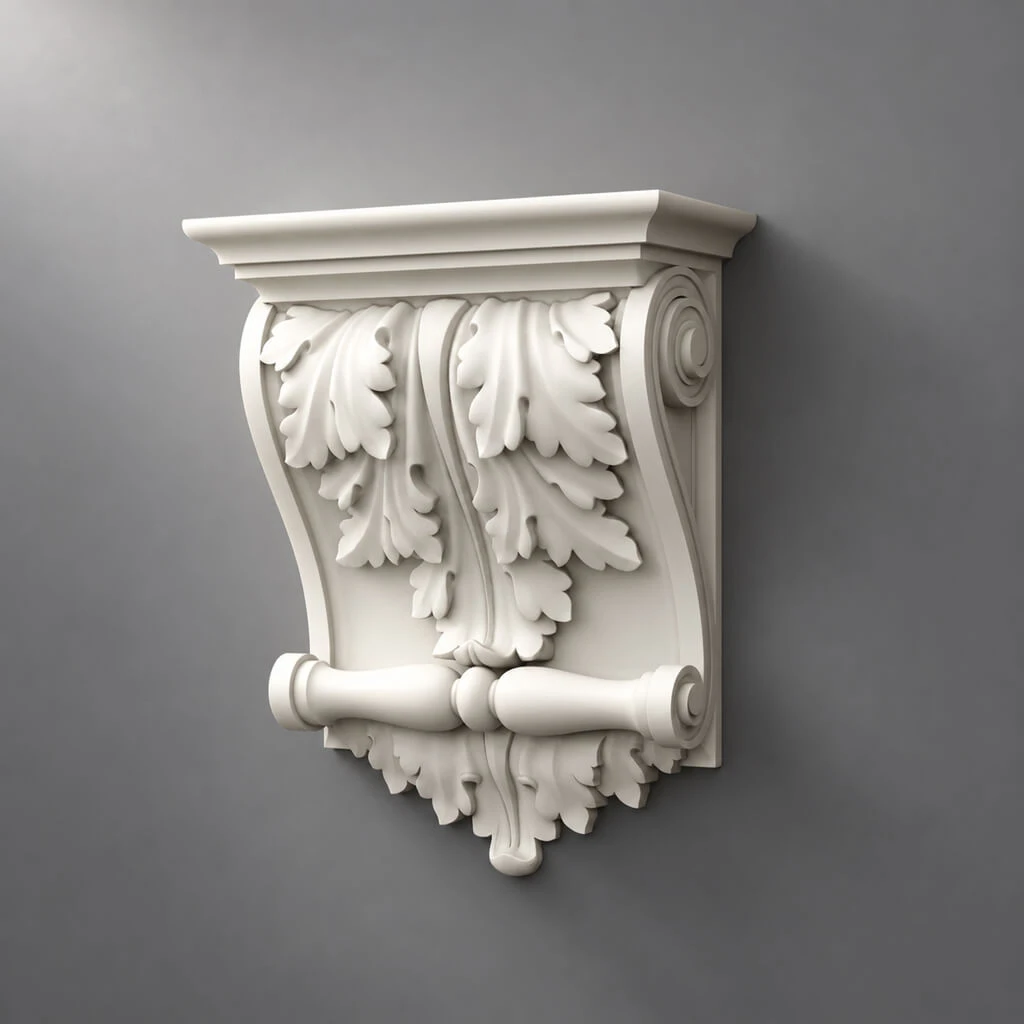
Decorative elements for the wall made of polyurethanein the form of corner blocks, consoles, capitals, keystones—these are pinpoint architectural accents. A single corner block at the intersection of moldings. A decorative console above a window opening. A keystone above a door arch.
In modern interiors, such elements work as 'quotations' of classicism—delicate, singular, intentional. Not the entire interior in stucco, but one detail that speaks to an understanding of architectural tradition. It's subtle. It's smart. And it works precisely because it's used with measure.
Casings: framing openings as an architectural technique
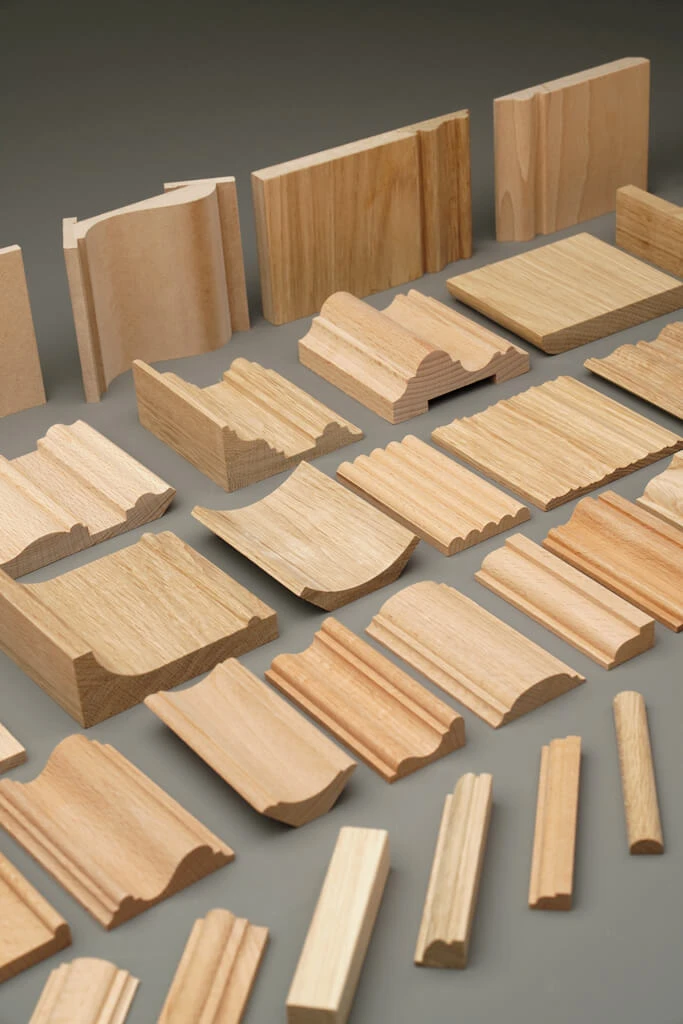
A door or window casing made of polyurethane is the boundary of an opening. Without it, the opening looks like an unfinished hole in the wall. With it—like an architectural element with framing, a sense of a frame.Solid wood moldings, cornices, and baseboards—another category that fulfills the same tasks in wood: for interiors where natural material is preferable to polyurethane.
Rule: the style of the casing must match the style of the cornice. An ornamental casing with a minimalist cornice is a conflict. A geometric casing with a geometric cornice is a system.
How to combine the vertical rhythm of slats and the relief of polyurethane decor
This is the most practical section. Because you can understand everything about each material individually—and still make a mistake when applying them together. Here are specific principles.
First principle: one language of forms
A batten is a linear, strict, repeating element. If you choose a batten with clear geometry—polyurethane wall decorthe cornice should also be geometric: straight lines, sharp edges, without rounded ornamentation. If the batten is soft, with rounded bevels—the cornice can have a soft ogee profile.
Conflict arises when a clear rectangular batten is paired with a Baroque ornamental cornice with scrolls. This is not eclecticism—it is an incompatibility of languages.
Second principle: tonal affinity
Warm wood (natural oak, ash in amber tones) requires a warm white cornice. Cold gray wood or concrete-look MDF requires a neutral or cool white. The conflict between warm and cool in one space is the most common subtle mistake when selecting materials together.
Check the tonality of samples under your type of lighting: under warm light at 2700K, the difference between 'warm white' and 'neutral white' becomes obvious. Under neutral daylight, it is almost imperceptible.
Third principle: scale correspondence
The width of the batten and the height of the cornice should be in proportional correspondence:
| Batten width | Optimal cornice height |
|---|---|
| 40–55 mm | 50–70 mm |
| 60–85 mm | 75–100 mm |
| 90–120 mm | 95–125 mm |
| 130–160 mm | 120–150 mm |
Violating this ratio works against you: a massive cornice with a thin batten looks aggressive, a tiny cornice with a wide batten looks random.
Fourth principle: dividing the surface horizontally
A wall is a vertical plane. Battens create a vertical rhythm. Polyurethane profiles and moldings create a horizontal rhythm. The interaction of verticals and horizontals is an architectural grid that structures the surface.
A combination that always works:
-
Lower third of the wall — batten panels (vertical).
-
Horizontal profile — boundary between zones (horizontal).
-
Upper two thirds — neutral surface or molding frames.
-
Cornice at the top — final horizontal.
This scheme creates a space organized along both axes—and that's precisely the sense of 'architecturality' that distinguishes a high-end interior from an ordinary one.
Where slatted panels and polyurethane decor work especially convincingly
Living room: hierarchy through contrast
Slatted panels in the living room interior— one accent wall. Behind the sofa or behind the TV—not both at once. One slatted surface against three neutral walls gives maximum accent effect with minimal material.
TV area with slatted panels— slats from floor to ceiling, TV mounted on a bracket directly onto the wooden surface. A powerful contemporary technique that simultaneously accents the zone and integrates the TV into the overall design.
Polyurethane decor in the living room: a cornice around the entire perimeter, 90–110 mm geometric profile + thin molding frames on neutral walls. Nothing extra.
Slatted panels with lighting— hidden LED strip 2700K in the gaps between the slats. Warm light highlights the wood texture, creates an evening atmospheric mode, and adds depth to the surface.
Bedroom: silence is more important than expressiveness
slatted panels in the bedroom— the wall behind the headboard. Warm tone, medium or narrow rhythm of slats. No dark wood species in a small bedroom—dark wood absorbs light and shrinks the space.
Polyurethane wall decor in the bedroom—maximally delicate. Cornice 60–75 mm simple profile. No ornamental elements—in the bedroom, they create a formality incompatible with the function of a rest space.
Bedroom slat wall lighting: hidden LED strip behind slats with warm 2700K light and dimmer — perfect evening mode. No chandelier, no spotlights — soft diffused glow through wood.
Hallway and corridor: spatial magic of verticals
Slatted panels in the hallway interior— vertical slats along the long wall of a narrow corridor create a perspective effect, visually elongating the space into depth. This is a rare technique that simultaneously decorates and solves a spatial task.
The most important condition for an Izhevsk hallway: in a dark narrow space — only light-colored slats. Milky, cream, bleached ash. Dark slats in a dark corridor create a tunnel effect — something you want to pass through, not linger in.
A cornice in the hallway is mandatory. It 'raises' the ceiling and adds scale. For a standard 2.6 m ceiling — a 70–85 mm cornice. Decorative overlay elements in the hallway — in moderation: one corner block at the molding point — an accent. Five corner blocks — clutter.
Home office: concentration through order
Slat panels in the office solve a non-obvious task: they create a sense of order and concentration. The rhythm of vertical lines is a visual structure that subconsciously associates with organization. It's no coincidence that slat walls are so popular in workspaces.
For the office: dark wood or dark MDF behind the desk or shelving creates a 'study' effect.Wooden slat panels— from walnut or brushed oak in dark tones — a characteristic choice for a serious workspace.
Polyurethane decor in the office: a cornice with a strict geometric profile, without ornament. Molding frames — if there is space for a bookcase or built-in library — frames 'frame' the shelves, making them part of the wall architecture.
Children's room: lightness through color and scale
Batten panels in the children's room — light, narrow (40–60 mm), in the play or study area. White, cream, light blue — anything except dark and heavy.
Polyurethane wall decor in the children's room: minimal 50–60 mm cornice without ornament. Light, delicate, unobtrusive. No ornamental molding — in a children's room it creates a heaviness incompatible with a play space.
Batten panel formats: complete guide
Types of slat panels— not only by material, but also by construction:
Individual battens — mounted one by one on battens. Maximum design flexibility: you can vary the spacing, width, alternate wood species. Ideal for non-standard solutions.
slatted modular wall panel— battens assembled on a backing into a ready-made module. Quick installation, perfect geometry without manual fitting. The best choice for DIY installation.
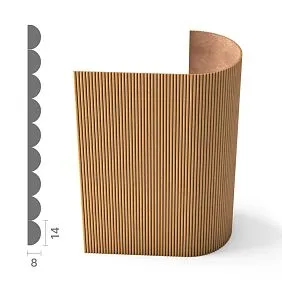
Soft (flexible) slat panels— battens on a flexible base, follow curved surfaces. For arches, rounded columns, non-standard geometries — indispensable.
Ceiling slat panels — specialized lightweight structureswith hidden ceiling mounting. Do not use wall battens on the ceiling — the structure and loads are fundamentally different.
Facade slatted panels — thermowood or WPC for exterior use. For Izhevsk facades with harsh winters — only specialized materials with protection against cyclic freezing-thawing.
Size range: how to choose slat width for a room
Slat width is one of the most influential parameters. It determines the rhythm of the surface and the scale of the space.
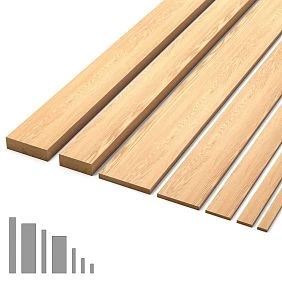
40–55 mm (narrow slat): dense rhythm, dynamism, suitable for small rooms, corridors, areas with low ceilings. Many vertical lines per unit area — an active, but not heavy surface.
60–90 mm (medium slat): universal format. Works in most residential interiors — living rooms, bedrooms, standard-sized offices.
100–130 mm (wide slat): monumental effect. For high-ceilinged rooms, spacious living rooms, halls. In a small room, a wide slat feels oppressive — use with an understanding of scale.
140–180 mm and above: facades, high-ceilinged representative halls, commercial spaces. In a residential apartment — only with a ceiling height from 3.5 m.
Installation of slatted panels in an Izhevsk apartment: what not to miss
installation of slatted panels— a sequential process where no stage can be skipped.
Acclimatization. For solid wood in an Izhevsk apartment in winter — 7–10 days with heating on. The wood must reach equilibrium moisture content before installation, not after. MDF — 3–5 days.
Battens. For solid wood — mandatory, with a ventilation gap of 10–15 mm. Horizontal battens spaced 400–500 mm apart, strictly level. For MDF, adhesive installation is acceptable on a flat wall.
The first plank is critical. Strictly vertical, using a level. All subsequent planks are installed relative to the first one. If the first one is off, it 'guides' the entire plane.
Expansion gap. For solid wood — 1–2 mm between planks. Especially important in Izhevsk with its dry heating air: the gap compensates for seasonal wood shrinkage. Without a gap, when shrinking, planks will 'stand on edge' — waves will appear.
Trim elements. Starter profile at the bottom, finishing profile at the top, corner elements.Installation of slatted panels on the wallwithout trim — an unfinished result regardless of the quality of the planks themselves.
Wall errors, where too much is done at once
This is a separate topic — and a painful one. Because most of these mistakes are made with good intentions.
First mistake: 'more means richer'
Slatted panels on three walls + ornamental cornice + overlay elements on each wall + bright accent ceiling color. Each element is expensive. Together — visual noise where no single element stands out.
Richness in interior design is not about the quantity of materials. It's about the quality and precision of their combination. One expensive solid oak slatted wall + a delicate cornice works more convincingly than four slatted walls made of cheap MDF.
Second mistake: slatted panels and bold wallpaper simultaneously
A slatted wall creates a rhythm. A bold wallpaper pattern on an adjacent wall creates a different rhythm. Two rhythms in one space — competition, not collaboration. Combine slatted panels only with a neutral background: plain plaster, paint, solid-color wallpaper without a pronounced pattern.
Third mistake: overlay elements that don't fit the theme
Decorative elements for the wall made of polyurethanein the form of ornamental rosettes and consoles in the Rococo style — paired with a slatted wall of brushed wood in a loft style. A style conflict that cannot be 'fixed' with subsequent decor.
Stylistic consistency is not a limitation, but freedom: when you clearly understand the language of your interior, the choice of each subsequent element becomes obvious.
Fourth mistake: installation without samples
The decision was made based on catalog photos. Delivered — and the shade is off, the scale is wrong. Redoing it costs twice as much as making the right choice with samples from the start.
Always order physical samples of slats and polyurethane decor. View them in the room under your lighting. Place them next to each other. Only this way.
Mistake five: ignoring trims
Beautiful slats, neat installation — and exposed ends along the top and bottom edges. Or an external corner without a corner profile. This feeling of incompleteness that ruins the entire result.
How to install slatted panelsDoing it right means not only installing the surface but also properly closing all transitions, corners, and junctions. It's the 20% of the work that provides 80% of the quality feel.
Style combinations: a table for quick reference
| Style | Slat panels | Polyurethane decor | Wall Color |
|---|---|---|---|
| Modern Classic | Oak 90–110 mm, warm tone | Cornice with soft ogee 100–120 mm + moldings | Warm White, Cream |
| Scandinavian | Light ash or MDF, 55–75 mm | Straight geometric cornice 55–70 mm | White, Light Gray |
| Loft | Dark brushed wood | Straight cornice or no cornice | Gray concrete, dark brick |
| Neoclassical | Light dense wood, 70–90 mm | Ornamental cornice 120–150 mm, rosette | White, light beige |
| Minimalism | White MDF, narrow slat 40–55 mm | Right angle 40–55 mm | White, Light Gray |
| Eco | Thermowood with matte oil | Minimalist cornice 50–65 mm | Natural earthy tones |
Reveals and non-standard zones
Slatted wall panelsThey work not only on the main wall planes. Window and door reveals finished with slats create an architectural accent in zones that are usually made as neutral as possible. This is a non-trivial solution that is noticeable and memorable.
Narrow slats 40–55 mm work well on reveals—they are proportional to the reveal width and create a neat rhythm. Material: MDF or solid wood, the same tone as the main slatted wall.
STAVROS: a manufacturer where the system is thought out in advance
When you decide to buy slatted panels in Izhevsk and simultaneously selectPolyurethane wall decoras a unified architectural system — STAVROS offers exactly this approach.
STAVROS producesRafter panelsmade of solid oak, ash, thermowood, MDF with film coating and for painting — in the full range of formats. Simultaneously — a wide range ofwall decor made of polyurethane: cornices, moldings, baseboards, overlay elements, corner blocks, rosettes. Everything is produced in one system with a guarantee of stylistic consistency.
Solid wood moldings, cornices, and baseboards— wooden analogs for those interiors where natural material is preferable to polyurethane: oak, ash, beech in a wide range of profiles.Pogonazh iz massivacovers transitions, joints and abutments — those details that turn good installation into a professional result.
Delivery to Izhevsk is a standard service for any project scale. Order samples before making a decision. View them under your lighting. Make decisions based on real material — not a screen.
STAVROS is a manufacturer that understands that an interior is not a set of beautiful products, but an architectural system where each element occupies its place in the hierarchy. It is this logic that makes the difference between 'bought' and 'designed'.
FAQ: Answers to popular questions
Is it possible to buy slatted panels in Izhevsk with delivery from the manufacturer?
Yes. Most manufacturers of quality slatted panels offer Contact us to confirm shipping to your destination., including Izhevsk. It is recommended to order samples before the main order to check tonality and quality.
Which material for slatted panels is better for the Izhevsk climate with dry heating?
MDF with sealed edges is the most stable. Solid oak — with oiled edges and back side, with 7–10 days of acclimatization. Thermowood — for wet areas.
Is acclimatization needed for MDF slats before installation?
For MDF, 3–5 days is enough. For solid wood in the Izhevsk climate — 7–10 days is mandatory.
How to combine polyurethane wall decor with wooden slats?
One language of forms, tonal unity, scale correspondence. Geometric slats — geometric cornice. Warm wood — warm white cornice.
How many slatted panels to take with a margin?
15% to the calculated volume. Considering delivery to Izhevsk — it's better to take more at once than to pay extra for repeated delivery.
Where to buy samples of slatted panels before ordering?
From the manufacturer online. STAVROS provides samples with delivery. It's a small investment that eliminates errors in tone and quality.
Can slat panels be installed independently?
Yes, especially in modular format. Complete step-by-step instructions — in the article %sHow to attach slat panels to the wall.
What is a two-level wall with battens and moldings?
The lower part of the wall is a batten panel up to a horizontal restraint. The upper part is a neutral wall with molding frames. A horizontal profile divides the zones. This creates richness and complexity without overload.