











































































Article Contents:
- Where slat panels are appropriate: an honest application map
- Accent wall in the living room
- Bedroom: headboard and side walls
- Hallway: rhythm instead of emptiness
- Kitchen: dining area and backdrop for open shelves
- Ceiling: the fifth dimension
- When a ceiling requires decorative molding
- First task: decorating the ceiling and wall junction
- Second task: visually lowering a high ceiling
- Task three: zoning the ceiling plane
- Task four: centering the chandelier
- What is important to know about polyurethane molding
- How to combine an accent wall and ceiling molding
- The principle of hierarchy: one main, one supporting
- Color as a linking tool
- Scale of molding relative to the panel
- Transition between wall and ceiling: a key point
- Which rooms particularly benefit from this solution
- Living room with high ceilings
- Dining room or dining area
- Home office and library
- Bedroom in a neoclassical style
- Entryway with unconventional geometry
- How to maintain balance: a coordinate system for decorative solutions
- Rule: 'one surface — one material'
- Rule: 'no more than two accent surfaces per room'
- Rule: 'quiet background for an active accent'
- Rule of proportionality to the room's scale
- Mistakes of an overloaded interior: point-by-point analysis
- First mistake: three different slat rhythms in one room
- Second mistake: molding that is 'heavier' than the slats
- Third mistake: everything in one color but different shades
- Fourth mistake: unfinished edges
- Fifth mistake: decor instead of structure
- Materials in detail: what to choose for a specific task
- MDF: color freedom with precise geometry
- Solid oak: a living surface that ages beautifully
- Flexible panels: for non-standard surfaces
- WPC for wet areas and outdoors
- Installation: the technology that determines the result
- Preparation for slatted panels
- Acclimatization is a mandatory step
- Work sequence: panels first, then molding
- Panel joint treatment
- Ceiling molding installation
- Slatted panels and molding in different interior styles
- Modern minimalism
- Neoclassicism and Modern Classicism
- Scandinavian Style
- Loft and Industrial
- Types of slatted panels: a brief navigator
- FAQ: answers to the most frequently asked questions
- About the Company STAVROS

Ceiling and walls are not separate surfaces that can be designed independently. They are a single spatial envelope, and if you decide to add accent materials to it — slatted panels on the wall andmolding on the ceiling— the task boils down to one thing: achieve an effect without overload. Make the interior speak confidently but not shout.
That's exactly what we'll talk about. Not about what looks good 'in principle,' but about how it works on specific walls, in specific rooms, with specific proportions. If you're looking for where and how to buy slatted panels in Chelyabinsk while also thinking about ceiling decor, you're already thinking like a designer. Now it's time to figure out the details.




Where slatted panels are appropriate: an honest application map
First, let's dispel a common misconception:Rafter panels— not a universal solution for any wall. They work where rhythm, linearity, and a structured surface are needed. Where a wall should speak, not just exist.




Accent Wall in Living Room
Slatted panels in the living room interior— is almost a classic of the genre. The wall behind the sofa or the area around the TV are the two most logical places for slatted decor. Why exactly these? Because the gaze lingers there the longest. A person sitting on the sofa looks either at the screen or past it — at the wall behind it. And it is this wall that forms the first and most lasting impression of the room.
TV area with slatted panels— is ubiquitous today. But the difference between 'installed panels' and 'created an accent wall' is huge. In the first case — it's just a clad surface. In the second — an architectural object that holds the entire interior together.
Our factory also produces:


Bedroom: headboard and side walls
slatted panels in the bedroom— solve several tasks simultaneously: they visually anchor the bed as the center of the space, create a warm natural background, and add tactile comfort — that feeling of coziness that neither a painted nor a plastered wall provides. A headboard made of oak slatted panels with a light oil finish is perhaps the most mature and elegant solution for a bedroom in a neutral color palette.
Get Consultation
Hallway: rhythm instead of emptiness
In the hallwayslatted panels for walls— serve a purely practical purpose: they structure a small transitional space. A narrow corridor with the vertical rhythm of slats visually stretches in height — the ceiling seems higher, the volume — larger.Slatted panels in the hallway interior— is not a luxury, it's an architectural technique available on any budget.
Kitchen: dining area and backdrop for open shelves
Slatted panels in the kitchen— is a special topic. The main rule: place them outside the zone of direct contact with steam and grease. The dining area, the wall opposite the kitchen set, the end of the island — these are the right places. In the dining area, the panel creates a restaurant atmosphere: a warm wooden backdrop plus proper lighting — and the kitchen ceases to be just a kitchen.
Ceiling: the fifth dimension
Finally — the ceiling. There's a separate big discussion about it in the next section. Here we'll just note:Batten panels for ceilings— is not just a design technique. It's a way to change the emotional temperature of a room. The horizontal rhythm overhead creates a sense of intimacy, a 'gathering' of space that is otherwise unreproducible.
When the ceiling requires stucco decoration
The ceiling is the most underrated surface in an apartment. Most people paint it white, stretch a film, or hang a chandelier — and consider the topic closed. But it is the ceiling that sets the visual height and the emotional ceiling (in every sense) of the space.
Ceiling moldings— is not an attempt to reproduce a palace interior in a standard apartment. It's an architectural tool that solves specific problems. Which ones exactly?
First task: designing the junction of the ceiling and wall
The boundary between the wall and the ceiling is a seam that is either architecturally resolved or not. In most modern apartments, it is simply painted. A polyurethane cornice transforms this seam into an architectural detail: it adds depth to the transition, eliminates the 'dirty' corner, and creates a visual frame that makes the ceiling look 'finished'.
Ceiling molding— in the form of a perimeter cornice — is the minimally necessary solution for any space where accent decor is otherwise applied. A slatted wall without a ceiling cornice looks like an unfinished sentence — there is meaning, but no period.
Second task: visually lowering a high ceiling
In rooms with ceiling heights of 3 meters and above, a massive perimeter cornice acts as a visual 'anchor' — it brings the ceiling closer to a human scale, making the space proportionate. This is a classic technique used by architects long before the emergence of modern interior trends.
Third task: zoning the ceiling plane
In open-plan layouts, ceiling molding can perform a zoning function — precisely where there are no walls. A rectangular frame of moldings above the dining area 'marks' this space from above, creating a visual dome over the table. This is a subtle, almost imperceptible technique — but it works flawlessly.
Fourth task: centering the chandelier
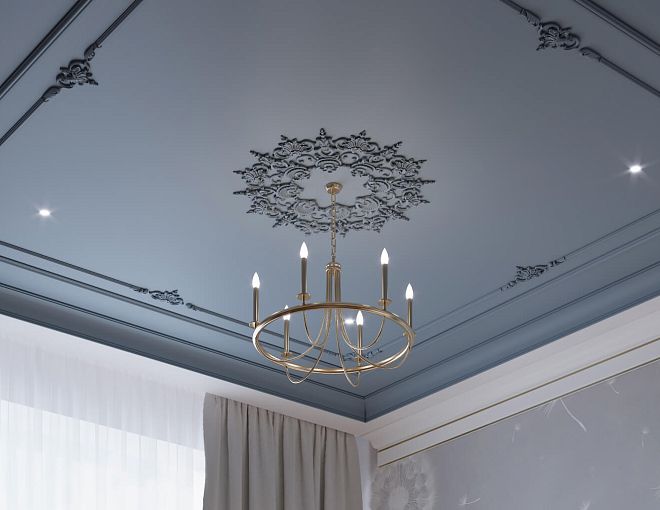
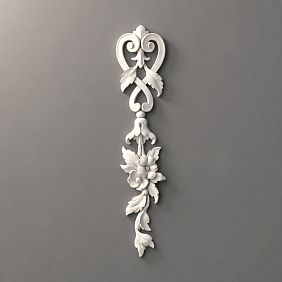
A ceiling rosette for a chandelier — seemingly a decorative detail without utilitarian value. In fact, it does three things: visually centers the light fixture, adds relief to the ceiling above the most active spot in the room, and organizes the gaze.buy ceiling moldings— in the form of a rosette — means adding one detail that will change the perception of the entire ceiling.
What is important to know about polyurethane molding
Polyurethane is today the best material for ceiling decor among all available options. It is several times lighter than plaster, which is critically important for ceilings: heavy decor requires reinforced fastening and professional installation. A polyurethane element is fixed with mounting adhesive—quickly, reliably, without additional anchors.
The material is not afraid of moisture, does not deteriorate from temperature fluctuations, and can be easily cut to any angle with a regular fine-toothed saw. After installation, the profile can be painted any color—either to match the ceiling (it will disappear, leaving only a shadow) or in contrast (becoming an active decorative element).
How to combine an accent wall and ceiling molding
This is where real design begins. A wall with slatted panels is already an accent. A ceiling with molding is another accent. Two accents in one space is either a well-balanced composition or visual noise. How to achieve the first and avoid the second?
The principle of hierarchy: one dominant, one supporting
In any pair of 'slatted wall + ceiling molding,' one element should be dominant, the other—supporting. They should not be equal—that creates competition. It is hierarchy that creates harmony.
If the main accent is the slatted wall, the ceiling molding should be restrained: a thin cornice around the perimeter, without ornaments, matching the ceiling color. It structures the space but does not steal the spotlight.
If the main accent is a ceiling with rich molding decor, cornices, and a central rosette—the walls should be calm.Slatted wall panelsHere, slatted panels are appropriate in one zone, with a closed rhythm, painted in a neutral color. They create a textured background without claiming dominance.
Color as a linking tool
The most effective way to 'tie together' a slatted wall and ceiling molding is a unified color. White slats plus a white cornice plus a white ceiling create a monochromatic architectural composition, where expressiveness arises from relief and chiaroscuro, not from color contrast.
Another option: paint the slatted panel and cornice in one accent color, leaving the other walls and ceiling white or light gray. Then both elements visually 'rhyme'—they unite into a single color theme.
What not to do: paint the panel and molding in two different accent colors. Two competing colors on two competing surfaces guarantee visual chaos.
The scale of the molding relative to the panel
The width of the cornice and its profile should be proportionate to the rhythm of the slats on the wall. If the slats are narrow—30–40 mm—the cornice should be thin and clean: no more than 50–60 mm in height. A wide profiled cornice next to a fine slatted rhythm creates a scale conflict—the two elements 'look' in different directions in terms of size.
If the slats are wide—60–80 mm, with a large spacing—the molding can be more massive. The scale is coordinated, and both elements exist in the same 'language' of forms.
Transition between wall and ceiling: a key point
The boundary where the slatted panel ends and the ceiling with molding begins is a critical point of the entire composition. Three solution options:
First. The slatted panel runs from the floor to the cornice of the molding. The cornice 'covers' the top edge of the panels. Clear separation: wall—slats, ceiling—molding. A professional option.
Second. The slatted panel ends at a height of 110–130 cm—like a 'panel field'. Above it—a painted wall, along the top edge of the panels—a horizontal molding. On the ceiling—a cornice. A classic three-part division: baseboard, field, cornice. Works in any style.
Third. The slatted panel and ceiling molding are placed on different walls. On the accent wall—only panels, without molding. On the ceiling perimeter—only molding, without panels behind it. This is the most 'safe' option for those unsure of their sense of proportion.
Which rooms particularly benefit from this solution
Not every room benefits equally from the combination of slatted panels and ceiling molding. There are spaces where this pairing works especially powerfully.
Living room with high ceilings
This is perhaps the ideal situation. A high ceiling (from 2.8 m) provides scale for a cornice with a rich profile. A slatted wall behind the sofa from floor to ceiling creates a vertical rhythm that 'pulls' the gaze upward. The cornice around the perimeter completes this movement, creating a horizontal frame. Two rhythms—vertical and horizontal—enter into a dialogue, and the space gains architectural clarity.
Add to thisSlatted panels with lighting—an LED strip in the gap between the backing and the wall—and the evening space will transform completely. Light flowing from behind the slats gives a soft, diffuse glow that changes the entire atmosphere of the room.
Dining room or dining area
The dining area is one of the best candidates for combining slatted panels and molding. The wall behind the dining table with a slatted accent creates a 'stage' for dinners and gatherings. Ceiling molding above the table—a frame molding that defines the zone from above—completes this stage and makes it a self-sufficient space within a large room.
Study and home library
The study is a room where details matter more than anywhere else. This is where a person spends time in concentration, and every element of the surrounding space either supports or disrupts that focus.Wooden slat panelsOak on the wall behind the desk is a material that doesn't distract but doesn't leave a feeling of emptiness either. A light cornice molding on the ceiling completes the composition, adding a sense of 'gathered' space.
Bedroom in a neoclassical key
Slatted panels in the bedroom interiorcombined with ceiling molding create precisely that image of an 'adult, mature bedroom' that many dream of but don't know how to realize. Headboard wall panels are a warm natural material. The ceiling cornice is a clear frame that visually completes the space. Color unity (everything white, or everything in one tone) makes the bedroom resemble a design journal, not a random set of solutions.
Hallway with non-standard geometry
This is where they truly come into their ownsoft slat panelson a fabric base. If a hallway has rounded corners, columns, or arched openings, only a flexible panel allows applying a slatted rhythm to such a surface without deformations or seams. A perimeter ceiling cornice, including rounded corners, completes the composition.
How to observe measure: a coordinate system for a decorative solution
Measure is the most difficult thing in design. Not because it's technically hard to calculate. But because it's hard to stop in time. Here are several specific principles that work.
The 'one surface — one material' rule
A wall is either slatted, plastered, or wallpapered. Not three options on one wall. A ceiling is either with molding or plain. Mixing several materials within a single plane almost always looks like an unfinished renovation.
Rule: 'no more than two accent surfaces per room'
One accent wall plus ceiling decor is two accents. Already the maximum for most rooms. Three accent walls plus a ceiling is overload, where the eye has nowhere to rest.
Rule: 'quiet background for an active accent'
The more active the slatted panel, the quieter the adjacent walls should be. A dark, expressive oak panel with an open rhythm requires white or light gray adjacent walls. Otherwise, it 'drowns' in the general noise.
The same goes for molding. A rich profiled cornice requires a clean, uncluttered ceiling.
Rule of proportionality to the scale of the room
The width of the slats and the scale of the molding profile must correspond to the size of the room. In a 15 sq. m room, large slats 80 mm wide with a wide spacing will feel oppressive. A narrow rhythm of 30–40 mm works. In a 40 sq. m hall, conversely, a small rhythm gets lost — mass and a large spacing are needed.
Practical guideline: the height of the molding cornice in centimeters should be no more than 2–3% of the ceiling height in centimeters. For a 2.5 m ceiling, that's 5–7.5 cm of profile height.
Mistakes of an overloaded interior: breakdown by points
An overloaded interior is easy to recognize — something always feels 'off,' but it's unclear what. In reality, this feeling stems from specific technical mistakes.
First mistake: three different slat rhythms in one room
This happens when panels are chosen separately: some for the living room, others for the hallway, and a third set for the kitchen, only to find that all three spaces are adjacent and visible at once. As a result, three different slat patterns compete in the viewer's sight. Solution: use a single panel type for the entire open space.
Second mistake: molding that is 'heavier' than the slats
If the slats are thin and light, but the cornice is massive and ornate, the cornice 'kills' the wall. The eye is drawn to the ceiling, and the wall becomes merely a stand for the molding. The scale of the molding profile should be proportionate to the thickness and rhythm of the slats.
Third mistake: everything in one color, but different shades
White MDF plus a milky ceiling plus a cream cornice — this is not monochrome, it's three uncoordinated whites. They clash subtly, imperceptibly, but constantly. Either use one precise white for everything — or opt for a deliberate contrast with a clear color scheme.
Fourth mistake: unfinished edges
slatted wall panels for interior finishingwith unsealed ends, without trim elements at the corners, without molding along the top edge — this is a visually incomplete structure. All edges must be resolved: corner overlays, end strips, moldings around the perimeter of the field.
Fifth mistake: decor instead of structure
The most subtle mistake. Decor is what is added on top of the structure. But when there is a lot of decor and no structure, the space looks cluttered. Slatted panels and moldings should first and foremost structure the space: divide, complete, set boundaries. And only then decorate.
Materials in detail: what to choose for a specific task
MDF: color freedom with precise geometry
MDF Slatted Wall Panel— the choice of those who work with color as the main tool. The density of the material provides a perfectly smooth surface for painting.paintable slatted wall panels— offer maximum freedom: you can precisely match a catalog color, coordinate the tone with textiles and furniture, and repaint when changing the interior concept.
Limitation: moisture. MDF is not intended for constantly damp rooms.
Solid oak: a living surface that ages beautifully
Oak Slat Panel— a material with character. It doesn't need to be decorated with anything: the natural grain pattern makes the surface interesting on its own. Under clear oil, oak gives a warm golden tone. Under stain — Scandinavian gray, tobacco cognac, almost black wenge.
A special quality of oak: it ages with dignity. After 10–15 years, a properly treated oak panel looks better than on the day of installation — the surface acquires a noble patina.
Flexible panels: for non-standard surfaces
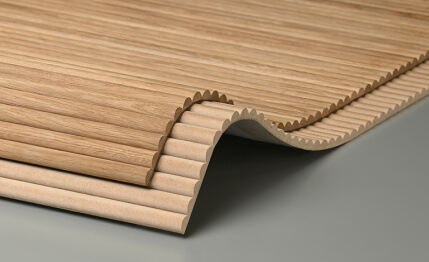
soft slat panelsOn a fabric backing — the answer to the question 'how to do slatted finishing on a curved surface.' Arches, columns, rounded niches — all are accessible for slatted decor thanks to the flexible design. No deformation of the slats, no unsightly joints.
WPC for wet areas and outdoors
For high-humidity rooms and facade structures —DCP slatted panelsWood-polymer composite does not absorb water, does not rot, is resistant to ultraviolet light and temperature fluctuations. This is the right choice for balconies, terraces, open areas, and bathrooms without forced ventilation.
Installation: the technology that determines the result
Technically competent installation is half the result. The most expensive material with sloppy installation will look cheap.
Preparation for slatted panels
The base must be dry, clean, without crumbling. For irregularities exceeding 5 mm per linear meter — installation on a frame. Frame made of metal profile: vertical studs every 400–600 mm, horizontal crosspieces every 600 mm. This levels the plane, creates an air gap, and allows for laying acoustic filler.How to install slatted panels— on adhesive plus headless finishing nails; for frame installation — self-tapping screws through the panel backing.
Acclimatization — a mandatory step
Wooden products must be stored in the room at operating temperature and humidity for at least 48 hours before installation. This allows the material to adjust to the dimensions corresponding to the operating conditions. Ignoring this stage leads to deformation of the installed panels: separation of slats, warping of the substrate, and the appearance of gaps.
Order of work: first panels, then molding
This rule has no exceptions.installation of slatted panelsis completed entirely — including all end and corner elements. Then the molding is installed: it covers the edges of the panels, hides the joints, and finishes the transitions. Never the other way around.
Processing panel joints
In high-qualitya slatted modular wall panelthe joint between two modules is designed so that the rhythm of the slats is not interrupted. The slats from the edges of adjacent modules form a symmetrical gap, indistinguishable from the internal gaps. This is called a 'seamless joint' — and it is a sign of a professional product. When choosing, clarify this parameter.
Installing molding on the ceiling
The ceiling cornice is glued with mounting polyurethane adhesive. The surface is primed. The cornice is cut into segments according to the length of the walls, and the corners are joined at a 45° angle. The joint is filled, sanded, and primed. After drying — painting in the same tone as the ceiling or in an accent color. The entire process is suitable for DIY with a miter saw and basic painting experience.
Slatted panels and molding in different interior styles
Modern minimalism
MDF for painting to match the wall color, closed slat rhythm, thin flat molding cornice — barely noticeable, working only through shadow. Color: white, light gray, warm linen. No ornaments. Nothing superfluous. Effect — through relief and proportions.
Neoclassicism and modern classicism
Here the combination unfolds to its full potential.Wall slat panels in interiorIn the lower wall zone (up to 110–130 cm height), a dado rail at the border, the upper zone — painted or with wallpaper, and a ceiling cornice with a classic profile. Three-part wall: panel field — main field — cornice. A timeless architectural structure, working in any era.
Scandinavian style
Oak with light oil finish — on one wall. Molding cornice — wooden or white, without ornaments. The rest — white. Accent through material and texture, not through form and decor.
Loft and industrial
Dark tinted panels, metal molding instead of polyurethane.Slatted Façade PanelsIn loft interiors, they are used as decorative screens, zoning partitions, column cladding. Molding here — in an industrial interpretation.
Types of slat panels: a brief navigator
For the final choice to be informed, it is important to understandTypes of slat panelsand how they fundamentally differ:
| Panel type | Material | Application | Features |
|---|---|---|---|
| MDF for painting | MDF 750–850 kg/m³ | Walls, niches, backsplashes | Perfect surface for color |
| Oak solid wood | Oak with oil/varnish finish | Walls, headboards, ceiling | Live texture, durability |
| Flexible fabric-backed | MDF + fabric | Arches, columns, curves | Installation on non-standard surfaces |
| WPC (Wood-Plastic Composite) | Wood-polymer composite | Wet areas, facade | Water resistance, frost resistance |
| MDF with backlight | MDF + gap for LED | Accent walls, TV zones | Glow effect due to slats |
FAQ: answers to the most frequently asked questions
Can I buy slatted panels in Chelyabinsk with door-to-door delivery?
Yes. STAVROS company delivers throughout Russia, including Chelyabinsk and the Chelyabinsk region. Orders are placed online, and consultation on material selection is free.
Is ceiling molding difficult to install on your own?
No. A polyurethane cornice is glued with mounting adhesive and cut with a regular saw. Main tools: saw, adhesive, level, spatula. No specialized equipment required. Carefulness and precise corner cuts are important.
Which slatted panels are better for a bedroom: MDF or oak?
For a bedroom, oak is preferable: a natural warm material creates an atmosphere of tranquility. MDF for painting — if an exact color concept is important or the budget is limited.
Do MDF panels need to be primed before painting after installation?
If factory primer is already applied — finishing paint in 1–2 coats is sufficient. If the panel is without factory primer — priming is mandatory, otherwise the paint will apply unevenly and will not provide the necessary adhesion.
How to match a plaster cornice to slatted panels?
Main principle: the scale of the cornice corresponds to the scale of the slats. Narrow slats — thin cornice (up to 50 mm in height). Wide slats with large spacing — cornice up to 80–100 mm. Color — either matching the ceiling or matching the panels.
Slatted panels made of DPC — can they be used in residential premises?
Yes, but not advisable: DPC was created for wet areas and facades. In residential premises, MDF or oak provide better aesthetics at a comparable price.
How to calculate the quantity of slatted panels for a room?
Measure the area of surfaces to be finished in square meters. Add 12–15% for cutting and waste. Divide by the area of one module (specified in the product card). Round the result up.
What is a seamless module joint and why is it important?
With a seamless joint, the slats of two adjacent modules form a uniform rhythm without a visible boundary between modules. This is a sign of a professional product. Without a seamless joint, asymmetrical strips will be visible at module joints, disrupting the rhythm.
About the company STAVROS
When you need not just to buy material, but to get a solution — the right supplier matters no less than the right product choice.
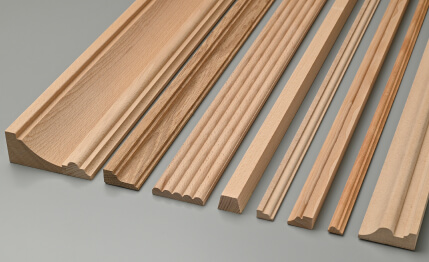
STAVROS is a manufacturing company specializing in solid wood and polyurethane products for professional interior finishing. The STAVROS catalog includes Rafter panels made of MDF and solid oak in several formats and configurations, Ceiling moldings made of polyurethane — cornices, rosettes, moldings, overlays — and Pogonazh iz massiva for finishing slatted structures.
STAVROS accepts orders from Chelyabinsk and all regions of Russia. Delivery is via transport companies with full packaging and accompanying documentation. The STAVROS website features detailed articles on the selection, application, and installation of all presented products — a practical knowledge base that helps make decisions without unnecessary calls and consultations.
Buy slatted panels in Chelyabinsk with delivery, select ceiling molding decor, get material calculation — all on the STAVROS website.