





























































Article Contents:
- What slatted panels bring to modern finishing
- Slatted wall panels: what happens to the space
- Wooden slatted panels: natural texture as an architectural argument
- Wall panels in interior design: the function of accent
- Why polyurethane moldings restore architectural depth
- What exactly do moldings do to space
- Types of molding decor: what exists and where it works
- How to combine vertical rhythm and relief decor: laws of combination
- Scale rule: the cornice cannot be smaller than the batten
- Tone rule: white molding and dark batten
- Zone rule: batten accents, molding frames
- Which zones particularly benefit from combining batten panels and polyurethane decor
- Living room: theater of architecture
- Bedroom: architecture of tranquility
- Entryway and Corridor: First Impression
- Study: concentration and authority
- Children's room: system without overload
- Mistakes when combining panels and molding: honest and detailed analysis
- First mistake: ornamental cornice with modern batten panels
- Second mistake: slatted panel + molding frames on the same wall
- Third mistake: cornice without baseboard (or vice versa)
- Fourth mistake: slats of different tones on different walls in the same room
- Fifth mistake: ignoring finishing profiles
- Sixth mistake: different casing profiles in the same room
- Seventh mistake: molding without coordination with the room's architecture
- How to choose a solution to match the interior style: specific combinations
- Modern minimalism
- Scandinavian Style
- Modern classicism
- Neoclassicism and 'Soft Classic'
- Loft and Industrial Style
- Material language: how slats and polyurethane interact physically
- Comparison table: slatted wall with molding and without
- About scale again: why it matters more than anything else
- STAVROS: a system, not a set of products
- FAQ: answers to the most common questions
There are interiors that are felt with the body — even before the eye has time to read them. You enter a room, and the space is already speaking to you: through the rhythm of verticals, through shadows in the relief, through how the wall meets the ceiling. This is not a matter of expensive furniture or rare materials. It is a matter of architectural logic — when every finishing element is not random, but is exactly where it should be, in the right scale and proper context.
Rafter panelsandPolyurethane moldings— two tools that, in skilled hands, transform a standard apartment into an architecturally meaningful space. But the word 'skilled' is key here. Because these same two tools, when applied chaotically, produce exactly the opposite effect: an overloaded, contradictory, visually heavy interior.
This article is about how slatted panels and polyurethane decor work together: by what rules, in what proportions, in what zones. And about what mistakes to avoid in the process.
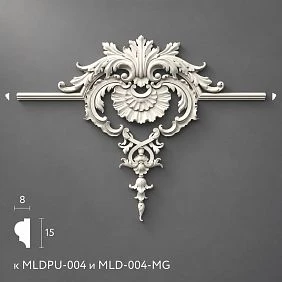
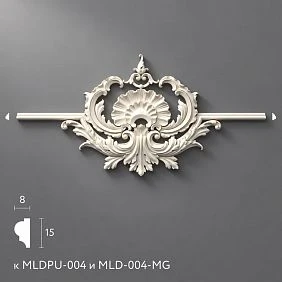
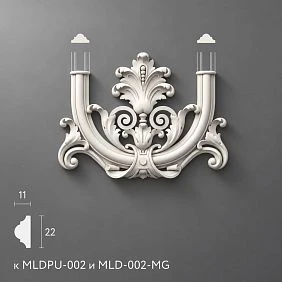

What slatted panels bring to modern finishing
Before talking about the combination, let's talk about each element separately — truly, not formally.
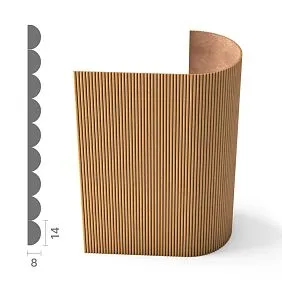
A slat on the wall is not just 'wooden cladding'. It is rhythm. A visual pulse that sets the internal frequency for the entire room. Vertical slats accelerate the perception of space — the eye moves up and down. Horizontal ones — slow down and calm. Diagonal ones — create dynamism.
And this is the fundamental difference between a slatted panel and any other finishing material. Wallpaper creates texture, paint — tone, plaster — relief. A slat creates movement.

Slatted wall panels: what happens to the space
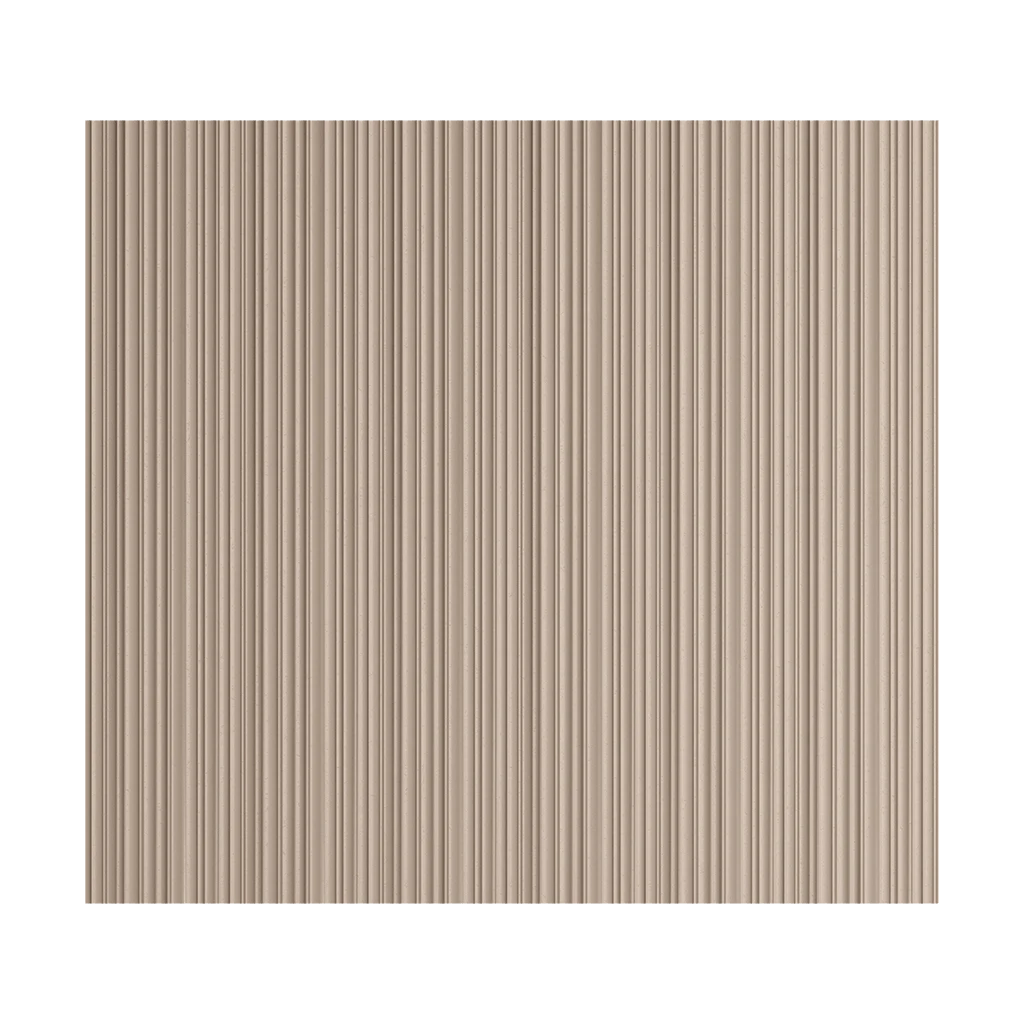
slatted panels for wallswhen installed vertically create an optical effect that in architecture is called 'accent vertical articulation'. The ceiling is visually raised. The wall gains structure. The room acquires directionality — it is no longer just a 'rectangle', but a space with an internal axis.
It works in any room — but the scaling principles differ. In a room with a 2.6 m ceiling — a 55–68 mm slat with moderate spacing. A wider slat in a low room creates the opposite effect: it doesn't raise the ceiling but makes the wall feel heavy. With a 3.0–3.2 m ceiling — an 80–100 mm slat, and the space begins to breathe differently.
The second parameter often ignored is the spacing between slats. A closed rhythm (spacing equal to or less than the slat width) gives density and richness — suitable for a bedroom, niche, or study. An open rhythm (spacing 1.5–2 times the slat width) — lightness and air, suitable for a living room, hallway, or against a mirror backdrop.
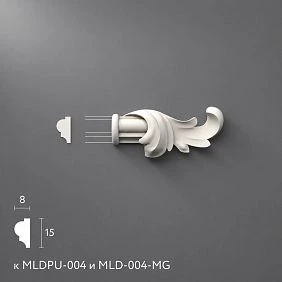
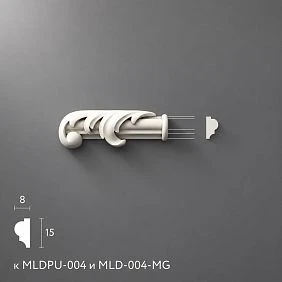
Our factory also produces:





Wooden slat panels: natural texture as an architectural argument
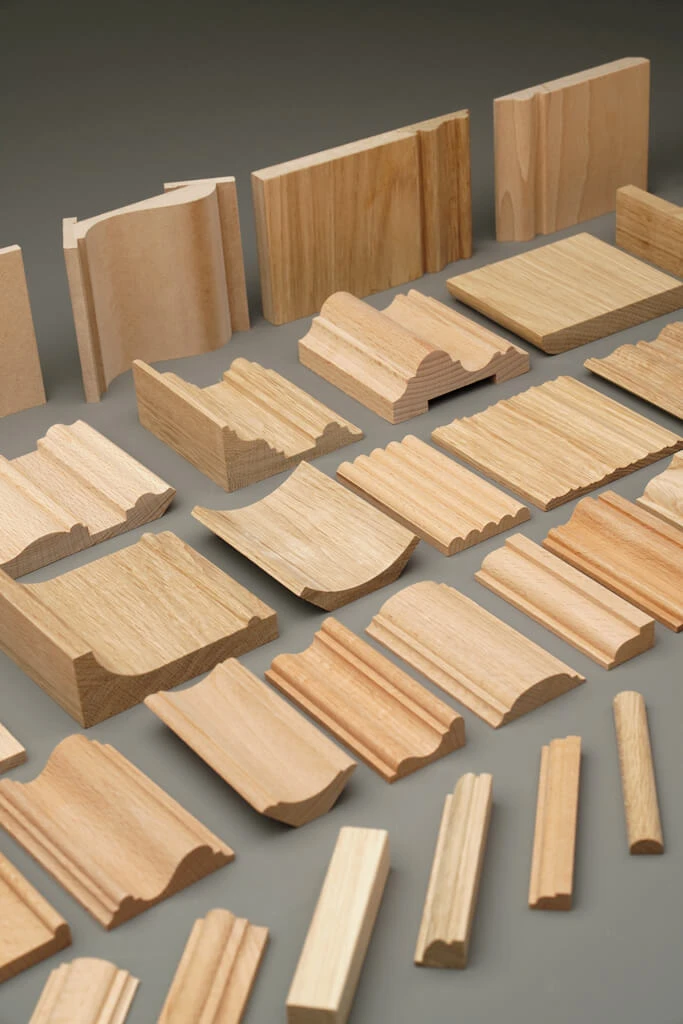
Wooden slat panels— a living surface in the literal sense. Wood is never perfectly identical: each slat carries its own grain pattern, its own micro-relief, its own response to light. This living character is what makes a solid wood slat wall fundamentally different from any imitation.
Oak. Ash. Walnut. Thermally treated larch. Each species has its own 'voice' in the interior. Oak — solidity and durability, pronounced large grain, radial cut with characteristic medullary rays. Ash — softer, more pliable, with a fine fibrous texture. Walnut — dark, intense, aristocratic. Thermowood — neutral brown tone, complete stability, suitable for areas with variable humidity.
slatted MDF panel— an alternative that should not be underestimated. It's not 'cheaper than solid wood' — it's a different tool with different properties. Geometrically precise, stable, non-reactive to humidity changes. MDF for painting allows changing the wall tone without replacing the material — a freedom that solid wood does not offer.
Get Consultation
Wall panels in interior design: the function of an accent
Slatted panels in interior design— always an accent element. Not a background. One slat wall in a room is an architectural statement. Three slat walls in the same room is visual noise. This rule has no exceptions.
An accent works only in contrast with a neutral environment. This is precisely why a slat wall is most effective when the other three walls are neutral: plaster, painted surfaces, calm wallpaper.
Why polyurethane molding restores architectural depth
If slatted paneling is rhythm, then molding is the frame. It outlines. It gives space a beginning and an end. It holds.
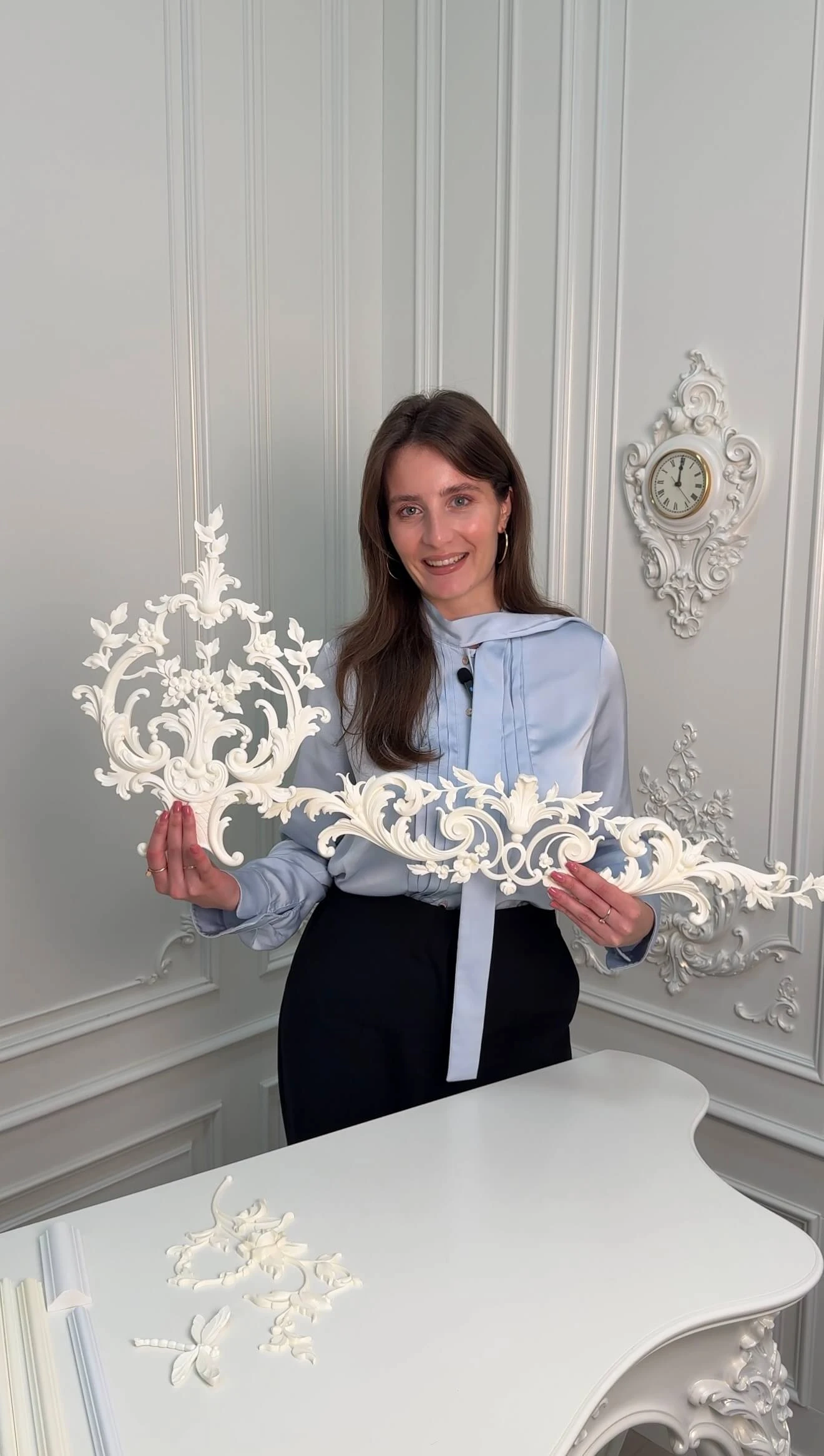
Molded decor in interiors disappeared from mass practice around the 1960s—along with the rejection of 'ornamentation' in favor of functionalism. For several decades, interiors were flat—literally. A right angle between wall and ceiling without a cornice. A floor without a baseboard. Openings without architraves. Geometrically strict—and architecturally poor.
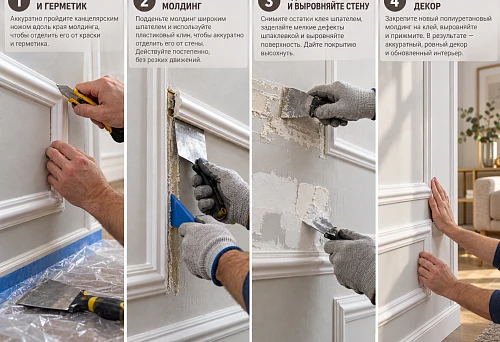
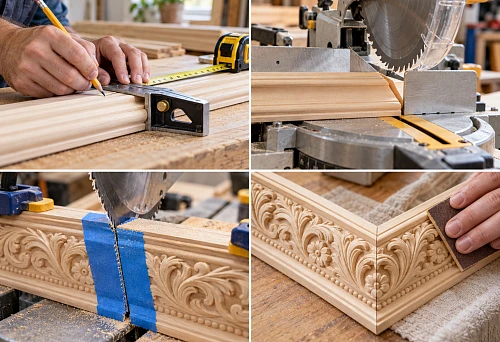
Polyurethane decor made possible what seemed a privilege of expensive projects: cornices, moldings, baseboards, architraves—lightweight, precise, requiring no plaster molding or professional sculptors.Polyurethane Decor— is not 'plastic plaster.' It is an independent material with its own advantages: lightness, flexibility, resistance to deformation during building settlement, and the ability to be painted any shade with acrylic paint.
What exactly does molding do to space
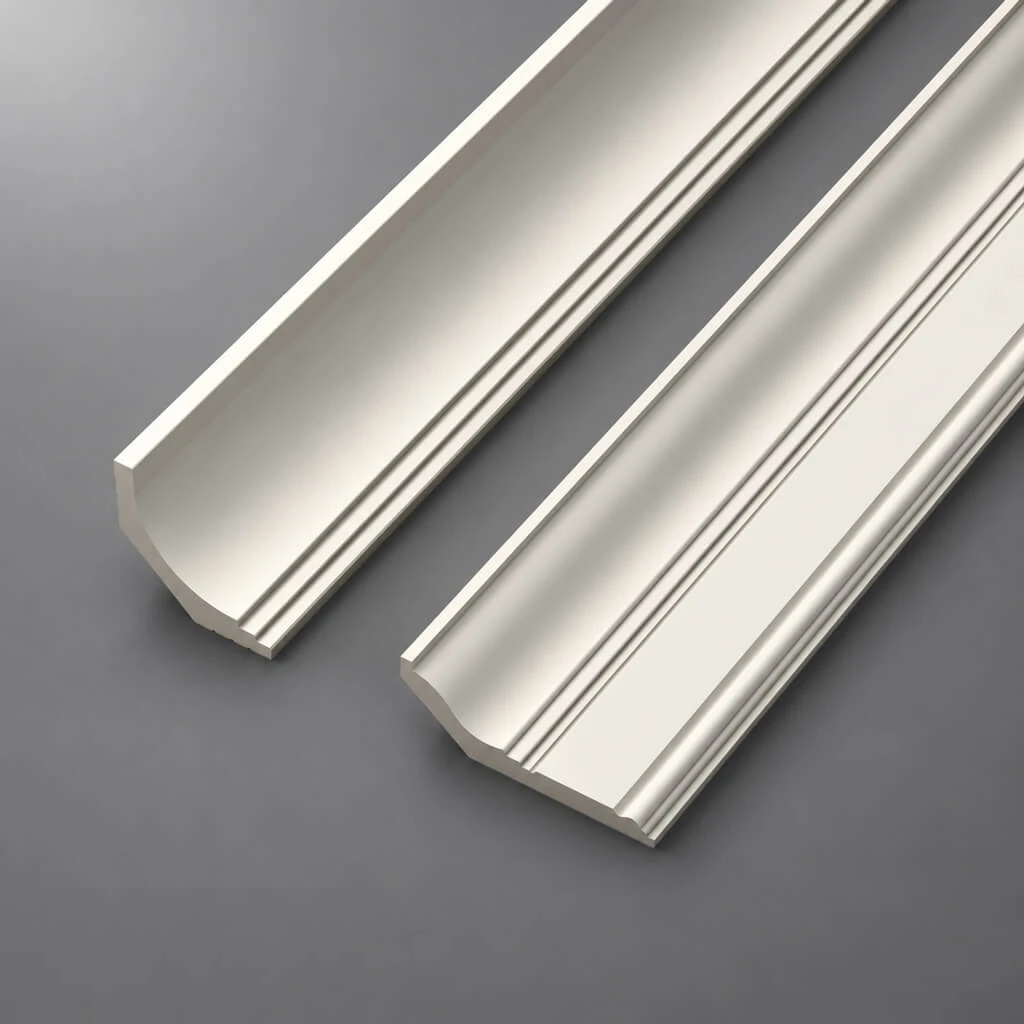
A ceiling cornice separates the plane of the wall from the plane of the ceiling. It might seem like a purely technical operation. In practice, it's a transition from two planes to three: wall, transitional element, ceiling. Space gains tiering, depth. The ceiling 'detaches' from the wall and visually rises.
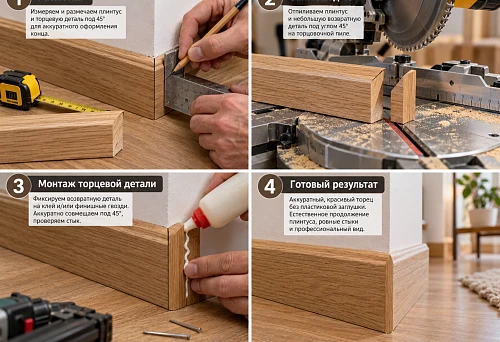
A baseboard creates a base. It holds the wall from below. A room without a baseboard is like text without a bottom margin: technically possible, but perceived as incompleteness.
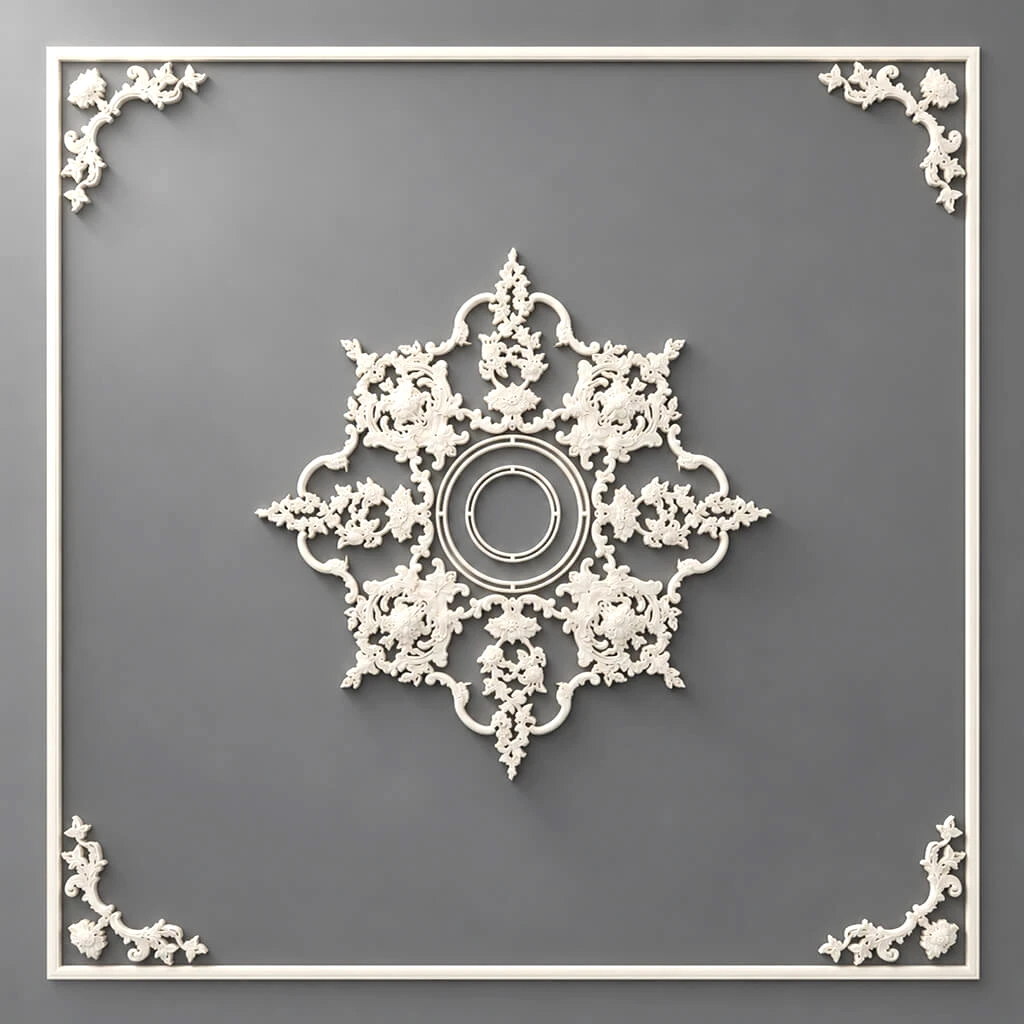
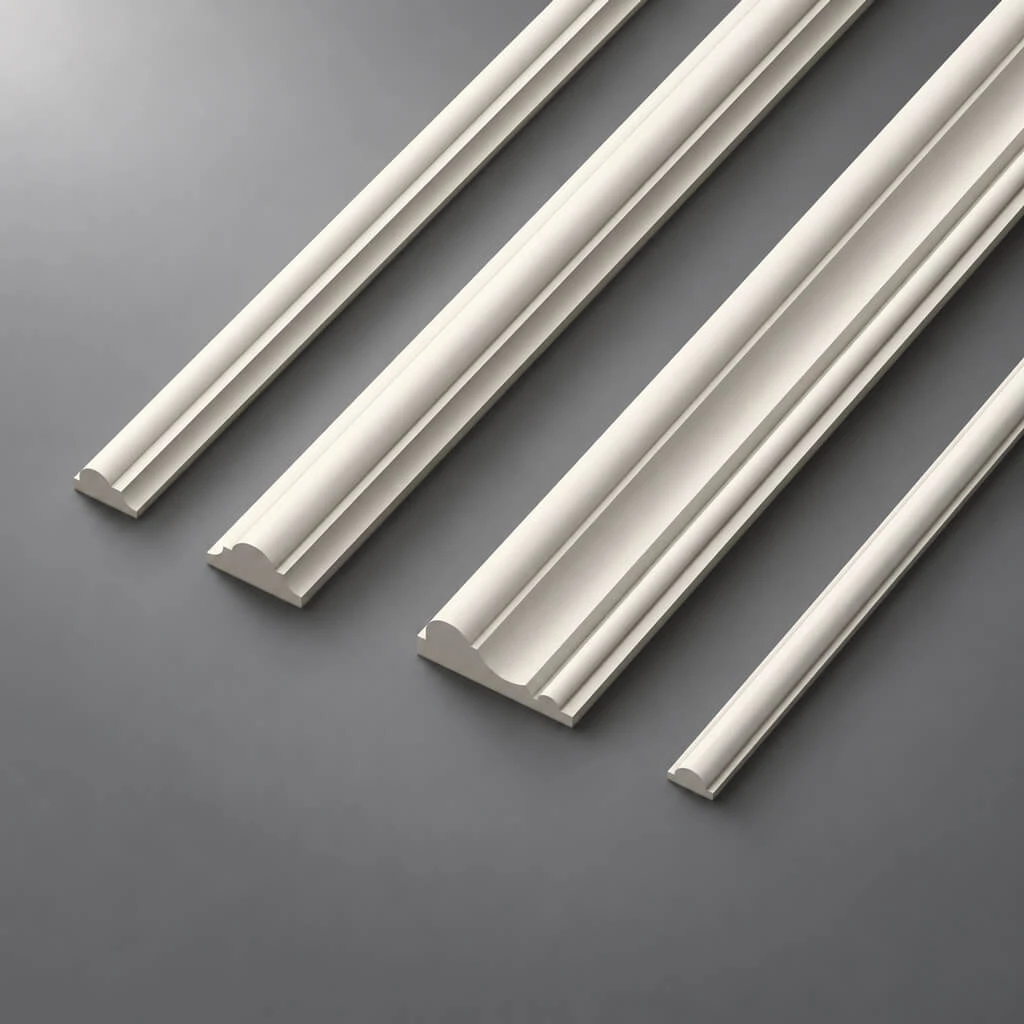
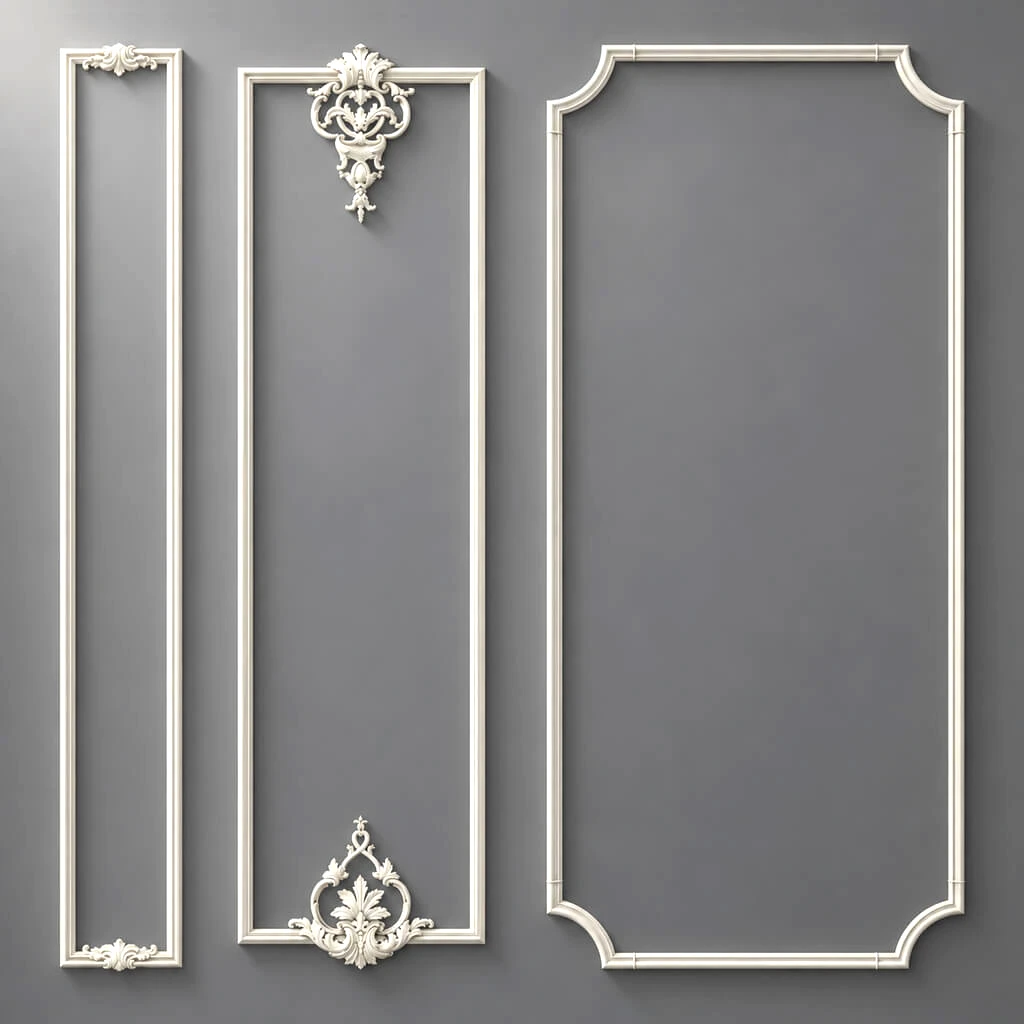
Molding frames on walls are panel breakdown without actual surface change. A flat wall gains depth through the shadows in the molding's relief. Rectangular frames organize the wall field into rhythmic zones—visually neutral space becomes structured.
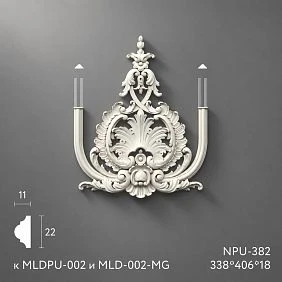
Polyurethane moldings— is not decoration. It is an architectural tool that works with boundaries: where the wall begins, where it ends, how an opening relates to the wall, how the floor relates to the vertical.
Types of molded decor: what exists and where it works
types of molded decorationThey are diverse—and each has its own architectural place.
Ceiling cornice—the most important element. Works along the entire perimeter of the room. Size: 60–180 mm, depending on ceiling height.
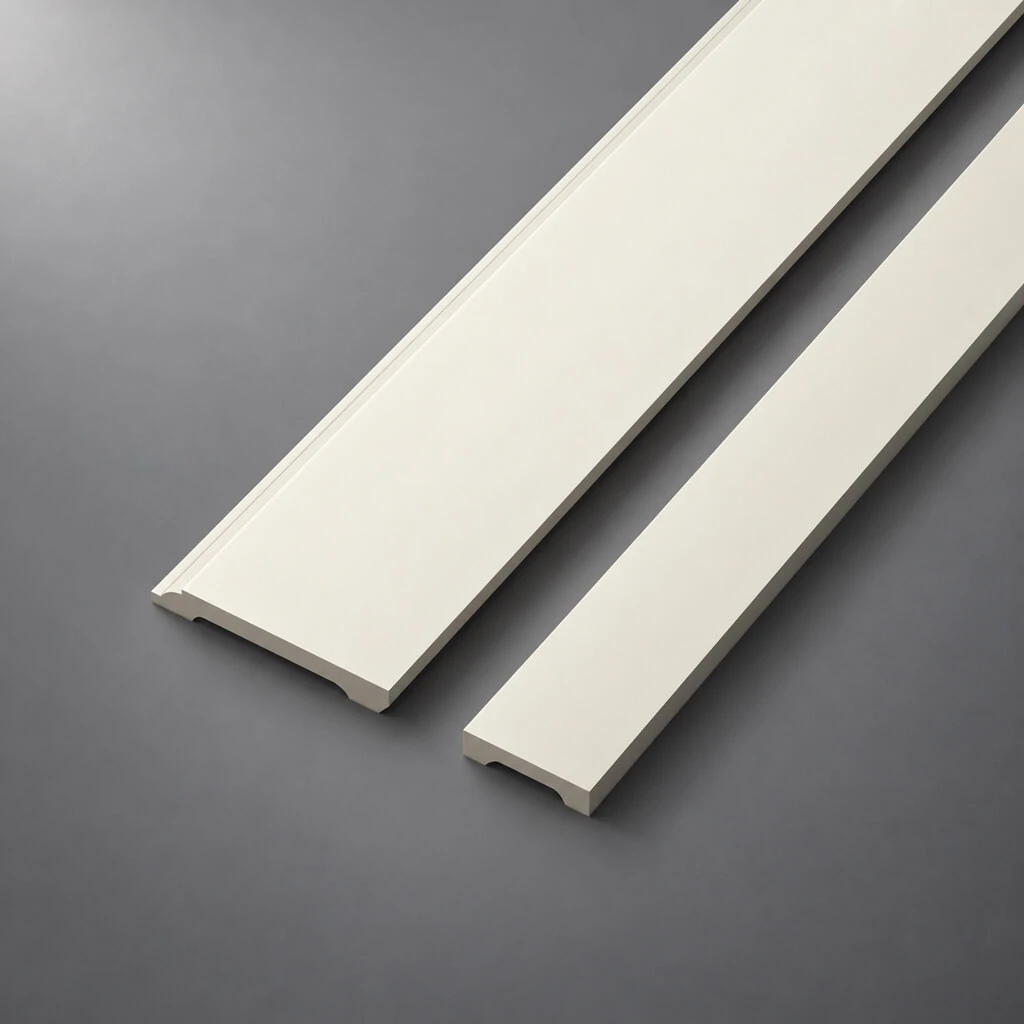
Baseboard—the lower boundary of the wall. 65–165 mm.
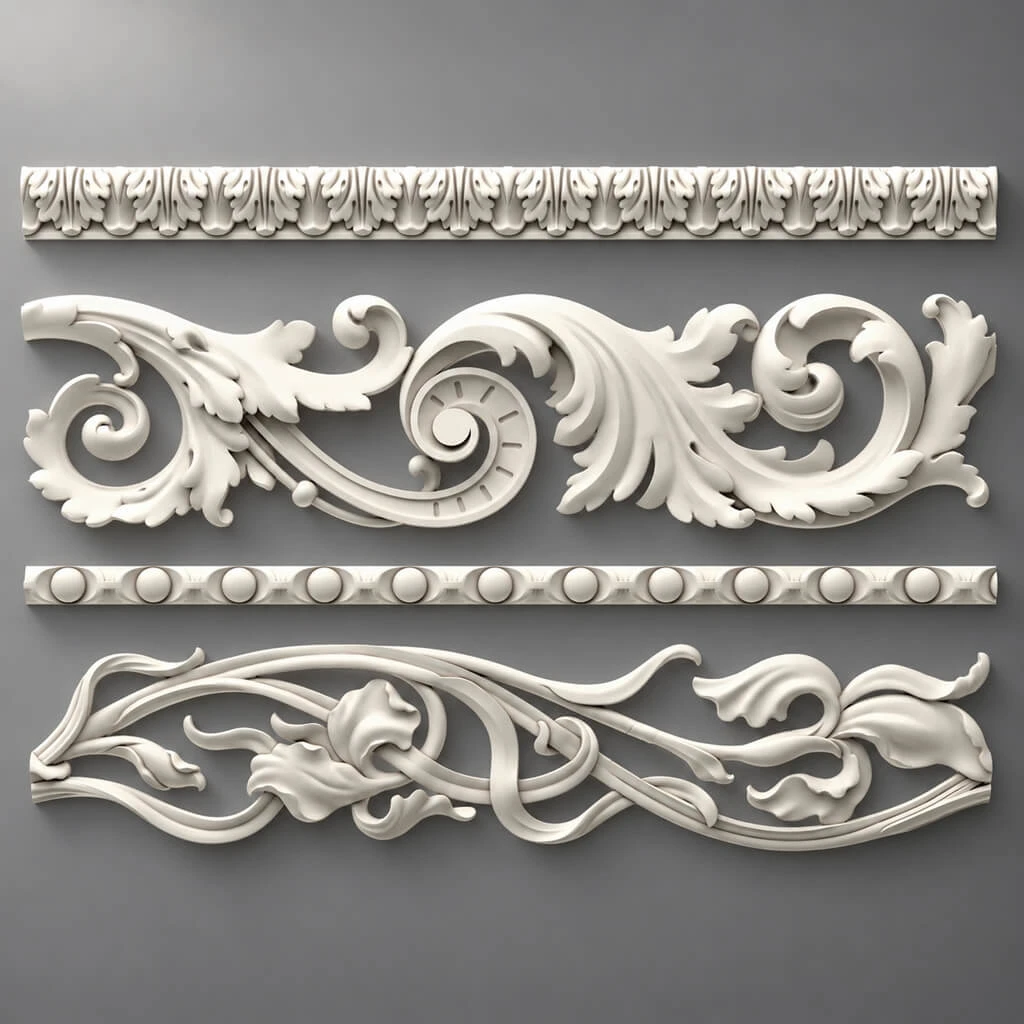
Molding—a linear profile for frame decoration. 16–55 mm.
Casing—framing for an opening. 55–115 mm.
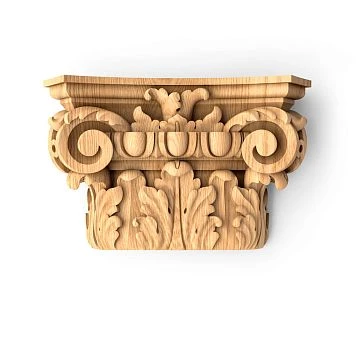
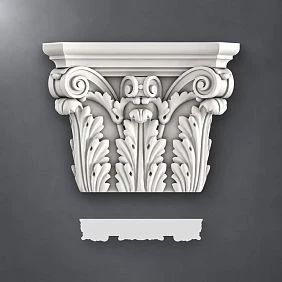
Pilaster—a vertical flat element imitating a column.
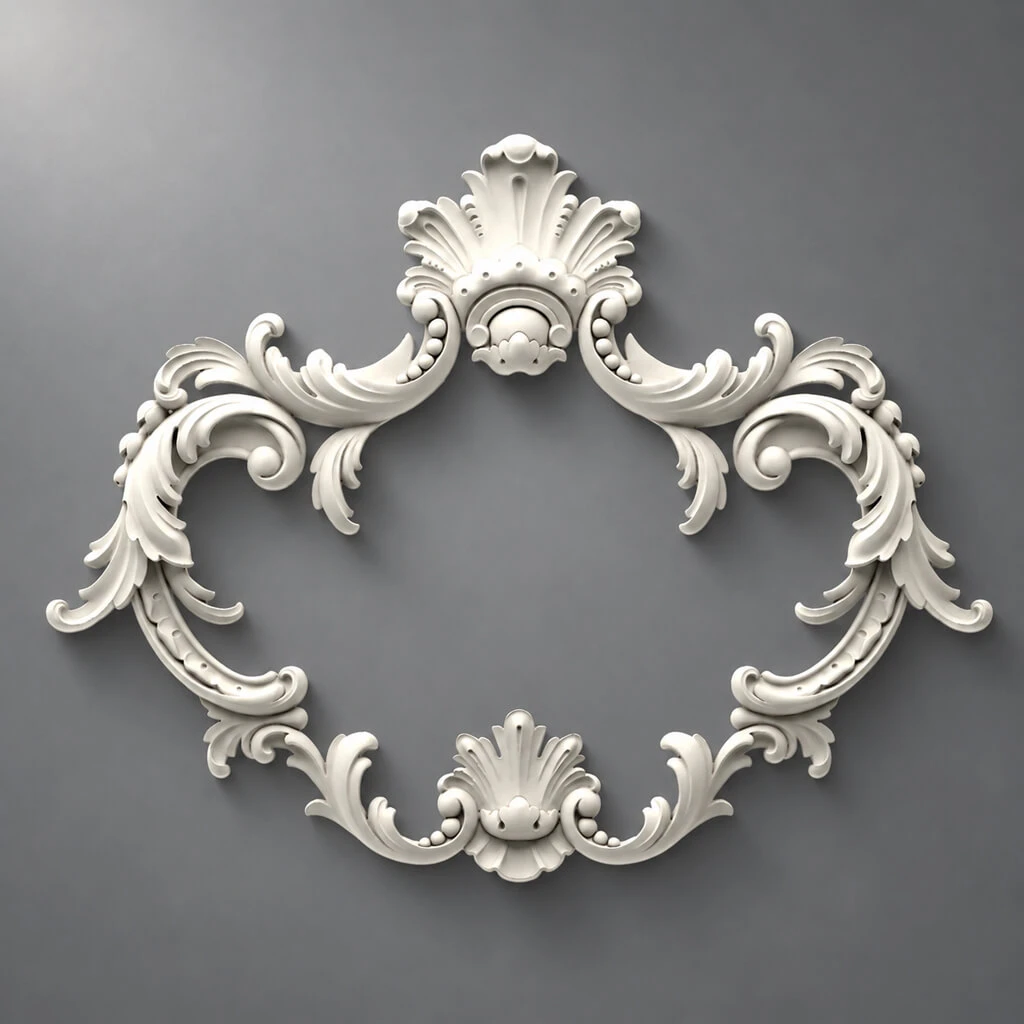
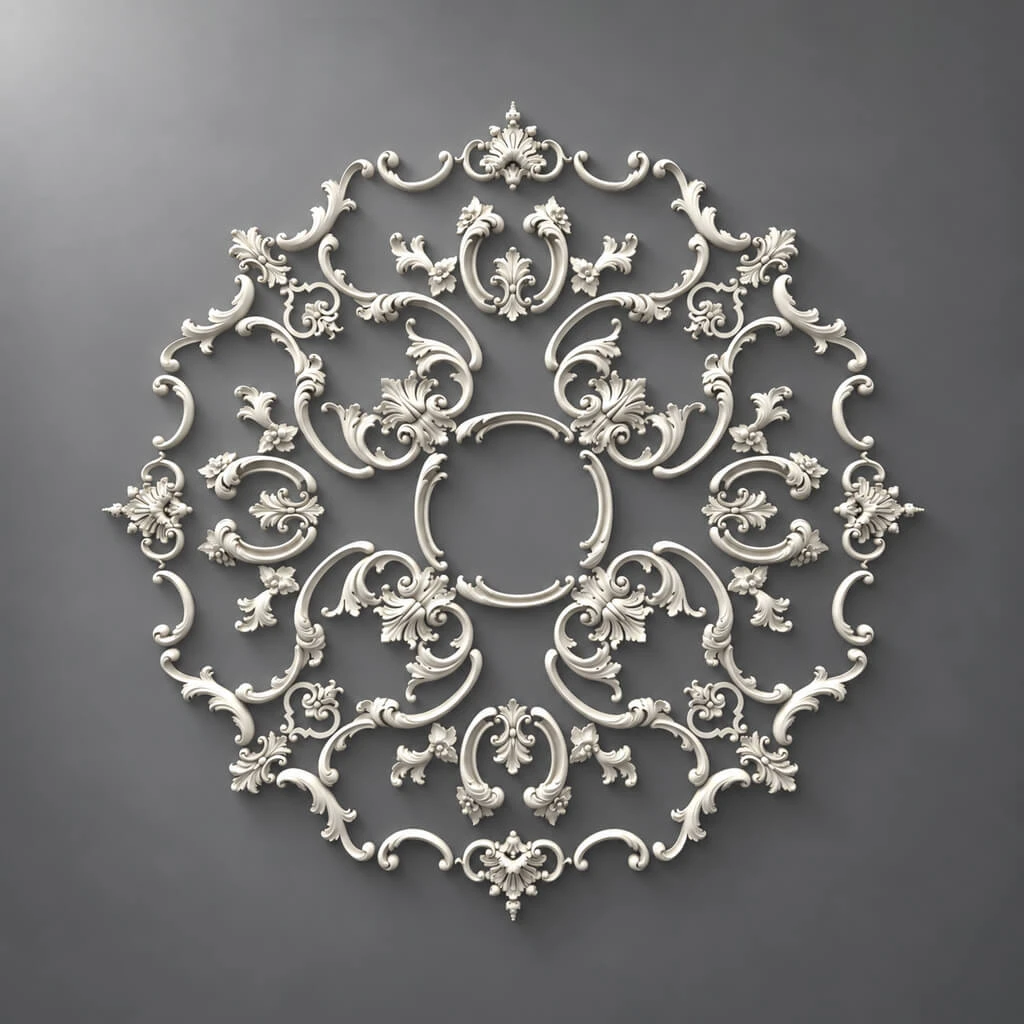
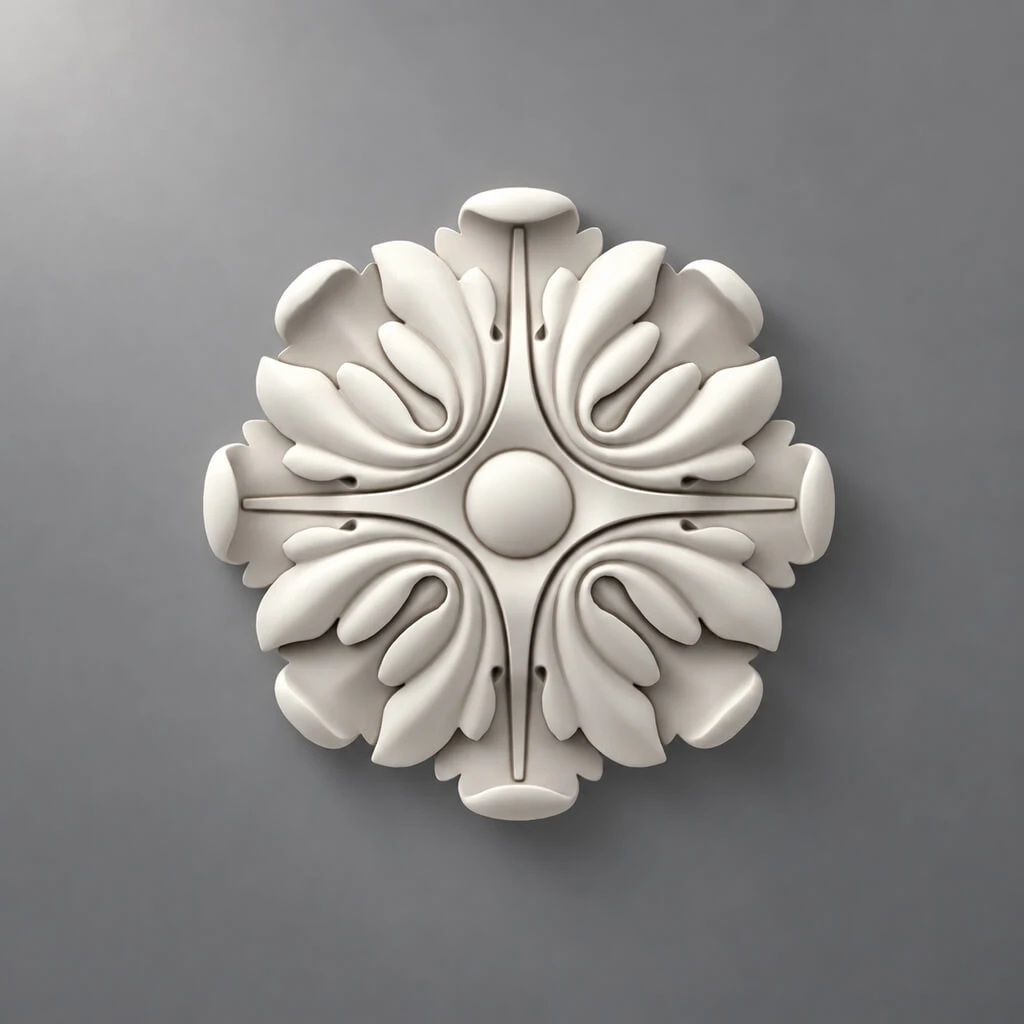
Rosette—a round accent element on the ceiling.
Corner block—a decorative intersection of moldings.
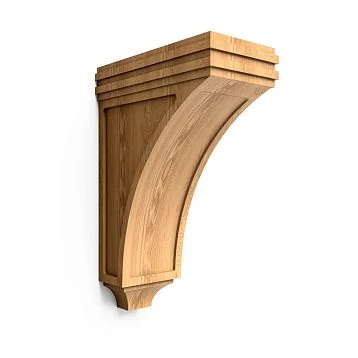
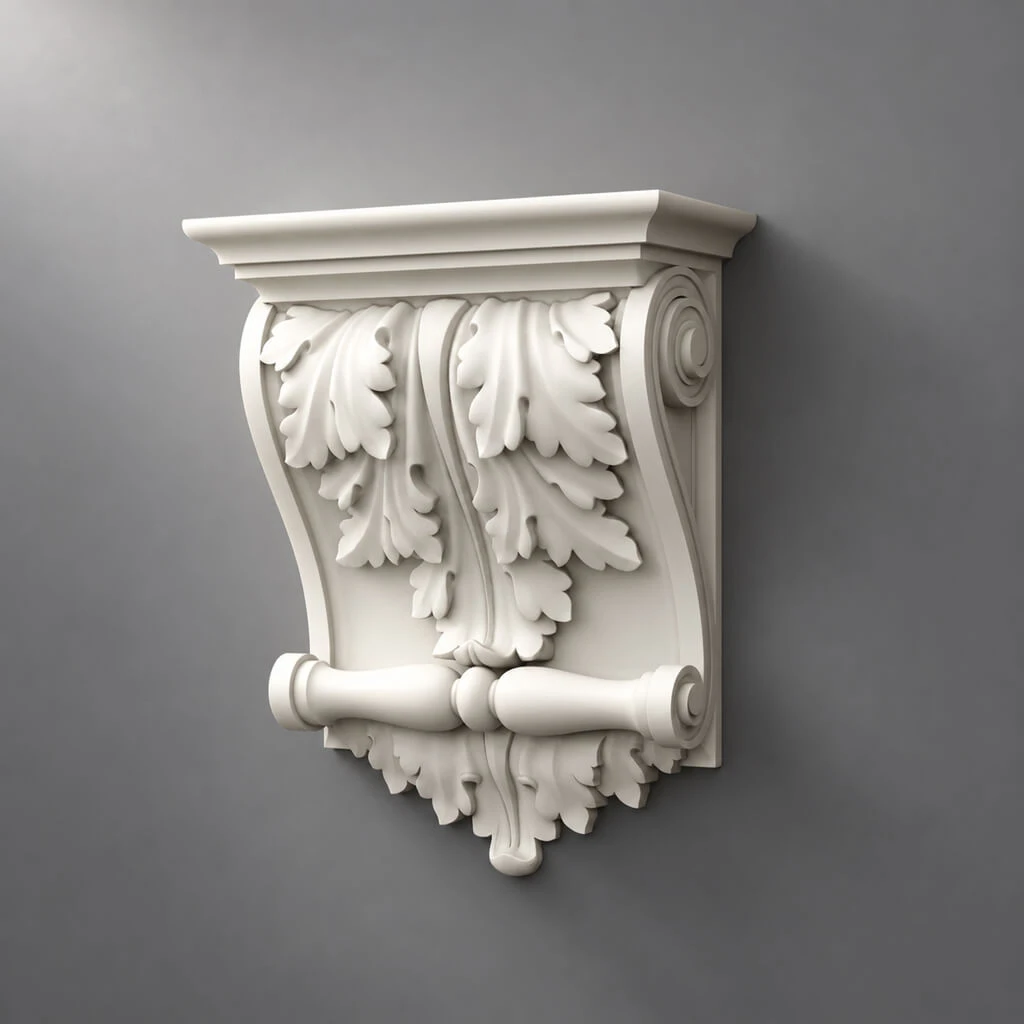
Bracket, console—decorative support elements under horizontal cornices.
Each of these elements—name of molding decorfading into the history of European architecture. But their use in modern interiors is not historical reconstruction. It is working with architectural tools that have stood the test of time.
How to combine vertical rhythm and relief decor: the laws of compatibility
This is the central question of the article. Because this is where most people make mistakes—not due to ignorance of specific rules, but because of a lack of a general principle.
There is one principle: the slatted panel and the molding must speak the same language.
What does this mean?
The language of a profile is the character of its lines. Right angles, chamfers, geometric transitions—this is one language (minimalist, modern). Smooth curves, ogees, torus moldings—this is another language (transitional, classical). Ornament with leaves, beads, egg-and-dart—a third language (classical).
A slatted panel in its pure form speaks the first language—geometric. Straight parallel lines, clean ends, rhythm without ornament. This means the most organic partner for a slatted wall is molding with geometric profiles.
However, this is not a strict prohibition against more complex combinations. It is a starting point.
Rule of scale: the cornice cannot be smaller than the slat
Technically—it can. Visually—it cannot. If the slat has a pronounced vertical dimension (the height of the room), and the cornice is negligibly small, 45 mm with a 2.8 m ceiling—the balance is destroyed. The cornice looks 'accidental,' the slat—unjustifiably dominant.
Approximate rule: the height of the cornice should be at least 2.5–3% of the ceiling height. For a 2.7 m ceiling — cornice at least 68 mm. For 3.0 m — at least 75 mm. For 3.5 m — at least 88 mm.
The baseboard scales differently: it should 'echo' the height of the slat but not compete with it. For a 65 mm slat and a 2.7 m ceiling — an 85–95 mm baseboard is optimal.
Tone rule: white molding and dark slat
This is one of the most common combinations — and one of the most effective. A dark slat (thermowood, stained oak, brushed ash with tinting) on a neutral wall — and white molding around the perimeter.
The contrast works because the slat and molding are on different planes and serve different functions. The slat is an accent on the wall. The molding is the contour of the space. Dark and light do not compete — they occupy different levels of perception.
Reverse combination: light slat (whitewashed oak, white matte MDF) and tinted molding (gray, beige, soft taupe). Creates a more delicate, restrained space without harsh contrasts.
Zone rule: the slat accentuates, the molding frames
The slatted panel works on one or two walls. The molding works around the entire perimeter of the room — ceiling cornice, baseboard, trims of all doors and windows. These are different scales of presence in the space.
A mistake is to think that molding is only needed where there is a slat. No. The cornice and baseboard frame the entire room, including neutral walls. This is precisely why the entire interior gains unity: the decorative system is present everywhere, and the slatted wall is just one of the focal points of the accent.
Which zones particularly benefit from the combination of slatted panels and polyurethane decor
The combination works everywhere—but in some spaces, it unfolds especially fully.
Living Room: A Theater of Architecture
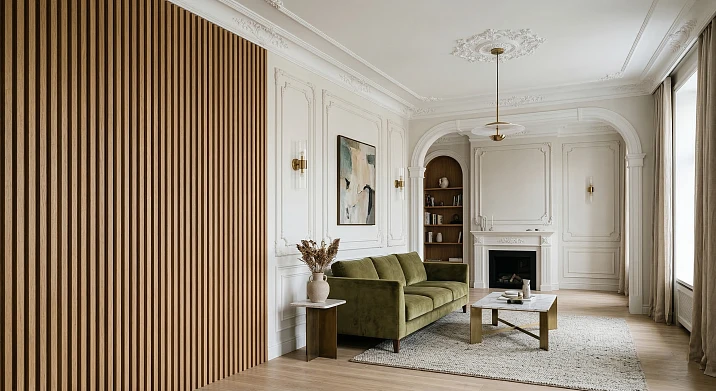
Slatted panels in the living room interior—usually the TV area or the wall behind the sofa. The purpose of an accent wall is to create a visual 'anchor' for the space, a focal point around which everything else is organized.
In the living room, this combination works through several layers:
-
The slatted wall sets the rhythm and texture.
-
A cornice around the entire perimeter raises the ceiling and 'frames' the space.
-
Molding frames on neutral walls create paneling that echoes the rhythm of the slatted wall.
-
A baseboard of a unified profile ties all surfaces into a cohesive system.
Result: A space with an internal structure that feels intentional—even if the viewer can't explain why.
Whenlighting of the slatted panelsThe effect multiplies: warm light cutting through the slats creates an additional layer of depth. Shadows from the relief cornice under properly directed lighting are another visual layer.
Bedroom: The Architecture of Tranquility
slatted panels in the bedroom— the wall behind the bed headboard. This is the most 'personal' wall in the apartment: you see it last before sleep and first upon waking.
Delicacy is especially important here. The bedroom is a space of tranquility, not a grand hall. Slats: light, with a soft texture, moderate spacing. Molded decor: a geometric cornice of modest size 62–75 mm, a plain door casing. No ornamental cornices with leaves and beads—they introduce excessive 'decorative energy' incompatible with the bedroom atmosphere.
A subtlety rarely taken into account: molding frames in the bedroom are only appropriate with ceilings from 2.8 m. In a low room, they create visual crampedness.
Hallway and corridor: first impression
Slatted panels in the hallway— the most precise signal about the character of the entire apartment. The hallway—the first three seconds. Here, the expectation is formed with which a person moves into the living room.
Vertical slats in the hallway 'stretch' the corridor upward. In a narrow corridor—light slats, open spacing. A cornice is mandatory: it makes the corridor feel finished. All door casings are of a single profile, coordinated with the cornice. This rule works especially sharply in the hallway: mismatched casings in the corridor are instantly noticeable.
Study: Concentration and Authority
A home study is a space for focused work. A slatted panel on the work wall or the wall behind the workspace creates an 'architectural focus'—a point that holds the gaze and, through that, concentration.
Here, a darker tone of slats (thermowood, stained oak) and more pronounced molded decor are appropriate: a cornice with a moderate profile of 82–100 mm, a wooden or polyurethane baseboard of 90–110 mm, casings with a pronounced profile. In the study, the combination of architectural rigor and material weight works to its full potential.
Children's room: a system without overload
This is an area where the 'one accent' rule applies especially strictly. There is only one slatted wall in the nursery. Light slats, open spacing, delicate texture. Molded decor: a simple geometric cornice, a modest baseboard. No ornamentation — a children's room with classic molding looks not cozy, but formal.
An interesting technique:Slatted panels with lightingin the nursery behind the headboard — create warm, diffused light that works as a nightlight and simultaneously as a visual accent for the sleeping area.
Mistakes when combining panels and molding: an honest and detailed breakdown
To speak only about 'how to do it right' means giving an incomplete picture. Let's analyze specific mistakes that occur most often.
First mistake: an ornamental cornice with modern slatted panels
Slats are geometry. A cornice with acanthus leaves is ornamentation. These two languages are incompatible in one space without a very strong stylistic justification (historical apartment, intentional eclecticism, author's concept). In a standard residential interior, such a combination reads as a mistake.
Solution: for solid wood or MDF slatted panels — only geometric or softly profiled cornices without ornaments.
Second mistake: slatted panel + molding frames on the same wall
This is a double accent in one spot. Reiki already structures the wall through rhythm. Molding frames over a slatted surface are an excess that destroys both elements. The frames lose clarity against the slats, and the slats lose rhythm in the context of frame decor.
Rule: molding frames only on neutral walls. A slatted panel is in itself a sufficient statement.
Third mistake: cornice without baseboard (or vice versa)
Cornice and baseboard work in pairs: the cornice frames from above, the baseboard from below. A cornice without a baseboard is an incomplete system. A baseboard without a cornice is the same. Both parts are mandatory.
A separate nuance: baseboard and cornice should be from the same stylistic line—geometric together, profiled together. A geometric cornice and an ornamental baseboard are a stylistic conflict.
Fourth mistake: slats of different tones on different walls in the same room
Sometimes this is done intentionally—and with strong conceptual justification, it can work. In most cases, it violates unity. A slatted accent wall has value precisely because it is singular. Adding a second slatted wall in a different tone is no longer an accent; it is chaos.
Fifth mistake: ignoring finishing profiles
Wall finishing with slatted panelsWithout starter and finishing profiles, without corner elements—incomplete installation. An open slat end at the floor or ceiling is technically sloppy and visually ruins the impression. Finishing profiles are a mandatory part of the system, not optional.
Sixth mistake: different casing profiles in the same room
Three doors in the hallway — three different architraves. This scenario occurs during phased renovations: one door was installed now, two — a year later, from a different batch. Result: the hallway looks like a 'hodgepodge' even with quality materials.
All architraves in the direct line of sight are of a uniform profile. This is not a compromise, it is a condition of a systematic solution.
Mistake seven: molding without coordination with the room's architecture
A 140 mm cornice with a 2.55 m ceiling — an architectural disaster. Or another case: a very complex ornamental cornice in an apartment with a standard layout without any other classical elements. Decoration without context is a set piece, not architecture.
Molding works when it is coordinated with the scale of the room and the overall stylistic solution. Stepping outside these boundaries is always a mistake, visible immediately.
How to choose a solution for the interior style: specific combinations
Now — practice. Not abstract principles, but specific 'batten + molding' combinations for each style.
Modern minimalism
Batten: MDF for painting or light natural oak. Width 48–65 mm. Open rhythm, spacing 55–80 mm. Vertical installation.
Molding decoration:
-
Cornice: right angle with a bevel, 65–78 mm
-
Baseboard: straight profile, 72–88 mm
-
Casing: straight profile 55–68 mm
-
Frame moldings: flat, 18–22 mm — optional, rarely
Tone: monochrome. White + natural wood, or gray + warm beige.
Exclude: any ornament. Rosettes. Corner blocks. Brackets.
Scandinavian style
Batten: light ash or birch, white matte MDF. Narrow batten 40–55 mm. Light open spacing.
Molding decoration:
-
Geometric cornice, 58–70 mm
-
Straight baseboard, 68–80 mm
-
Minimalist casings
Tone: white + natural light wood + one or two warm accents.
What to exclude: all ornamental elements. Scandinavian style does not tolerate an excess of details.
Modern classic
Board: natural oak or ash, moderate texture. Width 62–80 mm. Closed or moderately open spacing.
Molding decoration:
-
Cornice with a soft ogee profile, 82–105 mm
-
Baseboard with a moderate projection, 88–115 mm
-
Casing with a soft profile, 65–82 mm
-
Moldings 22–32 mm with a light relief
-
Corner blocks — possible
Tone: warm white + natural wood + accent in beige or soft gray.
Neoclassicism and "soft classicism"
Board: used very sparingly. Dark oak, walnut, brushed solid wood. Only in the study, library, one accent zone. Boards 80–110 mm, confident closed rhythm.
Molding decoration:
-
Cornice with moderate ornamentation (without overload), 100–130 mm
-
Baseboard 105–135 mm
-
Pilasters for framing niches
-
Moldings 30–45 mm with pronounced relief
-
Corner blocks at molding intersections
-
Ceiling rosettes — only with a height from 3.0 m
Tone: warm white molding + dark wood. Or tinted molding (taupe, soft gray-brown) + light slat.
Loft and industrial style
Slat: brushed dark wood, dark thermowood.Wooden slat panelswith visible, accentuated texture. Slat 70–110 mm, open rhythm.
Molding decor: as minimal as possible. If molding is present — only straight geometric profile. Baseboard — wide, simple. No ornaments. In a loft, exposed pipes, concrete ceiling, uncovered utilities are part of the concept, and a cornice in this context is a foreign element.
Material language: how the slat and polyurethane interact physically
There is a technical aspect of the combination that usually remains behind the scenes.
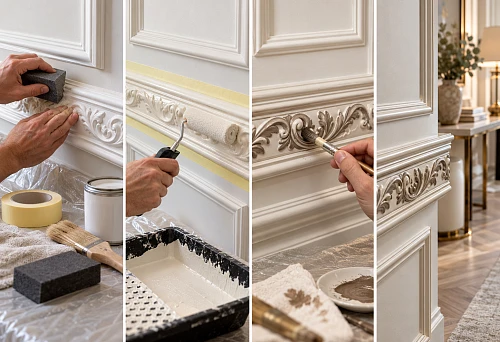
Polyurethane molding is a soft and lightweight material with a precise profile. It is mounted with adhesive (liquid nails + acrylic sealant), easily trimmed, and forgives minor wall irregularities. Paint adheres to it stably—acrylic in 2 coats over primer.
Solid wood slat paneling is a living material that expands and contracts. It is mounted with a ventilation gap, on battens, with thermal expansion gaps. It is finished with oil or varnish.
Installation sequence when combining:
-
Battens for slat panels—first stage
-
Installation of slat panel on battens
-
Installation of molding decor—after finishing the slat panel, at the junction
-
Priming and painting polyurethane decor
-
Final treatment of slat panel (oil, varnish)
The order is not random: the molding is installed last; it covers technical joints and ensures a smooth transition to the slat surface.
MDF for painting + polyurethane decor is technically the most convenient combination: both materials are painted with acrylic paint, allow for a uniform tone or tonal differentiation, and are easily refreshed by repainting.
Comparison table: slatted wall with molding and without
| Parameter | Slats only | Slats + molding |
|---|---|---|
| Spatial completeness | Partial | Complete |
| Accent wall | Present | Present |
| Perimeter framing | Absent | Yes (cornice + baseboard) |
| Opening finishing | Not provided | Door casings |
| Visual 'base' of the floor | Absent | Baseboard creates |
| Optical ceiling height | Moderate (via batten) | Enhanced (via cornice + batten) |
| Sense of system integrity | Partial | Complete |
| Cost | Below | 30–50% higher (considering entire perimeter) |
| Longevity of impression | 5–8 years without losing relevance | 15–25 years |
About scale once again: why it's more important than everything else
You can choose the wrong decor — and fix it with repainting. You can change the tone of the slat. But the wrong scale — too large a cornice or too small a baseboard — is a mistake that can only be corrected by replacing the material.
Therefore — the scale table once again, refined:
| Ceiling Height | Recommended slat width | Crown Molding | Skirting board |
|---|---|---|---|
| Up to 2.55 m | 38–52 mm | 58–70 mm | 62–78 mm |
| 2.60–2.75 m | 50–68 mm | 68–85 mm | 75–92 mm |
| 2.80–3.00 m | 62–88 mm | 82–108 mm | 88–112 mm |
| 3.05–3.30 m | 80–110 mm | 100–130 mm | 102–132 mm |
| 3.35–3.80 m | 100–140 mm | 120–155 mm | 120–150 mm |
| Above 3.80 m | 130–160 mm | 148–185 mm | 138–168 mm |
These ranges are not arbitrary. They are derived from classical architectural proportions, adapted to modern residential ceiling heights.
STAVROS: a system, not a product collection
A space whereRafter panelsandPolyurethane moldingseverything works as a unified whole is a space created through a system. Not by purchasing the 'most beautiful' items from different places, but by choosing coordinated elements from a single logic.
STAVROS manufactures both solid oak, ash, thermowood, and coated or paintable MDF slatted panels, and a full range of polyurethane decor — cornices, moldings, baseboards, architraves, pilasters, rosettes, corner blocks. All of this is developed as a system: scalable series, coordinated profiles, stylistic compatibility between wood and polyurethane.
What does this mean in practice? By choosing a STAVROS slat and a STAVROS cornice — you get not two separate products, but two elements of a single architectural language. The proportions are coordinated. The profiles are compatible. The scale is precise.
Consultation on element compatibility — before ordering. Samples — before making a decision. Calculation of linear footage and areas — based on your data. Delivery to any region.
Because architectural logic is not a privilege of designer objects. It is something available to everyone who chooses a system, not a set.
FAQ: answers to the most common questions
Can MDF slatted panels be combined with classic ornamental cornices?
In most cases — no. MDF slats speak a modern geometric language. Ornamental cornices speak a classical one. Combining them creates a stylistic conflict that cannot be resolved by any design tricks. Exception: intentional eclecticism with a very strong conceptual solution.
Is it necessary to paint a polyurethane cornice white?
No. White is the most common choice because it works with most tonal solutions. But a tinted cornice (to match the wall, to match the slat, in an accent color) is a full-fledged design solution. A monochrome ceiling cornice that matches the ceiling color visually 'dissolves' and makes the transition delicate.
How to attach slatted panels to the wall when subsequently installing molding?
installation of slatted panels— first. Lathing, installation of slats with finishing profiles. Then — installation of molding to abut the mounted surface. The molding covers the technical joints and ensures a clean abutment.
Is a ventilation gap needed when installing solid wood slats?
Yes, definitely. Solid wood expands and contracts with changes in humidity. Without a ventilation gap, the slat will deform. Minimum gap — 20–25 mm between the wall and the lathing.
Is it worth installing molding frames on neutral walls when there is a slatted accent wall?
Yes — with ceilings from 2.8 m and in a suitable style (modern classic, neoclassic). Molding frames on neutral walls create a panel breakdown that echoes the rhythm of the slatted wall without duplicating it.
What type of cornice suits slatted panels in a bedroom?
Geometric profile 62–78 mm, warm white or matching the ceiling color. No ornament. A delicate cornice in the bedroom is correct.
Can slatted panels be installed independently or is a crew needed?
Depends on the type of panel.DIY slatted panelModular systems — quite feasible with basic construction skills. Solid wood slats with lathing, ventilation gap, and finishing profiles — better with a professional crew.