Article Contents:
- What is known today about PLT-007 without assumptions
- The old URL helps find the product, but does not replace physical verification
- The most valuable document of an old project sometimes lies in the storage room
- How to check the new PLT-007 and the old MLD-036 by eight parameters
- Height 97 mm
- Offset 22 mm
- Full cross-section shape
- Back side
- Bottom junction
- Door joint
- Material
- Finish
- If the old profile was made of regular MDF
- If moisture-resistant MDF was used
- If the old MLD-036 was made of beech
- If the old profile is oak
- Front surface
- Material
- Finishing sample
- Baseboard
- Framing element
- Heel blank
- Mistake 1. Treating a URL as proof of complete identity
- Mistake 2. Checking only the height of 97 mm
- Does MLD-036 no longer exist?
- Are PLT-007 and MLD-036 definitely the same profile?
- Why can't you trust the old URL?
- What is the size of PLT-007?
- What do these sizes mean?
- What is the length of PLT-007 made of MDF?
- What is the length of beech?
- What is the length of oak?
- Is there regular MDF?
- Is there moisture-resistant MDF?
- Can I buy PLT-007 made of beech?
- Can I order an oak PLT-007?
- What does 'Prestige' mean?
- Can PLT-007 be used under enamel?
- Can oak be tinted?
- Is PLT-007 only a floor plinth?
- What is a heel for a platband?
- For which platband does the card offer PLT-007 as a heel?
- What is the size of MLD-007.1?
- Is it mandatory to buy MLD-007.1?
- Can the old MLD-007.1 and the new PLT-007 be used together?
- Why a physical sample if the dimensions match?
- What length of sample is enough to take?
- Can the profile be compared by photo?
- What to do if there is no old leftover?
- What to do if the end face is not visible?
- Can I just order two strips and try?
- How to replicate old white enamel?
- Why might the old color code not match?
- How to replicate an old oak skirting board?
- Can PLT-007 be installed flush against old MLD-036?
- What to do if there is a one-millimeter difference?
- How to calculate the quantity?
- Is a spare needed?
- Can heels be made from leftovers?
- Should I paint first or install first?
- Do I need to use the same glue as in the old room?
- What to do if the floor height differs between the old and new room?
- Where can I see other profiles if PLT-007 didn't match?
- Where can I find solid wood baseboards?
- Where can I find MDF profiles?
- Can I recreate the interior after several years without the old estimate?
- What is best to keep after a new renovation?
- Do I need to record the old designation MLD-036 in the new estimate?
- What should I write to the manager?
- When can compatibility be considered confirmed?
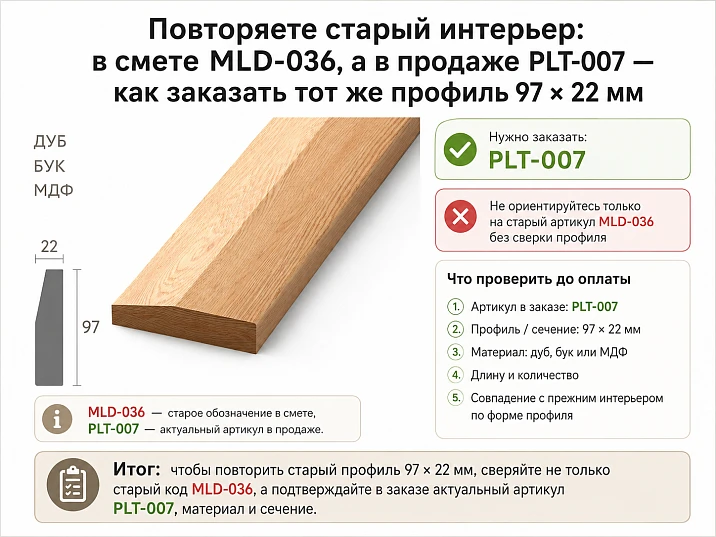
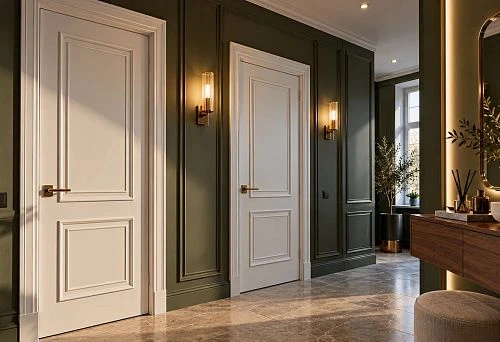
The old interior already exists. A thick baseboard runs along the corridor, trim is installed, doorways are finished, and the finish color was approved several years ago. Now you need to continue the decoration in the adjacent room, replace a damaged section, or complete a renovation that was once split into several stages. In the archived estimate, everything looks simple: MLD-036. But searching by the old designation leads to a page where the product is now called PLT-007, and the specifications list a profile of 97 × 22 mm.
This is exactly where you cannot act on the principle "if the URL is the same, then the article number just changed." For a new interior, it is enough to choose a suitable profile. For a repeat renovation, the task is stricter: the new element must meet the already installed old baseboard so that the transition does not look like a random replacement. One millimeter in height, a different depth of the cutout, a shifted step, or a different projection from the wall can be more noticeable than the difference between the designations MLD-036 and PLT-007.
Therefore buy baseboard PLT-007 97 × 22 mm to continue the old system, it is reasonable after checking several features: the overall cross-section, the full profile pattern, the material, the length, the finish, and a physical sample. The current card links the old URL MLD-036 to PLT-007, but this link itself does not prove that any old batch and today's part are absolutely interchangeable without a trial fit.
If the old MLD-036 and the new PLT-007 must meet on the same straight wall, the requirements are maximum. Light slides along the tall baseboard and highlights any step. If the new profile starts in another room behind a doorway, a slight difference is more acceptable. Therefore, a repeat order is not just a search for an article number. It is the restoration of the specific geometry of an existing interior.
What is known today about PLT-007 without assumptions
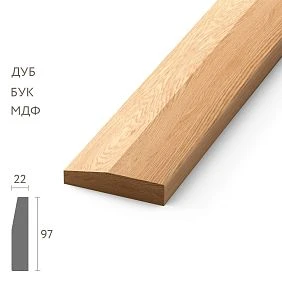
The current card calls the product "Wooden baseboard / trim / heel PLT-007." Already from the name, it is clear that the profile can perform several functions. It is used as a tall floor baseboard, included in door framing, and used to make a heel next to the trim MLD-007.1.
For a repeat order, it is useful to move the parameters from the browser into a separate working spreadsheet.
| Characteristic | Current value | What to check when repeating MLD-036 |
|---|---|---|
| Current SKU | PLT-007 | Lock in new request |
| Old designation in URL | MLD-036 | Save as link to old estimate |
| Cross-section | 97 × 22 mm | Measure old profile |
| Moisture-resistant MDF | Length 2600 mm | Check material of old batch |
| MDF | Length 2600 mm | Match with existing finish |
| Beech | Length 2400 mm | Check wood species and painting method |
| Oak | Length 2400 mm | Check pattern and tinting |
| Sanding quality | «Prestige» | Repeat in specification |
| Beech | available version for enamel coating | Verify the selected item |
| Oak | available version for tinting | Verify the selected item |
| Functions | plinth / architrave / heel | Specify purpose in the estimate |
| Related profile | MLD-007.1 | Check the door unit at 1:1 scale |
The table immediately shows why the question "MLD-036 or PLT-007?" is insufficient. Even with a fully confirmed link between old and new designations, the order remains multi-parameter. The buyer needs not a set of letters, but a profile of the required geometry, material, and finish.




The old URL helps find the product, but does not replace physical verification
Old address with ending molding-mld-036 today opens PLT-007. For the owner of the old specification, this is a good starting point: the search does not end with a 404 page and does not send a person to a random similar plinth.
But the URL does not answer the most practical question: whether the new strip will match the one already installed at the wall.
The existing interior does not store an article number. It stores a physical object: a profile of a specific cross-section, made from a specific material, sanded, painted or tinted, mounted at a certain height relative to the floor and wall.
Even if the serial geometry has not changed, the old profile after finishing may be perceived differently. A layer of primer and enamel slightly softens sharp edges. Oak under tinting changes shade over time. The floor covering may have been replaced. An additional layer of plaster or decorative panel may have appeared near the wall.
Therefore, the old URL is a navigation tool. The sample checks the match.
Our factory also produces:
The most valuable document of an old project sometimes lies in the storage room
If after the first renovation you have kept a piece of MLD-036 at least 100–150 mm long, do not throw it away and do not treat it as construction waste.
For a repeat order, this is a control part.
The old piece can be placed end-to-end against the new PLT-007 and compared:
-
total height;
-
maximum thickness;
-
top shelf;
-
all flutes;
-
position of steps;
-
radii;
-
front plane;
-
bottom support part;
-
back side;
-
actual abutment to the wall.
That is why before ordering tens of meters it is especially useful to buy a sample of wooden molding and compare it with the old remainder.
A short sample is enough to check the cross-section pattern. It is, of course, not intended for assessing the length and straightness of the entire strip, but it solves the main task of a reorder: it shows whether the shape matches.
Get Consultation
How to check the new PLT-007 and the old MLD-036 by eight parameters
Height 97 mm
The first dimension is the overall height of the profile.
It is best to measure it at the open end. If the end is not accessible, use a precise template and a measuring tool.
Why can't this be done from a photo? Because the camera and perspective easily introduce an error of several millimeters. On a tall baseboard, even a small difference can break the continuity of the top line.
Projection 22 mm
The second dimension determines the maximum protrusion of the profile from the wall.
If the new strip is thicker, the front part will protrude forward relative to the old one. If it is thinner, a step inward will form.
This defect is especially noticeable on a door casing, where the horizontal baseboard meets the vertical piece.
Full section shape
97 × 22 mm — only the outer rectangle, inside which the actual pattern is located.
Two baseboards of the same height and thickness may differ:
-
groove depth;
-
roller radius;
-
width of the top platform;
-
number of steps;
-
bevel position.
Therefore, for repeated repairs, it is not enough to say: "The size matches."
You need to say: "The entire section matches."
Back side
It is often forgotten because no one sees it after installation.
But the back geometry affects the fit against the wall.
If the old profile had a different cutout or a different flat section, the new element can sit a few millimeters differently.
Bottom junction
The position of the lower part relative to the floor is especially important after replacing the flooring.
The old parquet board could be thicker than the new covering. Or vice versa.
With the same PLT-007, the visual line will be different if the floor level changes.
Door joint
If the system includes MLD-007.1, the profile cannot be checked in isolation.
Place the new sample against the trim and compare it with the adjacent old door.
Material
MDF, moisture-resistant MDF, beech and oak cannot be replaced imperceptibly just because the surface is later painted.
The material determines the length of the plank, the nature of preparation, and the finishing task.
Finish
The old and new surfaces must either match or be deliberately separated by an architectural boundary.
No old remnants left: how to restore the profile along an installed baseboard
This happens more often than we'd like. Offcuts were thrown away right after renovation, the contractor changed, and only the estimate MLD-036 remains in the archive.
This is not a dead end yet.
First, find a place where the profile can be examined as fully as possible. It's good if an end is accessible somewhere: near built-in furniture, in a utility room, or at an unfinished junction.
Take a series of photos:
-
general view of the wall;
-
profile strictly from the side;
-
top part close-up;
-
bottom junction;
-
area near the ruler;
-
joint of two planks;
-
door assembly;
-
external corner;
-
internal corner;
-
area under side lighting.
Photos are needed not to "guess the article number from the picture," but to record features.
The next step is to request or use the current drawing PLT-007 and compare it with the actually installed profile.
Profile template: a simple way to check the shape without disassembly
If there is no open end, the craftsman can take a template of the existing profile.
For a preliminary check, thick cardboard or another material that can hold its shape is used. For a professional check, profile templates and precise measuring tools are used.
The task of the template is not artistic copying. It should show whether the following match:
-
top point;
-
bottom point;
-
maximum overhang;
-
transition radii;
-
recesses;
-
steps.
Then the template is applied to the PLT-007 sample.
If there is a complete match, you can proceed to the material and finish.
If not, don't convince yourself that "everything will be hidden after painting." Paint can hide the color of the wood, but not the disappearance or appearance of an entire step of the profile.
A thick baseboard does not forgive approximate matching.
The main request of this topic is a thick baseboard. And it is the thickness that makes the check especially important.
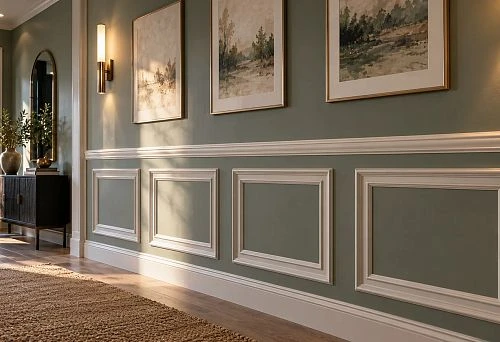
The 97 × 22 mm profile creates a pronounced architectural band at the bottom of the wall. It protrudes noticeably, catches light, and forms a shadow.
The more relief the baseboard has, the more visible the mismatches are.
They are especially well visible:
-
in a long corridor;
-
near a panoramic window;
-
under side artificial light;
-
on solid-color enamel;
-
in a dark color;
-
next to a wide architrave;
-
on the outer corner.
Therefore buy a thick wooden skirting board to complement the old trim, it is worth doing after checking the profile, not just the search results.
The material of the old MLD-036 determines the next step
If the old profile was made of regular MDF
The current PLT-007 has an MDF version with a length of 2600 mm.
For a painted system, this is often a convenient repetition scenario: the natural wood texture does not need to be matched. But the geometry and color still must match.
If PLT-007 did not fit in shape, you can order an MDF skirting board after comparing other profiles in the specialized section.
If moisture-resistant MDF was used
This needs to be specified separately in the new request.
You cannot silently replace it with regular MDF just because both have dimensions of 97 × 22 mm.
The material must be a conscious part of the project.
If the old MLD-036 was made of beech
For beech, the current length is 2400 mm.
If the old interior is painted with opaque enamel, the match of geometry and finish is visually more important.
If the wood remained visible, the surface character also needs to be checked.
If the old profile is oak-like
With oak, the material's grain pattern becomes part of the interior.
Therefore order an oak skirting board to continue the old room, it's better after checking two samples: the old fragment and the new oak PLT-007 with trial tinting.
MDF 2600 mm and solid wood 2400 mm: why length can't be considered a trifle
The 200 mm difference on one plank seems small.
In a long hallway, it changes the joint layout.
Five MDF planks of 2600 mm give 13 meters of source material.
Five solid wood planks of 2400 mm — 12 meters.
But even more important than the total is the ability to cut long pieces.
Let's imagine a wall of 2500 mm.
From PLT-007 MDF, it can be covered with one plank.
From beech or oak with a length of 2400 mm — no longer.
A joint or a different layout will be required.
Therefore, the material is chosen before the final calculation of the quantity.
The cutting map is more important than the total length.
The buyer measured the rooms and got 19.4 m of skirting board.
Then he divides 19.4 by 2.6 and gets 7.46. So, eight planks?
Not necessarily.
If among the parts there are several walls 2550–2580 mm long, almost each will require a separate MDF plank.
If most sections are short, the leftovers can be used more efficiently.
The correct calculation looks like a table of individual parts:
| Section | Finished length | Material | Where to cut from | Note |
|---|---|---|---|---|
| Wall 1 | 2550 мм | MDF | Plank 1 | Almost without waste |
| Wall 2 | 2400 мм | MDF | Plank 2 | Remainder for the heel |
| Pier | 900 мм | MDF | Remainder | Check the cut |
| Heel 1 | By template | MDF | Remainder | MLD-007.1 |
| Heel 2 | By template | MDF | Remainder | MLD-007.1 |
This way you see not just the number of meters, but the actual structure of the order.
Where is the best place to join the old and new profiles
If the project allows choosing the transition point, use the room's architecture.
Suitable boundaries:
-
a doorway;
-
internal corner;
-
corridor transition;
-
built-in wardrobe;
-
portal;
-
column;
-
furniture panel.
The idea is simple: the eye perceives a change near an architectural boundary as more natural than a random step in the middle of a five-meter wall.
If the old and new profiles inevitably meet end-to-end on the same line, the cross-section match must be as precise as possible.
Sample PLT-007 is not a formality, but a cheap insurance for a complete order.
When choosing a brand new skirting board, the sample helps to assess the scale and pattern.
When reordering, its role is more important: the sample becomes the standard for the current batch.
On it, you can:
-
check the cross-section;
-
compare the material;
-
attach it to the old MLD-036;
-
try it against the trim;
-
make a test heel;
-
do a paint test;
-
show to the customer;
-
hand over to the painter.
And only after such a test does it make sense to order 20, 30, or 50 meters.
What to check on the sample besides the shape
Sometimes the buyer aligns two ends, sees a match, and immediately places an order.
It is better to do three more checks.
Front surface
Look at it in side light. Especially if enamel is planned.
Material
Compare MDF, beech, or oak.
Finishing test
Apply the selected system to a short section. With a transparent finish this is critical, with an opaque one it is still useful.
MLD-007.1: the door casing cannot be left out of the scope of repeated renovation
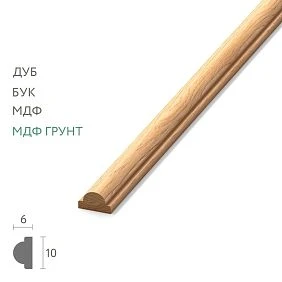
The description of PLT-007 states that a heel for the MLD-007.1 casing can be made from the profile.
Current Casing MLD-007.1 has a cross-section of 93 × 18 mm.
If the old interior was built on the combination:
MLD-036 → baseboard
MLD-007.1 → casing
MLD-036 → heel
then the entire composition needs to be repeated.
The baseboard may perfectly match the old one, but the new door will still look different if the casing or heel is made to a different proportion.
Door casing heel: a small detail that solves a complex joint
An additional search query for this article is door casing heel.
The name sounds technical, but the function is very clear.
The vertical casing meets the floor. The horizontal baseboard also meets the door opening. These two profiles differ in thickness and pattern.
If you simply butt them together at a random angle, a complex, visually messy transition appears.
The heel creates an intermediate block.
It allows you to:
-
finish the vertical casing;
-
accept the horizontal baseboard;
-
align the projections;
-
emphasize the door base;
-
repeat the architecture of adjacent openings.
How to check the PLT-007 heel next to MLD-007.1
Assemble a small mockup at a 1:1 scale.
Place MLD-007.1 vertically.
Bring PLT-007 horizontally.
Place the future heel blank between them.
Look at the assembly from the front, side, and at an angle.
Need to check:
-
heel width;
-
height;
-
its protrusion relative to the trim;
-
his speech regarding the baseboard;
-
alignment of decorative lines;
-
position of the top edge of the baseboard;
-
gap at the floor;
-
symmetry of the left and right sides of the door.
If the neighboring old door is preserved, the new layout is compared directly with it.
Why 97 × 22 and 93 × 18 mm create a meaningful pair
PLT-007 is slightly larger than MLD-007.1.
This is useful for the door assembly: the lower part gets a more massive support, while the vertical casing remains slightly lighter.
If instead of PLT-007 a random profile of 80 × 15 mm is used, the composition will lose architectural support.
If you take an excessively heavy baseboard, the heel will become disproportionate.
Therefore choose wooden trim and baseboards from the same series more useful than collecting such elements solely by price or approximate width.
PLT-007 as a baseboard, trim, and heel blank
The universal card name sometimes raises the question: what kind of product is this really?
The answer depends on the project.
The same long-length part can be used in different positions.
Floor baseboard
Horizontally along the perimeter of the wall.
Framing element
Vertically or in another position, if such use is intended by the designer.
Heel blank
Short pieces near the doors.
These three functions cannot be mixed in the calculation.
In the specification, it is better to separate them:
-
PLT-007 — baseboard, 8 planks;
-
PLT-007 — heel material, 1 plank;
-
MLD-007.1 — trim, separate calculation.
A tall baseboard already sets the scale of the old interior
In a new room, one can spend a long time choosing between 60, 80, 100, and 120 mm.
When continuing an old system, there is almost no such choice.
If the hallway, living room, and doors are already assembled around a profile of about 97 mm, the new baseboard should support this proportion.
Placing a thin modern strip next to it just because it's easier to find would make the boundary of the new renovation visible.
This is especially noticeable when two doorways are visible from one room at the same time.
Wide wooden baseboard in a classic system
The 97 × 22 mm profile supports well:
-
wide casings;
-
paneled doors;
-
molding frames;
-
boiserie;
-
high ceilings;
-
developed cornices.
But for this article, another conclusion is more important: if such elements already exist in an old interior, the repeated baseboard should work as part of the system, not as a standalone purchase.
PLT-007 in a calm modern interior
A high profile doesn't have to look decoratively heavy.
If it's painted in the wall color, the relief reads as a soft shadow.
In a modern room, this approach can connect the old architecture of the apartment with more minimalist new furniture.
The result is an interesting effect: the dimensions and plasticity remain the same, but the color makes the system calmer.
White enamel: why "the same white" might turn out to be different
The old specification often contains the entry "white enamel."
this is not enough.
White can be:
-
neutral;
-
warm;
-
cold;
-
milky;
-
grayish;
-
creamy.
Besides the shade, there is a degree of gloss.
A semi-matte old baseboard and a new glossy PLT-007 can be perceived as different products even with the same color code.
Moreover, the old coating could have changed over time.
Therefore, the new paint sample is compared with the installed part today, not just with the archived paint passport.
Dark color increases requirements for the profile
Graphite, black, dark green, or deep blue baseboard emphasizes the chiaroscuro.
Each step becomes clearer.
It is on dark enamel that a slight difference between the old MLD-036 and the new PLT-007 can be especially pronounced.
Therefore, dark systems are better not to continue without physical comparison.
Oak: you need to repeat not only the article number, but also the character of the wood.
The oak surface is alive.
In different planks, the pattern, width of annual rings, and shade vary.
After tinting, differences may decrease or, conversely, become stronger.
When repeating the old oak MLD-036, it is useful to:
-
compare the new PLT-007 without finishing;
-
select a test composition;
-
do a paint test;
-
place it next to the old one;
-
evaluate in daylight and evening light.
It is wrong to promise a complete match of natural wood grain. The goal is to achieve a visually consistent system.
Beech under enamel: a different priority
If the wood is still completely covered by opaque paint, the grain pattern ceases to be the main factor.
What comes to the forefront:
-
geometry;
-
polishing;
-
preparation;
-
smoothness;
-
precision of angles;
-
uniform color.
This makes beech convenient for projects where a colored architectural profile is important.
MDF: opaque finish does not eliminate the need to check edges
MDF is often chosen for painting.
But after cutting, the edge is exposed, which behaves differently than the factory surface.
During rework, it is especially important that the craftsman prepares equally:
-
straight cuts;
-
angles;
-
connections;
-
heels;
-
edge sections.
Otherwise, the new PLT-007 may match in geometry but differ in surface quality.
Replacing flooring: why the old profile may 'not match itself'
Suppose PLT-007 completely matches the remainder of MLD-036.
But the old corridor has parquet 15 mm thick, while the new room has thin flooring.
If the baseboard is installed from the new floor, the top line will be lower.
With the door open, the two rooms will show different levels.
This is no longer a product error. This is a design error in the installation level.
Therefore, repeat not only the profile but also the level.
How to align the baseboard height with different flooring
There are several design options:
-
align the floor covering levels;
-
maintain a single top line of the baseboard;
-
use the doorway as a boundary;
-
adjust the wall base;
-
change the threshold joint.
The choice depends on the specific renovation.
The main thing is to notice the problem before installation.
What to buy with PLT-007
It makes sense to order the repeated trim as a set.
| Position | What it's for | When to add | What to Check |
|---|---|---|---|
| PLT-007 | Main baseboard | Always | 97 × 22 mm, material |
| Sample PLT-007 | Comparison with old MLD-036 | Before full order | Section drawing |
| MLD-007.1 | Door casing | For new openings | 93 × 18 mm |
| Heel from PLT-007 | Transition at the door | With corresponding node | Scale 1:1 |
| Installation materials | Mounting | After checking the base | Compatibility |
| Finishing materials | Enamel or tinting | After material selection | Test swatch |
| Reserve | Trimming and repair | According to the cutting map | Whole planks |
| Delivery | Long-length transport | Before payment | 2400/2600 mm |
For a full cycle, you can order materials for finishing the baseboard after the material and future finish have been determined.
Why you can't choose glue based only on the old renovation
The phrase "we used to glue it the same way" is not a technical argument.
The wall could have changed over several years.
The old profile was installed on plaster.
The new one will be attached to the panel.
Or vice versa.
The wall finish itself could have changed.
Therefore, the installation method is chosen based on the current base, profile material, and finishing technology.
Calculation of the quantity of PLT-007: first the walls, then whole strips
First, take the finished lengths.
Not just the perimeter of the room, but each section separately:
-
wall 1;
-
wall 2;
-
partition;
-
section behind the door;
-
external corner;
-
short extension;
-
heel.
Then the parts are laid out on the original planks.
For MDF — 2600 mm each.
For beech and oak — 2400 mm each.
Why the formula "perimeter / 2.6" can give an incorrect order
Suppose the total length is 10.2 m.
10,2 / 2,6 = 3,92.
Four planks would seem to be enough.
But if four walls are each 2550 mm long, each will require a separate plank. Almost no useful offcut will remain.
And if there are still heels and short partitions, a fifth will be needed.
Therefore, the total length is the first check. The cutting map is the final one.
Example for MDF
Need details:
-
2500 mm;
-
2450 mm;
-
1800 mm;
-
1200 mm;
-
900 mm.
Total — 8850 mm.
Theoretically, these are four planks of 2600 mm each.
The layout confirms:
-
plank 1 → 2500;
-
plank 2 → 2450;
-
plank 3 → 1800 + short pieces;
-
plank 4 → 1200 + 900.
But the craftsman still accounts for the allowance for cutting and possible error.
The same calculation for solid wood
With an original plank length of 2400 mm, a 2500 mm piece can no longer be obtained as a single piece.
You need to:
-
provide a joint;
-
change the layout;
-
reconsider the position of the joint.
Therefore, the length of the material affects not logistics, but the appearance of the finished wall.
Is a standard 10% reserve needed?
The percentage helps in the preliminary estimate.
But long-length material is more convenient to count in planks.
If the calculation shows three planks and a small risk, a fourth adds 33%, not 10%.
If twenty-five planks are needed, one spare is only 4%.
Therefore, the decision is made based on the cutting plan.
Where is it better to use leftovers?
Good leftovers of PLT-007 can be used:
-
for heels;
-
short partitions;
-
test cuts;
-
cutout;
-
repair stock.
Don't try to use every centimeter in the finished area. Sometimes a short joint costs more than the leftover material.
After the repair, keep a control piece
The change of designation MLD-036 → PLT-007 already showed how useful a physical sample is.
Leave a short fragment of the new batch.
On the back side, write:
PLT-007
97 × 22 mm
oak / beech / MDF
Finishing
order year
room
In five years, this inscription can save several days of searching.
How PLT-007 differs from a random wide baseboard
A search for "wide wooden baseboard" will yield many solutions.
But repeated renovation requires more than just width.
PLT-007 is identified by a set of features:
-
97 × 22 mm;
-
specific profile cross-section;
-
link to the old URL MLD-036;
-
options from MDF, beech, and oak;
-
possibility of use for the heel;
-
connection with MLD-007.1.
Therefore buy wide wooden baseboard can be done after a general comparison of the assortment, but to continue an old wall, they choose not a category, but a proven specific shape.
How not to confuse PLT-007 with another MDF baseboard
There may be several tall MDF profiles.
Look not only at the height.
Minimum check:
97 mm → 22 mm → full pattern → length 2600 mm → material.
If one parameter is different, the product already requires a new evaluation.
How not to confuse the profile function
The versatility of PLT-007 sometimes works against the buyer.
He sees the words "plinth / trim / heel" and starts counting one length for everything.
In the estimate, it is better to separate the functions.
For example:
-
PLT-007, plinth — 24 m;
-
PLT-007, material for heels — 1 plank;
-
MLD-007.1, trim — separate quantity.
This way the installer understands what leftovers can be used and which parts cannot be accidentally cut up.
Scenario: continuing the old corridor
In the old estimate, MLD-036.
There is a remainder.
The profile is painted with white enamel.
Then the optimal chain is:
remainder MLD-036 → sample PLT-007 → comparison of 97 × 22 and full section → test painting → main order.
The article number no longer causes a problem: the decision is made based on the facts.
Scenario: replacing one damaged plank
This is more difficult than finishing a new room.
The new part will stand among the old ones.
It will be necessary to match:
-
the shape;
-
in height;
-
into the shade;
-
into the gloss;
-
into the line of the top edge.
Sometimes it is more rational to repaint the entire finished section between two doors than to try to match the old faded shade on a single fragment.
Scenario: new room separated by a door
Conditions are milder.
If PLT-007 differs slightly in finish aging, the doorway breaks the line.
But the scale of the baseboard and trim should still support the adjacent room.
Scenario: old oak profile
First, geometry.
Then the material.
Then the tinting.
Do not change the sequence.
If you start selecting the stain right away, and later it turns out that the new profile is different, all the color work will be pointless.
Scenario: the old MLD-036 was made of beech under enamel.
Checking the shape is usually more important than the natural grain.
After the cross-section matches, a test coat is done on the new beech and compared with the old surface.
Scenario: only the estimate remains.
This is a common case.
The old designation helps find PLT-007.
But the main volume is not ordered until the template of the existing part is removed.
Scenario: need to replicate the door assembly
Then the main question is no longer "does the baseboard match."
Need to restore the trio:
PLT-007 → heel → MLD-007.1.
One sample of a horizontal strip without a casing will not provide full confidence.
Scenario: repair is performed by a new contractor
Pass on to him:
-
old estimate MLD-036;
-
current card PLT-007;
-
physical remainder;
-
reference sample;
-
finish code;
-
photos of the old unit.
Do not make the new master guess the previous team's decisions.
Scenario: repeat the interior in another apartment
There is no direct physical joint here.
Therefore, one can primarily rely on the modern PLT-007 and its current characteristics.
The old MLD-036 is needed as a design reference to the original interior.
Scenario: a large batch for a hotel or restaurant
In commercial renovation, repeatability is especially important.
One mistaken order multiplies across dozens of rooms.
It is useful to create a reference set:
-
100-millimeter sample PLT-007;
-
finishing sample;
-
piece of MLD-007.1;
-
heel mock-up;
-
working drawing;
-
specification.
All contractors are already working according to the reference.
When PLT-007 can actually be ordered as a continuation of MLD-036
A positive answer consists of several "yes"s.
Yes — the current card is open at the old URL.
Yes — the size 97 × 22 mm matched.
Yes — the cross-section matched completely.
Yes — the material was chosen correctly.
Yes — the length was taken into account.
Yes — the door unit was checked.
Yes — the finish was tested.
Only after such a sequence does the phrase "order PLT-007 for repeated repair" become meaningful, not promotional.
When it's better to postpone a full order
Don't rush if:
-
the old profile was measured only with a tape measure on the front side;
-
no end;
-
new and old material must connect directly;
-
unknown species;
-
clear oak finish is planned;
-
door assembly is complex;
-
old heel is non-standardly trimmed;
-
floor level has changed;
-
drawing and actual profile diverge.
One day for checking is cheaper than full dismantling.
Mistakes that most often turn a simple purchase into a rework
Error 1. Considering a URL as proof of complete identity
A URL helps find the current product card. This is not enough for physical compatibility.
Error 2. Checking only the 97 mm height
Need also 22 mm and weight
How to place a repeat order for a manager
The wording should immediately reveal the situation:
We are repeating a previously completed interior. In the old estimate, the profile is listed as MLD-036. The current card at the old URL is called PLT-007, size 97 × 22 mm. Please confirm the current item and the possibility of ordering a sample to compare with the existing profile. The old material is [MDF / beech / oak]. After verification, we plan to order [quantity] slats in the appropriate length and finish.
There is no ambiguity in such a letter.
The manager understands that the buyer is not looking for a new design, but is repeating an existing one.
What to check in the invoice
After all fittings, the order must include:
- PLT-007;
- 97 × 22 mm;
- MDF / moisture-resistant MDF / beech / oak;
- 2600 or 2400 mm;
- "Prestige";
- selected finish;
- quantity;
- samples;
- additional materials;
- delivery.
MLD-036 can be saved in the note as the old designation from the project documentation.
How to maintain the list if old and new rooms are being renovated simultaneously
Create two columns:
| Old project | Current order |
| MLD-036 | PLT-007 |
| Actual old material | Currently selected material |
| Old color | New confirmed color sample |
| Old length | 2400/2600 mm |
| Old casing | MLD-007.1 |
| Old heel | New heel per sample |
Such a table immediately shows which parameters are confirmed and which still require verification.
What to do if PLT-007 does not match the old MLD-036
There is no need to adjust the result to a pre-selected product.
There are several normal ways.
The first is to find another serial profile.
The second is to use PLT-007 in a separate room where it does not meet the old baseboard.
The third is to move the replacement boundary to the doorway.
The fourth is to replace the entire baseboard in a finished section.
The fifth is to discuss individual reproduction of the cross-section.
The decision depends on the volume of the old interior, budget, and requirements for historical accuracy.
What to do if the shape matches but the color does not
This is no longer a product task, but a finishing task.
For enamel:
- match the color to the existing part;
- make a test coat;
- check the gloss;
- evaluate under different lighting.
For oak:
- match the tint;
- evaluate the grain pattern;
- accept natural variations in wood.
Sometimes it's better to place the transition behind the door than to try to achieve the illusion of perfectly matching age of natural material.
What to do if only the length of the planks differs
Then the profile compatibility is preserved.
You just need to recalculate the cutting layout.
In the old interior, the joint might have been absent, but in the new one it could appear.
Place it where it will be less noticeable.
How to use STAVROS categories if PLT-007 didn't solve the problem
General section of wooden baseboards and trims allows comparing adjacent profiles.
For natural wood, you can order a skirting board made of oak or beech among solid wood moldings.
If you need a paintable option, the section where you can is commercially relevant order an MDF skirting board.
The main thing is not to turn a wide category selection into a reason to forget about the physical old sample.
Delivery PLT-007: long-length items need to be planned in advance
MDF has a length of 2600 mm.
Beech and oak — 2400 mm.
Even five planks take up little space in width, but a lot in length.
Before payment, it is reasonable calculate delivery of skirting board 2400–2600 mm and understand:
- how the product is packaged;
- how to receive it;
- where to unload;
- whether it will fit in the elevator;
- whether there is storage space;
- when the craftsman can accept the material.
Do not try to solve logistics by bending a long wooden plank forcefully.
Acceptance of a new batch at the site
Do not start by recounting the boxes.
First, take the control stock of MLD-036.
Open access to the end of the new PLT-007.
Compare.
Then check:
- the material;
- quantity;
- length;
- surface;
- absence of damage;
- marking.
If the batch is intended for tinting, look at the wood before starting the finish.
Storage until installation
Long elements do not like random loads.
Do not place heavy boxes on top.
Do not leave the profile where wet work is still ongoing.
Do not lean long planks so that they experience constant bending.
Separate materials by room and purpose.
Heels and samples are better stored separately from finished long-length materials.
Why reordering PLT-007 is useful not only during renovation
The situation MLD-036 → PLT-007 well illustrates the general rule of working with durable interiors.
SKUs exist in the information system.
The interior exists physically.
In five, ten, or fifteen years, a physical sample may prove more reliable than an old link.
Therefore, for complex objects, it is useful to create a material archive.
It includes:
- piece of skirting board;
- piece of trim;
- finishing sample;
- specification;
- photographs;
- drawings;
- color data.
Then the next repair stops being an investigation.
FAQ: MLD-036, PLT-007 and reorder of profile 97 × 22 mm
Does MLD-036 no longer exist?
The old MLD-036 URL today opens the PLT-007 card. A broader history of nomenclature changes is better not to invent without separate confirmation from STAVROS.
Are PLT-007 and MLD-036 definitely the same profile?
The current page links these designations, but to continue an already established batch, the physical cross-section needs to be verified.
Why can't the old URL be trusted?
Because for joining, the real geometry matters, not just the page address.
What is the size of PLT-007?
97 × 22 mm.
What do these dimensions mean?
They describe the overall cross-section dimensions of the profile. The full drawing needs to be checked against the blueprint or sample.
What is the length of PLT-007 made of MDF?
2600 mm.
What is the length of the beech?
2400 mm.
What is the length of the oak?
2400 mm.
Is there regular MDF?
Yes, the current card contains an MDF option.
Is there moisture-resistant MDF?
Yes, such material is also available.
Can I buy PLT-007 made of beech?
Yes.
Can I order an oak PLT-007?
Yes.
What does "Prestige" mean?
This is the specified profile sanding quality.
Can PLT-007 be used under enamel?
The card shows the relevant options; the specific combination of material and finish must be selected when ordering.
Can oak be tinted?
The current card includes an oak variant in a tinted finish.
Is PLT-007 only a floor plinth?
No. The card also refers to it as a trim and a heel.
What is a heel for a trim?
It is the lower transition element of the door frame that helps connect the trim to the plinth.
For which trim does the card offer PLT-007 as a heel?
For MLD-007.1.
What is the size of MLD-007.1?
93 × 18 mm.
Is it mandatory to buy MLD-007.1?
No. It is only needed where the project includes the corresponding door frame.
Can the old MLD-007.1 and the new PLT-007 be used together?
The actual joint needs to be checked at a 1:1 scale.
Why a physical sample if the dimensions match?
Because 97 × 22 mm does not describe all radii, steps, and flutes.
What length of sample is sufficient to take?
For checking the cross-section, a short piece of trim is convenient. Samples of 100 mm length are available on the samples page.
Can the profile be compared using a photo?
For a preliminary assessment — yes. For precise fitting, a physical sample is better.
What to do if there is no old leftover?
Remove the template of the installed profile and compare it with PLT-007.
What to do if the end face is not visible?
Use measurements, photographs, and a professional template.
Can I simply order two strips and try?
You can, but it is more expensive and riskier than first checking a short sample.
How to replicate the old white enamel?
Make a new color sample and compare it with the actual existing coating.
Why might the old color code not match?
The coating changes over time, and the same code with different gloss is also perceived differently.
How to replicate the old oak baseboard?
Check the geometry, then do a stain test on the new oak.
Can PLT-007 be placed flush against the old MLD-036?
Yes, if the cross-section match is confirmed and the finish is visually approved.
What to do if there is a one-millimeter difference?
On a straight joint, such a difference may be noticeable. Better to move the transition or choose another profile.
How to calculate the quantity?
Make a list of all finishing parts and lay them out on planks 2400 or 2600 mm long.
Is a reserve needed?
Yes, but it's better to calculate the allowance using whole planks and actual cutting layout, not by automatically adding a percentage.
Can heels be made from leftovers?
Yes, if the leftover is large enough and matches the design node.
Do you need to paint or install first?
The sequence depends on the technology. But before final finishing, the shape, completeness, and fitting are always checked.
Do I need to use the same glue as in the old room?
No. Installation is chosen based on the current base and material.
What to do if the floor height differs between the old and new room?
Design the level of the top line of the baseboard and the door transition separately.
Where can I see other profiles if PLT-007 doesn't match?
In the general section of STAVROS linear products.
Where to look for solid wood baseboards?
In the section of solid beech and oak linear products.
Where can I find the MDF profile?
In a separate section for MDF moldings.
Can the interior be replicated after several years without the old estimate?
Yes, if a physical sample is preserved or the profile of the installed product can be accurately measured.
What is best to keep after a new renovation?
A piece of PLT-007, a finish sample, and the current specification.
Should the old designation MLD-036 be recorded in the new estimate?
As a note — it's useful. The main product should be recorded based on the current item PLT-007 and actual characteristics.
What to write to the manager?
Indicate that the old MLD-036 is being repeated, the current card is called PLT-007 97 × 22 mm, and request a sample for physical verification before full purchase.
When can compatibility be considered confirmed?
When the cross-section, material, and connection points matched, and the finishing passed the test fitting.
Final check before payment
Before reordering, go through one checklist:
- old MLD-036 found in the estimate;
- current PLT-007 opened via the old URL;
- cross-section 97 × 22 mm verified;
- actual old profile measured;
- full pattern compared;
- sample ordered or checked;
- material confirmed;
- length of 2400 or 2600 mm taken into account;
- cutting map has been created;
- floor level has been checked;
- MLD-007.1 has been checked;
- heel mock-up has been assembled, if needed;
- test cut-out has been performed;
- mounting materials have been selected for the new base;
- delivery has been calculated;
- PLT-007 is specified in the new specification;
- old MLD-036 has been kept in the note for project history.
Such control is much more reliable than a single phrase "it seems to be the same article".
The old designation helps find the page, and the physical profile helps replicate the interior.
In repeat renovation, there is a temptation to find a simple answer: MLD-036 was renamed to PLT-007 — so you can buy right away. Such a conclusion would be convenient, but too strong without physical verification.
The correct route is more accurate.
The old estimate reports MLD-036.
The old URL leads to the current PLT-007.
The card reports a cross-section of 97 × 22 mm.
Next, it is not a search engine that comes into play, but a professional check: the old remnant or template is compared with the new sample, specifying material, length, door assembly, MLD-007.1, heel, and finish.
If everything matches, you can safely order the main footage. If not, the difference was found on a short sample, not after delivery of dozens of planks.
STAVROS company allows you to assemble such a check in one system: Buy PLT-007 97 × 22 mmselect MLD-007.1, order molding samples, compare options from solid wood и MDF, select finishing materials and decide on delivery in advance.
For an old interior, this exact order is the main advantage: you don't buy a "similar wide baseboard" and don't blindly trust the old article number, but consistently confirm the profile that should continue the existing architectural line. Then the transition from the old MLD-036 to the current PLT-007 remains a technical catalog detail, not a noticeable mistake in the finished interior.