








































Article Contents:
- Two languages of one plane: fundamental differences
- What is a slatted ceiling: construction and character
- What is a molded ceiling: history and modernity
- Comparative analysis: slats vs. molding
- In which interiors a slatted ceiling is appropriate
- Scandinavian Style
- Japandi
- Loft and Industrial Style
- Eco-Interior
- Modern minimalism
- In which interiors a molded ceiling is appropriate
- Classic and neoclassic
- Modern classic
- Art Deco style
- French Charm (French Country)
- Hotels, Restaurants, Representative Spaces
- Can You Combine Battens and Molding on One Ceiling?
- Five Working Schemes for Combining Battens and Molding on a Ceiling
- When Combining Doesn't Work
- Room Scale, Ceiling Height, and Lighting Scenario
- Ceiling Height: Critical Values
- Room Area and Pattern Scale
- Lighting Scenario: How Light Interacts with Battens and Molding
- Pros and Limitations: An Honest Breakdown
- Suspended Ceiling: Pros and Cons
- Molded Ceiling: Pros and Cons
- Combinations for Private Houses, Apartments, and Commercial Spaces
- Private Country House
- City Apartment
- Commercial Space: Restaurant, Boutique, Office
- Mistakes in Ceiling Design Scenarios
- Mistake 1: Suspended Ceiling with Critically Low Ceiling Height
- Mistake 2: Off-Center Molded Rosette
- Mistake 3: Too Much Molding
- Error 4: Recessed lights aligned with the long axis in a narrow room
- Error 5: Different color temperatures of lighting
- Frequently Asked Questions (FAQ)
- Can you make a slatted panel ceiling yourself?
- How heavy is a polyurethane decorative ceiling?
- How does finishing the ceiling with slatted panels affect the room's acoustics?
- How to choose the right cornice for the ceiling with a slatted wall?
- Slatted or decorative ceiling — which is more expensive?
- Is special paint needed for painting polyurethane moldings?
- Conclusion

Above our heads — five square meters that most people paint white and consider the task solved. But the ceiling is the freest surface in an apartment. No furniture is placed on it. It is not covered by curtains. It is always visible, from any point in the room, in any lighting. And it is precisely this — the final chord that turns a set of walls into architecture.
slatted panel ceilingandPlaster ceiling— two fundamentally different answers to one question: how to make the upper plane lively, expressive, and architecturally significant? One is natural, rhythmic, warm. The other is ornamental, centered, historically rooted. One speaks the language of the forest and nature. The other — the language of palaces and classical architecture.
But there is a third path, which is discussed much less frequently: to combine both. And here is where the most interesting part begins.


Two languages of the same plane: fundamental differences
Before comparing and choosing, one must understand the nature of each solution. Not the technical specifications—but precisely the nature: where does expressiveness come from and how does it work on the viewer.
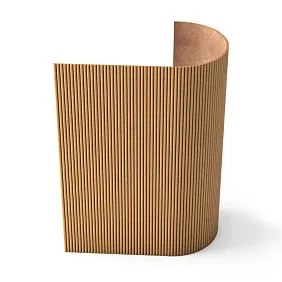
Ceiling finishing with slat panels—this is the architecture of rhythm. Slats are a repeating element, and it is this repetition that creates the effect. The gaze moves along the slats, the ceiling 'recedes' into perspective, the space is perceived as more extended. A flat surface acquires 'direction'—this is almost a cinematic technique: the viewer senses movement in stillness.
Plaster ceiling—this is the architecture of the center. Cornice, medallion, coffers—all these elements organize the ceiling plane around an axis: the geometric center, the point of the chandelier's suspension, the focus of the composition. The gaze is drawn to the center and from there—spreads to the edges. This is a centrifugal system in which each element 'points' to the source.
Understanding this difference, one can formulate a simple rule of choice: rhythm or center? Movement or concentration? The natural horizontality of a forest overhead—or the classical architectural vault, rooted in history?
But life is more complex than rules. And the best interiors are those where rhythm and center find peace with each other.




What is a slatted ceiling: construction and character
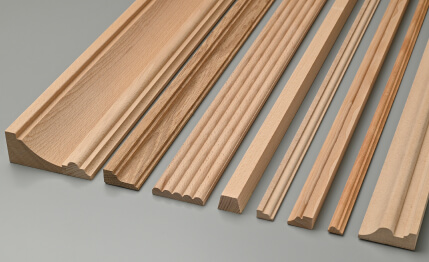
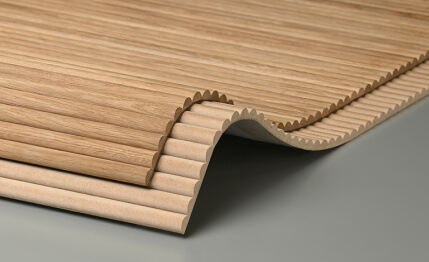
slatted panel on the ceiling needed?—this is a system of wooden or MDF slats mounted on a frame with a specific gap. The gap is the key element: it is what creates the 'breathing' of the surface, its nonlinearity, shadow, depth.
Construction parameters:
-
Slat width: 20–100 mm
-
Gap between slats: 8–40 mm
-
Batten height (construction depth): 30–60 mm
-
Room height loss: 45–80 mm
-
Orientation: across or along the long axis of the room
Materials for slatted ceilings: natural oak, ash, pine, thermowood — for natural and warm concepts; MDF for painting — for monochrome and modern solutions.
Surface character: lively, natural, "breathing." Throughout the day, shadows from the slats change depending on the sun's position. In the evening — under artificial lighting — the slats create dramatic shadows, the ceiling "recedes" into depth. This is a "living" surface — unlike a static white plane.
Our factory also produces:


What is a molded ceiling: history and modernity
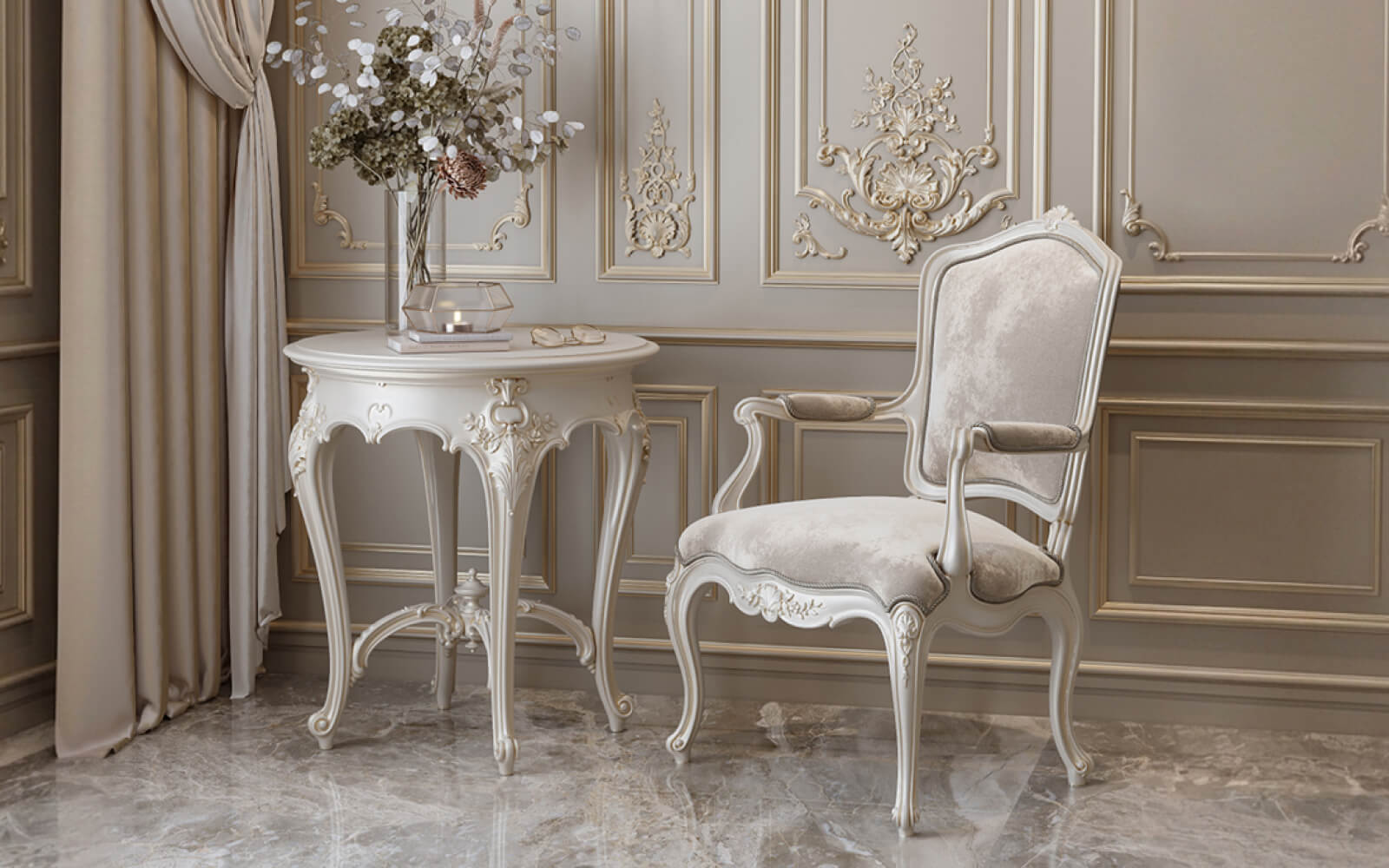
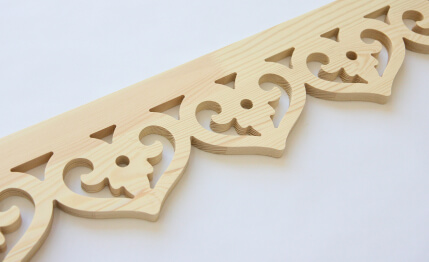
Ceiling with molding— a surface decorated with three-dimensional architectural elements: cornices, rosettes, coffers, beams, molding frames. Historically, molding was made from plaster — a labor-intensive, heavy material requiring skill.
Modernpolyurethane molded ceiling— a technologically different solution. Polyurethane elements: lightweight (3–8 kg/m³), water-resistant, mounted with adhesive, accepting any paint. They accurately reproduce historical profiles—acanthus, ionic, meander, dentils—yet cost an order of magnitude less than gypsum counterparts and can be installed independently in one day.
Character of a molded ceiling: static, monumental, 'historical' in a good sense. It appeals to architectural tradition—European, classical. It creates a sense of a 'capital' interior, where every detail has cultural meaning.
Get Consultation
Comparative Analysis: Battens vs. Molding
Direct comparison is the best way to understand what suits a particular space.
| Parameter | Slatted ceiling | Molded ceiling |
|---|---|---|
| Architectural principle | Rhythm, movement | Center, hierarchy |
| Material | Wood, MDF | Polyurethane, plaster |
| Visual character | Natural, dynamic | Classic, monumental |
| Ceiling height | Decreases by 45–80 mm | Decreases by 15–30 mm (cornice only) |
| Installation difficulty | Medium (battens + slats) | Low–medium (adhesive + trimming) |
| DIY possibility | Yes | Yes |
| LED compatibility | Excellent (LED behind slats) | Good (LED in cornice groove) |
| Repainting | Yes (MDF) | Yes (polyurethane) |
| Appropriate styles | Scandinavian, loft, minimalism, eco, Japandi | Classic, neoclassical, modern, contemporary classic |
| Limitations | Not for low ceilings (up to 2.5 m) | Conflict with overly modern concepts |
In which interiors a slatted ceiling is appropriate
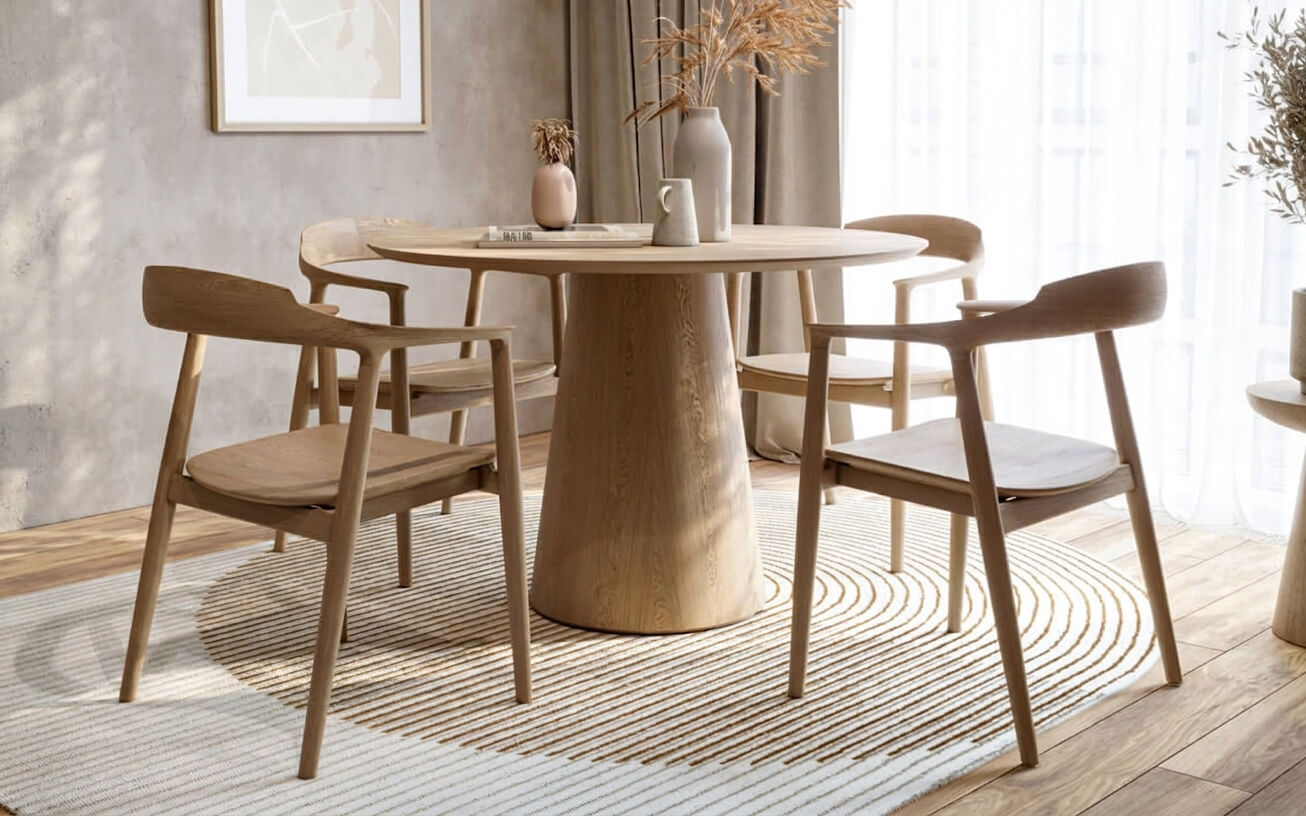
A slatted ceiling is a 'natural' element. It feels natural where the interior gravitates toward natural materials, warm tones, organic forms.
Scandinavian style
Whitewashed pine or ash slats overhead are practically a quote from a Finnish country house. Light wood, white walls, maximum natural light.Ceiling finishing with slat panels30 mm bleached ash slats / 12 mm gap, along the long axis of the room — and the Nordic character of the space is set without unnecessary words.
Japandi
A hybrid of Japanese minimalism and Scandinavian naturalness. Dark slats (ash 'smoky', thermowood) on a dark ceiling — in daylight, the ceiling 'disappears', the space seems boundless. Narrow slats 20–25 mm / gap 8–10 mm — a delicate rhythm, almost 'hatching'. No stucco — here it would be a foreign body.
Loft and industrial style
Dark or anthracite MDF slats 50–70 mm / gap 20–25 mm — a monumental, 'industrial' rhythm. Metal track lights in the gaps. No ornaments — only geometry and function.
Eco-interior
Natural amber or honey-colored oak, slats 40–55 mm / gap 15–20 mm. The ceiling is a 'forest canopy' over the living space. Perfectly combines with natural wall materials: lime plaster, jute textiles, stone.
Modern minimalism
Monochrome white MDF slats on a white ceiling. The relief is visible only through shadows — delicate 'structuring' without an obvious decorative element. For those who love 'surfaces that make you think: why does it feel so good here?'
In which interiors is a stucco ceiling appropriate
A stucco ceiling is a 'historical' element. It is organic where the interior appeals to architectural tradition, classical order, monumentality.
Classicism and neoclassicism
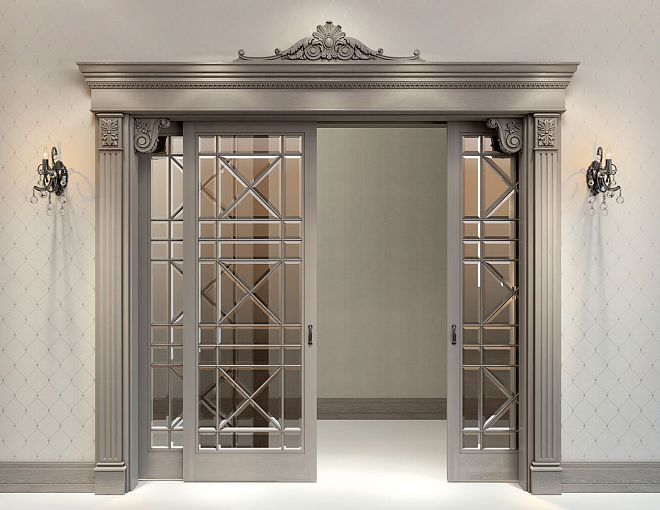
A cornice with an 'acanthus' or 'dentil' ornament, a ceiling rosette with a multi-band profile, a coffered pattern — all of this is the natural habitat of a stucco ceiling.Ceilings with polyurethane stuccoIn a classic interior, it is not a 'decoration' but a structural element: the cornice completes the walls, the rosette organizes the center, and coffers create scale.
Modern classic
A blend of classical forms and modern restraint. A simple-profile cornice of 60–70 mm (one or two setbacks, without ornament), a rosette with minimal relief, a ceiling without coffers—but in a crisp white color with well-proportioned design.Ceiling with moldingIn modern classicism, it is respect for tradition without its literal reproduction.
Art Deco style
Geometric cornices with straight lines, medallions with ray-like ornamentation, coffers with diagonal patterns. Art Deco is a style where stucco decoration 'quotes' classicism through the lens of geometry. Polyurethane elements here are ideal: precise geometry, easy installation.
French charm (French country)
Soft, slightly aged stucco decoration: a cornice with gentle 'curls,' a rosette with a floral motif, delicate painting in a warm cream-white. The ceiling doesn't 'shout'—it whispers of a French country house, of Provence, of breakfast under chestnut canopies.
Hotels, restaurants, representative spaces
A stucco ceiling in a commercial context is an unmistakable signal of 'quality' for a guest. A large cornice, a central medallion, correctly chosen proportions—and the space immediately 'reads' as a serious establishment. This is architectural marketing without words.
Can you combine slats and molding on the same ceiling?
A question rarely asked—and in vain. Because the answer is 'yes, and it can be brilliant'—with one condition: both elements must speak the same architectural language.
The main fear when combining: conflict between the 'natural' and the 'classical.' Wooden slats are associated with nature, molding with palaces. How will they coexist?
The answer lies in neutralizing the 'historical' code of the molding. If the molding is painted the same color as the slats (or to match the background surface between the slats), its 'classical' code is removed. Only the geometric pattern, volume, and shadow remain. And this 'depersonalized' molding element coexists perfectly with the wooden rhythm of the slats.
Five working schemes for combining slats and molding on the ceiling
Scheme 1: 'Slatted field in a molding frame'
The slatted 'island' occupies the central part of the ceiling (70% of the area). Around the perimeter of this island is a polyurethane molding frame 40–60 mm wide in the color of the ceiling. Along the outer edge of the frame is a cornice running along the entire perimeter of the room. The slatted field is 'enclosed' in an architectural 'picture frame' of molding. Slats are the content, molding is the framing.
Scheme 2: 'Molding center in a slatted field'
Slats occupy the entire ceiling plane. In the center is a cutout in the shape of a circle 600–800 mm in diameter. In this cutout is a clean white (or colored) ceiling surface with a ceiling rosette and chandelier. The slatted rhythm 'makes way' for the classical center. The rosette is a 'pause' in the slatted 'chorus.'
Scheme 3: 'Beams across the slats'
The battens are mounted along the long axis of the room. Across the battens, at intervals of 700–900 mm, are decorative polyurethane beams. The beams are painted to match the color of the battens or the ceiling. A 'double rhythm' is created: longitudinal (battens) + transverse (beams). The result is a 'coffer-like' ceiling without the complex installation of coffers.
Scheme 4: 'Cornice with LED — floating battens'
The battens cover the entire or most of the ceiling. Around the perimeter — a polyurethane cornice with an LED groove. Warm light from the cornice illuminates the ends of the battens from below and the side. The batten ceiling 'floats' — it appears not to touch the walls but hangs in the air. Here, the cornice is not decorative but a lighting tool. And it is precisely this that makes the combination not 'historical' but contemporary.
Scheme 5: 'Zonal division'
Different zones of the room — different ceiling scenarios. Above the sofa group — a batten 'island' made of natural oak. Above the dining table — a clean ceiling with a large ceiling rosette and a chandelier. Around the entire perimeter of the room — a unified polyurethane cornice. The cornice is a 'grammatical frame' that makes the different ceiling zones part of a single 'text'.
When the combination doesn't work
Honesty is more important: there are cases where battens and molding on the same ceiling do not coexist.
-
Different historical 'periods'. An ornamental cornice with 'acanthus' molding + dark thermo-wood battens in a Japandi concept — a stylistic conflict without resolution. The ornamental molding 'shouts' too 'loudly' about history, and the battens next to it look like a random element.
-
Scale conflict. Large battens 80–100 mm + delicate molding 20 mm — the battens visually 'swallow' the molding. Or vice versa: a monumental plaster cornice 120 mm + small battens 20 mm — the cornice 'presses down' on the delicate rhythm.
-
Different color 'temperatures'. Warm amber oak battens + cold white (RAL 9016) plaster decor — a temperature conflict. When combining: either the battens are neutral (whitewashed), or the molding is in a warm creamy white (RAL 9001).
Room scale, ceiling height, and lighting scenario
Three physical parameters of a space — size, height, light — determine which ceiling solution works and which does not.
Ceiling height: critical values
Up to 2.5 m. A slatted ceiling across the entire plane is undesirable: a 45–80 mm loss in height is critical. Alternative: a slatted 'island' covering 30–40% of the area above the main functional zone. A plaster ceiling is acceptable: a 40–50 mm cornice around the perimeter does not significantly 'lower' the ceiling.
2.5–2.7 m. A slatted ceiling is acceptable with slat widths up to 40 mm — a delicate rhythm. A plaster ceiling — full range of elements. Combination is possible, but with a minimalist cornice (no more than 60 mm).
2.7–3.0 m. Optimal height for both solutions. Slatted ceiling with slats 35–60 mm, gap 15–25 mm. Plaster cornice 60–90 mm. Full ceiling scenarios with combination.
3.0 m and above. 'Open space' for monumental solutions. Slats 60–100 mm, gap 25–40 mm. Plaster cornices 90–140 mm. Coffered ceilings. Large medallions. Decorative beams.
Room area and pattern scale
Room area determines the scale of the slatted pattern and plaster decor:
-
Up to 12 m²: slats 20–30 mm / gap 8–12 mm (delicate rhythm). Cornice 40–55 mm. Rosette 300–400 mm.
-
12–20 m²: battens 30–50 mm / gap 12–20 mm. Cornice 55–80 mm. Socket 400–600 mm.
-
20–35 m²: battens 45–70 mm / gap 18–30 mm. Cornice 70–100 mm. Socket 550–750 mm.
-
Over 35 m²: battens 65–100 mm / gap 25–40 mm. Cornice 90–140 mm. Socket 700–1000 mm.
Mismatch between pattern scale and room area is one of the most common mistakes. Small battens in a large hall 'get lost' and create a 'fine grid' feeling. Large battens in a small room feel 'oppressive'.
Lighting scenario: how light interacts with battens and molding
Light and relief are inseparable partners in ceiling design.
Batten ceiling and light:
Slatted panels with lighting— LED behind battens — creates a 'glowing' lighting effect: warm light from the gaps, dark wooden 'silhouettes' of the battens. This is one of the most atmospheric lighting scenarios for a living space. When dimmed to 10–15% — an evening ambiance unmatched by any other light source.
Track lights in the gaps between battens — task lighting, directed at specific zones. The battens 'hide' the track — only the light heads are visible.
Molded ceiling and light:
Cornice with LED slot — "floating ceiling". Hidden light from the cornice illuminates the ceiling plane from below and the side — reveals any relief of stucco. Each cornice profile, each "ledge" of a rosette — gets its own shadow from the grazing light of the cornice.
With direct overhead light (chandelier in the center) — stucco loses its relief, its "volume" disappears. This is precisely why a stucco ceiling always loses with cheap "spot" lighting and wins with well-thought-out side or hidden lighting.
Combined lighting scenario:
Slatted ceiling with LED behind the slats (warm glowing light from the gaps) + cornice with LED slot around the perimeter (floating light along the edge). Two independent lighting circuits with separate dimming — two scenarios in one room. Workday — both circuits at 70–80%. Evening relaxation — slatted LED at 30%, cornice LED at 15%.
Pros and limitations: an honest breakdown
Slatted ceiling: what's good and what's not
Advantages:
-
Natural warmth. Wood overhead — this is a biophilic effect: a person in a space with natural materials feels more comfortable, calmer. Scientifically proven, in demand in interiors.
-
Acoustics. A slatted ceiling with felt or acoustic filling behind the slats — a functional solution that reduces sound reflection. For home theaters, office meeting rooms, restaurants — a valuable bonus.
-
Hiding utilities. Behind the slats, you can "hide" pipes, cables, ventilation ducts — not in a "black box", but in a living wooden surface.
-
Repairability. An individual slat — can be removed and replaced without destroying the entire system.
-
Variety of concepts. From white monochrome to amber oak, from fine rhythm to monumental — hundreds of solutions.
Limitations:
-
Loss of height. 45–80 mm is a lot for rooms with ceilings up to 2.5 m.
-
Acclimatization. Wooden slats require 72–96 hours of conditioning — you cannot 'install today and paint tomorrow'.
-
Maintenance. Wood in living spaces needs periodic coating renewal — oil or varnish every 3–5 years.
-
Style limitations. Does not work in historical classical concepts — looks 'random' next to plaster moldings and classic furniture.
Molded ceiling: what's good and what's not
Advantages:
-
Architectural scale. A properly designed molded ceiling 'raises' the perceived height of the room: a perimeter cornice visually 'detaches' the ceiling from the walls.
-
Minimal loss of height. A 60–80 mm cornice adds only 15–20 mm of structural depth to the ceiling. This is incomparable to the 50–80 mm of a slat system.
-
Reversibility. If it is necessary to remove polyurethane decor — the adhesive is scraped off with a spatula, and the surface is puttied. This is easier than dismantling a slat frame.
-
Style versatility. A molded ceiling scales from Art Deco to Neoclassicism, from 'Provence' to 'English club'.
-
Compatibility with stretch ceilings. Polyurethane cornices can be mounted on both concrete and stretch ceilings while maintaining the 'hidden' fabric fastening effect.
Limitations:
-
Not for all modern styles. In Japanese minimalism, hardcore loft, or industrial interiors, molded decor will be an 'alien' element.
-
Requires proper proportions. 'Incorrect' molding—too small a cornice, too large a rosette, wrong profiles—creates a sense of cheapness. Proportions are key.
-
Vulnerability to temperature fluctuations. With large temperature changes, joints of polyurethane elements may crack. The solution is elastic putty at joints and proper adhesive.
-
Does not create acoustic comfort. The smooth surface of a molded ceiling is reflective. For rooms with acoustic requirements, additional measures are needed.
Combinations for a private house, apartment, and commercial space
Now—from principles to specific scenarios. Three types of spaces, three sets of tasks, three approaches.
Private country house
A private house is a space of maximum freedom. There are no restrictions of multi-unit construction here: ceilings are often higher (2.8–3.5 m and above), layouts are non-standard, the atmosphere is personal.
Living room of a country house (ceiling 3.2 m, area 40 m²):
— slatted panel ceilingmade of natural oak 55 mm / 22 mm gap on 60% of the area (above the sofa and dining zones)
— Ceiling cornice made of polyurethane 90 mm along the entire perimeter with an LED groove
— Above the entrance area (40% of the area) — a clean ceiling with a ceiling rosette 750 mm and a chandelier
— The cornice connects the slatted and 'clean' zones into a single architectural system
Bedroom of a country house (ceiling 2.9 m, area 20 m²):
— Slatted 'island' 2.4×1.8 m above the bed made of 'smoky' ash 30 mm / 12 mm gap
— Molding frame made of polyurethane 50 mm along the perimeter of the island
— Along the entire perimeter of the bedroom — a 70 mm cornice with an LED groove (warm light 2700K)
— Result: a 'natural' zone above the bed in an 'architectural' frame
Kitchen of a country house (ceiling 2.8 m, area 16 m²):
— Transverse slatted panels 35 mm / 15 mm gap on the ceiling above the kitchen area
— Decorative polyurethane beams across the slats — 800 mm spacing
— 60 mm cornice around the perimeter
— Above the dining area — a slatted "island" with LED behind the slats (2700K)
City apartment
An apartment imposes stricter conditions: ceilings are often 2.6–2.7 m, areas are limited, neighbors above and below. The task: maximum architectural effect with minimal "consumption" of height.
Living room in an apartment (ceiling 2.7 m, area 22 m²):
— Accent slatted wall (not ceiling!) made of MDF 40 mm / 16 mm gap with lighting — preserving height
— Ceiling cornice made of polyurethane 65 mm around the entire perimeter (height loss: 15 mm)
— Central ceiling rosette 580 mm
— Chandelier on a cable (adjustable hanging height)
— Result: ceiling 'raised' by cornice, room height preserved
Bedroom in an apartment (ceiling 2.6 m, area 14 m²):
— Slatted 'island' above bed 2.0×1.6 m of bleached ash 25 mm / 10 mm gap (delicate rhythm, minus 50 mm height only above bed)
— 50 mm cornice around bedroom perimeter matching ceiling color
— Socket 400 mm above bed — no chandelier, only sconces
— Result: local slatted 'canopy' without overall loss of room height
Hallway in an apartment (ceiling 2.6 m, area 6 m²):
— slatted panel on the ceiling needed?— Across the short axis (visually 'expands' the narrow hallway)
— MDF slats 30 mm / 12 mm gap matching wall color (monochrome) — ceiling 'disappears' but remains textured
— 45 mm cornice along two long walls
— Track spots in the gaps between slats — lighting without a separate fixture
— Result: a narrow corridor appears visually wider, the ceiling is textured but not 'oppressive'
Commercial space: restaurant, boutique, office
In a commercial space, the ceiling serves as a tool for branding and managing customer emotion.
Restaurant (ceiling 3.5 m, area 80 m²):
— slatted panel ceiling made of thermowood 'dark walnut' 60 mm / gap 22 mm — in the central zone (70% of the area)
— 110 mm cornice with LED groove around the perimeter of the hall — 'floating' slatted ceiling
— Above the bar counter — clean ceiling with three ceiling rosettes 700 mm in a row above the bar
— Decorative polyurethane beams across the slats with a 1200 mm spacing — zoning of tables
Result: a 'forest' ceiling with an architectural 'frame' of stucco decor. The atmosphere is warm, 'luxurious', and memorable.
Boutique (ceiling height 3.0 m, area 40 m²):
White MDF battens 40 mm / gap 18 mm — across the entire ceiling (white monochrome, 'gallery' neutrality)
80 mm cornice with LED slot — warm hidden lighting, highlighting the merchandise, not the interior
No sockets, no metallic accents — battens as a neutral 'background' for the merchandise
Track lights in the batten gaps — spot lighting on displays
Office meeting room (ceiling height 2.9 m, area 18 m²):
AcousticWooden slat panelswith felt behind the battens on the ceiling — reducing reverberation
Battens natural oak 45 mm / gap 18 mm
— 70 mm cornice around the perimeter — a professional 'frame' for the space
— Central ceiling rosette 520 mm with a track spotlight instead of a chandelier
— Result: comfortable acoustics, a 'serious' architectural look, and the natural warmth of wood
Mistakes in designing a ceiling scenario
Mistake 1: Slatted ceiling with critically low ceiling height
Ceiling 2.4 m + slatted frame + slats = 2.35 m final height. The space literally 'presses down.' Instead of coziness — claustrophobia.
Solution: with a ceiling below 2.5 m — a slatted 'island' covering 25–35% of the area, not a full overlay. Or switch to wall slatted panels while keeping the ceiling clean.
Mistake 2: Off-center molded rosette
The rosette is installed 'where the hook was' — not in the geometric center of the ceiling. A shift of 15–20 cm from the center is immediately noticeable. All the architectural 'seriousness' of the molding is ruined by this single oversight.
Solution: the geometric center of the ceiling plane — marked with a laser level before installation. The hook is relocated if necessary.
Error 3: Too much molding
Cornice around the perimeter + decorative beams + coffers + rosette + molding frames — all on one ceiling in a small room. An 'overloaded' ceiling creates a sense of chaos and cheap 'pseudo-luxury'.
Rule: one 'main' molding element + one 'supporting' element per ceiling. Cornice + rosette. Or beams + cornice. Or coffers + cornice. Not all at once.
Error 4: Slats aligned with the long axis in a narrow room
Slats along the long axis of a narrow room 'lengthen' it even more, making the space uncomfortably elongated.
Solution: in narrow rooms (hallway, elongated kitchen) — slats across the long axis. The eye moves across, the space 'expands'.
Error 5: Different color temperatures of lighting
Warm LED behind slats (2700K) + cold chandelier (5000K) above a molding rosette. Two sources with different temperatures on one ceiling — color dissonance, the ceiling looks 'broken'.
Solution: uniform color temperature for all ceiling lighting sources. For living spaces — 2700–3000K. For offices — 3500–4000K.
Frequently Asked Questions (FAQ)
Can it bemake a ceiling from slat panelsby yourself?
Yes, with basic skills and tools: a hammer drill, laser level, miter saw, screwdriver. Difficulty — medium. Critical stages: acclimatization of slats (72–96 hours), precise marking of the first slat using the level, using spacer shims for equal gaps.
How heavy is it?polyurethane molded ceiling?
Polyurethane — 3–8 kg/m³. A linear meter of an 80×60 mm cornice weighs 150–250 g. For comparison: a gypsum cornice of the same cross-section — 1.5–2.5 kg/m. Polyurethane molded decor is so lightweight that it is mounted with adhesive without dowels or anchors (except for very large elements).
HowCeiling finishing with slat panelsaffect the room's acoustics?
A slatted ceiling without filling behind the slats — slight reduction in sound reflection. With acoustic felt or an acoustic panel behind the slats — significant improvement in acoustics: reduction of reverberation by 30–50%. For meeting rooms, home theaters, studios — a functional and aesthetic double effect.
How to correctly choose a cornice for the ceiling with a slatted wall?
The cornice should 'belong' to the overall ceiling architecture, not to the wall's slatted field. Rule: the cornice is painted to match the ceiling color (not the wall). Its height: 40–80 mm for a ceiling 2.5–3 m high. With a slatted wall, the cornice is installed last — it 'covers' the upper ends of the slats and conceals any inaccuracies in the joint.
Slatted or molded ceiling — which is more expensive?
At a comparable scale — a slatted ceiling made of natural wood is usually more expensive than basic molded decor made of polyurethane. A molded ceiling made of polyurethane with a perimeter cornice and a rosette is one of the most budget-friendly architectural solutions for a ceiling. A slatted ceiling made of paintable MDF is comparable in cost to basic molded decor.
Do you need special paint for painting polyurethane moldings?
Regular water-based or acrylic paint. Mandatory condition: preliminary priming of the polyurethane surface with a water-soluble primer — to improve adhesion and uniform absorption of paint. Without primer, the paint 'pulls' and applies unevenly.
Conclusion
The ceiling is not the 'fifth element' that is remembered last. It is the first element that sets the scale of the entire space.slatted panel ceilingspeaks of nature, of rhythm, of warm wood overhead.Plaster ceilingspeaks of architecture, of tradition, of architectural order rooted in history. And where they are united — in a cornice with LED, in a slatted 'island' in a molding frame, in beams across the slats — something third is born: an interior in which every decision is made consciously.
Batten panels for ceilingsmade of natural wood and MDF,Ceilings with polyurethane stucco— cornices, rosettes, beams, coffered profiles, moldings — the entire range of materials for an expressive ceiling scenario is presented in the STAVROS company catalog.
STAVROS is a Russian manufacturer of slatted systems made of natural wood and MDF, as well as polyurethane decorative elements of a full production cycle. Own production, a wide range of slatted panels and molding decor, professional consultation on designing ceiling architectural solutions — for those who look at the ceiling as architecture, not as a 'painted slab'.