








































Article Contents:
- Ceiling skirting for ceilings in Moscow: which option to choose for your interior
- What ceiling skirting boards can be bought in Moscow
- Wooden ceiling skirting boards
- Paintable MDF skirting boards
- Polystyrene ceiling cornices
- Polyurethane decorative profiles
- How to choose ceiling skirting by material
- When wood is better
- When MDF is more convenient
- When polystyrene is more cost-effective
- When a decorative polyurethane profile is needed
- How to choose a ceiling skirting board by width and profile
- Narrow profile for low ceilings
- Medium universal profile
- Wide skirting board for high ceilings
- Smooth profile
- Decorative profile
- How to choose a ceiling skirting board by room
- living room
- for the bedroom
- For Kitchen
- For the hallway
- For Apartments
- For Country Houses
- Ceiling skirting board for stretch ceilings and regular ceilings
- What to choose for a stretch ceiling
- What to choose for a painted ceiling
- What to choose for high ceilings
- What to choose for low ceilings
- What to combine ceiling skirting with in interior design
- With wall moldings
- With wooden moldings
- With polyurethane molding
- With floor skirting in a unified interior system
- With slatted panels
- Where to buy ceiling skirting for ceilings in Moscow
- Common mistakes when choosing ceiling skirting
- Too narrow profile for a high room
- Too heavy decorative profile for a simple interior
- Incorrect material for the task
- Lack of connection with wall and floor decor
- Buying 'by eye' without a sample and measurements
- Frequently Asked Questions
- Conclusion

The upper line defines the perception of height. A correctly chosen Ceiling skirting board visually raises the ceiling in a low room and structures it in a tall one. An incorrect one—weighs down, presses, and fragments the space.
Buying ceiling molding in Moscow with the right result is not a matter of luck. It is a matter of knowing three variables: material, profile width, and interior style. This article will examine each variable in detail—with specific recommendations, parameters, and links to the current assortment.




Ceiling Molding in Moscow: Which Option to Choose for Your Interior
Moscow is a market with a wide range of interior solutions. Here, classic apartments in Stalin-era buildings with 3.5 m ceilings coexist with Soviet 'panel' apartments with 2.5 m ceilings, modern business-class new builds with open layouts, and country houses with 4–5 m ceilings in the living room.
For each of these contexts—its own ceiling molding. A wide, figured profile in a Stalin-era building sounds organic. The same profile in a panel apartment will crush the ceiling. A thin, minimalist profile in a modern apartment—spot on. The same in a classic study—a mismatch.
Therefore, before buying ceiling molding in Moscow—three questions:
-
Ceiling height? Up to 2.7 m—narrow or medium profile. 3 m and above—medium or wide. Above 3.5 m—wide decorative.
-
Ceiling material? A painted ceiling allows for any profile. A stretch ceiling—special installation conditions.
-
Interior style? Classic — figured profile with relief. Minimalism — smooth rectangular. Scandinavian — white smooth MDF or polystyrene.
buy skirting for the ceilingIn Moscow, you can get it from the STAVROS warehouse with delivery within the city in 1–2 business days. But first — let's break down the materials.




What ceiling skirting boards can be bought in Moscow
On the Moscow market, there are four main categories: wood (solid wood), MDF, high-density polystyrene, and polyurethane. Each is for its own context, its own budget, its own aesthetic.
Our factory also produces:


Wooden ceiling skirting boards
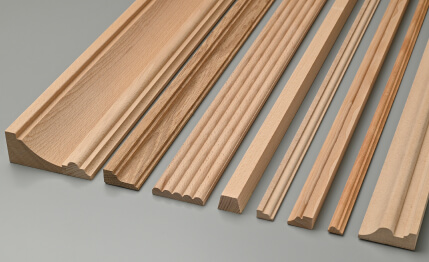
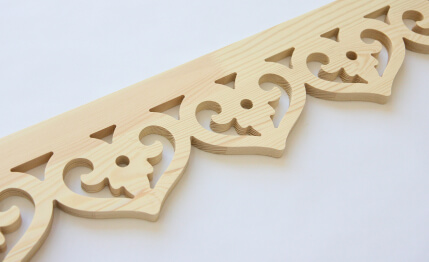
Wooden ceiling skirting board— this is a material that imitates nothing. It is itself: fiber texture, living shade, natural irregularity. Solid oak or beech at the wall-ceiling junction — an architectural detail that speaks of interior quality without words.
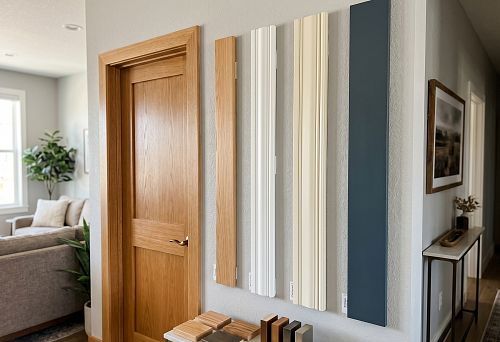
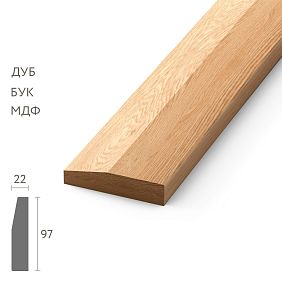
Wooden skirting boards and battensfrom oak and beech by STAVROS are produced in widths of 60–120 mm. Surface: sanded for painting, oil-tinted, under varnish. Plank length: 2.5 m.
Wooden ceiling profile in Moscow is chosen for:
-
Classical and neoclassical interiors with parquet, wooden doors, and moldings
-
Country houses where wood is the recurring material motif
-
Prestigious spaces: studies, living rooms of apartments, meeting rooms
To buy a wooden ceiling skirting board is to choose a material that allows for renewal: re-toning with oil, sanding, repainting. Wood does not require complete replacement — it can be restored.
Installation feature: wooden profile is heavier than MDF and polystyrene. Adhesive + finishing nails. On a drywall ceiling — only into the frame overlap.
Get Consultation
Baseboard — it is a modest detail, often unnoticed, but plays a critical role in creating the completeness of the interior.
MDF — pressed wood fiberboard. Homogeneous structure without texture, perfectly smooth surface, precise color reproducibility. To buy an MDF ceiling skirting board — for interiors where a unified white or colored system is needed.
MDF ceiling skirting board for painting — a standard for Scandinavian, modern, and minimalist interiors. White ceiling + white MDF profile + white walls — a homogeneous space without visible boundaries.
Acrylic enamel on MDF lays perfectly: without texture 'showing through', without stains, with the desired sheen — matte, satin, or semi-matte. A specific shade of white according to NCS or RAL — is reproduced accurately.
MDF limitation: the bottom end at the ceiling needs to be primed before installation. Without primer, MDF absorbs moisture through the end — critical in the kitchen and bathroom.
Polystyrene ceiling cornices
Ceiling cornice made of polystyreneHI WOOD skirting boards are the most practical option for most apartments. High-density closed-cell polystyrene: does not crumble, is moisture-resistant, and does not deform from temperature fluctuations.
Polystyrene ceiling skirting boardsThis is not 'Soviet-era mass-market foam plastic.' It is a dense engineered material with reproducible geometry, primed surface ready for painting, and a wide range of widths: from 55 to 160 mm.
Buying polystyrene ceiling skirting in Moscow is the optimal choice for:
-
Apartments in new buildings and secondary housing with standard ceiling height
-
Kitchens and hallways where moisture resistance is important
-
Projects with stretch ceilings — lightweight polystyrene is attached with adhesive without putting load on the fabric
-
Budget solutions with a worthy result
Polystyrene ceiling skirtingCan be installed in one day by one person: special adhesive for polystyrene + working from the corner. Does not require complex tools.
Polyurethane decorative profiles
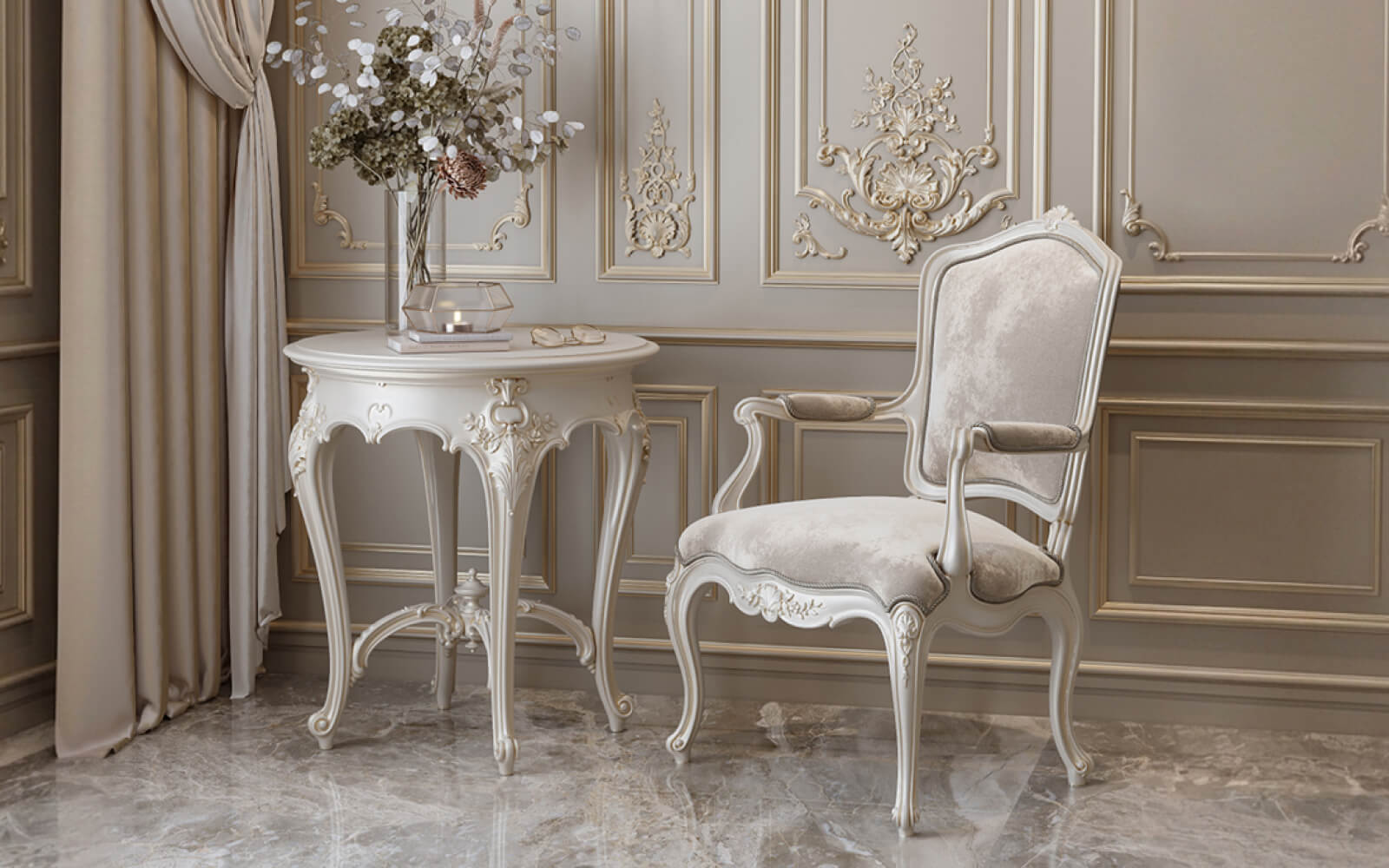
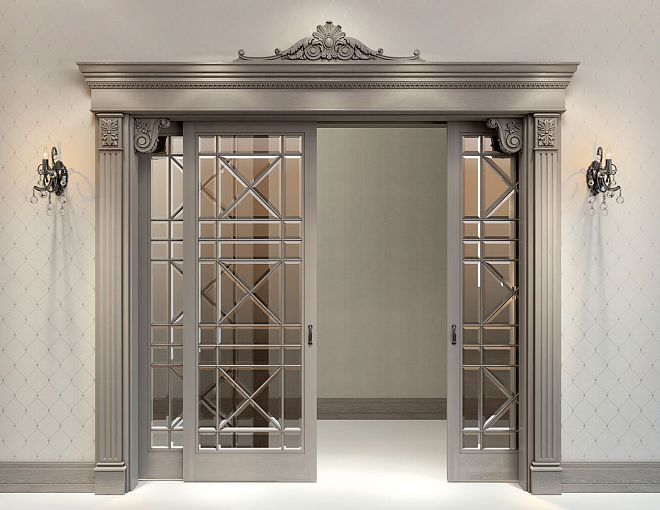
polyurethane decor— for classic and neoclassical interiors requiring complex relief: meander, acanthus, laurel belt, coffered profiles, multi-step cornices.
Polyurethane accurately reproduces intricate molded relief—with a level of detail that wood and MDF cannot achieve at a comparable price. White primed polyurethane for painting accepts any shade of acrylic enamel.
For ceiling profiles, polyurethane is primarily used where a 'heavy' classic frame is needed—a multi-step cornice 80–150 mm high with rich relief.
How to choose a ceiling skirting board by material
This choice is less about 'what looks prettier' and more about 'what solves the task better.' Each material has its own niche.
When wood is better
Wood—when naturalness is essential. In an interior with parquet, solid doors, wooden architraves, and moldings—a ceiling profile made of the same material completes the system.
Wooden trim— from oak and beech: floor skirting + wall moldings + ceiling cornice from the same line—this is an architectural monolith. Not 'similar,' but identical. One wood species, one tint, one manufacturer.
Wood—when service life is critical. With proper treatment, a wooden ceiling profile lasts 30–50 years.
When MDF is more convenient
MDF—when a precise white or colored system is needed. Scandinavian interior, modern 'white box,' monochrome studio—here, paintable MDF delivers a result that wood cannot: a perfectly uniform surface without texture.
MDF — when the budget is limited but you want the aesthetics of wood. In terms of strength and lifespan in dry rooms, MDF is close to solid wood.
MDF — when the ceiling skirting is planned to be painted along with the walls in a single color. The MDF surface does not require special preparation for painting.
When polystyrene is more advantageous
Polystyrene — when moisture resistance is important. Kitchen, hallway, rooms with condensation — MDF is vulnerable in these conditions, polystyrene is stable.
Polystyrene — when quick installation without special tools is needed. Glue + 15–20 minutes of fixation — the job is done.
Polystyrene — when low weight is important. For stretch ceilings: a heavy profile glued to the stretch fabric creates a risk of detachment. Polystyrene weighs 200–400 g per linear meter — many times lighter than wood.
When a decorative polyurethane profile is needed
Polyurethane — when you need complex molded relief at a reasonable price. Acanthus, meander, egg and dart profile, multi-step cornice — this level of detail is technically impossible in MDF or polystyrene.
Polyurethane — for classic interiors in old Moscow housing stock, in country houses with high ceilings, in living rooms with symmetrical decor.
Combination: wooden floor skirting + wooden wall moldings + polyurethane ceiling cornice = a complete system where natural and synthetic complement each other in function.
How to choose a ceiling skirting board by width and profile
Width is the most influential parameter after material. It determines the visual weight of the upper horizontal line and the proportion relative to the ceiling height.
Narrow profile for low ceilings
Width 35–55 mm. For rooms with ceilings 2.4–2.7 m — the standard for most Moscow apartments from the Khrushchev and Brezhnev-era housing stock.
A narrow profile on a low ceiling is a rule of proportion. A wide profile in such a room weighs down the ceiling: it appears even lower visually, and the space feels compressed.
A smooth narrow profile made of polystyrene or MDF in the color of the ceiling is the most 'quiet' option: the skirting board covers the joint and literally disappears.
Medium universal profile
Width 55–80 mm. The widest selection in any material category. Universal for ceilings 2.7–3.2 m.
The medium profile is the 'default' choice for most modern Moscow business-class apartments. It is visible but not dominant. It defines the upper line without fragmenting the space.
Wide skirting board for high ceilings
Width 80–160 mm. For ceilings from 3 m — in Stalin-era buildings, country houses, apartments with non-standard ceilings.
Buying a wide ceiling skirting board in Moscow means turning the upper horizontal into an architectural element. In a high room without a wide cornice, the wall 'sinks' into the ceiling without a clear boundary. A wide profile holds this connection — gives the high space completeness.
Buy a wide ceiling skirting board made of solid wood — for a country house with a ceiling of 4–5 m. Width 120–160 mm, shaped profile with several steps.
Smooth profile
Profile without relief: rectangular or beveled cross-section, smooth surface. For modern, Scandinavian, and minimalist interiors.
Smooth white profile in a white interior — it is almost invisible. Its presence is felt not as decor, but as an architectural boundary: the ceiling and walls are clearly separated, without an accidental crack line.
Decorative Profile
Profile with relief: chamfer, ovolo, beads, ornament, steps. For classical, neoclassical, 'Stalinist' interiors.
Decorative profile creates a shadow with side lighting. It is the play of shadow — the main effect of the relief. With properly placed lighting, the decorative ceiling cornice comes to life: each step casts its own shadow, the profile gains volume.
Selection table:
| Ceiling Height | Profile width | Profile type | Material |
|---|---|---|---|
| up to 2.6 m | 35–55 mm | smooth | MDF, polystyrene |
| 2.7–3 m | 55–80 mm | Smooth or with a bevel | Any |
| 3–3.5 m | 80–120 mm | With a bevel or decorative | Wood, polyurethane |
| Above 3.5 m | 120–160 mm | Decorative, multi-step | Wood, polyurethane |
How to choose a ceiling skirting board for the room
For the living room
The living room is the face of the apartment. Here the ceiling skirting board is maximally visible: from the sofa, from the dining area, from the entrance. Here the mistake in choice is most visible — and here the right choice sounds most convincing.
Buy a ceiling skirting board for the living room — taking into account ceiling height and style. A classic living room with parquet and symmetrical furniture arrangement — a wooden or polyurethane cornice with relief, width 80–120 mm. A modern living room with an open layout — a smooth white profile, width 60–80 mm.
In a living room with high ceilings (from 3 m), a wide decorative cornice additionally accentuates the height — it serves as an 'underline' for the ceiling from above.
For the bedroom
The bedroom is a space of calm. Here the ceiling skirting board should not attract attention. It should be present — but not dominate.
Buy a ceiling skirting board for the bedroom — a smooth profile of medium or narrow format in the color of the ceiling or walls. MDF for painting or polystyrene. White — in a neutral interior. Matching the walls — in a colored one.
Trend for the bedroom: ceiling profile with lighting. A hollow profile with a niche for an LED strip — warm indirect ceiling lighting. This is not technically complex but requires planning before finishing: the cable is laid in advance.
For Kitchen
The kitchen is a high-humidity zone with steam and splashes. For the kitchen, only moisture-resistant material.
Polystyrene ceiling skirtingHI WOOD is the optimal choice for the kitchen. Closed-cell structure: zero water absorption, stability during wet cleaning, no deformation from temperature fluctuations.
MDF in the kitchen comes with caveats: edges and the back surface must be sealed. Without sealant, swelling and detachment occur within 2–3 years.
Wooden profile in the kitchen only with full lacquer coating (2–3 layers). Open oil in the kitchen absorbs grease mist.
For the hallway
The hallway is a short space that greets and forms the first impression. Here, the baseboard is seen 'head-on': you enter, and your gaze travels across the entire space.
For the hallway: moisture-resistant polystyrene (risk of condensation from outerwear), medium width 55–70 mm, smooth or lightly chamfered profile. In a narrow hallway — no wider than 55 mm: a wide cornice visually consumes the already limited height.
For apartments
'Apartment' is a generalized query. If the apartment is typical (ceiling 2.5–2.7 m), style modern or neutral — HI WOOD polystyrene or MDF, width 55–70 mm, smooth or with light relief.
Buy ceiling baseboard for an apartment in Moscow — wide selection from STAVROS: all materials, all widths, all profiles in stock.
For a country house
A country house has different scales. Ceiling 3–5 m in the living room, exposed wooden structures, natural materials. Here, wooden ceiling profile is not an option, but a standard.
Wooden trimOak for a country house: ceiling cornice 80–120 mm, in 'natural oak' or 'whitewashed oak' finish — depending on the overall design. With exposed wooden beams — dark profile to match the beams.
Ceiling skirting for stretch ceilings and regular ceilings
The type of ceiling affects the choice of profile — primarily in terms of mounting method.
What to choose for a stretch ceiling
A stretch ceiling is a PVC or fabric sheet stretched onto a wall-mounted profile. The ceiling skirting for a stretch ceiling is attached to the wall — not to the ceiling. The lower edge of the profile covers the gap between the sheet and the wall.
For a stretch ceiling, the weight of the profile is critical. Lightweight polystyrene is the optimal choice: it is glued to the wall, creating minimal load.
A special 'ceiling skirting for stretch ceilings' is a profile with an enlarged lower flange: it covers the technical gap near the sheet more widely.
A wooden profile for a stretch ceiling is attached with adhesive plus wall anchors (not into the sheet). Distance from the sheet: the profile must not touch the stretch ceiling — only cover the gap.
What to choose for a painted ceiling
A painted or plastered ceiling offers maximum freedom of choice. Any material, any width, any profile. Mounting: adhesive + anchors into the floor slab or drywall frame.
For a painted ceiling, wooden or MDF profiles are most often chosen — they are mounted more securely, last longer, and look more convincing against high-quality plaster.
What to choose for high ceilings
High ceiling (from 3 m) — wide profile. A narrow cornice on a high ceiling gets lost — the top line is not readable, the space loses completeness.
Rule: cornice width in mm ≈ ceiling height in meters × 30–40. Ceiling 3.5 m — cornice 105–140 mm.
For high ceilings — solid wood or polyurethane profile. Wide polyurethane cove with rich relief + wooden frieze below = classic system for a formal room.
What to choose for low ceilings
Low ceiling (up to 2.6 m) — the most common type in Moscow's old housing stock. The task of the baseboard: to close the joint and not weigh down the space.
Buy ceiling baseboard for low ceilings — narrow profile 35–50 mm, smooth, in the color of the ceiling. The profile literally dissolves into the ceiling — the gaze does not fix the lower boundary, the ceiling appears higher.
Not allowed: wide and relief profile on a low ceiling. It draws the eye downward and visually 'lowers' the ceiling.
What to combine ceiling skirting with in interior design
Ceiling baseboard is not an isolated detail. It works in a system. And this system must be coordinated in material, shade, and 'level of richness' of decoration.
With wall moldings
Moldings and cornicesOn the walls — horizontal and frame profiles. When the ceiling cornice and wall moldings are from the same line, same material, same tint — the wall and ceiling are read as a single architectural object.
Typical system: 80 mm ceiling cornice + wall-mounted horizontal belt at 100 cm height + frame moldings on the lower wall zone. All made of solid oak wood in a single finish. A classic interior without unnecessary words.
With wooden trim
Unified wooden trim: ceiling cornice + floor skirting + door architraves + possibly window belts. With a 3 m ceiling, this system gives the apartment the level of a country house—a sense of completeness and material honesty.
Important: all wooden parts should be from the same batch or product line. The finish of wood from different batches may vary, and this is noticeable on large surfaces.
With polyurethane molding
Ceiling cornice made of solid wood or MDF + corner blocks and rosettes frompolyurethane decor— a hybrid system. The wooden linear profile is geometrically precise, while the polyurethane decor reproduces complex relief. Together—a complete classical picture.
Primed polyurethane: accepts white or colored acrylic paint. The wooden cornice nearby: in a finish or ready for painting in the same color. Color compatibility is a mandatory condition.
With floor skirting in a unified interior system
Horizontal line at the floor + horizontal line at the ceiling = frame of the space. Whenbaseboardand a ceiling cornice from the same line, the same material, and a similar width—the room gains architectural completeness.
Proportion calculation: the width of the ceiling cornice should be approximately equal to or slightly greater than the width of the floor skirting. Floor 70 mm + ceiling 80 mm = a proportional system.
With slatted panels
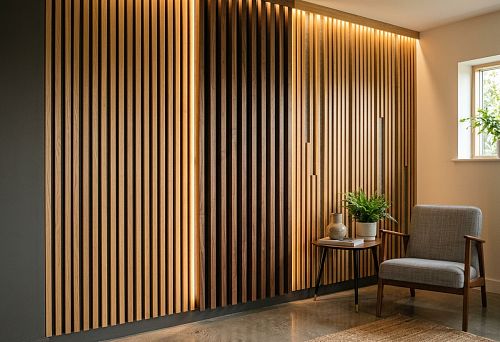
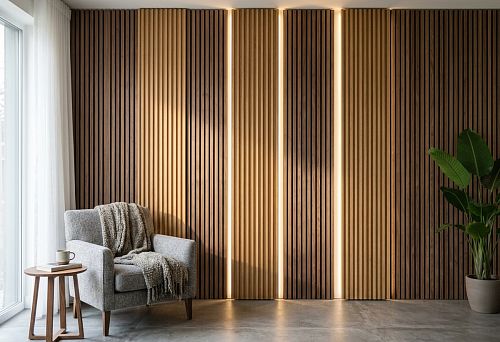
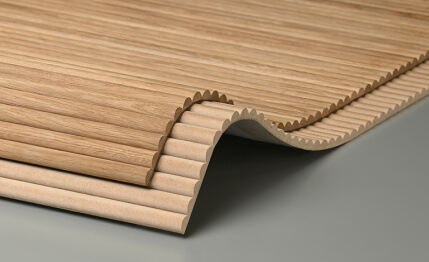
Rafter panels— vertical wooden rhythm on the wall. Combining slatted panels with a ceiling cornice: panels occupy the lower zone of the wall, a horizontal belt limits them from above, and the ceiling cornice completes the transition to the ceiling.
Three levels of horizontals: skirting at the floor + horizontal belt in the middle of the wall + ceiling cornice. Between the first and second—slatted panels. This is the complete structure of an interior wall in one solution.
Where to buy ceiling skirting for the ceiling in Moscow
This is the main question of the page. And here it's important to speak directly: not every store selling 'ceiling skirting' sells the right product.
The Moscow market is filled with cheap polystyrene profiles with unclear geometry, yellowing after a year, and crumbling during installation. This is not the material that works for the interior.
What is fundamental when choosing a supplier:
Availability of a complete system. Ceiling cornice, floor skirting, moldings, decor—from one manufacturer, from the same line. Only this guarantees matching shades and geometry.
Warehouse availability. Skirting is long-length linear material. An order 'for production' from different batches results in variations in tinting. Stock items are safer.
Professional consultation. Choosing the correct width, profile, and material for a specific interior and ceiling height is not intuition, but calculation. A good supplier provides consultation for free.
Delivery in Moscow. Long-length molding 2.5–3 m is a transportation specific. Professional packaging and delivery without deformation.
Catalog for transition:
Common mistakes when choosing ceiling skirting
Mistakes here are costly—literally. Choosing the wrong molding isn't just unsightly: it needs to be removed, the traces filled, and reinstalled. Or you have to live with a result that irritates you every day.
A profile that is too narrow for a high-ceilinged room
The most common mistake. People buy something 'simpler,' install a 40 mm profile in a room with a 3.2 m ceiling—and end up with an invisible strip near the ceiling. The upper boundary of the space isn't defined. The ceiling 'floats away.'
The rule is simple: ceiling height in meters × 30–35 mm = minimum cornice width. For a 3.2 m ceiling, the cornice should be no narrower than 96–112 mm.
A decorative profile that is too heavy for a simple interior
An ornate polyurethane cornice with intricate patterns in a Scandinavian interior—a clash of styles. Simple furniture, white walls, wooden floors—and suddenly a baroque profile near the ceiling. The mismatch is felt by everyone who enters.
The level of decoration of the ceiling profile = the level of decoration of the entire interior. A simple interior requires a simple profile. An ornate interior requires an ornate one.
Incorrect material for the task
MDF without sealant in an entryway or kitchen. Wooden profile without varnish in a kitchen. Decorative foam (not HI WOOD) in a room with normal humidity—it will yellow and crumble.
Each material is for a specific context. Wet areas: HI WOOD polystyrene or wood with varnish. Dry areas: any material.
Lack of coordination with wall and floor decor
Bought a ceiling cornice without thinking about the floor skirting board, architraves, and moldings. Result: white MDF floor skirting board, tinted oak ceiling cornice, laminated MDF 'walnut' architraves — three different 'woods' in one room.
Solution: systematic purchase. First — determine the material and color of all wooden trim. Then — purchase from one product line.
Buying 'by eye' without a sample and measurements
The width 'seems normal' in the picture. The shade 'roughly matches' the parquet. In reality — neither one nor the other.
A sample in hand, under the specific lighting of the room, next to samples of the floor and walls — is the only reliable check.
Frequently asked questions
Which ceiling skirting board is better for an apartment with a 2.7 m ceiling?
Width 55–70 mm. Smooth or with a slight bevel. Material: MDF for painting (white interior) or HI WOOD polystyrene (universal). Wooden — if the interior features natural materials.
How does HI WOOD polystyrene differ from a regular foam skirting board?
Fundamentally. A regular foam profile is low-density expanded polystyrene: crumbles, yellows, deforms, with imprecise geometry. HI WOOD is high-density closed-cell polystyrene: does not crumble, does not yellow, stable in humidity, with precise geometry and a primed surface.
How to attach ceiling skirting to a stretch ceiling?
The profile is attached to the wall — not to the stretch fabric. Special adhesive for polystyrene (or liquid nails for wood) on the wall + if necessary, dowels into the wall. The skirting does not touch the fabric — it only covers the gap between the fabric and the wall.
Should a wooden ceiling skirting be painted before installation?
It is recommended. Treating with oil, wax, or primer before installation means protecting all surfaces, including the back. After installation, the back side is inaccessible for treatment.
How much skirting is needed for a 20 m² room?
Room perimeter 4×5 m = 18 m. Minus two door openings 0.9 m × 2 = 16.2 m. Plus 15% reserve = 18.6 m. With plank length 2.5 m — 8 planks.
Can wooden ceiling skirting be combined with white walls?
Yes, this is one of the classic techniques. A warm wooden cornice on a white wall creates a contrast that emphasizes the transition line. The wood shade — natural or tinted — is chosen in coordination with other wooden elements in the room.
Is there delivery of ceiling skirting in Moscow?
Yes, STAVROS provides delivery in Moscow and the Moscow region. Long-length molding is transported in protective packaging. Delivery time: 1–3 business days.
White ceiling skirting board – which material is better?
MDF for painting or HI WOOD polystyrene. MDF – for an exact shade of white (NCS/RAL) according to the designer's system. Polystyrene – ready-made white with factory primer, no self-painting required.
Can a wooden skirting board be installed on a drywall ceiling?
Yes, but with a condition: fastening only into the metal profile of the frame (not into the drywall). Drywall itself does not hold a heavy wooden profile. With a stud profile spacing of 60 mm – additional fastening every 30–40 cm.
Conclusion
Ceiling skirting board for a ceiling in Moscow – a detail on which the completeness of the entire space depends. Not in theory – in practice: a correctly chosen cornice holds the upper horizontal of the room, visually manages the height and creates a transition between the wall and ceiling with architectural precision.
Choose according to the system: material – based on room conditions, width – based on ceiling height, profile – based on interior style. Buy as a set: ceiling cornice, floor skirting board, moldings – from the same line.
Go to the catalog:
STAVROS – a Russian manufacturer of interior decor made from natural wood, MDF, and polystyrene, with production and a warehouse in Moscow. The STAVROS range includes ceiling cornices and skirting boards made of solid oak and beech, wooden millwork (floor skirting boards, moldings, architraves, battens), moisture-resistant ceiling cornices from the HI WOOD line made of high-density polystyrene, polyurethane decor for classic interiors, slatted panels made of natural wood.
STAVROS works with designers, architects, construction contractors, and private buyers across Russia. Warehouse in Moscow, delivery within the city in 1–3 business days, free professional consultation on selecting ceiling skirting boards for specific interiors, ceiling height, and type of finish.