































































Article Contents:
- Why you need a ceiling polyurethane rosette
- What role does it play in the interior
- Why a rosette for a chandelier makes the composition complete
- When a ceiling rosette is truly appropriate
- What types of polyurethane ceiling rosettes are there
- Round ceiling rosettes
- Oval and shaped models
- Smooth, laconic rosettes
- Relief decorative rosettes
- Rosettes for classic and neoclassical interiors
- How to choose a ceiling rosette for a chandelier
- How to match rosette size and chandelier diameter
- When you need an expressive relief rosette
- When it's better to choose a calm model
- How to combine chandelier shape and rosette pattern
- How not to overload the ceiling center
- How to choose ceiling rosette diameter
- For small rooms
- For medium-sized rooms
- For spacious living rooms and halls
- How to consider ceiling height
- Why a too small ceiling medallion gets lost, while a too large one feels oppressive
- How to choose a ceiling medallion to match the interior style
- For classic style
- For neoclassical style
- For a modern interior with decorative accents
- For a strict and restrained design
- For interiors with moldings and cornices
- What to pair a ceiling medallion with
- With cornices
- With wall moldings
- With ceiling coffers and frames
- With a decorative room centerpiece
- With the overall rhythm of the stucco decor
- What to choose for different tasks
- If you need a medallion only for the chandelier
- If you need an expressive ceiling accent
- If the interior is already rich with decor
- If you want to emphasize the ceiling height
- If you need to neatly decorate the center of the ceiling
- Advantages of ceiling roses made of polyurethane
- Ease and convenience of application
- Clear decorative relief
- Suitable for various interior scenarios
- Convenient for combining with other ceiling decor
- Practical for apartments, houses, and commercial spaces
- What mistakes are most often made when choosing a ceiling rosette
- Choose a ceiling medallion without considering the size of the chandelier
- Do not take ceiling height into account
- Choose too complex a relief for a small room
- Do not coordinate the medallion with the rest of the ceiling decor
- Try to create an accent where it is not needed
- How to buy a polyurethane ceiling medallion in Moscow without making a mistake
- First, define the task
- Then choose the shape and diameter
- Check the combination with the chandelier
- Consider the style of the room
- Select a rosette together with a cornice and other decor
- Checklist before buying a ceiling rosette
- Comparison table of ceiling rosette types
- FAQ: Answers to Popular Questions
- Which ceiling rosette to choose for a chandelier?
- How to Choose the Size of a Ceiling Rosette?
- Is a polyurethane rosette suitable for a small room?
- What is better: smooth or relief rosette?
- Can a rosette be combined with a cornice and moldings?
- Where to buy a polyurethane ceiling rosette in Moscow?
- Is a rosette needed in a modern interior?
- How to choose a rosette for neoclassicism?
- Conclusion
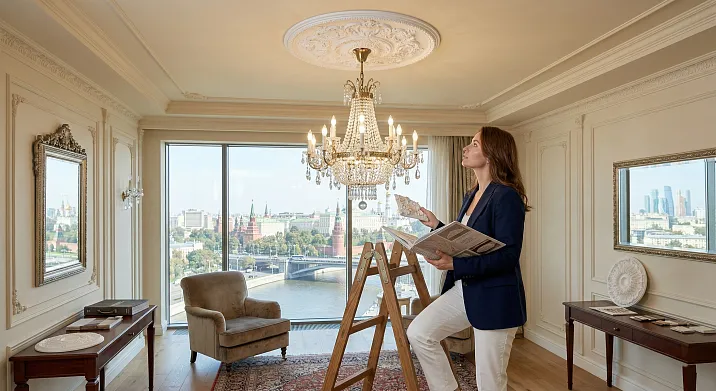
Look at the ceiling in any well-thought-out interior—classical, neoclassical, contemporary with an attention to detail. The center of the ceiling is never empty. There is always a focal point—an element around which the entire lighting and decorative logic of the space is built. This element most often becomesceiling rose made of polyurethane.
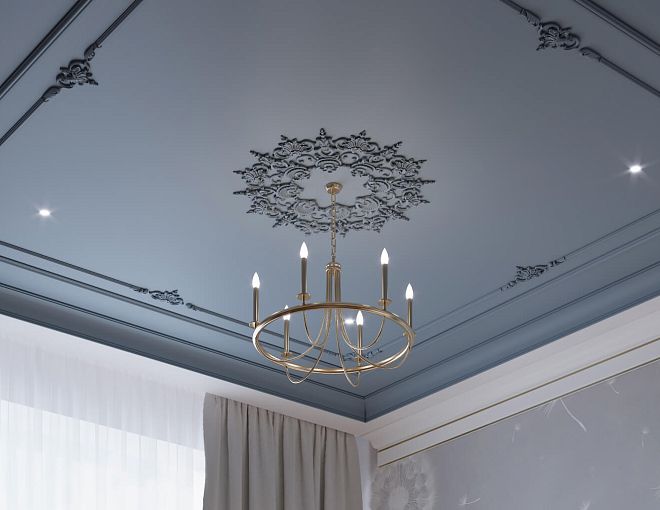
A ceiling medallion is not just a decoration under a chandelier. It is the compositional center of the ceiling, its 'focal point,' which organizes the space around itself. When chosen correctly, it transforms an ordinary ceiling into an architectural plane. When chosen incorrectly—it creates a sense of disproportion and randomness.
If you are looking forpolyurethane ceiling medallion in Moscow—means you are already on the right track: you have chosen the material, you understand the task. Now it remains to figure out the main things: what size, what relief, what style—and how to relate all this to the chandelier, ceiling height, and the overall decorative logic of the room.
This is exactly what this article is about.





Why You Need a Polyurethane Ceiling Medallion




What Role It Plays in the Interior
The ceiling is the fifth wall. And the only one a person sees immediately upon entering a room, even before looking around. An empty white ceiling with a single point for hanging a chandelier looks unfinished—like text without punctuation. There is meaning, but no structure.
A medallion solves this task elegantly and precisely. It creates a decorative center for the ceiling plane, 'frames' the point of light entry, sets the scale and style. At the same time, it does not require complex installation, does not weigh down the structure, and does not necessitate ceiling reconstruction.
A polyurethane medallion is attached with special adhesive directly to the ceiling surface—in a matter of minutes, without a hammer drill, without reinforcement, without dust. And after installation, it can be painted any color: white, cream, gold, gray—to match the ceiling or with intentional contrast.
Our factory also produces:




Why a ceiling medallion makes the chandelier composition complete
A chandelier is a light accent. A ceiling medallion is its architectural pedestal. Together they create what designers call a 'ceiling composition': complete, logical, and visually balanced.
Imagine a chandelier without a medallion: the wire goes into a point on a white ceiling, and it looks like a temporary solution, like an unfinished renovation. Now add a medallion — and the ceiling gains a center around which everything else is organized.
That is why a ceiling medallion for a chandelier is not optional decor, but a logical completion of the interior solution. It indicates that the interior was created with intention — not hastily, not by chance.
Get Consultation
When a ceiling medallion is truly appropriate
There are several scenarios in which a decorative ceiling medallion becomes truly indispensable.
Classical and neoclassical interiors — here a medallion is a mandatory element. Without it, the interior looks unfinished, like a ballroom without a chandelier.
Apartments in houses with high ceilings — a large ceiling plane needs an accent center. A medallion structures the space without overloading it.
Rooms with central lighting — living room, dining room, bedroom, study with a central chandelier — wherever there is a pendant light, a ceiling rosette is justified.
Interiors with stucco decoration — where there isPolyurethane Crown Moldingandmoldings on walls, a ceiling rosette becomes a logical completion of the decorative system.
Modern apartments where a single decorative accent is needed — in a minimalist space, a rosette can be the only decorative element, and that is enough.
What polyurethane ceiling rosettes are available
Assortmentceiling roseare significantly broader than they seem at first glance. When choosing 'just a rosette,' you are actually selecting shape, size, relief, and style — and each of these parameters matters.
Round ceiling rosettes
The round shape is a classic. It is neutral in relation to the room's architecture, looks equally good in square and rectangular spaces, and harmonizes with any chandelier shape.
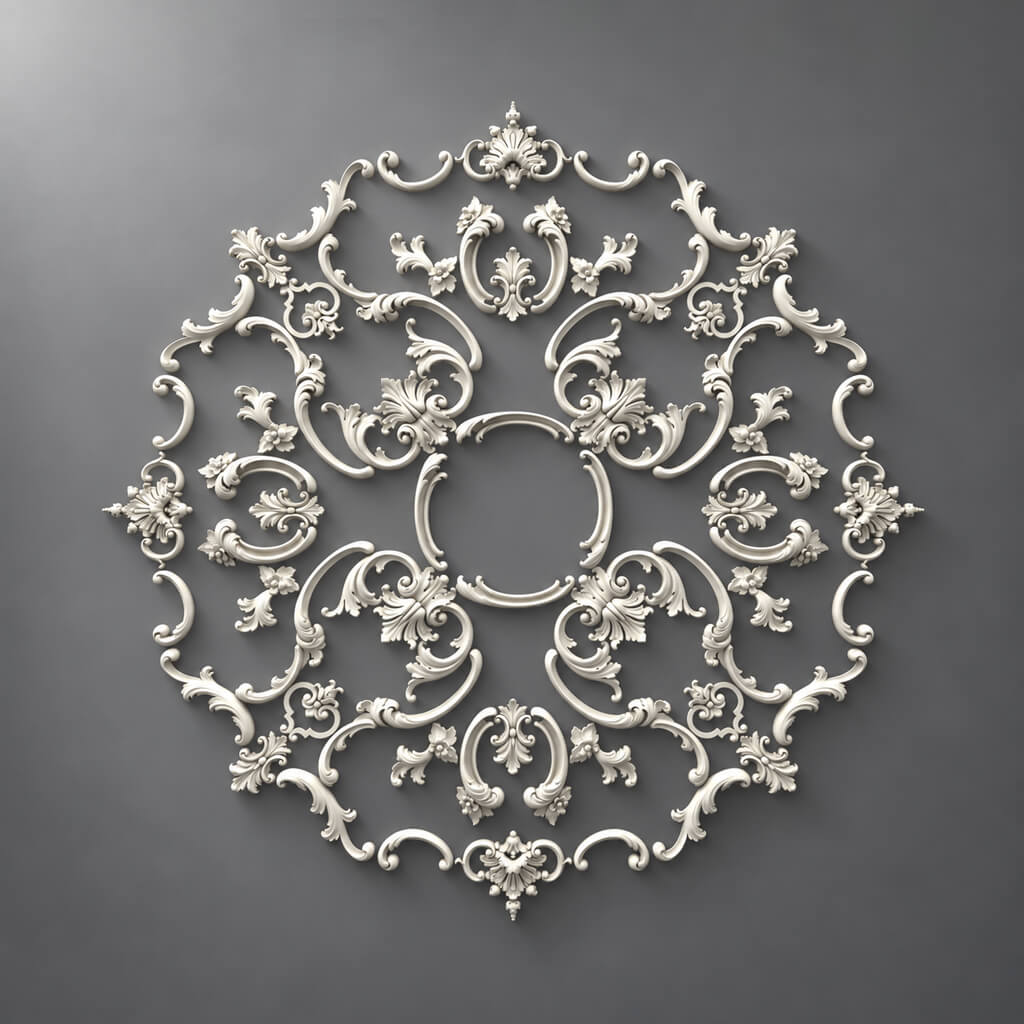
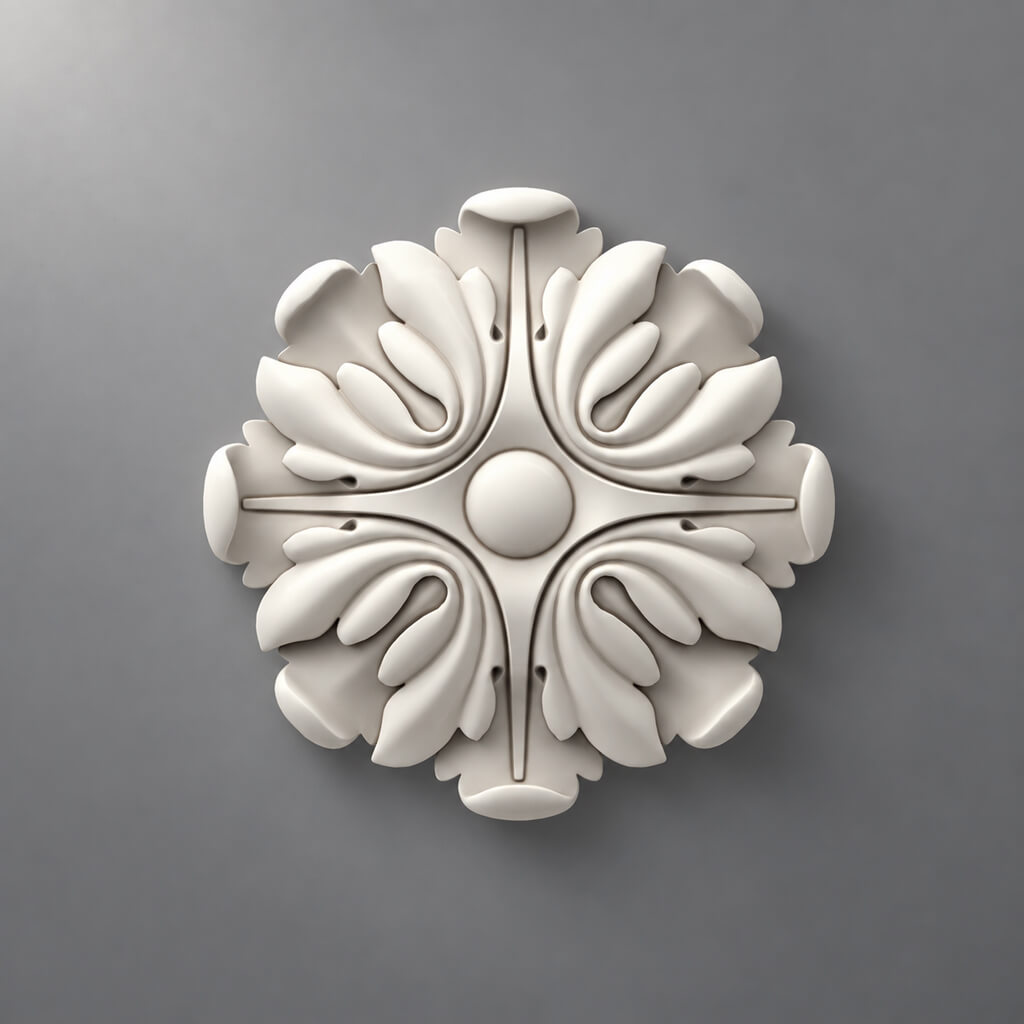
Round rosettes are produced in a wide range of diameters: from 20 centimeters to 80–100 centimeters and more. The relief can be concentric — bands of ornament radiating from the center to the edge — or radial, with petals, leaves, geometric elements.
Concentric ornament creates a sense of depth and movement. A rosette with such a pattern looks alive — it 'rotates' around its axis, adding dynamism to the ceiling plane.
Oval and shaped models
Oval rosettes are a less common but very expressive option. They look best in elongated spaces: hallways, rectangular living rooms, dining rooms with long dining tables. The oval echoes the proportions of the room and creates a sense of intentional, deliberate design.
Shaped rosettes — square, rectangular, hexagonal, and octagonal — are characteristic of classical and Empire interiors. A square rosette in a square room creates a geometric rhyme that is perceived as an architectural gesture.
Smooth minimalist rosettes
A smooth rosette — without ornamentation or with minimal relief in the form of several concentric bands — is a choice for modern interiors.
Such a rosette works as a pure form: it creates an accent on the ceiling without drawing unnecessary attention to details. In interiors in minimalist, Scandinavian, Japandi, or modern classic styles — it is the perfect solution.
A smooth rosette in the color of the ceiling is perceived as an architectural detail, not as a decorative ornament. It 'reads' only with side lighting — creating a subtle play of light and shadow that adds depth without overload.
Relief decorative rosettes
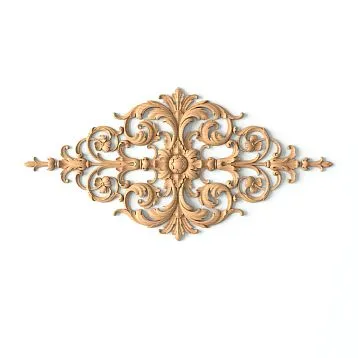
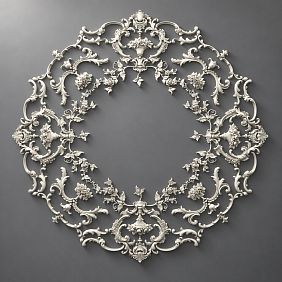
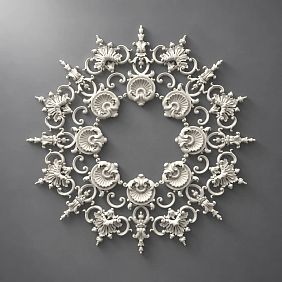
A relief rosette with rich ornamentation is a statement. Petals, acanthus leaves, scrolls, floral motifs, geometric bands — all of this turns the center of the ceiling into a decorative medallion.
Such a rosette requires an appropriate context: high ceilings, spacious rooms, classical or richly finished interiors. In a cramped space, rich relief will feel oppressive — but in the right conditions, it becomes a true adornment.
Important: the richer the rosette's relief, the more restrained the chandelier should be. Complex ornamentation and an ornate chandelier compete with each other. The 'rosette+chandelier' rule: one is the main element, the other supports it.
Rosettes for classic and neoclassical interiors
For classic interiors, STAVROS offers rosettes from collections with rich floral relief, multi-tiered profiles, and exquisite proportions. Diameters range from medium (40–50 cm) to large (70–100 cm).
For neoclassicism — more restrained models: clean geometry, minimal ornamentation, neat relief. The 'Neoclassic' and 'Neoclassic Light' collections offer profiles that work organically together withwall moldingsandcornicesfrom the same collections.
How to choose a ceiling medallion for a chandelier
This is the most important section of the article. This is where most people make a mistake — they choose a rosette based on appearance, without considering its connection to the chandelier. Yet, it's precisely the 'rosette + chandelier' pair that determines whether the ceiling center will look like a deliberate design accent or like a random combination of two unrelated items.
How to correlate rosette size and chandelier diameter
Key rule: the rosette diameter should be approximately 15–30% larger than the diameter of the chandelier's upper part — its 'dome', lampshade, or upper frame.
For example:
-
Chandelier with an upper diameter of 30 cm — rosette from 38 to 45 cm.
-
Chandelier with an upper diameter of 50 cm — rosette from 60 to 70 cm.
-
Compact ceiling medallion — 25 to 35 cm in diameter.
If the medallion is smaller than the top of the chandelier — it 'hides' behind it and loses its purpose. If the medallion is much larger — it creates a feeling of disproportion, like a 'mushroom' on the ceiling.
Exception: when the medallion is intended as an independent decorative element — then it can be significantly larger than the chandelier. But in this case, the chandelier should be compact and laconic.
When an expressive relief medallion is needed
Rich reliefpolyurethane ceiling medallion for a chandelieris justified in the following situations:
-
Interior in a classic or neoclassical style with moldings and cornices on the walls.
-
Ceiling height from 10 feet and above.
-
Spacious living room, dining room, or hall.
-
A chandelier with a laconic form, where the decorative emphasis is deliberately shifted to the ceiling medallion.
-
A ceiling without other decorative elements, where the medallion should be the sole, yet expressive accent.
When it's better to choose a subdued model
A subdued, smooth, or minimally textured medallion is the right choice for:
-
Modern interiors with minimal decor.
-
Small rooms up to 20 sq. m.
-
Ceilings with a height of up to 2.7 m.
-
Chandeliers with complex decorative forms — when the ornament is carried by the chandelier itself, the medallion should be neutral.
-
Interiors where there is already a lot of decor on the walls.
How to match the form of the chandelier and the pattern of the medallion
The shape of the chandelier and the pattern of the ceiling medallion are a visual dialogue. They should complement, not copy each other.
A round, tiered chandelier pairs well with a medallion featuring a concentric pattern: the rings of the ornament echo the tiers of the chandelier, creating a rhythm.
A chandelier with straight-line elements (Art Deco, modern) is appropriately matched with a medallion featuring a geometric pattern.
For a chandelier with crystal and rich relief, it's better to choose a calm medallion with a simple profile: the decoration of the chandelier itself is already sufficiently rich.
For a compact modern lampshade, you can choose a larger and more expressive medallion, which compensates for the chandelier's simplicity.
How to avoid overloading the center of the ceiling
Overloading the center of the ceiling is one of the most common design mistakes. An overly large ceiling medallion, plus a massive chandelier, plus bold relief—and the ceiling 'falls' on your head.
Balance rules:
-
An ornate ceiling medallion + a simple chandelier.
-
An elaborate chandelier + a simple ceiling medallion.
-
A large ceiling medallion is only suitable for high ceilings.
-
The ceiling medallion and chandelier together should not occupy more than 1/5 of the ceiling area.
How to choose the diameter of a ceiling medallion
Diameter is not just a technical parameter. It's a matter of proportions that either create harmony or destroy it.
For small rooms
Rooms up to 15 sq. m — hallways, compact bedrooms, children's rooms, small offices. For these, medallions with a diameter of 20 to 35 centimeters are optimal.
In a small room, a large medallion will visually 'lower' the ceiling and create a feeling of tightness. A small, neat medallion is a precise, proportionate accent that adds completeness without overloading.
For medium-sized rooms
Rooms with an area of 15–30 sq. m — typical living rooms, bedrooms, offices, and dining rooms in apartments. Here, the optimal medallion diameter is from 35 to 55 centimeters.
This is the 'working' range: the medallion is visible and expressive but not dominant. It creates a center for the ceiling without claiming to be the only visual object in the room.
For spacious living rooms and halls
Large rooms from 30–40 sq. m — formal living rooms, halls, dining rooms with high ceilings. Here, medallions with a diameter from 55 to 100 centimeters or more are appropriate.
In a spacious room, a small ceiling medallion gets lost—it looks like a random detail on a large empty plane. A large medallion with rich relief becomes a true architectural accent, giving the room monumentality.
How to account for ceiling height
Ceiling height is the second most important parameter after area.
With a standard height of 2.5–2.7 m: medallion diameter no more than 40–50 cm, relief—moderate.
With a height of 3 m: medallions from 50 to 70 cm with more expressive relief are possible.
With a height from 3.5 m: opportunities open up for large medallions 70–100 cm in diameter and rich ornamentation.
Rule: the higher the ceiling, the more large-scale thea decorative ceiling medallionand the richer its relief.
Why a too-small medallion gets lost, and a too-large one feels oppressive
These are two sides of the same mistake—a mismatch of scale.
A too-small ceiling medallion in a large room looks like a forgotten detail lost on the vast ceiling plane. It doesn't create an accent—it merely hints at the attempt.
A ceiling medallion that is too large in a small room psychologically 'lowers' the ceiling, creating a claustrophobic effect. Instead of decoration, you get a visual problem.
Rule of proportion: the diameter of the ceiling medallion should be approximately 1/8–1/10 of the smaller room dimension. For a room 4 meters wide, a medallion 40–50 cm in diameter.
How to choose a ceiling medallion to match the interior style
For classic style
Classical interiors imply rich decor: moldings, cornices, pilasters, opulent textiles. The ceiling medallion here should be a worthy participant in this ensemble.
For classic styles, choose medallions with multi-tiered ornamentation, floral motifs, lush relief. Diameter — medium or large. Color — white with light gilding or pure white in contrast with dark walls.
A medallion from the classic STAVROS collection paired with, friezes, rosettes.andwall decor elements from the same series creates a unified decorative system that transforms an ordinary apartment into a space with the character of a mansion.
For neoclassical style
Neoclassicism is a balance between architectural form and restraint. The medallion here should be expressive but not excessive.
The 'Neoclassic' and 'Neoclassic Light' collections are the right choice: clean geometry, neat relief, one or two decorative zones without overload. Diameter — medium. Color — white or matching the ceiling.
Such a rosette works as an elegant architectural detail—it is noticeable but does not shout.
For a modern interior with decorative accents
A modern interior does not exclude a rosette. On the contrary—in recent years, a laconic ceiling rosette matching the ceiling color has become a characteristic detail of 'modern classic,' neoclassicism, and the 'new luxury' style.
Choose a smooth rosette with two or three concentric bands. The diameter should be modest or medium. The color must strictly match the ceiling so that the rosette reads as texture, not as ornament.
For a strict and restrained design
A strict interior—a study, meeting room, or modern living room with architectural lighting—requires a strict rosette. Minimal relief, clear geometry, and absence of ornament.
Here, the rosette works as an architectural element—not decorative, but structural. It fixes the center of the ceiling and thereby creates order.
For interiors with moldings and cornices
If the interior already hasMoldings made of polyurethaneon the walls and a cornice along the perimeter of the ceiling—the rosette should be from the same collection or a compatible profile. This is fundamentally important: a decorative system where everything is coordinated is perceived as a unified architectural solution. Uncoordinated elements appear as a random set of alien details.
What to pair a ceiling rosette with
With cornices
A ceiling rosette and a cornice are two 'horizontal' decorative elements that work on the ceiling. They should be coordinated in style and scale.
If the cornice is rich, multi-tiered — the rosette can be more restrained. If the cornice is laconic — the rosette can be made more expressive. But both elements should belong to the same decorative 'language'.
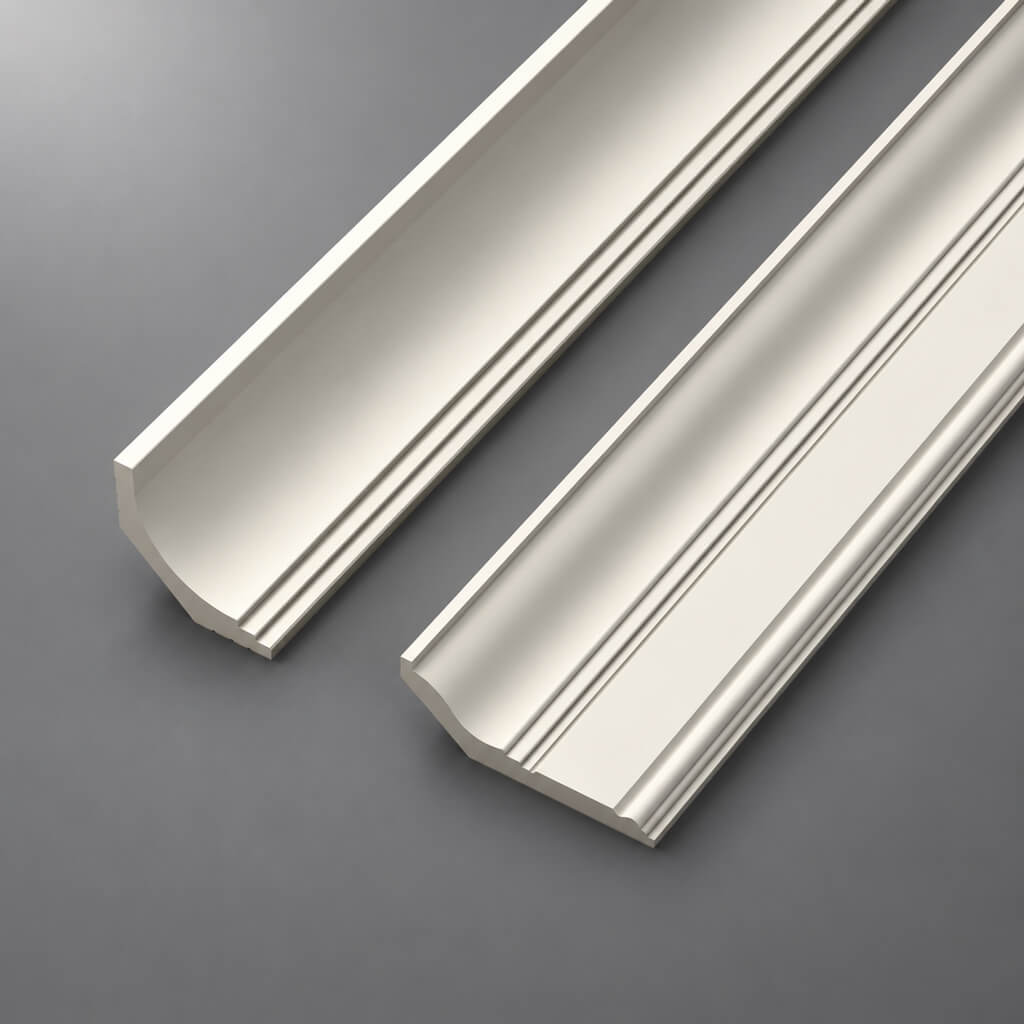
Polyurethane Crown MoldingSTAVROS are selected in collections with compatibility with ceiling rosettes in mind — which significantly simplifies the choice.
With wall moldings
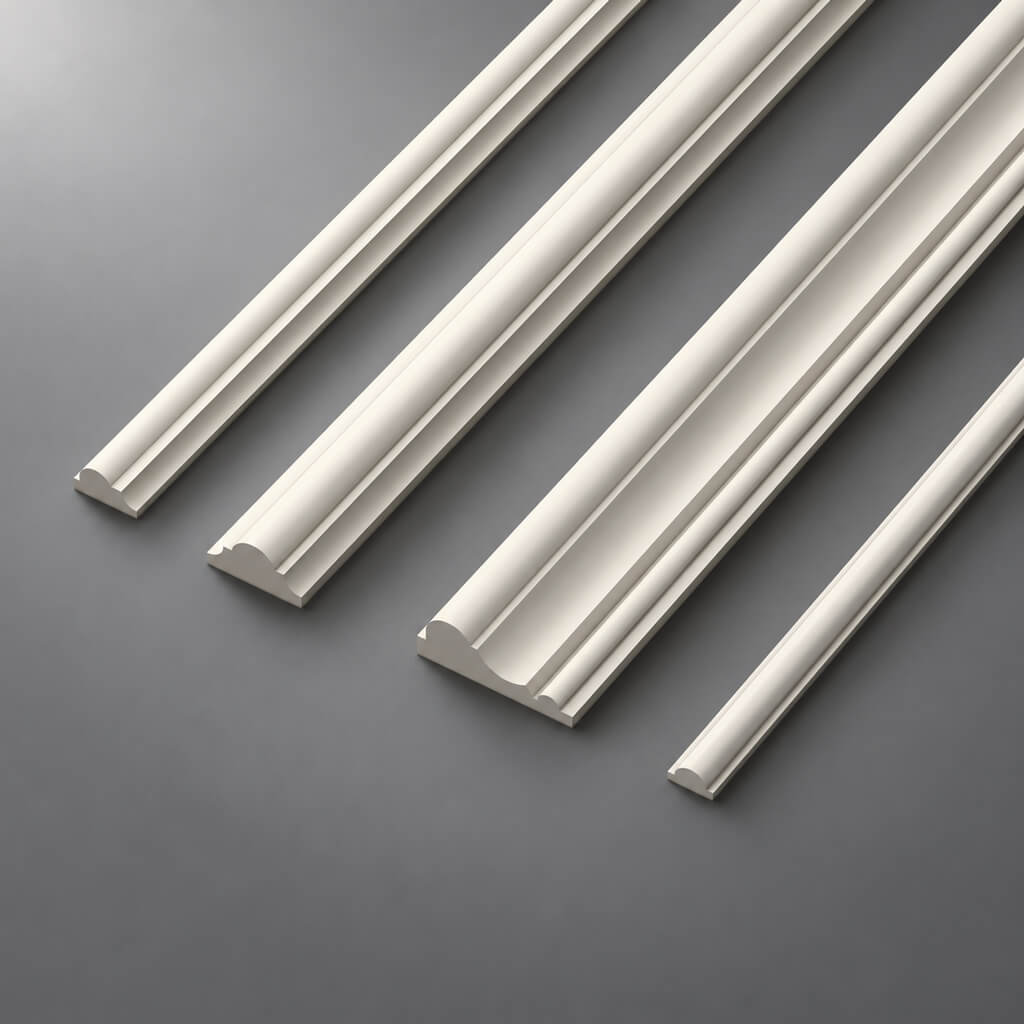
Wall decor and the center of the ceiling should be connected. If the walls have classicalmoldings with ornament— the ceiling rosette should be in the same vein. If the moldings are smooth and laconic — the rosette should also be restrained.
This is the rule of a unified decorative system: everything that decorates the space should speak the same language.
With ceiling coffers and frames
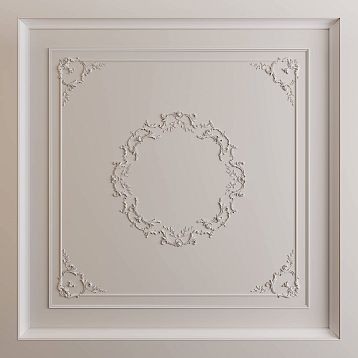
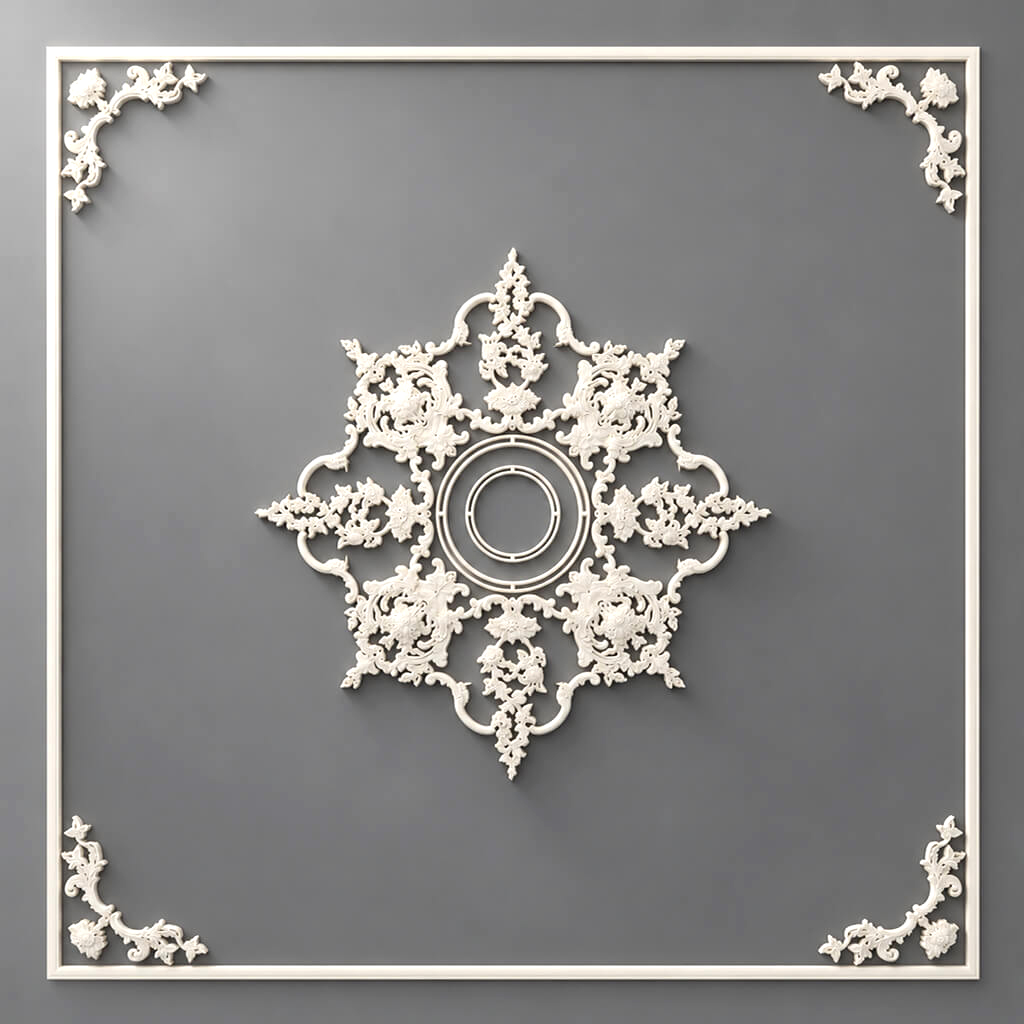
A ceiling coffer — a decorative box or frame around the rosette — significantly enhances the effect. A rosette in the center of a coffer turns into a true ceiling medallion.
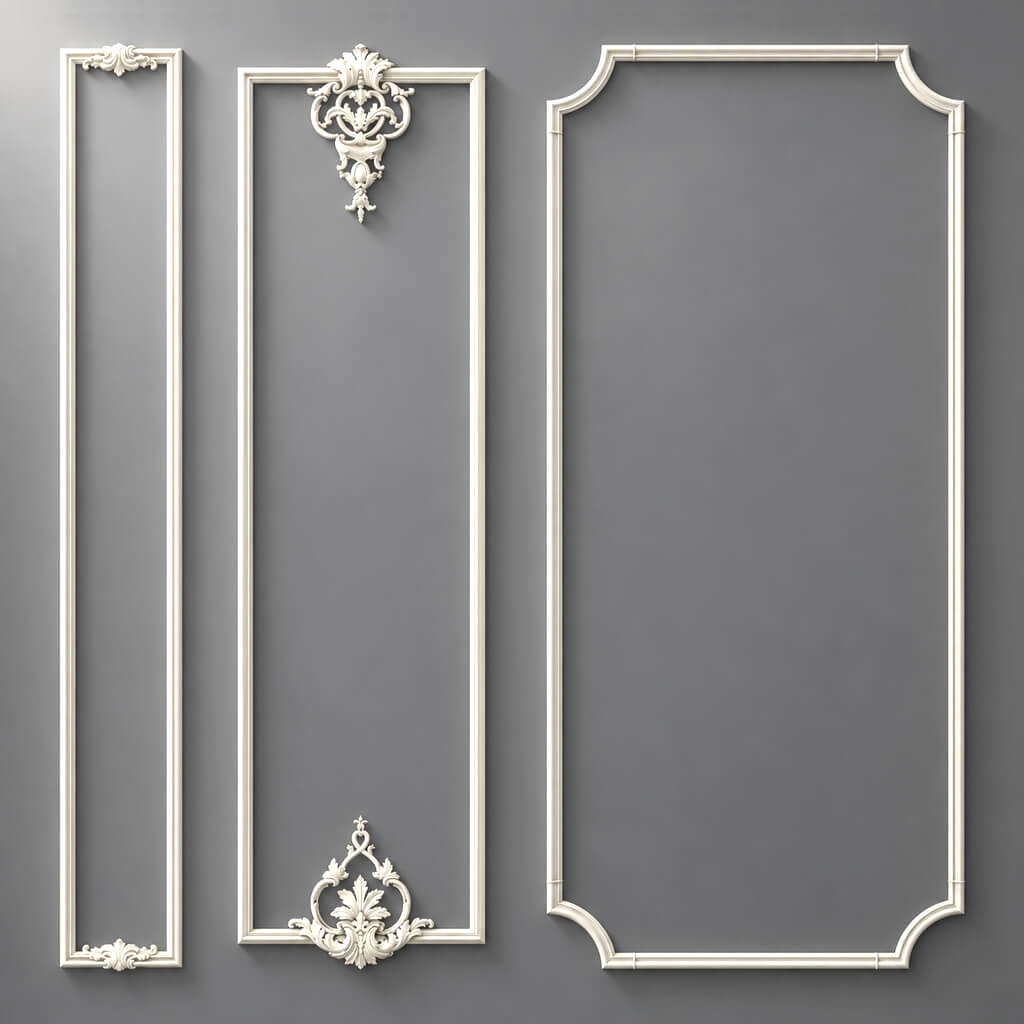
To create coffers, the same moldings are used as for wall frames. A rectangular frame made of molding around the central rosette — and the ceiling acquires the architectural expressiveness of a palace hall.
With a decorative ceiling medallion
In rooms with asymmetrical furniture arrangement or non-standard layout, the ceiling medallion serves as a 'coordinate center'—a fixed point around which the entire space is organized. Its selection is particularly important here: it should be positioned above the functional center of the room—typically above the dining table or seating area.
In harmony with the rhythm of the molding decor
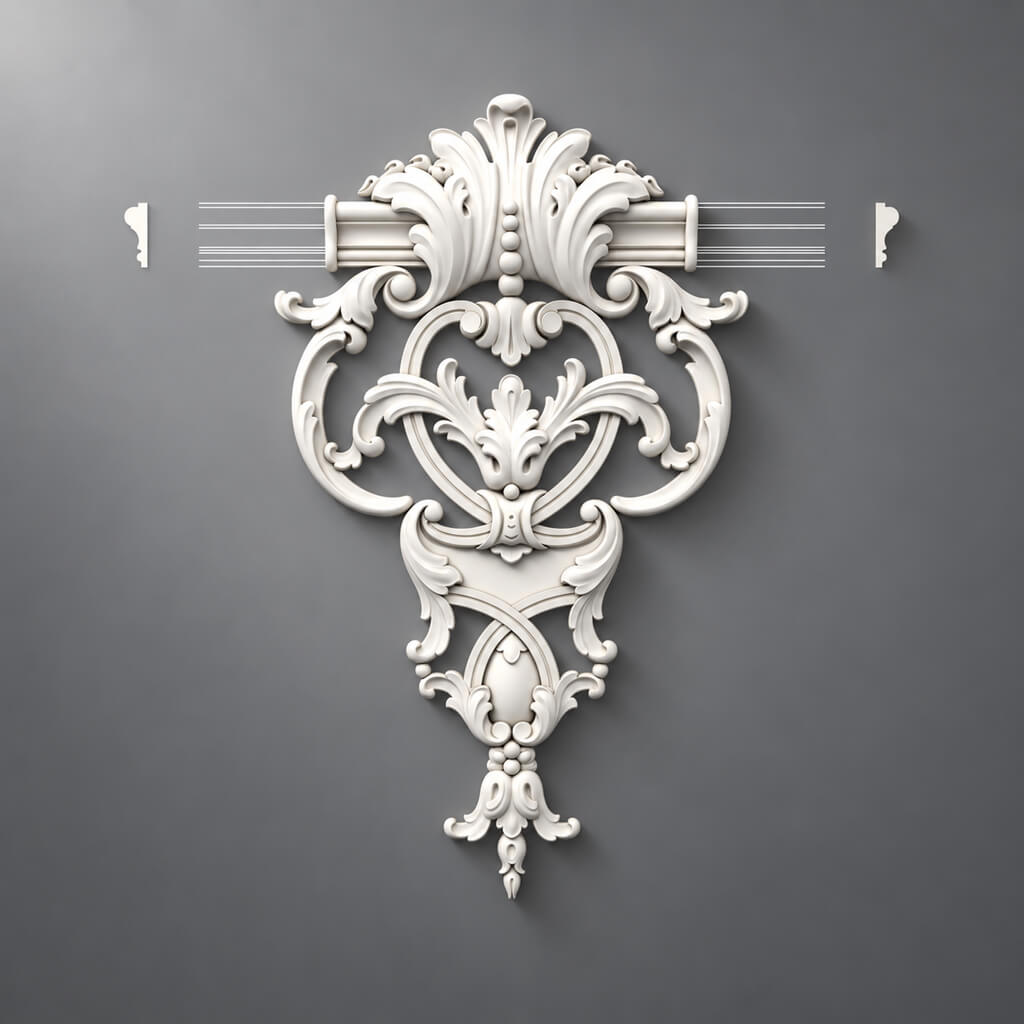
If the interior design includes a full system of moldingspolyurethane molding decoration— cornices, moldings, rosettes,applique, Baseboards—then the ceiling medallion is the final 'upper' accent of this system. It completes the vertical axis of decor: baseboard at the bottom, wall moldings, cornice near the ceiling, and the medallion at the center.
What to choose for different tasks
If you only need a medallion for a chandelier
The task is minimal—you need to neatly 'cover' the chandelier entry point and add a touch of decor. Choose a compact medallion with a diameter of 25–40 cm and moderate relief. A smooth or semi-smooth profile, round shape, and white color. It will be inconspicuous on its own but noticeably improve the overall impression of the ceiling.
If you need an expressive ceiling accent
The task is large-scale—the medallion should be an independent decorative element, the center of the ceiling composition. Choose a large medallion with a diameter from 60 to 100 cm and rich ornamentation. Gilding or contrasting painting is possible. Essential—for high ceilings and spacious rooms.
If the interior is already rich in decor
When the walls are already decorated with moldings, the cornices are rich, and the wallpaper has a pattern, the ceiling rosette should be restrained. Overloading the decor ruins the interior more than its absence. A concise, smooth rosette of medium diameter is the right choice for a saturated space.
If you want to emphasize the height of the ceiling
A high ceiling is a luxury worth highlighting. A large rosette with multi-tiered relief creates a sense of scale, reminiscent of palace interiors. It 'declares' the ceiling height and turns it from an architectural fact into an aesthetic virtue.
If you need to neatly decorate the center of the ceiling
Sometimes the task is simply to finish the ceiling plane without unnecessary noise. A small, neat rosette in the color of the ceiling, 30–45 cm in diameter, with one or two concentric bands, is a delicate solution that adds completeness without drawing unnecessary attention to itself.
Advantages of ceiling roses made of polyurethane
Lightness and ease of application
A polyurethane rosette weighs many times less than a plaster one. This means it can be attached to any ceiling surface without dowels or drilling—only with special mounting adhesive. Installation takes 10–20 minutes and is doable without hiring professionals.
Polyurethane does not crumble during transportation, does not chip during installation, and is easily cut with a regular handsaw—if trimming to a non-standard size is needed.
Clear decorative relief
Metal molds and pressure casting ensure perfect relief precision. Every curl, every petal, every geometric band comes out of the mold with absolute clarity. The relief does not crumble, wear away, or deform during use.
Suitable for various interior scenarios
One category—ceiling rosettes—encompasses dozens of collections and hundreds of models: from compact smooth ones to large ornamented ones. This ensures precise selection for any style, any room, and any task.
Convenient for combining with other ceiling decor
STAVROS ceiling rosettes are produced in the same collections asCrown Molding, Moldingsandceiling decor. This allows you to easily create a coordinated decorative system.
Practical for apartments, houses, and commercial spaces
Polyurethane is not afraid of moisture, temperature fluctuations, or mechanical loads. Rosettes can be easily repainted when the interior changes. They last for decades without repair or replacement.
What mistakes are most often made when choosing a ceiling rosette
Choosing a rosette without considering the size of the chandelier
The rosette is purchased 'by eye'—based on its appearance in the catalog. At home, it turns out to be smaller than the chandelier's lampshade and 'hides' behind it. Or it is much larger—creating a sense of disproportion.
Solution: always measure the top diameter or maximum horizontal size of the chandelier before selecting a ceiling medallion.
They don't take ceiling height into account
A large, textured ceiling medallion on a 2.5 m ceiling 'lowers' the space, creating a feeling of tightness. The same element on a 3.5 m ceiling looks appropriate and elegant.
Ceiling height is the main parameter determining the permissible scale of the medallion.
They choose too complex a texture for a small room.
In a small room, a rich rosette pattern creates visual noise. It competes with furniture, interferes with the perception of space, and makes the ceiling feel 'heavy'.
In a small room — always a simple profile. The beauty of the decor is determined not by the complexity of the ornament, but by the accuracy of the choice.
They don't connect the medallion with the rest of the ceiling decor.
The rosette was bought separately, the cornice is from another collection, the moldings are from a third. As a result, the interior looks like a set of unrelated details, each beautiful on its own, but together they don't work.
They try to create an accent where it is not needed
Not every ceiling needs a decorative rosette. In an interior with spot lighting, no central chandelier, in a room with open space and an industrial style, a rosette will not be a fitting accent but an out-of-context detail.
How to buy a polyurethane ceiling rosette in Moscow and avoid mistakes
First, define the task
First and foremost, answer clearly: what exactly needs to be done? Neatly frame the chandelier's entry point? Create a striking ceiling accent? Complete a decorative system with cornices and moldings? The task determines the scale and style of the choice.
Then choose the shape and diameter
Based on the task, room size, and ceiling height, choose the shape—round, oval, square—and determine the diameter range. This narrows the choice to a few suitable models.
Check the combination with the chandelier
Measure the chandelier's top diameter. Choose a rosette with a diameter 15–30% larger. Ensure the rosette's style and the chandelier's style are coordinated: both minimalist, both classic—or one ornate, the other restrained.
Consider the room's style
Compare the chosen rosette with the interior style. If the room already has decor—ensure the rosette doesn't clash with it. If there is no decor—the rosette can be slightly more independent.
Select a ceiling medallion together with cornices and other decor
If you plan to create a full decorative system — choose a ceiling medallion together with crown molding, wall moldingsandbaseboards from the same collection. Only this way will you achieve a unified decorative language for the room.
Checklist before buying a ceiling medallion
-
For which room — area, ceiling height, room type?
-
Will the chandelier be the central accent — or is the lighting spot-based?
-
What is the diameter of the top part of the chandelier — to correctly select the medallion size?
-
What is the ceiling height — to determine the permissible scale?
-
Is calm or expressive decor needed — a background element or an accent?
-
Are there cornices and moldings — with which the choice needs to be coordinated?
-
Should it match the rest of the molding — a unified collection or not?
Comparison table by types of ceiling rosettes
| Rosette type | Where it looks better | What effect it gives | When to choose |
|---|---|---|---|
| Smooth round | Modern, Scandinavian, minimalist interior | Delicate architectural accent without ornament | When texture is needed, not decoration |
| Relief round | Classic, neoclassical, saturated interiors | Decorative medallion with ornament | In classic and neoclassical spaces |
| Large accent | Spacious halls, high ceilings | Monumental ceiling centerpiece | In formal living rooms and halls |
| Compact, laconic | Small rooms, modern apartments | Neat ceiling finish for chandelier | When restraint and proportionality are needed |
| Figurative (oval, square) | Elongated rooms, art deco interiors | Geometric accent, unconventional solution | For unconventional spaces and styles |
| Multi-tiered | High ceilings, classic interiors | Volumetric decorative medallion with depth | In formal rooms with rich decor |
FAQ: Answers to popular questions
Which ceiling rosette to choose for a chandelier?
The ceiling medallion diameter should be 15–30% larger than the top part of the chandelier. Style — coordinated: an ornate relief medallion + a minimalist chandelier, or a simple smooth medallion + an expressive chandelier. Full catalogceiling fixtures made of polyurethaneis available at stavros.ru.
How to choose the size of a ceiling rosette?
Consider the area and ceiling height. For rooms up to 15 sq. m — diameter 20–35 cm. For 15–30 sq. m — 35–55 cm. For spacious halls — 55–100 cm or more. With low ceilings — a smaller diameter and simple relief.
Is a polyurethane ceiling medallion suitable for a small room?
Yes — with the correct size choice. A compact smooth or lightly relief medallion with a diameter of 20–35 cm looks excellent in a small room, giving the ceiling a finished look without overload.
What is better: a smooth or relief ceiling medallion?
Depends on the interior style. Smooth — for modern, Scandinavian, and minimalist spaces. Relief — for classic, neoclassical, interiors with stucco decor. Both options are good — in the right context.
Can a ceiling medallion be combined with a cornice and moldings?
Not only can — it should be. A medallion, cornice, and moldings from the same collection create a unified decorative system. STAVROS produces collections in which medallions,Crown MoldingandMoldingsare coordinated in style and scale.
Where to buy a polyurethane ceiling rosette in Moscow?
In the catalog of the company STAVROS on the website stavros.ru — the full rangeceiling roseof polyurethane rosettes, from compact to large, from smooth to richly ornamented. Delivery across Moscow and all of Russia.
Is a rosette needed in a modern interior?
It is needed — if there is a central chandelier and the interior leans towards details. A laconic smooth rosette matching the ceiling color is an absolutely modern solution, characteristic of 'new luxury', contemporary classic, and neoclassical styles. Without a chandelier, with spot lighting — a rosette is not needed.
How to choose a rosette for neoclassicism?
For neoclassicism, rosettes from the 'Neoclassic' and 'Neoclassic Light' collections are optimal: clean geometry, neat relief, medium diameter of 40–60 cm. White color, without gilding. In combination withcornices and moldings from the same collectiona perfect decorative system is created.
Conclusion
A ceiling rosette is not just a decoration. It is the center of the ceiling composition, an architectural point around which the entire lighting and decorative logic of the space is built. It should be chosen not 'by a beautiful photo,' but for a specific chandelier, a specific ceiling, and a specific style. Only then does the rosette cease to be a random detail and become what it should be — a conscious final touch of the interior.
STAVROS offers a complete catalogof polyurethane ceiling rosettesfor any space, style, and purpose. Compact smooth rosettes for modern apartments, richly ornamented medallions for classic halls, concise geometric profiles for neoclassicism — this entire assortment is created as a system where every element is coordinated with the others.
Along with rosettes, in the STAVROS catalog you will findCrown Molding, Moldings, Wall Decor, appliqueandBaseboards— all from unified collections, allowing you to create a full-fledged decorative interior system without extra effort.
STAVROS is European-quality material, perfect relief precision, dozens of collections, and years of experience in creating interior decor. Your ceiling deserves a worthy center.Choose it consciously.