












































































Article Contents:
- The era of total stylistic harmony: why a unified decoration system is needed
- From ceiling to furniture: how to build a hierarchy of decorative elements
- Ceiling — the main stage
- Walls — continuation of the theme
- Door and window openings — accent nodes
- Furniture — the final chord
- Materials and their combinations: creating multi-layered effects
- Polyurethane for ceilings and large elements
- Wood for mid-level and furniture
- MDF for utilitarian zones
- Color strategies: white, contrasting, tonal
- Monochrome: white on white
- Contrast: dark on light, light on dark
- Tonal: play of shades of one color
- Stylistic systems: from classic to bio-futurism
- Classic and neoclassic
- Modern and art deco
- Minimalism and Modern Style
- Eclecticism and maximalism
- Technical solutions: how to connect the incompatible
- Corner elements — key to connections
- Transitional elements between materials
- Scale gradation
- Practical cases: from concept to implementation
- Entry hall in neoclassical style
- Modern studio in minimalist style
- Eclectic bedroom at the intersection of eras
- Special zones: kitchen, bathroom, hallway
- Kitchen: where aesthetics meet practicality
- Bathroom: decoration under high humidity conditions
- Entryway: First Impression
- Details that matter
- Decorative friezes and architectural accents
- Furniture details as continuation of architecture
- Decorations that unify space
- Installation and technical execution
- Surface Preparation
- Marking and symmetry
- Mounting and final finishing
- Frequently Asked Questions
- Can polyurethane ceiling moldings be combined with wooden wall elements?
- What width should a ceiling cornice have in a standard apartment?
- How to choose furniture handles that will harmonize with moldings?
- Do corner elements need to be used for moldings, or can they be simply mitered at 45 degrees?
- Can MDF elements be used in the bathroom?
- How often should ceiling moldings and moldings be repainted?
- Which color to choose for decoration — white or matching the walls?
- Can ceiling moldings be installed by oneself, or are professionals required?
- Conclusion: home as a single artwork
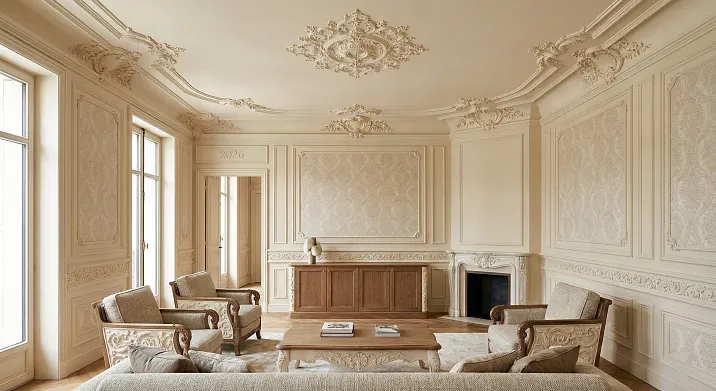
Look at your home through an architect's eyes. Do you see scattered details? Or a unified space where each element echoes another, creating a symphony of forms? In 2026, interior design moves from a chaotic collection of beautiful objects to a thoughtfully designed system, whereCeiling moldingdictates the language of wall decoration, cornices echo baseboards, andFurniture Handlesrepeat the ornamentation of molded rosettes. This is not caprice — it is the philosophy of wholeness, when the interior becomes a single statement.


The era of total stylistic harmony: why a unified decoration system is needed
Why diversity is no longer a virtue? Because modern people are overwhelmed by visual noise, and home becomes the last island of calm. An interior built on a unified decorative system is instantly readable — the gaze does not stumble over contradictions, does not dart between incompatible elements.Ceiling moldingsets the rhythm that is picked up byCorner decorative elementson walls,wooden corniceabove the door and even furniture details.
Imagine a living room where ceiling rosettes under chandeliers repeat the vegetal motif of carved appliqués on cabinets. A hallway where the cornice above the doorway echoes in shape and scale with the ceiling baseboard. A bedroom where drawer handles seem miniature copies of molded corner elements on walls. This is not literal copying — it is visual rhyme, a subtle echo of forms that creates a sense of thoughtfulness and completeness.
The main principle — unity without monotony. Elements should belong to the same stylistic family, but differ in scale, level of detail, function. Largeceiling molding rosettecan be rich in detail, while wall moldings remain minimalist, and furniture hardware merely hints at the overall ornamental motif.




From ceiling to furniture: how to build a hierarchy of decorative elements
Architectural decoration has its own internal logic, based on scale and functional significance of elements. Properly building this hierarchy is key to creating a harmonious space.
Our factory also produces:


Ceiling — the main stage
The ceiling zone is always in view; it is the first to catch the eye upon entering the room. Here, the most expressive, large-scale elements are appropriate.Buy ceiling moldingshould be considered in relation to room height: for standard 2.7 meters, cornices 8–12 cm wide are suitable, for high ceilings over 3.5 meters — 15–20 cm and more.
Polyurethane Ceiling Moldingsopens up boundless possibilities. Classic cornices with acanthus leaves, modern wavy profiles, geometric stepped forms — all of this sets the main stylistic theme of the interior.Ceiling molding elementsinclude not only cornices, but also rosettes, coffered ceilings, corner elements, friezes — a full architectural language on which you will continue to speak further.
Get Consultation
Walls — continuation of the theme
Wall decor picks up and develops the ceiling theme, but in a more restrained manner. If the ceiling features an ornate, relief cornice with botanical ornamentation, walls can use moldings with a simplified, graphic version of the same motif.Paintable MoldingMade from MDF or wood, it allows creating panels, frames, and trimmings that structure the wall surface.
paintable wall moldingsEspecially practical: they can be painted to match wall tones for a subtle relief or in contrasting colors for active zoning.Decorative corner elementsThey solve joint problems, turning a technical necessity into an elegant detail.
Door and window openings — accent nodes
Portals and openings are transition points between spaces and deserve special attention.door frame trimUsing cornices, sash moldings, and corner elements, they create architectural expressiveness.Door Frame InstallationIt should harmonize with ceiling cornices in style but be slightly more restrained in scale.
Cornice in architectureIt is a horizontal projection above a door or window, similar to a miniature cornice.Sandrok corniceIt can replicate the profile of the ceiling cornice in a reduced scale, creating visual continuity between different decorative levels.Framing a Doorway Without a DoorIt transforms an ordinary passage into an architectural accent.
Furniture — final chord
Furniture decor — the smallest in scale but no less important. Carved appliqués on facades, cabinet legs, and especiallyFurniture HandlesThey become miniature reflections of architectural decor. If the interior features botanical motifs in stucco, handles may have the shape of leaves or flowers. A geometric style requires minimalist forms and in furniture hardware.
Medium in Furniture— a vertical or horizontal divider between doors or drawers — can also be styled according to the overall decorative system, repeating molding or baseboard profiles.
Materials and their combinations: creating multi-layered depth
Unified stylistics does not mean uniform materials. On the contrary, the play of textures and finishes enriches the interior, giving it depth and tactile appeal.
Polyurethane for ceilings and large elements
Polyurethane molding — an undisputed leader for ceiling decor. Lightweight, moisture-resistant, and resistant to temperature fluctuations, it is installed quickly and lasts for decades.Ceiling molding for chandelierMade from polyurethane, it can have a diameter from 30 to 120 cm and more, recreating the most complex historical ornaments or modern geometric compositions.
Mold Intermediate ElementIt is a vertical decorative element that can be used to divide walls into panels, create visual columns or pilasters. Combined with horizontal moldings, it forms a classic paneling grid.
Wood for mid-levels and furniture
Wood brings warmth, naturalness, and tactile pleasure.Wooden Corner ElementsFor moldings, carved appliqués,wooden corniceAbove doors, they create an intermediate layer between the polyurethane ceiling and the rest of the space. Wood can be painted to match the polyurethane for visual unity or left natural for contrast.
Ceiling moldings for paintingMade from MDF — a compromise option: cheaper than solid wood but stronger than polyurethane, ideal for wall panels and door frames.MDF ceiling moldings for paintingIt allows creating complex profiles with sharp edges.
MDF for utilitarian zones
MDF for PaintingIt is indispensable where strength and resistance to mechanical impacts are required: baseboards, cornices, panels in hallways and children’s rooms.— is a horizontal element that frames the room at the bottom of the walls where the wall meets the floor. Skirting boards perform several functions: they hide the technological gap between the wall and floor covering (necessary for thermal expansion), protect the lower part of the wall from mechanical damage, create visual completion, and may conceal wiring.can repeat the profile of the ceiling cornice, closing the composition and creating an effect of framing the entire space.
MDF Cornices for Paintingsuitable for kitchen cabinets and built-in storage systems.MDF furniture cornice for paintingcrowning the upper line of furniture, making it architecturally complete.
Color strategies: white, contrasting, tonal
Color is the most powerful tool for uniting disparate elements into a unified system. Three main strategies work reliably.
Monochrome: white on white
Classic, never outdated. All decorative elements—from ceiling cornices to furniture handles—are painted white. Differences in material and texture create subtle play of light and shadow, relief emerges through highlights and shadows.White Paintable MDF Skirting BoardOn white walls, white molding on a white ceiling—this is not boring, it is refined.
The secret of expressiveness lies in variations of white shades. The ceiling may be cool, snowy white, walls—warm cream, molding—light gray. These nuances are subconsciously perceived, creating multi-layered depth even within a single color.
Contrast: dark on light, light on dark
A bold approach for those who are not afraid of drama. Black moldings on light gray walls, white ceiling molding on dark blue ceiling, graphite furniture handles on light facades. Contrast makes each element maximally noticeable, turning decoration into graphic design.
It is important to maintain balance: if large contrasting elements (ceiling cornices) are used, small elements (furniture hardware) should be more delicate. Excessive contrast creates visual noise.
Tonal: play of shades of one color
Modern approach, especially popular in Scandinavian and minimalist interiors. All decorative elements are painted in shades of one color—from light to saturated. For example, ceiling cornice—light beige, wall moldings—sand, baseboards—warm beige-gray, furniture handles—terracotta. Color gradient creates volume without compromising unity.
Stylistic systems: from classic to bio-futurism
Each interior style has its own decorative code, its set of forms and ornaments, which must be consistently applied across all levels—from ceiling to furniture.
Classicism and neoclassicism
Here, symmetry, classical orders, botanical motifs prevail.Decorative door frame trimUsing pilasters and sardines, coffered ceilings, rich cornices with acanthus and rosettes. Furniture with carved appliqués, leaf-shaped, volute, rosette handles. All of this must be executed in a unified scale and rhythm.
Window and Door Framingrepeat the profile of ceiling cornices.framing the doorway with a casingis topped with a sardine, creating a mini-porch.decorative door openingmay include side pilasters, keystone, frieze.
Modern and Art Deco
Smooth asymmetrical lines of modernism, geometric zigzags of art deco require a special approach.Mold Corner Elementmay have the shape of a stylized flower for modernism or a stepped pyramid for art deco.Wooden smooth furniture molding for paintingallows creating the characteristic graphic lines of art deco.
Furniture handles in these styles are true sculptural miniatures: organic curved forms of modernism or clear geometric compositions of art deco. They must precisely echo motifs used in ceiling and wall decoration.
Minimalism and modern style
It seems that minimalism and decoration are incompatible, but this is not true. Decoration here is extremely laconic.Paintable wall moldingwith a simple rectangular profile creates graphic frames on walls. Ceiling cornices are stepped geometric forms without ornament.Corner element for ceilingresolved as a clean cube or smooth rounding.
Furniture handles — cylinders, parallelepipeds, brackets without ornamentation. But even here unity is important: if the ceiling cornice has rounded edges, the handles should also be rounded. If lines are sharp — everywhere sharp.
Eclecticism and maximalism
Here you can mix elements from different eras and styles, but — and this is critically important — within a unified color and scale system. A Baroque plaster rosette on the ceiling, modern moldings on the walls, Art Deco handles on furniture — this will work if all elements are painted in a single color and properly proportioned to each other.
and frames create a home atmosphere, making it truly cozy and individual. This is an investment in beauty, which pays off every day through aesthetic pleasure from admiring the beautiful.Styles are unified through a repeating motif (e.g., vegetation) or through rhythm (repetition of certain intervals).decorative ornamentation elementMay be historically inaccurate or authorial, but it must dialogue with adjacent elements.
Technical solutions: how to connect the incompatible
Creating a unified decorative system — not only an aesthetic, but also a technical task. How to connect polyurethane molding with wooden moldings? How to ensure a smooth transition from ceiling decoration to wall decoration?
Corner elements — key to connections
Corner decorative elementssolve the main problem — joints.Buy corner moldingshould be selected in advance, matching the specific profile of the cornice or baseboard. A correctly chosenCorner Element for Moldingmakes the joint invisible or, conversely, turns it into a decorative accent.
Facade Corner Elementslarger than interior ones, but the principle is the same: they must match the main profile in style and scale.Corner Polyurethane Elementlighter than wooden, easier to install, especially for ceiling areas.
Transition elements between materials
When a polyurethane ceiling cornice transitions into a wooden door frame, a visual bridge is needed. This can be an intermediate zone where a neutral element — for example, a smooth molding without ornamentation, painted in a color that unites both materials — is used.
Another approach — color unification. If both polyurethane and wood are painted in the same color, the difference in material becomes imperceptible.Moldings on wallpaper for paintingallow creating an intermediate layer that connects the wall with architectural elements.
Scale gradation
Elements must decrease in size as they move away from main points. The ceiling cornice — largest. Wall moldings — medium. Door casings — slightly smaller. Furniture elements — smallest. This gradation creates visual logic and hierarchy, intuitively understood.
Corner elements for wallsshould be smallercorner elements for ceilings, even if they are executed in the same style. This creates a sense of perspective and depth of space.
Practical cases: from concept to implementation
Theory is beautiful, but how does it work in real projects? Let's consider several scenarios.
Grand foyer in neoclassical style
A ceiling height of 3.2 meters allows using large-scale decoration. A wide cornice (18 cm) with acanthus leaves and beads encircles the perimeter. A central plaster rosette with a diameter of 80 cm frames the crystal chandelier. The ceiling is divided into coffers using thinner (8 cm) moldings that repeat the cornice pattern in a simplified form.
on the walls — panels createdmolding for painting to buyfrom MDF, whose profile references coffer moldings.Framing Doorway Openingsexecuted with plant ornamentation, above the door —Buy a Door Sondrikrepeating the shape of the ceiling cornice in miniature.
Furniture — a set in neoclassical style — features carved appliqués with the same acanthus leaves as the cornice. Handles — cast bronze in leaf shape, whose size and proportions correspond to the molded details.Paintable MDF Floor Skirting Board— high (12 cm), with a profile simply echoing the ceiling cornice. Everything is painted in a soft cream tone, creating a noble unity.
Modern studio in minimalist style
Concrete ceiling 2.7 meters high, white walls, light oak floor. Decoration is extremely minimalist, yet thought out to the smallest details. Around the ceiling perimeter — a hidden cornice for LED strip, made ofpolyurethane molding for walls to be paintedwith a simple rectangular profile.
On the walls — a graphic grid ofMDF grooved panels for painting are popular not only in residential interiors but also in offices, medical centers, and educational institutions. A properly designed grooved system can enhance work productivity and improve overall well-being.dividing the space into functional zones.Painted MDF plank panelscreate a rhythmic vertical structure in the TV zone. Doorways are framed with minimalist MDF casings, without sills or ornament.
Kitchen cabinet topped byKitchen MDF crown molding for painting— the same rectangular strip used on the walls. Handles — recessed or simple cylindrical stainless steel brackets.MDF skirting board 100 mm for painting— high but without profiling, simply a smooth rectangular strip. Everything is painted white, creating an effect of continuous surface interrupted only by thin graphic lines.
Eclectic bedroom at the intersection of eras
Medium-height ceiling (2.9 m) allows moderate decoration. Cornice — polyurethane, in modern style, with smooth wavy lines, without excessive ornament. Central rose — asymmetrical, with iris motif.
Walls — combination of techniques. Headboard of the bed is finished with paneling ofceiling moldings to be paintedin art deco style: rectangular frames withcorner elementsstepped shape. Opposite wall has smooth moldings echoing the ceiling cornice’s waves.
Furniture — vintage chest, restored and supplemented with new handles in modern style, whose shape corresponds to the irises on the ceiling rose. Built-in cabinet has facades decorateddecorative inlayswhere art deco geometry combines with modern organic forms. Skirting board —MDF skirting board 80 mm for paintingwith wavy profile matching the ceiling cornice. Color palette — gradient from powder pink ceiling to beige-gray walls and dark gray floor, unifying contrasting elements.
Special zones: kitchen, bathroom, hallway
Utility rooms require a special approach — here, decoration must be not only beautiful but also functional, resistant to moisture, dirt, and mechanical impacts.
Kitchen: where aesthetics meet practicality
MDF Hangers for Furniture for Paintingtop the upper line of the kitchen cabinet, visually connecting it with ceiling decor.MDF furniture details— pilasters, appliqués, baseboards — must be executed in the same stylistic approach as wall moldings in other rooms.
Kitchen ceiling cornice may be simplified compared to the living room, but should retain the overall profile.Plastic molding to be paintedor polyurethane is preferable to wood due to resistance to moisture and temperature fluctuations.
Furniture handles must not only be stylistically consistent but also comfortable and easy to clean. Matte surfaces are more practical than glossy — fingerprints are less visible on them.
Bathroom: decor in high-humidity conditions
Here, polyurethane is the king.Buy polyurethane wall moldingsFor the bathroom — the only sensible solution: the material is completely moisture-resistant, does not swell, does not mildew. Wall panels created with moldings can frame the mirror, shower area, or sections with decorative tiles.
If wooden decor is used elsewhere in the house, it can be imitated in the bathroom using polyurethane painted to resemble wood. Or, conversely, make the bathroom a neutral zone with minimalist decor that merely hints at the overall style of the house.
Entryway: first impression
The entry zone sets the tone for the entire house.buy door framesThe entrance door deserves special attention — it’s the first thing guests see.Buy door opening framingBetween the hallway and the living room — the next step, creating a visual transition between spaces.
Ceiling decor in the hallway can be more modest than in grand areas, but it must be perceived as part of the overall system.Wall moldings for painting — buyFor creating panels — a practical and beautiful solution for a narrow corridor, visually expanding the space.
Details that matter
As is known, the devil is in the details. And the angel — too.
Decorative gables and architectural accents
If the house has a mansard or complex ceiling architecture,decorative gableIt can become an interior highlight.Decorative Elements of the Facade GableThey repeat ceiling molding motifs but in an enlarged, architectural scale.Carved pedimentAbove the interior entrance door, it creates solemnity and theatricality.
Furniture details as an extension of architecture
Decorative elementsFurniture — appliqués, legs, cornices — this is the bridge between architecture and furnishings.Wooden decorative detailsThey can be custom-made, precisely replicating the ornamentation of wall moldings or ceiling moldings.MDF furniture part— an economical alternative to solid wood for large elements.
Decorations that connect space
Wall decorative ornaments— outlets, cartouches, garlands — can be placed at key points, emphasizing symmetry and marking the composition’s center.wall decor for interiorThey function as accents, drawing attention and guiding the gaze.
Ceiling decoration— not only outlets, but also corner elements, friezes, borders — create a frame that turns the ceiling from a mere technical element into part of an artistic composition.Decorative Accents for FurnitureThey complete this picture at the closest, tactile level.
Installation and technical execution
A beautiful concept requires proper implementation. Mistakes during installation can destroy even the most refined design idea.
Surface preparation
Moldings and moldings require flat surfaces. The ceiling must be leveled, walls aligned. Even minor irregularities will be visible through decorative elements, creating misalignments and gaps. Primer is mandatory — it improves adhesive bond, prevents peeling.
Marking and symmetry
Careful marking is required before installation. Ceiling cornices must run strictly horizontally, wall panels with molding should be symmetrical relative to the room's axes. Laser level, straightedge, and square are mandatory tools.
Special attention — corners.Corner finishing elementCan be done in two ways: using pre-made corner pieces or cutting molding at 45 degrees. The first method is simpler and more reliable, the second requires precision and experience.
Mounting and final finishing
Polyurethane elements are mounted with special adhesive, wooden ones — with adhesive plus finish nails without heads. Joints are spackled, sanded, and primed. After painting, they should be completely invisible.
Painting — the final and critically important stage. Quality paint applied in multiple layers with intermediate sanding creates a flawless surface. Matte paint hides minor defects, satin provides a noble sheen, glossy — grandeur and elegance.
Frequently asked questions
Can polyurethane ceiling moldings be combined with wooden wall elements?
Absolutely yes, and even necessary if it matches the interior concept. The key is to maintain stylistic unity and use color as a unifying factor. Paint both materials in the same color, and the difference in texture will become an interesting detail, not a discord.Polyurethane Ceiling MoldingsEasier and simpler to install, wood adds warmth and tactile appeal at the level of human interaction.
What width should a ceiling cornice have in a standard apartment?
For ceilings 2.5–2.7 meters high, the optimal cornice width is 8–12 cm. A narrower cornice will look short, a wider one visually lowers the ceiling. For high ceilings over 3 meters, cornices 12–20 cm wide can be used — they appear proportionate and emphasize the monumentality of the space.Buy ceiling moldingShould be considered not only height, but also room area — in a small room, a bulky cornice will be overpowering.
How to choose furniture handles that will harmonize with moldings?
Look for common motifs. If the molding has a botanical ornament, handles can be leaf-shaped, floral, or branch-like. If the decor is geometric — handles should be angular with sharp edges. If the molding is classical with volutes — handles should be scroll-shaped. Scale is also important: large, ornate moldings require expressive handles, minimalist decor — restrained hardware.Furniture HandlesMade of wood or metal, can be painted to match the molding for maximum unity.
Do you need to use corner pieces for moldings, or can you simply cut them at 45 degrees?
Ready-madecorner elementsEasier to install, guarantee perfect pattern alignment, and eliminate the need for precise trimming. Cutting at 45 degrees requires professional skill, a high-precision saw or a circular saw. For complex profiles with deep relief, cutting is practically impossible — only pre-made corner pieces are suitable. For simple geometric profiles, cutting is acceptable if you have experience and tools.
Can MDF elements be used in the bathroom?
MDF fears direct contact with water, so its use in high-humidity zones is limited. IfMoldings for paintingCovered with quality water-resistant paint in multiple layers, they can be used on walls outside wet zones. However, for ceilings above showers, or for framing bathtubs, polyurethane is preferable. In dry zones of the bathroom — on walls with sinks, around mirrors — MDF is acceptable provided there is good ventilation and reliable protective coating.
How often should molding and molding paint be refreshed?
With proper initial painting and normal usage conditions — every 7–10 years. In highly polluted areas (kitchen, hallway) refreshment may be needed every 5 years. Polyurethane and MDF under paint practically do not deform, so repainting is more of a cosmetic procedure to refresh color than a necessity. Wooden elements may require attention more frequently depending on conditions.
What color should be chosen for decoration — white or matching the walls?
White — classic, always works, provides clear relief, visually structures space. Decor matching wall color creates a subtle, barely noticeable relief, working through light and shadow play. This technique is characteristic of minimalist and Scandinavian interiors. Contrasting color (e.g., black moldings on light walls) — bold solution for eclectic and modern spaces. The choice depends on how actively you want to emphasize architectural decor.
Can ceiling moldings be installed by yourself, or are professionals needed?
Polyurethane elements are relatively easy to install — a handyman with basic repair skills can handle them. Corners, joints, and symmetry alignment are more complex. For simple cornices around the room perimeter — it’s entirely feasible to do it yourself. For complex systems with coffered ceilings, rosettes, and multiple elements, it’s better to hire professionals. Wooden elements require more experience, especially in fitting and finishing.
Conclusion: home as a single artwork
We started with a simple idea: the interior should be cohesive. Now you understand that this is not an abstract philosophy, but a concrete system of principles and decisions.Ceiling molding, Corner decorative elements, Moldings for painting, Furniture HandlesAll of this — not scattered details, but elements of a single visual language on which your home speaks.
In 2026, interior design will definitively move away from the eclectic chaos of the 2000s and return to meaningfulness, structure, and thoughtfully designed hierarchy of elements. This does not mean a return to dull uniformity — on the contrary, the play of scales, materials, and levels of detail creates richness and multi-layeredness. But this richness is organized, governed by a common logic, readable as a coherent text, not as a collection of random words.
Creating such a system requires time, attention, and investment. But the result exceeds all expectations. You get not just a beautiful home, but a space that works for you — calming, inspiring, highlighting your taste and status. A space where every detail is in its place, where nothing can be added or removed without losing harmony.
frommoldings from polyurethanetosolid wood productsFor over two decades, the company STAVROS has helped create such interiors, offering a full range of decorative elements — from %s to %s. The extensive assortment allows you to select elements in a unified style for your entire home, and the option for custom manufacturing ensures your interior will be unique. Professional STAVROS consultants will help you build a decorative system tailored to your space’s features, stylistic preferences, and budget. Choosing STAVROS means choosing quality proven over time and aesthetics that never go out of style — because true harmony is eternal.


