












































































Article Contents:
- Choose a solution for joints and abutments
- What does 'skirting for joints' mean and where is it needed
- Which joints are most often covered with skirting
- Joint between floor and wall
- Joint between floor covering and vertical plane
- Joint between panels and wall
- Joint in corners
- Joint of decorative elements in interior
- Which skirting board to choose for joints: MDF or wood
- When MDF is better
- When wood is better
- What is more convenient for modern interiors
- What is better for classic solutions
- Popular solutions for joints and abutments
- How to choose a skirting board for a specific joint
- For floor-to-wall joint
- For panel joints
- For corners
- For complex abutments
- For visible decorative lines in the interior
- Baseboard for floor and wall junction: what to look for first
- Baseboard for panel and decorative finish junction
- How to design the lower junction of wall panels
- Where a calm profile is needed, and where a decorative one
- How to link baseboard with panel rhythm
- Why panel junctions cannot be left random
- How to choose color and profile for junction baseboards
- White profile
- Wood-look
- For painting
- Wide profile
- High profile
- How to match skirting boards for joints with floors, doors, architraves, and panels
- Mistakes when choosing skirting boards for joints
- Installing skirting boards at joints: what's important to consider
- Preparing the abutment
- Working with internal and external corners
- Cutting
- Joining on runs
- Mounting adhesive and fasteners
- How to cover a gap with a skirting board
- 4 ready-made scenarios: what to choose
- For a modern bright interior
- For a classic interior with wood
- For wall panels and battens
- For complex corners and transitions
- What to view together with joint skirting
- FAQ: Answers to Popular Questions
- About the Company STAVROS

Look at any renovation that seems unfinished. Most often, it's not about the floor, not the walls, and not the furniture. It's about the lines. About how one surface transitions to another. About whether the joint is visible — or it's neatly closed, assembled, designed as part of the architectural concept.
Joint skirting is precisely the tool for working with these lines. It closes the junction between floor and wall, designs panel transitions, hides gaps at bases, removes visual 'noise' in corners. When chosen correctly — the interior looks assembled. When not — the eye inevitably catches on an uneven seam, a gap, a material mismatch.
This article is a detailed discussion on how to choose skirting for joint design: which one is needed for a specific junction, which material to prefer, how to match by color and profile, how to avoid mistakes and create a neat, readable contour in any interior.




Select a solution for joints and junctions
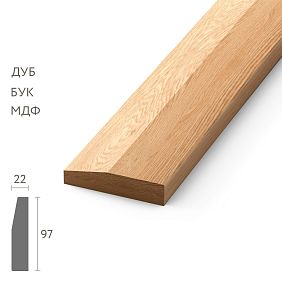
MDF Skirting Board— white, paintable, geometrically precise
Wooden baseboard— oak and beech array for warm joints
All STAVROS skirting boards— full catalog of profiles and formats
Wooden corner bracket— for internal and external corner joints
Pogonazh iz massiva— battens, corner pieces and profiles for complex joints




What does 'joint skirting' mean and where is it needed
The term 'joint skirting' is not a separate product category. It's a functional description of the task that skirting solves. Any floor or decorative profile that covers the joint line between two surfaces is skirting for joint finishing.
But each specific joint has its own task. The joint between floor and wall is one story: you need to cover the expansion gap, hide the unevenness of the base and create a clear horizontal line. The joint between panels is another: here it's important to continue the rhythm of the finish, not to break the plane. The joint in a corner is a third: you need a profile that will fit exactly into the geometry and won't open up when humidity changes.
Where joint skirting is most often needed:
-
At the base of the wall — classic joint between floor and vertical plane
-
In the area of wall panels — lower and upper edge of the panel, side joints
-
In corners — both internal and external, where two planes meet at a right or non-standard angle
-
At transitions between decorative materials — where one finishing material ends and another begins
-
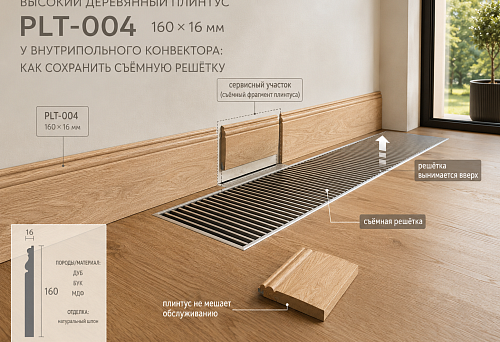
In areas with cable channels — when the cable route is concealed within the baseboard housing
Baseboard for junctions is not just about covering a technical gap. It is an architectural tool that creates visual order in a space. That is why its selection requires understanding: which specific joint needs to be finished, in what material, and in what style.
Our factory also produces:


Which joints are most often covered with baseboard
Let's examine the main types of junctions that most people encounter during renovation or finishing.
Get Consultation
Joint between floor and wall
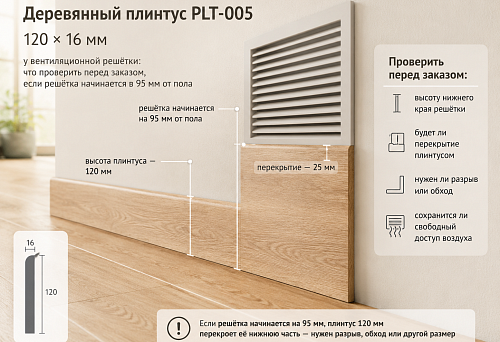
This is the most common application of baseboard. A gap always remains between the floor covering and the wall — a technical, expansion gap necessary for the proper installation of laminate, quartz vinyl, or parquet. The width of this gap is 8–12 mm. The baseboard covers it, creating a clear horizontal line along the entire perimeter of the room.
Baseboard for the floor-to-wall joint is selected based on:
-
Type of floor covering (parquet, laminate, quartz vinyl, tile)
-
Ceiling heights and overall room scale
-
Wall color and material
-
Interior style
Junction between flooring and vertical plane
A situation similar to the previous one, but with a nuance: sometimes the vertical plane is not just a wall, but a clad surface: a drywall box, column, or niche. Here it is important to consider the thickness of the cladding and provide a baseboard that will cover the possible stepped transition between the wall and the cladding.
Junction between panels and wall
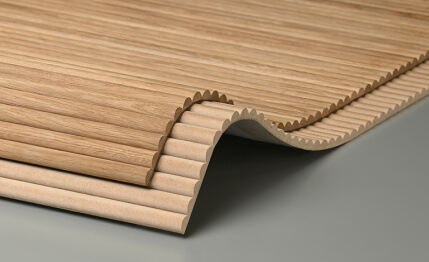
If the walls are finished with MDF panels or slatted panels, they definitely have a lower end - the junction with the floor. This end needs to be covered. The baseboard for the panel junction here works as a lower transition, linking the plane of the panel with the plane of the floor into a single solution.
Details on how to select a baseboard specifically for panels - in the article baseboards for panels.
Junction in corners
Internal corners are a high-risk zone. Two walls are always slightly misaligned in geometry: the angle is rarely exactly 90°. A baseboard for junctions in corners requires precise cutting or the use of special corner caps that hide the imperfection.
External corners are less common — for example, on protruding columns or boxes — but they also require a precise profile.Wooden corner bracket— a separate type of trim specifically for such junctions.
Junction of decorative elements in the interior
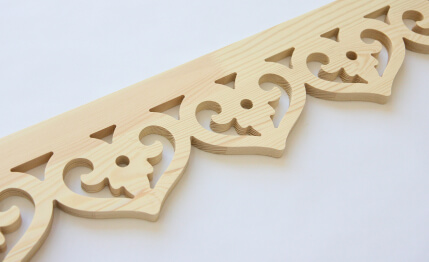
When different finishing zones alternate on a wall — panels and plaster, slats and paint — a junction appears at the boundary that needs to be finished. Here, a decorative skirting for joints in the form of molding or a narrow profile works, covering the transition.
Which skirting to choose for joints: MDF or wood
This is the main choice — and it affects not only the price but also how the finished joint will look in a year and in ten years.
When MDF is better
MDF skirting for joints— the first choice for most modern interiors. Its main advantage is geometric precision. MDF has no natural defects: no curvature, no density variations, no knots. Each plank is perfectly straight, the profile milling is sharp, and the surface is uniform.
MDF is preferable when:
-
The interior is modern, bright, painted in a unified color scheme
-
The baseboard will be painted to match the color of the doors, slopes, or windowsills
-
Joints should be made neat and technically clean
-
Floor — laminate, quartz vinyl, solid-color tile
-
Wall panels — made of MDF, and a uniform material is needed around the entire perimeter
-
Budget is moderate, but surface quality requirements are high
MDF for painting — a separate case. The profile is primed, accepts acrylic or alkyd paint of any shade according to RAL or NCS. Indispensable for design projects with precisely calculated color programs. More about the types and sizes of MDF profiles — in the articleMDF skirting board: types, sizes, installation and care.
When wood is better
Wooden baseboard for jointsWood works where the material matters, not just the form. Natural texture, living surface, warm tone — this is what MDF cannot fully reproduce.
Wood is preferable when:
-
Floor made of natural materials — parquet, engineered board, solid board
-
Interior is classic, neoclassical, rustic
-
Doors and staircase made of wood — a single wood species is required
-
Slatted wall panels made of solid wood — the skirting board should continue their texture
-
Goal — durability with restoration capability: wooden skirting board can be sanded and repainted
About choosing a wooden skirting board for the floor based on materials — in the articlewith a classic profile creates a sense of solidity, reliability..
What is more convenient for modern interiors
For a modern interior with clear geometry, white walls, and laminate flooring — MDF is definitely more convenient. Precise profile, uniform white surface, zero maintenance, easy installation. That is why white MDF skirting board has become the standard in most urban apartments of the last decade.
What is better for classic solutions
For classic style with parquet, wood-look doors, cornices with relief — only solid wood. A wooden skirting board for joints here is not just a floor profile, but part of an architectural system where all natural materials support each other.
Popular solutions for joints and abutments
Wood — for warm and classic interiors
White profiles — for light abutments
Wide profiles — for expressive architectural lines
How to choose a baseboard for a specific joint
Baseboard for joints is not a universal product 'for everything'. Each type of abutment dictates its own requirements for profile, height, and material.
For the joint between floor and wall
First question: what is the floor covering? This determines the required expansion gap and, consequently, the minimum baseboard thickness. Second: what is the ceiling height? This determines the profile height. Third: what is the color and style of the interior? This determines the material and finish.
For laminate or quartz vinyl flooring in a modern interior — MDF baseboard 60–100 mm, white or paintable. For parquet flooring in a classic space — wooden baseboard 80–120 mm of the same or similar wood species.
For panel joints
The key parameter here is panel thickness. The skirting must either have the same cross-section or sufficient height to cover the panel end and create a neat bottom transition. For MDF panels - MDF skirting. For wooden slat panels - wooden skirting from the same wood species.
Very important: skirting for wall panel joints must maintain the finishing rhythm. If panels are vertical - skirting lies horizontally and creates a clear baseline. Read the article on how to properly join slat panels and design their jointsHow to join slatted panels.
For corners
Internal corners are finished either by cutting skirting at 45° or with a special corner element. The first option is more professional, the second is simpler for DIY installation.Wooden corner bracket— ready-made solution for corner junctions that installs without cutting and gives a clean result.
External corners are rare but difficult. Here precise measurement is needed and either cutting skirting for external corners or a special external corner piece.
For complex junctions
There are situations where standard skirting doesn't solve the problem: the gap between wall and finish is too large, the angle is non-standard, the junction follows a curve. In such cases, use a combination of skirting and additional profile elements fromsolid wood trim— corner pieces, moldings, slats.
For visible decorative lines in the interior
When a joint is not a hidden technical element but a decorative line in the interior, the choice of profile becomes a design decision. Here, moldings come into play—horizontal profiles that create architectural transitions between finishing zones. The full range is available in the categorymoldings, cornices, and baseboards.
Baseboard for floor-to-wall joints: what to look for first
This is the main application scenario, and it has a clear parameter system. Let's break down each one.
Profile height. Depends on ceiling height. For 2.5 m ceilings—50–70 mm. For 2.7–2.8 m ceilings—70–100 mm. For 3 m and above—100–150 mm. The rule is simple: the higher the wall, the taller the 'signature' at its base should be.
Profile thickness. Important for covering the expansion gap. If the gap is 10–12 mm, the baseboard thickness at the base should be at least 12–15 mm. Otherwise, the gap will be visible.
Floor material. Parquet and engineered wood—use wooden baseboards from the same or similar wood species. Laminate and quartz vinyl—MDF to match door color or paintable. Tile—MDF or wood with good moisture-resistant treatment; for high humidity—special solutions.
Wall geometry. The flatter the wall, the more precise the baseboard fit. For uneven walls, either use soft installation with gap filling using sealant or a thicker profile that covers the deviation.
Color solution. Three strategies: match floor color, match wall color, match door color. The most popular and universal is matching door color. It creates a system: doors, trims, slopes, baseboard—one theme, one color.
Doors and trims. If trims are large—the baseboard should correspond in height. A scale mismatch between tall trims and narrow baseboard is immediately noticeable. Designing baseboards as part of a unified system with doors is a professional standard that turns good renovation into excellent.
More aboutMDF floor skirting board— in a separate guide on selection and installation.
Skirting board for panel joints and decorative finishing
This is a special topic often overlooked when choosing skirting boards. If walls are finished with panels, the task becomes more complicated because an additional layer appears, changing the geometry of the junction.
How to design the bottom junction of wall panels
MDF panels or slatted panels installed on walls create an additional protrusion relative to the wall plane. If the skirting board adheres to the wall surface without accounting for this protrusion, a gap will remain between it and the panel—and this spot will always be noticeable.
Correct solution: the skirting board should adhere to the panel plane. For this, either choose a skirting board with sufficient depth to cover the protrusion, or mount it flush against the panel end so there is no gap.
Where a calm profile is needed, and where a decorative one
For slatted panels with pronounced vertical rhythm—it's better to choose a calm skirting board with a smooth front surface. It won't compete with the slat pattern and will create a neutral horizontal base.
For MDF panels with moldings or frame elements—a skirting board with a relief profile will continue the architectural theme of the panels. Here, a pronounced profile with a shelf or chamfer is appropriate.
How to match skirting boards with panel rhythm
Key rule: the skirting board should be part of a unified wood or MDF system. WoodenRafter panelsand wooden skirting boards made from the same wood species create a unified environment. MDF panels and white MDF skirting boards follow the same logic.
For detailed information on installing slatted panels and finishing their joints, see the articleHow to install slatted panels.
Why panel joints shouldn't be left to chance
Imagine a beautiful wall made of wooden slats—and at its base, a random plastic skirting board or an unfinished edge. This contrast ruins the entire impression. The panel joint is the last visible element of the decorative system and should be planned with the same care as the panel itself.
How to choose skirting board color and profile for joints
The color and shape of the skirting board are not random choices. They affect the perception of the entire joint: how noticeable it is and how organically it fits into the interior.
White profile
White skirting boards for joints are the most common and versatile option in modern interiors. They work with any light-colored floor, any colored or white wall, and most types of doors. The white profile is perceived as a neutral element—it's present, creates order, but doesn't attract unnecessary attention.
Important nuance: white comes in different shades. Cool white (with a bluish undertone) is for neutral and cool interiors. Warm white (cream, ivory) is for spaces with wood, warm color palettes, and amber accents. Mixing temperatures in one room is not recommended.
Wood-look
Wood-look skirting board is for interiors where the wooden theme is consistent. If the panels are oak, the skirting board should be oak. If the slats are beech, the skirting board should be beech. This is not a strict rule, but in most cases, matching the wood species and shade yields the best result.
MDF with decorative wood-grain film is an acceptable alternative, especially for laminate floors with a similar pattern. However, under daylight, the difference between the film and natural veneer is always noticeable.
For painting
Painting-ready skirting board is the professional standard for projects with precise color systems. Primed MDF profiles are painted in the desired shade according to the chosen color scale, achieving a perfect match with door frames, reveals, or wall panels. This is especially valuable in projects where the skirting board should literally 'disappear'—becoming part of the wall.
Wide profile
Wide skirting board for joints—when you need not only a neat transition but also architectural emphasis. With high ceilings and large wall surfaces, a wide profile of 80–100 mm creates a solid visual foundation. It is particularly appropriate in areas with decorative panels and slats, where the lower junction should be legible and convincing.
Learn more about choosing wide profiles in the article Wide Wooden Skirting Board.
Tall profile
Tall skirting board for joints—when the joint between the floor and wall runs along a long wall with a high ceiling. A tall profile (100–150 mm) creates a strong horizontal line that structures a large plane and gives the space scale.
How to coordinate skirting board for joints with floors, doors, trims, and panels
The skirting board for joints doesn't work in isolation. It's part of a system — and you need to see it as a whole.
If the joint runs along the floor — focus on the floor and doors. The floor sets the tone and material, the doors set the color. If the floor is warm wood and the doors are white — the skirting board is often chosen white: it supports the door theme and creates a neutral transition. If both the floor and doors are wood-like — a skirting board made of the same material creates a unified natural environment.
If the joint is near panels — rhythm and texture are important. Wall slats create a vertical rhythm, and the skirting board at their base should pick it up — with a smooth horizontal line, a calm surface, and a uniform material. A mismatch between the texture of the slat and the texture of the skirting board will be noticeable.
If the interior is light — a white profile is often the best choice. It blends into the whiteness of the walls, doesn't create unnecessary horizontals, and doesn't break up the space. This is exactly what makes white MDF skirting boards so popular in modern apartments.
If there's a lot of wood in the interior — support the solid wood shade. Parquet, slats, doors, furniture in natural wood — the skirting board for neat joints in this system should be made of the same material or have the same tonal temperature. A cold gray skirting board next to warm oak is a color conflict that is immediately visible.
Consider the architraves. The architrave and skirting board should be in the same system — in height, material, and color. A massive architrave next to a narrow skirting board creates a mismatch in proportions. The profile of the architrave and the profile of the skirting board ideally echo each other — matching in milling style.
Mistakes when choosing a skirting board for joints
Most mistakes when choosing a skirting board for joint finishing are systemic. They aren't made out of ignorance of a specific model. They are made because the joint isn't seen as an architectural task.
Mistake 1. Too massive a profile for thin finishing. If wall panels are thin (8–10 mm), and the skirting board is thick (20 mm in projection), a step forms between them — unattractive and very noticeable. The skirting board should match the thickness of the panel.
Mistake 2. Random color. Choosing a skirting board based on the principle of 'the first one you find in the store' means getting a joint that stands out from the overall color theme. The color of the skirting board is part of the design solution, not a coincidence.
Mistake 3. Not accounting for panel thickness during installation. When panels are mounted over a wall, they create a protrusion. The skirting board that adjoins the wall behind the panel does not cover the panel's end. You either need to install the skirting board after the panels, or choose a profile that accounts for this protrusion.
Mistake 4. Not planning corners in advance. Corner elements are often purchased at the last minute — and the needed model isn't available, the color doesn't match, the exact profile is missing. Corners should be purchased together with the main skirting board.
Mistake 5. One model for all junctions. The same skirting board is not always suitable for both the floor and panels, and for corners. For different junctions, sometimes different profiles from the same line are needed — skirting board, corner piece, molding.
Mistake 6. Ignoring corner geometry. If the wall is not exactly 90°, a standard 45° cut will leave a gap in the corner. You either need to measure the angle and adjust the cut, or use corner caps that compensate for the deviation.
Mistake 7. Skirting board without connection to doors. Buying skirting board separately from door casings and getting a color mismatch is one of the most common mistakes. Skirting board should be chosen as part of a system with doors and casings, not separately from them.
Installing skirting board at joints: what's important to consider
Installing skirting board for joints is not a difficult task, but requires attention to detail. This is precisely where the difference between 'almost done' and 'done professionally' becomes apparent.
Preparing the junction
Before installation, you need to check if the wall at the base is even. With a deviation of more than 3–4 mm per linear meter, the skirting board will not fit tightly — and a visible gap will remain. Significant unevenness is leveled with filler, minor ones are filled with acrylic sealant after installation.
It is important to ensure that the floor covering is laid before installing the skirting board, and that the expansion gap at the wall is not filled with foam or cement mortar — it must remain free.
Working with internal and external corners
Internal corner: cut two pieces of skirting board at 45° towards each other. Always check dry before final fixing — if the corner is not exactly 90°, adjust the cut for a tight fit. A small gap in the corner is sealed with acrylic sealant matching the skirting board color.
External corner: cut at 45° in the opposite direction. Precision is even more important here — the external corner is visible from the entire room. For wooden skirting boards, the external corner is often protected with an overlaywooden corner piece.
Cutting
Miter saw with precise 45° angle — standard for professional installation. Hand saw with miter box — acceptable but requires care. Wide and tall skirting boards with inaccurate cuts produce noticeable gaps — check the connection dry before fixing.
Joining on runs
For wall lengths over 2.5–3 m (standard plank length), skirting boards are joined. The joint is made 'on a miter' — at 45° along the length — this hides potential opening during seasonal humidity changes. Two planks meet diagonally, and the gap from drying remains almost invisible.
Mounting adhesive and fasteners
Installation with liquid nails — working standard for MDF skirting boards. Apply adhesive in a zigzag pattern 3–4 cm from edges, press the plank and secure with painter's tape for 30–40 minutes. For heavy wooden skirting boards — additionally use finishing nails or screws with countersunk heads, filled with wood putty.
How to close a gap with a baseboard
If there is unevenness at the base of the wall and the baseboard does not fit tightly — after installation, the gap is filled with acrylic sealant, matched to the color of the baseboard. The sealant is applied in a thin strip and smoothed with a finger using a small amount of water. After drying (2–4 hours), the surface is smooth and unnoticeable.
4 ready-made scenarios: what to choose
For a modern light interior
Space: apartment, white walls, laminate flooring in light wood, white doors, ceilings 2.7 m.
Solution:MDF Skirting Board80–100 mm high, white or paintable in RAL 9003. Smooth flat surface, without relief. The baseboard will blend into the white wall theme and create a clear horizontal contour — subtle but structuring.
For a classic interior with wood
Space: living room, oak parquet, doors in natural oak, ceilings 3 m, casings with a profile.
Solution:Wooden baseboardMade of oak, 120 mm, with a classic relief profile. Color — matching the parquet or slightly darker. Baseboard, casings, and door frames — one wood species, one shade. The result is an interior that looks crafted by one hand.
For wall panels and slats
Space: living room or study with vertical wooden slats, oak engineered plank floor, ceilings 2.8–3 m.
Solution: wooden skirting board from the same wood species as the battens, 80–100 mm, in a unified system withwooden planksandplank panels. All from one catalog, one wood species — a unified wooden environment from floor to mid-wall.
For complex corners and transitions
Space: hallway with a protruding column, or kitchen with niches and various finishing zones.
Solution: combination of skirting board andwooden corner for external corners. Main skirting board — MDF or wood, depending on style. Corner pieces — same species and finish. Additionally — moldings for decorative transitions on the wall.
What to view together with skirting board for joints
moldings, cornices, and baseboards— complete decorative molding system
Wooden corner bracket — for corner abutments without mitering
Rafter panels — for decorative walls in a unified system with skirting board
Wooden planks — vertical decorative solution
Pogonazh iz massiva— battens, corner pieces and profiles for complex joints
FAQ: Answers to popular questions
What is a skirting board for joints?
It is any profile that covers the junction line of two surfaces: floor and wall, panels and wall, in corners, at decorative transitions. The task is to hide the gap, create a neat outline, and connect different surfaces into a single interior system.
Which skirting board to choose for the joint between floor and wall?
For laminate or quartz vinyl in a modern interior — white MDF 70–100 mm. For parquet in a classic interior — wooden from the same species. Height depends on ceilings. More details — Baseboard MDF.
What is better for joints: MDF or wood?
MDF — for precise, painted, modern solutions. Wood — for natural, classic, warm interiors. Both options are in the catalog all STAVROS skirting boards is convenient..
How to cover the joint between panels and wall?
With a skirting board of the same material as the panels: MDF skirting for MDF panels, wooden for wooden slats. The skirting should fit against the panel, not the wall behind it. More details — baseboards for panels.
Which skirting board is suitable for slatted panels?
Wooden skirting board from the same species as the slats. A unified material creates a system: slats, skirting, floor — one wooden story. All slatted panel options are in the section Rafter panels.
White or wood-look skirting for joints — what to choose?
White — for light interiors with white doors. Wood-look — for spaces with wooden floors, furniture, and doors. The main principle: the skirting should be part of the system, not a random element.
How to finish an internal corner with skirting?
Cut two pieces at 45° facing each other. Check dry-fit, adjust if necessary. Seal small gaps with acrylic sealant matching the skirting color.
How to finish an external corner with skirting?
Cut for an external corner orWooden anglein the skirting color — a ready-made element for corner joints without complex cutting.
How to hide a wall gap with skirting?
Small gaps (up to 4–5 mm) are sealed with acrylic sealant after installation. Large wall irregularities are corrected with putty before installation. Skirting only covers the standard expansion gap — not construction defects.
Is a wide skirting needed for complex joints?
A wide profile is suitable for high ceilings, large wall surfaces, and next to massive decorative panels. It creates a pronounced horizontal line. For low ceilings and small rooms, a standard or medium profile is preferable.
How to attach skirting board at the joint?
Using liquid nails with fixation by painter's tape until dry. Heavy wooden profiles are additionally secured with finishing nails or screws.
Where to buy skirting board for joints?
In the STAVROS catalog — MDF and solid wood, corner pieces, battens, and moldings for any type of abutment. See MDF Skirting Board, Wooden baseboard and the full Pogonazh iz massiva.
About the company STAVROS
STAVROS is a Russian manufacturer of wooden architectural millwork made from solid oak and beech. The company's assortment includes skirting boards, moldings, cornices, corner pieces, battens, plank panels, and decorative elements for finishing any joints, abutments, and transitions in interiors.
All STAVROS products are made from kiln-dried wood, with precise milling and a finished surface finish. Each element is designed for long service life and is compatible with other items in the catalog — allowing for the creation of unified finishing systems: from floor to ceiling, from skirting board to plank panel.
Chooseskirting board for joints in the STAVROS catalog — and turn every abutment into a neat architectural line that speaks of the quality of the renovation without unnecessary words.