









































Article Contents:
- What is skirting for seams and when is it needed
- For covering visible seams between panels
- For masking gaps at the wall
- For joints of different finishing materials
- For finishing corners and abutments
- For neat completion of TV zones and niches
- How skirting for seams differs from other solutions
- Skirting for seams and joining strip
- Baseboard for seams and corner
- Baseboard for seams and molding
- Baseboard for seams and panel profile
- Which material is better for seam baseboard
- Wood: warmth, texture, durability
- MDF: precision, evenness, painting
- Polyurethane: relief, classic, lightness
- For what tasks do they buy seam profile
- For seams between wall panels
- For slatted panels
- For decorative joints in TV area
- For gaps between wall and finish
- For corners and junctions
- For classic interiors
- For modern minimalist interiors
- How to choose joint profiles correctly: six key parameters
- By joint width
- By depth and visibility of gaps
- By finishing material
- By room style
- By color and finish
- Combination with other elements
- What solutions for joints and seams are available at STAVROS
- Wooden moldings and profiles
- MDF profiles and trim
- Wooden corners and battens
- Batten panels with framing
- Polyurethane decor
- Decorative appliqués
- What to combine joint profiles with: seven working combinations
- With Mouldings
- With slatted panels
- With decorative battens
- With cornices
- With decorative overlays
- With molding
- With floor skirting board
- Common mistakes when choosing joint profiles
- Choosing too wide a profile
- Not considering wall material
- Mixing floor skirting and wall profile
- Not planning joints in advance
- Do not consider the finish
- Installation of joint profile: the main points in several items
- How to assemble the system: profile + panels + decor in a unified logic
- STAVROS: a complete system for neat finishing of joints and seams
- FAQ: answers to popular questions about joint profiles
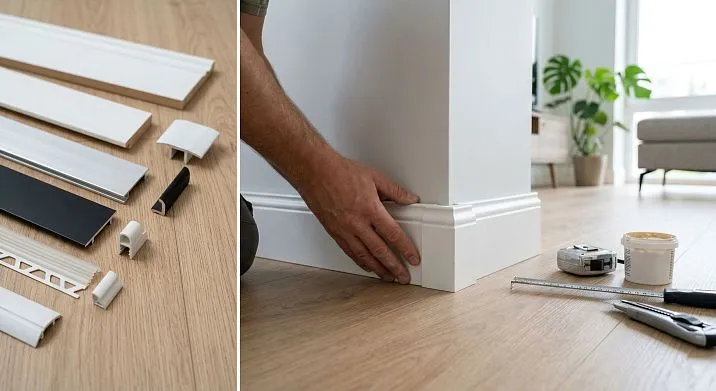
There is a moment in any renovation when the builders say, 'Well, it's done' — and leave. And you look at the wall. And you see: where the panel meets the wall, a gap remains. Where one finish ends and another begins — an unsightly joint. Where the wall panel meets a corner — a two- or three-millimeter gap that becomes a black line in the light.
This is not a defect. It's physics. Any two materials meeting create a seam. Any panel adjoining a wall leaves a joint. Any corner is a place where mismatches concentrate.
The question is not whether there will be seams. The question is how to close them beautifully, architecturally correctly, and for a long time.
The answer is called a joint skirting — or more precisely, a decorative profile for joints, gaps, and abutments. And this is not a single product, but an entire class of solutions, each with its own task, material, and logic of application.
Go to the STAVROS catalog:
-
Moldings for walls to buy— wooden and MDF profiles for seams and joints
-
Buy wooden molding— natural array for framing and masking joints
-
Buy slatted panels for walls— wooden slats with profiles for joints
-
Buy moldings— polyurethane profiles for decorative seam closure




What is a seam skirting board and when is it needed
The term 'seam skirting board' is colloquial and broad. It conceals fundamentally different situations, and each requires its own solution.




For closing visible seams between panels
Wall and slat panels are mounted flush or with a gap. In the first case, the seam is almost invisible if the wall geometry is perfect. But in reality, walls are never absolutely even, and a gap remains between two panels, which under side lighting turns into a dark line.
Buy a profile for wall panel seams— means placing a decorative dividing strip between panels that will close this gap and simultaneously create a neat rhythmic pattern on the wall.
Our factory also produces:


For masking gaps at the wall
The most common case: a panel, slat, or any finishing element abuts a wall. Perfect abutment doesn't exist—there's always a gap of 1–5 mm.Buy Wooden Angleor install a narrow cover strip—the first thing that comes to mind here. The correct solution depends on the gap width and type of abutment.
Get Consultation
For joints between different finishing materials
Transition from wooden slats to painted plaster. The boundary between a wall panel and a mirror insert. The joint of laminate on a wall with wallpaper. Wherever two materials meet—adecorative joint profileis needed, which masks the transition and turns it into an architectural solution, not a construction compromise.
For finishing corners and abutments
Internal corners—where wall meets wall. Without a profile, unevenness or an open gap here is inevitable.buy wooden corner pieceand mount into an internal corner—a straightforward solution for this task. External corners—a high-risk zone for finishing: paint chips, plaster crumbles. A corner profile protects and covers simultaneously.
For neatly finishing TV zones and niches
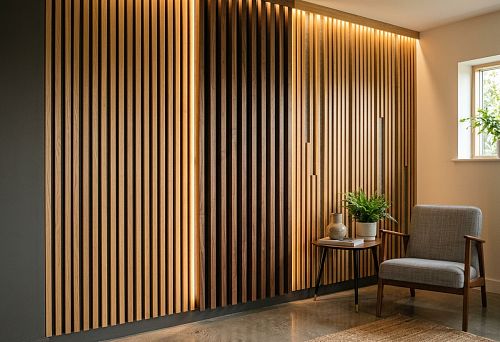
A TV zone with a slatted panel is a popular and strong solution. But where does the panel end? The slats don't just stop in mid-air: their bottom, top, and side edges require a framing profile. The same applies to niches, shelves, and any built-in zones with decorative finishes.
How a joint skirting board differs from other solutions
It's important to understand the terminology here, because the market offers many outwardly similar products with different application logic.
Joint skirting board and joining strip
A joining strip is a technical element for floor coverings. It lies on the floor and connects two different coverings on a horizontal plane. A joint skirting board is a wall-mounted, decorative product. The tasks are similar (to cover a joint), but the plane and context are different.
Joint skirting board and corner bead
Wooden angle— a profile with a cross-section in the shape of the letter 'L'. It covers a corner — internal or external. A joint skirting board is a flat or slightly convex strip that bridges a gap on a straight plane. Different geometric situations require different products.
Joint skirting board and molding
Buy wooden molding— means getting a decorative profile that functions as an independent architectural element. Molding lives on the wall, forms frames, creates rhythm. A joint skirting board is a more functional element: its task is specifically to bridge a gap, not to decorate the wall for decoration's sake.
In practice, these concepts often overlap:Moldings for wallssimultaneously decorate and conceal seams between finishing zones.
Skirting for seams and panel profile
Panel profile is a specialized product for wall and slat panel systems. It covers ends, connects panels together, and frames the perimeter.Buy slatted panels for wall finishingtogether with framing profiles — the correct systematic approach.
Which material is best for skirting on seams
Three materials — three strategies. Let's examine each honestly.
Wood: warmth, texture, durability
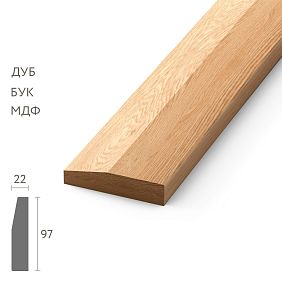
to buy wooden baseboardfor closing seams — the right choice where the interior is built on natural materials. Woodendecorative joint profileoak skirting next to oak slats on the wall — this is a monolithic image. One texture, one tone, one living surface.
Wood paints, stains, and varnishes well. After installation, it can be treated to any color and shade, achieving a perfect match with the finish.
Limitation: the tree requires a stable microclimate. Humidity fluctuations are a potential cause of microdeformations. For rooms with constantly high humidity — kitchens with open cooking, bathrooms without exhaust — it is better to consider other materials.
Best wood species for seam profiles:
-
Oak — dense, expressive texture, wear-resistant. For open joints that are visible and touched
-
Beech — smooth homogeneous surface. Ideal for white enamel
-
Pine — affordable, easy to process. For country and budget interiors
Buy molding items from the right species in the right cross-section is the basic task when selecting a profile for wooden seams.
MDF: precision, evenness, painting
buy MDF skirting board for joints — a pragmatic and practical choice. MDF profiles have precise geometry with a tolerance of ±0.1 mm, a smooth surface without texture, and take paint well.
MDF is unrivaled specifically for painting. Modern white interiors with molding layouts, light Scandinavian walls with clear horizontal lines — this is the kingdom of MDF profiles. Cover a seam with such a profile, paint it the color of the wall — and it will become invisible. Paint it in contrasting white — and it will become an architectural accent.
When MDF is better than wood:
-
When perfect smoothness under enamel is needed
-
When the profile will be completely repainted
-
When the budget is limited
-
When the interior is a laconic modern or neoclassical white
Polyurethane: relief, classic, lightness
Polyurethane Items— is the world of relief decor. Polyurethanedecorative joint profileweighs significantly less than its wooden counterpart, is easily mounted with adhesive, and holds the profile shape well even with complex cross-sections.
For sealing seams in classic interiors — where there are alreadyWall molding, ceiling cornices with ornament — polyurethane profile fits organically into the system.
When polyurethane is better:
-
In classic and baroque interiors
-
When a complex relief profile is needed
-
When the joint is high up and easy installation is important
-
When everything is painted white anyway
For what tasks joint profiles are purchased
For joints between wall panels
Wall panels — MDF, wood, PVC, veneer — are installed flush or with a forced gap. A forced gap is a design solution: it creates rhythm and a visible wall structure. But a gap without a profile is an open crack with a visible base.Buy wooden skirting boardin the required cross-section and inserted as a dividing element between panels — the correct system logic.
For wider joints, U-shaped or T-shaped profiles — cover strips — are used, which are inserted into the gap and overlap it on both sides.
For slatted panels
buy wall slat panels— means simultaneously planning their perimeter framing. A panel on a wall has four edges: bottom (at the floor or lower profile), top (at the ceiling or cornice), sides (adjacent to walls or transition to another finish).
Each edge requires its own profile. Bottom — Wooden baseboard. Top — Buy wooden crown or a simple transition molding. Sides — Wooden corner bracket or a cover strip.
For decorative joints in the TV zone
The TV zone is an accent wall or part of it, designed as the visual focus of the living room. Buy oak wooden planks for walls for a TV backdrop is a popular solution. But the slats end — and where they end, the work of the seam profile begins.
The top profile under the ceiling creates a horizontal cornice that visually defines the zone. The bottom one — a clear line at the floor. The side ones — vertical frames that turn a section of the wall into a distinct architectural element.
For gaps between the wall and the finish
A wall is not a perfect plane. Any panel, when fitted against it, creates a gap. A narrow one — 1–3 mm — is sealed with silicone or acrylic sealant and painted over. A medium one — 3–10 mm — requires a profile. A wide one — over 10 mm — requires a separate solution: a cover strip, decorative slat, or batten.
Baseboard for seamsIn this role, it is a narrow slat or molding that covers the gap and is fixed to the main finish or to the wall.
For corners and junctions
Internal corners — the place where wall meets wall. Slats or panels going into the corner must somehow end. First option: cut at 45° and join — requires perfect wall geometry and skill. Second option: cover the internal cornerwooden corner piece— simpler, faster, often looks better.
External corners — a zone of mechanical risk. An impact corner that chips paint and crumbles plaster. A wooden or MDF profile on an external corner is both protection and decor.
For a classic interior
In classic style, a seam profile is not just about covering a hole. It is an architectural element of the system. The transition between wall zones is designed as a horizontal belt with a profile that matches the character of the other moldings.Buy moldingsfor decorative inserts at the corners of joints — the finishing touch.
For a modern minimalist interior
In minimalism, a seam profile is an invisible element that simply solves the problem. Thin, smooth, painted the color of the wall — it is present but not accentuated. Or the opposite: a contrasting black profile on a white wall as a deliberate design move.
How to choose the right joint profile: six key parameters
By joint width
This is the first measurement to start with. The profile should overlap the joint with a margin—typically one and a half to two times wider than the gap.
| Gap width | Recommended solution |
|---|---|
| up to 3 mm | Sealant + painting |
| 3–8 mm | Narrow cover strip 10–15 mm |
| 8–20 mm | Profile 20–35 mm |
| 20–50 mm | Molding or decorative strip |
| over 50 mm | Wide decorative strip or panel |
By depth and visibility of the gap
A deep gap with a dark background is more noticeable. It requires a profile with a flat base that completely covers the gap. A shallow gap with a suitably colored base is less critical.
By finishing material
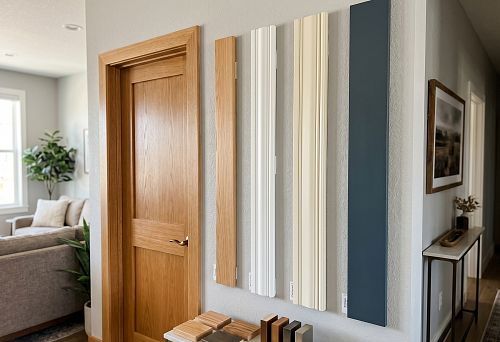
Wood next to wood — definitely a wooden profile. Wooden slats on the wall —Wooden planks— as separators and framing. MDF panels — MDF profile. Mixed finishes — neutral MDF for painting or polyurethane, which can be easily repainted to the desired color.
Based on the style of the room
Straight smooth profile — minimalism, Scandinavian style, modern classic. Shaped with a bead — neoclassical and classic interior. Embossed with ornament — Baroque, Empire, rich classic.wooden molding— with a soft bead — a universal solution that reads well in most styles.
By color and finish
White profile in a white interior — dissolves into the wall and creates a sense of unified space. Wood-look profile in a wooden interior — a monolithic look. Contrasting dark profile on a light wall — a graphic accent. Clear varnish on oak — warmth and naturalness.
— is a horizontal element that frames the room at the bottom of the walls where the wall meets the floor. Skirting boards perform several functions: they hide the technological gap between the wall and floor covering (necessary for thermal expansion), protect the lower part of the wall from mechanical damage, create visual completion, and may conceal wiring.— a base for any color solution.Wooden baseboard— under varnish, for those who need a lively texture.
Regarding combination with other elements
Joint profile — a system element, not a standalone artifact. It must be coordinated with:
-
wall moldings— in one profile or in coordinated sections
-
plank panels— in one wood species and tint
-
with wooden cornices— at the ceiling, in one material
-
— with floor skirting at the bottom of the wall, in one profile character
What solutions for joints and seams are available at STAVROS
STAVROS is a manufacturer and supplier of a full range of wood, MDF, and polyurethane products for finishing. Everything needed for neatly closing joints and seams in any interior is gathered here.
Wooden moldings and profiles
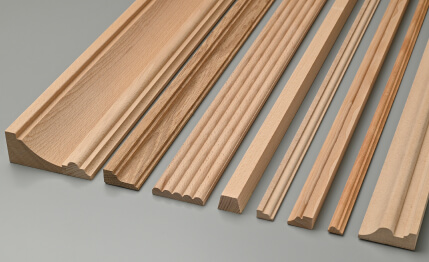
Solid wood moldings for sale— wooden decorative profiles in several cross-sections. Oak, beech, ash — depending on the task. Kiln-dried, precise geometry, ready for varnishing or painting.
Used as dividing profiles between finishing zones, as framing for slatted panels, as decorative dividers in molding layouts.
MDF profiles and millwork
MDF Skirting Boardand MDF moldings — profiles with perfect geometry for painting. For modern white and neutral interiors. For wall layouts. For sealing seams where a smooth painted surface is needed.
Wooden corners and battens
Buy oak wooden planks for walls— vertical and horizontal elements for decorative solutions. A batten as a divider between finishing zones — a simple and elegant way to design a joint.
buy wooden corner piece— profile for internal and external corners. Where the finish meets a corner — the perfect solution.
Slatted panels with framing
Buy slatted panels for wall finishing— means choosing not just battens, but a ready-made system for an accent wall. Panels are supplied as a kit with framing profiles that seal all perimeter seams.
Polyurethane decor
Buy moldings— polyurethane products for classic interiors. Polyurethane profiles, overlays, moldings, and cornices — for concealing seams in rich decorative schemes.
Wall molding— as corner inserts along the edges of profiles — the final architectural accent.
Decorative appliqués
Buy decorative elements— corner inserts, overlay rosettes, accent details. Used to finish joints in molding layouts: where two profiles meet at a corner.
What to combine seam profiles with: seven working combinations
With moldings
Seam profile and Moldings for walls— one system. The molding creates a frame, the seam profile closes the gap inside this frame or at its boundaries. One species, one cross-section, one finish.
With slatted panels
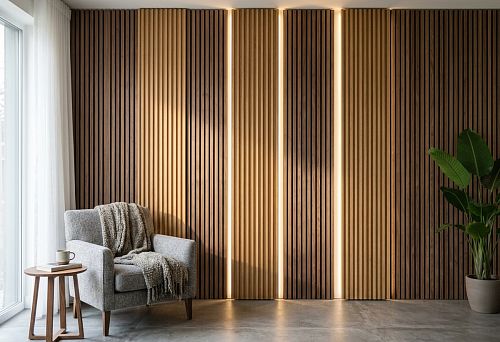
slatted panels for walls and seam profiles — an inseparable pair. Battens provide vertical rhythm, perimeter profiles — horizontal framing. Without perimeter profiles, a batten panel looks like an unfinished construction job.
With decorative battens
Wooden planks on the wall create rhythm. The seam profile between battens — a dividing element that sets the distance and closes the gap between the batten and the base.
With cornices
The upper boundary of the panel or molding zone is the place forwooden cornice. The cornice simultaneously covers the seam between the top of the panel and the ceiling and creates an architectural horizontal line.
With decorative overlays
Decorative Inserts in the corners of the frames — where two profiles meet at a 45° angle. This is the final touch of the molding layout: the corner insert hides the joint of the cut and adds an ornamental accent.
With plasterwork
Buy Molded Decoration for the corners of molding frames and joints — is to turn a functional element into a decorative one. In a classic interior, molding masks the joints so that they are not visible — only the ornament.
With floor skirting board
The lower profile at the floor and the wall profile for seams are two elements of one horizontal system. When they are made of the same material and have a coordinated profile character — the wall reads as a holistic architectural system from the baseboard to the cornice.
Common mistakes when choosing a profile for seams
Even knowing that a profile is needed — it's easy to make a mistake in the choice. Here are the most typical miscalculations.
They take too wide a profile
The logic is simple: the wider — the more reliably it will cover. In reality — a too wide profile for a seam becomes a dominant element where it should be inconspicuous. The rule: the profile overlaps the seam with a margin of 5–8 mm on each side. No more.
They do not take into account the wall material
Wood doesn't adhere well to drywall if the wrong adhesive is chosen. MDF molding on a damp wall may swell after a year. Polyurethane on a wall with chalk paint peels off along with the paint. Before installation — analyze the substrate.
Mixing floor skirting and wall molding
Floor skirting andwall joint molding— are different products with different application logic. Installing floor skirting on a wall is technically possible but visually creates a sense of mismatch.
Not planning joints in advance
The most costly mistake. When panels are already installed, battens are nailed, walls are painted — and only then do they remember the joint molding. Dismantling, selection, installation — additional work and costs. Joint moldings must be planned at the wall solution development stage.
Not considering the finish
Buying wooden molding and painting it with alkyd enamel is fine. Buying MDF molding and trying to stain it to look like oak won't work. The material and planned finish must be coordinated in advance.
Installing joint molding: the key points in a few bullet points
A detailed installation guide is a separate topic. But the key principles are:
Surface preparation. The surface must be dry, clean, free of dust and grease. If the wall is painted — check paint adhesion before installing the profile.
Fastening. For wood and MDF profiles — liquid nails + finishing nails for painting. For polyurethane — special polyurethane adhesive.
Angle cutting. Straight 90° angles — miter box or miter saw. Non-standard angles — angle finder + cutting to the exact angle. Cut joints — putty or decorative overlays.
Finishing. After installing wood or MDF profiles — sanding joint areas, priming, painting or varnishing to match the main finish.
Shrinkage gap. For wooden profiles longer than 2 m — leave a 1–2 mm expansion gap at the walls, seal it with color-matched silicone sealant. Wood is a living material: it slightly expands and contracts in different seasons.
How to assemble the system: profile + panels + decor in a unified logic
Imagine an accent wall in the living room. Here's how it's built systematically:
-
Base —Rafter panels oak in a dark stain on the central wall
-
Lower framing — Wooden baseboard from the same species
-
Upper framing — wooden cornice with a coordinated profile
-
Side framings — Wooden corner pieces along the vertical edges of the panel
-
Seams inside the panel — Wooden plank as a dividing element
-
Transition to adjacent walls — wooden molding as a vertical profile for the seam
-
Decorative accents —Decorative Inserts at intersection points
The result is an accent wall where every seam is intentionally concealed and every profile is part of the architectural solution, not a separate detail.
STAVROS: a complete system for neat finishing of seams and joints
When the task is —buy joint profile and close joints beautifully and for a long time — it's important to get a material that exactly matches the rest of the finish in wood species, tint, and profile character.
STAVROS manufactures and supplies:
-
Wooden skirting and solid wood profiles — kiln-dried oak, beech, ash
-
Wooden moldingsfor wall layouts and divider profiles
-
Wooden anglesfor internal and external corners
-
Wooden railsfor divider elements and decorative solutions
-
Rafter panelswith a full set of framing profiles
-
polyurethane moldingand overlays for classic interiors
-
Decorative Inserts— corner inserts and accent details
One supplier, one system, one material quality — this is exactly what's needed for a result where all seams are closed, all joints are neat, and the wall looks like a thoughtful space.
STAVROS — where details become architecture.
FAQ: answers to popular questions about seam profiles
Which baseboard is suitable for wall seams?
Depends on the joint width and finishing material. Narrow gap — thin cover strip orwooden molding. Medium — 20–40 mm profile. Corner —Wooden angle.
How to cover joints between wall panels?
wooden battenor MDF cover strip inserted into the gap. Color and material should match the panels or create an intentional contrast.
What's better for gaps: corner bead, molding, or baseboard?
Corner bead — for corners. Molding — for decorative joint coverage on a flat surface. Baseboard — for the bottom edge of the panel at the floor. Each product has its own geometry.
Can MDF be used to cover wall joints?
Yes, an excellent option for painting.MDF Skirting Boardinstalled with liquid nails, puttied at joints, and painted any color.
Can wood be used for joint profile?
Yes, and it's the best option for natural interiors.to buy wooden baseboardor a wooden molding from the same species as the finish—the only condition.
How to close the joint at the wall where the slatted panel ends?
wooden corner pieceon the vertical edge of the panel, if it's a room corner. Or with a vertical molding, if it's a transition to another finish.
Which profile to choose for framing slatted panels?
Bottom—Wooden baseboardtop—Corniceor molding, side—corner or vertical slat.
Can you paint the seam profile?
Yes. MDF is the best material for painting. Wood—for varnish or enamel with prior priming. Polyurethane—acrylic paint.
What to choose for a classic interior?
Figuredwooden moldingorpolyurethane profilewith a cove. Addmolded overlayat the corners.
What to choose for a modern minimalist interior?
Straight smooth profile without relief.MDF for Paintingin wall color or wooden slat with a thin profile.
How not to miss with the size?
Measure the width of the gap, take a profile that overlaps it with a margin of 5–8 mm on each side. Consider the scale of the room: small room + wide profile = heavy.
Where to buy seam profile in Saint Petersburg?
In the STAVROS catalog —moldings and profiles, Trimming Items, Rafter panels with delivery.