Article Contents:
- What is a Baseboard for Finishing: Broader Than It Seems
- Types of Baseboards and Profiles for Finishing: A Complete Registry
- Baseboard
- MDF Baseboard: A Separate Discussion
- Wooden baseboard
- High skirting board
- White baseboard
- Molding
- Cornice
- Profile for Panels
- Corner Trim
- Which Profile for Which Finish: A Practical Matrix
- For Floor Finishing
- For Wall Finishing
- For Decorative Panels
- For slatted panels
- For joints and connections
- For classic finishing
- For modern finishing
- Wood or MDF: what to choose for finishing
- When Wooden Skirting Board is Better
- When is MDF skirting best
- When is the best time for molding
- When cornice is needed
- When to combine several profiles at once
- How to choose a skirting board for finishing according to interior style
- Classic
- Neoclassicism
- Modern Interior
- Minimalism
- Interior with moldings
- Interior with slatted panels
- How to choose by material and coating
- Solid wood
- MDF
- Profile for painting
- Smooth and figured profile
- How to choose by height and proportions: the mathematics of interior
- Low skirting board (up to 60 mm)
- Medium height (60–80 mm)
- High skirting board (from 80 mm)
- Wide profile
- How to choose a profile for wall height
- Skirting board + molding + cornice + panels: how to combine in one interior
- Baseboard + molding
- Skirting board + cornice
- Skirting board + slatted panels
- Skirting board + architraves
- Skirting board + decorative elements
- What to buy together with skirting board for finishing
- Moldings
- Cornices
- Angles
- Slatted panels
- Decorative elements
- Molding in one style
- Common mistakes when choosing a profile for finishing
- How to buy skirting board for finishing without mistakes: step-by-step instructions
- Step 1. Determine the application area
- Step 2. Choose material
- Step 3. Choose height and profile
- Step 4. Select color
- Step 5. Check combination with other elements
- Step 6. Assemble the full set
- FAQ: Frequently asked questions about skirting boards for finishing

Renovation is a marathon. And the finishing tape in it is not the last layer of paint on the walls or laying the last tile. The finish is the moment when all elements of the space come together as a whole: floor, walls, ceiling, openings, panels. This is where the skirting board for finishing plays a much more significant role than it is usually given.
Most customers think about skirting boards last. This is a fundamental mistake. Skirting board for finishing is not 'buying what's left', it is a system of profiles that structures the space: separates floor from walls, walls from ceiling, covers joints, forms horizontal and vertical lines of the interior. Chosen correctly - it makes the entire space complete. Chosen hastily - it ruins even the most expensive finishing.
This article is a complete commercial breakdown: what profiles are used in finishing, where and why, how not to mix incompatible elements, how to assemble a system from one material and in one style. Read carefully: here are fifty years of practice compressed into one clear text.
Select profiles for STAVROS finishing:
-
Wooden baseboard— floor and decorative solid wood profile
-
MDF Skirting Board— stable profile for painting
-
Wooden moldings— decorative profiles for walls and panels
-
Wooden cornice— ceiling profile for top finishing
-
Rafter panels— wall finishing with profile framing
-
Pogonazh iz massiva— all profile battens for any tasks
-
decorative elements— overlay decor for finishing touches
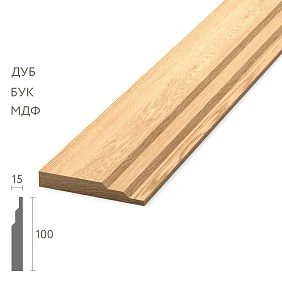
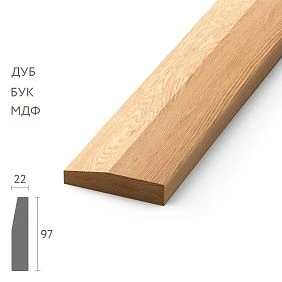
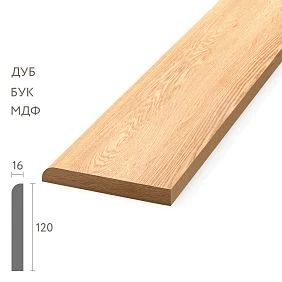
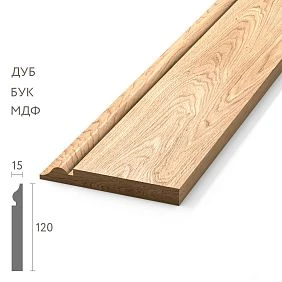
What is baseboard for finishing: broader than it seems
When people say 'baseboard for finishing,' they first think of floor baseboard. And that's correct—it is indeed the main one. But full-fledged finishing requires a system where each profile performs its function.
Under the query 'baseboard for finishing,' different tasks are hidden:
-
Floor skirting board — covers the gap between the flooring and the wall, forms the bottom line of the interior
-
Wall skirting board — a molding or profile that creates a horizontal belt, divides the wall into zones, forms framed panels
-
Skirting board for decorative panel finishing — a profile that frames the top and bottom of wall or slat panels
-
Profile for joints and abutments — corner piece, extension strip, thin molding for covering gaps near furniture, slopes, openings
-
Cornice as top skirting board — a mirror response to floor skirting, creates the top horizontal line at the ceiling
That's why discussing skirting boards for finishing work is always about a system, not a single product.




Types of skirting boards and finishing profiles: complete registry
This is the key section. Here — not theory, but a practical catalog of tools that work in finishing.
Our factory also produces:

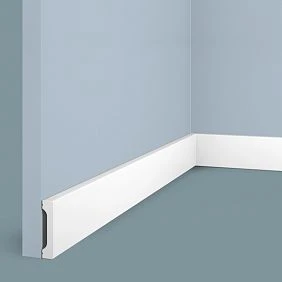
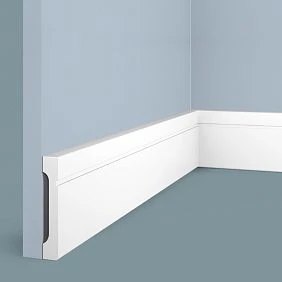
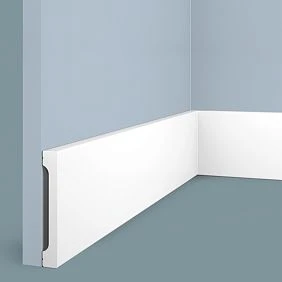
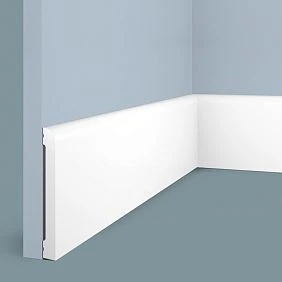

Floor skirting board
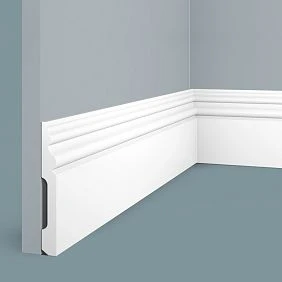
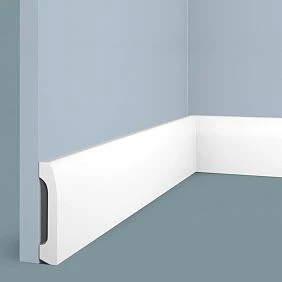
Classic function: cover the technical gap between floor covering and wall. But the role of floor skirting is broader: it sets the bottom horizontal line of the room, creates a transition from the vertical plane of the wall to the horizontal plane of the floor.
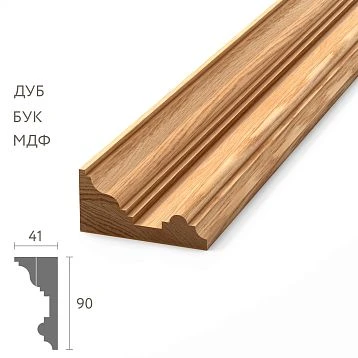
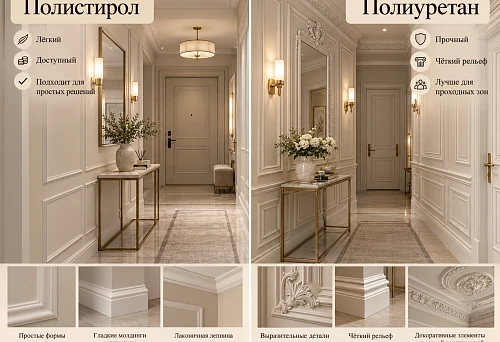
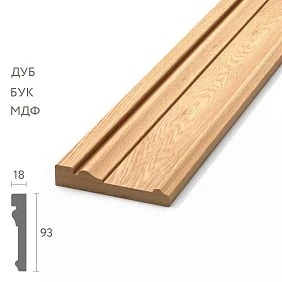
Wooden baseboardSolid wood — for parquet floors, classic interiors, high-end residential spaces. Texture, warmth, naturalness — things that neither MDF nor plastic can reproduce.
MDF Skirting Board— for laminate and vinyl floors, for rooms with unstable humidity, for finishing under painting. Flawless geometry, stability, perfect surface for any paint.
Floor skirting height: 40–60 mm (low), 60–80 mm (medium), 80–150 mm (high). More details — in the articleWooden baseboard.
Get Consultation
MDF skirting: a separate topic
Baseboard MDFdeserves special attention as a material for finishing. Its main advantage over wood in the context of finishing is the perfect reaction to painting. The MDF surface has no pores or fibers, so the paint applies evenly, without stains or drips. White MDF skirting in a white interior is both a decorative profile, a visual boundary of space, and a neutral background.
Important detail:MDF Skirting Boardfor painting can be painted in any color according to RAL or NCS — this opens up design possibilities unavailable for solid wood. Dark blue skirting in a white interior as a lower graphic accent; skirting in the color of the wall to make it 'disappear'; skirting in the color of the floor to visually expand the plane — all this is realized precisely through MDF. Complete guide — in the articleMDF baseboard types sizes installation.
Wooden skirting board
Wooden baseboardmade of solid wood is a product that has what no synthetic material has: living texture, organic warmth, the ability to accept wood-like toning. Oak, beech, pine — different species for different tasks. Oak — durability and expressive texture. Beech — homogeneous fine-pored surface that accepts painting well. Pine — warm reddish tone and affordability.
to buy wooden baseboardfor parquet from the same species is a professional design technique: a unified material environment from the floor to the lower line of the wall.
High baseboard
High skirting (from 80 mm) is not just protection for the gap near the floor. It is an architectural element: it creates a plinth belt for the room, makes the ceiling visually higher, enhances the sense of scale. In interiors with ceilings from 3 m, highWooden baseboard100–120 mm is the norm, not a luxury.
In combination withwooden corniceAt the same ceiling height, a vertical rhythm is achieved: the lower and upper belts frame the walls, creating a sense of complete architecture.
White baseboard
A white skirting board for painting or in factory white enamel is the most popular solution for interior finishing. It works with any wall and floor covering color. In a white interior, whiteMDF Skirting Boardcreates a unified white perimeter. In an interior with dark walls, it provides a clear light accent at the floor.
Molding
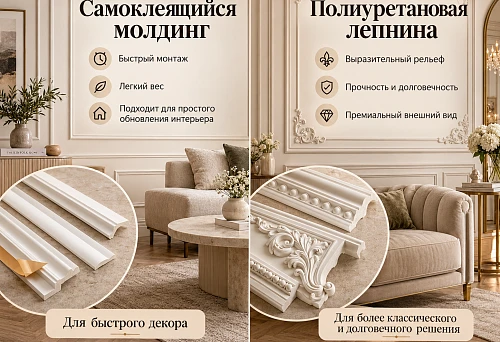
Wooden molding— a decorative horizontal or vertical profile. In the finishing system, it performs several functions: creates horizontal belts on the walls (upper and lower), forms framed panels, decorates transitions between panels and the wall, and conceals joints at decorative inserts.
Molding is wall architecture without renovation: stick the profiles onto rectangular markings, paint them to match the wall or in a contrasting color—and a full-fledged molding panel is ready. This technique changes the space radically and costs incomparably less than stucco or gypsum profiles.
Cornice
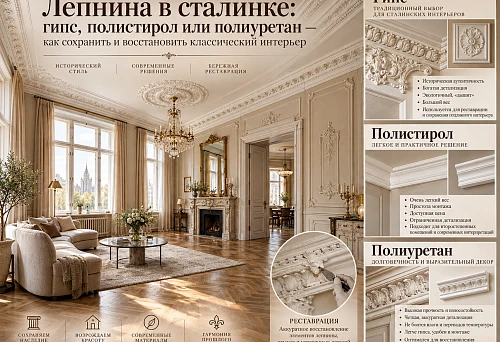
Wooden cornice— a ceiling profile, the mirror counterpart to the floor skirting board. It conceals the joint between the ceiling and wall, creates an upper horizontal belt, and with rich relief, becomes a full-fledged architectural element of a classic interior.
MDF Crown— for modern interiors, paintable. Height from 50 to 150 mm — the larger the room scale, the taller.
Important: the skirting board and cornice must be made of the same material and from the same profile line. This is a rule of system integrity that must not be broken.
Profile for panels
When walls are decorated with wall or slatted panels, specialized profiles are needed around the perimeter of the panel field: at the bottom—a skirting board, at the top—a horizontal molding, on the sides—a vertical molding or corner. For details, see the articlebaseboards for panels.
Corner Trim
Wooden corner bracket— a tool for corner joints and abutments. Covers gaps in built-in furniture, cabinet sides, and door reveals. An important component of the finishing system often overlooked during budget planning.
Which Finish — Which Profile: A Practical Matrix
This is the most important question. The answer depends on the application area.
For Floor Finishing
Task: close the expansion gap, create a bottom horizontal line. Tools:
-
Wooden baseboard— for parquet, solid wood flooring, engineered wood flooring
-
MDF Skirting Board— for laminate, quartz vinyl, tile
-
Height: 60–120 mm depending on ceilings and style
For Wall Finishing
Task: create horizontal belts, form frame panels, divide the wall into zones. Tools:
-
Wooden moldings— horizontal and vertical profiles for frame panels
-
Wooden cornice— for top finishing
For decorative panels
Task: frame the perimeter of the panel field. Tools:
-
At the bottom:Wooden baseboardor MDF
-
At the top: horizontalWooden molding
-
On the sides: vertical molding or corner
For slatted panels
Rafter panelscreate a strong vertical rhythm. The baseboard at their base should support this rhythm, not compete with it. A thin straight profile matching the slats — or a narrow corner. Detailed analysis — in the articleslatted panels for walls.
For joints and abutments
Wooden corner bracketthin molding, extension strip fromsolid wood trimDetails — in the articleskirting board for gaps.
For classic finishing
The entire perimeter — from one material: woodenSkirting, Wooden moldings, Wooden cornicewith rich relief,decorative elementsat corner joints.
For modern finishing
Straight profiles, minimal relief, painted to match the wall color or in a contrasting color.MDF Skirting Boardwithout relief + straight MDF cornice + thin molding matching the wall color.
Wood or MDF: What to Choose for Finishing
This is a question asked in nine out of ten cases. The answer is contextual.
When is a wooden skirting board best
-
Parquet and Wooden Flooring — Unity of Material
-
Country House, Eco-Interior, Classic
-
Toning "to Wood" or Under Varnish with Open Texture
-
High-End Residential Real Estate, Where Naturalness is a Priority
-
Long-Term Operation:Wooden baseboardwith proper coating, it lasts for decades and allows restoration
When is MDF skirting best
-
Laminate, Quartz Vinyl, Tile — Universal Material for Any Coating
-
Rooms with Variable Humidity (Kitchen, Hallway, Open Corridors)
-
Finish for painting in exact RAL color
-
Large commercial facilities where geometric stability is important
-
White interior, minimalism, modern classic
buy MDF skirting board— when a perfect surface for painting is needed under any operating conditions.
When to choose molding
Molding is needed not instead of a baseboard, but next to it. If a full decorative wall program is created in the room — frame panels, horizontal belts —Wooden moldingsbecome the main tool. They turn a flat wall into an architectural surface.
Separate scenario: molding as the top finishing profile for a wall panel instead of a cornice. Works in rooms with low ceilings or in a modern style where a cornice would be overloaded.
When a cornice is needed
Wooden corniceis mandatory in classical and neoclassical interiors. It creates the top finishing belt and together with the baseboard forms a full three-level system: baseboard–wall–cornice. Without a cornice in a classical space, the wall looks 'suspended'.
In a modern interior, a cornice is not mandatory but can be used as a design accent — a thin straightMDF Crownin the color of the wall gives a thin horizontal line at the ceiling, visually expanding the room.
When to combine multiple profiles at once
Always — in the high-end segment. In an interior with parquet, molding wall panels, and slatted cladding in a niche, a unified wooden profile — made from one material, one wood species, in one finish — is what creates the class of the space.Pogonazh iz massivaIn a unified style throughout the entire perimeter — a sign of a professional approach to finishing.
Choose a solution for your task:
-
Wooden baseboard— for parquet flooring and classic interiors
-
MDF Skirting Board— for laminate floors and white interiors
-
Wooden moldings— for wall panels and framed compositions
-
Wooden cornice— for ceiling finishing in classic style
-
Wooden corner bracket— for corner joints and seams
-
Rafter panels— for wall finishing with profile framing
How to choose a baseboard for finishing according to interior style
Style is not an option, it's a condition. A profile that doesn't match the style of the space ruins even a perfectly executed finish.
Classic
In a classic interior, the entire profile system should be rich in relief. HighWooden baseboardwith a shaped cross-section (ogee, cavetto, multi-bead profile),Wooden moldingson walls as frame panels,Wooden corniceat the ceiling with a wide ogee — this is a unified decorative program where there are no random elements.
Material: solid oak or beech. Finish: white enamel or wood stain with varnish. Additionally —decorative elementson corner joints of baseboard with architraves.
Neoclassicism
Neoclassicism is classicism freed from excess. Profiles retain relief but become more elegant. Baseboard height — 80–100 mm, cornice — moderate, moldings — without overload. White enamel is the main finish.MDF Skirting Boardwith a thin shaped profile plusWooden moldingsIn framed panels — this is pure neoclassicism.
Modern interior
No relief. Straight lines, minimal profile, often — a baseboard matching the wall color.Baseboard MDFRectangular section 60–80 mm in factory white enamel or paintable. Cornice — not required. Instead — a thin light line in a niche or simply nothing.
Minimalism
Here, the law 'less is more' applies. Baseboard matching the wall color, height 40–60 mm, straight profile without protrusions.MDF Skirting BoardPaintable — ideal: painted to the exact wall color, 'disappears' in the space. No cornice. No moldings. Maximum purity of lines.
Interior with moldings
This is a space whereWooden moldingsbecome the main decorative tool of the walls. The baseboard here is the lower base of the molding system. It should be proportionate: with a high (100 mm) molding of the lower frame — baseboard 80–100 mm. With a thin (40 mm) molding — baseboard 60 mm.
Key rule: baseboard and moldings are purchased from the same line, from the same material, in the same tint. Not 'similar,' but exactly from the same line.
Interior with slatted panels
Rafter panels— powerful vertical rhythm. The baseboard for them is chosen neutral: narrow, without relief, matching the slats or in a contrasting dark color. A wide shaped baseboard under slatted panels is a stylistic conflict.
How to choose by material and finish
Solid wood
Main advantages: naturalness, durability, ability to be restored. Can be repainted, re-varnished, re-sanded.Wooden baseboardMade from solid wood — an investment in long-term finishing.
Important: before installation, solid wood needs to be acclimatized (2–3 days in the room). Installation — with adhesive or liquid nails, pressed against the wall.
MDF
Main advantage — stable geometry.MDF Skirting BoardDoes not change shape with humidity fluctuations, does not crack at joints, does not warp. For commercial properties and living spaces with unstable microclimate — the optimal choice.
Profile for painting
Painting-ready profile — includes both MDF and wood with a primed surface. Feature: before final painting, the surface is sanded and a finishing primer is applied. Then — paint in the desired color. Baseboard matching the wall color — the main designer trick for visually increasing room height.
Smooth and shaped profile
Smooth rectangular profile — for modern and minimalist interiors. Shaped profile with relief (ogee, cavetto, shelf) — for classic and neoclassical styles. Must be chosen before installation begins: different profiles in one room — a stylistic disaster.
How to choose by height and proportions: interior mathematics
Baseboard height is not just about aesthetics. It's mathematics: the profile must match the scale of the room.
Low skirting board (up to 60 mm)
For rooms with ceilings up to 2.7 m. For minimalist interiors. For small rooms where a high skirting board would eat up the height. ThinMDF Skirting Board40–50 mm in wall color — practically disappears.
Medium height (60–80 mm)
Universal format. Suitable for standard apartments with ceilings 2.7–3 m. Works in all styles: modern, neoclassical, Scandinavian.Wooden baseboard70–75 mm — the gold standard of residential finishing.
High skirting board (from 80 mm)
For rooms with ceilings from 3 m. For classic interiors with a rich molding program. A 100–120 mm skirting board creates a lower architectural belt, which visually structures the space and makes it 'weightier'.
Wide profile
A wide skirting board simultaneously covers a large expansion gap (important for parquet) and creates an accent. Width here refers to the horizontal plane of the front part: the wider the profile, the more noticeable the lower line of the interior.
How to match the profile to the wall height
Simple rule: skirting board height is 3–5% of ceiling height. With 2.7 m ceilings — 80–135 mm skirting. With 3 m — 90–150 mm. This is a guideline, not a standard: design tasks may require deviations in both directions.
Skirting + molding + cornice + panels: how to combine in one interior
This is the moment when finishing stops being a set of details and becomes an interior.
Baseboard + Molding
Basic two-level system:Wooden baseboardat the floor +Wooden moldingson the walls as a horizontal belt at a height of 80–100 cm. This is a classic technique for dividing a wall: the lower "base" and the upper "clean" plane.
Material: one. Toning: one. Profile: coordinated (not identical, but of the same character).
Skirting + cornice
Vertically closed system: the lower line of the skirting and the upper line of the cornice create a "frame" for the walls. The height of the skirting and cornice should be proportionate: a thin skirting with a massive cornice is an imbalance, and vice versa.Wooden corniceandWooden baseboardfrom one series — professional result.
Baseboard + slatted panels
Baseboard in front ofplank panels— a mandatory element. The slats do not reach the floor: a gap remains underneath them, which is covered by a baseboard with a tight press against the panel end. The baseboard hides the technical setback and simultaneously creates a horizontal finish at the base of the vertical rhythm.
Baseboard + door casings
Door casings and baseboard are one system. Uniform material and tinting turn the doorway into part of the room's decorative language. The transition from baseboard to vertical casing is a technically critical junction. In a quality solution, a corner connecting rosette made ofdecorative elements.
Baseboard + decorative elements
decorative elements— corner overlays, carved cartouches, ornaments — these are accent points in the profile system. At the junction of baseboard and casing, in the upper corners of the molding frame, above the doorway — wooden ornament turns a technical junction into a decorative one.
Assemble the finish comprehensively:
-
to buy wooden baseboard— the lower line of the space
-
Wooden moldings— frame panels and horizontal belts
-
Wooden cornice— top finishing at the ceiling
-
Rafter panels— wall finishing with a framing system
-
decorative elements— accent decor on corner joints
-
Pogonazh iz massiva— all additional profiles in one style
What to buy together with skirting board for finishing
Plan your purchase systematically: a skirting board without adjacent elements is an incomplete solution.
Moldings are linear profiles used to create framed compositions, zone walls, and frame openings. They come in various widths (from 20 to 150 mm) and relief complexity — from smooth to richly decorated.
Wooden moldings— a mandatory addition in classic and neoclassical interiors. Purchased simultaneously with the skirting board, from the same line.
Crown mouldings
Wooden cornice— the ceiling counterpart to the floor skirting board. In high-end finishing — mandatory. In modern interiors — at the designer's discretion.
Corner pieces
Wooden corner bracket— for corner adjacencies at furniture and reveals. Often forgotten during planning — and purchased separately with the risk of finding a different shade.
Rack panels
If the project includes Rafter panels— the entire set of profiles for framing them is purchased at once.
Decorative elements
decorative elements— corner rosettes, ornaments, carved accents. Small budget, big visual impact.
Molding in one style
Pogonazh iz massiva— all non-standard and additional profiles needed for a specific project are purchased from the same material and with the same finish.
Common mistakes when choosing trim profiles
These mistakes cost money and nerves. Let's break them down right now.
Choosing baseboard based solely on price. A cheap plastic baseboard in a parquet interior is like an expensive suit with plastic buttons. The price of a wooden or MDF baseboard is a small part of the finishing budget, but its role in the final result is disproportionately high.
Not considering the style of the finish. A classic profile with a bead in a minimalist interior. A straight, thin baseboard in a rich classic room. Both options are mistakes that are noticeable immediately.
Mixing different profiles without logic. Wooden baseboard + plastic cornice + MDF molding in different finishes — that's three materials, three textures, three characters. The system falls apart.
Choosing random plastic instead of a decorative solution. Plastic baseboard is a compromise that only looks good for the first six months. Under stress — it yellows, deforms, loses its shape. NaturalWooden baseboardorMDF Skirting Board— fundamentally different quality.
They don't coordinate the skirting board with panels and cornices. They buy the skirting board, then moldings, then cornice. Each element is from different batches, with different tints. Result: 'looks similar, but not quite.' Buy the system all at once.
They choose too small a profile for large rooms. A low skirting board in a hall with high ceilings and large windows gets visually lost. The space requires proportionate accents.
How to buy skirting board for finishing and not make a mistake: step-by-step instructions
Step 1. Determine the application area
Floor, walls, panels, junctions — each zone has its own task and its own type of profile.
Step 2. Choose the material
Parquet and classic →Wooden baseboard. Laminate and white interior →MDF Skirting Board. Decorative belts and frames →Wooden moldings.
Step 3. Choose height and profile
Ceilings up to 2.7 m → 60 mm. 3 m → 80–100 mm. Higher → 100–150 mm. Style: modern → straight profile. Classic → shaped relief profile.
Step 4. Choose the color
To match the wall, to match the floor, or in contrast. For painting → MDF. For clear varnish → solid wood.
Step 5. Check the combination with other elements
Is the skirting board coordinated with the cornice, architraves, moldings? One material, one tint, one profile character.
Step 6. Assemble the full set
Skirting board + moldings + cornice + corner pieces + decorative elements — all from one line, from one catalog.Solid Wood ItemsSTAVROS — a complete system of finishing profiles in a unified style.
FAQ: Frequently Asked Questions about skirting boards for finishing
Which skirting board is better for final finishing — wood or MDF?
Depends on the floor and style. For parquet — wood. For laminate and in a white interior — MDF. Both materials provide a professional result with the right choice. Detailed comparison — in the articleSkirting board for MDF.
Is a cornice needed in a modern interior?
Not necessary. A thin, straight cornice in the color of the ceiling creates a horizontal line without visual overload. In pure minimalism, a cornice is not used at all.
Can you combine a wooden baseboard and MDF moldings?
Yes, if both elements are painted the same color. When painted, the material is not visible—only the shape and color are. But in a classic interior with varnish, a uniform wood is preferable.
How to choose the height of the baseboard relative to the ceiling height?
The 3–5% rule: for a 2.7 m ceiling — baseboard 80–135 mm. For 3 m — 90–150 mm. This is a guideline; the final choice depends on style and design.
What is a profile for painting?
These areMDF Skirting BoardA primed wooden baseboard with a ready surface for applying paint. Does not require additional preparation—primed once, painted in the desired color.
Where to buy a full set of finishing profiles in one style?
In the STAVROS catalog—baseboards, moldings, cornices, corners, paneling, and solid wood trim in a unified line.
Are decorative elements needed at the joints of baseboards and trim?
In a classic interior — yes. A wooden corner rosette at the joint covers the technical corner and creates a decorative accent. In a modern interior — no: a straight joint without an overlay aligns with the minimalist style.
How to correctly choose a profile for slatted panels?
A narrow straight baseboard or corner piece matching the slats at the bottom, a thin molding at the top. A wide shaped baseboard under the slats is a stylistic conflict.
A baseboard for finishing is not the final touch on the horizon nor the last item on the estimate. It is an architectural tool that shapes the space from the bottom up. A correctly chosen profile for the floor, walls, and panels is what transforms a set of building materials into a complete interior with character.
The company STAVROS produces a complete system of wooden finishing profiles:Wooden baseboardandMDF Skirting Boardfor floor finishing,Wooden moldingsandWooden cornicefor walls and ceilings,Rafter panelsanddecorative elementsfor accent decor. AllPogonazh iz massiva— in a unified line, made from natural wood, for any coating. The result: not 'purchased profiles,' but a ready-made finishing system in one style — from floor to ceiling.
View the full catalogof solid woodand choose the solution for your project.