





































































Article Contents:
- Why Do You Even Need a Stair Skirting Board
- Where Exactly is Skirting Board Placed on Stairs
- Skirting Board Along the Stair Flight by the Wall
- Skirting Board on the Landing Before the Stairs
- Skirting Board at the Junction of Stairs and Floor
- Finishing Details at the First and Last Steps
- Which Material to Choose: Wood or MDF
- When Wooden Skirting Board is Better
- When is MDF skirting best
- How to choose skirting for a specific staircase
- For a wooden staircase
- For a staircase painted with enamel
- For a modern straight staircase
- For a classic staircase with balusters
- For a staircase with a landing and complex angles
- How to choose height, thickness, and profile
- How to match skirting with balusters, handrails, and steps
- When wooden slats and slatted panels are suitable for a staircase
- Mistakes when choosing skirting boards for stairs
- Installing skirting boards on stairs: what's important to consider
- What to choose for stairs: 3 ready-made scenarios
- Scenario 1. Solid wood staircase — wooden skirting board to match
- Scenario 2. Modern white staircase area — MDF skirting board for painting
- Scenario 3. Staircase + accent wall — skirting board, slats and balusters in a unified solution
- Where to buy skirting boards for stairs and what to order together with them
- Combining skirting boards with other interior elements: an extended view
- Popular questions and answers (FAQ)
- About the Company STAVROS
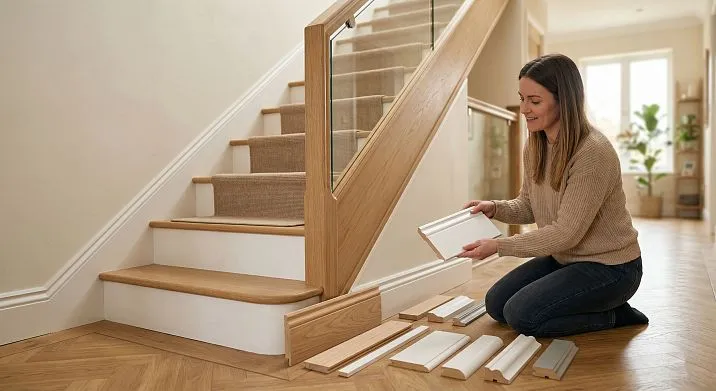
A staircase is not just a functional structure that connects floors. It's an architectural accent, the calling card of a house, a place where materials, textures, colors and styles meet. And it's precisely here that most people make the same mistake: they take a regular floor skirting board, install it along the flight — and get a result that hurts the eyes. The profile is tilted at the wrong angle, the joints bulge, and the wall junction looks sloppy.
Skirting boards for stairs are a separate task. Here there's different geometry, a different installation scenario, a different logic for material selection. The regular floor scenario doesn't work here. You need to simultaneously finish the stair flight at the wall, close the junction to the landing, properly join the profile at the first and last step — and at the same time maintain a unified style with the steps, balusters, handrails and walls of both floors.
That's exactly what this article is about. No fluff, with specific answers to questions that actually arise when finishing the staircase area.
Choose a solution for your staircase right now:
Wooden baseboard— solid oak and beech
MDF Skirting Board— for painting and in ready-made colors
balusters for staircases— wooden, solid wood
staircase components— everything in one place




Why do you even need a staircase skirting board
At first glance, a staircase seems like a self-sufficient structure. Especially if it's wooden, excellently crafted, and looks solid. Why would you need any skirting board here?
But as soon as the installation of the steps is finished and the construction dust is cleared away, it becomes clear: a gap remains between the stringer or carriage and the wall. Sometimes a few millimeters, sometimes a centimeter or more. The wall is uneven, the staircase has its own geometric rhythm. This gap cannot be closed with plaster or putty—it will work, breathe along with the wood. And it is precisely the staircase skirting board that closes this joint: neatly, professionally, forever.
But the function of a skirting board on a staircase is not only technical. It solves several tasks at once:
-
Closes the joint between the wall and the stair flight — eliminates the gap, dust, and unwanted cracks at the base
-
Makes the transition from the stairs to the landing neat — each landing has its own angle, its own joint, and the skirting 'reads' it
-
Completes the look of the staircase — without it, even the highest-quality construction appears unfinished
-
Visually connects the staircase with the floor of the first and second floors — the skirting should pick up the rhythm set on both levels
-
Protects the wall near the flight — this area regularly receives mechanical loads: when moving furniture up, during cleaning, from accidental contact
Finishing a staircase with skirting is not decoration for decoration's sake. It is a proper architectural detail that either emphasizes the quality of the entire work or reveals its weak points. Stair skirting is not noticed when it is there. It is noticed when it is missing.




Where exactly is skirting installed on a staircase
Before choosing a profile, you need to understand exactly where it will work. On a staircase, it's not a single line along the wall — it's several zones with different tasks.
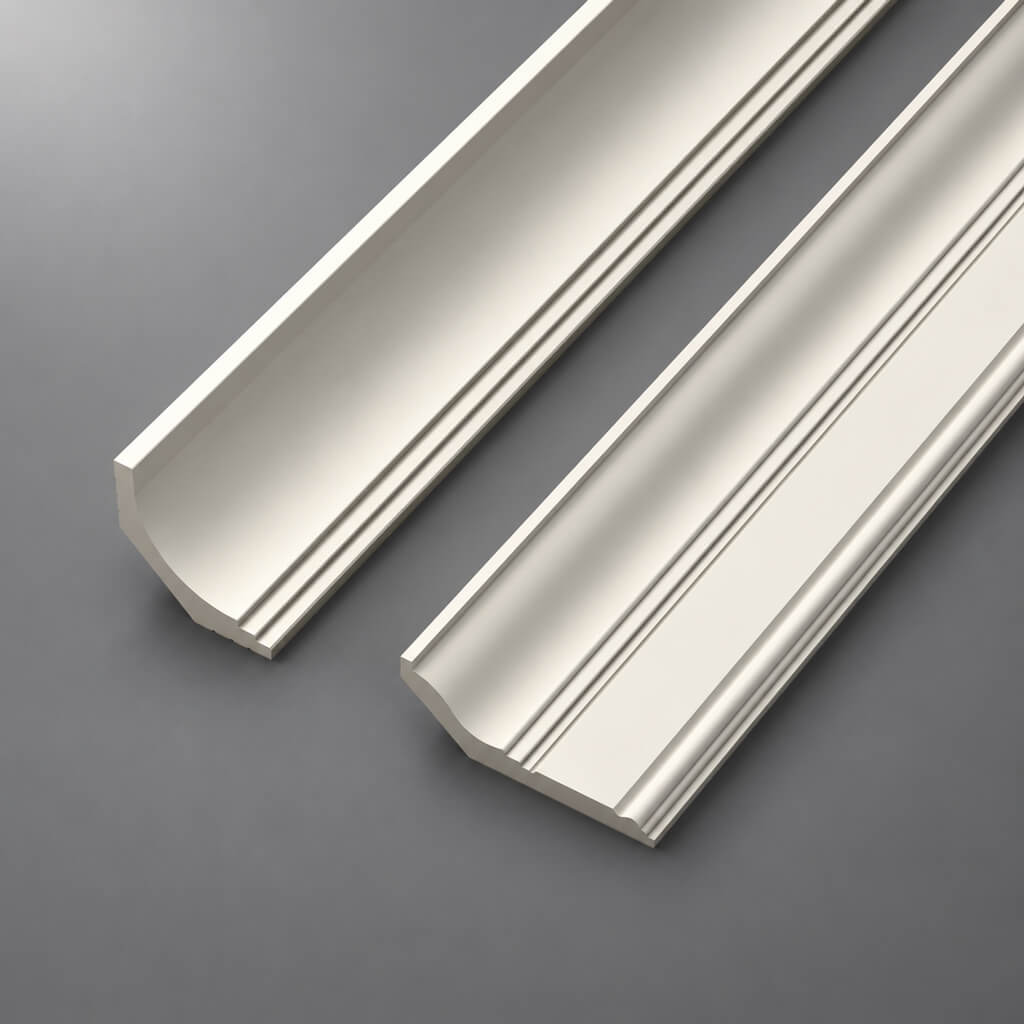
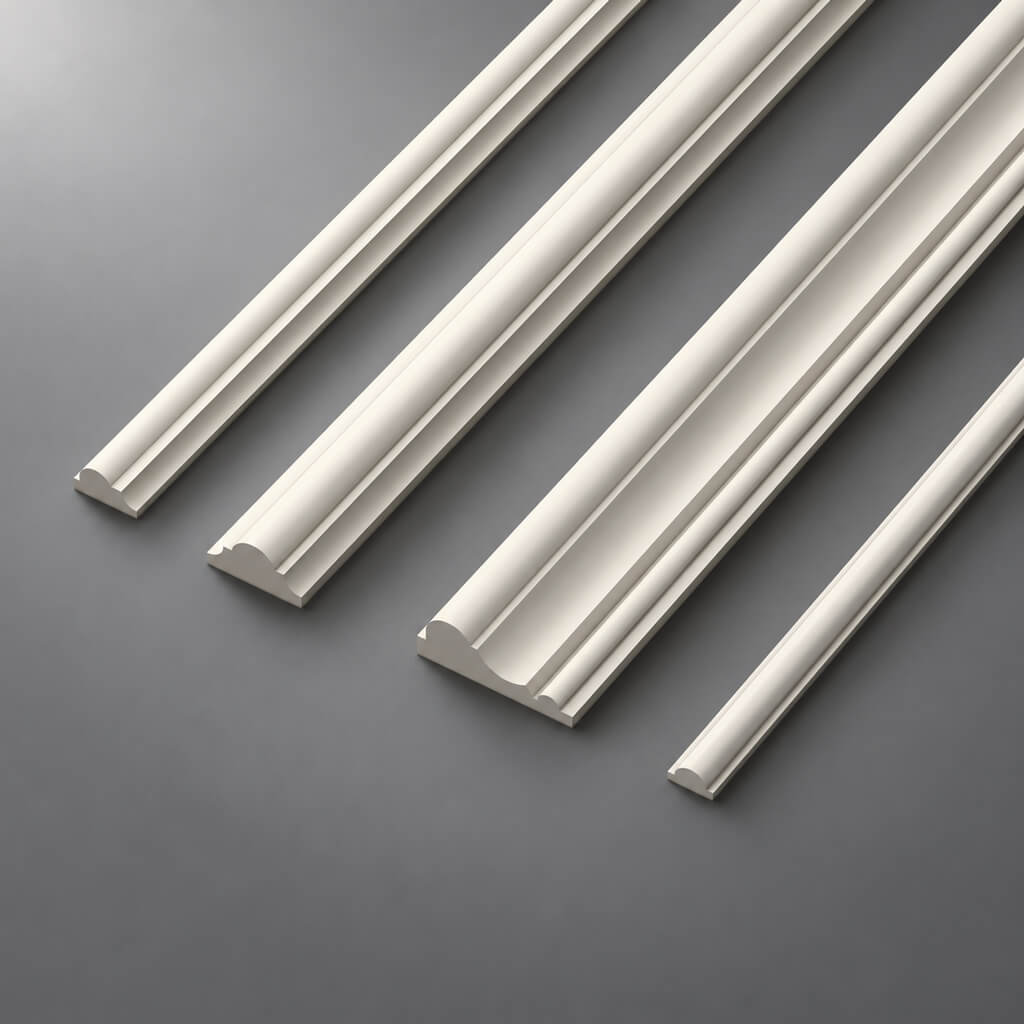
Our factory also produces:


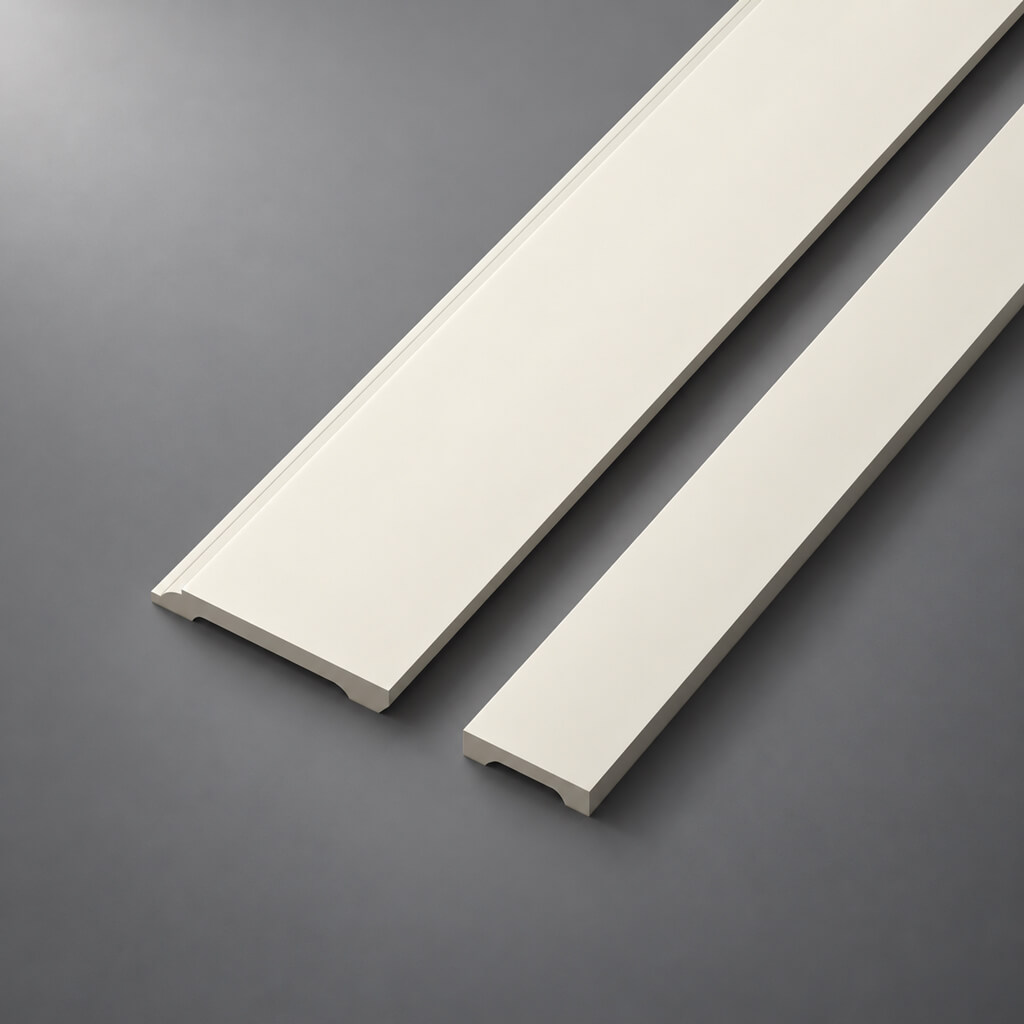
Skirting along the stair flight by the wall
This is the main and longest zone. The skirting for the stair flight by the wall runs along the entire ascent — at an incline, following the angle of the flight. Here, it's important that the profile not only closes the gap but also fits organically into the angle between the wall and the stair structure. The skirting along the stairs is installed at the same angle as the flight itself — typically from 30° to 45°, depending on the steepness of the ascent.
This is the section where mistakes are most often made: they take a profile without considering the angle and end up with crooked joints at the top and bottom points of the flight.
Get Consultation
Baseboard on the landing in front of the stairs
Landing — a horizontal zone at the base or at the top exit of the stairs. Here, the baseboard for the stair landing already functions as a regular floor baseboard but must seamlessly connect with the flight profile. The transition from inclined to horizontal is the most complex joint in all stair finishing. It requires careful cutting or special connecting elements.
Baseboard at the junction of the stairs and the floor
The bottom point of the stairs — the place where the flight meets the first-floor floor. Here, the baseboard must join with the floor profile without creating a visual break. Ideally, they are taken from the same series or matched in height and tone.
Finishing the joints at the first and last steps
The first step from the bottom and the last from the top are special points. In these places, the baseboard ends, is cut, or transitions into another profile. Without proper finishing, these joints look incomplete. Here, they often useWooden corner bracketas an additional element that covers the end of the profile and gives the corner a finished look.
Which material to choose: wood or MDF
This is the main question when choosing a baseboard for stairs in a house. The answer depends not on personal preferences but on specific conditions: what kind of stairs, what interior, for painting or in a natural texture.
When is a wooden skirting board best
Wooden baseboard— the number one choice if the staircase is made of solid wood. Oak to oak, beech to beech — this is not just aesthetics, it's material integrity. Natural wood reacts to humidity and temperature in a similar way, so the joints remain stable even with seasonal changes.
A wooden skirting board for a wooden staircase is appropriate in the following situations:
-
Staircase made of solid oak, beech, ash, or softwood
-
Interior in classic, Scandinavian, rustic, or eco-style
-
A noble texture with visible wood grain is desired
-
The possibility of subsequent restoration and repainting is important
-
A premium presentation is planned — house, cottage, country home
A skirting board for a wooden staircase made of solid oak is an investment. It lasts for decades, doesn't require replacement, and can be sanded and stained. Oak skirting is chosen when you want the staircase to become a decoration of the home, not just a functional structure.
A skirting board for a beech staircase — slightly softer in tone, with a more uniform texture. It pairs well with interiors in light, natural shades and with staircases made of light-colored woods.
When is MDF skirting best
MDF Skirting Board— the right choice where uniformity of coating, even color, and a neat modern profile matter. MDF skirting for stairs is suitable if:
-
The stair area is painted the same color as the walls and doors
-
Interior in minimalist, hi-tech, or modern classic style
-
You need white or enamel skirting for stairs — without texture, smooth as a taut thread
-
It's important to visually connect the stairs with the walls, door frames, and painted elements
-
The budget is limited, but quality and appearance are important
MDF skirting for stairs for painting is a universal solution for those who want a perfectly smooth surface. The factory geometry of MDF is more precise than solid wood: no knots, no unevenness — only a smooth profile that takes paint perfectly.
What will suit you best:
Solid wood stairs →Install wooden skirting board on stairs
Painted interior →Choose MDF skirting board for stair area
Classical staircase with balusters →View balusters for wooden staircaseand select skirting board in unified style
How to choose skirting board for specific staircase
Theory is good. But it's more important to understand exactly how your staircase looks — and what suits it. Let's examine specific scenarios.
For wooden staircase
The main rule — don't fight the texture. If the staircase is made of oak,to buy wooden baseboardFrom the same oak or a similar species is the right choice. The tone can be taken slightly lighter or a bit darker than the steps—this creates depth, not monotony.
The baseboard for a wooden staircase in a private house must withstand seasonal humidity fluctuations. Solid wood handles this better than MDF—it 'breathes' in sync with the staircase.
For a staircase painted with enamel
A white baseboard for the staircase is a classic for interiors where everything is painted: treads, risers, the wall along the flight. Here— is a horizontal element that frames the room at the bottom of the walls where the wall meets the floor. Skirting boards perform several functions: they hide the technological gap between the wall and floor covering (necessary for thermal expansion), protect the lower part of the wall from mechanical damage, create visual completion, and may conceal wiring.is the perfect solution. A white MDF profile with enamel creates the impression of a monolithic architectural line that runs along the entire ascent.
A painted MDF baseboard for the staircase can be taken ready-made in white or choose a profile for painting and paint it yourself in the desired RAL shade—for example, the same color as door frames or window sills.
For a modern straight staircase
A minimalist baseboard for the staircase—low profile, clear geometry, without decorative milling. A modern staircase with open treads and a metal handrail does not tolerate 'baroque' baseboards. Here, a profile 40–60 mm high with a flat front surface, matching or contrasting the steps, is appropriate.
For a classic staircase with balusters
WhenBalusters for staircaseturned, handrail—with a profile, and treads—made of oak, the baseboard should pick up this architectural rhythm. A classic baseboard for the staircase with a shaped profile, milling, slightly expressive relief—will organically fit into the ensemble and complete the look.
The profile height here should be noticeable: 80–100 mm. This gives the staircase flight base a sense of solidity and matches the scale of the balusters and handrail.
For a staircase with a landing and complex angles
Baseboard for a staircase with a landing is a case where all joints need to be thought through in advance. On the landing, the profile transitions from sloped to horizontal—this requires precise mitering or the use of a special connecting element. MDF works better here: it cuts more easily, doesn't chip, and joints more precisely.
How to choose height, thickness, and profile
This is not a technical question—it's a question of proportions. A correctly chosen baseboard height makes the staircase visually complete. An incorrect one creates a feeling that something is off, though you can't immediately tell what exactly.
Low profile (up to 50 mm)—for light, modern staircases. Open treads, metal, glass—that's their company. Such a baseboard on a staircase flight is almost unnoticeable, and that's correct: the focus here should be on the staircase itself.
Medium profile (60–80 mm)—a universal choice. Suitable for most wooden and painted staircases, doesn't clash with balusters, looks organic against standard walls.
Wide baseboard for a staircase (from 90–100 mm and above)—for massive staircases, classic interiors, high ceilings. Such a profile becomes an architectural element in itself. Suitable for wooden balusters, turned handrails, voluminous treads.
Profile thickness also matters. On a staircase, it should relate to the thickness of the stringer or carriage. If the stringer is 40 mm, a 12 mm baseboard will look thin and weak. Choose a profile with a thickness of at least 18–22 mm—this gives a sense of sturdiness and solidity.
Regarding color: a baseboard for a staircase matching the tread color creates a monolithic look, where the flight is perceived as a single whole. A baseboard matching the floor color connects the staircase with the horizontal plane of the floor. A dark baseboard for a staircase on a light wall—a graphic accent that emphasizes the geometry of the ascent.
How to match baseboards with balusters, railings, and steps
This section is one of the most important in terms of the final result. It is here that taste and architectural thinking are revealed.
A staircase is an ensemble. It consists of steps, risers, stringers, handrails,Wooden balustersand finally, the baseboard against the wall. All these elements should speak to each other in the same language.
If there are wooden balusters, the baseboard should not clash with them in tone. It's better to choose a baseboard from the same wood species or in the same color palette. An exact match is not necessary: slightly lighter or slightly darker creates a subtle play of shades and adds depth.
If the staircase is classic, tie the baseboard, balusters, and handrail into a unified story. The baseboard profile can echo the milling of the balusters: repeat their shape on a smaller scale or use the same rounding radii. It's subtle, but it's precisely such details that distinguish professional finishing from amateur work.
If the staircase is modern, the focus remains on the steps. Here, the baseboard should not steal the show:select a baseboard for the flight of stairswith a minimal profile, in a neutral color, and step back into the shadows, letting the steps take center stage.
Railings and handrails are indirect guides for choosing the baseboard color. If the handrail is dark, a dark baseboard rhymes with it and creates a vertical and horizontal frame for the flight. If the handrail is light or white, you can choose a baseboard in the same tone.
Wooden railings and balusters from the catalogstaircase componentsallow you to select the entire staircase ensemble from one line — the baseboard, balusters, and handrail will be in the same texture and wood species. This is the simplest way to achieve a professional result without a design education.
When wooden slats and slatted panels are appropriate for a staircase
The staircase area is not just the flight itself. It also includes the wall next to it: it occupies a large area, is the focal point, and sets the tone for the entire space.
In modern interiors, the wall along the staircase is increasingly made an accent. And hereslatted panels for wallsis one of the most expressive techniques. VerticalWooden planksalong the staircase flight create rhythm, add tactile texture, and make the wall come alive.
It's important to understand: slats and slatted panels are not a replacement for the baseboard. This is a related design technique that works in tandem with it. The baseboard covers the junction with the floor, the panels or slats cover the wall plane, and together they create a finished finish for the staircase area.
Several combination rules:
-
The baseboard and slats should be made from the same wood species or be the same color — this creates a unified system
-
If the slats are vertical, it's better to choose a baseboard with a minimal profile to avoid overloading the lower zone.
-
The color of the baseboard can match the color of the slats or be slightly darker—this visually 'grounds' the wall.
-
On the landing, you can continue the slat pattern onto the horizontal wall—then the staircase area becomes a cohesive interior object.
Read more about howbuy slatted panelsand how to properly combine them with baseboards and other elements—read in the article aboutslatted panels for walls.
Mistakes when choosing a baseboard for a staircase
Practice shows: most problems arise not from material quality, but from an incorrect approach to selection. Here are typical mistakes that spoil the result.
Mistake 1. Using a standard floor profile without considering the angles of the flight
A floor baseboard is designed for horizontal installation. On a staircase flight, it must run at an angle—and a standard profile here results in crooked joints at the top and bottom because its geometry does not account for such a scenario.
Mistake 2. Not considering the height of the baseboard on the landing and floors
The baseboard for the staircase should organically connect with the baseboard of the first and second floors. If the floor has 80 mm and the flight has 45 mm, the transition looks random. It's better to use the same or a similar height around the entire perimeter.
Mistake 3. Choosing white MDF for a warm wooden staircase without transitional solutions
A cold white baseboard next to warm oak is a contrast that should be consciously used as a design technique. If it wasn't planned, the result looks like a mistake. For a warm wooden staircase, it's better to use MDF in a warm white shade or cream, or switch to solid wood.
Mistake 4. Not linking the baseboard with balusters and handrail
The baseboard is part of the staircase ensemble. Ifbalusters for a wooden staircaseare made of dark walnut, and the baseboard is light beech without treatment, there will be no visual connection. The ensemble falls apart.
Mistake 5. Forgetting about complex cuts and joints
The upper and lower nodes of the flight, the transition to the landing, joints near the steps—all of this needs to be thought through before installation begins. Otherwise, it turns out during the process that there isn't enough material, the cuts don't align, and redoing it costs more than proper planning from the start.
Mistake 6. Choosing too thin a profile
On a staircase, a thin baseboard looks weak and unserious. It gets lost against the backdrop of massive steps and balusters. The minimum thickness for the staircase area is 18–22 mm, preferably more.
Installing baseboards on stairs: what's important to consider
Installing baseboards on stairs is a more complex task than it seems. There are no standard 90-degree angles, no straight horizontal line, no familiar floor scenario. That's why it's important to prepare in advance.
Step 1. Check the wall geometry
Before installing baseboards along the stairs, check the wall for unevenness. On a stair flight, even a slight wall curve will be noticeable—the baseboard won't hide it, it will only emphasize it. If necessary, level the wall before installation.
Step 2. Determine the flight angle
The staircase's angle of inclination is the key parameter for cutting the baseboard. It must be measured precisely so the top and bottom joints fit without gaps. How to cut baseboard for stairs: use a miter saw with an adjustable blade tilt angle. For solid wood—use a blade with carbide teeth; for MDF—use a fine-tooth blade.
Step 3. Calculate the joints at the first and last step
The lower point of the flight—where the baseboard transitions to horizontal. The upper point—where it either ends or continues onto the landing. How to join baseboard on stairs at these points: make cardboard templates in advance, check the dry fit—and only then secure it.
Step 4. Lay out all material by length
Complex sections—the inside corner on the stairs, outside corner, transition to the landing—lay them out by length in advance. Cut them, assemble dry, check. Only after that, attach them.
Step 5. Consider the difference in installation between solid wood and MDF
How to attach baseboard on a solid wood staircase: use screws with countersunk heads, cover the fastening points with wooden plugs or wood-colored putty. For MDF, a combination of glue and finishing nails is suitable. Apply the glue in a zigzag pattern, press the baseboard and secure it with a nailer until it sets.
Step 6. Baseboard on a staircase: internal and external corner
The baseboard on a staircase has an internal corner where it meets the wall at the landing and an external corner where it wraps around the protrusion of the structure. Both corners require precise mitering or the use of ready-made corner elements. For MDF, external corners are best finished with factory-made end caps — a homemade miter cut is usually less precise here.
What to choose for a staircase: 3 ready-made scenarios
Theory is good, but a specific choice is better. Here are three real scenarios with clear recommendations.
Scenario 1. Solid wood staircase — wooden baseboard to match
Oak staircase, solid wood treads, profiled stringer, turned balusters. The interior is warm, classic or eco.
Solution:Wooden baseboardOak, height 80–100 mm, profile with a soft rounding. Tone — matching the color of the treads or half a tone darker. Installation with screws and wooden plugs. Finish — water-based varnish or oil, the same as on the treads.
Additionally:balusters for staircasesFrom the same wood species, wooden corner piece for finishing the ends,staircase components— in one order.
Scenario 2. Modern white staircase area — MDF skirting for painting
The staircase is painted white. Treads and risers — white enamel. Handrail — metal or white MDF. Walls — light, minimalist.
Solution:buy MDF skirting boardwith a smooth profile, height 60–80 mm. For painting or already in ready-made white. Mounting on glue + finishing nails. All corners — with factory caps. Joints on the platform — via a connector.
Additionally: considerslatted panels for wallsin white color along the flight — will create a modern accent without overload.
Scenario 3. Staircase + accent wall — skirting, slats, and balusters in a unified solution
The staircase is wooden, the wall along the flight — accent with vertical slats. Interior — modern classic or neoclassical.
Solution:Wooden baseboardin the tone of the slats — for example, oak with white oil.Wooden planksalong the wall create a vertical rhythm.balustersfrom the same breed and in the same finish. Skirting, rails, and balusters — from the same STAVROS line.
Effect: the staircase area turns into a full-fledged designer object, where all elements speak the same language.
Where to buy skirting for stairs and what to order together with it
One of the main advantages of proper planning is the ability to order everything in one place. This saves time, eliminates material mismatches, and simplifies selection.
What is included in the full set for the staircase area:
-
Buy skirting for stairs— wooden or MDF, depending on the scenario
-
balusters for staircases— turned, made of oak or beech, to suit any style
-
staircase components— handrails, fastening elements, extensions
-
Buy slatted panels for the wall— for an accent wall along the staircase
-
Wooden corner bracket— for finishing ends and corner joints
-
Wooden planks— decorative, for staircase wall area
If you're decorating the entire staircase area from scratch — it's more cost-effective and convenient to order everything together. This makes it easier to select a unified tone, control material compatibility, and achieve a coordinated result.
What to order together with staircase skirting:
Wooden balusters— for any style
Components for wooden staircase— complete set
Select slats and panels for the wall along the staircase— accent finishing
Wooden corner bracket— additional elements for complex nodes
Combining baseboards with other interior elements: an expanded perspective
A staircase does not exist in a vacuum. It is always part of a broader interior context: an entryway, hall, living room, or second-floor corridor. And the baseboard for the staircase must not only fit into the structure itself but also seamlessly continue the finish of adjacent spaces.
For those who want to delve deeper into choosing a wooden profile for the floor and flight, we recommend the article Floor wooden skirting — all formats, sizes, and application options are detailed there. And for those considering MDF solutions, it's useful to study Baseboard MDF with an analysis of installation features and finishing.
If you are simultaneously working on balusters — the article balusters for a staircase: types and selection will help you understand the variety of shapes, wood species, and combinations. And practical installation questions are covered in the material about installing balusters and railings on a wooden staircase.
Popular questions and answers (FAQ)
Can regular floor baseboard be used for a staircase?
Technically — it's possible. Practically — not advisable. A standard floor skirting board is not designed for slanted installation and lacks the geometry for proper joining at the nodal points of the flight. This results in crooked cuts, gaps near the steps, and untidy transitions. It's better to choose a profile specifically designed for stair applications from the start.
Which skirting board is better for stairs — wood or MDF?
It depends on the type of staircase. For a solid wood staircase — wood is better.Wooden baseboard. For a painted stair area, white interiors, modern styles — MDF for painting is better.MDF Skirting BoardBoth materials, if of good quality, last long and look dignified.
What height of skirting board should I choose for a staircase?
For modern staircases — 50–70 mm. For classic ones with balusters — 80–100 mm and above. Consider the scale of the staircase and the skirting height on adjacent floors — they should correspond.
Is a skirting board needed on a stair landing?
Yes. The landing is a separate horizontal zone, and here a skirting board is needed as on any floor. The profile on the landing should be the same as on the flight — or compatible with it. Otherwise, the transition looks unfinished.
How to close the junction between the staircase and the wall without a skirting board?
Without a skirting board, this gap can only be sealed with caulk or plaster — but both options provide a short-term result: they crack when the staircase moves. A skirting board is the only reliable way to seal the junction between the staircase and the wall durably and neatly.
Can slatted panels be used instead of a skirting board?
No. Slatted panels cover the vertical plane of the wall, while a skirting board covers the junction with the floor or the flight structure. These are different zones and different tasks. They work in tandem, not as replacements for each other.
How to choose a skirting board for a staircase in a private house or cottage?
In a private house, the staircase is typically a central element of the interior. Here, it's worth investing in solid wood:Wooden baseboardmade of oak or beech with the correct height and profile will create a finished look that will last for decades.
How many meters of skirting board are needed for a staircase?
Basic calculation: flight length × 1.1 (allowance for cuts and joints) + perimeter of landings. For a two-flight staircase with a landing — from 12 to 20 linear meters depending on floor height and configuration.
Where to buy a skirting board for a staircase with delivery?
The entire range of skirting boards for the staircase area — wooden and MDF — is available in the catalogSTAVROS skirting boards with Contact us to confirm shipping to your destination.
About the company STAVROS
STAVROS is a Russian manufacturer of architectural wooden elements made from solid oak and beech. The company specializes in the production of solid wood skirting, MDF skirting boards, balusters for staircases, staircase components, of slatted panels and decorative moldings.
All STAVROS products are made from selected solid wood that has undergone chamber drying, with finishing on modern equipment. The range allows for complete outfitting of the staircase area — from the skirting board at the flight to balusters and slats on the accent wall — in a unified system of materials, colors, and textures.
STAVROS operates throughout Russia with delivery, accepts orders online, and consults on material selection for specific projects. If you are finishing a staircase and want to achieve a coordinated result — start with the catalog of skirting boards for stairs and select a set from one product line.