











































































Article Contents:
- Laminate Skirting Board in Moscow: Which Option to Choose for Apartment and House
- What Skirting Boards for Laminate Can Be Bought in Moscow
- Wooden skirting boards made of oak and beech
- Paintable MDF skirting boards
- Moisture-resistant polystyrene skirting boards
- Hidden and Modern Solutions
- How to Choose a Skirting Board for Laminate by Material
- When wood is better
- When MDF is better
- When a Moisture-Resistant Option is Needed
- How to Choose a Skirting Board to Match the Color of Laminate and Doors
- Matching floor color
- White Skirting Board for Laminate
- Matching the door color
- Contrasting skirting board
- How to Choose a Skirting Board for Laminate by Height and Profile
- Narrow skirting board for compact spaces
- Medium Height as a Universal Option
- High skirting board for a status interior
- Straight Profile
- Shaped Profile
- Baseboard with cable channel
- Which skirting board to buy for a specific interior with laminate
- living room
- for the bedroom
- For the hallway
- For a modern apartment
- For classic interiors
- What is important specifically for laminate: gap, installation, abutment
- Expansion gap
- Abutment irregularities
- Profile selection for real walls
- When a moisture-resistant skirting board is needed
- What to combine skirting board with for laminate
- With doors and architraves
- With moldings and cornices
- With slatted panels
- With the general system of wooden decor
- Where to buy skirting board for laminate in Moscow
- Common mistakes when choosing
- Profile too small
- Color error
- Unsuitable material
- Ignoring the gap and wall irregularities
- Comparison table of laminate skirting board materials
- Conclusion
- About the Company STAVROS
- Frequently Asked Questions

Laminate is a flooring that can look expensive and convincing. Proper installation, good pattern, seamless joints. But place an unsuitable skirting board next to it — and the entire effect falls apart. It is the final element that most often either secures the success of the renovation or exposes its weak points.
If you're currently looking for wherebuy skirting board for laminate in Moscow with a real warehouse, live selection, and adequate delivery times — this material is written specifically for you. There will be no fluff and empty listings. Only specifics: on material, color, height, style. And on which mistakes cost Moscow buyers nerves and money most often.




Skirting board for laminate in Moscow: which option to choose for an apartment and house
Let's start with the most important:skirting board for laminate is not a decorative detail 'as an afterthought'. It is a functional element that solves several tasks at once: it closes the expansion gap between the floating floor and the wall, protects the lower edge of the wall from mechanical damage, forms the horizontal architectural contour of the room, and visually connects the floor with the other surfaces.
In Moscow apartments, laminate is one of the most common floor coverings. It's laid in living rooms, bedrooms, hallways, studies, and even kitchens. For each room, there's a specific logic for choosing a baseboard. For each shade of laminate, there's a specific color strategy. For each interior style, there's a specific profile.
Three parameters determine the choice: material, color and finish, height and profile shape. Everything else is details. Let's examine each of them in detail.




What baseboards for laminate can be bought in Moscow
The market for floor baseboards in Moscow offers a wide choice — from cheap plastic profiles to massive handcrafted oak planks. But there are really four competitive categories: wooden, MDF, moisture-resistant polystyrene, and modern hidden solutions.
Our factory also produces:


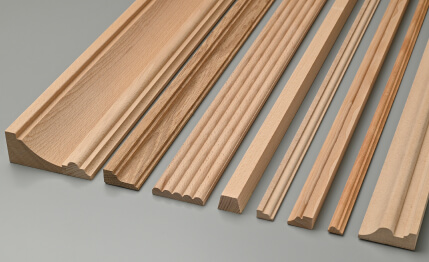
Wooden skirting boards made of oak and beech
Wooden baseboard is classy. Not because it's expensive, but because it's organic. Natural wood next to laminate, which imitates wood, creates an interesting dialogue: one is real, the other visually references it. In modern interiors with an emphasis on natural materials, this combination works flawlessly.
Oak is the most in-demand type. Dense fiber structure, expressive grain pattern, resistance to impact and abrasion. Beech baseboard is slightly lighter, with a finer grain pattern — ideal for light laminate in Scandinavian tones.solid wood baseboardIt is produced for painting or oiling, with varnish coating or without finishing — depending on the task.
When to choose wooden: if the apartment has natural parquet, engineered wood flooring, or high-quality laminate with a pronounced wood texture; if the interior is built on natural materials — wood, stone, linen — and if you want the baseboard to be not just functional, but a decorative element with its own character.
An important nuance: it's worth buying wooden baseboard for laminate with a slight moisture reserve. Wood is a living material; it reacts to the room's microclimate. In Moscow with central heating and dry winter air, baseboard made from raw solid wood can warp. Choose seasoned material from a trusted manufacturer.
Get Consultation
Baseboard — it is a modest detail, often unnoticed, but plays a critical role in creating the completeness of the interior.
MDF baseboard is a practical choice for most Moscow apartments. Stable geometry, precise straightness, even surface without knots or cracks. It doesn't warp with humidity fluctuations (within reasonable limits), it's easily painted any color, and provides a perfect surface for a brush or roller.
Buying MDF skirting for laminate means getting a product that will look equally good both on the day of installation and five years later, provided it is used normally. White MDF skirting for laminate is the absolute sales leader in Moscow construction stores. It is chosen for any laminate: light or dark, gray or warm shades.
Buying MDF skirting for painting for laminate is especially advantageous when the exact wall color is still unknown. You first wallpaper or paint the walls—and only then select the exact shade of skirting.
Full rangewooden and MDF skirting boards— height from 60 to 120 mm, several profiles, white and paintable—all collected in a single catalog. It is convenient to compare items and immediately see availability.
Moisture-resistant polystyrene skirting boards
This is the real revolution of recent years. The HI WOOD technology has made it possible to create skirting that looks like wood but behaves fundamentally differently: it is not afraid of water, steam, or sharp temperature changes.
Polystyrene skirting HI WOOD— is a high-density polymer-based material that imitates the texture of natural wood with astonishing accuracy. It is used where wood or MDF cannot cope: in bathrooms, toilets, kitchen areas with high humidity, on loggias and terraces.
You need to buy moisture-resistant skirting for laminate if the laminate is laid in a room with an unstable microclimate. Yes, laminate in wet areas is a controversial decision, but it happens. And then wooden or MDF skirting will warp and crack, but polystyrene skirting will not.
HI WOOD size range: from 58 to 140 mm. Profiles—straight and with relief. An important technical feature: HI WOOD skirting covers an expansion gap of up to 10–15 mm and hides wall-to-floor junction irregularities up to 5 mm. This is critically important for Moscow Soviet-era buildings, where walls are rarely perfectly even.
Hidden and modern solutions
Hidden skirting is a profile that forms a shadow gap between the floor and the wall. Visually, the walls seem to 'float' above the floor, creating a sense of lightness and air. This solution is actively used by the Moscow design audience—in studio apartments, interiors with panoramic windows, in minimalist spaces without unnecessary details.
Buying a hidden skirting board for laminate flooring means betting on architectural expressiveness through absence. Here, the skirting board doesn't draw attention but instead guides the eye along the horizontal line.
How to choose a skirting board for laminate flooring by material
An honest answer to the question 'which material is better' — it depends on the situation. Each option has its niche, and a smart choice isn't about finding a universal winner but selecting for specific conditions.
When wood is better
Wood — when the aesthetics of natural materials matter. If the apartment has oak parquet, wooden doors, and solid wood furniture, adding a wooden skirting board continues this theme organically. No imitation — everything is real.
It's worth buying an oak wooden skirting board for laminate flooring even when the laminate is chosen with a pronounced wood texture — like aged oak, walnut, or ash. A natural skirting board next to such laminate creates a sense of material richness that plastic or MDF cannot replicate.
Limitation: wood does not tolerate systematic moisture. In bathrooms and kitchens with sinks — wood is undesirable. In living rooms, bedrooms, studies with normal humidity — excellent.
When MDF is better
MDF wins where precise geometry without surprises is needed. Straightness along the entire length of the plank is not empty words. Poor-quality wood can have local bends that create gaps during installation. MDF lacks this problem: the structure is homogeneous, the shape is stable.
Buying an MDF skirting board for laminate flooring is especially advisable when laying laminate in large spaces — living rooms, open-plan layouts, hallways. Absolute straightness is important there, and MDF provides it effortlessly.
Another plus: MDF cuts well — corner cuts come out clean, without chips. This is appreciated by anyone who has installed skirting boards themselves.
When a moisture-resistant option is needed
A moisture-resistant skirting board is needed in three cases: in damp rooms (bathroom, toilet, kitchen near the sink), in apartments with unstable heating and sharp temperature fluctuations, and where laminate is laid in a room with possible condensation — for example, on the first floor with a cold floor.
Polystyrene HI WOOD is the only correct solution in these scenarios. Neither wood nor MDF will provide the same moisture resistance while maintaining aesthetics.
How to choose a baseboard to match the color of laminate and doors
Color is the most emotional issue when choosing a baseboard. And the most contentious: everyone has their own idea of harmony. Let's look at specific strategies that work.
Matching the floor color
A baseboard matching the laminate color is an 'invisible' baseboard. It blends with the floor, doesn't create a horizontal line, and the space visually appears wider and longer. The effect is especially pronounced in narrow hallways and small rooms.
How to implement: take a laminate plank to the showroom or store, compare it with baseboard samples. Perfect color matching is rare, so aim for a shade 'slightly darker than the floor' — this is a classic designer rule that works in 90% of cases.
Buying a baseboard for laminate in the floor color is most often chosen for bedrooms, where calmness and uniformity are desired, and for small spaces where preserving visual space is important.
White baseboard for laminate
White is about contrast and clarity. A white baseboard against dark laminate creates an expressive horizontal line that separates the floor and walls. It's modern, easy to maintain (white is easy to repaint when changing the interior), and versatile.
Buying a white baseboard for laminate is the right choice for apartments with white or light walls, Scandinavian interiors, and rooms with abundant natural light. A white baseboard 'adds light' to the space — this is an optical effect well known to designers.
Nuance: 'white' comes in different shades. Warm white (with a yellow undertone) and cool white (with a blue undertone) will look completely different next to the same laminate. Compare samples in daylight.
In the color of the doors
A skirting board that matches the door color is about the architectural system. If the doors are white, the skirting board is white. If the doors are gray, the skirting board is gray. If the doors are a warm beige shade, the skirting board is in the same spectrum. This approach creates the feeling that all wooden elements in the apartment are 'from the same collection'.
Buying a skirting board for laminate that matches the door color is a design solution that is especially effective in apartments with several doorways where doors are visible simultaneously from different points. A uniform color for skirting boards, doors, and architraves creates a clear architectural grid for the room.
Contrasting baseboard
Contrast is a bold solution for those not afraid to experiment. A dark skirting board on a light floor. Or a black skirting board in a space with white walls and light laminate. This option is a clear design statement, and it only works in a well-thought-out interior.
Contrasting skirting boards are actively used in loft interiors, in apartments with industrial elements, in modern spaces with a graphic black-and-white solution. But it requires confidence in the concept: if the contrast is not justified by the overall idea, it looks like a mistake.
How to choose a skirting board for laminate by height and profile
The height of a skirting board is not just about aesthetics. It's about the geometry of the space and a technical function: the skirting board must reliably cover the expansion gap at the wall.
Narrow skirting board for compact spaces
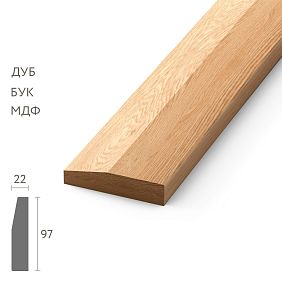
A skirting board 60–70 mm high is for small rooms, corridors, bathrooms, apartments with ceilings 2.5–2.7 meters high. A narrow skirting board doesn't weigh down the space, gives the walls 'air,' and works as a neat finishing strip at the base.
Technically: even a narrow 60 mm skirting board covers the standard 8–10 mm expansion gap with a margin. There are no installation issues.
If you take a narrow skirting board for laminate to buy for light laminate in a white room, it will practically dissolve, creating a minimalist effect.
Medium height as a universal option
80 mm is the point of equilibrium. This skirting board is noticeable enough to become a full-fledged architectural element, yet it doesn't weigh down the space. In Moscow apartments, 80 mm is the best-selling size, and that's no coincidence.
Buying a wide 80 mm skirting board for laminate is a good choice for living rooms, bedrooms, and offices with ceilings 2.6–2.9 meters high. It works with both straight and shaped profiles, and in both modern and classic interiors.
Tall skirting board for a status interior
100–120 mm is already an architectural statement. Such a skirting board is appropriate in rooms with ceilings from 2.9–3.0 meters high, in classic and neoclassical interiors, in formal living rooms with moldings and stucco.
Buying a 100 mm high skirting board for laminate flooring means adding weightiness to the interior. A high profile visually 'raises' the horizontal line, making the room more solemn. However, with low ceilings, such a skirting board will create the opposite effect—it will compress the space.
Straight profile
Straight profile—rectangular cross-section without relief. This is the language of minimalism, Scandinavian style, contemporary. Buying a straight skirting board for laminate means choosing conciseness as a principle.
A straight skirting board pairs well with laminate in light and gray tones, with smooth white walls, and with furniture without carved details. This is a solution that doesn't age and never goes out of style.
Shaped profile
Shaped profile—with a bead, relief transition, or 'step' along the top edge—carries a classic or neoclassical load. You need to buy a shaped skirting board for laminate where there are doors with shaped casings, moldings on the walls, and the interior is built around architectural details.
Important: a shaped profile requires precise mitering in corners. The complex cross-sectional shape doesn't forgive inaccuracies—gaps in the corners will be very noticeable.
Baseboard with cable channel
Buying a skirting board for laminate with a cable channel is a practical solution for modern apartments with lots of electronics: TVs, speakers, chargers, internet cables. The cable channel is a cavity inside the skirting board where wires are hidden. It looks neat, wires are invisible, and installation is simple.
In Moscow, such skirting boards are especially popular in living rooms, where audio-video equipment is placed along the walls, and in offices with computer equipment.
Which skirting board to buy for a specific interior with laminate
For the living room
The living room is the main space of the apartment. Everything is on display here: the floor, the walls, and the transitions between them. When buying an MDF skirting board for laminate in the living room, pay attention to the height — 80–100 mm — and the color. White for painting or ready-made white suits most modern living rooms. A figured profile suits a classic living room with moldings.
The living room is often a large area. The straightness of the skirting board is immediately visible here: a curved profile with bends will create unsightly gaps near the walls. MDF is more reliable in this sense.
For the bedroom
In the bedroom, the skirting board should be almost unnoticeable — calm, not distracting. It's better to buy a skirting board for laminate for the bedroom to match the walls or in a neutral white. Height — 60–80 mm. Profile — straight or with a slight bevel.
If the bedroom has laminate in a warm tone (like light oak), and the walls are painted in powder or beige, a skirting board matching the walls will create an enveloping, cozy effect.
For the hallway
The hallway is a room with high traffic and mechanical load. The skirting board here should be durable and easy to clean. Buying a wooden oak skirting board for laminate for the hallway is an excellent solution: oak is impact-resistant, easy to wash, and long-lasting.
If the hallway is small — choose a narrow profile of 60–70 mm so as not to narrow the already small space. If spacious — 80 mm in a white straight profile looks clean and modern.
For a modern apartment
Modern apartment — open floor plan, large windows, neutral colors, minimal decor. A straight white MDF skirting board 80–100 mm is ideal here. No moldings, no relief — just a clean horizontal line at the base of the walls.
To buy a modern skirting board for laminate flooring means choosing a profile that doesn't compete with the interior but supports its logic. In a modern space, the skirting board should work like punctuation: unnoticeable but necessary.
For a classic interior
Classic style requires details. A shaped skirting board with a molded edge, height 100–120 mm, white or cream finish — paired with doors, architraves, and moldings, this creates that very architectural completeness often missing in many Moscow 'classical' interiors.
To buy a classic skirting board for laminate flooring, you need to get it from the same product line as the architraves — only then will they look like a system, not a random coincidence.
What's important specifically for laminate: expansion gap, installation, joint
Laminate is a floating floor covering. This is a fundamental point that directly influences the choice of skirting board.
Expansion gap
When laying laminate flooring, a gap is left between the outermost plank and the wall — usually 8–15 mm. This is not an installer's mistake but a mandatory technical requirement. Laminate changes dimensions with fluctuations in humidity and temperature, and without a gap, it will start to buckle, and the seams will lift.
The skirting board's task is to cover this gap. Therefore, the profile's width must overlap the gap with a margin. For a standard 10 mm gap, a skirting board 14–16 mm wide is sufficient. For non-standard gaps up to 15 mm — a wider profile is needed.
The HI WOOD skirting board explicitly states it covers an expansion gap of up to 15 mm — this is an important technical characteristic worth clarifying when purchasing.
Irregularities at the junction
In Moscow homes—especially those built during the Soviet era—walls often have irregularities at the base. The baseboard must fit tightly against the wall along its entire length; otherwise, gaps will appear, which are not only unsightly but also collect dust.
HI WOOD baseboard compensates for junction irregularities up to 5 mm without using putty or additional wall preparation. This is critically important when renovating old housing stock, where 'ideal' walls are practically non-existent.
MDF and wooden baseboards, in cases of significant irregularities, require either surface puttying or precise fixation with liquid nails at several points along the length.
Choosing a profile for real walls
If the walls are uneven—choose a profile with a wider support surface. A wide baseboard presses against the wall over a larger area and conceals minor deviations from vertical. A narrow profile will immediately reveal the problem with crooked walls.
For apartments with crooked walls—good news: the baseboard can be fixed not only with clips or dowels but also with liquid nails, which allow for compensating deviations along the entire length.
When a moisture-resistant baseboard is needed
A moisture-resistant baseboard for laminate flooring should be purchased in several specific situations:
-
laminate is laid in the kitchen area near the sink;
-
Periodic wet cleaning with abundant water use occurs indoors;
-
First-floor apartment with possible subfloor condensation;
-
Laminate is installed in the bathroom (yes, that happens).
In these cases, wood and MDF will swell, darken, and require replacement over time. HI WOOD polystyrene will not.
What to match laminate skirting with
A good interior is not a collection of successful individual items, but a system. Skirting works better when integrated into the architectural logic of the space.
With doors and architraves
Door architraves and skirting are the closest 'neighbors' in an interior. They meet at every doorway. If their profiles and colors are from different collections — it's a visual conflict. If from the same system — it's architectural harmony.
Buying laminate skirting for doors from the same line as the architraves is a basic rule for those who want a cohesive result. White straight skirting + white straight architraves — a clean, modern, flawless combination.
With moldings and cornices
Wall moldings and ceiling cornices form a vertical architectural system. Skirting closes it from below. When all three elements are from the same collection — a sense of architectural completeness emerges, distinguishing a designer interior from just a 'well-renovated apartment'.
In the sectionMoldings and cornicesProfiles developed in conjunction with skirting boards are collected here. This allows selecting a complete decorative system in one catalog visit.
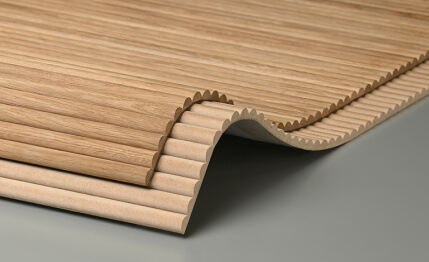
With slatted panels
Slatted wall panels are one of the main trends in Moscow renovations over the last two to three years. Vertical wooden slats create depth and texture that cannot be achieved by any other means. In this combination, the skirting board serves as the lower visual boundary of the slatted panel.
When slatted panels and skirting boards are from the same system, it creates a cohesive decorative story: the slats run from the floor (from the skirting board) to the ceiling (to the cornice), forming a unified architectural composition.
Rafter panelsSTAVROS — wooden profiles for walls and ceilings — pair well with skirting boards from the same line in terms of tone, texture, and proportions.
With a unified wooden decor system
STAVROS builds its product line as a system. Skirting boards, moldings, cornices, architraves, slatted panels, decorative inserts — all are developed with a unified stylistic logic. Buying a skirting board from one manufacturer guarantees that when you add a molding or cornice, they will 'speak the same language.'
This is not marketing — it's practice. When a room has skirting boards and cornices from different systems by different manufacturers, the mismatches in profiles, shades, and proportions are immediately apparent.
Where to buy laminate skirting boards in Moscow
A practical question behind any internet search. Let's break down the key criteria for choosing a supplier.
Stock availability. For Moscow buyers, this is critically important: there's no point in ordering for 'delivery' in three weeks if the renovation is already underway. A proper supplier has the entire range in stock in Moscow, and you can either pick it up yourself or receive delivery within one to two days.
Choice by material. Wooden, MDF, moisture-resistant — all three categories should be in stock. Otherwise, you'll have to visit several stores to compare samples.
Color matching. The skirting board color should be viewed in person, next to the laminate and door samples. This is possible in a good showroom. In an online store without the option to order a sample — it's a lottery.
Delivery. Skirting boards 2400–2800 mm long are inconvenient to transport by car and impossible by metro. Delivery within Moscow is a standard service from professional suppliers. Check the terms and conditions.
Go to catalog. Full assortmentfloor baseboardswith wooden, MDF, and moisture-resistant options is available online — it's convenient to first explore the assortment, compile a list of needed items, and then come for samples or place an order with delivery.
Common mistakes when choosing
Over years of experience working with customers, several mistakes stand out that almost everyone makes. We hope that after this section, your list will shrink.
Too small profile
They take a narrow skirting board 'so it doesn't stand out,' but then it turns out that 60 mm doesn't cover the expansion gap at the wall — especially if the installer left a gap wider than standard. Or that a narrow skirting board in a spacious room with high ceilings looks lost and random.
Rule: the minimum skirting board height for a standard laminate expansion gap is 60 mm. For non-standard situations (uneven walls, wide gap) — 70–80 mm. Don't sacrifice function for minimalism.
Color mistake
They buy a 'white' skirting board from a photo — and get a milky or cool white that contrasts with warm white doors. Or they take 'oak-like' — and the shade doesn't match the laminate in tone or saturation.
Solution: always get a sample. At least one plank — before ordering for the entire room. Compare it with doors, door frames, and laminate under natural daylight in the actual room.
Unsuitable material
They install MDF skirting boards in the kitchen next to the sink — within a year, it darkens and swells. Or they buy expensive oak skirting for the bathroom, where it warps from steam. Choosing the material isn't just about aesthetics; it's about function and durability.
A simple rule: wet areas — only moisture-resistant skirting. Dry living spaces — wood or MDF, as you prefer.
Ignoring the gap and wall irregularities
They don't check how even the wall is at the base and buy a narrow profile — later discovering gaps in several places. Or they don't account for the laminate expansion gap and get skirting that doesn't cover it.
Before buying: measure the actual gap at the wall (lift the edge plank and measure), check the wall's evenness at the floor with a straightedge or level. This takes 10 minutes and saves several hours of work replacing unsuitable skirting.
Comparison table of skirting materials for laminate
| Parameter | Wood (oak/beech) | MDF | HI WOOD (polystyrene) |
|---|---|---|---|
| Moisture resistance | Low | Medium | High |
| Geometric precision | Medium | High | High |
| Paintability | Yes | Yes | No |
| Aesthetics | Natural | Neutral | Wood imitation |
| Price | Above average | Medium | Medium |
| Application | Dry rooms | Dry rooms | Wet and dry |
| Height range | 60–120 mm | 60–120 mm | 58–140 mm |
Conclusion
A laminate skirting board is not the last detail to be chosen as an afterthought. It is an element that determines the final quality of the interior and performs an important technical role: it protects the expansion gap, conceals uneven junctions, and protects the wall.
Chooseskirting board for laminateaccording to three key parameters: material for the room conditions, color to match the floor and doors, height for the ceilings and style. If you want a wooden one — look atSkirting made of solid wood. Need a practical and precise one —wooden and MDF baseboardsin the full range. For wet areas — onlyMoisture-resistant skirting board HI WOOD.
About the company STAVROS
STAVROS is a Russian manufacturer of architectural decor made from natural wood, MDF, and high-density polystyrene. The company specializes in the production of skirting boards, moldings, cornices, architraves, paneling, and decorative interior elements.
The entire STAVROS product line is developed as a unified architectural system: skirting boards, moldings, cornices, and paneling are created with coordinated profiles, proportions, and colors — so any elements from the assortment complement each other without additional matching.
Production is equipped with modern machinery, and multi-stage quality control is applied at every stage — from raw material selection to final packaging. STAVROS works with Moscow and all regions of Russia, delivering from the warehouse within agreed timeframes.
Frequently asked questions
Is a gap needed between the skirting board and laminate?
The skirting board is attached only to the wall and should not touch the laminate. A 1–2 mm technical gap is left between the bottom edge of the skirting board and the laminate surface. This allows the laminate to expand freely. The skirting board merely covers the expansion gap at the wall without pressing down on the flooring.
Which skirting board is better — wooden or MDF — for a laminate floor?
In dry rooms, both options are equally durable. MDF provides more stable geometry — especially important for long spans. Wood is for those who value naturalness and plan the interior around natural materials. For wet areas — only moisture-resistant polystyrene HI WOOD.
How to properly cut baseboards for corners?
Internal corners — cut at 45° using a miter saw or miter box. Alternative — ready-made corner pieces that forgive minor inaccuracies. External corners — also 45° with careful fitting. For MDF, use a saw with a fine-toothed blade (80+ teeth) — the surface will be chip-free.
How much baseboard is needed for an apartment?
Measure the perimeter of all rooms. Subtract the width of doorways (0.9–1.0 m each). Add 10–15% for cutting and possible defects. Divide by the length of a plank (usually 2400 mm) — you'll get the number of planks. Round up.
Can you paint MDF baseboard directly on the wall?
Yes. It's even more convenient: first install the baseboard, seal gaps with acrylic sealant, then paint. Use interior water-based paint in 2–3 coats. Sealant around the perimeter creates a smooth joint between the baseboard and wall, and the paint hides it.
How to choose a baseboard for light Scandinavian-style laminate?
White straight MDF baseboard 70–80 mm high is the ideal choice. You can take one for painting and paint it the same shade as the walls — it will become an 'invisible' baseboard. Or pure white — for a clean, light line at the base of the walls.
Which baseboard to choose for an entryway with dark laminate?
Two options: white straight baseboard for contrast and a modern look — or a baseboard matching the floor color to create a sense of more space in a small entryway. Material — oak or MDF with a durable finish, as the entryway is a high-traffic area. Height 70–80 mm.