Article Contents:
- Kitchen as a Special Case: Why You Can't Choose a Skirting Board Casually Here
- What Types of Skirting Boards for Kitchens Exist: A Complete Overview
- Solid Wood Skirting Board
- MDF Skirting Board
- PVC and Polyurethane Skirting Board
- Tall Skirting Board for Kitchen
- White Skirting Board for Kitchen
- Wooden Skirting Board for Kitchen: When Natural Wood is the Right Choice
- MDF Skirting Board for Kitchen: When Engineered Material is More Convenient
- When MDF is Preferable to Wood in the Kitchen
- Practical Tips for MDF Skirting Board in the Kitchen
- How to Choose a Skirting Board for the Kitchen to Match the Floor Covering
- Skirting Board for Kitchen Under Tile and Porcelain Stoneware
- Skirting Board for Kitchen Under Laminate
- Skirting Board for Kitchen Under Quartz Vinyl
- Skirting Board for Kitchen Under Wooden Floor
- How to Choose a Skirting Board for the Kitchen by Height, Color and Style
- Height: How Many Centimeters are Needed in the Kitchen
- Kitchen Skirting Board Color: Three Working Logics
- Style: Skirting Board as Part of Kitchen Interior
- Kitchen Skirting Board Practicality: What Really Matters in Use
- Profile Relief and Cleaning
- Color and Stain Resistance
- Skirting Board at the Dining Table
- Skirting Board in Kitchen-Living Room
- Skirting Board for Wet Cleaning
- Wooden Kitchen Interior System: Skirting Board as Part of the Whole
- Mistakes When Choosing a Skirting Board for the Kitchen
- Error 1: overly complex relief profile
- Error 2: dark skirting board in a small light kitchen
- Error 3: conflict with kitchen fronts and plinth
- Error 4: skirting board matched only to the floor, without considering doors
- Error 5: selection based solely on price
- Error 6: too low skirting board in a high room
- Error 7: lack of sealing around the sink
- Where to buy kitchen skirting board: from selection to order
- About the Company STAVROS
- FAQ: Answers to Popular Questions

And that is precisely why the choiceKitchen skirting boards— is a more serious task than it seems at first glance. It's not enough to just choose a nice profile here: you need to understand which material can withstand kitchen conditions, which profile is easier to keep clean, which color won't show every stain, and how to integrate the skirting board into the overall interior context of the kitchen space.
This article is a practical guide without fluff. There are no abstract musings about the beauty of skirting boards in general. Here — a specific kitchen scenario: materials, profiles, height, color, compatibility with kitchen flooring and furniture, common mistakes, and honest answers to the question of where to buy a kitchen skirting board and not regret it.


The kitchen as a special case: why you can't choose a skirting board here haphazardly
Before moving on to catalogs and SKUs, you need to understand the context. The kitchen is not a bedroom or a living room. It has special operating conditions that directly affect the requirements for the skirting board.
Humidity. It's always higher in the kitchen than in other rooms. Condensation from pots and kettles, splashes near the sink, wet cleaning twice a day — all this affects the skirting board for years. A material that would last 30 years without problems in a bedroom will start to delaminate in the kitchen in five years if it's not designed for such conditions.
Grease contamination. Kitchen air is saturated with grease vapors. The horizontal surfaces of a skirting board with an active relief — grooves, recesses, decorative elements — accumulate grease and require regular cleaning. The more complex the profile, the more difficult the cleaning.
Mechanical loads. Chairs at the dining table, kitchen unit cabinets, refrigerator legs — all of these regularly come into contact with the skirting board. Soft materials with low surface strength quickly lose their appearance here.
Chemical exposure. The cleaning agents used to wash the kitchen floor are more aggressive than those in living rooms. A painted skirting board with a low-quality coating will fade within a year.
That's why a floor skirting board for the kitchen is not 'just a skirting board, only for the kitchen.' It's a specific choice considering the operating conditions. And this choice begins with the question of material.




What types of kitchen skirting boards are there: a complete overview
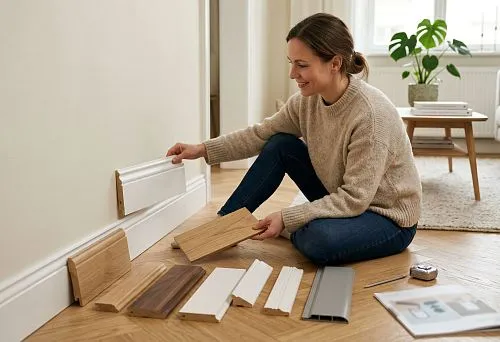
The market offers several fundamental options, each with its own success story and specific limitations in the kitchen context.
Our factory also produces:


Solid wood skirting board
Wooden baseboardMade of oak or beech — it is a natural material with a density of 620–750 kg/m³, high surface hardness, good resistance to mechanical impacts, and the possibility of complete restoration. With proper treatment — double varnishing or oil with hard wax — a wooden skirting board in the kitchen lasts for decades.
The key phrase is 'with proper treatment'. An untreated or poorly primed wooden skirting board in the kitchen will absorb moisture, darken, and deform. Properly treated oak is one of the most durable materials for kitchen skirting boards among all available options.
Get Consultation
MDF skirting board
MDF Skirting Board— an engineered high-density board with excellent geometry, a smooth surface, and a low price. It paints beautifully, provides a neat line along the wall, and is produced in a wide range of profiles. For the kitchen — a functional and practical option provided that the surface is well primed and coated with waterproof enamel.
The weak point of MDF is the edges. When the end cuts get wet, the material swells and delaminates. Therefore, in the kitchen, it is important that all edges of the skirting board are properly sealed, and the joints near the sink are treated with silicone.
PVC and polyurethane skirting board
Waterproof, lightweight, affordable. Completely indifferent to moisture. The downside — limited decorative potential, a sense of cheapness in a good interior, and the impossibility of restoration.
Tall skirting board for kitchen
A separate category — not by material, but by height. Skirting boards 100 mm and above create a powerful lower line of the room. In the kitchen, this works especially well in kitchen-living rooms with high ceilings: a tall skirting board visually 'grounds' a large space and creates the correct architectural proportion.
White skirting board for kitchen
One of the most popular requests. White skirting board is a universal solution for a light kitchen. It works with white, cream, gray, beige, and pastel interiors. Made of beech or MDF under white enamel — it's a neutral, clean, modern choice.
Wooden skirting board for kitchen: when natural wood is the right choice
Some might say: a wooden skirting board in the kitchen is risky. And in a sense, they would be right. But the risk here is not in the material, but in whether it is chosen and treated correctly.
Wooden baseboardMade of oak with double varnish coating or oil impregnation with hard wax — this is a protected surface with high hardness. Oak is denser than many types of MDF, does not crumble at corners, and does not delaminate when hit by a stool. With proper treatment, it can be washed with any neutral detergents, it is not afraid of accidental splashes and regular wet cleaning.
When is a wooden skirting board for the kitchen the best choice?
Classic wooden kitchen. Solid oak fronts, veneered surfaces, wooden countertops — in such an interior, only a wooden floor skirting board creates a sense of a single natural material. MDF here will look like an alien compromise.
Kitchen-living room with parquet flooring. An open space where the kitchen smoothly transitions into a living room with parquet — here the skirting board should be uniform throughout.to buy wooden baseboardfrom oak to match the parquet tone — the only solution that will preserve the visual continuity of the space.
Country house with wooden interiors. In a house made of timber or glued wood, the kitchen is an organic part of the wooden interior. Here, a wooden kitchen skirting board is not an alternative, but an architectural necessity.
Neoclassicism and modern classicism. Kitchens in the neoclassical style with white or cream facades, marble countertops, brass hardware — require natural materials.Buy wooden skirting board for kitchenMade of beech with white enamel — this is a perfect match for the style.
When you are doing a renovation for 20–30 years. An oak wooden skirting board can be sanded and repainted after 15 years, when it is time to update the interior. MDF does not offer this option.
MDF skirting board for kitchen: when engineered material is more convenient
MDF Skirting Board for Kitchen— an honest, practical choice for those who want a neat result without increased investment. Modern MDF with a density of 750–850 kg/m³ is not a cheap surrogate, but a normal engineered material with predictable characteristics.
When MDF is preferable to wood in the kitchen
Aggressive zone near the sink. If the sink is built into a corner and the skirting board will regularly get splashed — MDF with a water-resistant coating handles this better than untreated wood. With proper sealing of the ends with silicone, an MDF skirting board in this area lasts for years.
A budget project with a quality result. MDF is 2–3 times cheaper than solid wood, while providing even geometry, paints well, and does not require complex surface preparation. For a kitchen with a budget renovation, this is the optimal choice.
Modern minimalist interior. In a kitchen in minimalist, high-tech, or Scandinavian style—handleless fronts, smooth surfaces, neutral color palette—wood texture would be excessive. White MDF skirting for the kitchen matching the walls or ceiling: neat, modern, functional.
Rental property or temporary renovation. If the renovation horizon is 5–7 years, there's no point in investing in solid wood. White MDF skirting will handle the task without unnecessary expenses.
Practical tips for MDF skirting in the kitchen
-
Use waterproof primer before painting.
-
Seal all end cuts, especially near the sink.
-
For painting, choose acrylic semi-matte enamel—it's easier to clean than matte and less prone to showing marks than glossy.
-
At the joints of the skirting with tiles and walls, use transparent silicone sealant—it will prevent moisture from penetrating under the skirting.
How to choose skirting for the kitchen to match the floor covering
The kitchen floor is often a special case. In many apartments, the kitchen has tiles or porcelain stoneware, while the adjacent living room has parquet or laminate. This creates the task of joining two different floor coverings and two skirting zones.
Baseboard for kitchen under tile and porcelain stoneware
Tile is the most common kitchen flooring. Hard, moisture-resistant, cold. Both wooden baseboards and MDF or PVC work well with it. The main question is color.
Three practical approaches:
-
Baseboard matching the tile — maximally neutral, makes the space appear larger.
-
Baseboard matching the walls — soft transition, focus on vertical surfaces.
-
Baseboard matching the door trims — creates a unified wooden frame for the entire space.
Baseboard for kitchen under porcelain stoneware with concrete or stone imitation — smooth dark gray or anthracite profile works well. It emphasizes the industrial character of the flooring.
Baseboard for kitchen under laminate
Laminate is laid less often in the kitchen than in the living room, but it's possible with the right choice of moisture-resistant class. Baseboards matching the color or tone of the flooring work well with laminate. If the laminate imitates wood — a wooden floor baseboard in a similar shade creates an organic ensemble.
Important technical detail: the baseboard under laminate is attached to the wall, not to the flooring. A gap must remain between the baseboard and the laminate — the floating floor must be able to expand freely with changes in humidity.
Skirting board for kitchen under quartz vinyl
Quartz vinyl in recent years has been one of the most popular options for kitchen flooring. It is waterproof, warm, and soft underfoot. Both wooden and MDF skirting boards are suitable for it. If the quartz vinyl is in warm tones with a wood imitation, use a wooden skirting board in a similar shade. If it is neutral light or gray, use white MDF or a beech wooden skirting board under white enamel.
Skirting board for kitchen under wooden floor
Solid wood board or parquet in the kitchen is rare but found in country houses. In this case, the answer is unequivocal: only a wooden skirting board made from the same species or in a similar shade.wooden baseboardOak skirting board to oak parquet is a unified natural system where all elements are connected by material and texture.
How to choose a skirting board for the kitchen by height, color, and style
Height: how many centimeters are needed in the kitchen
In the kitchen, standard residential rules for skirting board height apply, but with kitchen-specific considerations.
| Ceiling height | Recommended skirting board height |
|---|---|
| Up to 2.5 m | 60–70 mm |
| 2.5–2.8 m | 70–80 mm |
| 2.8–3.0 m | 80–100 mm |
| Kitchen-living room with a ceiling of 3+ m | from 100 mm |
In a small kitchen of 8–10 sq. m with a 2.5-meter ceiling, a high 120 mm skirting board will visually feel oppressive. Here, a moderate 60–70 mm one is needed, in the tone of the wall or floor, to make the space seem larger.
In an open-plan kitchen-living room with 3-meter ceilings, a tall kitchen skirting board serves as an architectural accent that organizes the lower line of the large space.
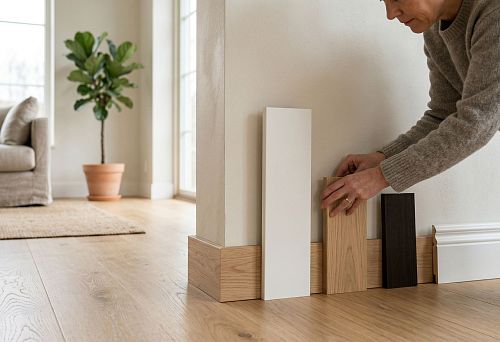
Kitchen skirting board color: three working logics
White skirting board in the kitchen is the most popular choice, and for good reason. White is neutral, works with any color of floor and walls, and is easy to keep clean (stains on white are immediately visible, which motivates timely cleaning). For a light kitchen with white or cream fronts, it's the perfect solution.
Skirting board matching the floor color is for those who want to visually expand the space. The skirting board 'dissolves' into the flooring, the wall appears higher, and the room feels more spacious. Works well in small kitchens.
Skirting board matching the door trims is the most stylistically refined option. It creates a unified frame for the kitchen space, where all wooden elements are linked into a system. For this, the wooden skirting board,Wooden casingand, if present,Wooden corniceshould be made from the same wood species and have the same tint.
Style: skirting board as part of the kitchen interior
Modern kitchen. Smooth fronts, built-in appliances, minimalist hardware — here you need a smooth profile without decoration, matching the walls or floor. The skirting board should be almost invisible.
Classic kitchen. Milled fronts, turned legs, hardware with patina — here a skirting board with a light decorative profile made of solid wood or MDF is appropriate. A rich classic ogee would be excessive here, but a neat bevel or soft rounding is just right.
Neoclassical. A transitional style between classic and contemporary. White or cream facades, marble inserts, natural materials. A beech wooden skirting board under white enamel is a perfect match.
Loft and industrial style. Dark surfaces, metal, concrete, exposed pipes. Skirting in dark tones, graphite or black, smooth profile without decoration.
Practicality of kitchen skirting: what really matters during use
This is a section for practitioners. For those who not only look at photos in the catalog but also clean the kitchen every day.
Profile relief and cleaning
The simplest rule: the more complex the profile, the more difficult the cleaning. Deep grooves, coves, multi-level reliefs are places where grease and dust accumulate. In the kitchen, this is especially critical.
A skirting with a smooth profile or one neat bevel wipes clean in seconds. A skirting with a classic multi-level relief will require a toothpick or brush in the grooves.
Conclusion: for the kitchen, simple, smooth profiles are preferable. If you want a wooden skirting board — choose a straight one or with one level of relief. A classic decorative profile is for the living room and bedroom.
Color and susceptibility to soiling
A light skirting board — especially white — in the kitchen will require regular attention. Any contamination is clearly visible. But this is not a drawback — it's a motivator. A kitchen skirting board that inconspicuously accumulates grease contamination on a dark surface ultimately looks worse.
Tip: for the stove and sink area — a smooth profile in a light or neutral tone, with regular wiping using a damp cloth. For the dining table area — you can opt for a darker tone that shows less dirt.
Baseboard at the dining table
The baseboard at the dining table suffers the most — it gets bumped by chair legs, leaned against, and food spills nearby. Surface material strength is crucial here. An oak wooden baseboard is the optimal choice for this zone: high hardness, scratch resistance, and the possibility of local restoration.
Baseboard in the kitchen-living room
In the open space of a kitchen-living room, the baseboard transitions continuously from one zone to another. Different materials cannot be used here: a plastic baseboard in the kitchen and a wooden one in the living room create an obvious visual break. A wooden baseboard that runs along the entire perimeter of the combined space is the only correct solution.
Baseboard for wet cleaning
What does 'baseboard for kitchen for wet cleaning' mean? It is a profile with a water-resistant surface coating, sealed ends, and good adhesion of the mounting adhesive to the base.
A wooden baseboard with double varnish or oil-wax coating — withstands regular wet cleaning without issues. If you wash the floor with a mop attachment and the baseboard regularly gets wet — ensure the bottom mounting seam is sealed with silicone.
Wooden kitchen interior system: baseboard as part of the whole
One of the most common design mistakes is choosing each wooden element of the kitchen separately, without considering how they relate to each other. As a result, a baseboard made of light oak, architraves made of dark walnut, and a cornice made of painted MDF create a sense of a chaotic assortment rather than a well-thought-out interior.
Correct logic is a unified wooden system. Floor skirting, door architraves, ceiling cornice—all from the same wood species, same tint, same profile character.moldings, cornices, and baseboardsIn a unified style—this is what makes a kitchen interior complete and expensive regardless of the overall budget.
If the kitchen has wooden doors with a classic architrave profile—the wooden floor skirting should echo it in tone and character. If the doors are white lacquered—a white beech skirting under the same enamel.
For those building a wooden interior from scratch,solid wood molding—is an additional element of the system used for finishing transitions, decorative panels, reveals. In the kitchen, it could be a decorative rail under wall cabinets or a dividing element between backsplash tiles and plaster.
Mistakes when choosing skirting for the kitchen
A list of specific mistakes that are easy to avoid if you read this in advance.
Mistake 1: overly complex relief profile
A rich decorative profile with beads is beautiful in the living room. In the kitchen, it's a grease trap. After a year, such skirting will look unkempt, no matter what you do with it. For the kitchen—smooth or with minimal relief.
Mistake 2: dark skirting in a small, light kitchen
A small kitchen of 6–8 sq. m, light-colored fronts, light flooring — and a dark brown baseboard. It visually 'lowers' the space, creating a feeling of tightness. In a small, light kitchen, the baseboard should match the wall or floor color.
Mistake 3: Clash with kitchen fronts and kickboard
A kitchen kickboard is a decorative strip near the floor that conceals the space under the lower cabinets. It's already part of the kitchen and has its own color. Adding a floor baseboard of a different tone creates a 'double frame' — two horizontal elements of different colors in the same lower zone. This is chaotic. The rule: either a kickboard or a baseboard. Or they should be the same color.
Mistake 4: Baseboard chosen only to match the floor, without considering the doors
If the kitchen door is wooden with a white casing, and the baseboard is dark brown — this is a clash that's immediately noticeable. Casings and baseboards should form a unified system.
Mistake 5: Choosing based solely on price
The cheapest baseboard in the kitchen is the most costly mistake in the long run. Cheap MDF with poor coating will swell near the sink within a year and lose color by the stove in two. A wooden floor baseboard with good treatment will last 20 years and can be restored if needed.
Mistake 6: Too low a baseboard in a high-ceilinged room
In a kitchen-living room with 3-meter ceilings, a 60 mm baseboard doesn't work. It's simply not visible, and the lower line of the space remains unorganized. A tall baseboard for the kitchen in a large space is an architectural necessity.
Mistake 7: Lack of sealing around the sink
Technically, this is already an installation error, but the buyer should be aware of it. The baseboard near the sink and dishwasher regularly gets wet. Without a silicone seal at the bottom, moisture penetrates under the baseboard, and unnoticed damage to the foundation begins.
Where to Buy Kitchen Baseboard: From Selection to Order
In practice, the question 'where to buy' means 'how to choose correctly, without overspending or regretting it later.'
Buy Kitchen Baseboardat a construction hypermarket — quickly and affordably. But the selection there is standard: MDF, PVC, a few widths, a few colors. No choice of wood species, no consultation on compatibility with your specific floor and cabinets.
If you need awooden kitchen baseboardmade from a specific wood species, with a specific stain to match the parquet or a specific color — the right choice is a specialized manufacturer. Here you see the full range, compare profiles, get consultation, and order exactly what you need.
Buy MDF Kitchen Baseboarddirectly from the manufacturer — this also guarantees material quality: correct MDF density, proper priming, and proper finishing coating.
Delivery — across all of Russia. Moscow and St. Petersburg — warehouses with stock and self-pickup. For out-of-town projects — shipment via transport companies with precise packaging for lineal products.
About the company STAVROS
STAVROS — a Russian manufacturer of wooden architectural lineal products and decorative elements made from solid oak and beech. The company's history began in 2002 with a small workshop for carved wooden items. As early as 2003, STAVROS participated in the reconstruction of the Konstantinovsky Palace in Strelna — and this set the quality standard for all subsequent years.
Among completed projects — interiors of the Hermitage, the Alexander Palace, the Trinity-Izmailovsky Cathedral, and numerous private residences and commercial properties across Russia. Experience in restoring cultural heritage sites — this is not a marketing claim, but a proven project history.
STAVROS production is equipped with European woodworking machinery. Raw materials undergo chamber drying to 8–12% moisture content. Each batch — incoming inspection and final check of geometry and surface. Milling accuracy ±0.1 mm — this is not an advertising slogan, but a production standard.
STAVROS showrooms operate in St. Petersburg and Moscow. For designers, architects, and construction companies — partnership programs and special terms for bulk orders. Manufacturing of custom profiles based on individual drawings — for runs from 50 linear meters.
FAQ: Answers to popular questions
Which skirting board is better for the kitchen?
Depends on conditions and style. For a kitchen with wooden fronts, parquet flooring, or in a classic style — a wooden skirting board made of oak or beech with double lacquer coating. For a modern, light kitchen with tile or quartz vinyl — a white MDF skirting board for high-quality enamel. Both options, with proper selection and installation, will last a long time.
What is better for a kitchen: a wooden skirting board or MDF?
A wooden skirting board made of oak is more durable, mechanically stronger, and can be restored. MDF — cheaper, easier to install, paints well. For a kitchen with heavy use and a wooden interior — wood. For a modern kitchen with tile and a budget renovation — MDF.
Which skirting board to choose for tile in a kitchen?
For tile — any material: wood, MDF, or PVC. The main question is color. Skirting board matching the tile, walls, or architraves — three viable options. Profile — smooth or with minimal relief.
Which skirting board to choose for laminate flooring in the kitchen?
Wooden skirting board in a similar tone. The skirting board is attached to the wall, not to the laminate — a free gap is left between them for the expansion of the flooring.
Where to buy a skirting board for the kitchen?
From a specialized manufacturer, where you can choose the wood species, profile, and tone to match a specific interior. STAVROS offers wooden skirting boards made of oak and beech with delivery throughout Russia.
What color of skirting board to choose for the kitchen?
White — universal, works with any light interior. Matching the floor — expands the space. Matching the architraves — creates a unified wooden system. For a small kitchen — white or matching the wall. For a large kitchen-living room — you can allow a more expressive tone.
Is a white skirting board suitable for the kitchen?
Yes, and it is one of the best options. A white beech skirting board under acrylic enamel is neutral, works with any floor and cabinets, and is easily refreshed by repainting. The only nuance — dirt is clearly visible on white surfaces, which requires regular maintenance.
Is sealing the skirting board in the kitchen necessary?
Absolutely — in the area of the sink and dishwasher. The lower seam between the skirting board and the floor is sealed with transparent silicone sealant. This prevents moisture from penetrating under the skirting board and extends its service life several times.
Can one baseboard be used for both the kitchen and living room?
In a kitchen-living room—definitely yes, and that's exactly how it should be done. A single wooden baseboard around the entire perimeter of the combined space is the only solution that maintains visual continuity.