Article Contents:
- Same shape matters more than same length
- Wave HL-006M in numbers: ten lengths and ten center distances
- Overall length and center distance cannot be swapped
- What a "single line of handles" means on real furniture
- Same shape on different facades
- Common axes
- Repeating the proportion
- Matching edge marks
- General finishing
- 180 and 260 mm: not "small versions," but the basis of drawer rhythm
- 400 and 500 mm: the working middle for kitchen and dresser
- 600 and 700 mm: a line that already shapes the facade architecture
- 900 and 1200 mm: transition from hardware to the wardrobe vertical
- 1500 and 1800 mm: a handle at full facade height without literal equality
- Upper and lower modules do not have to be the same length
- On an island, the handle is visible from several sides
- A tall cabinet should continue, not break, the system
- Check the edges
- Check the neighboring handles
- Check the opening
- Check the handle
- How to arrange handles by pattern
- Why you cannot mark from different edges
- Why a long handle requires a two-step check
- Why you can't pull a crooked facade with a handle
- Order all handles of the same length
- Confusing length with center-to-center distance
- Choosing lengths from individual cards without a general layout
- Mixing finishes
- Drilling before receiving the hardware
- Do not consider the opening direction
- Place the long handle too high
- Ignore the inner side
- Order HL-006M and HL-006 as one set without a finishing plan
- Do not check the oak pattern
- Use one marking base incorrectly
- Forget about spare parts
- What material is the Wave HL-006M made of?
- What sizes are available for the Wave HL-006M?
- What is the cross-section of the handle?
- How does the overall length differ from the center-to-center distance?
- What is the center-to-center distance for the 700 mm handle?
- What is the center-to-center distance for the 900 mm handle?
- What are the center-to-center distances for lengths 1200, 1500, and 1800 mm?
- Can the Wave be installed horizontally?
- Can the same handle be installed vertically?
- Which Wave is suitable for a small drawer?
- How to choose a handle for a wide kitchen drawer?
- What length should be chosen for a tall pencil case?
- Is it mandatory to install an 1800 mm handle on a door that is 1800 mm high?
- Can I assemble a kitchen and a cabinet with handles of the same model?
- Are mounting screws included in the set?
- Do I need to buy decorative caps?
- What is the difference between FUR-032 and FUR-033?
- Can facades be drilled before receiving handles?
- Will Wave be suitable for replacing old handles?
- How to measure the old center-to-center distance?
- Can I mix several lengths in one kitchen set?
- Do all adjacent drawers need to have different lengths?
- What to choose: HL-006M or HL-006?
- Can I order handles in different finishes?
- How can I check a long handle on a facade before purchasing the entire set?
- Why is the oak pattern important on paired doors?
- Where can I see drawings of Wave and other products?
- Where can I buy the Wave HL-006M set?
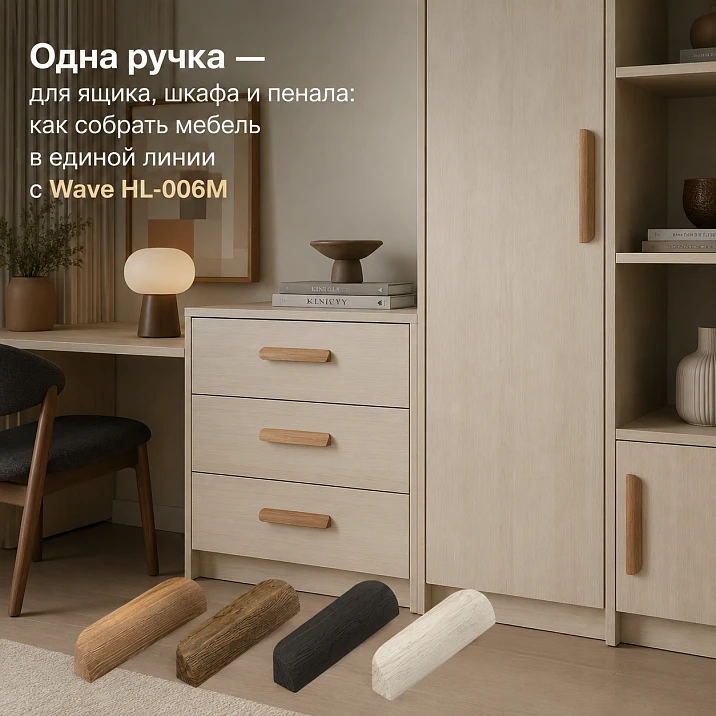
A kitchen can be assembled from a dozen facades, and almost none of them repeats its neighbor. A low cutlery drawer, a wide pot drawer, a narrow door, a swing cabinet, and a tall pencil cabinet exist in different proportions. If you select hardware for each element separately, the furniture quickly falls apart into a random set: here a short bracket, there a long rail, a vertical profile on the pencil cabinet, and another shape on the upper facades. Functionally, everything opens. Visually, there is no unified system.
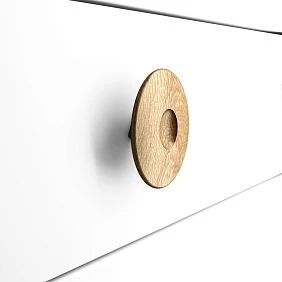
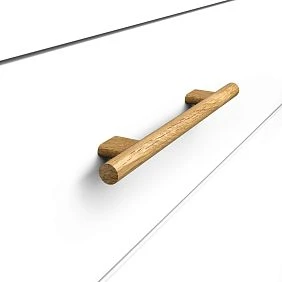
Long furniture handles Wave HL-006M offer a different approach. One shape repeats in ten sizes — from 180 to 1800 mm. Short options work on drawers and compact doors, medium ones support wide facades, and a handle 1200, 1500, or 1800 mm long can run vertically along a tall cabinet or pencil cabinet door. The scale changes, but the silhouette, material, character of the wave profile, and finish are preserved.
This is what distinguishes a thoughtful set of furniture handles from buying identical brackets of one size. Unity does not require placing the same length on every facade. On the contrary, a too-short handle will get lost on a pencil cabinet, and a one-and-a-half-meter one will look ridiculous on a small drawer. A unified line is built differently: one model adapts to different furniture dimensions while maintaining a recognizable shape.
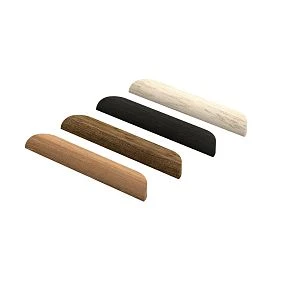
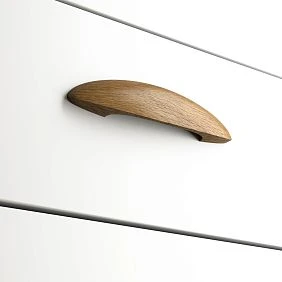
Wooden handle Wave HL-006M Made of oak, supplied with a finish coating and complete with mounting screws. The model can be installed horizontally and vertically. Thanks to this, one article can connect kitchen drawers, swing fronts, a chest of drawers, a wardrobe, and a furniture cabinet without inconsistency in shape.
But the wide size range does not eliminate precise design. The total handle length and the center-to-center distance are different parameters. The front cannot be drilled according to the 700 mm figure if the distance between the mounting holes for this variant is 576 mm. You cannot order handles "approximately by door height" without checking the edges, the opening of adjacent fronts, and the position of the palm. You cannot mix finishes, hoping that natural oak will automatically equalize the shade.
The task of the article is not just to list the sizes of Wave HL-006M. It is necessary to understand how to turn ten variants of one handle into a system: where to choose 180 or 260 mm, when to move to 600–900 mm, what the sizes 1200–1800 mm are for, what line to build on drawers, and how to check the entire set before the first hole in the finished front.
The same shape is more important than the same length
When talking about handles for a wardrobe and a chest of drawers in the same style, they often imagine one size repeated on all furniture. This solution is only suitable for fronts with similar proportions. In a kitchen or dressing room, the dimensions differ too much.
A handle 180 mm long looks confident on a compact drawer. On a cabinet door about two meters high, it turns into a small mark and stops supporting the vertical. A 1500 mm handle, on the contrary, can emphasize a tall front, but will not fit on an ordinary bedside table.
The Wave system is arranged more flexibly. It repeats:
-
the wave-shaped profile;
-
the width and depth of the cross-section;
-
the oak base;
-
coating character;
-
surface-mounted installation method;
-
grip logic;
-
visual language of modern furniture fittings.
The length changes together with the facade. The customer gets not ten different handles, but ten scales of one model.
This approach is especially useful in interiors with several furniture groups. For example, in a kitchen-living room, short Wave handles can be installed on buffet drawers, medium ones on lower kitchen modules, and long ones on built-in wardrobes. The fittings do not have to be identical to the millimeter to be perceived as one collection.
Unity of form also helps with future changes. If a tall cabinet or a separate sideboard is later added to the kitchen, there is no need to look for a similar handle from another brand. It is enough to choose the appropriate length in the same line and check the coating.




Wave HL-006M in numbers: ten lengths and ten center-to-center distances
Wave HL-006M is a surface-mounted profile handle with a constant cross-section of 35 × 23 mm. Four values are used in the dimensional notation: overall length, width, depth, and center-to-center distance. For all variants, the width and depth remain the same, while the overall length and the distance between the centers of the mounting holes change.
| Overall length A, mm | Width B, mm | Depth C, mm | Center distance D, mm | Practical scale |
|---|---|---|---|---|
| 180 | 35 | 23 | 128 | Compact drawers, small doors |
| 260 | 35 | 23 | 192 | Medium drawers, cabinets, narrow fronts |
| 400 | 35 | 23 | 320 | Wide drawers, hinged fronts |
| 500 | 35 | 23 | 384 | Large drawers, chests, kitchen modules |
| 600 | 35 | 23 | 512 | Wide lower fronts and cabinets |
| 700 | 35 | 23 | 576 | Long horizontal and vertical solutions |
| 900 | 35 | 23 | 832 | Wide fronts and tall doors |
| 1200 | 35 | 23 | 1120 | Tall cabinets, wardrobes, and tall narrow cabinets |
| 1500 | 35 | 23 | 1440 | Long vertical handles for tall fronts |
| 1800 | 35 | 23 | 1728 | Handle almost the full height of a large door |
The last column is not a strict assignment, but a design guideline. A 700 mm handle can be placed horizontally on a wide drawer or vertically on a hinged door. A 900 mm size can support a tall front, but is sometimes also suitable for a long kitchen drawer. The decision is determined by the proportions of the furniture, the opening direction, and the overall composition.
The table shows the key point: a request for a "700 mm furniture handle" describes the overall length, but the installer must drill the front based on the center-to-center distance of 576 mm. For the 900 mm option, the center-to-center distance is 832 mm, for the 1200 mm handle it is 1120 mm, for the 1500 mm model it is 1440 mm, and for the longest handle of 1800 mm it is 1728 mm.
If old furniture is already drilled, the choice should primarily be based on the existing center-to-center distance. If the fronts are new, first select the overall length and handle position, then transfer the exact mounting centers to the drawing.
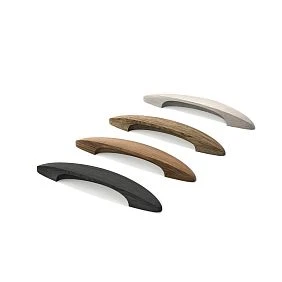
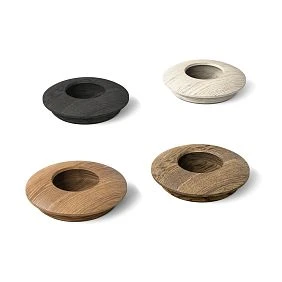
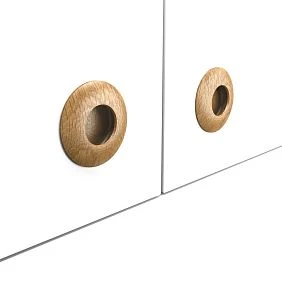
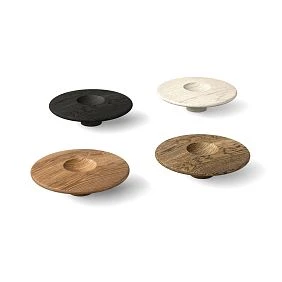
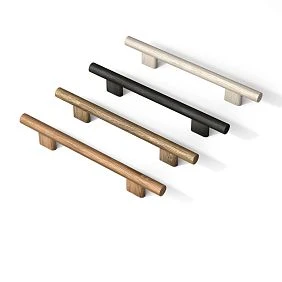
Our factory also produces:
Overall length and center-to-center distance cannot be swapped
Confusion arises because both numbers are expressed in millimeters and refer to the same handle. But they answer different questions.
The overall length shows how much space the handle will take up on the front and how it will look relative to the edges. It is important to the designer and the client.
The center distance shows the distance between the centers of mounting holes. It is important for a furniture maker and an installer.
Suppose a 700 mm furniture handle is chosen. If the craftsman measures 700 mm from one hole to another, the mounting will not match. For Wave HL-006M of this length, a distance of 576 mm is needed. There are sections of the handle body left at the edges, so the total length is always greater than the mounting base.
The same logic works for the short model. For a handle 180 mm long, the mounting centers are located at a distance of 128 mm. If the furniture is being updated and the facade already has 128 mm holes, this size may fit without new drilling—but only after checking the full dimension and the position of the old points.
Before installation, it is useful to open STAVROS product drawings and verify the size markings. The drawing helps to see not only the numbers, but also the position of the holes relative to the edges, the cross-section, and the installation direction.
On the work sheet, it is better not to write “Wave 700 handle.” A correct line looks more detailed:
Wave HL-006M — total length 700 mm — center distance 576 mm — vertical installation — door P-01.
Such a record eliminates three errors at once: substituting the total length for the center distance, losing orientation, and mounting on the wrong facade.
Get Consultation
What does “a single handle line” mean on real furniture
A single line is not necessarily a physically continuous strip. It is a system of repeating solutions that the eye reads as a whole.
With Wave HL-006M, it can be built in several ways.
The same shape on different facades
The most obvious option: all handles belong to the same model, but the length is selected according to the size of doors and drawers. A short Wave on a cabinet and a long Wave on a wardrobe have the same cross-section and bend character, so they do not conflict with each other.
Common axes
On a row of drawers, the centers of the handles are placed on one horizontal line. On tall doors, vertical handles are placed at the same distance from the nearest edge. Even different lengths look cohesive if they follow a common axis.
Repeating the proportion
You can choose the length not by a single fixed size, but by a similar ratio to the facade. For example, the handle occupies a noticeable but not full part of the drawer width; on a wide facade, a longer version is taken, on a narrow one, a shorter one.
Matching edge marks
On several drawers of different widths, handles are sometimes aligned not by centers, but by one edge or a common vertical. This technique is appropriate in an asymmetric composition, but requires a precise drawing.
General finishing
Even perfectly distributed sizes will lose unity if some handles have a transparent coating, some have a white one, and a few items differ in tone. For a set, one coating is chosen and fixed in the specification sheet.
The unified line begins not at the moment of installation. It appears in the facade table, where each door is assigned an article number, length, center-to-center distance, orientation, and coating.
Horizontal installation: drawers, cabinets, and wide facades
On a drawer, the direction of movement is obvious: the user pulls the facade toward themselves. A horizontal handle supports the width, provides a comfortable grip, and visually connects a row of modules.
Short options of 180 and 260 mm suit compact drawers where long hardware would come too close to the edges. Sizes of 400 and 500 mm work on wider facades. For large kitchen drawers, 600, 700, or 900 mm can be considered if proportions and neighboring elements allow.
Long handles for kitchen facades should not automatically take up the entire width. Between the ends of Wave and the edges of the door, visual breathing room and installation clearance should be left. The handle should not extend into the zone of an adjacent facade, catch when opening, or come so close to the side wall that it is inconvenient to grip.
On a group of drawers, it is useful to choose one of two systems.
The first is handles of the same length on facades of the same width. It creates a calm rhythm.
The second is a sequential increase in length along with the width of the drawers. For example, a compact top drawer gets a Wave of 260 mm, the middle one — 400 mm, the wide bottom one — 600 mm. The shape repeats, and the scale follows the furniture.
Don't change the size without a visible reason. If two adjacent facades differ only slightly, handles of different lengths can look like a configuration error. In this case, it's better to keep one size and align the centers.
Vertical installation: swing cabinets and tall tall units
A tall door is built vertically, and a short horizontal bracket often looks random on it. Wave HL-006M allows you to rotate the same shape vertically and choose a length that supports the facade.
The handle for a tall cabinet can have a length of 700, 900, 1200, 1500, or 1800 mm. The choice depends not only on the door height. You need to check:
-
where the comfortable grip zone is located;
-
whether the handle starts too close to the floor;
-
whether the top end fits under the cornice or mezzanine;
-
whether there is space for mounting holes;
-
whether the handle conflicts with the adjacent door;
-
how both doors open simultaneously;
-
Does handle access remain when the cabinet is positioned at an angle?
A handle running the full height of the facade is an expressive technique, but it's not always necessary to literally match its length to the door height. For a 2000 mm door, an 1800 mm handle will leave margins at the top and bottom. Their sizes should be distributed deliberately: symmetrically or offset toward the work zone.
On a tall cabinet next to kitchen drawers, a long vertical Wave solves an important task. It doesn't introduce a new shape but continues the language of horizontal handles. The furniture appears designed as a unified set, even if the facades open differently.
Horizontal and vertical should meet, not argue
In one kitchen, Wave can lie horizontally on drawers and stand vertically on a tall cabinet. Such a change in direction doesn't break the system if common rules are followed.
The cross-section and finish remain the same. The centers or edges of the handles follow the architecture of the facades. Lengths are chosen from the same range. Distances to the nearest edges look related.
A bad option arises when horizontal handles are installed strictly in the center, while a vertical one on the tall cabinet is accidentally pressed against the top edge. The eye sees not a change in direction but a lack of a common principle.
Before ordering, it's useful to create a layout of the entire furniture wall. Not a separate drawing of each facade, but a general front view with handles at real scale. On it, the following quickly become noticeable:
-
a handle that is too short on a tall door;
-
inconsistent offsets;
-
jumps across centers;
-
overloaded row;
-
different density of fittings;
-
conflict of vertical and horizontal.
One model gives freedom, but by itself does not create a composition. It is created by the distribution of sizes.
How to distribute ten sizes among facades
It is convenient to divide the size range not into "small, medium, and large" in a general sense, but by the role of the handle in the composition.
| Length of Wave HL-006M | Center-to-center distance | On which facades to consider | What to check before ordering |
|---|---|---|---|
| 180 мм | 128 мм | Narrow drawers, small cabinets, compact doors | Does the handle not look cramped between the edges; do the old holes align |
| 260 мм | 192 мм | Medium drawers, dressers, small hinged fronts | Is the grip length sufficient; is the overall rhythm with neighboring handles maintained |
| 400 мм | 320 мм | Wide drawers, kitchen fronts, cabinet doors | Do the ends not come too close to the edges; is it convenient to open with one hand |
| 500 мм | 384 мм | Large drawers, dressers, lower kitchen modules | How does the handle relate to the width of the front and neighboring dimensions |
| 600 мм | 512 мм | Wide pull-out sections, hinged doors | Does it not conflict with the neighboring front when opening |
| 700 мм | 576 мм | Long drawers, tall or wide doors | Do not confuse the total length with the center-to-center distance; check the orientation |
| 900 мм | 832 мм | Wide fronts, vertical wardrobe doors | Position of the palm, margins at the ends, rigidity and thickness of the front |
| 1200 мм | 1120 мм | Tall cabinets, wardrobe doors, high wardrobes | Mounting height, access to screws, no conflict with adjacent doors |
| 1500 мм | 1440 мм | Tall hinged fronts | Ratio to the full height and accuracy of marking the long base |
| 1800 мм | 1728 мм | Very tall doors and a handle almost the full height | Installation feasibility, position of the outermost holes, ease of grip at working height |
This table does not replace the drawing. It helps narrow down the choice. The final decision is made after the handle is shown on the front in natural proportion.
180 and 260 mm: not "small versions," but the basis of the rhythm of drawers
The shortest Wave handles are needed not only for miniature furniture. They form the lower scale of the system. Thanks to them, one model can appear on drawers without turning every facade into a platform for a long rail.
The 180 mm handle with a center-to-center distance of 128 mm is convenient for compact elements. This size is especially useful when updating furniture where a standard 128 mm mounting base already exists. But matching holes does not guarantee a fit: you need to compare the total length, edge positions, and shape of the old handle.
The 260 mm option with a center-to-center distance of 192 mm looks more elongated and can connect a small cabinet with larger facades. It is suitable when the 180 mm handle seems too point-like, and 400 mm already overloads the surface.
In a single set, 180 and 260 mm should not alternate randomly. One size is chosen for a specific group of facades: for example, 180 mm on narrow upper drawers, 260 mm on wider lower ones. The difference should be read as a reaction to the furniture's dimensions.
400 and 500 mm: the working middle for kitchen and dresser
The 400 and 500 mm sizes are the easiest to integrate into everyday furniture. They are noticeable enough to support a modern facade but do not require the height of a tall cabinet.
The Wave 400 mm has a center-to-center distance of 320 mm, and the 500 mm version has 384 mm. These values should be listed separately in the installation sheet. A craftsman accustomed to standard brackets may rely on familiar center-to-center dimensions, but drilling is done only after checking the specific handle.
On a dresser, the 400 mm handle can become the main one for wide drawers, and 260 mm for the upper narrow row. In the kitchen, 500 mm suits large pull-out facades and can be continued with a 700 mm model on a wider section.
600 and 700 mm: a line that already shapes the architecture of the facade
Handles 600 and 700 mm long cease to be a small accent. They become one of the main lines of the facade. An error in position is immediately noticeable.
For the 600 mm version, the mounting base is 512 mm, for the 700 mm — 576 mm. It is especially dangerous to confuse the 700 mm length with the 700 mm distance between holes. Such an error will require new holes or replacing the facade.
On a wide drawer, the handle can be placed in the center. On a hinged door, it is sometimes shifted closer to the opening edge. On paired facades, two long handles form a vertical or horizontal rhythm, so the distance between them is checked in the closed position.
900 and 1200 mm: transition from hardware to the vertical of the cabinet
A furniture handle of 900 mm with a center-to-center distance of 832 mm already works confidently on a tall door. The 1200 mm size with a base of 1120 mm emphasizes a tall cabinet or wardrobe facade.
Such handles cannot be placed only in the center of the geometry. The user should easily grasp them at a comfortable height. If a long handle starts too high, the lower part becomes decorative, and the working area is inconvenient. If it is lowered to the floor, the lower end may interfere with cleaning or visually weigh down the door.
The handle can be long, but a person uses only part of its surface. This is normal. The main task is to combine a convenient grip area with a solid vertical line.
1500 and 1800 mm: handle the full height of the facade without literal equality
The request for a "handle the full height of the facade" does not mean that the length must match the door to the millimeter. There must be margins between the edges of the handle and the facade. Their size depends on the height, construction, and overall design.
The Wave 1500 mm has a center-to-center distance of 1440 mm. For the 1800 mm version, the mounting centers are located at a distance of 1728 mm. For installing such a long part, the accuracy of the template is especially important: a small error between the extreme holes is not forgiven.
Before drilling, check the plane of the door. The long oak handle should fit against the facade without forced bending. If the surface is deformed, do not tighten the handle with screws hoping to fix the geometry.
Kitchen: how to assemble a set of handles, not ten separate purchases
The kitchen best demonstrates the capabilities of Wave HL-006M. One cabinet set can include:
-
narrow upper drawers;
-
wide lower drawers;
-
swing doors;
-
cabinet under the sink;
-
column with appliances;
-
tall pantry cabinet;
-
separate sideboard;
-
island.
A buyer often looks for long handles for kitchen fronts, and then separately selects short pulls. As a result, the shapes diverge. Wave allows you to start not with each door, but with the entire furniture wall.
First, the fronts are divided into groups by size and opening direction. Then each group is assigned one size. For example:
-
narrow drawers — 180 mm;
-
medium drawers — 260 or 400 mm;
-
wide lower sections — 500 or 600 mm;
-
large island drawer — 700 or 900 mm;
-
swing door — 600 or 700 mm vertically;
-
tall cabinet — 1200, 1500, or 1800 mm vertically.
This is only a scheme, not a ready-made specification. It needs to be checked on the layout. Perhaps two adjacent drawers are better combined with one length to avoid creating too many steps.
Upper and lower modules do not have to be the same length
Upper cabinets are usually narrower or lower. A large handle can take up too much space on them. But changing the shape is not required: it is enough to choose a short Wave.
If the upper fronts open from the bottom edge or have a different mechanism, an overlay handle may not be needed at all. Hardware should not be installed just for symmetry with the lower row.
On an island, the handle is visible from several sides
A kitchen island is viewed not only from the front. A long horizontal handle can stand out visually more than on wall-mounted furniture. You need to check the passage, the position of chairs, and the movement of people.
A tall cabinet should continue the system, not break it
A vertical Wave on a tall cabinet becomes a connecting element. It repeats the shape of the horizontal handles but changes the direction. If the finish, cross-section, and line character match, the tall cabinet is perceived as part of the set.
Walk-in closet and built-in wardrobe: a long handle as part of the facade
On tall doors, hardware can change the perception of the entire surface. A short pull emphasizes only the grip point. A long handle for a cabinet stretches the door and supports the furniture's architecture.
For a walk-in closet, sizes 900–1800 mm are especially interesting. But the choice depends on the height of the door leaf and the number of doors.
On two identical facades, handles are installed mirror-symmetrically or parallel to the central joint. Enough space is left between them for fingers. If the profiles are placed too close together, the two long oak lines merge into a massive strip.
On three doors, different layouts are possible:
-
one vertical handle on each facade;
-
handles only on the outer opening doors;
-
central door with a handle of a different length;
-
same working height with different dimensions.
Handles cannot be assigned before checking hinges and opening direction. On an outer door near a wall, a long handle may collide with the side plane or limit the angle.
For a cabinet up to the ceiling, it is useful to show the handle together with the plinth, cornice, and overhead compartment. The 1800 mm option may look expressive on the main door, but it does not have to continue onto the small overhead flap. There, a shorter size of the same shape or no separate handle is more appropriate, depending on the design.
Tall cabinet: the vertical handle should be comfortable, not just long
A tall cabinet often has a narrow, high facade. The issue of proportion is especially noticeable on it. A handle that is too short looks random, while one that is too long may come close to the top and bottom edges.
The vertical handle for the cabinet should intersect the comfortable grip height. If the 1200 mm option is chosen, it can be positioned so that the middle part falls on the palm. For the 1500 and 1800 mm models, the working area is wider, but the outer holes require careful checking of the facade structure.
On a kitchen tall cabinet, there may be a refrigerator, oven, or another tall module nearby. The handle should not interfere with the adjacent door. In the open position, not only the Wave body but also the user's fingers should be checked.
Dresser and nightstand: one form without the feeling of a "miniature copy of the kitchen"
The dresser is perceived as an independent piece. If the same model is placed on it as in the kitchen or on the wardrobe, the interior gains a connection, but the furniture should not look randomly repeated.
Sizes from 180 to 500 mm allow adapting Wave to a small scale. On a wide dresser, 400 or 500 mm can be used; on a compact nightstand, 180 or 260 mm.
A useful reference is provided by an example of a dresser with the Wave handle. The finished look helps evaluate not just a separate piece of hardware on a white background, but the connection of the handle with the facade, legs, and overall silhouette of the furniture.
There is no need to copy the example literally. Its purpose is to show the scale and principle. Your own dresser should be measured separately.
How to choose the handle length relative to the facade
There is no universal percentage that fits any furniture. The handle length depends on the width, height, number of adjacent elements, and the desired role of the hardware.
First, determine what Wave should be on a specific facade.
A small functional accent. Then the handle occupies a limited part of the surface and does not compete with the paneling or wood grain.
The main horizontal line. A long model emphasizes the width of the drawer and creates a modern rhythm.
The main vertical line. A size of 900–1800 mm becomes part of the cabinet's architecture.
A connection between different modules. Lengths vary, but the ends and centers follow a single grid.
It is useful to print or draw handles at a 1:1 scale and attach them to the facades. In a scaled-down project, a long line may seem calm, but in reality, it can be too heavy.
Check the edges
There should be a meaningful margin from the end of the handle to the edge of the facade. Too small a distance creates a feeling that the part does not fit. Too large can make the handle look short for this facade.
Check adjacent handles
The size is not chosen in isolation. A 500 mm handle may look good on one drawer, but next to a 600 mm model, the difference will be barely noticeable and will look like a mistake.
Check the opening
The long handle should not collide with adjacent furniture, a wall, a countertop, or other hardware.
Check the hand
Wave should be available at a convenient height. This is especially important for tall vertical models.
Covered Wave HL-006M or HL-006 without coating
The line includes two similar-shaped solutions that should not be mixed in an order without a clear reason. HL-006M comes with a coating. Wave HL-006 handle without coating is intended for a project where the finish is planned separately.
The difference affects not only the moment of painting. It affects the entire order route.
| Criterion | Wave HL-006M with coating | Wave HL-006 without coating |
|---|---|---|
| Readiness | Comes with finish | Requires selection and application of finishing system |
| Color control | Coating selected at order | Color formed with furniture or separately |
| Project timeline | Fewer operations after receipt | Need to account for preparation, test, and drying |
| Risk of shade differences | Reduced with a single order of one finish | Depends on the material, composition, and quality of application |
| Appropriate scenario | A ready-made installation kit is needed | Individual tinting or painting is required |
| Main check | Coating match across all sizes | Finish compatibility and test sample |
If the kitchen or wardrobe is ordered as a complete set, furniture handles with coating the number of operations on site is reduced. The buyer receives products that do not need to be brought to a finished state on their own.
unpainted wooden handles are needed in another situation: when the handle must exactly match the individual finish of the facade, undergo tinting together with the furniture, or receive a coating chosen by the project technologist.
Do not buy part HL-006M and part HL-006, and then try to bring them to a uniform appearance without samples. Even with the same shape, different finishing routes can result in differences in shade, gloss, and tactility.
Oak base: a uniform shape does not negate the natural grain
The Wave HL-006M is made of oak. The natural material gives the handle not only color but also a living texture. On longer versions, the wood grain is especially noticeable: a surface of 1500 or 1800 mm is perceived almost as a separate architectural line.
Oak does not have to look like uniform plastic. Two handles may have a distinguishable grain pattern. In a set, this is not a flaw but a property of the natural material. However, the degree of variability should be assessed in advance, especially if handles are installed in pairs on adjacent doors.
With a transparent or near-transparent finish, the texture remains noticeable. With an opaque color, the profile shape takes center stage. Current finish options are best checked in the specific item's card and ordered as a single set.
For a buyer who needs to understand production tolerances, processing, and the characteristics of natural material, it is useful to review the section in advance quality of wood products. Such a check helps distinguish real natural variation from damage and correctly formulate requirements for the set.
How to arrange handles by grain
Before installation, long oak handles should be laid out side by side in the order they will appear on the furniture. On paired facades, items can be selected so that the grain is perceived as balanced. In a kitchen, it is useful to compare adjacent horizontal models; on a wardrobe, two vertical ones.
There is no need to try to achieve a complete match of the grain. The goal is to avoid random contrast, where one handle is noticeably darker or more active than its neighbor, unless such an effect is intended by the design.
Coating as part of the system, not the last item in the order
In a single line of handles, color and gloss level work no less than length. Even the same Wave in different finishes will be perceived as several collections.
When placing an order, the coating is specified in each line, not just in the general note. This is especially important when the list includes short and long sizes. The table may look like this:
| Facade | Article | Total length | Center-to-center distance | Orientation | Finish |
|---|---|---|---|---|---|
| Box Ya-01 | HL-006M | 260 мм | 192 мм | Horizontally | One selected coating |
| Box Ya-02 | HL-006M | 500 мм | 384 мм | Horizontally | Same coating |
| Door D-01 | HL-006M | 700 мм | 576 мм | Vertically | Same coating |
| Pencil case P-01 | HL-006M | 1500 мм | 1440 мм | Vertically | Same coating |
Such a list leaves no possibility of accidentally adding an item in a different finish.
If the furniture has several colors, the handles can match one of them or work contrastingly. But the solution must be repeated. For example, all Wave handles remain dark and tie together light and wooden fronts. Or a transparent finish emphasizes the oak and unites different painted surfaces with a natural line.
Set of mounting screws: what to check anyway before installation
Wave HL-006M comes with metal mounting screws. This eliminates the need to look for random fasteners separately, but does not cancel the inspection of the front.
Before installation, you need to know:
-
thickness of the door or drawer;
-
the structure of the inner side;
-
absence of obstacles for screw heads;
-
tool access;
-
exact center distance;
-
position of holes relative to edges;
-
compatibility of the included screw with the actual assembly.
If the front has a non-standard thickness, an additional overlay, or a complex panel, the screw length must be checked on site. Do not tighten an overly long fastener all the way or compensate for an unsuitable length with random washers without approval.
Holes are drilled only after receiving the handles or an exact approved template. Even when dimensions are published, a physical fitting protects the finished furniture from an expensive mistake.
Decorative caps FUR-032 and FUR-033: clean inner side of the facade
The fastener head is usually located on the inner side of the door or drawer. In a kitchen, it is rarely considered a decorative detail, but it is visible when opened. On a display cabinet, sideboard, or tall wardrobe, an unrefined screw can disrupt the neatness of the project.
Decorative cap FUR-032 is made in an antique bronze shade and is designed to finish the fastener head. Screw cap FUR-033 has a nickel color. Both models are designed for an M4 screw with a semi-round head.
The choice between them depends not on the Wave length, but on the inner side of the facade and the metal parts of the furniture. The bronze cap will support warm hardware and classic accents. The nickel option looks calmer next to cold metal.
Before purchasing, you need to check the shape of the head of the included screw and actual compatibility. The cap does not fix incorrect fasteners, but covers a suitable head.
What to buy together with Wave HL-006M
The kit for a unified furniture line consists not only of handles. The buyer may need drawings, decorative caps, and materials for neat installation.
| What to add | Why this is needed | For which scenario | What to Check | Link |
|---|---|---|---|---|
| Wave HL-006M handles of different lengths | Assemble one shape on different facades | Kitchen, cabinet, wardrobe, dresser | Length, center-to-center distance, finish | Wooden handle Wave HL-006M |
| FUR-032 | Hide the screw head with a warm metal cap | Classic furniture, bronze accents | M4 screw with a pan head |