Article Contents:
- What "solid wood table legs" means
- Choose the leg material together with the tabletop
- Solid wood doesn't oblige you to keep the natural color
- First the table's construction, then the leg height
- How the apron affects the choice of legs
- Tabletop thickness and visible edge thickness are different reference points
- A wooden support needs to be checked in several cross-sections
- The shape of the leg changes how the wood is perceived
- Beech or oak: choose for the finishing task
- Slat selection and sanding quality are separate parameters
- How to coordinate the finish of the legs and the tabletop
- A test stain is done as a pair: tabletop and leg
- A wooden tabletop requires coordinated fastening
- How to move from the chosen material to a specific model
- Four legs are ordered as a set for one project
- What to include in the table specification
- Where to buy solid wood table legs
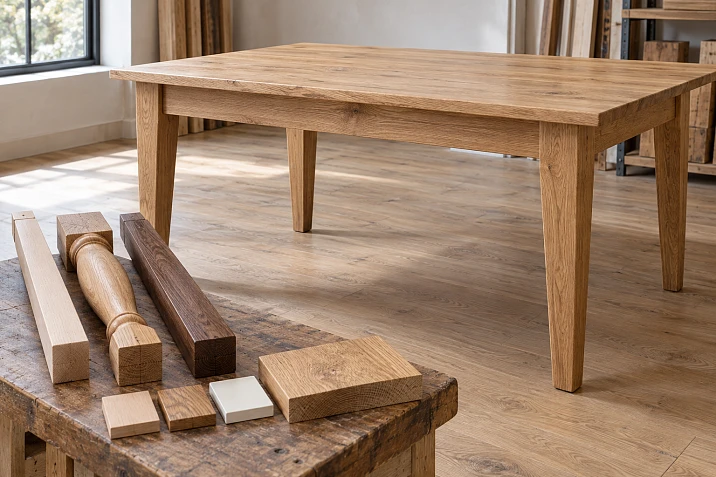
An oak tabletop and four oak legs do not yet promise a table of the same color. On a horizontal surface, the wood grain looks different than on a turned profile, and the same stain can produce noticeably different shades. If an overly heavy apron is added to this, the table changes even before the first test stain: the thin edge no longer looks light, and the space under the tabletop becomes cramped.
Solid wood table legs are selected together with the tabletop and the base. First, determine how the table will be constructed and how much space will remain for a seated person. Then choose the cross-section, species, wood preparation, and finish. The purchase is placed according to a specific article number and specification, once the geometry and appearance have been agreed upon.


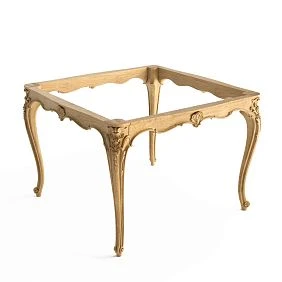
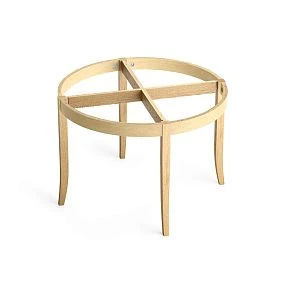
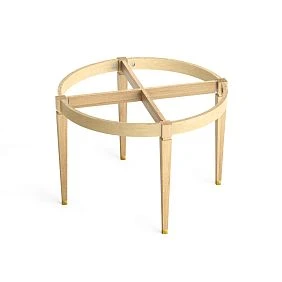
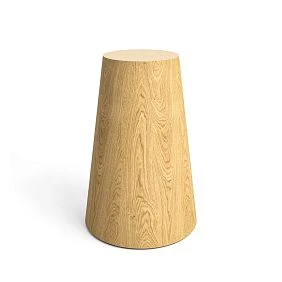
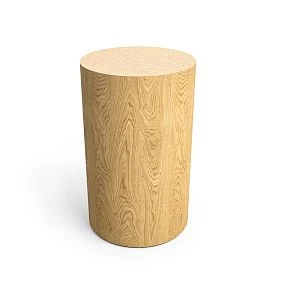
What does "solid wood table legs" mean?
This refers to a wooden support, not a surface with a wood pattern. However, the name of the material does not indicate the permissible load, the mounting method, or the dimensions of the top plate. This information is needed separately.
There is another difference: a finished leg is not necessarily cut from a single solid block. A blank glued from wooden lamellas may be used for its manufacture. This does not turn solid wood into a panel material, but it does affect the appearance of the surface under a clear finish. If the boundaries of wood sections are visible on the support, colorless varnish will not hide them.
Solid wood makes sense to choose when the project requires a wooden profile, carving, turning, open texture, or a support for the overall furniture paint finish. A request for brown color alone does not yet determine the material. If the project is already built on another load-bearing base, the wooden part may perform only a decorative role — this must be distinguished before ordering.




The material of the legs is chosen together with the tabletop
Start with a sample or an exact description of the tabletop. The words "wooden, light" are not enough: behind them may be solid oak, oak veneer on a panel, a painted surface, or a decorative coating with a printed pattern.
| Tabletop | What to coordinate with wooden legs | Where a mistake is possible |
|---|---|---|
| Solid wood | Species, grain pattern, shade and gloss; mounting construction | The same species is taken as a guarantee of the same color |
| Veneered | Type of veneer and finish, the actual base for the fastener | The decorative top layer is taken as a description of the entire board |
| Painted | Shape of the supports, color, degree of gloss and surface texture | Only the name of the shade is compared |
| Made of another material | The role of wood in the composition and a compatible mounting assembly | They plan to attach the supports in the same way as to a wooden panel |
The legs and tabletop can be made of different species. For example, under an oak tabletop it is acceptable to plan a beech base with opaque enamel: the wood grain remains on the upper surface, while the lower part is perceived by color and silhouette. With a clear finish, the differences between species will be more noticeable, so the combination is first tested on samples.
For a tabletop made of stone, glass, or another slab, wooden supports are chosen together with the base and the intended fastening system. The indication "for a table" in the leg's product page does not mean compatibility with any tabletop. If a separate load-bearing frame is needed, its dimensions and weight are included in the project from the very beginning.
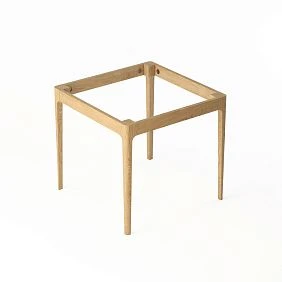
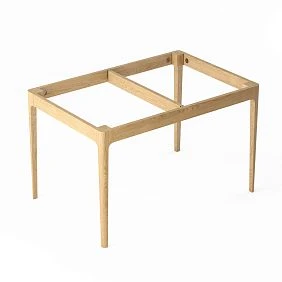
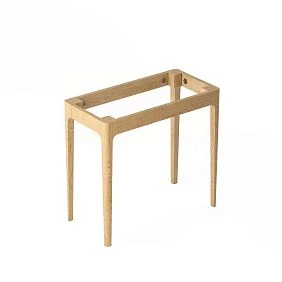
Our factory also produces:
Solid wood does not oblige you to keep the natural color
The species answers the question of what the part is made of. The finish determines what surface the finished furniture will have. A solid wood leg can be used under clear lacquer, oil, stain, or enamel — with suitable preparation and a compatible finishing system.
Therefore, it is useful to begin the choice of "beech or oak" with a different question: should the wood texture be visible? If the entire table is painted in one solid color, the expressiveness of the oak grain may not be a goal of the project. If the base remains open, the texture becomes one of the main criteria.
An opaque color also does not guarantee a completely smooth surface. If a uniform enamel without a noticeable pore pattern is required, this is agreed separately with the finisher. Color, surface relief, and gloss are three different properties. The entry "white legs" describes only part of the result.
Get Consultation
First the table design, then the leg height
Determine what the tabletop rests on: the upper ends of the legs, an apron base, mounting plates, or a separate frame. For each solution, the vertical dimensions add up differently.
Final table height = vertical height of the installed support + distance from its upper mounting plane to the tabletop surface.
The glide, plate, and intermediate parts are accounted for by their actual position in the assembly. If part of the leg is recessed into the structure, its full length is not equal to the visible height. For an angled installation, a vertical dimension is needed, not just the length along the axis.
In this case, first clarify the composition of the catalog dimension. If the installed plate is already included in the product height, its thickness does not need to be added a second time.
A conditional example: the design height of the table is 750 mm, the tabletop above the upper end of the leg occupies 35 mm, and the glide adds 5 mm at the bottom. For a straight installation without additional intermediate parts, a wooden support of 750 − 35 − 5 = 710 mm is needed. This is a calculation example, not a recommended height for all tables.
If the found model has a different size, first check the available versions and the possibility of changing the design. Trimming cannot be considered a mandatory default operation. At the top, it may affect the mounting part; at the bottom, it may change the profile and the contact area with the floor.
The height is chosen according to the purpose of the table and the seat. For a desk, a pull-out drawer is additionally taken into account; for a dining table, the ability to place chairs and use the end seats. The sum of dimensions alone is not enough to assess convenience.
How the apron affects the choice of legs
The apron connects the elements of the underframe and takes up space under the tabletop. Its height, thickness, and position must suit the upper part of the leg. A joint drawn over a thread or a narrow neck does not become workable just because it is barely visible in the general view.
On the detail drawing, show the end of the apron, the mounting zone of the support, and the selected joint. Clarify where the holes or slots run, what material remains around them, and whether the parts interfere with each other. The final dimensions of the joint are assigned for the specific design, not according to the overall width of the leg.
At the same time, the apron does not always need to be added to the table height. If it is located to the side of the upper part of the support, under the tabletop, its downward dimension reduces the free space but does not raise the top surface.
Suppose a table with a height of 750 mm has a tabletop 35 mm thick, and the apron begins immediately under it and extends down by 90 mm. Under the lower edge of the apron, 750 − 35 − 90 = 625 mm remains. These conditional dimensions show the geometry; convenience is checked with the chosen chair and person. The presence of a drawer or fasteners below the apron may further reduce the clearance.
When there is not enough legroom, the underframe is reconsidered. Simply increasing the leg height will raise the entire table. Eliminating the apron also requires another proven solution that preserves the rigidity of the structure.
Tabletop thickness and visible edge thickness are different reference points
For installation, the actual construction of the tabletop at the mounting point matters. For proportions, what matters is how it looks from a normal viewing angle.
A tabletop may have a thin beveled edge but remain significantly thicker in the main body. Another option is a relatively thin slab with a wide lower band along the edge. In a photograph, both solutions are easily mistaken for a solid piece of the corresponding thickness. This mistake will affect both the choice of fasteners and the scale of the legs.
On the side view, separately mark the thickness of the mounting base, the visible edge, and the lower line of the apron. This will give you the overall silhouette of the upper part of the table. It is precisely with this that the width of the support is compared.
On a wide tabletop with a thin edge, large legs can become a deliberate accent. With a visually heavy top, an excessively thin support sometimes seems accidental. But there is no universal ratio like “the leg cross-section equals two tabletop thicknesses.” What matters is the overhang, the length of the table, the shape of the supports, their placement, and the presence of an apron.
Several cross-sections need to be checked on a wooden support
A single maximum diameter is not enough. On a turned or carved leg, the wide decorative part may be located away from the mounting zone, and below it may transition into a narrow neck.
| Support section | What is checked |
|---|---|
| Upper mounting part | Placement of the apron, holes, plate, or other assembly |
| The narrowest section | The actual cross-section, its position, and its role in the structure's performance |
| Maximum outer contour | Visual volume, protrusions, and free space between the legs |
| Lower part | The shape of contact with the floor and the possibility of installing a glide |
The cross-section for strength is selected based on the table's design, taking into account the load, the height of the supports, and the joints. The wood species does not replace this check. You cannot assign an allowable load to a finished leg just because it is oak and appears thick.
It is also not enough to divide the weight of the tabletop by four. In use, uneven and lateral forces arise, and the result depends on the entire underframe. If the manufacturer has not specified the model's load-bearing capacity for the required configuration, it cannot be inferred from a photograph or a general article.
On the visual side, compare options at the same scale. A single drawing should include the entire tabletop, apron, legs, and chairs. A separately enlarged photograph of a support says almost nothing about how it will look under a specific top.
Then check how much space remains between the inner surfaces of the legs. In a hypothetical design, the tabletop length is 1600 mm, the outer faces of the two outermost supports are set back 100 mm from the ends, and the width of each leg at the level being checked is 80 mm. The free span is 1600 − 2 × 100 − 2 × 80 = 1240 mm. If, with the same outer setbacks, a 120 mm wide cross-section is chosen, 1160 mm remains — 80 mm less.
This calculation does not determine the number of seats. It shows the cost of increasing the cross-section in a specific layout. The chosen chairs and space for movement must fit into the resulting opening; for shaped legs, the contour is checked at the required height. Moving the supports toward the edges for a larger span requires rechecking the fastening and overhangs.
The shape of the leg changes how the wood is perceived
On a straight, wide face, the stripes and transitions of the grain read clearly. On a rounded surface, the pattern follows the curvature, and lighting creates light and dark areas even with a single finish color. That is why the material and the profile are assessed together.
Precision legs for a table compare across the entire profile: the position of the thicker sections affects both the silhouette and the inner opening. The maximum diameter of the ball or cylinder does not describe the upper connection to the apron.
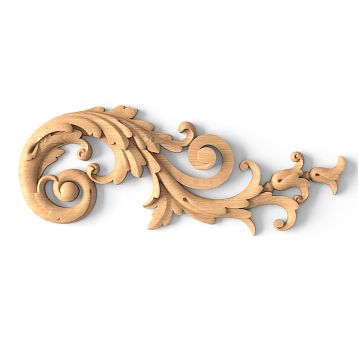
У carved legs for furniture the raised relief and the orientation of the pattern are considered separately. Active carving under the tabletop with pronounced wood grain can create too many small details. In that case, it is useful to compare a calmer profile or an opaque finish on the base.
geometric wooden legs allow you to focus on the proportion of the faces and the taper. But a simple shape does not mean universal mounting: the upper part is still matched to the table's construction.
Beech or oak: choose according to the finishing task
Beech is convenient to consider for a base under enamel: here the line of the leg, the relief, and the quality of the painted surface come to the fore. But beech can also be left under a clear finish if its own pattern and shade suit the project.
Oak table legs are chosen when you want to preserve a noticeable wood grain. They are compared especially carefully with an oak tabletop: a matching species name does not cancel out differences in pattern, base color, and the character of the blank.
| Task | Where to start choosing | What to confirm with a sample |
|---|---|---|
| Dense enamel on the entire base | Beech and suitable surface preparation | Smoothness, color, gloss |
| Open oak texture | Oak with a consistent blank appearance | Pattern and shade next to the tabletop |
| Light transparent finish | Comparison of specific beech and oak samples | The wood's own color after coating |
| Painted base under a wooden top | Wood species for the selected finishing technology | Combination of a painted shape and open texture |
These are selection guidelines, not a prohibition on other combinations. If a project calls for oak under enamel, the solution is checked against the required surface and processing cost. If beech under oil is chosen, it is evaluated on a sample piece rather than trying to achieve an oak pattern with a single color.
Structurally, there is no wood species here that is "best for any table." You need to compare finished models of the same purpose along with their dimensions and mounting. Replacing beech with oak does not fix an insufficient mounting area or a poor joint.
Lamella selection and sanding quality are separate parameters
At STAVROS in the section "Materials and Product Quality" two blank options are distinguished: "under enamel" and "under tinting." In the first case, lamellae are not selected by color and texture; in the second, such selection is provided for, although minor differences between wood sections and parts remain.
Surface treatment is specified separately: "Standard" or "Prestige." For example, in the MN-029 card, the "Prestige" sanding quality is combined with the selected "Under enamel" gluing option. More thorough sanding does not mean the blank is automatically selected for a transparent finish. These are different order characteristics.
The practical consequence is simple: for legs under clear lacquer, it is not enough to specify only the wood species and high sanding quality. The type of gluing and the permissible wood heterogeneity must be agreed upon. For opaque painting, the requirements for pattern selection may differ, but the requirements for geometry and joints remain.
If the finishing decision has not yet been made, it is not worth ordering the entire set on the assumption that "we'll choose oil or enamel later." Moving from an opaque coating to a transparent one can change the requirements for the wooden parts themselves. Clarifying this before purchase is easier than trying to hide the contrast of lamellae with a transparent finish.
How to coordinate the finish of legs and tabletop
The same color name on two cans is not a sample of the finished table. The appearance of the surface depends on the substrate, preparation, application, and lighting. On the tabletop, the observer sees a large horizontal plane; on the leg — facets, curvature, and shadows.
For a transparent finish, they decide how close the shades of the upper and lower parts should be. Sometimes an almost uniform tone is needed, sometimes a noticeably darker underframe. The difference must be consistent, otherwise a random shift of the legs toward a reddish or gray shade will be perceived as a selection error.
A covering finish is checked not only by color. A semi-matte tabletop and more glossy legs can look different even when the shade matches. If this is not intended, the degree of gloss is included in the finisher's task.
At the same time, the tabletop and supports work under different conditions. The top contacts dishes, hands, and objects; the legs have their own areas of wear and cleaning. Using literally one composition for all surfaces is not necessary. Systems are selected according to purpose, and their appearance is agreed upon with samples.
Unpainted furniture legs are suitable for a workshop that performs the finishing independently. If required furniture legs with finish, check the availability of the required version of a specific model. The presence of a separate section does not mean that any item is produced in all colors.
A test coat is made as a pair: tabletop and leg
For approval, two samples representing the future table are needed: a section of the tabletop with the actual preparation and the selected leg, or an approved sample of the same wood and version. A flat board is useful for initial color selection, but the final appearance of a complex profile is better checked on the part itself.
- Prepare both substrates according to the intended technology. Label the species and the blank variant.
- Apply the agreed system in full. Comparing only the stain, if lacquer will follow, is not enough.
- Wait for the coating to reach the state in which the manufacturer permits evaluation and further work.
- Place the countertop sample horizontally, and place the leg next to it in its working position. Look at the pair under lighting close to that of the future place of use.
- Record the accepted result and the technique for repetition.
On a turned support, inspect the transitions of the profile; on a carved one, the recesses; on a geometric one, the adjacent faces. One successfully painted surface does not describe the entire part. Pay especially close attention to places where shadow enhances the perception of a dark tone.
If the leg differs noticeably from the top, it is not necessary to change the species. First determine the cause: the wood's own color, the preparation, the coating composition, or its application. The finisher can adjust the technique, but the result is confirmed by a new test finish, not by the promise that "it will even out on the large piece."
Keep the control pair until the order is completed. A photograph is convenient for correspondence, but its color depends on the shooting conditions and the screen. For a repeat batch, a physical sample provides a more reliable basis for comparison.
A wooden countertop requires coordinated fastening
When humidity changes, wood changes dimensions. A coating can slow this process, but it does not eliminate it; this is separately noted in the technical reference on wood. Therefore, even well-dried and painted solid wood cannot be considered a completely motionless material.
For a table, this means that the fastening of the wooden tabletop to the underframe must be coordinated with its construction and the direction of the grain. The chosen joint must account for possible changes in dimensions. The specific solution is specified in the drawing; holes must not be arbitrarily changed or fasteners loosened for the sake of "letting the wood move."
Fastening a leg to an apron and fastening a tabletop to an underframe are different connections. Suitable hardware for the first does not automatically solve the task of the second. On veneered board, the core material is additionally checked: the outer veneer does not determine how well the fastener is held inside the part.
furniture leg hardware are selected after determining the support and the base. The scope of supply, hole dimensions, and required additional operations are determined before finishing.
How to move from the chosen material to a specific model
After the construction and finish have been agreed upon, ready-made table legs can be compared using the product cards. Record the dimensional specification in full: a single item number may have variants that differ in several parameters at once.
For example, the STAVROS catalog presents the following models:
| Model | Dimensional specification from the product card, mm | Material |
|---|---|---|
| Geometric leg MN-187 | A × B: 740 × 80 | Beech or oak |
| Turned leg MN-029 | A × B × F: 650 × 70 × 146; 740 × 80 × 167; 850 × 88 × 192 | Beech or oak |
The table shows how real products are described and does not confirm their interchangeability. The meaning of each letter is verified against the model drawing. Matching first numbers do not yet mean the same top plate, profile, and apron position.
For the selected variant, the material, preparation, mounting, and dimensions are specified after the intended assembly. If the project requires four supports, having one suitable piece does not complete the selection. The entire agreed set is needed.
For a new assembly, it is reasonable to first order one leg for a trial fit. It is compared with the drawing, the mounting part is checked, and it is used to approve the finish. Such a check of a single part does not replace the assessment of the rigidity and stability of the assembled table.
Four legs are ordered as a set for one project
For a table on four identical supports, the order specifies one article number, one size variant, one wood species, and one agreed finish. The number four refers to the selected design: for a different construction, the number and arrangement of supports are determined separately.
If directional carved parts are used, check whether left and right versions are needed. In that case, the set may consist of different article numbers installed on specific sides. They cannot be arbitrarily replaced with four identical legs.
Matching dimensions do not mean a complete match of the wood grain. Before a clear finish, it is useful to lay the parts out together and agree on the placement of prominent areas. This way the customer will see the overall appearance of the base, and the workshop will maintain the approved orientation during assembly.
Upon receipt, the marking, dimensions, surface condition, and mounting part are checked. Any difference in height is clarified before trimming. If the table wobbles, first distinguish between an uneven floor, an assembly error, and a difference in the supports: shortening a leg without this check is premature.
The sample that remains in the workshop is not included in the four parts for installation. Glides and fasteners are counted separately if they are not included in the delivery.
What to record in the table specification
For a repeat order, the wording “oak legs, four pieces” is not enough. The production record must allow restoring not only the appearance but also the mounting.
| Field | What to save |
|---|---|
| Position | Leg designation on the drawing |
| Article and size | Exact model, finish, link to the product card |
| Wood | Wood species and approved blank option |
| Preparation | Surface quality and required operations before coating |
| Finishing | Coating system, color, gloss, reference sample designation |
| Joints | Assembly with stretcher or frame, tabletop mounting |
| Layout | Position of supports, orientation, offsets from selected datums |
| Quantity | Parts for installation; sample and spare separately |
| Approval | Drawing version and sample approval date |
Next to the specification, keep the control pair “countertop — leg.” If after a few months the veneer supplier, coating composition, or support size changes, it will be clear which part of the solution needs to be re-approved.
Where to buy solid wood table legs
You can start your selection with the section wooden table legs STAVROS. A broader catalog solid wood furniture legs will be useful for comparing shapes and size options.
Before buying wooden table legs, prepare the dimensions and material of the countertop, the underframe diagram, the required height, and a description of the finish. If you need a transparent surface, attach a sample or an exact specification for the wood combination. For painted supports, indicate not only the color but also the expected texture and sheen.
Cost is compared across the entire set: wooden parts, hardware, preparation, coating, and delivery. A lower price for one unfinished leg does not yet mean a lower cost for the finished underframe. Especially if the execution requires additional work to achieve the agreed surface.
Availability, price, and lead time are confirmed for the selected material and size. Workshops should review conditions for manufacturers, and payment and delivery coordinate with the assembly and finishing schedule.
The order should include supports for which the place under the countertop, connections, and appearance after coating have already been determined. Then solid wood becomes part of a well-thought-out table: its grain, shape, and finish work together with the top surface, and the set can be assembled and later repeated according to the saved specification.