Article Contents:
- What is neoclassical wall decor: the essence without the history
- Light neoclassicism vs. overloaded classicism
- Why moldings and stucco work in neoclassicism: seven reasons
- Decorating a wall with moldings: basic schemes
- Scheme 1: One central frame
- Scheme 2: A pair of symmetrical frames
- Scheme 3: Three frames with equal spacing
- Scheme 4: Frame with a horizontal belt
- Scheme 5: Floor-to-ceiling frames
- Where neoclassical decor looks best
- Bedroom: wall as an architectural headboard
- Living room: accent wall behind the sofa
- Hallway: vertical as the first word
- Hall and corridor: rhythm as a principle
- Study: status through framing
- How to choose proportions: a practical guide
- Frame width relative to the wall
- Frame height relative to the ceiling
- Molding cross-section relative to frame scale
- Clearance from furniture and lighting fixtures
- Ready-made set or custom selection: what to choose
- Custom selection of elements
- Ready-Made Set of Decorative Molding
- How to choose a set for a specific room
- Narrow wall (less than 200 cm)
- Wide wall (from 350 cm)
- High wall (ceilings from 3 m)
- Wall behind the bed
- Wall with built-in lighting fixtures
- Interior with pronounced decor
- Common mistakes when decorating walls with moldings
- Mistake 1: too many frames on a small wall
- Mistake 2: too thin molding on a high wall
- Mistake 3: breaking symmetry
- Mistake 4: decor clashing with furniture
- Mistake 5: heavy ornament in a small room
- Mistake 6: disjointed elements without a unified scheme
- Mistake 7: painting without priming the joints
- What to place inside decorative frames
- Empty frame
- Wall sconce
- Mirror
- Painting or print
- Accent background color
- Perimeter frame lighting
- Kit materials: polyurethane and MDF in their proper roles
- Polyurethane: not 'plastic', but a structural decorative material
- MDF: perfect for straight lines
- Color solutions: how to paint decorative frames
- Monochrome — the main technique of modern neoclassicism
- White decor on a colored background
- Dark decor on a light wall
- Metallic paint for special contexts
- Neoclassical decor in the system: how to connect the wall with the ceiling and floor
- Where to view ready-made sets: the 'Neoclassic Light' collection
- About the Company STAVROS
- Frequently Asked Questions
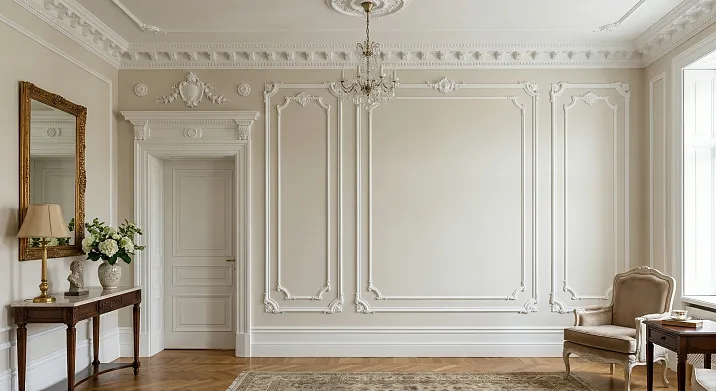
There is a question that sooner or later arises for everyone who undertakes a serious interior project: how to make a wall come alive without turning it into a theatrical set? How to add depth without drowning the space in ornamentation? The answer that architecture has given for millennia is moldings and stucco. And the style that reinterpreted this answer for modern housing is neoclassicism.
Neoclassical wall decorToday, it is not a reconstruction of palace decor. It is an architectural tool: molding frames, symmetrical panels, decorative corner accents made of polyurethane—everything that organizes the wall plane without excess and without losing character. This is precisely why this topic is so hotly searched: people want not a historical reference, but a practical understanding—which schemes work, where to place them, how not to make mistakes with proportion, and whether to assemble the decor by elements or take a ready-made set.
This material is a practical guide. From idea to scheme, from scheme to room, from room to a ready-made solution.



What is neoclassical wall decor: the essence without the history
Neoclassicism in interior design is not a style with rigid rules. It is a principle. A principle that says: space must be organized, symmetrical, and scaled to the human figure. Not overloaded, not empty—specifically organized.
In the language of walls, this means the following: a flat, monochromatically painted surface in neoclassicism is not a finished solution. The wall must have structure—horizontal and vertical axes, zones, frames, borders. Not for the sake of decoration itself, but so that the space reads as intentional, thoughtful, and architecturally meaningful.
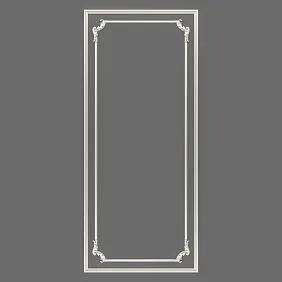
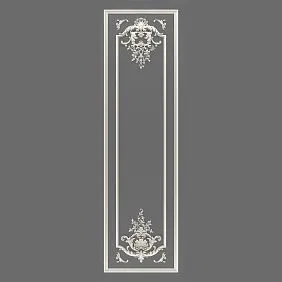
The main tools of this structure arewall moldings in neoclassicismand stucco decorative elements. Molding draws a line—horizontal, vertical, angular. A stucco element creates an accent—in the corner of a frame, at the intersection of axes, at the center of a panel. Together they transform a plane into an architectural surface.




Light neoclassicism versus overloaded classicism
It is important to understand the difference between traditional classicism and modern neoclassicism in terms of decor. In classicism, a wall can carry several layers of ornamentation: a complex-profile cornice at the ceiling, a horizontal pilaster belt in the middle, framed panels at the bottom, decorative rosettes at junctions, ornamental friezes. This is rich, formal, and completely appropriate in the corresponding context—a large house, a formal hall.
Modern neoclassicism works differently. Here, one or two layers of decor are chosen, but they are executed precisely, in correct proportions, with clear placement logic. A thin 22 × 11 mm molding forms a frame—that is enough. Corner decorative elements cover the vertices—that is enough. No fifth layer is needed. This is precisely what constitutes 'light' in the modern understanding of neoclassicism: maximum architectural effect with minimal decorative noise.
How to build a decorative system according to this principle is detailed in the STAVROS article"Decorative Molding: Profile Solutions for Neoclassicism and Modern Classicism"—there, the logic of profiles, proportions, and monochrome painting as the main technique is analyzed.
Our factory also produces:




Why moldings and stucco work in neoclassicism: seven reasons
One can theorize about style at length. But it's better to understand what exactly decor made of moldings and stucco gives to a wall in a neoclassical interior. Here are seven practical answers:
1. Structure the plane. A bare wall is just a surface. A wall with a molding frame is an architectural element with logic. It creates a top, bottom, center, and perimeter.
2. Create symmetry. Neoclassicism is built on symmetry along vertical and horizontal axes. Moldings make this symmetry visible: frames to the left and right of the central axis, equal margins top and bottom.
3. Add volume with monochrome painting. A white frame on a white wall seems invisible in diffused daylight. But turn on directed wall sconces in the evening — and the wall will come to life: moldings and corner elements will cast shadows, turning the plane into a textured surface.
4. Highlight functional zones. A frame behind the bed says: this is the sleeping area. A frame behind the sofa says: this is the lounge area. A decorative panel in the hallway says: this is the welcoming space. Moldings literally tell the purpose of zones without furniture or signs.
5. Organize light. A wall light — a sconce, spot, or decorative lantern — lives organically inside a decorative frame. The frame provides a visual justification for any light source on the wall.
6. Scale the space. A vertical frame 2300 mm high with a 2.7 m ceiling visually 'stretches' the space upward. This works even in low-ceilinged rooms: the eye reads the frame's height as the height of the space.
7. Allow avoiding wallpaper without losing character. A smooth, monochrome wall with molding frames is a full-fledged design solution, requiring neither complex wallpaper nor decorative plaster. One coat of paint plus decor — and the wall is ready.
Get Consultation
Wall decoration with moldings: main schemes
This is the most practical section of the guide. Before choosing a specific kit or calculating the number of moldings, you need to understand — which layout scheme to choose. Inwall decoration with moldings and stuccoSeveral basic schemes are used, each solving different tasks.
Scheme 1: One central frame
A single decorative frame centered on the wall is the most concise, most restrained solution. It is used where one architectural accent is needed, not a system.
When to use:
-
the wall behind the bed headboard in a bedroom;
-
the wall behind a console or fireplace in a living room;
-
the end wall in an entryway—the one visible upon entering;
-
a small wall in a study behind a desk.
Placement principles: the frame is centered horizontally—strictly along the wall's axis of symmetry. The offset from the ceiling and baseboard is made equal or proportional. A single frame should occupy 40–60% of the wall's width—if the wall is 250 cm, a frame 100 cm wide looks just right.
Scheme 2: A pair of symmetrical frames
Two frames of the same size, positioned symmetrically relative to the central axis of the wall. A classic paired solution.
When to use:
-
on both sides of the TV on the TV wall;
-
symmetrically by the bed in a spacious bedroom;
-
on both sides of the door in the hallway or entryway;
-
on a long living room wall with a window in the center.
The distance between the frames should be less than the width of each one — then the pair is perceived as a system, not as two unrelated objects. The optimal ratio: the gap between frames is 50–70% of the width of one frame.
Scheme 3: Three frames with equal spacing
Three frames with equal gaps between them and equal indents from the edges of the wall — a rhythmic system characteristic of formal classical halls.
When to use:
-
a long wall in the living room 4–5 m or more;
-
a hallway with high ceilings;
-
a corridor with sufficient width for three vertical accents;
-
a restaurant or hotel hall with rhythmic decor.
In this scheme, it is especially important to maintain equal spacing: between the frames and between the outermost frames and the wall corners. A visual discrepancy of even 3–5 cm is perceived as an error.
Scheme 4: Frame with a horizontal belt
The molding horizontal divides the wall into upper and lower zones. Vertical decorative frames are placed in the lower zone. The upper zone features a smooth surface or a thin frieze.
This is the most 'classical' of the schemes—it refers to the traditional division of a wall into a plinth, field, and frieze, familiar from the interiors of historical mansions. At the same time, in a modern interpretation, the horizontal can be very delicate—a single 22 mm profile—and not create a sense of historical reconstruction.
When to use:
-
rooms with ceiling heights from 2.8 m;
-
halls and formal areas;
-
bedrooms with high panels behind the bed;
-
meeting rooms and offices in a business interior.
Scheme 5: Floor-to-ceiling frames
Vertical decorative panels covering the full wall height — from baseboard to ceiling cornice. This is the most extensive scheme, creating maximum architectural impact.
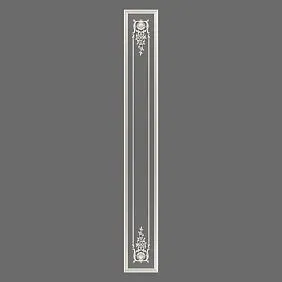
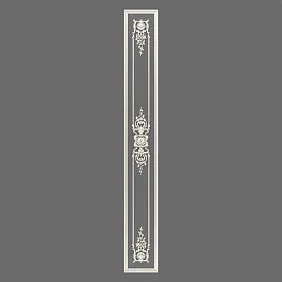
With frame height of 2300 mm and standard ceiling heights of 2.5–2.7 m — the frame essentially covers the entire usable wall surface. This exact format is implemented in theCPU-2-3 plaster decor set: width 1000 mm, height 2300 mm, four identical corner elements ensure complete symmetry along all axes.
Where neoclassical decor looks best
Bedroom: wall as architectural headboard
The bedroom is the main 'canvas' forneoclassical-style plaster decor. The wall behind the bed headboard is the most photographed surface in residential interiors. It's what people use to judge the entire room design, and it creates the first and main impression when entering the bedroom.
A decorative frame behind the bed serves as an architectural headboard—without bulky wooden panels, without soft upholstery, without additional furniture investments. One frame measuring 1000 × 2300 mm centered on the wall behind a 180 cm double bed is a complete solution: the frame matches the width of the bed, the bed visually 'fits' into the frame, and the sleeping area gains boundaries and character.
Color scheme for the bedroom: most often monochrome (frame matching the wall color) or a delicate contrast (white frame on a pastel background). A deep color behind the bed—sage, dusty rose, warm gray—paired with a white frame creates a classic duo solution.
For a bedroom with two bedside lamps—the frame becomes a vertical axis, on which sconces are logically placed symmetrically on both sides.
Living room: accent wall behind the sofa
In the living room, neoclassical decor works on several walls, but the main one is always the wall behind the sofa. This is the focal point of the space: it's what you look at from the TV area, and it's visible upon entering the room.
One wide frame or three vertical frames with equal spacing on the wall behind the sofa—and the living room stops being a 'furniture arrangement' and becomes a designed interior.
For a living room with a fireplace: frames of the same size are placed symmetrically on both sides of the fireplace portal. This is a classic scheme for formal living rooms, working organically in a modern interpretation.
For a TV wall: frames on both sides of the television create a symmetrical frame that turns a technical object into part of an architectural composition.
Entryway: the vertical as the first word
The entryway is the most commercially valuable space in terms of first impression. At the same time, it's most often the narrowest and most cramped. That's precisely whyvertical decorative panelswith a narrow format: they elongate the space vertically without taking away width.
The end wall at the corridor's end is the perfect spot for a single vertical frame centered. The eye automatically moves toward it as the corridor's final point, making the space read as organized and complete.
On both sides of the mirror in the hallway — two symmetrical frames create a mirror-like framing in a classic spirit. Meanwhile, the mirror remains the main element; the frames are its architectural context.
Hall and corridor: rhythm as a principle
In halls with ceiling heights of 3 m and above — rhythmic systems of several frames with equal spacing create an enfilade effect. This is one of the strongest architectural techniques: when you enter a space and see a sequence of identical decorative accents, the brain reads architectural order — and this feels like a 'luxury' interior.
Study: status through framing
One or two frames on the wall behind the desk in a study create a professional architectural backdrop. This works both physically — in the real space — and visually: in modern video call practice, the wall behind a person has become part of their professional image.
A delicate frame behind against a dark blue or deep gray wall — it's a signal without words.
How to choose proportions: a practical guide
Proportions are the most common source of errors when decorating walls with moldings. A molding that's too narrow on a tall wall gets lost. One that's too wide feels oppressive. A frame of the wrong scale ruins symmetry. Here are specific principles that work:
Frame width relative to the wall
For a single frame: its width should be 35–60% of the wall width. On a 250 cm wall — frame 90–150 cm. On a 180 cm wall — frame 70–110 cm.
For paired frames: the sum of the widths of both frames plus the gap between them and the margins from the edges — 80–90% of the wall width. The wall should not appear 'empty at the edges'.
For three or more frames: the width of each frame should be greater than the gap between them — otherwise the pattern falls apart.
Frame height relative to the ceiling
Classic rule: the frame leaves a strip of clear wall 15–25 cm above to the cornice or ceiling. Below — a symmetrical strip to the baseboard. This creates upper and lower 'margins' where the wall breathes.
Exception: 'floor-to-ceiling' frames (as in the 2300 mm format with ceilings 2.5–2.7 m) — here the free margin is intentionally removed. This creates a different effect — maximum height, characteristic of formal halls.
Molding cross-section relative to the frame scale
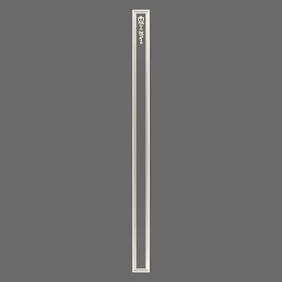
A frame 2300 mm high and 1000 mm wide requires molding with a minimum cross-section of 20 × 10 mm — otherwise the line is lost. Profile 22 × 11 mm (like molding MLD-002-MG from the 'Neoclassic Light' collection) — optimal for this scale.
For smaller format frames (500 × 800 mm), you can take a profile with a cross-section of 15 × 8 mm. For large panels 1200 × 2500 mm — profile 35 × 12 mm or more.
Clearance from furniture and lighting fixtures
The bottom edge of the frame should be no closer than 10–15 cm from the top edge of the furniture (headboard, sofa back, console tabletop). This creates breathing space between the furniture and the decor.
Lighting fixtures within the frame are positioned on the vertical axis of symmetry of the frame or symmetrically on both sides of it. Asymmetric placement of sconces relative to the frame is a typical mistake that ruins the entire scheme.
Ready-made set or independent selection: what to choose
This question is asked by every second customer. And there is no universal answer—there are two different scenarios with different advantages.
Independent selection of elements
Suitable for:
-
experienced designers with a precise vision of the result;
-
non-standard wall sizes for which there is no ready-made set;
-
projects with custom configurations (combination of several types of moldings, special rhythm of frames);
-
cases where separate items are needed — only molding or only a decorative element.
Risks:
-
mismatch in proportions between corner elements and molding;
-
stylistic break between elements from different series;
-
need to independently calculate the cutting;
-
risk of ordering too much or not having enough of what is needed.
Ready-made set of stucco decor
Suitable for:
-
private clients without experience in selecting elements;
-
designers who want to reduce time on object outfitting;
-
projects with serial application (several rooms, hotel, restaurant);
-
standard wall zones for which the kit format fits directly.
Advantages:
-
Elements are already coordinated in style and proportions;
-
kit composition is precisely calculated for the given frame format;
-
no risk of stylistic mismatch between molding and decorative accents;
-
easier to order — one SKU instead of multiple items.
inready-made wall molding decor setsThe logic of the 'Neoclassic Light' collection is exactly this: the designer work of selecting and coordinating elements is done for the customer. The molding and polyurethane corner accents are already matched in cross-section, relief, and proportion — and work as a system, not as a random set of parts.
For more details on how to approach assembling a complete set for an accent wall, see the article'Wall Molding, Decorative Panels, and Wooden Handles: Where to Buy a Complete Decor Set for the Living Room in 2026'.
How to choose a set for a specific room
The question 'which set is suitable' has specific answers if based on room parameters, not personal taste.
Narrow wall (less than 200 cm)
Optimal format: one vertical frame 70–100 cm wide. Tall format — 2000–2300 mm. On a narrow wall, a wide frame looks like a random patch; a narrow tall one looks like an architectural accent.
Not suitable: three or more frames side by side—they will create overload, making the wall appear even narrower.
Wide wall (from 350 cm)
Optimal format: a system of two to three frames with equal spacing. Alternative—one large frame 1200 × 2300 mm centered with decorative vertical panels on the edges.
Important: a wide wall without multiple frames seems incomplete—one frame is not enough here.
High wall (ceilings from 3 m)
On high walls, a frame 'from baseboard to ceiling' looks organic and appropriate. You can use a scheme with a horizontal molding belt in the middle of the wall, separating the upper and lower zones—with one or two frames in the lower zone.
Molding profiles for high walls are chosen with a larger cross-section—at least 30 × 12 mm, otherwise the line gets lost on the large-scale surface.
Wall behind the bed
Frame width—according to the bed width. For a 160 cm bed—frame 80–100 cm. For a 180 cm bed—frame 100–110 cm. For a 200 cm bed—frame 110–130 cm. A frame narrower than the bed looks weak; a frame wider is fine if it matches the wall width.
Frame height—from the baseboard or from 10 cm above the mattress. Frame top—10–15 cm below the ceiling cornice or flush with it.
Wall with built-in lights
If wall sconces are planned for the wall — first determine the axis of symmetry of the light fixture, then build a frame with its center on the same vertical axis. The light fixture should fall into the upper third of the frame or symmetrically on its sides — not chaotically, but logically.
Interior with pronounced decor
If the interior already has a rich ceiling cornice with a complex profile, plaster rosettes, decorative pilasters — choose more delicate wall decor profiles with a smaller cross-section. The principle: the richer one plane, the more restrained the other.
Typical mistakes when decorating walls with moldings
Mistakes in this topic are repeated with enviable regularity. Let's analyze the most common ones — so you don't repeat them.
Mistake 1: too many frames on a small wall
Attempting to 'fill' a small wall with three or four frames with minimal gaps turns it into a fragmented mosaic. The result is opposite to what was expected: the wall doesn't look richer — it looks smaller.
Rule: on a wall less than 200 cm — no more than two frames, and only if they are truly small.
Mistake 2: too thin molding on a high wall
A 10 × 5 mm profile on a 2.7 m high wall is an invisible line. For the frame to be readable from a distance of 3–4 m — a profile with a cross-section of at least 20 × 10 mm is needed.
Mistake 3: broken symmetry
A frame offset by 5 cm from the center of the wall is perceived as a mistake—precisely because symmetry is expected in neoclassicism. If symmetry is not precisely maintained, it's better not to start it. An asymmetric solution should be intentional and pronounced, not accidental.
Mistake 4: conflict between decor and furniture
A frame that starts behind the sofa back or visually 'cuts into' the headboard of a bed doesn't work. Always leave a gap between the top edge of the furniture and the bottom edge of the frame (minimum 15 cm).
Mistake 5: heavy ornament in a small room
A polyurethane corner element with large relief (projection 40–50 mm, rich baroque ornament) in a 12–14 m² room is a visual overload. For small spaces, choose delicate profiles with a small projection (15–20 mm) and restrained relief.
Mistake 6: disparate elements without a unified scheme
Buying molding from one series, a corner element from another, trimming on-site 'as it turns out'—and ending up with a wall where everything is present but nothing works. The stylistic mismatch of proportions and profiles is immediately noticeable.
It is hereready-made kits of moldings and decorative moldingwin over independent selection by default: in a set, the elements are already coordinated—both stylistically and geometrically.
Mistake 7: painting without priming the joints
Joints between molding and the wall, between a corner element and molding—are always filled with acrylic sealant and sanded before painting. If this step is skipped, the first coat of paint will reveal gaps and unevenness that cannot be hidden.
What is placed inside decorative frames
A decorative frame on the wall is not just a framing of emptiness. It is a stage that implies actors. Or it can remain elegantly empty—which in itself is a statement.
Empty frame
An empty decorative frame, painted to match or contrast with the wall, is an independent architectural solution. Especially effective with evening side lighting: the frame comes alive through light and shadow, not needing any content.
Wall sconce
A sconce inside a frame is a classic solution for bedrooms and living rooms. The light fixture is mounted on the vertical axis of symmetry of the frame, in its upper third. With two symmetrical frames on either side of the bed—one sconce in each frame at the same height.
Mirror
A mirror in a decorative frame is a double framing. The outer wall frame sets the architectural context; the mirror in its own frame is the central object. Works in hallways, living rooms, lobbies.
Important: the mirror should be noticeably smaller than the inner field of the frame—otherwise the two framings compete.
Painting or print
A painting inside a decorative wall frame is an almost literal reference to a museum gallery. The painting size is 50–70% of the frame's inner field. Prints in a single color scheme, arranged in symmetrical frames, are a modern technique with classical roots.
Accent background color
Inside the frame, the wall is painted a different color—either a contrasting shade or a more saturated tone of the same hue. Outside the frame, the background is neutral. This is one of the most striking solutions: the frame literally 'cuts out' the color spot, turning it into an architectural element.
Perimeter lighting around the frame
An LED strip along the inner perimeter of the frame with hidden installation creates a soft glow effect around the decorative panel. It adds a sense of atmosphere and depth. Works especially well in niches and behind the bed.
Kit materials: polyurethane and MDF in their proper roles
A discussion about neoclassical wall decor inevitably leads to materials—and here it's important to dispel several common misconceptions.
Polyurethane: not 'plastic,' but a structural decorative material
molded decoration made of polyurethaneIt is often perceived as a 'cheap substitute for plaster.' This is an incorrect comparison: polyurethane is a different material with different purposes and properties.
It excellently reproduces the complex relief of corner decorative elements, is resistant to mechanical impact (corner elements are the most vulnerable areas of a frame), unaffected by humidity changes, and accepts acrylic enamel without prior priming. For mass production in commercial projects—hotels, restaurants, residential complexes—polyurethane is optimal: all items from the same mold are identical.
MDF: perfect for straight lines
MDF molding profiles maintain a geometrically precise straight line over lengths of 2–2.5 m. This is their main function — and MDF handles it better than solid wood (which warps with humidity changes) and better than polyurethane (which can have straightness tolerances over long lengths). Factory priming of the surface is a plus for the installer: the molding is immediately ready for final painting.
Detailed characteristics of profiles for various projects are on the page of molding MLD-002 and in the section moldings, cornices, and baseboards.
Color solutions: how to paint decorative frames
Monochrome — the main technique of modern neoclassicism
Frame matching the wall color. Decoration is achieved only through volume and chiaroscuro. This is the most modern, most sophisticated solution. During the day — the wall appears structured, yet solid. In the evening with directional lighting — the frames 'emerge' from the plane.
Technically: the molding is painted with the same paint as the wall, but a slightly more matte or slightly more glossy finish is possible — this creates a subtle textural difference under side lighting.
White decor on a colored background
A classic solution. A white or cream frame on a wall of sage, terracotta, deep blue, warm gray — this is an image immediately read as a 'classical interior'. The contrast can be soft (white on pastel) or pronounced (white on deep dark).
Dark decor on a light wall
Inversion of the classic solution. An anthracite or graphite frame on a white or light gray wall is a modern, bold technique. It works well in interiors with dark furniture and brass or bronze hardware.
Metallic paint for special contexts
Gold, bronze, or antique silver on corner decorative elements with neutral molding. This solution is for Art Deco, 'glamorous neoclassicism,' and premium segment apartments. It requires precise balance: overdoing the metallic can make the result look kitschy.
Neoclassical decor as a system: how to connect the wall with the ceiling and floor
A separate frame on the wall is already good. But a full-fledged decorative program for a room is a system where the wall, ceiling, and floor are connected by a unified logic.
Ceiling cornice — the transition from wall to ceiling. Above the area with decorative frames, the cornice completes the vertical decorative program. A wide range of cornices is available in the section STAVROS moldings and cornices.
Baseboard with a complex profile — the lower horizontal belt. A 100–120 mm baseboard with a classic or neoclassical profile under the frame creates the foundation of the entire decorative system. The lower molding of the frame and the upper profile of the baseboard should be stylistically harmonious.
Ceiling rosettes — focal accents on the ceiling above decorative frames. A rosette above the center of the frame creates a vertical decorative axis 'frame — ceiling.' The selection polyurethane sockets in the STAVROS catalog is wide — from minimalist to rich classic.
How to properly combine all these elements into a unified interior ensemble is covered in the article 'Wall moldings and furniture legs: How to assemble the perfect set for an interior in the neoclassical style'.
Where to view ready-made sets: the 'Neoclassic Light' collection
If you already know what you want — a symmetrical decorative wall frame in the neoclassical style, with polyurethane corner elements and primed MDF molding — then the next step is obvious: view the ready-made solutions from the collection.
Neoclassic Light collection— is a selection of exactly such sets. Different formats — vertical panels, wide frames, symmetrical and directional compositions. All items are stylistically coordinated, all consist of elements selected for proportion and relief.
A ready-made guide to choosing stucco decor, taking into account current trends — in the article "The Complete Guide to Choosing Wall Stucco Decor".
About the company STAVROS
Decorative architectural decor is about details. And about who stands behind these details.
STAVROS — a Russian manufacturer of architectural decor: MDF moldings, polyurethane decorative elements, cornices, baseboards, rosettes, furniture legs. Production — in Russia, quality control — at every stage. Delivery — throughout the country.
The company works with private clients, design studios, architectural bureaus, and commercial projects of any scale — from a single bedroom to a chain hotel. Every order is made-to-order: this guarantees precision in execution and the absence of warehouse compromises.
STAVROS — is not 'decor from a catalog'. It is an architectural tool for those who understand that a wall is not a background, but an element of space.
Frequently asked questions
What is better for neoclassicism: moldings or a ready-made set?
Depends on the task. If the wall is of a standard format and you need a fast, predictable result without errors — a ready-made kit. If the project is non-standard or the designer has a precise vision for a custom scheme — selecting elements individually.
Can decorative frames be used in a small bedroom?
Yes. One vertical narrow-format frame behind the bed does not reduce space — it organizes it. The main rule: one frame, delicate molding, monochrome painting. Multiple frames in a small room risk overloading.
Is polyurethane stucco suitable for painting?
Yes, polyurethane takes acrylic matte and semi-matte enamel well without prior priming. Two coats with intermediate drying of 3–4 hours — and the surface is ready.
Where is it better to create an accent wall?
In the bedroom — the wall behind the bed headboard. In the living room — the wall behind the sofa or opposite the entrance. In the hallway — the end wall. In the study — the wall behind the desk. In the hall — the most visible surface from the entrance.
How many frames are appropriate on one wall?
On a wall up to 200 cm — one, maximum two small frames. On a wall 250–350 cm — one large or two medium ones. On a wall from 350 cm — three frames with equal spacing. More than three frames in a row — only on very long formal walls from 5–6 m.
What to choose for the wall behind the bed?
One vertical frame the width of the bed with four identical corner elements — for maximum symmetry. Frame height — from 80–100 mm above mattress level to 10–15 mm below the ceiling cornice.
How to choose the frame size for a specific wall?
Frame width = 40–60% of wall width for a single solution. For a paired system — both frames together occupy 70–80% of the wall width. Height — leave 15–20 cm of free space at the top and bottom.
Can the 'Neoclassic Light' collection decor be combined with STAVROS cornices and skirting boards?
Yes. The collection is designed as part of a unified decorative system and is stylistically compatible with cornices, skirting boards, rosettes, and moldings from other series in the STAVROS catalog — this allows for building a complete decorative program for a room within a single source.