








































Article Contents:
- What is a door casing and why is it needed
- What Types of Door Casings Exist
- By material
- By Profile Shape
- By purpose and place of application
- Why You Should Choose Wooden Casings
- How to Choose a Door Casing
- By interior style
- By width and profile
- By Color and Finish
- When to Choose a Patterned or Carved Casing
- What to Pair Door Casings With
- How to choose door trims for interior doors
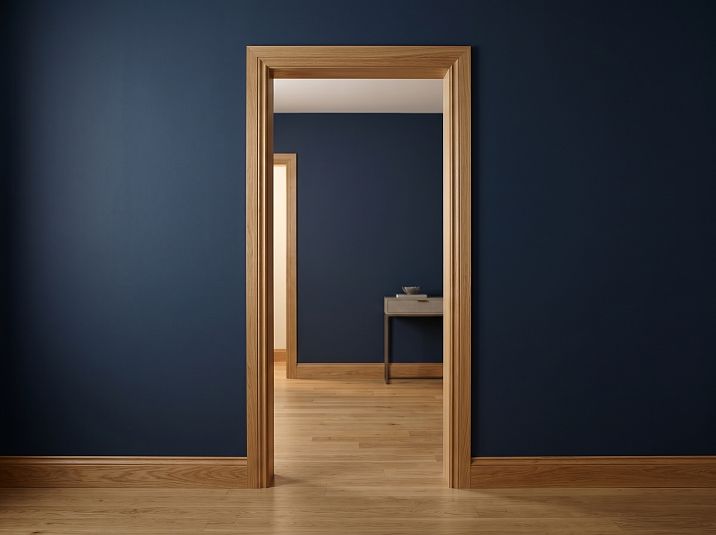
When it comes to finishing a door opening, most people think about the door itself — its color, texture, hardware. But there is one element that goes unnoticed only as long as it's chosen correctly: the door casing. Make a careless choice, and even the most expensive interior door will lose half its expressiveness. Conversely, a well-chosen wooden door casing can turn an ordinary opening into an architectural accent that sets the tone for the entire interior.
If you're currently looking for where to buy door casings, how to coordinate them with flooring, baseboards, and moldings, how not to miss the mark on profile and width — this article is written precisely for you. There's no fluff or abstract advice here. Only specifics: materials, formats, styles, combinations, and links to ready-made solutions.


What is a door casing and why is it needed
A door casing is a decorative strip installed around the perimeter of a door frame on both sides of the opening. It has a dual purpose: technical and aesthetic. Underestimating either one is a mistake.
The technical function is simple: there is always an installation gap between the door frame and the wall. It is necessary during installation, it compensates for building shrinkage, and it conceals the mounting foam. Without a door casing, this seam is visible and looks rough, unfinished, untidy.door casingssolve this problem first and foremost.
But then the most interesting part begins.
The aesthetic function is something people rarely think about, and in vain. The casing visually forms the boundary between the door and the wall. It either emphasizes this boundary, making it an accent, or softly dissolves it into the general background. The profile, width, and finish of the casing directly determine how well the door fits into the room—or, conversely, stands out from it.
In addition, a well-chosen wooden door casing serves as a connecting link between the architectural elements of the room. It connects the door withwooden baseboard, echoes withwooden moldingson the walls, forming a unified stylistic line. As a result, the interior does not fall apart into separate elements but is perceived as a cohesive, well-thought-out composition.
That's why choosing a casing is not a formality but a full-fledged design decision.




What types of door casings are there
Before searching for 'your own'—you need to understand what the market offers in general. The assortment here is wider than it seems at first glance. Let's break it down by key parameters.
Our factory also produces:


By material
Wooden architraves are a classic in the best sense of the word. Solid oak, beech, pine, ash. The material is natural, warm, with a pronounced texture. Wood holds its shape well, is easy to work with, and accepts any finish — varnish, stain, enamel, wax.Wooden trim— the choice of those who think about interior design seriously and for the long term.
MDF is a more affordable and technologically advanced option. It mills well, does not warp under stable humidity, and allows for precise reproduction of complex profiles. Often used for painting. The downside is it lacks a natural texture and falls short of solid wood in terms of material feel.
Polyurethane is lightweight, moisture-resistant, and inexpensive. It is most often used in bathrooms or budget projects. It imitates molding, but in classic and premium interiors, it looks weaker than natural wood.
Combined solutions — where the base is made of MDF or glued timber, and the decorative elements (overlays, inserts, corner rosettes) are made of solid wood. A good balance of price and appearance.
The conclusion here is clear: if the interior aims for a level above average — choose wooden door architraves. Especially where there is already wooden parquet, solid wood furniture, decorativeWooden trim.
Get Consultation
By profile shape
The shape of the architrave defines the character of the doorway and sets the tone for the entire design. There is no 'best' option here — only the one that suits your specific situation.
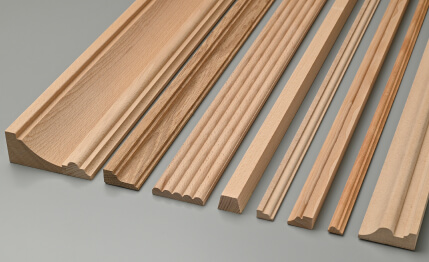
Smooth (flat) architraves — a minimalist rectangular profile without relief. Suitable for modern interiors, Scandinavian style, loft, minimalism. They look good in monochrome spaces where decor is kept to a minimum.
Profiled architraves — a profile with steps, bevels, coves, ogees. This is already an architectural detail. Such architraves are characteristic of classic interiors, modern classic, and neoclassical styles. They add volume to the opening and create a visual dialogue with other profiled elements — cornices, baseboards, moldings.
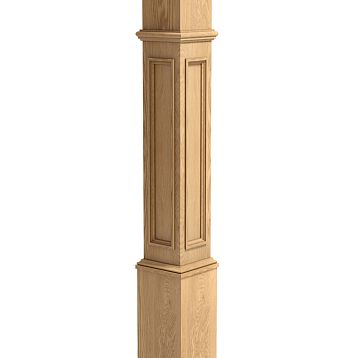
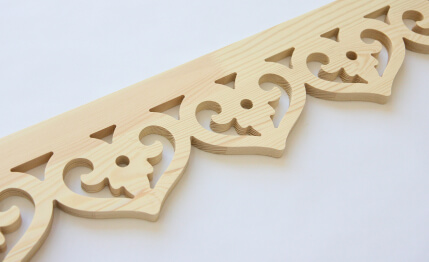
Carved architraves — products with hand-carved or milled carving on the surface. Floral ornaments, geometric patterns, Baroque scrolls. This is the highest level of decoration:carved door casingssuitable for formal interiors, studies, living rooms with high ceilings, where there is alreadywooden pilastersandCapitals.
Patterned casings are an intermediate option between smooth and carved. Embossing, relief patterns, geometric inserts. Suitable for transitional solutions — when classic is needed but without opulence.
Wide and narrow — this parameter affects the scale of the opening. Narrow casing (40–60 mm) is a neutral solution. Wide (80–120 mm and more) is an active accent that forms a door portal.
By purpose and place of application
Casings for interior doors are the most in-demand category. Used in residential apartments and houses. Requirements for them: matching the room style, compatibility with extension width, ease of installation.
Casings for classic doors are typically wider and profiled, with pronounced relief. Often paired withdecorative elements— corner blocks, rosettes, overlay ornaments.
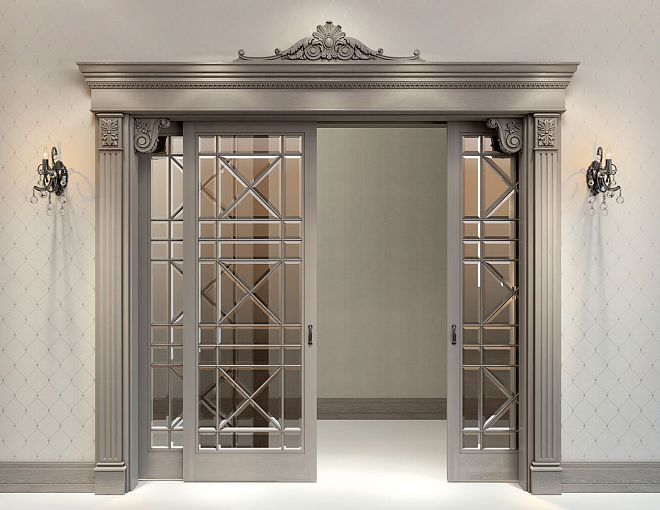
Decorative casings for door portals — a monumental solution for high openings. Here the casing ceases to be just a strip and becomes part of a full architectural structure together with pilasters, frieze, and cornice.
Why choose wooden casings
A reasonable question — there are plenty of alternatives on the market, and some are cheaper. But let's be honest: neither polyurethane nor painted MDF will give the feeling that natural wood creates. Let's break it down specifically.
Natural wood texture is something that cannot be replicated. The unique grain pattern, living surface, and play of shadow on the shaped profile. Unlike synthetic materials, wood doesn't 'deadens' the interior but adds depth to it.
Premium appearance - wooden architraves instantly elevate the perceived class of a room. Even in a modest apartment, properly selected solid wood architraves create a sense of quality and thoughtfulness.
Versatility in finishing - wood accepts any finish. Want a snow-white enamel for a classic look? No problem. Dark tinting for a wenge effect? Easy. Natural varnish preserving the texture? Without issue. Wooden architraves for enamel are one of the most popular requests in classic interior categories, and here solid wood outperforms any alternative.
Durability - with proper treatment, wooden architraves last for decades. They can be repainted, sanded, and refreshed without complete replacement. No synthetic material offers this possibility.
Architectural logic - wooden architraves organically integrate into the interior decor system. They connect the door with woodenbaseboards on the floor, witha wooden moldingon the wall, withwooden corniceunder the ceiling. It is precisely this unity of material and form that makes an interior an interior, not just a collection of furniture.
If you're working on a project where architectural decor matters - choosing wood is non-negotiable. It's a professional standard.
How to choose door architraves
This question is the most common and the most important. The answer depends on several parameters that need to be considered together, not separately.
By interior style
The style of the room is the first filter when choosing an architrave. A mistake here is the most costly: a beautiful architrave on its own can completely ruin the concept of a room if it is 'out of place'.
Modern classic is a style that currently sets the tone in most new business-class projects. Here, shaped architraves with a clean, uncluttered profile are appropriate. Width — from 60 to 90 mm. Finish — white enamel or tinting to match light walnut. Paired with white moldings and profiled baseboards.
Classical interior — strict symmetry, rich profiles, emphasis on architectural decor. Here, a wide architrave with a multi-stage profile is needed — from 80 mm. Preferably — made of solid oak or beech. Carving and ornament are appropriate. A combination withwooden pilasterandwooden capital— to form a full-fledged portal.
Neoclassicism — softer than pure classicism, but richer than modern. A medium-sized profile architrave, possibly with a small ornament. Finish in neutral tones or under natural wood. Combines well with wall moldings and cornices.
Interior with decorative moldings — if the walls are already decorated with moldings, the architrave should continue their logic. The ideal option: use the same profile, the same material, the same finish. It is here thatSolid Wood ItemsSTAVROS delivers maximum results — the entire line of moldings, cornices, skirting boards, and architraves is produced in a unified system.
By width and profile
The rule is simple: the width of the architrave sets the scale of the opening.
-
Narrow architraves (40–60 mm) — an unobtrusive solution. They work well in small rooms where there is no need to overload the space with details. A standard choice for minimalist and modern interiors.
-
Medium architraves (60–80 mm) are a universal format. They suit most living spaces and easily blend with various styles.
-
Wide architraves (from 80 mm) are for accent framing. They create a visual frame around the door, especially effective in spacious rooms with high ceilings. It is the wide, shaped architrave that forms the basis for a door portal.
By profile: the more steps and beads in the cross-section, the more 'classic' the feel. A flat profile gives a modern look. A complex stepped profile gives academic classicism. Intermediate solutions give modern classic and neoclassical styles.
Before purchasing, always check: the architrave must overlap the installation seam with a margin of at least 8–10 mm on each side. This is the technical minimum.
By color and finish
The color of the architrave is not just 'matching the door'. It is about positioning the element within the room's space.
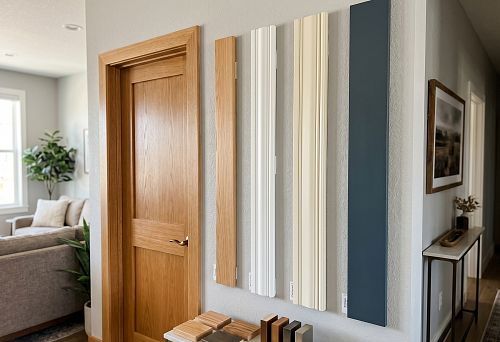
Matching the door is a classic approach. The architrave blends with the door leaf, making the opening appear as a single element. Works well in minimalist and modern interiors.
Matching the skirting and moldings is a professional approach. All wooden interior elements are a unified team. One color, one material, one character. This is the logic designers apply when working withmoldings, cornices, and baseboardswooden ones.
Contrasting the door is a bold solution. A dark architrave on a light door or vice versa. Creates an accent on the opening. Requires confidence in the overall concept.
Natural wood finish is for when preserving texture is important. Varnish or oil-wax with minimal pigment. Ideal for interiors where wood is the primary material.
White enamel finish is the most popular option in classic styles. A snow-white architrave combined with white molding and white cornice creates an architecturally complete space.
When is it better to choose a casing with a pattern or carving?
A carved wooden door casing with a pattern is not just beautiful. It is a functionally justified solution if the interior is ready for it. But when exactly?
If the door is a decorative accent of the room. When the door is not just a passage between rooms, but a focal point. The main entrance to the living room, study, library. In this case, a casing with carving enhances the effect, rather than overloading it.
If the interior is executed in a classic style. Classic is a style where details decide everything. Here every profile, every ornament carries semantic weight. A smooth casing in a classic space looks like a missed note in a melody.
If pilasters, capitals, and decorative elements are used nearby. This is the principle of stylistic unity. If the interior already containsWooden pilasterandwooden capital— the casing should be in the same league. A smooth plank next to a carved pilaster creates dissonance.
If you need to emphasize the door portal. A portal is an architectural structure around an opening: casings, frieze, cornice, pilasters. When all elements are worked out in the same ornamental key — the effect of real architecture arises. Look atDoor Decorationin the execution by STAVROS — this is exactly the level that serious projects strive for.
If the ceiling height allows. A carved casing requires space. In a room with a 2.5-meter ceiling, it can overload the opening. In a room with a 3-meter or higher ceiling — it unfolds to its full potential.
What to combine door casings with
One of the main questions asked by both clients and designers is: how to build a system of decor around a door opening? The answer is through the chain principle.
The chain looks like this: casing → door → baseboard → molding → cornice → portal. Each link must be coordinated with the neighboring ones. Let's break it down in detail.
Casing + baseboard. This is the basic combination in any room. The casing goes around the perimeter of the opening, the baseboard goes around the perimeter of the floor. If they are made of the same material and have a similar profile, the room gains unity.with a classic profile creates a sense of solidity, reliability.Wooden baseboard paired with wooden casing is the standard of a quality interior.
Casing + molding. If the walls are decorated with moldings, the casing should continue their logic. Similar profile, similar width, the same material. This is exactly how the feeling of architectural elaboration of the room is created.Wooden moldingsWooden moldings on the walls combined with wooden casings are a classic of the genre.
Casing + cornice. The cornice completes the vertical line of the interior. When the cornice profile echoes the casing profile, the eye moves smoothly through the room, without sharp transitions.Wooden corniceCornice from the same range as the casing is an ideal solution.
Casing + pilaster. For high openings and formal rooms. Pilasters are mounted on the sides of the door opening, the casing completes its framing around the perimeter. Together they form a door portal.Wooden pilasterWooden pilaster and wooden casing with a figured profile are a combination with a centuries-old tradition.
Casing + decorative elements. Corner blocks, overlay rosettes, ornamental inserts. These details allow you to 'assemble' the casing into something more — an artistic frame. Take a lookdecorative elementsSTAVROS — among them there are solutions specifically for reinforcing the door opening.
Practical advice: when forming an order, make a list of all interior decor elements in the room — baseboards, moldings, cornices. And choose the casing so that it fits organically into this system and does not become a foreign inclusion.
How to choose casings for interior doors
Casings for interior doors are a separate and important topic. An interior door opening in most cases is not a main entrance, but it is an element that is constantly visible. And it is here that mistakes in choice are most noticeable.
For an apartment with modern renovation — as a rule, medium-format shaped or smooth casings are suitable. If the renovation is in the spirit of modern classic — a shaped profile with white enamel. If Scandinavian style or minimalism — a thin smooth casing under light wood.
For a country house — here the style often gravitates towards natural materials, towards solid wood. Wooden casings with a tint under walnut or oak. A wider profile, possibly with carved decor. Connection with wooden floors, beams, stairs.
For high openings — non-standard height requires a non-standard approach. A wide casing with a pronounced profile will prevent the opening from looking 'stretched' and unfinished. With ceiling heights from 3 meters, it is recommended to consider a full-fledged framing of the door opening with wood — with pilasters and a cornice block.
For doors in a classic style — they require a 'classic' casing. Shaped profile with several levels, width from 80 mm, solid oak or beech, white enamel or tint under dark wood. A patterned wooden door casing with a pattern will be especially appropriate here.
For doors with decorative framing — if a full-fledged portal is planned, then the casing is only one of the elements. Pilasters, capitals, frieze, cornice are added to it. The result is a door opening as an architectural object. It is precisely to such a result that the solutions leaddecorating doorsfrom STAVROS.
An important parameter is the width of the extension. An extension is an extension strip that covers the end of the wall in the opening. The casing must cover the joint of the extension and the wall. If the wall thickness is non-standard, this must be taken into account when ordering.