Article Contents:
- What is NPU-416.4 and why its scale matters more than the photo
- First measure the free field, not just the width of the console
- Do not automatically consider 526 mm as horizontal width
- The 526 × 395 mm template should be made before purchasing
- What the calculation shows for a console 1200 mm wide
- It is more convenient to compare the range of furniture widths in a single table
- Console 700–800 mm: the large overlay becomes dominant
- Console 900–1200 mm: more space appears for one large piece
- Wide dresser 1400–1800 mm: NPU-416.4 may be too local
- The width of the free field matters more than the width of the furniture if there are architectural boundaries nearby
- Center NPU-416.4 relative to the furniture or the wall
- Height of 395 mm requires a separate calculation
- Do not raise the overlay too high just to fill the wall
- What will stand on the console after renovation
- When one NPU-416.4 is better than several small pieces
- When a single clear center is needed
- When you don't want to assemble an ornament from individual pieces
- When a large empty field requires a noticeable but single accent
- When the rest of the interior is already complex
- Can I order NPU-416.4 after the console is already installed and the wall is painted?
- Do I need to buy two NPU-416.4 units for symmetry?
- Can I use NPU-416.4 above the console without moldings?
- What should I do if the console is not centered on the wall?
- Will NPU-416.4 work for a very tall room?
- Can I combine NPU-416.4 with a painting?
- Can I place NPU-416.4 above a radiator with a console?
- How can I check the size if I can't print a 1:1 image?
- Does it make sense to buy NPU-416.4 if there will be a TV above the console?
- What should I do if the template fits in width but seems too tall?
- Can one large overlay look calmer than three small ones?
- Where can I see alternatives of a smaller or different size?
- Where can I order specifically NPU-416.4?
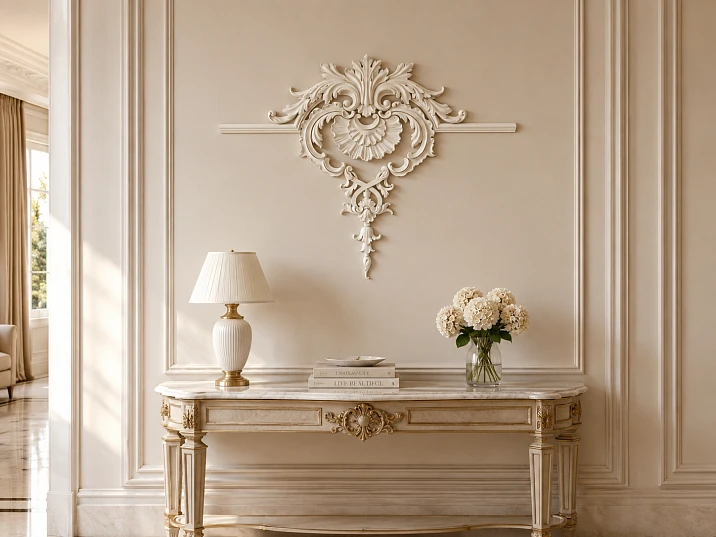
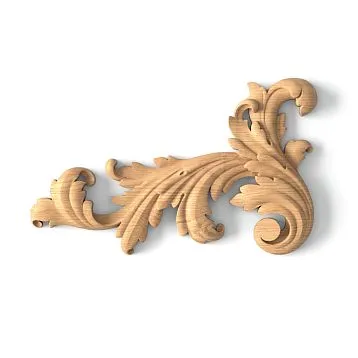
The console is already in place, the wall is painted, but a large empty field remains above the furniture. I don't want to fill it with a painting. Several small decorative elements would require a separate layout, and a new molding frame would noticeably change the wall's architecture. In this situation, it makes sense to check another option: one large carved overlay NPU-416.4 made of polyurethane.
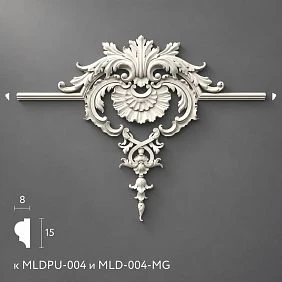
The size of NPU-416.4 is 526 × 395 × 18 mm, the price at the time of checking is 9,180 ₽. The STAVROS card confirms the material, dimensions, and current cost of the product.
This is a large wall accent. The long side of the product is 526 mm, i.e., 52.6 cm, the other side is 395 mm, or 39.5 cm. The relief has a depth of up to 18 mm. Therefore, NPU-416.4 should not be chosen based on an enlarged product photo: first, you need to see a rectangle of 526 × 395 mm directly above your furniture.
The safest order of actions is this: measure the free field → make a template of 526 × 395 mm → determine the actual orientation of the overlay → check the center relative to the furniture and wall → assess the height and lighting → only after that decide whether to buy one NPU-416.4, several smaller pieces, or leave the wall free altogether.
What is NPU-416.4 and why its scale is more important than a photo
NPU-416.4 — a carved decorative overlay made of polyurethane. The current card specifies dimensions of 526 × 395 × 18 mm and a price of 9,180 ₽ per piece. The manufacturer also provides drawings and a 3D model for the product, which is especially useful before making a final decision on placement.
| Parameter | NPU-416.4 |
|---|---|
| Product type | Carved overlay |
| Material | Polyurethane |
| Size | 526 × 395 × 18 mm |
| Long side | 526 мм |
| Other main side | 395 мм |
| Relief depth | 18 мм |
| Price at time of check | 9 180 ₽ |
The main mistake starts with the phrase: "526 mm seems a bit small."
In the catalog, 526 mm is just one line of specifications. On a real wall, it's more than half a meter.
395 mm is almost 40 cm.
Such an element can already independently form the center of a composition above a console. It doesn't need help from four rosettes, corner inserts, or additional small overlays.
This is exactly what distinguishes NPU-416.4 from point decor. A small element complements the composition. NPU-416.4, at the right scale, can be the composition itself.




First, measure the free space, not just the width of the console
The width of the furniture is useful, but by itself it doesn't answer whether NPU-416.4 fits.
Let's imagine a console 1200 mm wide.
Above it is a section of wall between two vertical molding lines only 900 mm wide.
For a decorative overlay, the real constraint will be 900 mm, not the 1200 mm of the furniture.
Another case: a console 900 mm wide, but above it a free wall 1800 mm wide. Then you can choose whether to center the overlay relative to the furniture or use the architectural center of the entire wall.
Before ordering, at least four measurements are needed:
-
width of the console or dresser;
-
width of the actual free field;
-
height of the free field from the top point of the furniture to the nearest constraint;
-
position of the central axis of the furniture relative to the wall.
The upper constraint may be a ceiling molding, a picture, a light fixture, an outlet, a switch, or an existing wall frame.
If you measure only the width, you can choose the overlay correctly horizontally, but find that 395 mm along the other axis leaves almost no free space vertically.
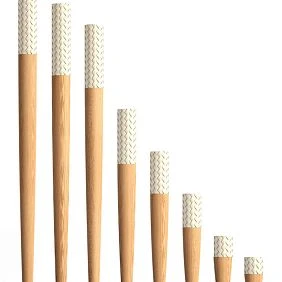
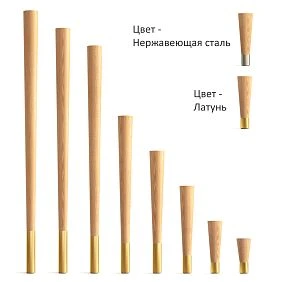
Our factory also produces:
Do not automatically consider 526 mm as the horizontal width
The product size is recorded as 526 × 395 × 18 mm, but the size notation itself does not determine how the plate will be oriented on a specific wall.
Therefore, it is more correct to consider two dimensions:
526 mm — the long side;
395 mm — the other main side.
If in your chosen position the long side runs horizontally, then 526 mm is used for the horizontal calculation.
If the composition allows another position, the horizontal dimension may be determined by the second main side.
The final orientation should be confirmed by the product image, drawing, or 3D model in the product card, rather than rotating the plate arbitrarily just because it is more convenient to fit it into the wall. The NPU-416.4 card indeed includes drawings and a 3D model.
In further examples where the calculation of 526 mm horizontally is used, this refers specifically to the option where the long side of the plate is positioned horizontally.
Get Consultation
The 526 × 395 mm template should be made before purchase
For NPU-416.4, a full-size mockup is especially useful because the cost of a mistake is already noticeable, and the size is large enough.
Cut out a rectangle of 526 × 395 mm from paper, packing cardboard, or another lightweight material.
Do not make it "about half a meter."
Measure exactly:
52.6 cm;
39.5 cm.
Secure the template with masking tape above the console.
Look at it first straight on, then step back to where the furniture is usually seen when entering the room.
After that, take a photo.
Then remove the template and take a second shot from the same point.
This makes it easier to understand whether a large element fixes the feeling of emptiness or, on the contrary, turns the wall into an overly dense decorative zone.
A rectangular template will look heavier than a real carved overlay because it is solid. Therefore, this is a check of the maximum occupied footprint, not an exact imitation of the decorative shape.
If the rectangle already seems too large, the real product is definitely not worth buying without additional verification.
If the size looks convincing, you can move on to a more precise fitting of the overlay image at a 1:1 scale.
What the calculation shows for a console 1200 mm wide
If the furniture is 1200 mm wide, and the NPU-416.4 in the selected orientation occupies 526 mm horizontally, then when centered relative to the console:
1200 − 526 = 674 mm.
Divide by two sides:
674 / 2 = 337 mm.
That is, the projection of the overlay will be narrower than the console, and from its overall edge to each side edge of the furniture there will be approximately 337 mm left.
This is a fairly clear proportion for the first test: the large decor occupies the central part but does not approach the side edges of the furniture.
However, the width of the furniture is only one axis. We also need to check the height of 395 mm and the position of the overlay itself above the tabletop.
It is more convenient to compare the range of furniture widths in a single table.
For the case where the long side of 526 mm is positioned horizontally and the overlay is centered relative to the furniture:
| Furniture width | Remainder after 526 mm | Approximately on each side |
|---|---|---|
| 700 мм | 174 мм | 87 мм |
| 800 мм | 274 мм | 137 мм |
| 900 мм | 374 мм | 187 мм |
| 1000 мм | 474 мм | 237 мм |
| 1200 мм | 674 мм | 337 мм |
| 1400 мм | 874 мм | 437 мм |
| 1600 мм | 1074 мм | 537 мм |
| 1800 мм | 1274 мм | 637 мм |
This table does not say that NPU-416.4 is prohibited for furniture with a width of 700 mm, or that it automatically fits for 1200 mm.
It shows the scale.
On a 700 mm console, the overlay occupies a large share of the furniture's width.
On a 1600 mm dresser, the same element becomes a much more local central accent.
Further, the solution depends on the height of the furniture, the dimensions of the wall, and the nature of the surrounding decor.
Console 700–800 mm: a large overlay becomes dominant
A narrow console is often placed in an entryway, a small partition wall, or near a door.
With a furniture width of 700 mm and a horizontal overlay size of 526 mm, only 87 mm of furniture projection remains on each side.
This does not mean that the decor is physically too large. The overlay is on the wall and does not have to fully match the scale of the tabletop.
But visually, it will be perceived as a very large element relative to the furniture.
This option should be checked especially carefully if:
the console has thin legs;
the tabletop is visually light;
there is a mirror nearby;
above the furniture there is a low free field;
the wall is narrow.
On a small console 526 × 395 mm, they can turn a decorative element into the main object, and the furniture itself becomes subordinate.
If this effect is not required, several more compact overlays or a small central decor may be better.
Console 900–1200 mm: more space appears for one large piece
In this range, one NPU-416.4 is already more easily perceived as a central wall accent.
With furniture 1000 mm wide in the considered horizontal orientation, approximately 237 mm remains on each side.
At 1200 mm — 337 mm on each side.
Enough space appears so that the overlay does not almost completely repeat the width of the furniture.
For a wall where nothing else is planned, one large carved piece can replace a composition of three to five small elements.
Especially if the task is not to create a complex gallery, but to mark the center once.
Wide dresser 1400–1800 mm: NPU-416.4 may be too local.
The wider the furniture, the smaller the share of the 526 mm overlay.
On an 1800 mm dresser, more than 600 mm remains on the sides of its conditional projection.
If the wall field is also wide, a single NPU-416.4 can look like a deliberately compact central accent.
But if a composition that would fill a significant part of the wall was expected, the result may seem insufficient.
Here you don't need to automatically buy two identical NPU-416.4 units.
First, decide what task the decor is meant to accomplish:
mark the center or fill a wide wall.
For the first task, a single overlay can be ideal.
For the second one, compare it with a molding frame, paired side elements, or another large composition.
The width of the free field is more important than the width of the furniture if there are architectural boundaries nearby.
Let's consider another situation.
The console is 1200 mm.
To the left and right of it, there are vertical moldings, between which there is only 950 mm of free space.
If the long side of NPU-416.4 is placed horizontally:
950 − 526 = 424 mm.
If the overlay is centered in this field:
424 / 2 = 212 mm.
This gives 212 mm of free space to each side boundary of the field.
This calculation is more useful than comparing with the console itself, because the overlay is located within an architectural space 950 mm wide.
If the wall is completely free and the console is the only object, centering relative to the furniture usually becomes a more natural starting point.
Center NPU-416.4 relative to the furniture or the wall
This is one of the main questions for a finished interior.
If the console is placed exactly in the center of a free wall, both axes coincide. There is no problem.
If the furniture is offset, the choice becomes noticeable.
Let's imagine a wall 2400 mm wide.
The console, 1200 mm wide, is not centered but is 150 mm closer to the right side due to a door.
If NPU-416.4 is installed in the center of the entire wall, it will be offset relative to the console.
If centered relative to the furniture, the decorative composition will be asymmetric relative to the wall's architecture.
Which option is better depends on what is perceived as the main object.
If the console is a standalone furniture group and there is nothing above it, it is reasonable to first check the center relative to the furniture.
If it is built into a strict molding panel, the architectural axis of the panel may be more important.
Do not average the two centers and place the overlay "approximately in the middle." This often looks worse than a conscious choice of one axis.
A height of 395 mm requires a separate calculation.
The width of NPU-416.4 attracts more attention, but in a small room, it is the vertical space that may be the constraint.
Suppose there is 900 mm of free space from the console countertop to the lower edge of the ceiling molding.
If in the chosen vertical orientation the overlay takes up 395 mm:
900 − 395 = 505 mm.
These 505 mm need to be distributed between the lower and upper free space.
If you place the overlay strictly in the center of the vertical field:
505 / 2 = 252.5 mm.
This results in a fairly loose layout.
But centering between the countertop and the ceiling molding is not always aesthetically correct. Usually, decor above furniture can be more connected to the furniture itself than to the ceiling.
Therefore, vertical arithmetic helps to check whether the item fits. The final height is chosen based on the composition.
Do not raise the overlay too high just to fill the wall
A large empty field has a common trap: you want to place decor in the geometric center of the entire free wall.
If the console is low, this center may end up significantly higher than the furniture.
Then the NPU-416.4 starts to look like a standalone wall decoration, randomly placed above the console, rather than part of a single composition.
The connection with the furniture is usually better preserved if there is a readable but not excessive distance between the top of the console and the decorative element.
It would be incorrect to set a universal number in millimeters here. The height depends on the furniture itself, the intended items on the countertop, the ceiling, and the shape of the overlay.
A full-size template solves this problem better than a normative number.
What will be on the console after renovation
An empty console during installation is a poor reference point.
After moving in, the following may appear on it:
table lamps;
vase;
candlesticks;
sculpture;
books;
flowers;
photos.
A tall vase can occupy a significant portion of the space directly in front of the NPU-416.4.
As a result, the beautiful central stucco element is partially hidden or conflicts with the object decor.
Therefore, the fitting should be done taking into account the real usage scenario.
If the console is intentionally planned to be left almost empty, one large overlay makes more sense: it itself serves as the main decor.
If the furniture will constantly have a rich object composition, the wall can be left calmer.
When one NPU-416.4 is better than several small details
One large element has several compositional advantages, but they are not evident in all interiors.
When a single clear center is needed
If the console stands alone on a large solid-colored wall, one large overlay immediately defines the axis of the composition.
Several small items have to be additionally connected by distances, a common line, symmetry, or a molding.
With NPU-416.4 the task is simpler: one product, one center, one marking point.
When you don't want to assemble an ornament from individual parts
Three small overlays require deciding:
what step between them;
which one is higher;
which one is lower;
whether they are identical;
whether there will be symmetry;
where the center of the whole group passes.
One NPU-416.4 eliminates most of these solutions.
When a large empty field requires a noticeable but single accent
On a wall 1500–2000 mm wide, a very small socket can get lost.
The large size of 526 × 395 mm allows creating a noticeable decorative object without filling the entire area.
When the rest of the interior is already complex
If the console has carved legs, decorative lamps stand nearby, and the floor and textiles are also active, several wall elements can add too much fine rhythm.
One large form often reads more calmly.
When several small overlays are better than one NPU-416.4
A large product is not a universal solution.
Several small decorative elements make more sense if the field has an unusual shape.
For example, above the console there is a switch, a wall thermostat, or a light fixture that prevents placing one rectangle of 526 × 395 mm. Small details can be distributed around functional objects.
Another case is a very wide wall. One NPU-416.4 turns out to be too compact, while two identical large plates look heavy. Then several small elements provide a more flexible rhythm.
The third scenario is an interior built on a repeating fine pattern. One large form can disrupt the scale.
Therefore, the question should not be "what is more impressive," but rather which structure better solves the specific empty field.
One large plate and several small ones — solutions that differ in installation logic
One NPU-416.4 has one main axis and one contour.
This simplifies marking.
But a large detail requires more careful checking of the entire contact area.
With a composition of small elements, the situation is reversed: each detail is simpler in size, but the number of marking points increases, along with the risk of getting different distances.
In a symmetrical group, an error of 5–10 mm on one small plate is sometimes more visible than a slight shift of a large central detail.
Therefore, "a few small ones" are not necessarily easier in actual installation.
NPU-416.4 or a molding frame
A molding frame solves a different task.
It forms the boundary of the field.
NPU-416.4 forms the center of the field.
If an empty wall above the console seems unfinished precisely because the composition lacks a center, adding one large overlay may be sufficient.
If the problem is that the furniture group is not separated from the large wall, a molding frame can work more effectively.
Sometimes both solutions are combined: first, a large panel is formed, and then NPU-416.4 is placed inside it.
But it is not necessary to automatically create moldings around every large overlay.
The range of profiles can be viewed in the section buy polyurethane moldingsif the wall structure itself is not yet formed.
When the NPU-416.4 inside the molding panel looks more convincing
The existing frame creates clear boundaries.
Then the overlay measuring 526 × 395 mm is evaluated not relative to the entire wall, but relative to the clear field inside the molding.
For example, the inner field measures 1000 × 900 mm.
If the long side of the overlay runs horizontally:
1000 − 526 = 474 mm of free space horizontally.
If the 395 mm dimension is used vertically:
900 − 395 = 505 mm.
That is, the product occupies a significant but not overwhelming part of the panel.
Here, both directions are checked with one calculation: it is clear how much space remains both horizontally and vertically.
If the inner frame is only 600 × 500 mm, the 526 × 395 mm dimension already occupies a larger portion of the field.
This option requires particularly precise fitting.
Do not add moldings just because the overlay seems lonely.
If NPU-416.4 looks too small on the wall, the first reaction is often to surround it with a large frame.
Sometimes this works.
But the frame does not enlarge the decor itself. It creates another object.
If the original problem is the incorrect scale of the product relative to the wall, the molding may only emphasize this contrast.
Before adding a frame, it is worth checking alternatives:
a different mounting height;
grouping with furniture;
a larger field of a different type;
other wall decor.
Options can be viewed in the section buy wall decor.
A depth of 18 mm changes perception more than it seems
The third dimension of NPU-416.4 is 18 mm, that is, 1.8 cm.
In the front image of the card, the depth is almost imperceptible. On a real wall, it creates chiaroscuro.
With side lighting, the carved pattern becomes more noticeable.
If the wall is lit by a window from the side, the overlay may look different in the morning and evening.
If there are two sconces or a directional spot above the console, shadows highlight the relief even more.
Therefore, NPU-416.4 cannot be judged only by its area of 526 × 395 mm. The depth makes the element visually more active than flat graphics of the same size.
What to check if there is a sconce nearby
If there are wall sconces on the sides of the console, the free space should be measured between them.
Do not place a large overlay so that it covers the mounting parts of the sconce or interferes with the intended access to the light fixture.
Besides the physical distance, there is a lighting issue.
Two sconces can produce opposing beams, and the relief of NPU-416.4 will be highlighted from both sides at once.
For plant or carved decor, this can create a beautiful effect, but at the same time increase its visual intensity.
Before final gluing, it is useful to see the composition with the lighting turned on.
What to check if there is an outlet or switch above the console
Functional elements reduce the actual area for decor.
For example, the free wall is 1000 mm wide, but a switch is installed inside it on the right.
You can't just do:
1000 − 526
and consider the resulting space fully accessible.
You need to mark out the dimensions of NPU-416.4 and check whether it intersects with the switch.
If it intersects, there are four possible solutions:
shift the overlay;
change its position, if the actual orientation of the ornament allows it;
choose a smaller decor;
abandon the overlay in that area.
Trimming the finished ornament arbitrarily for the switch is a completely different task and should not be considered a standard way of adapting the product.
Above the console with the mirror NPU-416.4 solves a different task.
If the mirror is already hanging in the center, there is effectively no empty central field.
NPU-416.4 cannot be used simultaneously in the same place as an independent large central accent.
Then the side or upper zones remain, and the scenario becomes similar to a composition around a painting.
Therefore, the topic of this article is especially suitable for a wall where the central space above the furniture is free.
If the mirror is needed for function, the choice between it and NPU-416.4 should be made before purchasing the molding.
Above a dresser, the principle is the same, but the scale of the furniture usually changes.
A dresser is often wider and visually heavier than a console.
On a model 1400–1600 mm wide, NPU-416.4 may be perceived more calmly than above a light console of 700–800 mm.
At the same time, the dresser is usually taller and has a greater mass of facades.
If the facades are already carved, additional wall decor may be excessive.
If the facades are smooth, one large overlay above the furniture creates a decorative focal point without interfering with the piece itself.
Therefore, for a dresser, it is especially useful to view the wall and furniture as a single rectangular block.
How to choose the height considering items on the countertop
Let's imagine a vase 450 mm high will stand on the console.
If NPU-416.4 is placed too low, the central part of the carved design will be hidden by the vase from a normal viewing angle.
If the overlay is raised too high, the connection with the furniture will be lost.
Therefore, with large decorative objects, marking should be done together with them.
You can place a vase, lamp, or other real object in its place, then attach the paper template NPU-416.4 and choose the height.
Such a test is much more useful than the universal recommendation "step back N centimeters from the countertop."
When one large overlay makes the interior calmer
The number of parts and visual complexity are not the same thing.
Five small overlays require five contours, several gaps, and repetition of the pattern.
One NPU-416.4 is large in size but reads as a single object.
In an interior where there are already many lines of furniture and textiles, this sometimes gives a calmer result.
Especially if the overlay is painted in the color of the wall.
The relief remains, but no new color spots appear.
Painting in the wall color
For a large NPU-416.4, this is one way to reduce visual heaviness.
With the same color of the wall and molding, the dimension of 526 × 395 mm remains noticeable due to the relief, but the boundaries of the product are not highlighted with a separate color.
During the day, the decor can be perceived softly.
Side light gradually reveals the carved pattern.
In the evening, under artificial lighting, shadows become deeper.
This option is especially logical when the console itself has a pronounced color or material, and you don't want to create another contrasting object above it.
Contrasting coloring requires more free space
The stronger the color contrast between the overlay and the wall, the more clearly the dimension of 526 × 395 mm is perceived.
On a dark wall, a light NPU-416.4 will appear larger and more active than the same element painted tone-on-tone.
This is not a physical increase in size, but a change in visual weight.
Therefore, a borderline composition that barely looks free in a monochrome version may become overloaded after contrasting coloring.
It is better to make the color decision before final fixation, rather than after the size has already been chosen without considering future contrast.
Patination makes sense only when the character of the interior is suitable
Patina emphasizes recesses and relief.
On a product with a depth of 18 mm, the effect may be noticeable.
If the console is classic, with brass, aged wood, or other ornamental decor nearby, this finishing method can support the overall composition.
If the furniture is simple and modern, strong patination can make the wall plate look visually out of place.
Therefore, the overall level of decorativeness is chosen first, and only then the finishing technique.
When an empty field is better left empty
A commercial article should help not only to buy a product but also to decline an unnecessary purchase in time.
NPU-416.4 may be unnecessary if above the console there is already:
a large lamp;
an accent wall texture;
bright wallpaper;
a tall object composition;
complex molding layout.
Free space between objects helps the interior "breathe."
If after installing the template your eye keeps returning to the thought "too much," an empty wall may be the more correct solution.
When NPU-416.4 physically fits, but the scale is still wrong
This is an important boundary between engineering and visual verification.
Suppose the free field has a width of 600 mm.
The overlay in the chosen horizontal orientation takes up 526 mm.
remains:
600 − 526 = 74 mm.
37 mm on each side when centered.
Formally, everything fits.
But the large carved contour almost fills the entire free field.
If moldings run nearby or there are light fixtures, the composition may look cramped.
Therefore, "526 is less than 600" is only a size compatibility check, not a purchase recommendation.
When NPU-416.4 looks too small, even though it is large in itself
On a free wall three meters wide, a 526 mm overlay occupies a relatively small area.
If the console is also wide, for example 1800 mm, and there is no frame around it, the decor may be perceived as a compact center on a large surface.
If such restraint matches the design intent, there is no problem.
If you need to fill the entire wall area, it is better not to choose several identical NPU-416.4 automatically, but to change the structure:
create a molding panel;
use paired decor;
add a mirror or a painting;
choose another large wall element
Comparison of four solutions for one empty wall
| Option | What forms | When it is logical | Main risk |
|---|---|---|---|
| One NPU-416.4 | one large center | the field is large enough, a single stucco accent is needed | too large for a narrow space or too local for a huge wall |
| Several small overlays | rhythm of several details | a complex layout or bypass of functional elements is needed | it is easy to get fractional values and distance errors |
| Frame of moldings | architectural boundary | the wall needs to be structured as a whole | does not by itself solve the issue of the central accent |
| leave the wall free | visual air | the furniture and surrounding interior are already active enough | the field can remain truly unfinished |
This table shows the main thing: products solve different tasks.
NPU-416.4 is needed not because it is larger than small overlays, but because one large center suits a specific composition better than a set of separate elements.
How to calculate the quantity for two identical zones
If there are two identical consoles in the room and after trying each one requires one NPU-416.4:
2 zones = 2 overlays.
Cost:
9 180 × 2 = 18 360 ₽.
For three identical zones:
9 180 × 3 = 27 540 ₽.
But the quantity of identical furniture by itself does not mean that all wall fields are also identical.
For example, one console stands between two doors, another on a free wall.
The width of the furniture matches, but the visual context is different.
For a serial order, each field should at least be checked by dimension.
For a hotel or several identical rooms, first one reference is needed
Suppose the project includes ten identical corridor consoles.
Ten NPU-416.4 at 9,180 ₽ each:
91,800 ₽ for the overlays themselves.
In such a situation, a full-scale test of one room becomes especially valuable.
First, one reference section is set up:
the size is checked;
height;
color;
lighting;
the relation to furniture.
If the result is suitable, the layout can be repeated in rooms with truly identical dimensions.
Mass purchasing based on a single catalog image creates too costly a risk of repeating the same mistake ten times.
The price of one large overlay and the cost of a composition of several small ones — the comparison must be made as a whole.
The price of NPU-416.4 at the time of verification is 9,180 RUB.
To compare it with several small items, it is not enough to look at the price of one small overlay.
Suppose the composition requires:
four decorative elements;
several separate mounting points;
more time for marking;
possibly, an additional molding.
The final choice is determined not only by the cost of one part.
But you also cannot automatically consider NPU-416.4 as "more profitable." For some walls, one small element costing significantly less will solve the task better than a large overlay.
First, the layout is determined. The price is compared only after that.
What to check before gluing
The STAVROS card indicates the adhesive method for mounting the decorative element.
But before fixing, the most important thing is to complete the marking.
Check:
center relative to the selected axis;
horizontal;
height;
adjacent lights and switches;
future items on the console;
actual direction of the ornament.
A large overlay more than half a meter in size is inconvenient to "adjust by eye" after the glue has already been applied.
First a dry fit, then installation.
Do not use the middle of the top edge of the console as the sole marking point.
One point defines the center, but not the horizon.
If the NPU-416.4 is slightly rotated relative to the furniture, its carved pattern may appear asymmetrical even when the center is correct.
For a large piece, it is better to mark at least:
central vertical axis;
a reference horizontal line.
After that, the template is aligned in two directions.
This is especially convenient when working inside a molding frame, where any small angle error is noticeable relative to the straight lines.
Mistake: buying the NPU-416.4 just because there is "a lot of space" above the furniture.
A large area may be empty, but it does not need to be filled.
If there is a bright painting nearby or the console has a very expressive design, the empty wall section creates the necessary contrast.
Error cause: emptiness is perceived as the absence of completed repairs.
Consequence: after installation, an extra center of attention appears.
How to check: live for two days with a paper template 526 × 395 mm, look at it in the morning and evening.
How to avoid: buy only when the template truly improves the balance between furniture and wall.
Error: comparing 526 mm only with the width of the furniture
This way, you can miss the vertical constraint.
Cause: the large first digit in the specifications is perceived as the main one.
Consequence: in width, NPU-416.4 fits, but along the other axis it turns out to be too close to the ceiling molding or countertop.
How to check: draw the full dimension 526 × 395 mm, not just a single line 526 mm long.
Error: considering the rectangular template as an accurate representation of the product
Solid cardboard looks heavier than an openwork carved overlay.
Reason: the template is needed for dimensions, but it starts being evaluated as a finished design.
Consequence: a suitable product is rejected only because a solid rectangle seems massive.
How to check: after the first check, print the actual outline to scale or use the product card materials.
Mistake: trying to solve a lack of space by random rotation
If 526 mm does not fit horizontally, there is a desire to rotate the product.
But the decorative ornament has its own orientation.
Reason: the buyer only focuses on the overall bounding rectangle.
Consequence: technically the part fits, but the pattern looks incorrect relative to the furniture.
How to avoid: first check the drawing, 3D model, and real product view; only then evaluate acceptable position options. The NPU-416.4 card provides such materials.
Error: collecting small details just because it seems "richer"
The number of elements does not guarantee a better composition.
Reason: individual small overlays from the catalog are perceived without an overall scale.
Consequence: four or five competing ornaments appear above the console instead of one clear center.
How to avoid: first compare two full-size mockups: one large NPU-416.4 and the proposed group of small details.
Error: adding a molding frame after NPU-416.4 has already been chosen tightly
Molding reduces the clear inner field.
Reason: first, the decor is calculated based on the wall size, then a frame is added around it.
Consequence: after installing the moldings, the overlay ends up too close to their inner borders.
How to avoid: if a frame is planned, first determine its inner size, and only then try on NPU-416.4.
Error: do not account for 18 mm relief in lighting
The size on the plane fits, but the evening look unexpectedly becomes too active.
Reason: the product was evaluated only under daytime frontal light.
Consequence: a sconce or spot creates deep shadows and visually enhances the carving.
How to check: before final finishing, view a test composition under real artificial lighting.
When it is better to move on to other decorative overlays
NPU-416.4 does not need to be adjusted to any wall.
If the template is too large or, conversely, does not solve a large empty field, you can compare others Polyurethane decorative appliques.
If you need not a separate overlay, but a wider selection of wall decor, the section is more useful buy wall decor.
If the task is specifically related to the molding system and its decorative elements, you can look at Decor for polyurethane moldings.
The general catalog is available via the link You can buy ready-made stucco matching the Baroque style. Calculate the quantity: linear meters of cornices and moldings, number of rosettes, pilasters, consoles, corner elements. Add a ten to fifteen percent allowance for trimming..
And if you need a wide section of stucco decor, you can go to catalog of stucco decor.
Where to order NPU-416.4
If after a full-size fitting the dimension 526 × 395 × 18 mm is suitable, the product can be ordered in the card carved overlay NPU-416.4.
Price at the time of check — 9,180 ₽ per piece.
For one console with one central accent, the basic order:
1 × NPU-416.4.
For two truly identical zones:
2 × NPU-416.4.
There is no need to automatically buy additional small overlays, rosettes, or moldings "for the set." First, one large piece should solve the original task on its own.
Practical algorithm before ordering
Step 1. Measure the width of the furniture.
Step 2. Separately measure the actual width of the free wall space.
Step 3. Measure the available height.
Step 4. Check whether there is a switch, socket, sconce, or other detail inside the intended dimensions.
Step 5. Make a template 526 × 395 mm.
Step 6. Determine the correct orientation of the product according to the card, drawing, or 3D model.
Step 7. Check the center first relative to the furniture, then relative to the entire wall architecture.
Step 8. Add real items that will stand on the console to it.
Step 9. Look at the composition in daylight and artificial lighting.
Step 10. Compare the wall with one large overlay and without it.
Step 11. Only if a single NPU-416.4 truly solves the empty field, place the order.
This sequence takes much less time than fixing an already finished decorative wall.
How to understand that exactly one NPU-416.4 is needed
A single large overlay has four signs of a suitable situation.
First: above the console there is one solid free field, not several scattered areas between lights and switches.
Second: the dimension 526 × 395 mm fits with sufficient visual space around it.
Third: the furniture needs one center, not a repeating rhythm of several pieces.
Fourth: after trying it on, the overlay supports the console but does not become significantly stronger in visual weight.
If these conditions are met, there is often no need to complicate the wall with several small elements.
How to understand that several small pieces are better
A small composition has an advantage when the field is non-uniform.
For example, on the right there is a sconce, on the left a switch, and the central part is too narrow for NPU-416.4.
Small overlays can be distributed in free spots.
The second case is a very wide horizontal composition where rhythm is needed along the entire furniture.
The third is an existing interior motif of repeating small elements.
Here, one large NPU-416.4 can disrupt the structure, even if it physically fits.
How to understand that moldings are needed
Moldings are more useful when the problem is not the absence of a central decoration, but the absence of a border.
For example, a wide console stands on a huge wall and looks lost.
One NPU-416.4 will add a center, but the space around it will still remain undefined.
A large molding panel can first form an architectural zone, and only then it is decided whether additional decor is needed inside it.
This is a different design order:
first the field → then the center.
In the scenario of this article, the furniture group is already sufficiently defined, and it is precisely the central space above it that remains empty. Therefore, NPU-416.4 is considered as an independent solution.
When nothing is needed
If after installing the console the free wall looks calm rather than unfinished, decor may not be required at all.
Especially if the furniture has a beautiful countertop, expressive texture, or a tall composition of objects will stand above it.
You should not buy NPU-416.4 just because the wall size allows it.
The criterion is different: after the template appears, the composition should become more convincing, not just more filled.
Solution for a console 700 mm wide
For narrow furniture NPU-416.4, you need to check especially carefully.
If the long side of 526 mm is positioned horizontally, only 87 mm remains on each side of the furniture projection.
This is already large decor relative to the item.
If the console is light and minimalist, the overlay may dominate.
If the furniture is massive, classic, and itself has pronounced decor, such a scale may be justified.
That is, the same size of 700 mm does not provide a ready answer. It only moves the option into the category of mandatory full-size checking.
Solution for a console of 1000–1200 mm
This is a more free scenario.
The overlay remains noticeable but does not repeat almost the entire width of the furniture.
Here, the idea of one detail instead of several small ones works especially well: the central axis is clear, free space remains on the sides, and the ornament does not need to be assembled manually from individual components.
If there are no tall objects on the countertop, NPU-416.4 can become the only wall accent.
Solution for a dresser 1600–1800 mm
Here the main risk is the opposite: a single overlay may not be large enough relative to the entire group.
But instead of doubling the quantity, it is worth first trying to add an architectural frame or change the height.
Large furniture itself creates a powerful horizontal line.
A small central stucco accent relative to it can sometimes look more elegant than an attempt to completely fill the entire width.
Therefore, for a wide dresser, the main question is no longer "will it fit," but what proportion of the wall we actually want to decorate.
Final check before checkout
Before purchasing NPU-416.4, answer eight questions.
Is there a single solid free space above the furniture?
Does the full dimension of 526 × 395 mm fit, not just the long side?
Is the orientation of the pattern confirmed?
Does the overlay look better centered on the furniture or centered on the architectural field?
Will future items on the console cover it?
Do wall sconces, switches, or moldings interfere with it?
Does the 18 mm relief make the composition too busy under evening lighting?
Does one large piece look better than an empty wall or a group of small decor items?
If the answers confirm this particular option, NPU-416.4 it can be ordered as a standalone central wall accent.
FAQ
Can NPU-416.4 be ordered after the console is already installed and the wall is painted?
Yes, the scenario itself allows you to first evaluate the finished furniture group. Before installation, you need to consider the actual condition of the finish surface and the requirements of the chosen adhesive material.
Do I need to buy two NPU-416.4 for symmetry?
Not for the scheme in question. Here, one large overlay is used as a central accent above the console. Two items would create a paired composition with a different visual principle.
Can NPU-416.4 be used above the console without moldings?
Yes. If a single overlay itself fills the empty central field, an additional frame is not a mandatory condition.
What to do if the console is not centered on the wall?
First, compare two template positions: centered on the furniture and at the architectural center of the wall. Choosing an intermediate point just for the sake of compromise is not always worth it.
Is NPU-416.4 suitable for a very tall room?
Physically, the room height does not limit the product, but in a large vertical field, an element of 526 × 395 mm may be perceived as relatively compact. Here, it is useful to evaluate not only the product but also the entire wall area from a distance.
Can NPU-416.4 be combined with a painting?
It can be done in a general interior composition, but if the painting occupies that very central place above the console, the two details begin to compete for one function. In such a case, it is better to determine the main object in advance.
Can the NPU-416.4 be placed above a radiator with a console?
The presence of a heating device changes the operating and installation conditions. Without data on the specific layout, temperature conditions, and distances, the standard free-wall scenario cannot be automatically applied.
How can I check the size if I cannot print the image at 1:1 scale?
A cardboard rectangle of 526 × 395 mm is sufficient to check the dimensions. It will not show the actual design, but it will allow you to assess the space it occupies.
Does it make sense to buy the NPU-416.4 if there will be a TV above the console?
If the TV occupies the central zone, the task changes: the NPU-416.4 can no longer serve as the sole central focal point. A separate side or overall architectural composition is needed.
What should I do if the template fits in width but seems too tall?
Do not ignore this impression. The full size is checked, not just 526 mm. If 395 mm on the other axis overloads the vertical field, it is better to compare a different decor.
Can one large overlay look calmer than three small ones?
Yes. One large element creates a single outline and a single center. Several small details create more separate outlines and gaps, so the composition may look more fragmented even with a smaller total decor area.
Where can I see alternatives of a smaller or different size?
Can compare Polyurethane decorative appliques and overall Wall Decor.
Where can I order specifically NPU-416.4?
After checking the scale, the model can be ordered in the NPU-416.4 card. The price at the time of checking is 9,180 ₽.