Article Contents:
- Why you need molding samples before purchasing the main batch
- What cannot be understood from a photo
- The economics of the decision
- What is included in the OMLD-005 molding sample set
- What exactly is presented in the set
- What tasks do wood molding samples solve for designers, architects, and clients
- Interior Designer
- Architectural firm
- Showroom and interior salon
- Furniture manufacturing
- Private client
- Molding samples: how to choose a profile for walls, furniture, and doors
- Profile width
- Relief depth and shadow
- Molding on walls, furniture, and doors: different requirements
- Wall molding samples
- Baseboard samples: how to check height, profile, and scale near the floor
- Baseboard height: bigger is not always better
- Top edge shape
- Compatibility with door casing
- Buy baseboard samples before the batch
- Ceiling baseboard and cornice samples: what is only visible in person
- Overhang from the wall
- Shadow on the ceiling
- Combination with cornice and moldings
- Oak, beech, ash: how to compare wood by sample
- Oak
- Oak
- Ash
- Comparison of species: table
- How to use samples when approving a project
- Step 1: collecting samples
- Step 2: initial screening by scale
- Step 3: comparison under different lighting
- Step 4: combination with other elements
- Step 5: final selection of 2–3 items
- Step 6: coordination with the customer
- Step 7: calculation of footage
- When one sample is needed, and when a professional set
- One sample is suitable if:
- A set of molding samples is needed if:
- Mistakes when choosing moldings without samples
- Choosing a profile that is too small
- Not seeing the actual depth of the relief
- Not checking the combination of baseboard with casing
- Making a mistake with the wood species
- Select a profile from a photo with different item scales
- Not accounting for finishing
- Not agreeing on scale with the client
- Where to order samples of STAVROS moldings, baseboards, and trim
- About the Company STAVROS
- FAQ: Answers to the Most Popular Questions
- Why are samples of moldings and baseboards needed?
- Why can't you choose trim only from photos?
- What is included in the OMLD-005 set?
- Who needs a professional sample set?
- Can samples be used for approval with the client?
- How do oak, beech, and ash differ in trim?
- How to order samples of wooden moldings and baseboards?
- Do I need to order samples for a specific finish?
- Is it possible to order a single sample instead of a set?
There is a special class of mistakes in renovation and interior design — those you only notice after installation. The trim is ordered, delivered, installed — and only then it turns out that the molding profile is too small for the ceiling height. Or the baseboard doesn't match the casing. Or the oak texture under the tint looks completely different than on the monitor screen. This is not a matter of inattention. It's a matter of not having a sample in hand before the main purchase.
Samples of moldings and baseboards — are not a marketing tool or a formality. They are a professional way to make an informed decision when a batch of trim for an entire project, floor, or house is at stake.
This article is a detailed guide: why samples of wooden trim are needed, what exactly is checked with them, how the Molding samples set OMLD-005 process works, and how to build an approval process from sample to final purchase.
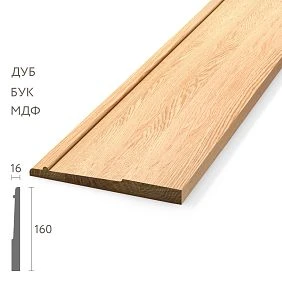
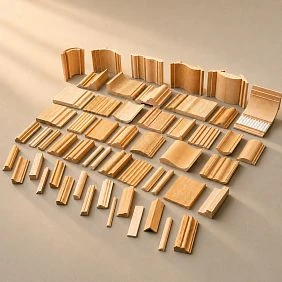
Why trim samples are needed before purchasing the main batch
Let's start with an honest question: why do many people skip this step? Because it seems like a photo in the catalog is enough. Or because deadlines are tight. Or because the cost of a sample seems like an unnecessary expense.
But let's calculate differently. A batch of wooden molding for an apartment of 120 sq. m is 300–500 linear meters. If the chosen profile turns out to be visually incompatible with the rest of the decor, the money is wasted. Samples cost incomparably less than this mistake.




What cannot be understood from a photo
A photo is flat. It kills exactly what matters most in wooden moldings:
-
The depth of the relief. On screen, a profile with a projection of 8 mm and a profile with a projection of 25 mm may look the same. In real life, these are fundamentally different products with different shadows and different visual weight.
-
The texture of the wood. Oak, beech, and ash on a monitor with the same tint are hard to distinguish. In real life, these are three different tactile sensations and three different results under enamel.
-
The scale. A molding 25 mm wide and a molding 70 mm wide occupy the same area in a catalog photo. Hold it against the wall, and it immediately becomes clear which one 'works' in your space.
-
The quality of sanding. How smooth is the surface? Are there any snags, tool marks, or unevenness? Only tactile contact with the sample provides the answer.
Wooden molding samples solve each of these tasks simultaneously.
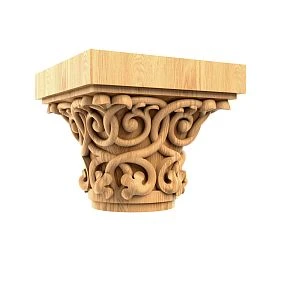
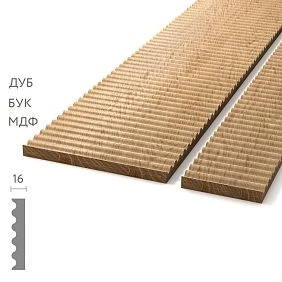
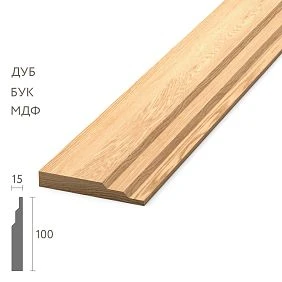
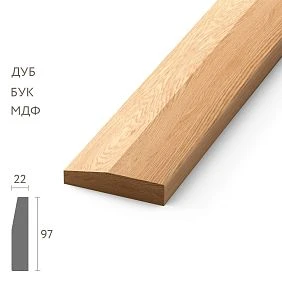
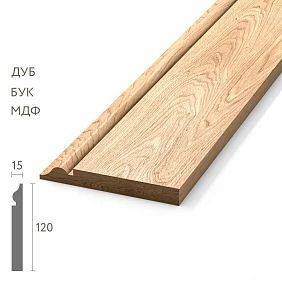
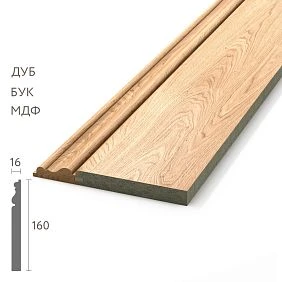
Our factory also produces:
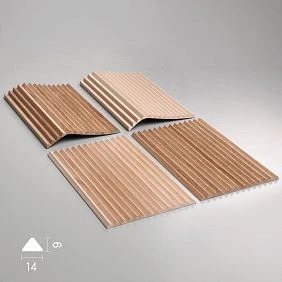
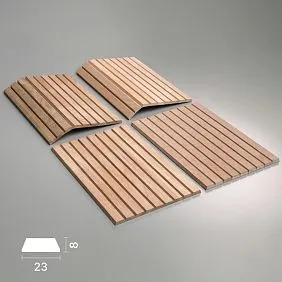
The economics of the solution
A professional designer or architect knows: the cost of a sample is an insurance premium against mistakes. If a project has 15 rooms and each requires a different molding, a sample set allows everything to be approved in a single working session without multiple trips to the supplier.
For a private client who buys millwork once and for all, a sample is a way to ensure the choice is correct before money is spent.
Get Consultation
What is included in the OMLD-005 molding sample set
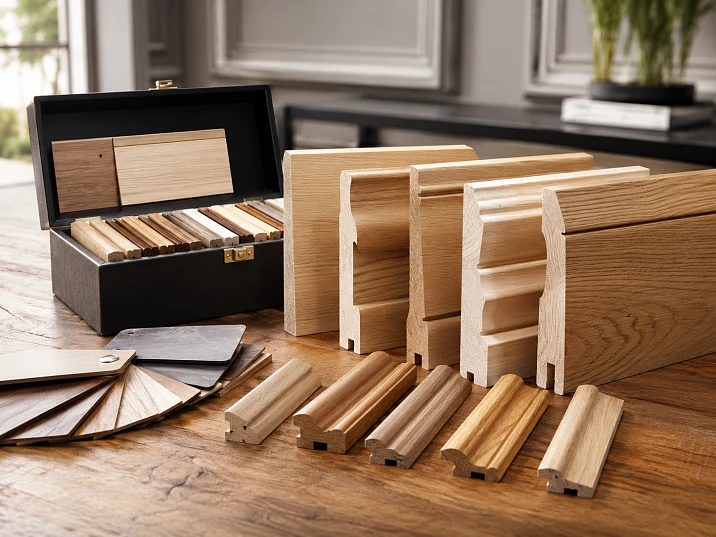
Talking about samples in general means talking about nothing. So let's be specific: Molding samples set OMLD-005 — this is a professional demonstration kit created specifically for those who choose wooden millwork seriously.
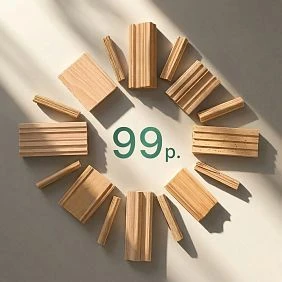
The set includes more than 60 types of decorative profiles from three wood species: oak, beech, and ash. Each sample is a short piece of the actual profile in full size, with or without real finish, depending on the item.
What exactly is presented in the set
-
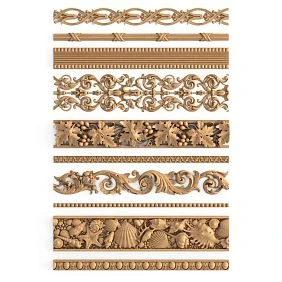
Moldings of various profiles: from thin linear ones with minimal relief to wide decorative ones with a cornice cross-section.
-
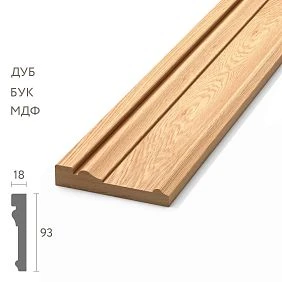
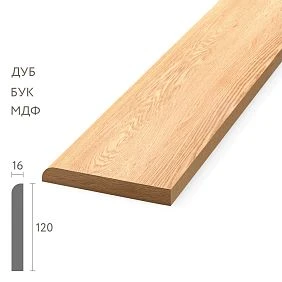
Baseboards: floor and ceiling profiles with different heights and top edge shapes.
-
Cornice profiles: for finishing the wall-ceiling joint with a deep overhang.
-
Trims: for framing door and window openings.
-
Corner profiles: for external and internal corners.
-
Material samples: oak, beech, ash side by side — to compare texture and color under identical conditions.
This is not a promotional brochure with pictures. This is a working tool.
What problems do wooden trim samples solve for designers, architects, and clients
Samples of wooden moldings and baseboards are a universal professional tool. But the tasks differ for different users.
Interior designer
A designer works on multiple projects simultaneously. Each has its own proportions, style, and budget. Samples for interior designers solve the comparison problem: you can lay out several profiles side by side, evaluate them together with samples of flooring, paint, and furniture decor — and make a choice once that won't need to be redone later.
Additionally, samples are a client presentation tool. You don't show a picture on an iPad — you place a real profile made of real oak on the table. The client's level of trust in such a presentation is incomparably higher.
Architectural firm
In architectural projects, trim is part of the specification. Samples of wooden moldings and cornices are needed for coordinating the finishing section with the client, for verifying compliance with the design solution, and for confirming the supplier selection.
Exhibition Stand SV-006 — this is an option for those who want to always have samples at hand in the form of a structured display. An ideal solution for a meeting room or project office.
Showroom and interior salon
A sample set for an interior salon is a consultation work point. The client comes, sees real profiles, holds them against floor and wall samples, and makes a decision immediately. This shortens the sales cycle and reduces returns.
Furniture manufacturing
In furniture manufacturing, wooden trim samples are needed to match moldings to facades: checking profile compatibility with furniture MDF or veneer, selecting molding height relative to decorative overlays.
Private Client
For someone doing a renovation once and wanting to do it right, samples are a way to avoid disappointment. Hold the baseboard against the wall, the molding against the ceiling joint, the casing against the door frame — and see the result before installation.
Molding samples: how to choose a profile for walls, furniture, and doors
Molding samples — this is the entry point for profile selection. But what exactly should you look at and how to make a decision?
Profile width
Molding width is the first and most obvious parameter. But 'obvious' doesn't mean 'simple'. A width of 30 mm and a width of 80 mm are different decorative weight categories that work differently on walls of different heights.
A rough rule: for rooms with ceilings up to 3 m — moldings 30–60 mm wide. For ceilings 3.5–4 m — 60–120 mm. For historical interiors with ceilings 4.5 m and higher — wide cornice moldings with deep projection.
With a sample in hand, this is instantly verifiable: hold it against the wall — and the proportion is immediately visible.
Relief depth and shadow
The relief of the molding creates a shadow. The shadow is what makes the profile visible. A molding without relief depth on the wall turns into a strip. A molding with pronounced relief becomes an architectural line.
On molding samples, this is immediately visible: hold it up to a lamp or take it into daylight. The shadow will show how the profile will look when installed.
Molding on walls, furniture, and doors: different requirements
-
On the wall — molding creates frame panels, divides the wall into zones, and frames niches. Here, width, relief, and behavior under enamel are important.
-
On furniture — molding frames the facades and works with decorative overlays. You need to check the compatibility of the profile with the facade thickness and overlay height.
-
On the door — molding frames the door panel. The profile should be proportionate to the size of the panel.
All three scenarios are only verified in person — with a sample in hand.
Molding samples for walls
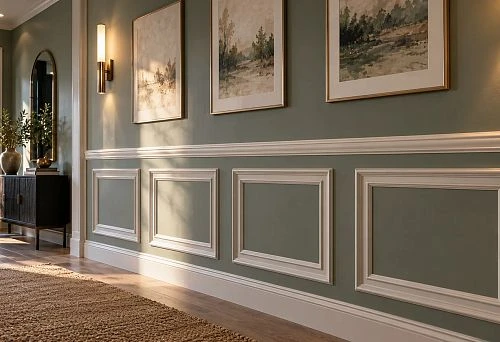
A special case is selecting molding for wall panel frames. Here, molding samples for walls are needed to check how the profile looks when installed vertically and horizontally, how it connects at corners (45° joint or with a corner overlay), and how well the relief reads on the specific wall color.
STAVROS wooden moldings — wide range of profiles for walls, furniture, and doors.
Baseboard samples: how to check height, profile, and scale at the floor
It would seem that a baseboard is a trifle. But it is the baseboard that determines the "weight" of the entire interior at the floor. It sets the lower boundary, connects the wall to the floor, works in tandem with door trims and — very importantly — with the flooring.
Baseboard samples are needed to check this exact connection before installation.
Baseboard height: bigger is not always better
A tall baseboard — 120–200 mm — creates a heavy, solemn lower belt of the interior. This is organic in rooms with high ceilings and classic decor. In an apartment with a 2.7 m ceiling, a tall baseboard "eats up" space from below.
Standard range for modern housing: 70–100 mm. For classic interiors with ceilings of 3 m and higher — 120–150 mm.
A sample allows you to lean the baseboard against the wall and immediately assess the proportion — without calculations and guesswork.
Shape of the top edge
The baseboard has a top edge — the boundary between the baseboard and the wall. It can be:
-
Straight — a strict, modern look.
-
With a chamfer — a subtle accent, a delicate profile.
-
With a profile molding — the top part of the baseboard replicates the shape of the molding, creating a rich relief.
On floor baseboard samples, this detail is visible in full size, allowing you to accurately assess how the edge will look against the wall.
Compatibility with door casing
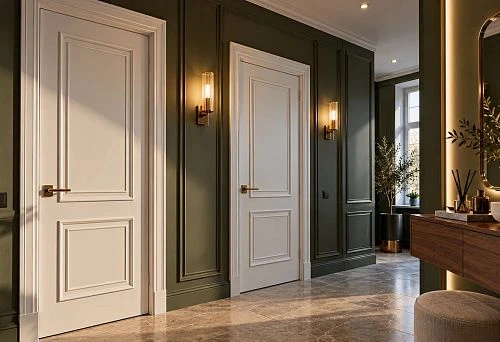
The baseboard and door casing are a pair. They meet at a corner point, and this joint is visible. Mismatched profiles create a visual conflict: different thickness, different edge shape, different relief height.
With samples in hand, you can check the joint instantly: hold the baseboard against the casing sample — and the joint is visible in real life.
Buy baseboard samples before the batch
If you plan to buy baseboard samples before the main order, it's an investment in confidence. Especially if the batch is large: a mistake in the baseboard profile for the entire project will cost many times more than the sample price.
Solid oak, beech, and ash floor baseboards — in the section of STAVROS millwork products.
Samples of ceiling baseboard and cornice: what is only visible in person
Ceiling baseboard and cornice are the most difficult elements to choose remotely. Why? Because they work at the junction of two surfaces — wall and ceiling — and their relief is perceived under specific overhead lighting conditions.
Samples of ceiling baseboard — the only way to understand how a specific profile will look in a real room.
Overhang from the wall
Projection is the distance the profile extends from the wall. Small projection (15–25 mm) — a light, almost invisible transition. Large projection (60–120 mm) — a powerful cornice belt that creates the feel of a historical interior.
On ceiling baseboard samples, the projection is immediately visible. Hold it against the wall-ceiling joint — and it becomes clear whether this scale 'works' in your space.
Shadow under the ceiling
A deep cornice profile creates a shadow. The shadow emphasizes the transition, adds volume, and creates a sense of an 'architectural' ceiling. A flat or shallow profile gives almost no shadow.
This cannot be understood from a photo with neutral studio lighting. Sample + real room light = the truth about the profile.
Combination with cornice and moldings
In classic interiors, the ceiling plinth works in a system: under the ceiling — a cornice, below — a frieze, even lower — a molding frame on the wall, near the floor — a floor plinth. All these profiles must be coordinated in scale, style, and material.
A set of samples allows you to lay out this entire system on a table and check its consistency at real scale — before anything is ordered.
Wooden cornices, moldings, and baseboards STAVROS — a section with a full line of ceiling and floor profiles.
Oak, beech, ash: how to compare wood by sample
Choosing a species is a choice not only of appearance but also of the material's behavior during finishing. And this comparison is correct to make only in person.
When you want to buy wood samples, to compare species — you are making one of the most important decisions in working with wooden moldings.
Oak
The most popular species for classic millwork. Large, expressive fiber structure. When tinted — a deep, rich color. Under oil or wax — a warm, lively texture.
Oak is dense and hard. This means it does not deform, delaminate, or lose its shape for decades. For floor baseboards, it is the optimal choice in terms of mechanical resistance.
Limitation: under white enamel, oak shows "bleeding" of the texture — dark pores appear through the enamel. For a smooth white finish, oak requires primer and several coats of varnish.
Beech
Fine-grained uniform structure. Smaller fiber pattern — a more neutral background. Under enamel, it is an ideal material: the surface becomes smooth, without "bleeding" of the texture.
Beech is slightly softer than oak, but for wall moldings and ceiling profiles this does not matter — there is no tensile load.
Optimal application: moldings and baseboards under white, cream, gray, or colored enamel. Soft classic, Provence, neoclassical.
Ash
Ash is a lighter species with a pronounced pattern, vaguely reminiscent of oak, but with softer tones. Under transparent finishes, ash gives a fresh, light result — Scandinavian spirit, light classic.
Optimal application: millwork under natural varnish, under light tinting, in Scandinavian and modern interiors with wooden elements.
Comparison of species: table
| Parameter | Oak | Beech | Ash |
|---|---|---|---|
| Structure | Coarse-grained, expressive | Fine-grained, uniform | Expressive, light |
| For tinting | Excellent | Good | Good |
| For enamel | Requires primer | Ideally | Requires primer |
| For oil/wax | Excellent | Good | Good |
| Mechanical strength | High | Medium | Medium |
| Style | Classic, baroque, empire | Provence, neoclassical, soft classic | Scandinavian, light classic |
Wood species samples nearby are the only way to make this choice based on reality, not a table.
How to use samples when approving a project
This is the most practical part. An algorithm that works for both a designer and a private client.
Step 1: collecting samples
Collect all samples that are potentially suitable: profiles of moldings, baseboards, architraves, cornices. Lay them out separately — do not mix zones and purposes.
Step 2: initial scale screening
Take each sample and apply it to a real surface. Molding — to the wall at the intended height. Baseboard — to the floor and wall in the corner. Cornice — to the joint of the wall and ceiling.
Anything that clearly doesn't fit the scale — set aside. This will take 15 minutes and save hours of discussion.
Step 3: comparison under different lighting
The relief of the molding greatly depends on lighting. Daylight side light and an overhead lamp will give different results. Be sure to check samples under the type of lighting that will be in the actual room.
Step 4: combination with other elements
Apply the selected samples to:
-
a sample of the flooring;
-
a sample of paint or wallpaper;
-
the door leaf or its fragment;
-
to furniture decor samples, if the molding goes with the cabinet furniture.
See a conflict — set it aside. Look for what creates a unified system.
Step 5: final selection of 2–3 items
After the initial screening, you should have 2–3 final options. These are used for the presentation to the client — or for the final personal decision.
Step 6: approval with the client
A sample on the table is a conversation without abstractions. The client sees, touches, and applies it. The question "can it be thinner?" or "is there a more expressive relief?" is resolved in seconds — you take another sample from the set.
It is for this scenario that the OMLD-005 sample setexists: it allows for a complete approval within a single meeting.
Step 7: calculation of footage
After approval, calculate the footage. This is a technical step: room perimeters, number of doorways, joints, overlaps, allowance for trimming. Standard allowance is 10–15% of the net footage.
When you need a single sample versus a professional set
The choice between a single sample and a professional set is a matter of scenario, not budget.
A single sample is suitable if:
-
The profile has already been selected from the catalog, only need to confirm scale and texture.
-
The project is small: one room, one type of molding.
-
The client has already seen samples from other suppliers and wants to compare a specific item.
-
Need to check the behavior of a specific wood species under a specific finish.
A set of molding samples is needed if:
-
The project is large: multiple rooms, different styles or zones.
-
You work with multiple clients regularly — a showroom, a design studio, an architectural firm.
-
You need to show the client options and not drag out the approval process.
-
You want to have a full range of profiles on hand for quick selection.
-
No profile has been selected yet and you need to start from scratch.
A demonstration set of moldings is a working tool that pays for itself on the first major approval. Especially if you work with wooden decor professionally.
Exhibition Stand SV-006 complements the sample set as a permanent display: samples are fixed, structured, ready for client demonstration at any time.
Mistakes when choosing trim without samples
Each of the listed mistakes is a real scenario that occurs regularly.
Choosing a profile that is too small
In the photo, the profile seemed expressive enough. After installation, it turned out that the relief was barely visible — especially after painting. The molding "dissolved" into the wall.
Not seeing the real depth of the relief
Due to the photo's characteristics, the profile protrusion looked massive. In reality — 6 mm, which barely casts a shadow. The whole effect is lost.
Not checking the combination of the baseboard with the architrave
The baseboard was ordered separately, the architrave separately. They were installed — and the joint in the corner looks rough: the profiles are incompatible in shape and height.
Making a mistake with the wood species
Oak was ordered for enamel. Through a thin layer of white paint, the coarse texture shows through. Had to repaint several times — and still the result is not ideal. Beech would have given a smooth finish from the start.
Choosing a profile based on a photo with a different scale of the object
In the photo, the molding seemed wide. In reality — narrow. The scale in the photo was not readable without a reference.
Not accounting for the finish
Wood color samples need to be purchased exactly in the tone that the final coating will be. If the sample is natural, but a dark tint is planned — visual verification is impossible.
Not coordinating the scale with the client
The designer chose a molding. The client only saw it on screen — agreed. After installation, they said: "This is too thin, I thought it would be bigger." Samples would have completely eliminated this misunderstanding.
Where to order samples of STAVROS moldings, baseboards, and trim
You can order samples of wooden moldings, baseboards, and trim in the section of STAVROS product samples.
For professional selection — Molding samples set OMLD-005: over 60 profiles of oak, beech, and ash in one set.
For ongoing work with clients — Exhibition Stand SV-006: a structured display of samples for a meeting room, showroom, or project office.
The full line of solid wood trim — in the section moldings, cornices, and baseboards. Individual filters: Wooden moldings, wooden moldings and corners, cornices, moldings and baseboards.
Additionally — Wooden Picture Frame for frame design and full section of wood and MDF products.
Contact us to confirm shipping to your destination. Showrooms in St. Petersburg and Moscow. Consultation on sample selection and batch calculation — upon request.
About the company STAVROS
STAVROS is a St. Petersburg manufactory of wooden decor. Founded in 2002. Restoration experience — the Hermitage, the Konstantinovsky Palace, the Alexander Palace, the Trinity-Izmailovsky Cathedral — became the foundation of a professional approach to material quality and product profile.
That is why the OMLD-005 sample set contains not a random set of items, but professionally selected profiles: those that are actually used in classic and modern interiors, have been tested for compatibility, scale, and finish workability.
By purchasing samples from STAVROS, you get not just a piece of wood — you get access to manufactory expertise that allows you to make the right decision before the main purchase.
FAQ: answers to the most popular questions
Why are samples of moldings and baseboards needed?
Samples allow you to evaluate the actual scale of the profile, the depth of the relief, the texture of the wood, and the behavior of the material under tinting or enamel — something that cannot be understood from a photo in a catalog.
Why you shouldn't choose molding only from photos?
Photos don't convey the depth of the relief, shadow, the actual profile width in the context of the room, or the surface texture. Scale in a photo without a reference point is an abstraction.
What's included in the OMLD-005 set?
Over 60 types of decorative profiles made of oak, beech, and ash — moldings, baseboards, cornices, architraves, corner profiles. A professional full-size demonstration kit.
Who needs a professional sample set?
Interior designers, architects, showrooms, furniture manufacturers, finishing companies, and private clients choosing molding for a large project.
Can the samples be used for approval with the client?
Yes — that's one of the main scenarios. A sample on the table eliminates ambiguity and shortens the approval cycle.
How do oak, beech, and ash differ in molding?
Oak — expressive texture, best choice for tinting and oil. Beech — smooth surface for enamel. Ash — light wood for natural varnish and light tinting.
How to order samples of wooden moldings and baseboards?
In the product samples section on the stavros.ru website or by requesting from a manager. The professional set OMLD-005 is available for order on the product page.
Is it necessary to order samples for a specific finish?
It is advisable if a non-standard tint or specific coating is planned. A natural sample plus a test coating on site will give an accurate result.
Is it possible to order a single sample rather than a set?
Yes. A specific profile can be ordered as a separate item. The set is for those who need to compare and work with clients regularly.