Article Contents:
- Why the wall behind the bed is the main architectural zone of the bedroom
- What moldings do to the bedroom space: seven functions
- Basic schemes for decorating the wall behind the bed
- One large central frame
- Two symmetrical vertical panels
- Central panel and two narrow side frames
- Frames with a top decorative accent
- Moldings combined with a soft headboard
- How to choose a scheme based on bedroom size and type
- Small bedroom (up to 12 m²)
- Narrow bedroom (width up to 3 m)
- Bedroom with high ceilings (from 3 m)
- Bedroom with a wide wall (more than 350 cm)
- Bedroom where the wall is already occupied by a sconce or air conditioner
- Which moldings and decorative elements to choose for a neoclassical bedroom
- Molding profile: cross-section and style
- Corner Decorative Elements
- Materials: polyurethane and MDF in the right roles
- How to combine moldings with sconces, mirrors, paintings, and textiles
- Moldings and wall sconces — a pair
- Moldings and mirror
- Moldings and paintings
- Moldings and soft headboard
- Moldings and bed linens
- Ready-made set or manual selection of elements: an honest breakdown
- Selection of elements individually
- Ready-Made Set of Decorative Molding
- How to choose a ready-made set specifically for the bedroom: a scenario table
- Color — the main decision after the layout
- Monochrome: frame matching the wall color
- Contrast: white decor on a dark background
- Dark moldings on a light wall
- Metallic Coatings
- Installation: What You Need to Know Before Starting Work
- Common mistakes when decorating a bedroom with moldings
- Mistake 1: too many frames on a small wall
- Mistake 2: too thin molding on a large wall
- Mistake 3: breaking symmetry
- Mistake 4: frame conflicting with a sconce
- Mistake 5: incorrect height of the frame's bottom edge
- Mistake 6: ornament of the wrong scale
- Mistake 7: painting without sanding the joints
- Ready-made ideas for different bedroom scenarios
- Bedroom in light neoclassical style
- Bedroom with a soft high headboard
- Bedroom with an accent wall and sconces
- Bedroom with a narrow wall
- Bedroom with a large empty wall
- STAVROS: architectural decor for those who appreciate details
- Frequently Asked Questions

Enter a bedroom where the moldings above the bed are precisely aligned along axes, where the symmetry of the frames holds the space like an architectural skeleton, where white plasterwork against a deep sage background breathes the very tranquility for which a bedroom exists. Now enter a room with exactly the same furniture but with a bare wall behind the headboard. The difference is obvious. And it's not about money. It's about the decision.
Moldings in the bedroom— is not a designer's whim or a tribute to fashion. It is an architectural tool that transforms a flat wall into an organized space with logic, rhythm, and character. The wall behind the bed in a neoclassical interior is the most 'eloquent' surface in the bedroom: it unmistakably reveals whether a designer was involved here or the owner simply placed furniture. A decorative frame, a symmetrical wall panel, subtle corner plasterwork—and the bedroom ceases to be a 'furnished room,' becoming an interior.
This material is not inspirational Pinterest. It's a practical guide: which schemes work, how to choose a format for a specific wall, where mistakes are most often made, and how to select a ready-made kit that will give a predictable result without the agonizing manual selection of elements.



Why the wall behind the bed is the main architectural zone of the bedroom
Conduct a thought experiment. Remove all furniture from the bedroom. What remains? Four walls and a ceiling. One of these walls — the one against which the bed is placed — is the functional and visual center of the entire space. It is the first thing that comes into view when entering the room. It is what a person sees every morning upon waking.
The wall behind the headboard carries a special semantic load. In classical and neoclassical interiors, this zone was always highlighted — with architectural canopies, wooden panels, mirror frames, decorative paintings. Not because it's 'beautiful in itself,' but because the bed needs a background — something that makes it not just a piece of furniture standing against a wall, but the central object of a designed space.
Moldings solve this task elegantly and without unnecessary expense: they do not require replacing the finish, do not compete with furniture, and do not require remodeling the entire room. One decorative frame or a symmetrical pair of vertical panels — and the wall behind the bed ceases to be just a background, becoming an architectural headboard.




What moldings do to the bedroom space: seven functions
Before talking about schemes and formats, it's worth understanding — through whatBedroom moldingworks. Not aesthetically — functionally.
1. Create a visual center. A frame or panel behind the headboard becomes the point towards which everything else gravitates: the bed fits 'into' the frame, bedside lamps symmetrically diverge along its axes, bedding rhymes with its tone. A compositional center appears that wasn't there before.
2. They structure the wall. An empty wall is just a surface. A wall with moldings is an architectural element with a top, bottom, center, and perimeter. The brain perceives it not as a 'background behind the bed' but as an intentionally designed object.
3. They visually increase the height. A vertical frame 2300 mm high with a 2.7 m ceiling naturally 'pulls' the space upward. The eye follows the vertical line of the molding and stops closer to the ceiling — the room feels taller than it is.
4. They integrate sconces into the architectural context. A wall sconce hanging on an empty wall is just a technical solution. Sconces symmetrically placed on vertical axes on the sides of a decorative frame are part of an architectural scheme. The difference in perception is colossal.
5. They organize lighting scenarios. Relief moldings create dynamic shadows with evening side lighting. The more complex the profile of the corner elements, the richer the play of light and shadow. A monochrome wall with moldings, with properly placed sconces, looks fundamentally different than the same wall in daylight.
6. They allow you to forgo wallpaper. A smooth wall with molding frames, painted in a rich hue, is a standalone design solution, not inferior to decorative wallpaper. And significantly more durable.
7. They connect the bedroom to the style. A neoclassical bedroom with moldings is an unmistakably readable style. Without moldings, the room might be 'just light' or 'just minimalist.' With them — it has an architectural identity.
Our factory also produces:


Main schemes for decorating the wall behind the bed
This is the central section of the article. Before choosing a set or ordering moldings, you need to decide — which layout scheme solves your specific task. There are several, and each has its own strengths.
Get Consultation
One large central frame
The most concise and yet powerful solution. One decorative frame in the center of the wall — the width of the bed's headboard or slightly wider. No side panels, no horizontal divisions. Just the frame.
When it works best:
-
wall behind the bed 200–280 cm wide;
-
bed 160–200 cm — the frame matches its width;
-
interior where decor is intentionally restrained, with emphasis on quality rather than quantity of elements;
-
monochrome painting, where the frame comes alive through volume and chiaroscuro.
Proportional rule: frame width — 50–70% of wall width. Height — from 80 mm above mattress level to 15 mm below ceiling molding. This creates maximum verticality with precise centering.
This format is implemented inwall molding decor sets of the 'Neoclassic Light' collection: one symmetrical frame with four identical corner polyurethane elements — and the wall behind the bed is ready without additional design.
Two symmetrical vertical panels
A pair of narrow vertical frames, positioned symmetrically on either side of the bed's central axis. Between them is the space above the headboard: empty, with a mirror, with a painting, or with a lamp.
This scheme is especially good for bedrooms where:
-
the wall is wide (from 300 cm), and one large frame seems insufficient;
-
sconces are planned — each light fixture fits organically into its own panel;
-
the bed headboard is high and decorative — the side frames frame it without competing.
The distance between the two panels is approximately equal to the width of the headboard. The gap from the edge of the wall to the outer edge of each frame is symmetrical. If the symmetry is broken even by 3–5 cm — the scheme falls apart.
Central panel and two narrow side frames
Triptych: a large central frame and one narrow frame on each side. This is one of the most 'expensive' in perception options — it creates a sense of architectural richness without actual overload.
The side frames can be two to three times narrower than the central one: with a central width of 100 cm, the side ones are 30–40 cm. Or they can be full-size but lower — not from the baseboard to the ceiling, but up to the line of the horizontal molding in the middle of the wall.
Application: spacious bedrooms with a wall width from 380 cm, bedrooms with high ceilings (3 m and above), formal bedrooms in high-end houses and apartments.
Frames with a top decorative accent
Vertical frame with a decoratively emphasized top corner or overlay element. The bottom corners are more restrained; the top ones have richer relief or a different decorative block.
This scheme creates direction: the gaze rises upward, toward the ceiling—which is especially valuable in rooms with not very high ceilings. The upward visual direction makes the space subjectively more spacious.
For this option, suitablesets with different top and bottom decorative elements, where the hierarchy of corner accents is intentionally arranged structurally.
Moldings combined with a soft headboard
This is a scheme where the decorative frame and the soft bed headboard work together. The frame creates an architectural frame; the soft headboard is a tactile and decorative object within this frame.
It is fundamentally important: the headboard should be noticeably lower than the top horizontal line of the frame—by at least 15–20 cm. Otherwise, the headboard 'bumps' into the molding, and the visual connection is broken. Ideally, the headboard occupies the lower 50–60% of the frame's height, with the upper third remaining open.
The width of the soft headboard and the width of the frame—preferably matching or the frame being 10–15% wider on each side. This creates the feeling that the bed is 'set into' the architectural element.
How to choose a scheme based on the size and type of bedroom
The most practical question is not 'what looks nicer,' but 'what works in my specific bedroom.' Let's break it down by scenarios.
Small bedroom (up to 12 m²)
In a small bedroom, the main mistake is trying to place too complex a decorative system. Three frames on the wall, a rich pattern in corner elements, heavy molding profiles—and the already limited space starts to feel oppressive.
What works:
-
one vertical frame centered on the wall behind the bed;
-
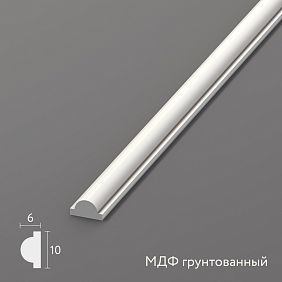
delicate molding profile—20 × 10 mm or 22 × 11 mm;
-
monochrome painting (frame matching the wall color): decoration through volume, not contrast;
-
without additional side elements.
A monochrome solution in a small bedroom is fundamentally the right choice. A contrasting white frame on a bright wall in a small room fragments the space. One color—one space.
Narrow bedroom (width up to 3 m)
In a narrow bedroom, verticality is your best ally. A tall, narrow frame on the end wall behind the bed visually 'stretches' the volume in depth and height.
Avoid using horizontal wall divisions with moldings in a narrow bedroom—they emphasize the width that isn't there. Only verticals. Only a tall frame format.
The optimal frame width for a narrow bedroom: 60–80 cm. Height—maximum, close to the wall height.
Bedroom with high ceilings (from 3 m)
Ceilings from 3 m are an opportunity many don't fully utilize. Here, a scheme with a horizontal molding belt is appropriate, dividing the wall into two zones: lower (with decorative frames) and upper (smooth or with a light frieze).
Frames in the lower zone with a high ceiling can be 1800–2000 mm tall—and still leave a noticeable 'field' above.
Molding profiles for high walls—with a larger cross-section: 30 × 12 mm or 35 × 15 mm. A thin profile on a three-meter wall gets lost—the line stops being readable.
Bedroom with a wide wall (more than 350 cm)
A wide wall with one small frame looks pitiful—like a painting in an ill-suited hall. Here, a system is needed: either one large frame (width from 120–150 cm), or two–three frames with equal spacing.
For a bedroom with a wide wall, the best scheme is 'two frames—symmetrically on either side of the bed.' If a 180 cm bed is centered on a 400 cm wall—place one frame 80–100 cm wide on each side of the headboard. The center between the frames—above the headboard—remains empty or with one accent element (mirror, painting, sconce).
Bedroom where the wall is already occupied by a sconce or air conditioner
If there are already technical or decorative elements on the wall — frames are built around them, not in conflict with them. The sconce should fall into the upper third of the frame or symmetrically on its sides. The air conditioner — above the frame, with a gap.
Never place a frame so that a technical element "cuts" its molding.
Which moldings and decorative elements to choose for a neoclassical bedroom
Theory of schemes is the first step. The second is the selection of specific profiles and elements. There is also its own logic here.
Molding profile: cross-section and style
For a bedroom in light neoclassicism — the optimal molding profile is 20–25 mm wide and 10–12 mm deep. This is a delicate line that reads clearly on the wall, creates an expressive shadow in evening lighting, but does not overload the interior.
For a classic bedroom with high ceilings and rich decor — a profile 35–45 mm wide, 12–18 mm deep. A more massive line that "holds" the large format.
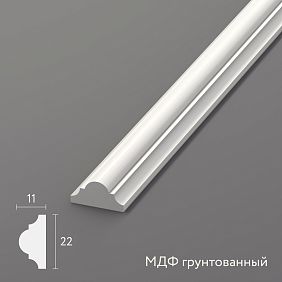
Molding MLD-002-MGwith a cross-section of 22 × 11 mm — a precisely calibrated profile for light neoclassicism. It is used in the sets of the "Neoclassic Light" collection and has proven its effectiveness precisely in the format of wall frames for residential interiors.
Corner decorative elements
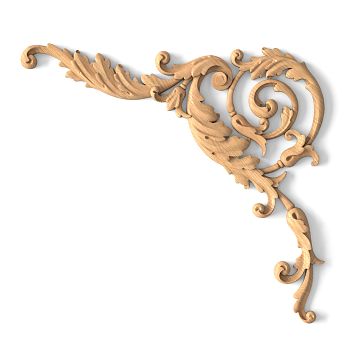
Corner elements are the nodes where the frame "lives" as a decorative object. It is they that carry the ornamental load. The molding draws the line; the corner element completes and decorates it.
For light neoclassicism – symmetrical corner elements with geometric or floral ornamentation, projection 15–18 mm. Four identical corners create complete symmetry – maximally 'correct' in the neoclassical spirit.
Wide selectionpolyurethane decorative overlaysallows you to choose a corner element for any degree of decorative saturation – from minimalist geometric to rich classical with leaves and scrolls.
Materials: polyurethane and MDF in their proper roles
Decorative corner elements for the bedroom – polyurethane. Lightweight, impact-resistant, accurately reproducing relief, non-reactive to humidity changes. Critically important in the bedroom: corner elements of the frame are the zones most vulnerable to accidental mechanical impacts, and polyurethane is significantly more reliable than plaster here.
Molding profiles – MDF with factory priming. Geometrically precise straight line over a length of 2–2.5 m without deformations. Surface priming by the supplier means readiness for final painting without additional operations.
On how to choose profile solutions for the neoclassical style, taking into account materials and relief – in the article"Decorative Molding: Profile Solutions for Neoclassicism and Modern Classicism".
How to combine moldings with sconces, mirrors, paintings, and textiles
One of the most frequent questions in interior practice: how to avoid creating conflict between moldings and other wall decoration elements. Let's break it down by items.
Moldings and wall sconces
This is the strongest combination, and it works on a very specific principle.
Option 1: sconce inside the frame. The light fixture is mounted on the vertical axis of symmetry of the frame, in its upper third. This option works when there is one frame — a centered sconce. With two frames on either side of the bed — one sconce in each, at the same height.
Option 2: sconces symmetrically on the sides of the frame. Two sconces outside the frame — on both sides, at an equal distance from the outer vertical moldings. In this case, the frame and the light fixtures form a wide symmetrical system.
Option 3: sconces on the vertical axes of the two side frames. With a layout featuring two side panels — each light fixture is aligned along the central vertical axis of its frame.
The key rule for all three options: the sconces must be aligned strictly horizontally (one mounting level), and their horizontal axis must be strictly within the field of the frame — not above the top molding and not below the horizontal axis of the frame.
Moldings and Mirror
A mirror in the bedroom behind the bed is one of the classic interior techniques. In combination with moldings, it works in two ways.
Mirror inside the frame: the mirror in its own frame is mounted in the center of the decorative wall frame. Rule: the mirror should occupy no more than 60–70% of the area of the frame's inner field. Two frames compete — if the mirror is almost equal in size to the inner field of the frame, both frames 'fight' for attention.
Mirror above the molding panel: a small mirror or a series of small mirrors is placed above the top horizontal molding of the frame. The frame is the lower architectural belt, the mirror is the upper one. Works well with high ceilings.
Moldings and Paintings
A painting inside a decorative frame—a nod to a museum gallery: the wall frame becomes a frame for the artwork. It works under one condition: the painting is noticeably smaller than the inner field of the frame—40–60% of the area. A painting 'flush' against the molding does not work.
A series of identical prints in identical formats, symmetrically arranged in two or three frames—a powerful technique for a gallery wall in a classical or neoclassical spirit.
Moldings and a soft headboard
Conflict between moldings and a soft headboard is a typical mistake. It occurs when the headboard 'butts up' against the lower horizontal molding of the frame or when the headboard is wider than the frame.
Rules for joint application:
-
the headboard must be at least 15–20 mm below the lower horizontal molding—never touching;
-
if the headboard is tall (from 120 mm)—the frame needs to be built significantly higher than the headboard, keeping it entirely within the frame's field;
-
the width of the frame—equal to the width of the headboard or 10–15% wider on each side; a frame narrower than the headboard does not work.
Moldings and bedding textiles
A color rhyme between moldings and textiles—a subtle but effective technique. Cream decorative pillows with a cream frame on a dark wall; a warm gray throw with a gray frame; snow-white textiles with white moldings on a pastel background. This is not a mandatory rule, but it contributes to the integrity of the look.
Ready-made set or manual selection of elements: an honest breakdown
A question that everyone seriously tackling bedroom design asks themselves. And it has specific answers.
Selection of elements individually
Who it's suitable for:
-
a designer with a precise vision and experience in selecting moldings;
-
a non-standard wall size for which there is no ready-made set;
-
a custom project with a custom configuration;
-
the need for a specific profile cross-section or a specific ornament on a corner element.
Difficulties:
-
you need to independently check the stylistic compatibility of the molding and decorative elements;
-
quantity calculation and cutting are the buyer's responsibility;
-
Risk of proportion mismatch: the molding may be too thin for the selected corner element;
-
Order consisting of multiple items with different production timelines.
Ready-made set of stucco decor
Who it's suitable for:
-
Private client without specialized experience in selecting decor;
-
Designer who wants to reduce time on kit assembly without compromising result quality;
-
Volume projects — multiple rooms, multiple properties;
-
Standard wall formats for which the kit fits directly.
Advantages:
-
Elements are coordinated in style, proportion, and relief — guaranteed to work together;
-
Composition is precisely calculated for a specific frame format;
-
One SKU instead of multiple items in the order;
-
Lower risk of style disconnect between molding and corner elements;
-
Simpler and faster for first use.
inReady-made sets of moldings and wall stucco decorThe 'Neoclassic Light' collection follows exactly this principle: the work of coordinating elements has already been done for the customer. Molding MLD-002-MG is matched to corner elements MLDPU-2U-1.1 in style, relief, and proportion—this is not a random combination but a developed system.
About the logic behind forming ready-made sets and what the right configuration choice provides—in the article'Wall moldings and furniture legs: How to assemble the perfect set for an interior in the neoclassical style'.
How to choose a ready-made set specifically for a bedroom: scenario table
| Scenario | Recommended format | Features |
|---|---|---|
| Narrow wall (up to 200 cm) | Vertical frame 70–90 × 2000–2300 mm | One set, without side elements |
| Wide wall (300–400 cm) | Two sets symmetrically or one 120–150 × 2300 mm | Equal spacing, symmetry along the bed axis |
| High ceilings (3 m+) | Vertical frame 1000 × 2300 mm + horizontal molding | Horizontal line divides the wall into zones |
| Bedroom with sconces | Frame with inner field for a light fixture | Sconce on the vertical axis of the frame |
| Soft high headboard | Frame is wider and taller than the headboard | Headboard inside the lower 50–60% of the frame |
| Small bedroom | One compact frame, 20–22 mm profile | Monochrome painting |
| Classic interior | Frame with rich corner elements | Overhang 18–25 mm, complex relief |
| Light neoclassicism | Frame with delicate corners, 22 × 11 mm profile | Four identical corner elements |
Color is the main decision after the scheme
Once the layout and format are chosen, it's time for color. And this is where many lose the already won game.
Monochrome: frame matching the wall tone
White frame on a white wall. Cream on cream. Light gray on light gray. This is the most sophisticated and modern technique—decoration through volume, not contrast. During the day, the frame almost dissolves into the wall; at night, with sconces on, it comes alive with shadows.
For small bedrooms—the only correct option. For large ones—a matter of style choice.
Contrast: white decor on a dark background
White or cream moldings on a wall of a saturated tone—sage, deep sea wave, warm terracotta, charcoal. This is the classic image of a 'luxury bedroom,' instantly recognizable as neoclassical.
When choosing a dark background, it's important to remember: the more saturated the wall, the more delicate the ornament of the corner elements should be. Too complex relief on a dark background turns into visual noise.
Dark moldings on a light wall
Anthracite or graphite on a white or light gray wall—an unconventional interpretation of classical forms. Suitable in modern neoclassicism with dark furniture and metal hardware. A bold choice, but with the right overall context—flawless.
Metallic finishes
Gold, old silver, or bronze on corner elements with neutral molding—for high-class bedrooms, Art Deco, 'glamorous neoclassicism.' Works in tandem with matching hardware, lighting fixtures, and textiles.
Installation: What You Need to Know Before Starting Work
Detailed installation instructions are a topic for a separate article. Here are the key principles that determine success.
Marking first. Laser level, tape measure, pencil. Mark the full outline of the frame on the wall with diagonal checks — before applying adhesive. Horizontal lines — strictly horizontal, vertical lines — strictly vertical. A deviation of 3 mm over a 2 m line length is already a noticeable error.
Adhesive and sealant. Apply polymer construction adhesive to the back of the molding — in a zigzag pattern, with a gap from the ends. Press for 30–60 seconds. Secure horizontal sections with tape during full curing (12–24 hours). Joints and gaps — acrylic sealant immediately after installation, sanding with P180 after drying.
Painting. Two coats of acrylic matte or semi-matte enamel with intermediate drying of 3–4 hours. MDF molding is factory-primed — additional priming is not required. Polyurethane corner elements accept acrylic enamel directly.
Cutting the molding. Joints at frame corners — at 45°. A miter saw provides a clean, precise cut. Start cutting with the longer pieces — cut the short ones from the leftovers.
A complete breakdown of tools, materials, and work sequence is in theguide to choosing wall molding decor.
Common mistakes when decorating a bedroom with moldings
These mistakes are repeated. Let's analyze them directly — without softening.
Mistake 1: too many frames on a small wall
Three frames on a 220 cm wall is visual chaos. The wall looks fragmented, overloaded. In a small bedroom — one frame, and only one.
Mistake 2: molding too thin for a large wall
A 10 × 5 mm profile on a 2.7 m high wall is an invisible thread. For frames sized 1000 × 2300 mm, a profile of at least 20 × 10 mm is needed. Rule: the larger the frame, the more expressive the molding line should be.
Mistake 3: broken symmetry
In a neoclassical bedroom, broken symmetry is perceived as a mistake — immediately, subconsciously. If symmetry cannot be precisely maintained — it's better to choose a different scheme or not install moldings at all.
Mistake 4: frame conflicting with a sconce
A sconce that 'cuts' a horizontal molding or extends beyond the outer vertical line of the frame — this looks like a mounting error. A sconce should always be inside the frame's field or strictly aligned with its axes on the outside.
Mistake 5: incorrect height of the frame's lower edge
The lower molding of the frame at the level of a lying person's shoulders is visually uncomfortable: the gaze hits the frame from below. The optimal placement is for the lower molding to be no lower than the top edge of the mattress, preferably 15–20 mm higher.
Mistake 6: ornament of the wrong scale
Large, bold relief of corner elements (projection 40–50 mm) in a small bedroom with a 2.5 m ceiling is a visual overload. For such spaces, use a delicate profile with a projection of 15–18 mm.
Mistake 7: painting without sanding the joints
Joints between the molding and the wall, and between the corner element and the molding — always seal with caulk and sand before painting. Without this step, gaps and the relief of the joints become obvious under a coat of paint.
Ready-made ideas for different bedroom scenarios
Bedroom in light neoclassical style
Wall behind the bed — warm cream or light gray. One central frame — molding 22 × 11 mm, four identical corner elements with a delicate geometric pattern. The frame is painted to match the wall. Two brass sconces symmetrically on either side of the frame.
Result: lightness, clarity, architectural character without overload.
Bedroom with a soft, high headboard
Wall — deep sage. One frame 120 cm wide and 2200 mm high — white, with clear corner accents. A soft bed headboard 100 × 140 mm in olive velvet occupies the lower 60% of the frame. The upper third is open.
Result: a dialogue between textiles and architecture, where neither overpowers the other.
Bedroom with an accent wall and sconces
Wall — deep blue. Two symmetrical vertical sets on either side of the bed — white frames 80 × 1800 mm. One sconce in the upper third of each frame. Above the bed between the frames — an empty field.
Result: formal, elegant, symmetrical. The bed stands as if in an alcove.
Bedroom with a narrow wall
Wall width 200 cm. One vertical frame 70 × 2100 mm in the center — white on a light gray background. No side elements. One sconce in the center of the frame.
Result: the narrow space is structured, the vertical is emphasized, no additional elements are needed.
Bedroom with a large empty wall
Wall 400 cm wide and 3 m high. Three frames with equal spacing — each 90 cm wide, 2400 mm high. A horizontal molding belt at a height of 2200 mm separates the lower frames from the upper smooth zone.
Result: a formal bedroom, an architectural system that is perceived as being designed from the wall.
On how to link wall decor with the overall decorative program — cornices, baseboards, and ceiling rosettes — in the article Molding in Interior Design: Types, Categories, and Elements.
STAVROS: Architectural Decor for Those Who Understand Details
Moldings and molding are details. And behind how good they are stands the manufacturer.
STAVROS is a Russian company that produces architectural decor: MDF moldings, polyurethane decorative elements, cornices, baseboards, rosettes. Production is in Russia, each batch is made to order with quality control at all stages. Delivery is nationwide via SDEK.
STAVROS works with private clients, design studios, architectural bureaus, construction companies, and commercial property operators. One set for one bedroom or several hundred for a hotel project — the approach is the same: precision in details, honesty in composition, predictability of the result.
Full catalogWall molding decoration and collections "Neoclassic Light" — on the STAVROS website. Also there — moldings of all profiles, decorative polyurethane overlaysandOutlets for ceiling accents.
Frequently asked questions
Which moldings are best for a bedroom?
For light modern neoclassicism – a profile 20–22 mm wide with a projection of 10–12 mm. For a classic bedroom with high ceilings – a profile from 35 mm. Corner elements – polyurethane with symmetrical ornament.
Can moldings be used in a small bedroom?
Yes, under one condition: one frame, a delicate profile, monochrome painting. Several frames in a small bedroom fragment the space. One – structures and adds character.
How to decorate the wall behind the bed without overloading it?
One central element – a frame the width of the headboard. Monochrome painting or soft contrast. Symmetrical offsets from the ceiling and baseboard. Ornament of corner elements – delicate. No more than one frame in a small bedroom.
What is better for a bedroom: one frame or several?
Depends on the width of the wall. Up to 250 cm – one frame. 300–400 cm – two frames or three with equal spacing. More than three frames in a row – only for very long formal walls from 5–6 m.
How to combine moldings and sconces?
Sconces are mounted strictly on vertical axes or inside the field of the frame in its upper third. Height – the same for both fixtures. Never – asymmetrically relative to the frame.
Is it worth buying a ready-made set?
Yes, if you have no experience in independently selecting moldings. A ready-made kit consists of coordinated elements, precise calculation of composition, and no risk of stylistic mismatch. Saves time and nerves.
How to choose the height of the frame for the wall behind the bed?
The bottom edge of the frame should be no lower than the top edge of the mattress, preferably 15–20 mm higher. The top edge should be 15–20 mm below the ceiling cornice or flush with it. For the 'floor-to-ceiling' format, it should extend from the baseboard level to the cornice.
Are moldings suitable for painting over an already finished surface?
Yes. Moldings are installed with mounting adhesive on any painted or plastered surface that is ready for adhesion. For glossy paint, lightly matte the base with P120 sandpaper.