Article Contents:
- What is Wall Molding and Why is it Needed
- Types of Molding by Material
- Wooden Molding (Solid Wood)
- MDF Molding
- Polyurethane moldings
- Wooden Molding: When Solid Wood is Indispensable
- Natural Texture as an Argument
- Compatibility with Wooden Interiors
- Unlimited Finishing Options
- Repairability
- MDF Moldings: When They Are More Convenient Than Solid Wood
- Perfect Geometry for Painting
- Shape Stability
- A Good Base for Complex Profiles
- A More Affordable Option
- Polyurethane Moldings: When They Are Better
- Moisture Resistance Without Compromise
- Light Weight and Easy Installation
- Reproduction of the Most Complex Profiles
- Temperature Stability
- Wide Decorative Context
- What Is Better for Walls: Wood, MDF, or Polyurethane
- By appearance
- On installation
- User Manual
- By style
- Where are wall moldings used
- Living Room
- Bedroom
- Entry Hall
- Kitchen
- Bathroom
- Decorative frames and wall panels
- How to choose molding according to interior style
- Classicism and Baroque
- Neoclassicism
- Molding for neoclassicism in modern housing
- Modern interior and minimalism
- Accent Wall
- Where to buy wall moldings
- Wooden and MDF moldings
- Polyurethane moldings
- Mistakes when choosing wall molding
- Choosing polyurethane for kitchen instead of moisture-resistant — on the contrary
- Mismatch of profile scale to wall height
- Mixing wooden and polyurethane profiles without thoughtful logic
- Purchase without sample
- FAQ: the most important questions about wall moldings
- STAVROS: wall moldings made of wood, MDF, and polyurethane
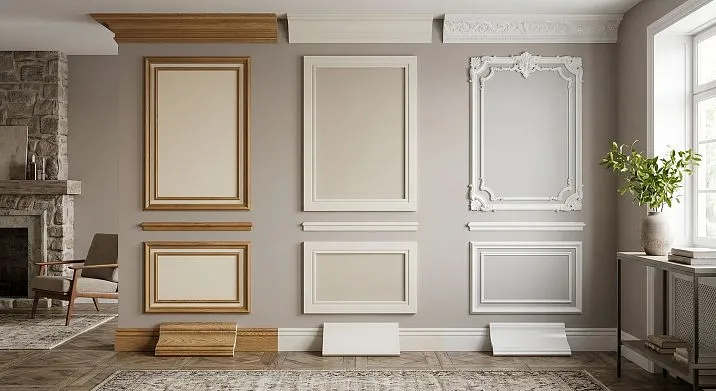
Three materials, one result—a beautiful wall. But the path to this result is different for each material, and confusing them means either extra hassle or disappointment with the outcome.Moldings for walls to buytoday you can choose from wood, MDF, and polyurethane—and these aren't just three variations of one product, but three different concepts for working with space.
Some need the living texture of an oak profile in a classic living room. Others—a white molding in a frame system for a bedroom, straight as a ruler, perfectly taking enamel. Others—a lightweight polyurethane profile in a hallway, which glues in an hour and isn't afraid of dampness. All three tasks are solvable. But each is solved by its own material—andPolyurethane moldingwill never replace solid wood where natural grain is important, and a wooden profile won't replace polyurethane where moisture resistance is needed without compromise.
This article is a selection tool. Read it as a guide to action, not as a theoretical course on decor.


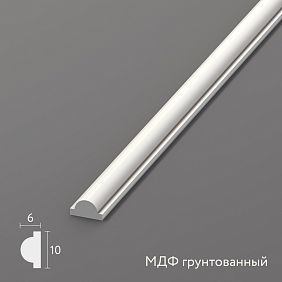
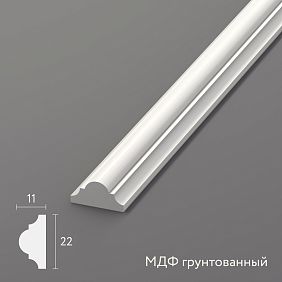


What is wall molding and why is it needed
Molding is a decorative trim profile with a shaped cross-section. It is mounted on walls to create frame systems, horizontal bands, frame niches and openings, and divide wall planes into architectural zones. It's not just decoration—it's a tool for working with space.
The principle is simple: the molding casts a shadow. It is this shadow that makes a flat wall appear three-dimensional. Even a thin 10–15 mm profile changes the perception of the surface: it stops being just a painted slab and starts to 'read' as an architectural element. More massive 50–100 mm profiles create a true relief structure, comparable to historical stucco interiors.
Decorative wall moldings are used in living rooms, bedrooms, studies, hallways, kitchens, and even bathrooms — with adjustments for the material, of course. Panel frame systems, boiserie, horizontal belts, architraves, cornice finishes — all these are varieties of the same tool.
The question 'which molding for wall decor?' always begins with the question of material. And it is precisely this that we will examine in maximum detail.




Types of Moldings by Material
Before moving on to comparisons, it's necessary to understand what the market actually offers. Today, three main materials are used in interior projects.
Our factory also produces:


Wooden Moldings (Solid Wood)
Profiled strips made from solid wood — oak, beech, ash, walnut. Produced by milling to a specified profile followed by sanding. The density of oak molding is 670–720 kg/m³, beech — 680–750 kg/m³. Natural texture, live wood grain pattern, the possibility of tinting to any color — all this is part of the basic set of advantages.
Get Consultation
MDF Moldings
MDF (Medium Density Fiberboard) — a pressed wood fiberboard with a density of 750–850 kg/m³. Essentially, it's wood in a 'reprocessed' form: without a grain pattern, without pores, absolutely homogeneous. Perfect profile geometry, smooth surface ready for painting, stability under normal temperature changes for residential spaces.
Polyurethane moldings
Expanded Polyurethane — a synthetic polymer with a density of 400–600 kg/m³. 2–3 times lighter than wood, moisture-resistant, not susceptible to mold and fungus, withstands a temperature range from −40 to +80 degrees Celsius. Installed with construction adhesive in one day. Reproduces the most complex classical profiles with the highest detail, including the finest scrolls and ornaments.
All three materials share one thing: they are used to solve the same decorative tasks. But each does it in its own way.
Wooden moldings: when solid wood is irreplaceable
There are rooms and projects where wooden profile is not just one of the options, but the only correct choice. And there are significantly more such situations than it seems at first glance.
Natural texture as an argument
Wooden moldingsmade of oak or beech carry something that synthetics cannot reproduce—the living pattern of wood. Medullary rays in oak on a radial cut create a characteristic shimmering effect. Beech gives a uniform fine grain with a delicate pearly sheen. Ash—a wavy, large pattern that is especially expressive on wide profiles.
This effect cannot be imitated. You can apply a decorative wood-like coating—but upon close inspection, the difference is obvious. That is why in premium projects, in business-class interiors, in handmade furniture and decor, the choice is always in favor of natural solid wood.
Compatibility with wooden interiors
If the house has wooden floors, solid wood doors, furniture with wooden fronts—wooden wall molding becomes mandatory. It fits into a unified material system, 'breathes' together with the rest of the wood, creates a sense of monolithic, consciously designed space.
Finishing treatment without limitations
Wooden profile accepts any coating: transparent varnish preserving the texture, oil for a matte natural surface, tinting for color shifting, white or colored enamel for monochrome modern solutions, patina for an aged effect. No special primers, no limitations on coating systems.
Repairability
Wood is repaired spot by spot. Scratches, chips, and wear are treated locally without replacing the entire element. Properly dried and finished oak molding lasts 20–50 years without losing shape or appearance.
Towooden trimRelated products include wooden baguettes, trim, cornices, and baseboards—which, together with molding, create a comprehensive architectural design for the room.
Wooden molding is the right choice for:
-
classical and neoclassical interiors
-
interiors with wooden furniture and floors
-
projects where natural texture is important
-
boiserie and historical styles
-
premium residential properties
MDF Moldings: When They Are More Convenient Than Solid Wood
MDF is a material that is often underestimated. Meanwhile, MDF molding often turns out to be the ideal solution—not a compromise, but truly the best for a specific task.
Perfect geometry for painting
The main property of MDF molding is an absolutely homogeneous, non-porous surface. When the entire decorative wall system is painted in a single color—white, light gray, dark anthracite—MDF provides the perfect base. The enamel applies without drips or runs, without highlighting pores, without uneven gloss. The result is a monochrome relief surface where the molding is visible only through the play of shadows, not through a difference in materials.
For modern neoclassicism, where white walls with white frames are a standard technique,MDF moldingis the optimal choice for painting.
Shape stability
High-density MDF (750–850 kg/m³) has no grain direction—meaning it does not warp or twist in stable indoor climate conditions. The geometric tolerance of the profile ±0.1 mm is maintained along the entire length of the linear material, which is critical for joints in corners and seams.
A good base for complex profiles
MDF holds thin and complex cross-sections excellently—where solid wood might chip along the short grain. Therefore, carved and multi-stage profiles made from MDF are often more precise than similar ones made from solid wood.
A more affordable scenario
MDF molding is cheaper than solid wood for a similar profile. For projects requiring a large linear footage—panel systems in several rooms, a multi-room apartment—the difference in budget becomes noticeable.
MDF molding is the right choice for:
-
monochromatic walls for painting
-
modern neoclassicism
-
frame systems in white tones
-
projects with a limited decor budget
-
any dry living spaces
Polyurethane moldings: when they are better
Polyurethane molding is not a budget substitute for wood. It is an independent tool with its own area of expertise. And in this area, it outperforms all competitors.
Moisture resistance without reservations
Polyurethane moldingdoes not absorb water. At all. Condensation, steam loads, direct moisture exposure—none of this affects the structure or shape of the product. This is why polyurethane wall moldings are the standard solution for kitchens, bathrooms, toilets, pool rooms, loggias, and glazed verandas.
Wood and MDF under similar conditions require special protection, and with regular contact with moisture, they gradually lose their shape.
Light weight and easy installation
Polyurethane density is 2–3 times lower than wood. A linear meter of polyurethane molding weighs several times less than a wooden counterpart of the same cross-section. This means installation without mechanical fasteners — only adhesive, only a construction gun. One person in one day.
For ceiling systems where weight is critical, this advantage becomes decisive.
Reproduction of the most complex profiles
Polyurethane is poured into a mold, meaning it can reproduce profiles of any complexity — the finest curls, Baroque ornaments, composite cornices that would require hand carving and cost many times more if made from solid wood.MoldingPolyurethane is an affordable way to achieve the effect of historical plaster molding without its weight and cost.
Temperature stability
Polyurethane retains all physical properties in the range from −40 to +80°C. This makes it applicable where wood performs poorly: cold zones, unheated rooms in winter, balconies.
Wide decorative context
Other elements are organically added to polyurethane moldingstucco decoration: overlays, rosettes, corner elements.Polyurethane moldingsand decorative moldings are a unified system where each element has a coordinated profile and scale.
Polyurethane molding is the right choice for:
-
kitchens, bathrooms, humid rooms
-
ceiling systems (due to light weight)
-
complex baroque and classical profiles
-
projects with quick installation
-
un-glazed balconies, loggias, verandas
What's better for walls: wood, MDF or polyurethane
This is the main question you're probably reading this article for. Let's break it down with honest criteria, without marketing fluff.
By appearance
| Parameter | Solid wood | MDF | Polyurethane |
|---|---|---|---|
| Natural texture | ✓ Available | ✗ No | ✗ No |
| For painting | Good | Excellent | Excellent |
| For tinting | Excellent | Good | Imitation |
| Complex terrain | Limited | Good | Excellent |
| Visibility upon inspection | Live | Neutral | Neutral |
Installation
| Parameter | Solid wood | MDF | Polyurethane |
|---|---|---|---|
| Weight | High | Medium | Low |
| Mounting method | Adhesive + fasteners | Adhesive + fasteners | Adhesive only |
| Installation complexity | Medium | Medium | Low |
| Installation speed | Medium | Medium | High |
Operational
| Parameter | Solid wood | MDF | Polyurethane |
|---|---|---|---|
| Moisture resistance | Medium (with coating) | Low (requires protection) | High |
| Repairability | Good | Good | Limited |
| Service life | 20–50 years | 10–25 years | 15–30 years |
| Restoration | Possible | Partially | Difficult |
By style
Classical and neoclassical interiors with solid wood.
Modern neoclassical style for monochrome painting — MDF.
Highly decorative Baroque profiles — polyurethane.
Wet rooms of any style — polyurethane.
Eclectic style without a clear stylistic accent — MDF or polyurethane.
Choosing between wood and polyurethane for moldings is primarily a choice between material authenticity and practicality. Wood is sincere. Polyurethane is more convenient. MDF occupies the right middle ground in most dry rooms.
Where wall moldings are used
Let's break it down by specific zones — not abstractly, but with reference to the material.
Living Room
The main room of the house, a space for representativeness. Wall molding in the living room is either full boiserie made of solid wood (for classic style), or a frame system made of MDF for painting (for modern neoclassicism), or polyurethane cornices and profiles with rich relief (for Art Deco and formal classical style).
Accent wall for TV — a most popular request. Molding for the TV zone forms a geometric frame around the screen, creating a sense of a built-in niche or architectural accent. Both MDF and polyurethane work well for this task.
Bedroom
A chamber space where decor should be restrained. Wall molding for the bedroom is a medium-scale frame system. White MDF molding on light walls — minimal effort, maximum effect. Wooden profile in a natural tone — for classic or natural style. Molding in the headboard area of the bed is a separate technique that creates a custom interior feel.
Entryway
The hallway is a high-traffic area. The lower part of the wall up to 90–100 cm should be made of a material resistant to mechanical contact. Here, oak wood molding or paintable polyurethane is preferable to MDF without a protective coating.
Molding for the hallway also serves the function of a horizontal dividing belt between the lower dark zone and the light upper zone — a classic architectural technique that works in any style.
Kitchen
Wall molding for the kitchen is primarily a matter of moisture resistance. In areas where steam and splashes are possible, the unequivocal choice isPolyurethane wall moldings. They do not react to moisture, are easy to clean, and do not swell.
In dry areas of the kitchen — decorative frames above the work area, ceiling perimeter trim, horizontal belts at the hood level — MDF and wooden profiles with high-quality moisture-resistant coating are acceptable.
Bathroom
Molding for wet rooms — only polyurethane. Without exceptions. Wood and MDF under conditions of constant humidity, condensation, and temperature fluctuations will deform, delaminate, and lose shape. Polyurethane profile in the bathroom is a durable and correct solution.
Decorative frames and wall panels
Molding for wall frames is one of the most popular applications. Geometric rectangular frames made from profile, mounted on a flat painted wall, create the effect of expensive architectural finishing at minimal cost. This technique works with any material — the choice is determined by the room and style.
Molding for wall panels is an extended version of the frame system, where the profile frames not just a drawn frame, but an actual insert: veneer, a painted fragment, a mirror.
How to choose molding based on interior style
Material defines possibilities. Style defines the choice of profile and scale.
Classical and Baroque
For strict classicism — profiles with historical cross-sections: ogee, torus, scotia, astragal. Made from solid oak with a dark stain or from polyurethane with rich ornamentation for painting. Scale — large: moldings 60–120 mm wide, developed composite cornices.
Molding for a classic interior requires proportionality: ceiling height must 'support' the scale of the profile. For ceilings below 2.8 m — moderate profiles; for 3.5 m and above — you can afford Baroque opulence.
Neoclassicism
Wall moldings in the interiorin a neoclassical interpretation — these are classic profiles adapted to modern proportions. The same ogees and astragals, but thinner, lighter, in a white monochrome system. MDF for painting is the optimal material here. Polyurethane is also good, especially if a complex relief is needed without the cost of manual labor.
Molding for neoclassicism in a modern home
Molding 25–50 mm in a framing system, a single color with the wall, strict geometry of the frames. This solution works in apartments with ceilings 2.7–3 m — it doesn't overload but creates the necessary architectural effect.
Modern interior and minimalism
Molding for a modern interior is a rectangular or slightly beveled profile 10–25 mm. It adds a tactile accent and delineates the boundaries of planes without creating historical references. This decor is almost invisible — but that's exactly what's needed in a minimalist context.
Accent Wall
Molding for an accent wall is a free field for experimentation. Geometric patterns, hexagons, rhombuses, vertical rhythms — molding allows you to create almost any planar ornaments. Polyurethane profile is more convenient here due to ease of installation: shaped constructions require numerous joints and finishing.
Where to buy wall moldings
Now — to specifics. Having decided on the material and profile, you need to find the right source.
Wooden and MDF moldings
Buy Wall MoldingWood and MDF moldings can be found in the specialized STAVROS section — the section for solid wood and MDF millwork. Here, profiles are collected, filtered by material (solid wood, MDF) and product type, including moldings of several standard sizes.
Technical specifications of STAVROS products:
-
Oak, beech — density 670–750 kg/m³
-
MDF — density 750–850 kg/m³
-
Solid wood moisture content — 8–12% (kiln-dried)
-
Profile tolerance — ±0.1 mm per linear meter
-
Surface — sanded, ready for painting and tinting
To calculate the required linear footage: the perimeter of each wall, multiplied by the number of elements in the system, plus 15–20% for cutting in corners.
Related products in a unified material theme —Wooden trim: baguettes, cornices, baseboards, coving — are available in the same section for comprehensive design.Wooden molding— for projects where molding is combined with frame inserts.
Polyurethane moldings
Buy polyurethane moldingin the STAVROS catalog means gaining access to a wide range of polyurethane profiles of different scales and styles. Here you will find moldings from lightweight frame profiles to complex architectural cornices with elaborate ornamentation.
In the polyurethane section, the following are also available:
-
Polyurethane Decor— overlays, corner elements, decorative inserts for completing the molding system
-
Polyurethane rosettes and stucco— point decor for frame centers and ceiling medallions
When purchasing polyurethane moldings, it is important to consider corner and connecting elements — many manufacturers produce ready-made corner blocks for standard profile sizes, which significantly speeds up installation.
Mistakes when choosing wall molding
Choosing polyurethane for the kitchen instead of moisture-resistant — quite the opposite
The irony is that this is exactly where people make mistakes in both directions: some install wooden molding above the cooktop, others fear polyurethane where it is absolutely appropriate. The rule is simple: the steam and moisture zone — polyurethane. The dry zone — any material to your taste.
Mismatch of profile scale to wall height
A wide 120 mm cornice in a room with 2.6 m ceilings 'eats up' the height and creates a oppressive effect. Guideline: the lower the ceilings, the smaller the profile. For a height of 2.6–2.7 m — no more than 60–70 mm for cornices and 30–40 mm for frame moldings.
Mixing wooden and polyurethane profiles without thoughtful logic
This is a common mistake in eclectic interiors. Wooden molding on walls + polyurethane cornice on the ceiling — a possible, but requiring a conscious decision, combination. If the materials are not coordinated in color and style, the joining of the two systems is perceived as incompleteness.
Buying without a sample
Molding is a product with visual perception that depends on lighting, wall color, and adjacent materials. Buying a large batch without first viewing a sample is a risk. Always request samples and evaluate the profile in the actual conditions of the room.
FAQ: the most important questions about wall moldings
Which molding is best for walls?
Depends on the task: for natural texture and classic style — solid oak or beech, for monochrome painting — MDF, for wet rooms and complex relief — polyurethane. All three options are practical solutions, the choice is determined by the room and style.
What to choose for interior: wood, MDF, or polyurethane?
For classic with natural wood — solid wood. For modern neoclassical for painting — MDF. For baroque ornament or wet areas — polyurethane.
Where to buy wall moldings?
In STAVROS catalogs:wooden and MDF moldingsandPolyurethane wall moldings.
How does polyurethane molding differ from wooden molding?
Polyurethane — lighter (2–3 times), moisture-resistant, installed only with adhesive, reproduces complex ornament. Wood — natural texture, repairability, historical profiles, compatibility with wooden interior.
Can polyurethane moldings be painted?
Yes, polyurethane moldings paint excellently. The surface is already factory-primed, accepts acrylic and alkyd enamels. This is one of the main application scenarios: molding is painted to match the wall color, creating a monochrome relief effect.
Is polyurethane molding suitable for bathrooms?
Yes, polyurethane is the optimal choice for bathrooms. It does not absorb moisture, does not mold, does not swell, and withstands regular contact with steam and condensation.
Which molding to choose for painting?
For a smooth, perfect surface for painting — MDF. For complex relief for painting — polyurethane. For those who want to paint a profile while preserving the textured base — solid wood.
What is better for wall frames?
All three materials are suitable for decorative frames. MDF — if the frames are painted to match the wall color. Polyurethane — if quick installation or a damp room is needed. Solid wood — if the frames should be visible in the natural wood texture.
STAVROS: wall moldings made of wood, MDF, and polyurethane
The right molding is the one that solves your specific task. Not universal, not the most expensive, not the cheapest, but exactly the one that will make your wall as you envisioned it.
STAVROS is a Russian manufacturer of wooden and polyurethane architectural elements. Full production cycle for wooden products: chamber drying, profile processing with a tolerance of ±0.1 mm, sanding for painting. Own line of polyurethane moldings with a wide range of profiles from simple frame moldings to complex Baroque cornices.
In the STAVROS catalog:
-
Wooden moldings and MDF for walls— solid oak and beech, high-density MDF, over 40 profiles
-
Polyurethane moldings— lightweight, moisture-resistant, from classic to baroque profiles
-
molded decoration made of polyurethane— overlays, corner elements for completing molding systems
-
Wooden trim— baguettes, cornices, baseboards for a unified architectural system
-
Wooden molding— for frame structures with inserts
STAVROS works with private clients, designers, architects, and construction companies. Profile samples — upon request. Project completion of any scale. When you know exactly what kind of wall you want — start with the right profile.