Article Contents:
- What is a furniture cornice and how does it differ from a curtain cornice
- Upper furniture cornice: the main horizontal line of furniture
- What it does visually
- Dimensions of the upper cornice
- Lower furniture cornice: plinth and base
- Where furniture cornice is used: five main scenarios
- Furniture cornice for a wardrobe
- Furniture cornice for a kitchen
- Sideboard and display case: cornice as an "architrave"
- Library and office furniture: strictness and massiveness
- Furniture portal: cornice as a key element
- How to choose a furniture cornice profile: practical criteria
- Criterion 1: Profile height matches the scale of the furniture
- Criterion 2: Profile depth accounts for the gap to the ceiling
- Criterion 3: Profile relief is coordinated with other elements
- Criterion 4: Ornament is consistent with the style
- Criterion 5: Material and finish
- Solid wood furniture cornice: why it matters
- How to calculate the length of the cornice: a step-by-step approach
- Furniture cornice in different interior styles
- Classic: volume, profile and patina
- Neoclassical: rigor without asceticism
- Provence: lightness and whiteness
- Cabinet style: dark wood and strictness
- Modern classic: geometry without overload
- Furniture cornice in the decor system: what to combine with
- Installation of a furniture cornice: principles without mistakes
- Before installation
- Corner joints
- Fastening
- Final processing of joints
- Typical mistakes when choosing a furniture cornice
- Where to buy a wooden furniture cornice STAVROS: full list
- Frequently Asked Questions
- About the Company STAVROS
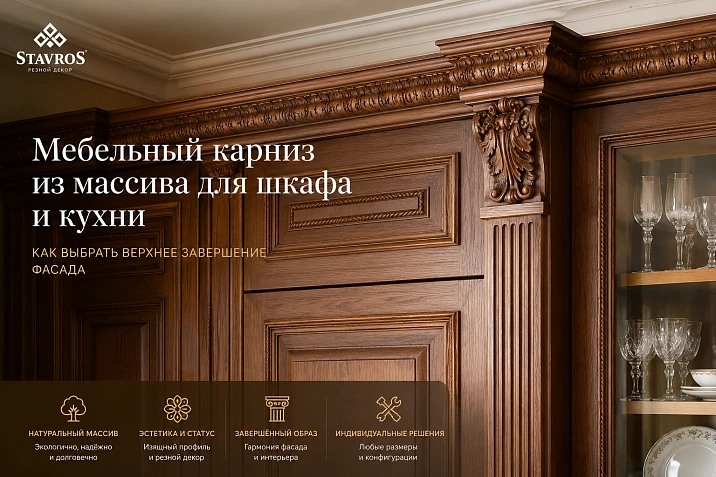
Look at any high-quality classic wardrobe or kitchen set. What makes it complete? Not the handles, not the fronts, not the fittings. Completeness comes from above — where the furniture meets the ceiling or the air above it. That's where the furniture cornice works. It is what separates "good furniture" from furniture with character.
Furniture crown molding — is a decorative profile for the top or bottom finish of a wardrobe, kitchen set, sideboard, library, furniture portal, or any built-in furniture composition. It has nothing to do with curtain rods — these are fundamentally different products with different purposes, different shapes, and different selection rules.
A wooden furniture cornice made of solid wood is not just a profile strip. It is the final touch that brings all the vertical decor of the furniture together into a single coherent composition. Without a cornice, the wardrobe "breaks off" at the top. With a properly selected cornice, it is completed.
How to choose? What to consider for a wardrobe, and what for a kitchen? Which mistakes are costly? We'll tell you in detail.
What is a furniture cornice and how is it different from a curtain rod
Let's start with a fundamental distinction that will eliminate confusion.
A curtain rod is a horizontal track for hanging curtains and drapes. It is attached to a wall or ceiling, is not connected to furniture, and exists in the world of "window textiles." It is a completely different item.
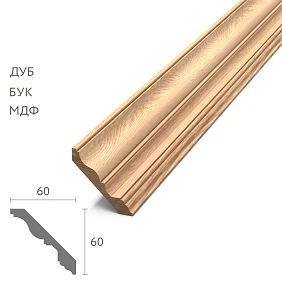
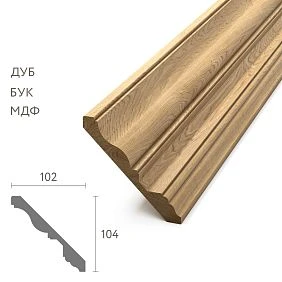
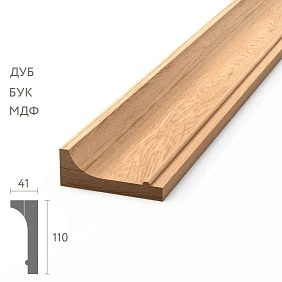
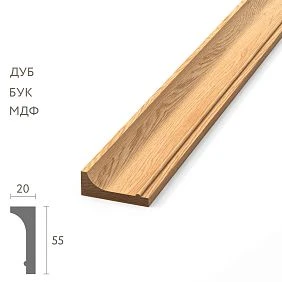
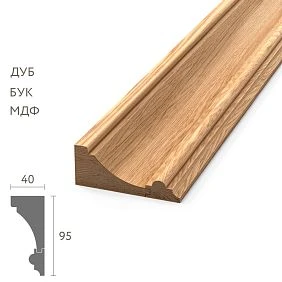
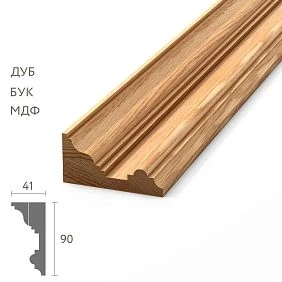
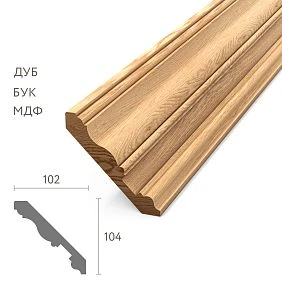
A furniture cornice is a profiled product made of wood that is attached to the top or bottom part of a furniture front. It is part of the furniture: it creates a finish, adds volume, and sets a horizontal "crown" or a lower decorative belt.
A furniture cornice in the classical sense is a simplified entablature. In architecture, the entablature is the upper horizontal part of an order, resting on columns and pilasters. In furniture design, the cornice performs the same role: it "closes" the upper part of the vertical front and visually loads it from above, giving the furniture architectural completeness.
A decorative furniture cornice can be:
-
Upper — main finish at the top of a cabinet, kitchen, portal, or sideboard
-
Lower — decorative band under the lower section of furniture, base line
-
Intermediate — horizontal band separating the upper and lower sections
Each of these types has its own selection logic.




Upper furniture cornice: the main horizontal line of furniture
Upper furniture cornice — the most critical decorative element in the furniture facade system. It is always visible, first and from all viewpoints.
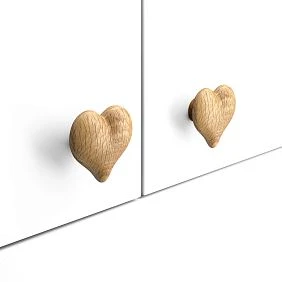
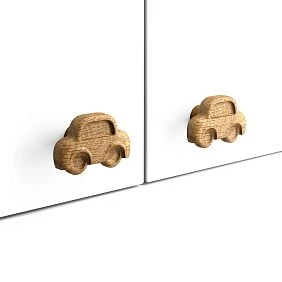
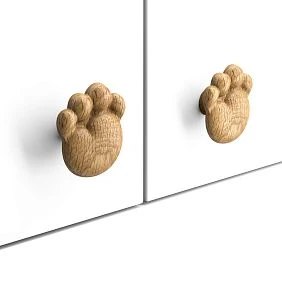
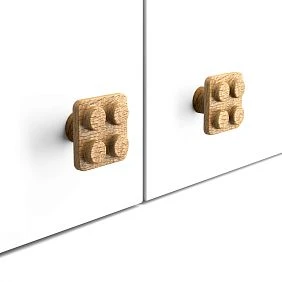
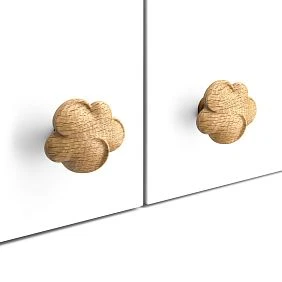
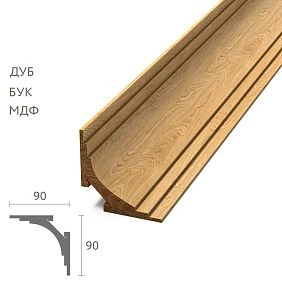
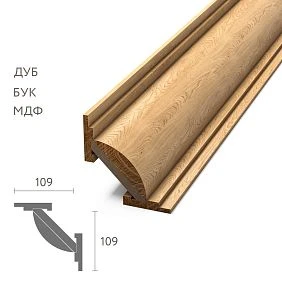
Our factory also produces:
What it does visually
The upper cornice solves several tasks simultaneously:
Covers the technical top edge. Any cabinet or kitchen set has a technical top end. Bolts, edges, seals, and gaps between furniture and ceiling are visible there. The cornice covers all of this decoratively and cleanly.
Creates the "crown" of the facade. In classic furniture, the upper cornice is what visually "completes" the vertical. Without it, the cabinet looks truncated. With the cornice, it acquires monumentality and completeness.
Connects furniture with the interior. The cornice is a transitional element between furniture and the ceiling or wall. When properly selected, it "dissolves" the boundary, making the furniture part of the room's architecture.
Enhances the horizontal rhythm. In a long kitchen set, the upper cornice runs along the entire length, creating a continuous horizontal line. This visually organizes the space and makes the kitchen a "single wall" of furniture.
Get Consultation
Dimensions of the upper cornice
The height of the upper cornice profile depends on the scale of the furniture:
-
Small cabinet (height up to 180 cm): cornice height 40–60 mm
-
Standard cabinet (180–220 cm): cornice 60–80 mm
-
Tall cabinet up to the ceiling (220–260 cm): cornice 80–100 mm
-
Furniture portal with pilasters (260–300+ cm): cornice 100–140 mm
Depth (overhang) of the cornice: must be at least the depth of the facade protrusion. For a kitchen set with standard wall cabinets 300 mm deep — a cornice with an overhang of 35–50 mm.
Lower furniture cornice: plinth and base
Lower furniture cornice — a decorative band at the bottom of furniture. Its purpose is to connect the furniture with the floor, create a decorative "plinth," and complete the lower line of the facade.
In classic furniture, the lower cornice works like an architectural stylobate: it "places" the entire furniture system on a visible base with a decorative character.
The lower cornice is used:
-
Under the lower drawers of a wardrobe or built-in closet
-
Under the lower sections of a kitchen set (plinth area)
-
As a decorative strip under a sideboard or bookcase
-
As an intermediate divider between the lower and upper tiers of furniture
Size of the lower cornice: typically smaller than the upper one. Height 30–60 mm is a typical range. An excessively high lower cornice "overloads" the lower part of the furniture.
Where to use furniture cornices: five main scenarios
Furniture cornice for a wardrobe
For a wardrobe, a cornice is an element of architectural dignity. Furniture cornice for a wardrobe is installed along the top edge of the facade perimeter. It creates the "crown" of the wardrobe.
Several specific options:
Built-in wardrobe up to the ceiling. When the wardrobe goes strictly up to the ceiling, the cornice is installed as a decorative transition. It covers the gap between the top end panel of the wardrobe and the ceiling, creating an illusion of solidity.
Freestanding wardrobe below the ceiling. Here, the cornice functions as a "crown" — the overhanging profile creates a silhouette on top, completes the vertical line, and gives the wardrobe an architectural look.
Portal wardrobe. This is a furniture system with side wooden pilasters and columns, a niche or section in the center. The cornice here works as an entablature: it "rests" on the capitals of pilasters and completes the entire portal system. Without a cornice, a portal is just a few vertical elements. With a cornice, it is an architectural statement.
Classic wardrobe. A two-door or three-door cabinet with framed molding facades — the cornice here should be in the same decorative system as the facade moldings. The style, relief depth, and ornament should be in the same key.
for cabinet decor The cornice is an essential detail, without which a systematic approach to decorative design is impossible.
Furniture cornice for kitchen
The kitchen is a space where horizontal lines define everything. The countertop line, the top line of wall cabinets, the ceiling line. If there is a gap between the wall cabinets and the ceiling, the cornice closes it and turns the "hole" into an architectural element.
Kitchen furniture cornice — is one of the most common tasks. Here's why:
Firstly, wall kitchen cabinets almost never reach the ceiling exactly. A gap remains between them and the ceiling: 20, 30, 50, sometimes 100 mm. This place attracts dust, looks untidy, and disrupts the integrity of the kitchen ensemble.
Secondly, a classic or neoclassical kitchen requires a horizontal accent above the wall cabinets. This is not just about "closing the gap" — it's about creating the upper decorative belt of the set.
A wooden furniture cornice for the kitchen is selected considering:
-
Height of wall cabinets (standard: 720 mm with ceiling height 2700 mm, or 900 mm with ceilings 3000 mm)
-
Gap between the top of the cabinets and the ceiling
-
Facade styles: paneled facades with a molding frame → a cornice with a developed profile; smooth facades → a more laconic cornice
-
Finishing colors: the cornice is painted the same color as the facades
for solutions for the STAVROS kitchen a wooden cornice made of solid wood is a standard component of classic and neoclassical kitchen projects.
Sideboard and display cabinet: the cornice as an "architrave"
A classic sideboard is a two-tier furniture system: the lower part (cabinet) + the upper part (display cabinet with glass doors). The cornice in the sideboard works on two levels:
Cornice above the lower section. It separates the lower cabinet from the upper display cabinet — a horizontal belt "cutting" the sideboard. Like an entablature.
Cornice above the upper section. Crowns the entire system from above, creating the sideboard's "crown."
For sideboards with side pilasters, both cornices must be coordinated with the pilaster profile. The three elements (lower cornice, pilasters, upper cornice) form a complete miniature order system.
solid wood millwork for vertical layouts on the sideboard body + wooden moldings, cornices, and baseboards for horizontal belts — this is a typical "set" for a classic buffet.
Library and office furniture: strictness and massiveness
A bookcase or library system in an office — here the cornice carries the maximum "architectural load." This is not a kitchen with practical tasks. This is a space of representation, where details work for the image.
Cornice for the library:
-
Made of solid wood — not MDF with veneering
-
With an expressive profile: several belts, cavettos, a shelf (abacus)
-
Coordinated in style with pilasters (if any) and wooden cornice glazing
-
In dark tinting — walnut, wenge, oak with stain
A cabinet library with a dark wooden cornice, side pilasters, glass doors in baguette frames, and a lower cornice-base is an interior with real "weight." This is exactly what it says. decor for a study in the boiserie system: vertical pilasters + horizontal cornices + wall panels = a unified architectural system.
Furniture portal: cornice as a key element
In a furniture portal — a cabinet system around a niche, TV area, or passage — the cornice takes the position of an "architrave." It is a horizontal crossbar that covers the vertical pilasters from above.
Principle of a correct portal cornice:
-
Cornice width = width of the entire portal (including side pilasters)
-
Cornice projection matches the projection of the pilaster capitals
-
Cornice profile is coordinated with the capitals
-
Above the cornice — possibly an additional belt of decorative elements
for TV zone frame A cornice is a mandatory horizontal element above the TV frame. Without it, the system is "open" at the top and does not read as a portal.
How to choose a furniture cornice profile: practical criteria
Criterion 1: Profile height matches the scale of the furniture
This is the simplest rule and the most frequently violated. The height of the cornice should be proportional to the height of the furniture:
-
A 40 mm cornice on a 240 cm high cabinet is unnoticeable, "gets lost"
-
A 120 mm cornice on 720 mm high wall cabinets is overwhelming
Guideline: cornice height = 4–6% of furniture height. Cabinet 240 cm → cornice 96–144 mm (round to 100–120 mm). Wall cabinet 720 mm → cornice 28–43 mm (optimal 35–45 mm).
Criterion 2: Profile depth accounts for the gap to the ceiling
If the cabinet is close to the ceiling, the cornice projection should be small. A cornice with a large projection with a small gap to the ceiling creates a visual "pinch".
Optimal gap: cornice height + 20–30 mm = minimum distance from top of cabinet to ceiling.
Criterion 3: Profile relief is consistent with other elements
wooden moldings, cornices, and baseboards in a furniture project should form a single decorative family. The cornice relief should not 'argue' with the moldings on the cabinet facades or with the baseboard profile.
Rule: depth of cornice relief ≥ depth of facade molding relief. The cornice is the 'largest' horizontal element. It protrudes further forward than the facade moldings.
Criterion 4: Ornament is consistent with style
A cornice with acanthus ornament in a modern Scandinavian-style kitchen is an obvious incompatibility. But it does occur.
Stylistic correspondences:
-
Classic: cornice with cavetto bands, scotia, breaks, and possible ornament
-
Neoclassical: geometric profiles, thin bands, without ornamental relief
-
Provence: soft breaks, light floral ornament or its complete absence
-
Cabinet style: strict profile, no frivolous details
Criterion 5: Material and finish
Solid wood furniture cornice — a material that accepts any finish:
-
Varnish (clear or tinted): preserves wood texture
-
Enamel (any color, matching kitchen fronts): provides a uniform coating without visible texture
-
Tinting to walnut, oak, wenge: changes wood color, preserves grain
-
Patina: dark recesses, light highlights — a 'historical' character
Principle: the cornice is painted the same color and with the same method as the furniture fronts. If the kitchen is white enamel, the cornice is white enamel. You cannot install a tinted cornice on white fronts.
Solid wood furniture cornice: why it matters
Solid wood furniture cornice fundamentally different from an MDF or polyurethane cornice.
Solid wood holds its shape. MDF can deform with changes in humidity. Wood is more stable with proper finishing.
Solid wood accepts carving. You can make a real carved detail on it. MDF under a router gives a different result — without the tactile and visual "liveliness" of wood.
Solid wood tones organically. When tinted to look like wood, a solid wood cornice and solid wood furniture fronts will give a consistent result. An MDF cornice with the same tint will give a different shade.
Solid wood is an honest material. In projects where the client values a genuine wooden interior — solid wood fronts, Solid Wood Items on walls and furniture — the cornice should also be made of solid wood.
How to calculate the length of a cornice: a step-by-step approach
This is a task that needs to be solved before ordering. Mistakes in calculating the length of a cornice are costly.
Step 1: Measure the width of the furniture.
The full width of the cabinet or set along the outer edges. Not along the inner edges, not along the fronts — along the outer edges of the body.
Step 2: Determine the cornice configuration.
Cornice only along the front (straight line) — or does the cornice wrap around the side walls of the cabinet (L-shaped or U-shaped configuration)?
For a built-in cabinet from wall to wall — cornice only along the front. For a freestanding cabinet or corner kitchen — the cornice wraps around the sides.
Step 3: Calculate the length based on configuration.
Straight: length = furniture width + 2 × cornice overhang (20–30 mm on each side for the "ears" protrusion).
U-shaped (three runs): front + 2 × depth of side runs.
Step 4: Account for corner joints.
For each external corner — an additional 50–70 mm of allowance. The corner joint of the cornice is cut at 45° — this requires length allowance.
Step 5: Add allowance for trimming.
Minimum 150–200 mm for each run. This is insurance against cutting errors.
Step 6: Check the height to the ceiling.
Cornice height + gap = distance from the top of the furniture body to the ceiling. If the gap is insufficient, choose a cornice with a lower height.
Step 7: Coordinate with solid wood millwork extension strips, if there are additional elements on the sides.
Furniture cornice in different interior styles
Classic: volume, profile, and patina
Classic allows — and requires — a cornice with a rich profile. Several horizontal bands (cavetto, shelf, quarter round, fillet, reverse cavetto) + possible ornament. Cornice height for classic furniture: 80–120 mm.
Finish: walnut tint or patina. Patina "reveals" the profile: recesses are dark, protrusions are light. This is readable even from a distance.
Example: a library cabinet with side pilasters, carved capitals, and a 100 mm high cornice in a "walnut with gold" patina — this is a solution that eliminates all questions about quality and style.
Neoclassical: rigor without asceticism
Neoclassicism is a space of restrained yet precise solutions. Cornice: a profile with a clear horizontal "stepped" silhouette, without ornamental relief. Several bands + a shelf. Height: 60–90 mm.
Finish: matte enamel in the color of the facades — white, gray, cream. The cornice "dissolves" into the facade plane, leaving only the shadow of the profile.
Provence: lightness and whiteness
Provence is the most "airy" style among the classics. The cornice here is small, with soft breaks, without heavy relief. Height 50–70 mm. Mandatory: white or cream enamel.
Light "aging" of the protrusions is acceptable and even appropriate. This creates the charm that Provence implies.
for solutions for furniture in the Provence style, a cornice is a mandatory detail. A cabinet without a cornice in Provence looks like an "unfinished" piece.
Cabinet style: dark wood and strictness
Cabinet style is the territory of dark wood, strict forms, serious details. Cornice: made of solid oak or beech in dark tinting. Height 100–140 mm. The profile is strict — without light floral motifs. Doric "straightness" is possible.
Combination with wooden pilasters и carved decoration — standard for cabinet library systems.
Modern classic: geometry without overload
Modern classic — a balance between expressive profile and restraint. A cornice with two or three clear bands without ornament. Height 50–80 mm. Matte enamel or light tinting.
This is a solution for those who want "something classic" but without the feeling of heaviness of an antique setting.
Furniture cornice in the decor system: what to combine it with
The cornice does not work alone. It is part of the decorative system of furniture.
С wooden moldings on facades: moldings create a frame system on each door — the cornice crowns the entire system from above. The profile of the cornice should be "richer" than the profile of the facade moldings.
С pilasters and columns: vertical pilasters + horizontal cornice = complete order system. The cornice "rests" on the capitals of the pilasters. The width of the cornice projection ≥ the width of the capital.
С wooden molding: linear elements provide additional horizontal bands and vertical layouts. The cornice is the "final" horizontal element at the top.
С wooden cornice: baguette is used for glazing upper cabinets (sideboard, library) and for framing mirrors. The cornice crowns systems with baguette glazing.
С decorative elements: rosettes, cartouches, and corner overlays can be installed directly on the cornice — above the pilaster or in the center of the portal. This enhances the decorative effect.
С carved decoration: in classical and baroque projects, the cornice can be supplemented with carved brackets (modillions) — decorative consoles rhythmically placed under the cornice shelf. This is a classic architectural motif.
Installing a furniture cornice: principles without mistakes
Installing a wooden furniture cornice is a task that needs to be thought through before purchase.
Before installation
Finishing (enamel, tinting, varnish) must be done before installation. After installation, painting the cornice is much more difficult: it is harder to reach the back side, ends, and joints.
Dry fitting is mandatory. Before fixing, ensure the cornice lies flat, the corner joints align, and the width and height match the calculations.
Corner joints
The corner joint of the cornice is cut at 45°. This is precise work. An error of 1–2° creates a visible gap at the joint.
For 90° right angles, a 45° + 45° cut gives an exact connection. For non-standard angles (not 90°), each cut is calculated separately: (angle) / 2 = angle of each cut.
Fastening
The cornice is attached to the top of the furniture body using glue + hidden screws from the inside of the body. There should be no visible fasteners on the front side of the cornice.
If the cornice is attached to the wall (non-standard furniture) — additionally through clamps or glue foam.
Final processing of joints
After installation, all ends and joints are puttied with acrylic putty, sanded, and painted to match the color of the cornice. This is the final operation, and the "cleanliness" of the result depends on its quality.
Typical mistakes when choosing a furniture cornice
Mistakes in this topic come in two types: aesthetic and practical. Both types are equally costly.
Aesthetic:
-
The cornice is too small for the scale of the furniture — "invisible," the furniture looks unfinished
-
The cornice is too large — "overwhelms" the furniture, disrupts proportions
-
Inconsistent ornament with other elements — decorative conflict
-
Different styles of cornice and moldings — no systemic integrity
-
Cornice without considering pilasters — violation of order logic
Practical:
-
The gap to the ceiling was not measured — the cornice does not fit
-
No allowance for trimming — not enough length
-
Corner joints not calculated — gaps at corners
-
Finishing after installation — uneven coverage and difficult access
-
MDF cornice in a wooden project — material mismatch during tinting
The most fundamental mistake is buying a curtain cornice instead of a furniture cornice, or vice versa, looking for a "furniture cornice" among textile cornice systems. These are different categories, different stores, and different specialists. STAVROS works exclusively with furniture and interior wooden products.
Where to buy STAVROS wooden furniture cornice: full list
-
STAVROS wooden moldings, cornices, and baseboards — main section for selecting furniture cornices
-
solid wood millwork — profile layouts and extensions
-
Wooden Picture Frame — for glazing frames and portals
-
Solid Wood Items — full catalog of wooden products
-
wooden decorative elements — rosettes, corner and center accents
-
wooden pilasters and columns — vertical division for portals and cabinets
-
STAVROS carved decor — for classic furniture systems
-
Cabinet decoration — system solutions for cabinets
-
Kitchen solutions — classic and neoclassical kitchens
-
furniture solutions — STAVROS furniture projects
-
Boiserie and wall panels — wall systems next to furniture
-
Consoles and Frames — console solutions
-
TV Zone Frames — TV portals
Frequently asked questions
What is a furniture cornice and how is it different from a curtain rod?
A furniture cornice is a decorative profile for finishing a wardrobe, kitchen, sideboard, library, or portal. A curtain rod is a guide for textiles. These are different product categories with different purposes.
How to choose a furniture cornice for a wardrobe?
You need to consider the height of the wardrobe, the gap to the ceiling, the style of the facades, the presence of pilasters, the color of the finish, and the profile. The height of the cornice = 4–6% of the furniture height.
How to choose a furniture cornice for a kitchen?
Focus on the height of the wall cabinets, the gap between the cabinets and the ceiling, the style of the facades, and the finish. For white facades — a cornice in white enamel. For wooden facades — tinting to match.
Why is a bottom furniture cornice needed?
The bottom cornice forms the base line of the furniture, connects it to the floor, and creates a decorative finish at the bottom. In classic furniture, it is a mandatory element of the lower belt.
Can I paint a wooden furniture cornice?
Yes. A solid wood cornice accepts any finish: varnish, tinting, enamel, patina. It should be painted before installation.
What does the STAVROS furniture cornice pair with?
With moldings on facades, wooden trim, pilasters, wooden picture frame molding for glazing, and decorative elements. All components are from the same decorative system, in the same finish.
How to calculate the length of the cornice?
Furniture width + side overhang + allowance for corner joints (50–70 mm per corner) + allowance for trimming (150–200 mm). For a U-shaped kitchen — three runs: front + two sides.
About the company STAVROS
A furniture cornice is a detail that goes unnoticed in a finished interior. That is a sign of its quality: it works when it is not seen as a separate item, but the furniture is seen as a single whole.
STAVROS produces solid wood products for furniture and interiors: cornices, moldings, baseboards, trim, picture frame molding, pilasters, carved decor, decorative elements, overlays, legs. This is a complete decorative system — from the first molding on the facade to the final cornice on the top edge of the cabinet.
STAVROS is a production where no detail is accidental.