Article Contents:
- Why smooth furniture looks cheap: the anatomy of an "empty facade"
- What is furniture stucco and where to use it
- Polyurethane moldings on furniture facades: how a frame changes everything
- How a molding frame works on a facade
- Choosing a molding profile for furniture
- Technical nuances of installing moldings on MDF
- Decorative stucco on a cabinet: an accent that doesn't overwhelm
- Three approaches to cabinet decor
- Large wall cabinet: specifics of decor
- Chest of drawers and bedside table: small furniture with big character
- Choosing decor for a chest of drawers: by interior style
- Bedside table: the most "visible" item in the bedroom
- Kitchen facades: where stucco is appropriate and where it is not
- Where stucco decor is appropriate in the kitchen
- Where stucco decor in the kitchen requires caution
- Dressing room and sliding wardrobe: from a "large slab" to an architectural wall
- Vertical frames as the main technique for sliding doors
- Repetition as a principle of a systematic dressing room
- Connecting the dressing room with the room's ceiling
- Old furniture for decor and repainting: how to make restoration professional
- What works especially well for old furniture to be painted
- How to connect furniture decor with wall and ceiling decor
- Practical combinations
- Four purchase formulas for furniture decor
- The "Wardrobe as built-in furniture" formula
- The "Chest of drawers as a designer accent" formula
- The "Kitchen sideboard with character" formula
- The "Room in one style" formula
- Practical tips for installing decor on furniture
- FAQ: Answers to Key Questions
- About the Company STAVROS
Here's a provocative question: why does one piece of furniture look expensive while another doesn't, even if they are made from the same MDF, cost about the same, and are sold in neighboring stores?
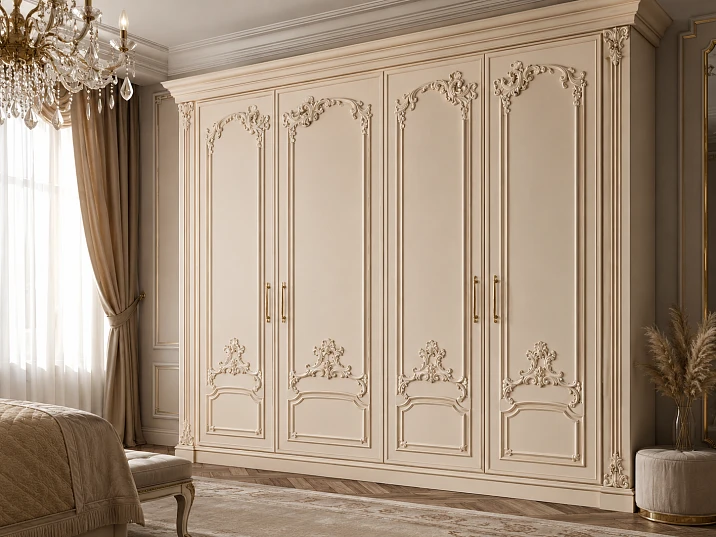
The answer is simple, but rarely spoken aloud: it's all about the facade. More precisely, the architecture of the facade. Whether it has a line, relief, symmetry, frame, or center. One piece of furniture is just a "slab with a handle." Another is a "facade with character." And this character is instantly read by the eye, without any analysis.
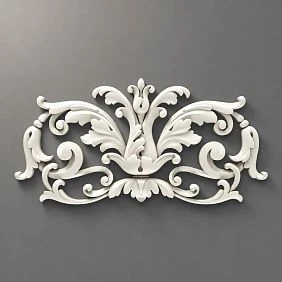
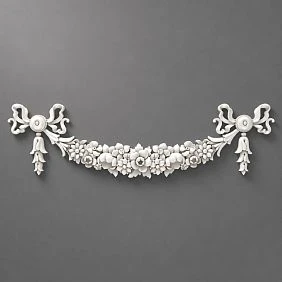
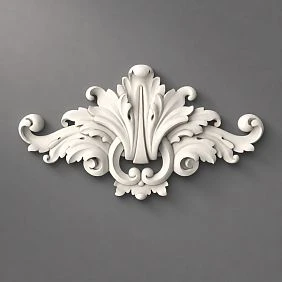
Moldings, Moldings made of polyurethane и Decorative stucco — these are tools that give ordinary furniture the architecture of a facade. Not a new cabinet, not a new kitchen, not a new chest of drawers — but a new facade for existing furniture. Or the right basket from the start when purchasing, which turns mass-produced furniture into something resembling custom joinery.
to buy molding for furniture is not exotic. It's a practical, affordable, and very effective solution. And this article is about it.
Why smooth furniture looks cheap: the anatomy of an "empty facade"
There is an architectural term — "smooth facade." This is a facade without relief, without divisions, without ornament, without profile. In modern architecture, it can be effective — but only if it is designed specifically as smooth: with well-thought-out proportions, material texture, and precise details.
In mass-produced furniture, a smooth facade is not a design choice. It's a technological economy. The facade is smooth not because it was intended, but because it's simpler and cheaper. And that's exactly why it looks cheap: there is no concept, no architectural statement, nothing but a flat surface.
What makes a facade look expensive? Three things.
First — the frame. Molding around the perimeter of a door or drawer creates a "paneled facade" — a type of facade that in joinery is a sign of quality work. The frame says: this facade is well thought out, it has structure.
Second is the center. A decorative element in the center of the facade — an overlay, ornament, geometric accent — creates the "axis" of the facade. The eye finds the center and calms down. A facade with a center looks balanced and complete.
Third is symmetry. Paired decorative elements at the corners or on the sides create symmetry — the most "expensive" of all visual qualities in an interior. Symmetry is associated with handwork, attention to detail, and intentional design.
Moldings for Furniture — this is a system for creating all three qualities: frame, center, and symmetry. On a standard mass-produced facade. In one day. Without replacing furniture.




What is stucco molding for furniture and where to use it
When we say "stucco molding for furniture," we mean specific polyurethane products, adapted in size and shape for furniture use:
-
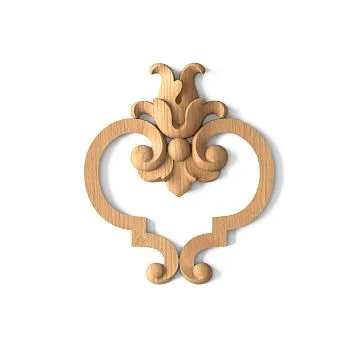
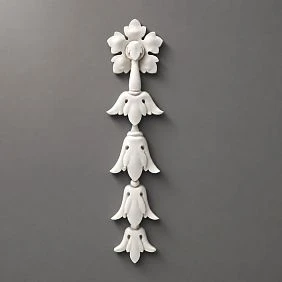
Decorative overlays — flat or semi-volumetric elements with ornament or geometric relief, glued to the facade surface
-
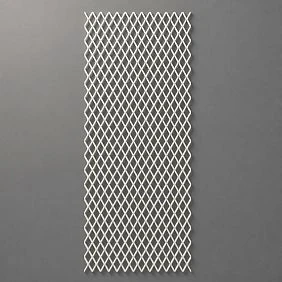
Thin profile moldings — linear profile with a width of 12–35 mm for creating frames, lines, and divisions
-
Paired L/R elements — symmetrical overlays forming decorative pairs along the facade axes
-
Corner decorative elements — small overlays for frame corners or end zones
Where is all this used?
Cabinets — sliding and hinged, built-in and freestanding. Molding frames on doors, decorative stucco at the top, corner elements at section joints.
Chests of drawers — especially old ones, for repainting. This is the most rewarding field for furniture stucco decor: small drawers with fronts that are close to the eyes.
Cabinets — bedside, TV cabinets, dressing tables. Small fronts where a little Relief Decoration creates maximum effect.
Kitchen fronts — sideboards, tall cabinets, islands, display upper doors. Decorative areas of the kitchen that are not affected by direct moisture and grease.
Wardrobes — large door panels that look like a 'wall of laminated boards' without decor.
Consoles and sideboards — items with a pronounced decorative character, where Relief Decoration works as an accent of an expensive 'antique' aesthetic.
Furniture in commercial interiors — showroom, boutique, beauty salon, office. Where furniture 'represents' the brand and must make an impression.
Buy Moldings for any of these applications — it is a solution that takes a place in the catalog with specific items, not 'something decorative'.
Our factory also produces:
Polyurethane moldings on furniture facades: how a frame changes everything
A frame is the main technique of furniture decor. This was known even by the masters of the Louis XV and XVI eras: it was the frame (panel) on a cabinet door that distinguished "furniture with craftsmanship" from "rough joinery." In modern interiors, this principle has not changed — only the material has changed.
Moldings made of polyurethane create a frame on any furniture facade with joinery precision — but without joinery tools, without a router, without complex installation. Only glue and a hacksaw.
Get Consultation
How a molding frame works on a facade
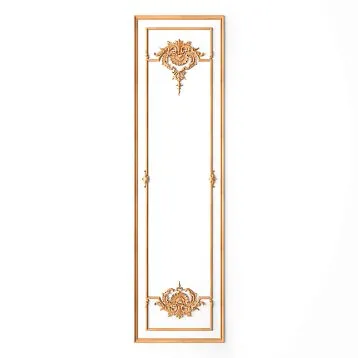
The molding is glued along the perimeter of the door — indented 2–5 cm from the edge. This creates an "inner frame," visually dividing the facade into a field (inner part) and a border (outer belt). This principle is one of the most fundamental in furniture architecture.
For dresser drawers, molding frames create a horizontal "division" of the facade: each drawer gets its own frame and its own identity, and the entire dresser gets an architectural vertical.
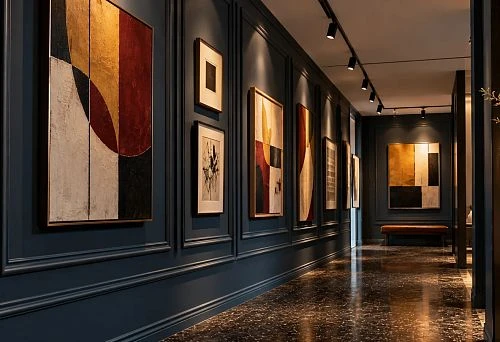
What happens with painting? The ideal option is monochrome painting: the molding, facade, and frame are painted in one color. The relief is read by shadow, not by color contrast. This is exactly what "custom furniture in wall color" looks like — and this is the effect created by polyurethane molding on a regular MDF facade.
Choosing a molding profile for furniture
Not every molding is suitable for furniture. Three parameters are important here:
Profile width. For small drawers (height 15–25 cm) — molding 12–20 mm. For cabinet doors (height 70–90 cm) — molding 20–35 mm. For large wardrobe doors (height 200–220 cm) — molding 30–55 mm. Rule: the frame should be proportional to the facade area.
Relief depth. For furniture that is frequently touched by hands, the relief should not be too deep (5–12 mm) to make it easy to paint and clean. For decorative furniture in a showroom or dressing room, a deeper relief can be used.
Profile type. A straight geometric profile is suitable for modern interiors. A classic stepped profile is for neoclassicism and retro. A natural ornament is for eclectic and boho styles.
Buy polyurethane moldings in the desired profile — the STAVROS catalog offers dozens of options for different styles and furniture scales.
Technical nuances of installing molding on MDF
MDF is a good substrate for installing polyurethane moldings: the surface is smooth, dense, and holds glue well. However, there are important subtleties:
-
The facade surface must be clean, degreased, and free of wax (especially relevant for facades with a film coating)
-
On film facades (PVC film), it is better to use a specialized glue that ensures adhesion to PVC — or remove the film in the installation area
-
On facades for painting (uncoated MDF or veneer for painting), acrylic-based assembly glue works reliably
-
Moldings are glued with pressure for 10–15 minutes, after which the seam can be puttied and painted to completely hide the joint
Key point: after painting, the molding looks like a part of the facade itself, not like something glued on. This is the fundamental result to strive for.
Decorative molding on a cabinet: an accent that doesn't overwhelm
A cabinet is a large piece of furniture. Its height is 2.0–2.4 m, width 1.0–3.5 m. This is a large surface, and the main mistake here is decorative overload. If you put a large overlay on each door, add four elements at the corners, and also apply a frame, the result will resemble a furniture warehouse rather than a designer object.
For cabinets, the principle 'one motif — one accent' applies.
Three approaches to cabinet decor
The 'frame only' approach. Molding frames on the doors, without additional overlays. This is the strictest, most versatile, and most modern option. It works in any interior from minimalism to neoclassicism. The frame sets the architecture of the facade — and that is enough.
The 'frame + central accent' approach. Molding frame + small Decorative stucco in the center of each door. The overlay should be proportional to the frame: not too small (will get lost), not too large (will overload). For a door 60×90 cm, a central overlay of 15–25 cm on the long side is optimal.
The 'frame + corner accents' approach. Molding frame + small corner overlays in the four corners inside the frame. This is a classic 'English' technique: corner 'angles' create the feeling that the frame is 'fastened' at the corners. It looks traditional, elegant, slightly historical.
decorative molding for a cabinet — in any of the three options — it is worth using one motif: either geometry, or floral ornament, or classical ornament. Mixing motifs on one cabinet is not recommended.
Large wall cabinet: specifics of decor
A built-in wall wardrobe with multiple sections is a special case. Here, the decor should not create separate "events" on each door, but a rhythmic system across the entire width of the wardrobe.
The strongest technique: identical molding frames on all doors with the same decorative element in the center of each. This creates rhythm—a repetition of one motif at equal intervals. Rhythm in an interior is what is perceived as "expensive" and "professional."
buy decorative moldings in sufficient quantity for rhythmic repetition across the entire wardrobe—this is not overspending, but a correct investment in the result.
Chest of drawers and bedside table: small furniture with big character
If a wardrobe is architecture, then a chest of drawers is the face. It stands in plain sight, at eye level, and is looked at every day. That is why detailing on a chest of drawers works differently than on a large wardrobe: here, every overlay is visible up close, and the quality of execution is especially important.
Relief Decoration for a chest of drawers—this is an opportunity to create a "designer" piece of furniture from an ordinary mass-produced chest. This is especially relevant for old chests that are planned to be repainted: an old massive chest with good proportions, refined with decor and covered with matte paint in the color of the wall, can look like an antique restoration.
Choosing decor for a chest of drawers: by interior style
Modern interior. Thin molding with a profile of 12–18 mm in the form of a rectangular frame on each drawer + a small geometric overlay 8–12 cm in the center. Monochrome painting in a neutral color (white, gray, beige, graphite).
Neoclassicism. Molding with a profile of 20–30 mm with a classic stepped profile + paired small overlays with a floral motif on the upper drawers. Painting in white, vanilla, or soft warm gray with a semi-matte finish.
Provence and country. Soft profile molding + overlays with natural motifs: birds, leaves, floral elements. Painting with light patina or aged technique.
Art Deco and glamour. Geometric molding 25–35 mm, symmetrical overlays with diamond or fan motif. Painted in a dark color (anthracite, blue, dark green) with a semi-gloss finish and gold handles.
For each of these styles Buy Molded Decoration means finding overlays with the desired motif and scale in the STAVROS catalog. The range is wide enough to cover any stylistic request.
Bedside table: the most "visible" piece of furniture in the bedroom
A bedside table is a small item, but psychologically very important: it stands next to the bed, where a person spends a third of their life. The first and last impression of the day is the glance at it.
Small Decorative stucco on the table's facade — an ornamental overlay, thin molding along the door perimeter, paired accent on the side edges — this is a detail you notice every morning. And it works: it creates the feeling of a "well-thought-out interior" where every detail is in its place.
A TV cabinet is a different case. It is a "horizontal object" visible from the front and side. Molding frames on the front doors + a small Relief Decoration — and the TV cabinet transforms from a "box under the TV" into a "sideboard."
Kitchen facades: where stucco is appropriate and where it is not
The kitchen is a special case. Here, furniture operates in conditions not found in other rooms: grease, steam, splashes, frequent cleaning. Therefore, the discussion about moldings for kitchen facades should start with an honest answer to the question: where does it work, and where does it not.
Where stucco decor on the kitchen is appropriate
A sideboard and a tall pencil case are decorative zones of the kitchen located away from active cooking areas. The sideboard facades do not suffer from constant splashes and grease. Molding frames + Decorative stucco on the sideboard facades create a 'dining' character for the kitchen.
Showcase upper facades with glass. A molding frame around the glass insert is a classic and very beautiful technique. The molding frames the glass, creating a 'showcase' inside the kitchen set.
Kitchen island. The side and end surfaces of the island are decorative, not working surfaces. Moldings on the facade of the island end and decorative overlays create an 'architectural object' in the center of the kitchen.
Lower cabinets in the 'dry' zone. Facades under the bar counter or in the dish storage area — not in the sink area and not near the hob — are quite acceptable for decorative molding.
Upper facades without a range hood. Facades located high and not in the direct steam zone from the cooktop can be decorated with moldings.
Where stucco decor in the kitchen requires caution
Sink area. Constant moisture, splashes, contact with detergents. Relief decor here is difficult to keep clean, and glue joints may deteriorate over time. It is better to use smooth facades.
Cooktop area. Steam, grease, high temperature. Decorative relief here collects grease and is hard to clean. For this area — only smooth or easy-to-clean facades.
Lower facades with intensive daily use. If drawers are opened and closed dozens of times a day, overlays may suffer mechanical damage from careless handling.
Conclusion: stucco in the kitchen is a tool for decorative zones, not for work areas. Use it where furniture 'presents' itself, not where it 'works'.
Buy stucco decor for a kitchen sideboard or island — this is a targeted solution that gives maximum visual impact with minimal compromise on practicality.
Dressing room and wardrobe: from a 'large slab' to an architectural wall
A wardrobe or built-in dressing room with sliding doors is perhaps the most 'uncomfortable' furniture from a design perspective. A large flat surface occupying an entire wall. Most often — white or gray, without relief, without division, without character. This is the 'large slab'.
The problem is compounded by the fact that such wardrobes occupy 30 to 50% of the wall. This is not a detail of the interior — it is its main visual element. And if it is 'empty', the interior looks empty.
Vertical frames as the main technique for sliding doors
A sliding door panel typically has a height of 200–220 cm and a width of 70–120 cm. On such a surface, the principle of vertical division works: a molding frame dividing the door panel into upper and lower parts (or into three horizontal fields) makes the door "divided" and significantly richer.
Two vertical of the polyurethane molding along the side edges + a horizontal molding at a level of 60–70 cm from the floor (the "lower belt" level) — and the sliding door transforms from a "slab" into a "paneled door."
Repetition as a principle of a system wardrobe
If the wardrobe has several door panels — four, six, eight — the same molding decor on each panel creates a rhythm, as mentioned above. This is a very powerful technique: identical frames repeating at equal intervals create a sense of a "designed system."
Buy decorative molding for rhythmic repetition throughout the wardrobe — means taking the same decorative elements in the required quantity (according to the number of door panels) and creating a system, not a set of individual "decorations."
Connecting the wardrobe with the room ceiling
A smart technique: the molding decor on the wardrobe facade visually "connects" with the room's ceiling decor. If the bedroom has Ceiling molding a cornice, a molding contour — and the same molding profile is used on the wardrobe facades, the furniture and ceiling begin to "talk" to each other. This creates a sense of a design approach to the interior.
Buy ceiling molding и Moldings made of polyurethane In one order, choosing similar profiles for the ceiling and furniture facades is a systematic approach to the interior that elevates its perception to a new level.
Old furniture for decor and repainting: how to make restoration professional
A separate and very strong topic: old furniture that is planned to be updated by repainting. A Soviet cabinet with good joinery, a grandmother's sideboard with solid wooden facades, a chest of drawers with MDF facades bought for pennies — all these are candidates for 'restoration with decor.'
The scheme is simple: sanding the surface → priming → installing moldings and overlays → puttying the joints → painting in one color.
Result: what was planned to be thrown away turns into a 'designer antique object.' And it is Decorative stucco + Moldings that ensure this transition — they add architecture where there was none before.
What works especially well for old furniture for painting
Chest of drawers with drawers. Each drawer is a separate 'facade.' A thin molding around the perimeter of each drawer + a small overlay in the center or at the corners. Painting in white, gray, or any trendy color — and the 'Soviet-era' chest of drawers becomes a 'Gustavian style chest of drawers' from an expensive interior store.
Sideboard. Upper part with doors + lower part with drawers. Molding frames on all facades + a small Decorative stucco on the upper doors + corner decorative elements. Painting in a dark color with a semi-gloss finish — and the sideboard becomes an 'English sideboard.'
Wardrobe with hinged doors. Molding frames on each door, division into upper and lower fields by a horizontal molding, small Relief Decoration in the upper fields. Monochrome painting — and the wardrobe that stood "temporarily" becomes a permanent accent of the bedroom.
How to connect furniture decor with wall and ceiling decor
Furniture with facade architecture is good. But furniture whose decor "rhymes" with wall and ceiling decor — that's an interior.
What does "rhymes" mean? It means that the type of molding profile on the furniture is close to the profile of the molding on the walls. That the motif of the decorative overlay on the dresser repeats the motif of the overlay on the mirror or fireplace. That the ceiling rosette is the same family of forms as the central overlay on the wardrobe.
It doesn't have to be identical — but it must belong to the same decorative "language." Then the room reads as a whole, not as a set of separate solutions.
Practical combinations
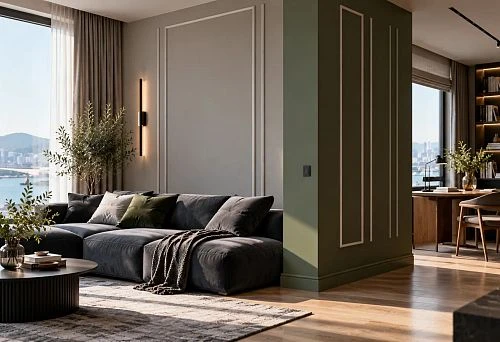
Wardrobe with molding frames + molding frames on the walls. The same molding profile — on the furniture and on the walls. The furniture becomes an "extension" of the wall architecture. The wardrobe ceases to be "furniture standing against the wall" and becomes "part of the wall."
Dresser with decorative overlay + stucco decor on the mirror above it. The overlay on the dresser and the overlay above the mirror are of the same motif (or related). The entire "vanity area" acquires a unified decorative context.
Walk-in closet with moldings + ceiling stucco in the bedroom. A cornice around the perimeter of the bedroom ceiling made of the same molding profile as on the closet doors. The bedroom reads as a "designed space," not a "room with furniture."
Buy ceiling stucco molding и Moldings From one collection is the right strategy for creating a cohesive decor system.
Four purchasing formulas for furniture decor
The "Cabinet as Built-in Furniture" formula
Goal: turn a standard cabinet into "built-in" furniture with facade architecture.
What to buy:
-
Moldings made of polyurethane — thin profile 20–35 mm for door frames
-
Decorative stucco — small overlay in the center of each door (if necessary)
-
Solvent-free acrylic glue
-
Matte paint in the color of the facade
Calculation: for a cabinet with 4 doors 60×200 cm — about 32 linear meters of molding + 4 center overlays.
The "Dresser as a Designer Accent" formula
Goal: turn an ordinary chest of drawers (or an old one, for repainting) into an "author's" item with character.
What to buy:
-
Relief Decoration — small overlays 8–15 cm for the center of each drawer
-
Paired decorative elements L/R for symmetry (if necessary)
-
Thin molding 12–20 mm for drawer frames
-
Glue, primer, matte paint
Calculation: for a chest with 5 drawers — 5 central overlays + about 15 linear meters of molding.
Formula "Kitchen sideboard with character"
Goal: highlight the sideboard or display area of the kitchen with decor while maintaining practicality.
What to buy:
-
Moldings made of polyurethane for frames on facades (profile 25–40 mm)
-
Decorative stucco — a calm ornamental motif
-
Moisture-resistant glue
-
Durable paint with a good washable surface
"Room in One Style" formula
Goal: create a cohesive decorative system "furniture + walls + ceiling".
What to buy:
-
Moldings (moldings) for furniture facades
-
Moldings on the walls — the same profile
-
Ceiling molding — cornice and rosette
-
Relief Decoration for accents (near the mirror, near the bed, near the fireplace)
Single order — single style — interior as a system.
Practical tips for installing decor on furniture
A few important technical nuances that are often overlooked.
Surface preparation. Before installing molding or overlay, the surface must be degreased. Grease stains, silicone lubricants, wax — all of these sharply reduce adhesive adhesion. Wipe the surface with isopropyl alcohol or regular acetone in the installation area.
Marking. Apply pencil markings before installation: the central axis of the facade, horizontal and vertical lines of the frame. Molding with glue leaves no time for adjustment — it bonds in seconds under pressure.
Frame installation order. First, the two long sides (horizontals), then the two short sides (verticals). Joints are cut at 45° strictly according to the markings.
Joint filling. After installation, all cut joints are filled with a thin layer of acrylic-based putty (or acrylic sealant). After drying — sanding with fine-grit sandpaper. After painting, the joints become invisible.
Painting. The first layer is a primer coat (same color, thinner consistency). After drying — two thin finish coats. Use a roller with a fine nap for even coverage without drips.
FAQ: Answers to Key Questions
Can stucco be used on furniture?
Yes, and it is one of the most effective ways to update furniture without replacement. molding, polyurethane moldings and decorative overlays can be mounted on MDF, wood, laminated chipboard (with surface preparation), and a number of other substrates.
What is better to buy for a cabinet: moldings or decorative stucco?
It's best to start with of polyurethane moldings — they create the frame and architecture of the facade. Decorative stucco added as an accent within the frame.
Is stucco decor suitable for kitchen facades?
For decorative kitchen areas — buffet, island, tall cabinet, display doors — yes. In the sink and cooktop area — no: the relief is difficult to keep clean during active use.
How to properly paint stucco on furniture?
Monochrome painting in the color of the facade is the best option. The relief is read through shadow, not contrasting color. This creates the effect of an "integrated detail" rather than a "glued-on decoration."
What to buy together with stucco for furniture?
Moldings, Decorative Inserts, solvent-free acrylic glue, primer, and matte paint in the color of the facade.
How much molding is needed for one cabinet?
For a cabinet with four doors 60×200 cm: perimeter of one door = (0.6 + 2.0) × 2 = 5.2 linear meters. For four doors = 20.8 linear meters + 20% reserve = about 25 linear meters of molding.
About the company STAVROS
The entire range for furniture decor — Moldings made of polyurethane, Decorative stucco, Relief Decoration, Ceiling molding, Wall Decor — is presented in the unified catalog of STAVROS company.
STAVROS produces products from extruded and cast polyurethane with precise relief reproduction, minimal weight, and full readiness for any painting without special surface preparation. This means that STAVROS decor works equally well on walls and ceilings as on furniture facades — creating a unified architectural interior system.
Buy molding choosing furniture from STAVROS means selecting products that turn a serial facade into an architectural one. Without new furniture, without renovation, without a designer — only a correctly assembled cart and one day of installation.