Article Contents:
- Short answer: NPU-491 is worth buying only as a small semantic accent, not as a mandatory "SPA symbol"
- NPU-491 "Lotus": confirmed characteristics and scope of the task
- NPU-491: what is confirmed and which characteristics are really important for this task
- The front dimension of 105 × 94 mm makes NPU-491 a small accent
- The 17 mm relief needs to be seen in volume
- What no longer needs to be re-examined: material moisture and furniture scenario do not answer the question of the lotus's appropriateness
- When the lotus starts to "explain the concept"
- The main surface for NPU-491 is a calm, smooth insert next to the slats, not the deep slatted relief
- Where to look for such an insert in an already finished SPA
- If there is no smooth area at all
- Check not in your hands, but on the wall
- Side lighting
- Near the shower or bathtub
- White lotus against a wood background: why strong contrast is not suitable for every SPA zone
- In the color of a smooth wall
- In the color of the slats
- Metallic, gold, bronze
- Direct contact with water and high humidity are not the same thing
- Installation on a smooth insert: why you need to confirm the substrate first, and then buy the adhesive
- Natural wood and "wet SPA": don't mix the choice of NPU-491 with the choice of slat wall material
- One NPU-491 as a sign — why repeating several lotuses should not be the first solution
- Scenario 4. Very strict minimalism
- Mistake 10. Creating a smooth substrate just for a small lotus
- Decision-making table: buy NPU-491 or leave the wall without a lotus
- Decision tree
- Moving to another location if
- How to choose
- If the SPA has several identical rooms, first approve one node
- Cost of the series
- Can NPU-491 be placed on the SPA ceiling instead of the wall?
- Is NPU-491 suitable for a small home SPA area in the bathroom?
- Can the NPU-491 be placed next to a round mirror?
- What to do if the SPA already has a lotus-shaped logo?
- Can the NPU-491 be used on a door in a SPA?
- Does the NPU-491 need to be placed strictly in the center of the smooth insert?
- Can the NPU-491 be rotated 90 degrees?
- How to tell if the lotus is too small for the wall?
- Can a round smooth backing be made for the NPU-491?
- Can the NPU-491 be placed directly between two vertical slats?
- Should separate lighting be installed for the NPU-491?
- Can the NPU-491 be painted black?
- Can one NPU-491 be used in a commercial spa or salon?
- Do I need to buy a spare NPU-491?
- Can NPU-491 be combined with natural stone?
- What to do if the white NPU-491 is appealing but stands out too sharply against wooden slats?
- Can NPU-491 be placed in a niche with scented candles?
- If the interior gets boring after a year, can NPU-491 be removed without a trace?
- How does the SPA scenario for NPU-491 differ from choosing NPU-491 or NPU-496 for furniture?
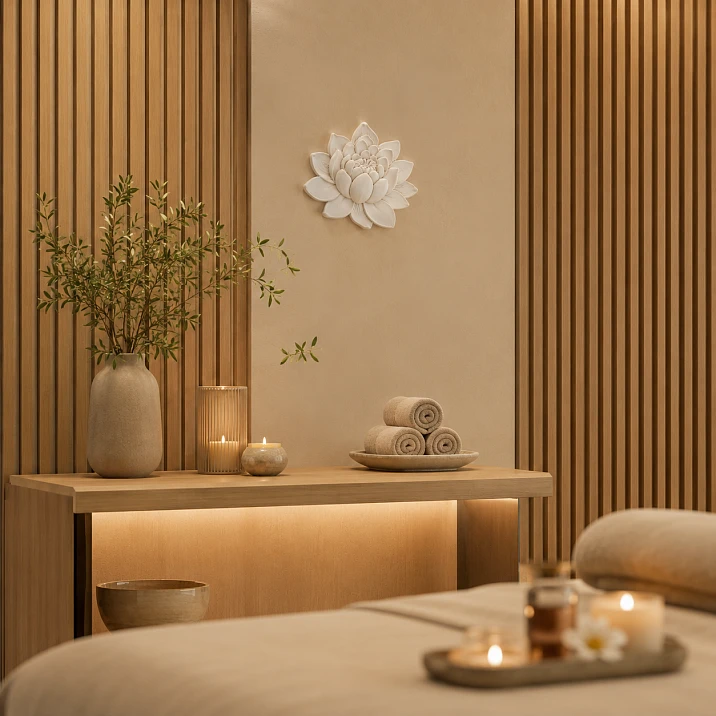
Short answer: NPU-491 is worth buying only as a small semantic accent, not as a mandatory "SPA symbol"
A spa area can already look complete without a single flower on the wall. If vertical slats, stone, lighting, and a calm palette create the desired feeling on their own, adding a lotus just because it is associated with water and relaxation is not necessary.
NPU-491 makes sense in another situation: the interior turned out too architectural — many straight lines, repeating verticals, and smooth neutral surfaces — and it really lacks one soft natural motif. Then a small carved decorative overlay can become a point that softens the rhythm without changing the entire style of the room.
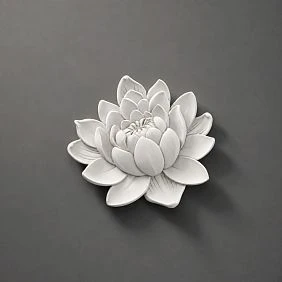
For the article, we fix a specific product: decorative overlay NPU-491 made of polyurethane, shaped like a stylized lotus flower. The current STAVROS card indicates dimensions of 105 × 94 × 17 mm, polyurethane material, and a price of 1,370 ₽ per piece. In the extended description, the manufacturer specifically associates this motif with bathrooms and SPA areas and allows the use of polyurethane decor in rooms with high humidity.
But the product card cannot answer the main question of a specific interior:
won't one recognizable lotus turn a modern SPA area with wooden slats into too literal a themed decoration?
Before purchasing, you need to check not "is polyurethane suitable for SPA in general," but five things:
-
Is there a calm, smooth surface near the slats where the lotus shape can be read in full.
-
Does the small frontal dimension of 105 × 94 mm get lost on the chosen wall.
-
Does the 17 mm relief become too active under side lighting next to the shadows from the slats.
-
Does the interior already repeat several natural symbols — leaves, bamboo, stones, ornaments, flowers.
-
Does the version with one NPU-491 look better than the same wall without it.
If all five answers are positive, the purchase for 1,370 ₽ makes clear sense. If the motif seems added "for atmosphere" and without it the interior looks calmer, the correct order is 0 pieces for this area.
After such a fitting, you can buy stucco decor NPU-491 "Lotus" already as a proven accent, rather than as a symbol that is trying to be fit into a finished interior retroactively.




NPU-491 "Lotus": confirmed characteristics and scope of the task
Our factory also produces:

NPU-491: what is confirmed and which characteristics are truly important for this task
NPU-491 has several confirmed characteristics that directly affect the solution.
| Parameter | Value |
|---|---|
| Article number | NPU-491 |
| Product type | Decorative polyurethane overlay |
| Motif | stylized lotus flower |
| Size A × B × C | 105 × 94 × 17 mm |
| Material | Polyurethane |
| Price | 1,370 RUB per 1 piece |
| Drawing | is on the card |
| 3D model | is on the card |
| SPA scenario | mentioned in the manufacturer's extended description |
For the new article, it is not so much the advertising advantages of the material that matter, but three geometric characteristics.
Get Consultation
The frontal dimension of 105 × 94 mm makes the NPU-491 a small accent.
The NPU-491 should not be perceived as a central panel for a large wall. Visually, it is a local floral sign.
That is why it has two opposite risk zones:
-
on a small smooth insert, it can look convincing;
-
on a large tall wall without other supports, it can get lost.
In this article, we will not artificially assign A as "width" and B as "height" if the drawing is not cross-checked for a specific composition. For a mockup, it is enough to reproduce the frontal dimension of 105 × 94 mm in accordance with the actual orientation of the product image or drawing. This eliminates the error when calculations are based on the order of numbers rather than the actual shape.
The 17 mm relief needs to be seen in volume.
In the existing STAVROS article, where the NPU-491 is compared with the NPU-496, 17 mm is directly considered as the depth of the relief. Therefore, this value is especially interesting for SPA with slats.
The slats already create chiaroscuro. The lotus adds another independent relief.
A flat printout shows the scale but does not show how strongly the flower will be visible in the evening under side lighting.
The price of 1,370 RUB is small relative to the repair, but that's not a reason to buy without checking.
The main risk here is not financial. Even an inexpensive decorative element can cheapen an expensive interior if the motif looks literal or random.
Therefore, the commercial question is not "is 1,370 RUB too much to spare," but:
does one NPU-491 add to the interior the precise natural note that was truly missing?
What no longer needs to be re-examined: the material's moisture content and the furniture scenario do not answer the question of the lotus's appropriateness
On STAVROS, there are already at least three closely related directions.
The first is a separate article on NPU-491 versus NPU-496 on furniture facades. There, NPU-491 is considered as a large lotus for a door, dresser, or cabinet, and the choice is built around furniture hierarchy and the number of floral elements.
The second is a large article on slatted panels for the bathroom and polyurethane decor. It already covers the wet environment, materials, installation, care, and general ways to combine slats with polyurethane decor.
The third is general material on polyurethane molding in the bathroom. It answers questions about material, painting, sealing, and use in a damp room.
For this task, a different focus is important:
-
not furniture;
-
not NPU-496;
-
not counting flowers;
-
not universal moisture resistance;
-
not general bathroom installation.
Its separate question:
is a recognizable lotus motif NPU-491 needed in an already finished SPA area with slatted walls, or will the interior be stronger without it?
Therefore, the material's moisture resistance should be considered as an initial constraint. The main choice revolves around style, scale, location, light, background, thematic overload, and checking before purchase.
Why the lotus is generally appropriate in a SPA — and why this obvious connection can ruin the interior
The NPU-491 motif itself was not chosen by chance. STAVROS directly describes the product as a stylized lotus flower and, in the extended block, suggests using it in a bathroom or SPA area due to the lotus's association with water.
This gives the product a clear semantic connection to the space.
But such a connection has a downside: the clearer the symbol, the easier it is to make it too literal.
When the lotus works as a natural accent.
It is usually perceived calmly if the interior already has:
-
wood or its visual equivalent;
-
stone;
-
neutral plaster;
-
soft warm light;
-
simple shapes;
-
a few plants;
-
free smooth surfaces.
Then NPU-491 does not explain to the visitor that it is a SPA. It only supports the existing natural theme.
When the lotus begins to "explain the concept"
The problem appears if, together with NPU-491, they add:
-
bamboo accessories;
-
stone pyramids;
-
oriental hieroglyphs;
-
golden Buddhas;
-
several floral ornaments;
-
turquoise backlighting;
-
images of water;
-
Aroma diffusers in a distinctly Asian style.
Each detail on its own can be appropriate. Together, they turn the interior into a set of obvious markers.
A high-level SPA more often wins not from the number of symbols, but from the precision of materials, light, silence, and proportions.
The "remove the room name" test.
A useful design test:
Imagine you don't know that this is a SPA.
Does NPU-491 look like a beautiful natural relief on its own?
If yes, the motif is self-sufficient enough.
If without the word "SPA" the lotus seems too thematic, it's better to abandon it.
Where and at what scale to place NPU-491 next to the slat wall.
The main surface for NPU-491 is a calm, smooth insert next to the slats, not a deep slatted relief.
The article topic starts with walls that are already finished with slats. This does not mean that NPU-491 needs to be glued directly onto the slats.
On the contrary, for a small flower this is often the worst background.
The slatted surface consists of:
-
protruding planks;
-
recesses;
-
repeating vertical shadows;
-
gaps;
-
sometimes a fabric or contrasting base.
NPU-491 has its own multi-petal relief. If you overlay one complex relief on another, the flower's shape may lose readability.
Why a smooth insert is stronger.
On a flat surface, the lotus receives:
-
a solid contour;
-
a calm background;
-
a clear shadow;
-
visual air;
-
independence from the batten spacing.
Then the eye first sees the flower, and only then the adjacent batten texture.
Where to look for such an insert in a ready-made SPA
This could be:
-
a smooth wall section between two batten fields;
-
area near the entrance;
-
a niche;
-
a wall near the waiting area;
-
smooth panel near the mirror;
-
area above the console;
-
side wall where the slats end.
It is not necessary to specially redo a finished wall.
First, see if there is already a natural quiet plane that lacks a small center.
If there is no smooth area at all
There is no need to forcefully make the lotus the main reason for renovation.
There are three options:
-
leave the slatted wall without NPU-491;
-
provide a small separate smooth backing if it itself looks architecturally justified;
-
move the lotus to another SPA surface.
The worst option is to glue NPU-491 over a deep slat rhythm just because the product is already purchased.
How to understand whether the 105 × 94 mm size will get lost on the chosen wall.
NPU-491 is small.
This is an advantage if a subtle accent is needed, and a limitation if it is being made the main panel.
Make a 1:1 template.
You need a paper or cardboard mockup of the actual frontal dimension of 105 × 94 mm.
It is better to print the silhouette of the product itself rather than use an empty rectangle. A flower visually occupies space differently than a solid geometric shape.
Check not in your hands, but on the wall
In the palm, 105 mm seems like a noticeable size.
On a wall 2.7–3 meters high, the same element can almost disappear.
Therefore, the template needs to be:
-
temporarily secured;
-
step back to the main viewpoint;
-
view in daylight;
-
view in the evening;
-
compare with a photo without the template.
Don't turn a small accent into the center of a huge wall.
If NPU-491 looks like an icon on the selected plane, the problem is not solved by a contrasting gold color.
Most likely, the wrong scale of the task was chosen.
Then it is better:
-
move the lotus to a more compact smooth area;
-
choose another, larger decor;
-
leave the large wall without a local flower.
The small size is especially useful near material transitions.
If the following meet nearby:
-
slats;
-
smooth plaster;
-
stone;
a small lotus can work as a point accent on one of the calm surfaces, without turning the entire transition into a decorative panel.
Relief, color, and light: why a small NPU-491 can become very noticeable
The 17 mm relief next to slats: light can make the small lotus much more noticeable.
The flat template only answers the question of scale. But the real NPU-491 has a pronounced relief.
17 mm by itself does not tell whether the decor will be "loud." Its visibility depends on light.
Frontal soft light.
With even lighting, the white or wall-toned NPU-491 can look very calm. The relief reads delicately, without deep shadows.
Side light
If light runs along the wall, the petals get shadows. The small element becomes more noticeable.
This is especially important next to a slat wall, because the slats themselves also create a long light-shadow pattern.
As a result, two textures can work simultaneously:
-
vertical from the slats;
-
radial/floral from the lotus.
If both are too contrasting, the interior becomes visually restless.
backlighting of the slatted wall.
If there is already LED backlighting behind or along the slats, NPU-491 does not need additional bright spot lighting by default.
First, check the regular lighting scenario.
Sometimes the side lighting itself casts enough shadow for the lotus to be readable.
Test in three modes.
Before purchasing, it's useful to look at the layout:
-
in daylight;
-
under the main evening lighting;
-
with decorative lighting of the slats.
If NPU-491 looks appropriate only in one rare mode, and in the other two it's too bright or completely lost, the spot isn't ideal.
Placement in the SPA: entrance, lounge area, mirror, and spots where the lotus is better not placed
Where NPU-491 is most appropriate in the SPA area.
Not the entire SPA area is equally suitable for the decorative overlay.
A calm wall section near the entrance.
This is one of the best scenarios.
A person sees the lotus upon entering, but it's not in the immediate water or service area.
The motif works as a sign of atmosphere, not as part of the wet finish.
Relaxation area.
If nearby:
-
an armchair;
-
lounger;
-
tea table;
-
towels;
-
calm lighting,
NPU-491 can support the natural character of the space.
Monochrome works especially well here.
Smooth niche.
A small niche provides a limited scale in which 105 × 94 mm no longer gets lost.
But we need to check if the center is occupied:
-
shelf;
-
with a lamp;
-
with aromatic accessories.
The wall next to the mirror.
The lotus can become a small decorative counterweight to the mirror.
But it doesn't need to be automatically placed symmetrically as a second element on the other side. One accent can be stronger than a pair.
Near the shower or bathtub
This is not automatically forbidden, but the location requires a more careful check of usage.
Need to consider:
-
direct splashes;
-
cleaning;
-
the chosen covering;
-
mounting base;
-
requirements for a specific zone.
The product card mentions polyurethane's moisture resistance, but that doesn't mean any place near water is equally suitable for decorative installation.
Where it's better not to place NPU-491.
There are zones where even a stylistically suitable lotus more often creates problems.
Directly on frequent deep slats.
The shape gets lost, the mounting base becomes complicated, and shadows become chaotic.
On a huge empty wall as the sole center.
105 × 94 mm may look too small.
Between several active objects.
For example:
-
mirror;
-
wall sconce;
-
a plaque;
-
shelf;
-
decor;
-
plant.
If NPU-491 becomes the sixth object, it does not create an accent, but increases noise.
In the area where it is constantly bumped.
The 17 mm relief must be taken into account near a passage, door, towels, cart, or other usage.
Where the flower has to be "explained."
If the designer has to constantly say, "this is a lotus because we have a SPA," the motif is not integrated naturally enough.
White lotus against a wood background: why strong contrast is not suitable for every SPA area
A white NPU-491 next to warm wooden slats can look beautiful in a catalog collage.
On a real site, the contrast can sometimes be too obvious.
White makes a small element visually larger and more graphic, especially on dark wood.
This may be appropriate if:
-
there is already white plumbing in the interior;
-
light towels;
-
white stone;
-
light plaster;
-
other white accents.
If the entire SPA is built in warm beige, wood, and gray tones, a pure white lotus may look out of place.
Then it is better to compare it with a paint option in the wall color or a close neutral shade.
Color NPU-491: four strategies that give completely different effects next to slats.
Choosing a color for a small lotus is more important than it may seem. The same relief 105 × 94 × 17 mm can be almost unnoticeable or become the loudest object on the wall.
In the color of the smooth wall
This is the basic and safest scenario.
If NPU-491 is painted in the same or very close shade as the smooth insert, the flower is read mainly through light and shadow.
Advantages:
-
the motif does not become literal;
-
the small overlay looks like part of the architecture;
-
next to the wooden slats, a calm hierarchy is maintained;
-
it is easier to avoid the feeling of a "decorative souvenir on the wall."
This option is especially good in a modern SPA, where the designer wants to add a natural form but not change the character of the room.
In the color of the slats
This is a more complex technique.
If the slats are of a warm wood tone, NPU-491 can be tinted visually close to them. But polyurethane remains a different material, and trying to "make it wood" at any cost is not necessary.
Color can connect surfaces, but texture and depth will differ.
On a light wall, a dark lotus in the color of the slats becomes a noticeable graphic sign. This can work if the interior is already built on contrast.
White on a dark background.
The most obvious option.
It shows the petals and contour well, but that is exactly why it turns the lotus into a symbol faster.
For a boutique SPA with a more decorative interior, this can be appropriate.
For a strict minimalist space, it is often too loud.
Metallic, gold, bronze
This method needs to be checked especially strictly.
A small NPU-491 in metallic can visually become much more active than its actual size.
If the room already has:
-
brass faucets;
-
bronze lamps;
-
metal profiles;
the color can be associated with them.
If a metal lotus is the only shiny decorative accent, it often looks added later.
How not to turn a spa into a themed restaurant: a test on the number of "speaking" symbols
This is one of the key blocks for the purchase decision.
The problem is not the lotus itself. The problem arises when the interior starts telling the same story in too much detail.
Let's imagine two compositions.
Option A: natural theme without literal decor.
Available:
-
wooden slats;
-
light stone;
-
soft lighting;
-
calm plaster;
-
one NPU-491 in wall color.
The lotus is only visible upon careful look. It adds a soft shape.
Option B: thematic set.
Available:
-
slats;
-
bamboo;
-
golden lotus;
-
image of Buddha;
-
pebbles;
-
character;
-
blue backlight;
-
artificial orchids.
Here NPU-491 becomes another word in an already too long phrase.
Test of five motifs.
Count not objects, but different symbolic themes.
For example:
-
water;
-
lotus;
-
bamboo;
-
eastern figurine;
-
stone pyramid.
If the interior already contains several literal symbols, the new flower does not add depth. It enhances stylization.
What counts as a "quiet" element.
Rails, stone, and plaster usually work as material and texture.
Lotus, hieroglyph, or shaped figurine — as a recognizable symbol.
The more characters, the higher the risk of a thematic effect.
Therefore, NPU-491 is strongest where there is a lot of material and few characters.
Wet environment and installation: what to check before permanently mounting NPU-491
Polyurethane and wet areas: what you need to know, and what you don't need to repeat from general articles.
The NPU-491 card directly indicates the material's moisture resistance and lists bathrooms, pools, and SPA areas among possible scenarios. STAVROS has also already covered polyurethane decor in wet rooms in detail in separate materials.
Therefore, in this article, it is enough to establish the practical boundary.
Room humidity by itself does not prohibit NPU-491.
This is confirmed by the manufacturer.
But "can be used in SPA" does not mean:
-
gluing onto a wet surface;
-
install without preparation;
-
ignore wall coverage;
-
consider any adhesive suitable;
-
place in direct water flow without checking the specific unit.
The base is more important than the overall material characteristics.
The overlay can be installed on:
-
a painted wall;
-
decorative plaster;
-
smooth moisture-resistant panel;
-
stone;
-
tile.
Each base requires a compatible installation technology.
Do not transfer recommendations from one surface to another.
Direct contact with water and high humidity are not the same thing
A wall in an SPA relaxation area may have high air humidity but receive almost no splashes.
An area near a shower may regularly get wet.
These two zones require different levels of caution.
If NPU-491 is chosen primarily for its atmosphere, it is often more logical to place it on a calm wall where the decorative motif is better visible and maintenance is easier.
Link to the general material instead of repeating 2000 words.
If a detailed breakdown of humidity, sealing, and care is needed, it is better to put it in a separate guide "Polyurethane stucco in the bathroom: moisture-resistant decor for restrooms".
Thus, the decision on NPU-491 is not mixed with the general technology of finishing a wet room.
Installation on a smooth insert: why you need to confirm the substrate first, and then buy the adhesive
The NPU-491 card in the related products block does include mounting adhesive. But this does not mean that the same compound automatically suits any SPA surface.
Correct sequence:
-
determine the material of the smooth insert;
-
check the condition of the coating;
-
confirm the compatibility of the mounting compound;
-
make the markings;
-
only after that proceed to permanent fastening.
If the surface is painted.
You need to understand how firmly the paint itself holds.
If the top layer is weak, the overlay may hold together with the paint, and the paint may peel off the wall.
If the surface is tile or stone.
The technology must be selected specifically for a smooth non-porous base.
Do not sand or scratch expensive cladding without a confirmed installation scheme.
If this is a separate furniture or wall panel.
Check whether it can be removed for maintenance.
NPU-491 should not overlap fasteners or hinder dismantling.
If you want to look at installation materials.
After confirming the base, you can open the section materials for installation and finishing and choose the composition for a specific task, rather than buying adhesive blindly along with the overlay.
How much free space is needed around the lotus: not a standard, but a way to check whether it looks like an "icon."
For NPU-491, it is impossible to honestly assign a universal offset:
-
50 mm;
-
100 mm;
-
150 mm.
The manufacturer does not set such requirements, and the composition depends on the scale of the smooth insert.
Therefore, it is more correct to assess the share of free space rather than look for a magic number.
What exactly to measure.
For a smooth zone, write down:
-
total width;
-
total height;
-
position of adjacent slats;
-
edge of the mirror;
-
a shelf;
-
a light fixture;
-
the rosette;
-
finishing seam.
After that, position the NPU-491 template so that there is an obvious calm zone around it.
Field too small.
If the flower almost touches:
-
edge of the panel;
-
end of the slats;
-
mirror frame.
-
shelves,
it begins to be perceived as a technically squeezed-in element.
In that case, it's better to:
-
choose another place;
-
refuse NPU-491;
-
change the smooth insert if the project is not yet completed.
The field is too large.
The opposite problem is a small lotus in the center of a huge wall.
It loses weight.
If to 'save' it, one has to:
-
make bright lighting;
-
paint with gold;
-
add a frame;
-
repeat the flower several times,
most likely, the scale of NPU-491 itself does not suit this plane.
Good field.
The optimal feeling occurs when the flower reads as a dot, not as a lost pictogram and not as an object squeezed by the edges.
This assessment is better done on a photo from the actual entry point to the SPA.
Entrance, lounge area, mirror, or wall near towels: four different roles of one NPU-491.
The same overlay can perform a completely different function depending on the location.
Near the entrance — a sign of character.
Here NPU-491 works as the first small message about the atmosphere.
It does not have to be large.
Advantages:
-
clearly visible;
-
does not compete with wet processes;
-
can be placed on a calm wall.
Cons:
-
if there is already an SPA logo nearby, the flower may compete with the brand sign.
In the relaxation area — a soft background.
This is the most natural scenario.
The lotus should not attract attention more than the furniture and light.
Better:
-
monochrome;
-
soft shadow;
-
calm smooth surface.
Near the mirror — a decorative balance.
Here you need to compare the shape of the mirror and the flower.
If the mirror:
-
round;
-
oval;
-
shaped,
NPU-491 adds another complex shape.
Sometimes it's beautiful.
Sometimes the wall becomes too "painted."
Near towels or storage — there is a risk of utilitarian proximity.
Shelves, hooks, stacks of towels, and baskets already create many small objects.
The lotus can get lost between them.
If the zone is constantly changing — towels appear and disappear — it's better to leave the decor on a more stable surface.
Materials and symbols: how to maintain a natural theme without decorative overload
Wood, stone, and NPU-491: why three materials can work more calmly than five symbols.
SPA is often built on natural associations.
A typical combination:
-
wood or a slatted panel imitating wood;
-
stone;
-
light plaster.
NPU-491 adds not a new large material, but a small relief.
This can be stronger than a literal set of "natural" accessories.
Tree + smooth mineral wall + lotus.
Good scheme.
Slats give verticality.
Smooth wall — a pause.
Lotus — a local soft form.
Stone + dark slats + white lotus.
More contrast.
Here we need to check if NPU-491 becomes too graphic.
Light slats + light wall + NPU-491 in tone.
Very calm option.
Relief is noticeable only by shadow.
Slats + marble with an active pattern + contrasting lotus.
The risk is higher.
Marble already has a complex pattern.
Slats provide rhythm.
The flower becomes the third active system.
Then a smooth area without molding can look more expensive.
Natural wood and "wet SPA": do not mix the choice of NPU-491 with the choice of slat wall material
If the walls are already finished with slats, a new article should not re-decide whether these slats are suitable for a specific wet area.
This is a separate task.
Why is it important to separate?
Because the user may have:
-
solid wood;
-
MDF;
-
DPC;
-
veneered panels;
-
another material.
Each system has its own limitations regarding humidity, finishing, and installation.
NPU-491 does not make an unsuitable slat panel suitable for wet conditions.
If panels are still being selected, you need to separately look at slatted panels for walls and check the material of the specific model.
If the walls are already finished, the task of this article begins after their technical approval: whether an additional lotus is needed against the background of existing slats.
Can NPU-491 be placed directly in the center of a slat field on a smooth substrate.
Sometimes the designer suggests a small medallion or a smooth area within a large slat field.
This can work if the area:
-
looks like part of the architecture;
-
has a clear form;
-
is quite noticeable;
-
does not seem like a random patch.
NPU-491 is then placed on it, not on the rails themselves.
When such a technique is appropriate.
If the slat wall is large and really needs a center.
For example, in the relaxation area there is a symmetrical composition:
-
two lamps;
-
a central smooth insert;
-
one lotus.
When inappropriate.
If a smooth substrate has to be created solely for the NPU-491 and without it, it makes no sense.
Then a small item starts dictating too much rework of the finished wall.
In such a situation, it is wiser to move the overlay to an existing smooth area.
One NPU-491 as a sign — why repeating several lotuses should not be the first solution
This article does not discuss purchasing 'one or five'.
The basic idea is one semantic accent.
Why is this important?
The lotus is a recognizable motif.
One flower:
-
is read as a sign;
-
remains delicate;
-
does not turn the wall into an ornamental system.
Several identical colors:
-
create a repetition;
-
enhance the thematic quality;
-
make the motif more noticeable from a distance.
This could be a separate design task, but should not become an automatic continuation of the purchase.
If one NPU-491 seems too small, first you need to ask:
maybe this wall actually needs a different scale of decor?
And not:
how many more lotuses should be added?
Five real SPA scenarios and additional visual checks
Five SPA scenarios where NPU-491 leads to different solutions.
The same product can be right in one interior and superfluous in another. It is more useful to analyze different initial conditions than to repeat "make a template" many times.
Scenario 1. A light SPA with oak slats and a smooth beige wall.
Initial Data:
-
warm oak;
-
calm beige plaster;
-
soft lighting;
-
minimal accessories.
Here, NPU-491 can be painted to match the wall color.
What will change:
-
a slight relief will appear;
-
the lotus will not be contrasting;
-
Vertical slats will remain the main material.
Likely solution: buy if the pattern doesn't get lost on the wall.
Scenario 2. Dark slats, black stone, brass.
The interior is already contrasting and expressive.
White NPU-491 might look too harsh.
In metallic — too dressy.
In wall color — calmer.
Here, it's not the size that matters, but the color.
Likely solution: buy only after a color mockup, otherwise leave without the flower.
Scenario 3. SPA with lots of plants.
Living plants already bring a natural theme literally.
Adding a lotus may be redundant.
Especially if nearby:
-
large leaves;
-
botanical images;
-
green tile.
Likely solution: more often 0 NPU-491, if the flower does not perform a separate architectural function.
Scenario 4. Very strict minimalism
Available:
-
light microcement;
-
thin slats;
-
built-in light;
-
hidden doors;
-
no classic stucco molding.
NPU-491 becomes the only carved object.
It can create an interesting contrast, but that is already a strong stylistic statement.
Likely solution: buy only if the designer deliberately introduces one soft biomorphic accent. If you want to “decorate a bit” — better without it.
Scenario 5. Neoclassical SPA.
Available:
-
moldings;
-
soft architecture;
-
calm stone;
-
slats as a modern accent.
NPU-491 has a ready stylistic context here.
A likely solution: the purchase is easier to justify because the lotus is not the only carved element.
But even here, you don't need to turn the wall into a floral arrangement.
How to evaluate the NPU-491 from a real viewpoint, not from arm's length.
Small decor is especially easy to overestimate when held close.
For a spa, it's useful to define three viewpoints.
Entry point.
From there, the visitor first sees the space.
If the NPU-491 completely disappears, it doesn't work as an accent of the entry composition.
Mistake 1: Buying the lotus only because the room is called a spa.
Why it happens: the symbol seems obvious and "correct".
Consequence: the interior gets a literal illustration of the room's function instead of independent architecture.
How to check: remove the word SPA from the project description and see if the lotus is appealing on its own.
How to avoid: buy the motif only if it works as a form, not as a caption for the room.
Mistake 2. Gluing NPU-491 directly onto deep slats.
Why it happens: the entire wall is already finished, and there is no free smooth area.
Consequence: the petals get lost on the vertical relief, creating complex gaps and chaotic shadows.
How to check: hold the template directly against the slats and take a photo from the side.
How to avoid: use a smooth insert or another wall.
Mistake 3. Considering 105 × 94 mm as a large central decor.
Why it happens: in the product card, the item is photographed close-up, making the scale hard to perceive.
Consequence: on a large wall, the flower looks like a small icon.
How to check: a full-size template on a real surface.
How to avoid: do not try to compensate for the small scale with gold, backlighting, or repetition.
Error 4. Ignoring the 17 mm relief.
Why it occurs: a flat image seems calm.
Consequence: with side lighting, the lotus becomes much more noticeable and starts competing with the shadows from the slats.
How to check: make a three-dimensional mockup or at least use 17 mm spacers.
How to avoid: evaluate evening light before installation.
Error 5. Leaving NPU-491 white just because it is shown that way in the catalog.
Why it occurs: white is perceived as "factory correct."
Consequence: a sharp contrast appears on the warm wood, which was not present in the project before.
How to check: compare the white and tinted paper mockup.
How to avoid: treat color as part of the design solution, not as an immutable characteristic.
Mistake 6. Making the golden lotus the main sign of "premiumness."
Why it occurs: metal is associated with expensive interiors.
Consequence: a small overlay turns into a decorative sign that can look cheaper than a calm monochrome.
How to check: look at the same mockup without the metallic finish.
How to avoid: use gold only if it is already systematically present in the hardware or lighting fixtures.
Mistake 7. Adding several NPU-491 if one "gets lost."
Why it occurs: it seems that the problem is in the quantity.
Consequence: instead of one weak accent, a series of lotuses appears, making the theme too literal.
How to check: compare one NPU-491 with a larger decor of a different type.
How to avoid: solve the scale problem with scale, not quantity.
Mistake 8. Placing it next to the logo without checking the hierarchy.
Why it happens: both elements seem small and "shouldn't interfere."
Consequence: the visitor doesn't understand what is main — the brand sign or the flower.
How to check: photograph the wall with both objects and look from the entrance.
How to avoid: separate them into different zones or remove the NPU-491.
Mistake 9. Treating material moisture resistance as permission for any wet area.
Why it happens: the word "moisture-resistant" is read too broadly.
Consequence: the base, adhesive, coating, and direct splashes are ignored.
How to check: determine the actual mode of the zone and the wall material.
How to avoid: use the manufacturer's recommendations on the material as a baseline characteristic, and check the installation joint separately.
Mistake 10. Creating a smooth substrate just for a small lotus
Why it occurs: the product is already selected, and the project starts being adjusted to fit it.
Consequence: a small overlay dictates too large a rework of the finished wall.
How to check: remove NPU-491 from the layout and ask whether the smooth insert is needed on its own.
How to avoid: if the substrate makes no sense without the flower, find another place or refuse the purchase.
When NPU-491 should not be purchased
This is not a formal anti-advertising block, but a full-fledged part of the selection process.
Do not buy NPU-491 for this SPA zone if at least one of the following conditions is met.
The interior is already finished without symbolic decor.
Slats, stone, and light provide the right atmosphere.
Adding a lotus does not solve the new task.
There is no calm, smooth surface.
You have to place the flower directly on active slats or create an artificial base just for it.
The 105 × 94 mm mockup is too small.
On the wall, the element gets lost, and disproportionate contrast is required for visibility.
The lotus is already repeated in other objects.
For example:
-
logo;
-
the tile pattern;
-
textile;
-
a light fixture;
-
accessories.
Then NPU-491 becomes another repeat.
The SPA is minimalist and built on clean lines.
If the entire interior deliberately avoids ornament, a single carved flower may look like a random stylistic concession.
There are already too many natural symbols in the zone.
Live plants, bamboo, stones, leaves, and images of water already set the theme.
The mounting base is not confirmed.
A beautiful mockup does not negate technical compatibility.
The overlay falls into an inconvenient operational zone.
If it is constantly bumped by towels, furniture, a hand, or cleaning equipment, the decorative effect does not justify the inconvenience.
You yourself are trying to "explain" why it is needed.
A strong detail is usually read without a long justification.
If the main argument sounds like 'the lotus is a SPA symbol', that is not enough.
From mockup to purchase: table, algorithm, and decision tree
Decision table: buy NPU-491 or leave the wall without the lotus
| Condition | What this means | Solution |
| There is a calm smooth insert next to the slats | the form reads separately from the vertical rhythm | continue checking |
| The only place is right on the deep rails | the outline and shadows blend together | More often 0 or another place |
| The 105 × 94 mm template is clearly visible from the main point | The scale fits | continue |
| The template gets lost on a large wall | selected decor is too small for the task | different scale or 0 |
| 17 mm relief gives a soft shadow | volume supports the composition | continue |
| side light makes the flower too active | two reliefs compete | change color/place or 0 |
| lotus in wall color looks calm | motif works through form | 1 × NPU-491 |
| white/gold version becomes the main object without such a purpose | contrast is too strong | monochrome or 0 |
| There is almost no symbolic decor in the interior | one lotus can be a precise accent | 1 with a good layout |
| There is already a lotus in the logo, textiles, or decor | the motif repeats | more often 0 |
| A smooth backing is needed even without NPU-491 | the architectural basis is justified | can be used |
| The substrate has to be created only for the overlay | The product dictates excessive rework | Move or 0 |
| Mounting surface and composition confirmed | Technical risk is manageable | Can be ordered |
| Base/adhesive not confirmed | Aesthetic solution not yet ready for installation | First check the technology |
The table does not replace the layout. It helps not to lose any of the reasons why small decor can be either very precise or completely unnecessary.
Practical algorithm: how to check NPU-491 before purchase.
Step 1. Record the actual product.
We check exactly:
NPU-491 — 105 × 94 × 17 mm — polyurethane — 1,370 ₽.
Do not replace it with NPU-496 during the process and do not turn the task into a size comparison.
Step 2. Choose up to three candidate zones.
For example:
-
smooth wall section at the entrance;
-
wall in the relaxation area;
-
small niche.
Do not spread mockups across the entire SPA at once.
First, find the best spot for a single accent.
Step 3. Exclude technically inconvenient spots.
Remove from the list areas:
-
with direct intense wetting, if the mounting point is not confirmed;
-
with service access;
-
with constant touching;
-
on a deep slat relief without a smooth base.
Step 4. Make a template 105 × 94 mm.
Check orientation against the actual image or product drawing, not just the A × B × C order.
It is better to print out the lotus silhouette.
Step 5. Photograph each candidate area without decor.
This is a control version.
Without it, it's easy to forget how strong the original smooth wall was.
Step 6. Secure the template.
Use a reversible safe method compatible with the surface.
Do not damage the finish for the sake of the test.
Step 7. Evaluate three viewing distances.
-
entrance;
-
main resting area;
-
close passage.
Note where the lotus should be noticeable and where it can blend in.
Step 8. Add 17 mm of depth.
The flat layout needs to be supplemented with a volumetric check.
This is especially important with side lighting.
Step 9. Turn on all lighting scenarios.
Daytime, evening, and decorative backlighting.
Step 10. Check the color.
Minimum:
-
in the color of the wall;
-
white;
-
the option in the color of the slats, if this was planned at all.
Add metallic only as a separate third test, not as a base.
Step 11. Count the existing symbolic motifs.
Are there:
-
flowers;
-
leaves;
-
bamboo;
-
eastern signs;
-
pebbles;
-
images of water;
-
thematic logo.
If the list is long, NPU-491 may be redundant.
Step 12. Compare the two final photos.
With NPU-491 and without it.
Do not compare "richer/poorer".
Compare:
-
calmer/noisier;
-
more cohesive/more random;
-
more architectural/more thematic;
-
whether the materials read better.
Step 13. Confirm the base and installation.
Only after the visual decision.
Step 14. Decide on the purchase.
If the lotus truly adds the missing soft natural form — buy it.
If it merely signals 'this is a SPA' — do not buy.
Decision tree
Do you specifically like the shape of NPU-491, not just the idea of a flower?
No → choose another decor or 0.
Yes → continue.
Is there a calm, smooth surface next to the slats?
No → another location or 0.
Yes → continue.
Does the frontal template 105 × 94 mm not get lost or look random?
No → another scale.
Yes → continue.
Does the 17 mm relief look calm under real light?
No → change light/color/place or 0.
Yes → continue.
Does the lotus not duplicate existing natural symbols?
No → more often 0.
Yes → continue.
Does the version with the flower look better than the one without it?
No → 0.
Yes → continue.
Is the mounting surface confirmed?
No → technology first.
Yes → you can buy NPU-491.
Alternatives if NPU-491 is not suitable
Rejecting a specific lotus does not mean the SPA cannot be refined.
Leave only the slats and light.
This is the best option if the interior is already self-sufficient.
Add a smooth solid panel without ornament.
If there is not enough pause between the slat fields, the problem can be solved with architecture, not with a symbol.
Choose a larger decorative element.
If NPU-491 gets lost on the wall, a different scale is needed, not a series of small flowers.
In the section polyurethane decorative overlays You can compare other models.
Use the plant as the only soft natural form.
A living object sometimes solves the same problem better.
Work with color, not relief.
A calm painted wall section can soften the slats without additional decor.
Move NPU-491 to furniture or another room.
If you like the product itself, but the SPA is too thematic for it, you don't need to force it to work here.
Purchase and scaling: what to actually add to NPU-491
What to buy together with NPU-491 and what not to add automatically.
If the check showed that one lotus is really needed, the base specification remains short:
1 × NPU-491 105 × 94 × 17 mm — 1,370 ₽.
Additional items appear only from a specific task.
Mounting compound — after checking the base.
The product card and STAVROS catalog have mounting materials, but they cannot be selected only by the name NPU-491.
First, you need to know:
-
is it plaster or paint;
-
tile;
-
stone;
-
smooth panel;
-
other base.
After that, you can open the section materials for installation and finishing and select a compatible system.
Other overlays are not a mandatory "kit".
Do not add automatically:
-
NPU-496;
-
second NPU-491;
-
floral corners;
-
sockets;
-
molding frame.
If one lotus looks lonely, first check the scale and location.
Additional decor should not mask the mistake of the first purchase.
Slat panels — only if the wall is not yet finished.
If the SPA is already finished, the panel category is needed more as an adjacent commercial branch for other areas.
If the project is still being assembled, you can buy wall slat panels separately and in advance design a smooth zone for small decor.
A general catalog of polyurethane molding is needed if the idea itself changes.
If NPU-491 is too small, too thematic, or does not fit the shape, it is more useful to go to polyurethane molding catalog and choose a different type of solution.
This is more correct than buying a lotus and then trying to make it work through color and lighting.
How to integrate NPU-491 into finished architecture without cheapening the interior
How should NPU-491 interact with the existing SPA architecture?
A small overlay should not rearrange the entire interior.
Its role is to fit into an already familiar system.
If the slats are the main accent.
NPU-491 should be quieter.
Better:
-
in the color of the wall;
-
without separate backlighting;
-
on a small smooth section.
If the slats are very calm.
For example, light, with a large sparse pitch and no contrasting base.
The lotus can be slightly more noticeable.
Consider:
-
soft contrast;
-
warm neutral color;
-
local side light.
If the stone is already the main material.
NPU-491 should support not the stone pattern, but the overall composition.
There is no need to place the flower directly on an active vein or in the center of the marble pattern.
If there are moldings.
The lotus gets a more natural decorative context.
But even then, it is not necessary to frame it.
If the interior is completely modern.
One carved flower can be used as a deliberate contrast.
The key word is deliberate.
If it appeared only because the wall was 'missing something,' that's a weak basis.
How to check that NPU-491 doesn't look like a cheap thematic detail.
The word 'cheap' is subjective, but there are several quite verifiable signs.
The decor should not be the sole carrier of the idea.
If the SPA still looks like a SPA without NPU-491, that's good.
If only the lotus creates the desired association, the problem is in the architecture, not in a lack of decor.
Color should not shout louder than form.
If the first thing you see is bright gold or a pure white spot, the relief itself becomes secondary.
The place should look pre-selected.
NPU-491 on the central axis of the smooth insert looks intentional.
A flower glued between the rail, the switch, and the edge of the mirror is accidental.
One motif should have enough breathing room.
The overlay should not be surrounded by a dozen small accessories.
The installation must be clean.
Any misalignment, visible glue, uneven paint, or sloppy seam instantly cheapens small decor because it is close to the eyes.
Commercial takeaway: what exactly the buyer should understand before adding to cart.
After the article, the buyer should have not a general feeling of "the lotus is beautiful," but a specific answer.
We buy NPU-491 if.
-
need one small natural accent;
-
the lotus shape really fits the concept;
-
there is a smooth spot near the rails;
-
the 105 × 94 mm template is not lost;
-
the 17 mm relief looks calm in real light;
-
the color is consistent;
-
the interior is not overloaded with other symbols;
-
the mounting base is confirmed.
We don't buy if.
-
the lotus is needed only because 'it's a SPA';
-
there is no smooth zone;
-
on rails the shape is lost;
-
the flower is too small for the wall;
-
it has to be made bright so it is noticeable;
-
there is already a lot of natural or oriental decor around;
-
without NPU-491 the interior looks cleaner.
We move it to another place if
-
the product itself is liked;
-
the SPA zone is too active;
-
there is a suitable smooth surface in another room or on furniture.
That is why this article has a normal commercial result even when the answer is "don't buy." It helps not only to add a product to the cart, but also to avoid buying an unsuitable motif for an expensive finished interior.
If all checks are passed, the logical next step is — buy stucco decor NPU-491 "Lotus".
Three mockups that provide more value than ten decoration options.
Before the final decision, it is enough to compare three versions of the same wall.
Mockup A — without NPU-491.
This is the control.
It is needed not for formality, but to not lose the original strength of the interior.
Take a photo:
-
a smooth insert;
-
slats;
-
stone;
-
light;
-
adjacent objects.
Mockup B — NPU-491 in the wall color.
This is a test of the form itself.
If this option already improves the composition, an additional color is not needed.
Layout C — contrasting NPU-491.
Use only the contrast that is actually being considered:
-
white;
-
slat color;
-
Metallic.
This layout shows whether the lotus needs additional graphic quality.
How to choose
If A is stronger than B and C — do not buy.
If B is stronger than A, and C is already too active — buy and do a calm finish.
If C is truly better and supports existing accents — the contrast may be justified.
If both B and C look weak, the problem is not in color, but in scale or the motif itself.
If the SPA has several identical rooms, first approve one node
In a commercial project, there may be:
-
several massage rooms;
-
private SPA rooms;
-
identical rest areas;
-
repeating entrances.
Then one NPU-491 easily turns into a series.
No need to order the quantity based on the number of rooms before checking.
First, select one typical unit:
-
specific smooth zone;
-
the exact position;
-
color;
-
light;
-
installation technology.
After that, evaluate not only one room, but the repetition of the entire series.
Why the series changes perception.
One lotus is a delicate sign.
Ten identical lotuses on an object is already a signature decorative theme.
If this was not the goal, repetition may turn out to be too literal.
Series cost
At the current price of 1,370 RUB, the cost of the overlays themselves is:
| Quantity NPU-491 | Cost |
| 1 | 1 370 ₽ |
| 2 | 2 740 ₽ |
| 4 | 5 480 ₽ |
| 6 | 8 220 ₽ |
| 10 | 13 700 ₽ |
This table does not suggest buying ten pieces. It shows why even an inexpensive single item in a commercial object should first be checked as a repeatable motif.
If the design implies one lotus only at the entrance, the quantity should not automatically grow with the number of rooms.
Final recommendation
NPU-491 is a small decorative polyurethane overlay in the shape of a stylized lotus. Its confirmed size is 105 × 94 × 17 mm, and the current price is 1,370 RUB.
For a SPA with already finished slat walls, the best scenario is not an attempt to glue a flower directly onto the vertical relief, but a single local accent on a calm smooth surface nearby.
The purchase is justified when NPU-491:
-
softens the architectural vertical;
-
does not turn the interior into a thematic decoration;
-
works in color;
-
reads at the right scale;
-
does not require additional flowers, frames, or symbols to explain its role.
If after a full-size fitting and light test the version without the lotus looks calmer, stronger, and more expensive, you should not consider the wall "under-decorated."
For a good SPA, the absence of excess decor is as much a full-fledged design decision as purchasing one precise element.
Before the final order, it is useful to leave a reversible mock-up in the chosen spot for at least a few regular lighting cycles — to look at it in the morning, in the evening, and after the first novelty effect wears off. If the lotus continues to be perceived as a natural part of the wall, rather than as a new object that the eye keeps noticing separately, the decision is sustainable. For small symbolic decor, this is a particularly valuable test: the initial "I like it" does not yet equal long-term appropriateness.
FAQ
Can NPU-491 be placed on the SPA ceiling instead of the wall?
The product card allows decorative applications, and the extended description shows different scenarios, including ceiling compositions. But for this article, the ceiling is a separate task. There, the viewpoint, lighting, and installation change. If the lotus is needed specifically on the ceiling, it is better to design it as an independent node rather than automatically transferring the wall scheme.
Is the NPU-491 suitable for a small home SPA area in a bathroom?
Yes, if there is a calm, smooth surface and the scale of 105 × 94 mm looks appropriate. In a small space, a single lotus can stand out more noticeably than in a large SPA. But if the bathroom is already saturated with patterned tiles, a mirror, lighting, and accessories, an additional flower can easily become superfluous.
Can the NPU-491 be placed next to a round mirror?
It can, but you need to check the competition of forms. A round mirror already creates a soft center, and the multi-petal lotus adds a second one. Sometimes they balance each other well, especially with asymmetric placement. If both objects are close in visual weight, the wall may lose clear hierarchy.
What to do if the SPA already has a lotus-shaped logo?
In most cases, there is no need to repeat the same symbol again just for the sake of connection. The logo already fulfills the function of a recognizable sign. The NPU-491 makes sense only on a different surface and with a different task—for example, as a very quiet monochrome relief. If the repetition looks literal, it is better to avoid it.
Can the NPU-491 be used on a door in a SPA?
The card classifies the product as a decorative overlay and allows various interior applications, but for a door, you need to separately check the opening, handle, contact with the frame, and the base. If the door is constantly used with wet hands or towels, the location may be less convenient than a calm wall insert.
Does the NPU-491 need to be placed strictly in the center of a smooth insert?
No. The geometric center is a starting point, not a mandatory rule. A niche, mirror, lamp, or furniture can form a different visual axis. The offset should look intentional. If its only reason is that "there was space left," it's better to compare another section of the wall.
Can the NPU-491 be rotated 90 degrees?
Before a non-standard rotation, you need to compare the actual image and the drawing. The NPU-491 has a stylized floral shape, so a slight rotation may be less noticeable than with a strict horizontal ornament, but the orientation cannot be considered neutral without a visual check. The mockup must replicate exactly the chosen position.
How to understand that the lotus is too small for the wall?
The sign is not in a specific number of square meters. If from the main viewing point the 105 × 94 mm pattern disappears, and to make it noticeable you have to make it contrasting, illuminate it separately, or repeat it several times, most likely the product does not match the scale of that surface.
Can a round smooth backing be made for the NPU-491?
Such a design can be considered, but then the backing becomes a second independent decorative object. You need to check whether the composition looks like an emblem or a plaque. If the smooth circle is needed only to "save" the lotus on a slatted wall, it's easier to choose another area or abandon the overlay.
Can the NPU-491 be placed directly between two vertical slats?
Only if there is a real solid smooth field of sufficient size between them and the installation does not have to be done on heterogeneous edges. A narrow gap between slats does not automatically become a suitable niche. The flower needs a solid background on which the petals are readable without visual fragmentation.
Is it worth making separate lighting for the NPU-491?
Not automatically. First check the regular lighting and the backlighting of the slat wall. The 17 mm relief already creates a shadow. A separate spot can make a small lotus too theatrical and turn it into the main symbol of the room. Backlighting is justified only if exactly this hierarchy is needed for the project.
Can NPU-491 be painted black?
Yes, as a design idea, if the chosen painting system is compatible with the product. But a black lotus on a light wall becomes very graphic. For a calm SPA zone, you need to check whether it looks like a pictogram or a sign. Monochrome in the color of the wall usually gives a softer effect.
Can one NPU-491 be used in a commercial SPA or salon?
Yes, the product scenario does not change: first, the location, scale, humidity regime, base, and style are checked. In a commercial facility, cleaning, intensity of use, and maintaining the brand concept are additionally important. If the lotus conflicts with the salon's branding, decorative appropriateness is more important than the SPA association.
Do I need to buy a spare NPU-491?
For a single local accent, there is no mandatory percentage of spare. A spare may be reasonable if the project is serial, uses complex custom painting, or replacement in the future is critical in terms of timing. For a regular home SPA zone, it is enough to first buy the actually needed quantity after approving the layout.
Can NPU-491 be combined with natural stone?
Yes, but not every stone surface should become a mounting base. Stylistically, a soft floral relief can contrast well with stone. Technically, the method of attachment to the specific cladding needs to be separately confirmed. If the stone has active veining, it is often better to place NPU-491 on an adjacent plain wall.
What to do if the white NPU-491 is liked but stands out too sharply on wooden slats?
Don't rush to discard the piece. First, move it from the slats to a smooth insert and compare the color against the wall tone. If the issue was only contrast, the composition will become calmer. If the motif itself still seems too literal, it's better to skip it for this area.
Can the NPU-491 be placed in a niche with aromatic candles?
Yes, if the niche is spacious enough, the base material and operating conditions are suitable, and the decor is not in the heat exposure zone. Don't invent safe distances from candles without requirements for the specific product and equipment. If open flames are used, fire safety takes priority over composition.
If the interior gets boring after a year, can the NPU-491 be removed without a trace?
Trace-free removal cannot be guaranteed. The result depends on the adhesive, wall covering, and surface preparation. If a design change is likely, this should be considered when choosing the installation technology. For expensive plaster, stone, or factory panels, it's better to discuss reversibility with the installer in advance.
How does the NPU-491 SPA scenario differ from choosing NPU-491 or NPU-496 for furniture?
This isn't about deciding between a large or small flower on the facade, nor counting how many go on the doors. This task is about the appropriateness of a single recognizable lotus in an already finished SPA with slatted walls: background, symbolism, smooth area, lighting, color, and the decision to buy or leave the interior without a floral motif.