Article Contents:
- Why Wall and Ceiling Molding is in Demand Again
- Not Nostalgia, but a Conscious Choice
- What molding does to a space
- What Belongs to Wall Molding and What Belongs to Ceiling Molding
- Elements for the Wall
- Elements for the Ceiling
- Cornice — An Element Uniting Both Levels
- Materials: What to Choose for Ceilings and Walls
- Polyurethane — The Main Material of Modern Molding Decor
- Plaster: A Tradition with Limitations
- Polystyrene: A Compromise with Caveats
- Wood and MDF: For Wall Panels and Textured Moldings
- How to Combine Wall and Ceiling Moldings: Rules and Principles
- The Principle of a Unified Ornament
- The Principle of Level Activity: One Speaks, the Other Supports
- Cornice as a 'Bridge' Between Levels
- The Principle of Proportionality
- Popular Compositions: Wall and Ceiling in a Unified System
- Composition 1: Cornice + Rosette + Calm Walls
- Composition 2: Cornice + wall frames from moldings
- Composition 3: Coffered ceiling + moldings and panels on walls
- Composition 4: Fireplace wall + ceiling decor
- Composition 5: Symmetrical living room with full decor
- In which styles does wall and ceiling molding work best
- Classic: the language of architectural luxury
- Neoclassical: structure without excess
- Modern classicism
- Minimalism with architectural accents
- Calm modern interior
- Where in an apartment or house does such decor look best
- Living room: the central arena
- Bedroom: delicate balance
- Hallway: the first architectural impression
- Study: decor as an attribute of professional seriousness
- Dining room and formal spaces
- How to select scale and pattern for a room
- Ceiling height selection table
- For small rooms
- For high ceilings
- For light, calm interiors
- What to choose for different tasks
- Delicate decor in a modern interior
- Accent ceiling in a classic spirit
- Expressive accent wall
- Prestigious classic interior
- Budget-friendly update
- Common mistakes when decorating walls and ceilings with molding
- Mistake 1: Two equally active levels
- Mistake 2: Disproportionate elements
- Mistake 3: Overloading with small ornamentation
- Mistake 4: Incorrect material choice
- Mistake 5: Mixing incompatible styles
- Error 6: Lack of compositional center
- Error 7: Ignoring lighting
- Conclusion: algorithm for selecting molding for walls and ceiling
- FAQ: answers to popular questions about wall and ceiling molding
- About the Company STAVROS
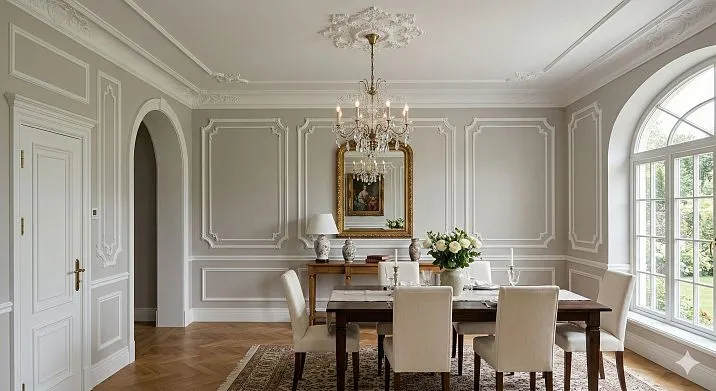
Look up. Now look at the wall. And now — back at the ceiling. You've just done what every person unconsciously does upon entering an unfamiliar room: you assess the space in two dimensions at once — vertical and horizontal. And if both surfaces work in harmony, the interior is perceived as a unified, complete whole. If not — something feels unsettling, though the reason is hard to articulate.
This is where the main principle of working with decorative molding on walls and ceilings lies: both levels must speak the same architectural language. This language is a system of elements, proportions, rhythms, and materials. How to master it — we'll explain in detail and honestly.


Why wall and ceiling molding is in demand again




Not nostalgia, but a conscious choice
Over the past ten years, the attitude toward molded decor has fundamentally changed. From an attribute of 'expensive renovation with historical pretensions,' it has transformed into a tool of design thinking — precise, scalable, and surprisingly flexible. Architects and interior designers today usepolyurethane moldings and moldingnot because it's 'classic,' but because it works: it gives walls and ceilings what cannot be achieved with paint or wallpaper — relief, rhythm, and architectural depth.
Wall and ceiling moldings today are a way to visually alter the proportions of a room, create accents without furniture, and define the character of a space before the first piece of furniture is brought in.
Our factory also produces:


What does stucco do to a space
A wall with moldings looks structured and deliberate—it ceases to be just a background. A ceiling with a cornice and a rosette gains a 'cap': the space becomes complete, rather than an upward-opening infinity. Together—the wall and ceiling with moldings—they create the effect of an architectural frame within which the interior unfolds.
That is why, when people speak of a harmonious interior, there is almost always a deliberate decorative system behind it—from the baseboard to the ceiling rosette.
Get Consultation
What belongs to wall moldings and what belongs to ceiling moldings
This is a fundamental distinction. Mixing wall and ceiling elements is not a mistake, but it must be done consciously.
Elements for the wall
Moldings—horizontal and vertical profiles that divide the wall into sections, frame niches and openings, and form frames. The foundation of any wall molding system.
Decorative frames—rectangular or square outlines made of moldings that break up the wall plane into panels. An English paneling technique that has become one of the most popular modern scenarios.
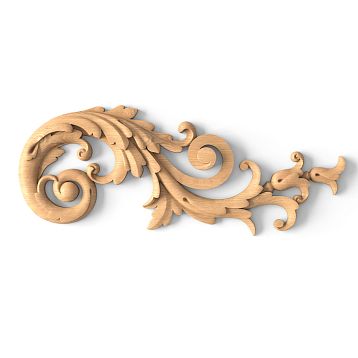
Appliqués and ornaments—individual three-dimensional elements: corner blocks at the intersections of moldings, central medallions within panels, frieze strips along horizontal moldings.
Pilasters and capitals—vertical architectural elements that imitate columns. Installed on the sides of fireplaces, doorways, TV zones. Visually raise the ceiling.
Wall panels (boiserie) are full-fledged architectural systems made of pilasters, moldings, and overlays, forming a complete wall cladding.
Ceiling elements
Cornices are profiles installed along the perimeter of the ceiling at the junction with the wall. This is the most important element that connects the wall and ceiling into a single system. The cornice 'closes' the space from above and simultaneously serves as a transition between the vertical and horizontal planes.
Ceiling stucco, cornices, and profilesSTAVROS offers over 100 models—from thin smooth profiles 3–4 cm high for minimalist interiors to massive ornamental cornices 12–18 cm for formal classical halls.
Ceiling rosettes are round or oval decorative elements installed in the center of the ceiling around a chandelier or as focal points. Diameter ranges from 15 to 90 cm. They draw the eye to the center of the ceiling, create a visual focus, and add solemnity to the ceiling.
Coffers are geometric frames that form a system of square or rectangular cells on the ceiling. A coffered ceiling is one of the most expressive architectural techniques. If desired, a rosette, ornamental insert, or lighting can be added to each cell.
Domes and friezes are more complex ceiling solutions. Dome inserts create the illusion of a vaulted ceiling, while friezes run as a horizontal strip along the perimeter.
Cornice is the element that unites both levels
A cornice is not purely a wall or ceiling element. It belongs to both. It is the cornice that serves as the architectural 'fastener' that stitches the wall and ceiling into a single system. If you are choosing stucco for walls and ceilings, you should start with the cornice: its profile, ornament, and size set the tone for the entire decorative system.
Materials: what to choose for ceilings and walls
Polyurethane — the main material of modern stucco decoration
Polyurethane molding STAVROS— the optimal choice for most modern projects, both for walls and ceilings. Arguments:
-
Light weight — a 2 m long ceiling cornice weighs 1–2 kg compared to 15–20 kg for a plaster counterpart. This is critical for ceilings;
-
Moisture resistance — does not react to humidity fluctuations, suitable for kitchens and bathrooms;
-
Precise relief — reproduces the detailing of the original plaster;
-
Easy installation — can be cut with a knife, attached with mounting adhesive;
-
Ready for painting — primed white surface accepts any paint without additional preparation.
This is why todayDecorative polyurethane moldinghas become an industrial standard for residential and commercial interiors worldwide.
Plaster: A Tradition with Limitations
Plaster molding possesses a unique density and weightiness that polyurethane only replicates visually. In restoration projects, in formal halls with ceilings of 4+ meters, and with an unlimited budget — it is the right choice. For ceilings, plaster requires reinforced fastening, a professional installer, and thorough surface preparation.
For walls, plaster is heavier to work with but justified where maximum authenticity is needed. The main limitations are weight, fragility, and sensitivity to moisture.
Polystyrene: A Compromise with Caveats
Polystyrene cornices and baseboards are sold in every hardware store and cost a minimum. For simply 'closing the joint between the wall and ceiling,' they are quite suitable. But calling polystyrene 'molding' is a strong exaggeration: the relief is unclear, the material is fragile, and paint adheres poorly. For an interior with architectural pretensions, polystyrene is not considered.
Wood and MDF: For Wall Panels and Moldings with Texture
STAVROS wooden moldingsSolid oak and beech are used in wall panels and furniture decor — where natural texture and the warmth of wood are important. MDF with white enamel — for wall panels to be painted in a classic style.
For ceilings, wood is used less frequently — in coffered systems with wooden beams and frames, giving the interior a library or rustic aesthetic.
How to Combine Molding on Walls and Ceilings: Rules and Principles
This is the most difficult and most important section. It is here that the entire interior concept is made or broken.
The principle of a unified ornament
First rule: the ornament of the ceiling decor and the wall decor must belong to the same stylistic group. Acanthus leaves on the cornice and geometric frames without ornament on the wall are a stylistic conflict. A smooth ceiling cornice and ornamental wall overlays are also a dissonance. A unified ornamental key: either both levels are decorative, or both are laconic.
The principle of level activity: one speaks, the other supports
This is the main principle of balance. In most well-designed interiors, there is one 'active' level (ceiling or wall) and one 'supporting' level. Two equally saturated levels create visual competition and a feeling of overload.
Two working scenarios:
Accent ceiling + calm walls: a cornice with relief, a central rosette, a coffered system — while the walls are designed delicately: one horizontal molding or simple frames without overlays.
Expressive wall panels + laconic ceiling: a full boiserie system on the walls — while the ceiling remains with a simple cornice and without additional elements.
Cornice as a 'bridge' between levels
A cornice is not just a profile at the junction. It is an architectural connection. Its height, shape, and ornamental solution must be coordinated with both the ceiling decor and the wall decor. A cornice with a pronounced ornament requires either corresponding wall overlays or a complete absence of wall decor — no 'competition' in the middle.
The principle of proportionality
The scale of elements on the ceiling and wall should correspond to each other. A massive coffered ceiling with large cells and small decorative frames with thin moldings on the walls is a disproportionate solution. The rule: the richer the ceiling decor, the more substantial the wall elements should be—or the more restrained (complete absence of decor).
Popular compositions: wall and ceiling in a unified system
Composition 1: Cornice + rosette + calm walls
The most common and accessible scenario. On the ceiling—a perimeter cornice and a central rosette for the chandelier. Walls—solid-colored, without plaster decor or with a minimal single horizontal molding. This solution works in any interior from 2.6 m and above, looks complete and neat.
This scenario is especially valuable because it allows 'dosing' the decor: the cornice gives the space architectural completeness, while the absence of wall decor preserves airiness and modernity.
Composition 2: Cornice + wall frames made of moldings
Here, both levels work, but in different roles. The ceiling—a medium-saturation cornice. The walls—a system of rectangular frames made of moldings in the wall color. All elements are from the same style series. The color solution is monochrome. This scenario is typical for neoclassical and modern classic styles and creates a finished 'architectural' image without ceremonial pomp.
Composition 3: Coffered ceiling + moldings and panels on the walls
The most complex and prestigious solution. The coffered system on the ceiling dictates a serious scale of decor. The walls can be decorated with full-fledgedwall panels boiserie STAVROSwith pilasters and cornices — or left with one or two rows of large frames with substantial overlays. Suitable for formal spaces with ceilings from 3 m.
Composition 4: Fireplace wall + ceiling decor
In a living room with a fireplace, a fireplace zone naturally forms — the architectural focal point. The wall with the fireplace is framed with a portal, pilasters on the sides, and a cornice above it. The ceiling above the fireplace zone can be complemented with a rosette or a small coffer — creating a 'frame' above the main element of the room. The other walls remain neutral.
Composition 5: Symmetrical living room with full decor
Classic symmetrical scheme — four walls with frame panels, a cornice along the ceiling perimeter, a rosette in the center. All elements in a unified style and scale. Such a scheme requires high ceilings (from 2.9 m), precise proportions, and good lighting. The result is an interior where architectural thinking is felt.
In which styles does wall and ceiling molding work best
Classic: the language of architectural luxury
In a classic interior, molding is a mandatory structural system, not a decorative choice. The ceiling is decorated with a cornice with a rich ornament (acanthus, meander, egg-and-dart molding), a rosette, and often coffers. The walls — with pilasters, frame panels, and ornamental overlays. Everything is connected by a unified ornament, color scheme (white on cream, gilding on white), and scale.
Neoclassical: structure without excess
Neoclassicism preserves the architectural logic of classicism — layering, symmetry, rhythm — but simplifies the ornament to a minimum. Cornices — with moderate relief. Rosettes — with a laconic pattern. Wall frames — without overlays or with minimal corner elements. Color — monochrome: both the molding, the wall, and the ceiling are in the same tone. It is neoclassicism that is today the most in-demand style for comprehensive molding design.
Modern classic
There is more freedom here: mixing materials (polyurethane cornice + wooden wall panels), neutral colors, profiles without ornament. Molding in modern classicism is a structural element, not decorative richness. The most flexible style for working with molded decor.
Minimalism with architectural accents
One cornice around the perimeter of the ceiling + one horizontal molding on the wall — this is the minimal and effective scenario for a minimalist interior. No ornament, monochrome, simple profiles. This is enough for the space to stop being bare and become architectural.
Calm modern interior
In modern interiors with a neutral color palette, natural materials, and laconic furniture, molding works as a 'quiet architectural accent.' A thin cornice, a small rosette, one or two frames on the wall — and the interior gains depth and thoughtfulness that is lacking in 'empty' modern spaces.
Where in an apartment or house such decor looks best
Living room: the central arena
The living room is the ideal place for the comprehensive application of molding on walls and ceiling. Here the walls are visible from the maximum distance, the ceiling is perceived as the 'sky' of the room, and the decor works at full capacity. Scenarios range from a simple cornice with a rosette to a full-fledged boiserie system on an accent wall.
Molded decor for the living room works especially effectively in the area behind the sofa and in the fireplace zone — where the interior presents itself in a formal perspective.
Bedroom: a delicate balance
In the bedroom, the request for architectural elements is more restrained. Here, solemnity is not needed—coziness and intimacy are. The optimal scenario: a cornice along the perimeter of the ceiling (not large, with a simple profile) + an accent wall behind the bed headboard with molding frames in the wall color. An outlet above the bed is an optional element.
A monochromatic color scheme for the bedroom is preferable to contrast: the relief is felt but does not dominate.
Hallway: the first architectural impression
The hallway is a small space, but it sets the tone for the entire home. A cornice along the perimeter + one or two vertical lines of molding on the walls (or frames on the end wall)—and the hallway ceases to be a functional 'passageway' and becomes part of a well-thought-out interior.
In narrow hallways, vertical moldings work better than horizontal frames—they elongate the space and do not overload the limited wall width.
Study: decor as an attribute of professional seriousness
In a home study, wall and ceiling moldings create an atmosphere of an intellectual environment. Frame panels on the walls behind the desk, a cornice transitioning to the ceiling, book niches with molding framing—all this speaks to the seriousness of intentions and the owner's taste.
Dining room and formal rooms
Dining rooms in private homes with ceilings from 3 m high are an ideal testing ground for coffered systems, decorative ceiling compositions, and full-fledged panel wall design. Here, the scale allows for the realization of the most ambitious ideas.
How to choose the scale and pattern for a room
Ceiling Height Selection Table
| Ceiling Height | Cornice (height) | Rosette (diameter) | Wall Molding |
|---|---|---|---|
| up to 2.6 m | 3–5 cm | 15–30 cm | 20–30 mm |
| 2.6–2.9 m | 5–8 cm | 25–45 cm | 30–45 mm |
| 2.9–3.5 m | 8–12 cm | 45–65 cm | 45–65 mm |
| over 3.5 m | 12–18 cm | 65–90 cm | 65–100 mm |
These are basic guidelines. A deviation of 10–15% is acceptable — a fundamental violation (for example, a 15 cm cornice with a 2.6 m ceiling) creates obvious perceptual discomfort.
For small rooms
-
Thin cornices with a simple profile;
-
Small rosettes or their complete absence;
-
No coffers — they visually lower the ceiling;
-
On the walls — simple frames without ornamental overlays;
-
Monochromatic color scheme;
-
Molding in the color of the ceiling and walls.
For high ceilings
-
Cornices at full height — 10–18 cm with pronounced relief;
-
Large rosettes — 50–80 cm in diameter;
-
A coffered ceiling system is appropriate;
-
Walls: full-height panels with pilasters;
-
Three-part wall division: baseboard, main field, frieze;
-
Color contrasts are acceptable.
For light, calm interiors
-
Monochrome molding: all in one tone;
-
Simple profiles without ornament;
-
Accent — only through relief and chiaroscuro;
-
One or two elements per level, not multi-layering.
What to choose for different tasks
Delicate decor in a modern interior
Cornice with a smooth profile 5–7 cm + a small rosette 25–35 cm + a horizontal wall molding at a height of 90–100 cm. All in the same color as the walls. Polyurethane is the only reasonable material for this scenario in terms of cost and result.
Accent ceiling in a classic spirit
Cornice with ornament 10–14 cm + a large rosette 55–70 cm + optional coffers. The walls are calm, with delicate frames or no molding at all. The accent is on top.
Expressive accent wall
Full set for an accent wall— a system of moldings, frames, corner overlays, and central elements on one wall. The ceiling features a cornice of medium saturation. The accent is on the wall.
Prestigious classic interior
Comprehensive system: cornice 12–16 cm with ornament + rosette 65–80 cm + wall boiserie panels + pilasters + decorative overlays at key points. A unified ornamental code, professional installation, ceiling height not less than 3 m.
Budget update
One cornice around the ceiling perimeter + a rosette in the center. On the walls — a horizontal molding at chair rail level. Installed independently over a weekend. This is enough for the apartment to stop looking like a 'standard renovation'.
Common mistakes in decorating walls and ceilings with molding
Mistake 1: Two equally active levels
A rich coffered ceiling + detailed walls with pilasters and overlays = visual chaos. Always determine what will dominate—the ceiling or the wall. The second level supports but does not compete.
Mistake 2: Disproportionate elements
A 5 cm cornice and wall frames with 80 mm moldings—this disproportion is immediately noticeable. Elements of both levels should be proportionate to each other and the space.
Mistake 3: Overloading with small ornamentation
Many small details on the ceiling and walls simultaneously create a 'carpet' effect—everything blends into one spot and becomes unreadable. Either enlarge the elements or reduce their quantity.
Mistake 4: Incorrect material choice
Polystyrene for decorative interiors, plaster for wet areas, a lightweight cornice where expressive relief is needed—these are problems of incorrect selection.STAVROS polyurethane moldingcovers 95% of residential and commercial tasks without restrictions on weight, moisture, or installation technology.
Error 5: Mixing Incompatible Styles
A Baroque cornice with lush swirls and geometric minimalist frames on the walls—this is a conflict. All elements of stucco decoration must speak the same architectural language.
Error 6: Lack of a Compositional Center
Decoration evenly distributed across all surfaces without an accent looks like wallpaper—monotonous. There must be a center: a ceiling rosette, an accent wall, a fireplace area—something for the eye to rest on.
Error 7: Ignoring Lighting
The relief of stucco exists only in light. Overhead diffused lighting smooths out all volumes. Directional light (sconces, spotlights, cornice lighting) creates a play of shadows and reveals the relief. When designing stucco decoration, lighting is planned simultaneously, not afterwards.
Conclusion: Algorithm for Selecting Stucco for Walls and Ceilings
When working with two levels of decoration simultaneously, sequence is important. Here is a clear order of actions:
-
Determine the interior style—this sets the ornamental key: rich for classic, moderate for neoclassical, smooth for modern classic and minimalism.
-
Start with the cornice—it connects both levels. Its profile and height set the scale for all other elements.
-
Decide which level will be active — ceiling or wall. The second level is supporting.
-
Select ceiling elements — rosette, coffers, dome (if the ceiling is dominant) or limit yourself to a cornice (if the wall is dominant).
-
Select wall elements — moldings, frames, overlays, pilasters (if the wall is dominant) or limit yourself to one horizontal molding.
-
Choose material — for most tasks, this is polyurethane. For wall panels with texture — wood or MDF.
-
Decide on color — monochrome (everything matching the walls and ceiling) for a delicate effect, contrast — for an expressive one.
-
Plan lighting — directional light that emphasizes the relief of the molding.
Start with a minimum: cornice and rosette on the ceiling + one molding or frames on an accent wall. This set works in 90% of interiors and does not require professional installation skills.
FAQ: answers to popular questions about molding on walls and ceilings
What is included in ceiling molding?
Cornices, ceiling rosettes, coffers, friezes, dome inserts. Cornice — a basic element installed around the perimeter. Rosette — a central element for the chandelier. Coffers — a system of framed cells on the ceiling plane.
What is included in wall molding?
Moldings (extended profiles), decorative frames, overlays, ornaments, pilasters, wall panels. Cornice is a transitional element belonging to both levels.
How to combine molding on walls and ceilings?
A unified ornamental style for all elements, proportionate scale, one active level (ceiling or wall) and one supporting level. Start with the cornice—it sets the coordinate system.
Should wall and ceiling molding be made from the same material?
Preferably, but not mandatory. Polyurethane + MDF for wall panels is a common and harmonious combination. The main thing is unity of stylistic language.
Is molding suitable for small apartments?
Yes, provided the scale is correct. A thin cornice + a small rosette + delicate frames in the wall color—this set works in any apartment and significantly improves the perception of space.
How to avoid overloading the interior with decor?
Define one dominant level. Limit the number of elements. Avoid competing accents. A monochrome solution is always more delicate than a contrasting one.
What is easier to install: ceiling or wall molding?
About the same when working with polyurethane. Ceiling cornices are technically a bit more challenging due to working overhead, while wall moldings are easier to install. Both options are suitable for DIY installation.
Can molding be painted to match the color of walls and ceilings?
This is one of the most striking and modern techniques. Monochrome stucco works exclusively through relief and chiaroscuro—without contrast, but with depth.
How to choose a rosette for a chandelier?
The diameter of the rosette should be 1.5–2 times larger than the diameter of the chandelier base. For rooms up to 20 sq. m — rosettes 25–45 cm. For larger spaces — 50–80 cm.
Where to buy high-quality molding for walls and ceilings?
The full range — cornices, rosettes, moldings, overlays, panels — is available in the catalogSTAVROS. Over 4,000 items, direct sales from the warehouse in St. Petersburg, delivery across Russia.
About the company STAVROS
A discussion about molding on walls and ceilings cannot be concluded without mentioning the manufacturer that has been setting the standards in this market in Russia for over twenty years.
STAVROS is a St. Petersburg-based company founded in 2002, with a 6,000 sq. m production facility and its own full-cycle manufacturing. Over two decades, STAVROS has expanded its range to 4,000+ items: polyurethane cornices (over 100 models), ceiling rosettes of all diameters, coffered systems, decorative overlays, moldings for walls and ceilings, pilasters, capitals, boiserie wall panels — everything needed to create a complete architectural interior.
Production is carried out on 19 CNC machines with manual finishing, raw materials are European, and quality control is multi-stage. This is why the relief of STAVROS elements remains crisp even on small details, and the surface is ready for painting without additional preparation.
The company's products are exported to the USA, Canada, the UK, France, and other countries. STAVROS is the holder of the 'Industry Leader of Russia' title, a partner of leading designers and architects.
When you choosedecorative wall and ceiling molding from STAVROS, you don't just get a product — you get a system where the cornice, rosette, moldings, and overlays are assembled in a unified style, proportionate to each other, and ready to become part of your interior. This is what distinguishes professional plaster decor from a hardware store.