Article Contents:
- Ceiling Molding to Buy: Why This Decor Remains in Demand
- What Kind of Ceiling Molding Can You Buy
- Ceiling Rosettes
- Ceiling Cornices
- Ceiling Moldings
- Decorative Inserts and Ornamental Elements
- Ceiling Decor Kits
- When to Buy Ceiling Molding
- For Living Room Design
- for the bedroom
- For Kitchen-Dining Room
- For hall and hallway
- For Office
- For commercial spaces
- Ceiling molding in interior design: how it transforms space
- Makes the ceiling expressive
- Emphasizes the interior style
- Visually unifies the space
- Helps decorate the center and perimeter of the ceiling
- Makes the interior appear more expensive
- Why you should buy polyurethane molding for the ceiling
- Low weight
- Ease of installation
- Clear relief
- Moisture resistance
- Suitable for painting
- Durability
- Good price-to-visual-effect ratio
- How to choose ceiling molding before purchase
- By ceiling height
- By room area
- By interior style
- By room type
- By size and relief of elements
- By color and painting possibility
- By combination with chandelier and other elements
- What's better to buy for ceiling: rosette, moldings or cornices
- If you need a focal point in the center of the ceiling
- If you want to decorate the perimeter
- If you want to create geometry on the ceiling
- If you need a full decorative ensemble
- Ceiling molding for different interior styles
- Classic
- Neoclassicism
- Modern Interior
- Art Deco
- Eclecticism
- What determines the price of ceiling molding
- Material
- Size of the item
- Complexity of relief
- Brand and quality of execution
- Purchase volume
- Installation Costs
- Where to buy ceiling molding and what to look for when ordering
- Geometry quality
- Pattern accuracy
- Range of compatible elements
- Material characteristics
- Delivery and packaging conditions
- How to finish the ceiling after purchasing molding
- One socket for a chandelier
- Ceiling with perimeter cornice
- Ceiling with frame-like moldings
- Ceiling with complex decor
- Concise modern option
- Expressive classic option
- Ceiling molding installation: what to know before purchase
- Surface Preparation
- Marking
- Trimming elements
- Adhesive Application
- Joint Processing
- Painting
- When it's better to entrust installation to specialists
- Common mistakes when buying ceiling molding
- Buying overly massive decor for low ceilings
- Choosing random elements without an overall composition
- Ignoring the room's style
- Incorrect size calculation
- Saving on relief quality
- Buying without understanding the installation scheme
- Frequently Asked Questions
- What ceiling molding is best to buy for an apartment?
- What to buy under a chandelier: a rosette or moldings?
- Is polyurethane molding suitable for the kitchen?
- Can ceiling molding be painted?
- What is cheaper: individual elements or a ready-made composition?
- Is it difficult to install ceiling molding yourself?
- Is molding suitable for a modern interior?
- Conclusion


Buying ceiling molding: why this decor remains in demand
When the interior is almost ready, the furniture is arranged, the walls are finished, but the ceiling remains an empty white plane — sooner or later the same question arises: something is missing. It is at this moment that people start looking for where to buy ceiling molding and discover that one decorative element can change the perception of the entire space.
Ceiling molding is not a relic of the palace era or an option exclusively for pompous living rooms. It is an architectural tool that works in a classic mansion, in a city apartment with a neoclassical interior, in a modern dining room with geometric decor, and in a study where strictness and weightiness are important. The difference lies in the choice of a specific element, its scale, relief, and application method.
Today, buying ceiling molding has become easier than ever: a wide range of polyurethane products, affordable prices, DIY installation without special skills. But it is precisely because of this abundance that the choice often causes confusion. A rosette or moldings? A cornice with an ornament or a smooth profile? What size? What style? This article provides a complete and honest answer to all these questions.




What ceiling molding can you buy
Ceiling decor is not a single product, but a system of interconnected elements. Each of them solves its own task, and understanding these tasks is the first step to making the right choice.
Our factory also produces:


Ceiling Rosettes
A rosette is a round decorative disc mounted in the center of the ceiling, typically in the area of the chandelier. It has two functions: to cover the mounting hook of the light fixture and to create an architectural accent at the central point of the ceiling. A rosette without a chandelier is an independent decorative object. A rosette with a chandelier is a complete system of 'frame plus light source'.
ceiling rosettesRosettes made of polyurethane are produced with diameters from 15 to 80 cm and above. The pattern form ranges from classic floral (acanthus leaf, scrolls, laurel garlands) to geometric (radial pattern, stepped profiles) and concise modern (clean silhouette, minimal relief). The choice of diameter depends on the size of the chandelier and the area of the room.
Get Consultation
Ceiling Cornices
A cornice is a linear decorative profile mounted along the perimeter of a room at the junction line of the wall and ceiling. Its main architectural role is to cover this transition, give the corner clarity, and create a 'frame' for the ceiling space. It is the cornice that first signals how well-thought-out the interior is: with a cornice, the ceiling looks finished; without it, it appears technically cut off.
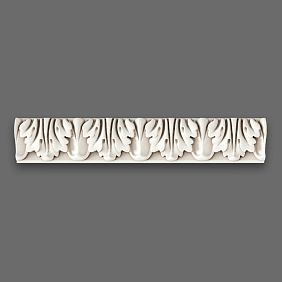
Cornices for the ceilingCornices made of polyurethane can be smooth (a profile silhouette without ornament), ornamental (with a relief repeat — egg-and-dart pattern, acanthus leaf, meander, cable) and composite (several profiles forming a complex multi-layered cornice). Width — from 4 to 20 cm and more.
Moldings for the ceiling
A molding is a decorative strip with a profiled cross-section, used on the plane of the ceiling to create rectangular frames, coffered patterns, zoning lines. If a rosette is a point, and a cornice is the perimeter, then a molding is the geometry inside the ceiling plane.
Moldings for the ceilingMoldings are glued directly onto the ceiling surface (including onto a stretch fabric — when using compatible acrylic adhesive). Systems of frames are built from moldings: one central frame, several nested rectangles, symmetrical sections. The width of moldings is from 1.5 to 10 cm.
Decorative inserts and ornamental elements
Corner inserts, medallions, decorative bands, ornamental overlays — these are auxiliary groups of elements that enhance and complete the main decorative system. Corner inserts cover the joints of cornices on internal corners. Medallions are installed on the ceiling or walls as independent decorative accents. Ornamental bands add rhythm between the main elements.
Ceiling decor sets
For those who want to assemble a cohesive composition with minimal effort — sets of coordinated elements from one collection. Cornice + rosette + moldings of one ornamental style — this is a ready-made system that guarantees visual unity. This is exactly the approach used in professional design projects.
When to buy ceiling molding
For living room decor
The living room is the main space where ceiling decor works to its full potential. A cornice around the perimeter conceals the mounting profile and creates a frame. Molding frames on the surface structure a large ceiling. A rosette frames the chandelier. Three elements — and the level of the interior is fundamentally different.
For the bedroom
In the bedroom, subtlety is key. A thin cornice without heavy ornamentation, a small rosette in the center, possibly one molding frame above the headboard of the bed. A matte white ceiling with white molding creates a quiet, calm surface with a barely perceptible relief. It is precisely this kind of ceiling that helps the bedroom space 'breathe'.
For kitchen-dining room
A molding frame above the dining area plus a rosette above the table — a designated formal space for dining. Zoning without walls, an architectural accent without major investment.molded decoration made of polyurethaneMoisture-resistant, which is especially important for kitchen spaces with their fluctuations in temperature and humidity.
For the hall and hallway
The first thing a guest sees is the hallway. The cornice here sets the tone for the entire interior. A small rosette above the chandelier completes the center. Even a minimal decorative system in the hallway speaks to the thoughtfulness and quality of the entire space.
For an office
A strict system: vertical pilasters on the walls, a cornice along the perimeter, a smooth rosette under the chandelier. No floral overload—only architectural logic. Molding in the study creates an environment that speaks of professionalism and status.
For commercial spaces
Restaurants, hotels, meeting rooms, executive offices—in all these spacesDecorative stuccocreates a sense of quality and seriousness that cannot be imitated by other means. Ceiling decor in a commercial interior is an investment in brand perception.
Ceiling molding in interior design: how it transforms space
Makes the ceiling expressive
A bare ceiling is an architectural vacuum. Even a single decorative element—a cornice or rosette—brings the ceiling out of neutrality and makes it a participant in the interior dialogue.
Emphasizes the interior style
The ornament of the molding is a direct reference to the style. Acanthus leaf is classic. Geometric radial pattern is Art Deco. Smooth profile is modernity. The choice of ornament is a signature under the stylistic concept of the entire space.
Visually unifies the space
The cornice creates a frame, molding frames structure the plane, the rosette fixes the center. Together they turn a set of surfaces into an architectural shell, inside which a person perceives the space as a whole.
Helps to design the center of the ceiling and the perimeter
The two most vulnerable spots of any ceiling are the center (the chandelier zone without framing) and the perimeter (the technically rough joint between the wall and ceiling). Molding covers both.
Makes the interior appear more expensive
There is a direct correlation between the presence of ceiling decor and the perceived value of an interior. A room with a cornice and rosette is perceived as more expensive and higher quality—even with identical furniture and finishes. This is not a subjective feeling, but an architectural regularity.
Why you should buy polyurethane molding for the ceiling
If you've decided to buy ceiling molding, the next question is what material. The answer in most practical situations is unequivocal: polyurethane. Not out of inertia, but due to a combination of objective reasons.
Low Weight
Polyurethane products weigh 10–15 times less than gypsum counterparts of the same size. A large 60 cm diameter polyurethane rosette weighs about 0.8–1.2 kg. The same gypsum rosette — 8–12 kg. For ceiling mounting, this is a fundamental difference: lightweight products do not require reinforced fastening and hold perfectly on acrylic adhesive.
Ease of installation
Polyurethane moldingsinstalled independently without special skills or tools. Acrylic adhesive, painter's tape for fixation until dry, a miter box for corner cuts of cornices — that's the entire arsenal. A standard room is decorated in one day.
Clear relief
The mold casting method ensures perfect relief accuracy. Each cornice is an exact copy of the previous one. Each rosette petal is of the same size and depth. This is especially important when creating systems with a large number of elements: symmetry and uniformity of the ornament create a professional result.
Moisture resistance
Polyurethane does not absorb moisture, does not swell, and does not crumble when wet. This is important for kitchens, bathrooms, and rooms with unstable humidity.Polyurethane ceiling decorationmaintains shape and relief under any normal operating conditions.
Suitable for painting
After installation, the entire decorative system — cornice, moldings, rosette — is coated with water-based paint in any color. Traditionally, this is white, which unifies the entire system. But colored solutions are also possible: gold, silver, a contrasting color relative to the ceiling.
Durability
Polyurethane does not deteriorate over time, does not yellow on its own, and does not shrink. With proper installation and normal operation, the service life of polyurethane stucco is comparable to the lifespan of the finish itself — decades.
Good price-to-visual-effect ratio
This is a key commercial advantage. Polyurethane molding is significantly cheaper than plaster while delivering comparable or identical visual results after painting. That's why, if the goal is a beautiful ceiling rather than historically authentic restoration, polyurethane is the optimal solution.
How to choose ceiling molding before purchase
Based on ceiling height
Ceiling height is the main limiting factor for the scale of decor.
| Ceiling Height | Cornice width | Socket diameter | Molding width |
|---|---|---|---|
| Up to 2.5 m | 4–6 cm | 20–35 cm | 1.5–3 cm |
| 2.5–2.7 m | 5–8 cm | 30–45 cm | 2–4 cm |
| 2.7–3 m | 7–12 cm | 40–60 cm | 3–6 cm |
| Above 3 m | 12–20 cm and more | 50–80 cm | 4–8 cm |
Violating this proportion leads to massive decor visually 'eating up' the height, while small decor gets lost on a high ceiling.
By room area
Small room (up to 15 sq. m) — delicate decor: thin cornice, small rosette. Medium room (15–30 sq. m) — standard scale: cornice 6–10 cm, rosette 40–50 cm. Large space (from 30 sq. m) — a full system with molding frames and large elements is possible.
By interior style
-
Classic — rich ornament, floral motifs, multi-layered cornices
-
Neoclassical — moderate ornament, clean profiles, restrained detailing
-
Art Deco — geometric patterns, stepped profiles, radial rosettes
-
Modern style — smooth profiles, minimalist rosettes, geometric moldings
-
Eclecticism — intentional combination of styles with internal logic
By room type
Living rooms — any style within the overall interior concept. Bathroom and kitchen — must be moisture-resistant material (polyurethane). Commercial spaces — scale and ornamentation according to branding and concept.
By size and relief of elements
Deep relief — active shadows, expressive plasticity, clearly visible from a distance. Shallow relief — delicate texture, pleasant up close, restrained from afar. For small rooms, shallow or medium relief is preferable. For spacious halls — deep relief is possible.
By color and painting capability
Most polyurethane products are supplied in white and ready for painting. This allows the decor to fit into any interior color scheme. When choosing, clarify whether the product is intended for painting and what type of paint to use (water-based paints are standard).
By combination with chandelier and other elements
The ceiling rosette is chosen proportionally to the chandelier—equal to it in diameter or 20–30% larger. The cornice should be from the same ornamental series as the moldings. Wall decor (if planned) should be from the same collection as the ceiling decor.
What is better to buy for the ceiling: a rosette, moldings, or cornices?
This is a question asked by every second person. The answer depends on the specific task.
If you need an accent in the center of the ceiling
Buy a rosette. One element in the center—and the ceiling is no longer empty. Especially important if there is a pendant chandelier: the rosette turns the technical mounting hook into a decorative object.
If you need to decorate the perimeter
Buy a cornice. It is mounted along the perimeter, covers the joint between the wall and ceiling, and creates a frame for the space. This is the most universal and effective element of ceiling decor.
If you want to create geometry on the ceiling
Buy moldings. They are used to build rectangular frames directly on the surface of the ceiling. One or several nested rectangles—and a flat ceiling turns into a structured architectural object.
If you need a full-fledged decorative ensemble
Purchase the system: cornice + moldings + rosette from one collection. This ensures the maximum decorative result with a coordinated appearance of the entire composition. It is precisely this approach that distinguishes a professionally designed interior.
Ceiling molding for different interior styles
Classic
In classic style, everything is purchased: a heavy ornamental cornice, a rich floral rosette, molding frames with ornamental corner inserts. This is an architectural system that completely covers the ceiling. Plaster is suitable here for restoration projects, polyurethane is for everywhere a classic result with a practical material is needed.
Neoclassicism
The most popular style for ceiling decor application today. A moderate cornice with an elegant profile, a rosette with a restrained ornament, thin molding frames. A white ceiling, white molding, a quality chandelier — this is enough for a full-fledged neoclassical ceiling.
Modern interior
Here, molding works as an intentional architectural accent. A thin, smooth cornice without ornament, a laconic rosette with a simple geometric pattern — this is not 'classic,' it is a modern detail that speaks to the culture of the space. Fewer elements are purchased, but they are placed precisely.
Art Deco
Geometric moldings with a stepped profile, a radial rosette, a cornice with geometric ornament. Often — painting in gold or bronze against a dark ceiling. This is a bold, expressive, stylistically very specific solution.
Eclecticism
Mixing is allowed here — but conscious. A classic rosette on a modern geometric ceiling, a thin molding in a room with antique furniture. The main thing is that the decor is an intentional statement, not a random set.
What determines the price of ceiling molding
Material
Polyurethane is the most affordable of the quality options. Plaster is more expensive. Wood is more expensive than plaster. Polystyrene is cheaper than polyurethane, but with significantly weaker relief and visual quality.
Product size
A large rosette costs more than a small one. A wide cornice is more expensive than a narrow one. A long molding is priced proportionally to the cost per linear meter. Size is one of the main pricing factors.
Complexity of relief
A smooth profile is cheaper. An ornamental relief of medium complexity is mid-priced. A multi-layered, rich floral ornament is more expensive. The complexity of the shape determines the complexity of production.
Brand and quality of execution
European material and high-precision manufacturing result in a higher price and fundamentally different quality of relief. Specifically, polyurethane products from STAVROS are produced using European materials, which ensures clarity of ornament, surface density, and durability of the products.
Purchase volume
Wholesale purchases and complete orders often come with more favorable terms. If several rooms or an entire property are being decorated, it makes sense to consider a complete order.
Installation cost
For self-installation, the cost of adhesive and consumables is minimal. When ordering professional installation, the price increases proportionally to the volume of work and complexity of the system.
Where to buy ceiling molding and what to look for when ordering
Geometry quality
A good manufacturer ensures precise geometry: right angles, uniform thickness, symmetrical relief. Visual defects—beveled edges, disrupted pattern symmetry, varying thickness—indicate low production quality.
Pattern accuracy
The ornament should be clear: all petals identical, curls symmetrical, pattern repetition—without shifts. This is what ensures a professional result after painting.
Assortment of compatible elements
A reliable supplier offers collections with compatible elements: cornice, molding, rosette, corner inserts—all from the same series, with a unified ornamental style. This allows you to buy ceiling molding as a system, not a set of random parts.
Material characteristics
Clarify: polyurethane or expanded polystyrene? This is a fundamental difference in quality. Polyurethane—dense, impact-resistant, with clear relief. Expanded polystyrene—lightweight, cheap, with unclear relief and weak strength.
Delivery and packaging conditions
Ceiling molding is a fragile product if improperly packaged. A good supplier provides reliable packaging that protects edges and the relief surface during transportation.
How to decorate a ceiling after purchasing molding
One ceiling medallion for a chandelier
Quick start. One ceiling medallion — and the center of the ceiling gets its finishing touch. Installation: a mounting plate (for a stretch ceiling) or directly onto the rough ceiling. Adhesive + holding until dry. Work time — one hour.
Ceiling with a perimeter cornice
Cornice — the most effective and least costly way to change a ceiling. Perimeter installation: adhesive, cutting corners at 45°, tape until dry. One person can handle it in 3–5 hours for a standard room.
Ceiling with molding frames
Rectangular frames are marked on the ceiling surface, moldings are cut to size and glued on. This requires precise marking — and delivers maximum decorative effect with minimal cost. One or several nested rectangles — half a day's work.
Ceiling with complex decor
Cornice + molding frames + ceiling medallion = an architectural ceiling. Done sequentially: first the cornice, then the frames, finally — the medallion. A complete system in a standard living room — one to two days of DIY work.
A laconic modern option
One thin, smooth cornice around the perimeter and one minimalist rosette. No molding frames. White ceiling, white molding. This is the modern approach: a little, precise, meaningful.
Expressive classic option
Ornamental multi-layered cornice, molding frames on the surface, floral rosette, corner inserts — a complete classical system. Requires more time for installation, but the result is a ceiling that reads as an architectural object.
Installing ceiling molding: what you need to know before buying
Surface preparation
The ceiling must be dry, clean, free of dust and flaking. Loose plaster, peeling paint — are removed. The surface is primed to improve adhesive bonding.
Marking
Marking is the most important stage. The center of the ceiling is determined by the intersection of the diagonals. All frames are built from the center, and the position of the rosette is measured from it. The cornice line — by level, strictly horizontal. An error in marking is visible in the finished work and can only be corrected by dismantling.
Trimming elements
Cornices are cut at a 45° angle on the corners — a miter box ensures accuracy. Moldings are cut to the length of the frames — a straight cut. Ready-made corner inserts eliminate the need for precise cutting in the corners.
Adhesion
Acrylic mounting adhesive is applied in a zigzag or dots to the back of the product. The element is pressed against the surface according to the markings and held for 30–60 seconds. It is fixed with painter's tape until completely dry (4–8 hours).
Joint Treatment
Joints of cornices in corners, gaps between the rosette and the ceiling — are filled with acrylic sealant and smoothed with a wet finger or spatula. After drying — sanding with fine sandpaper.
Painting
Water-based paint with a brush (for relief) or a small roller (for smooth surfaces). Two thin coats with intermediate drying. The first coat may slightly 'mute' the relief — the second one restores it.
When is it better to entrust installation to professionals
Complex multi-element systems in large spaces, restoration projects with plaster, installation on non-standard surfaces — in these cases, professional installation is justified and more reliable than DIY.
Common mistakes when buying ceiling molding
Buying overly massive decor for a low ceiling
A wide ornamental cornice and a large rosette on a 2.4 m ceiling — a visual trap. The decor literally lowers the ceiling. The rule is simple: the lower the height, the smaller the scale of the decor.
Choosing random elements without an overall composition
A cornice of one pattern, a rosette of another, moldings of a third — this is not a system, but a set of incompatible parts. All elements should be from the same collection or the same ornamental direction.
Ignoring the style of the room
A heavy Baroque cornice in a minimalist interior with built-in furniture and concrete surfaces — a stylistic conflict that cannot be resolved by painting. The ornament of the molding should match the overall concept.
Incorrect size calculation
Shortage of 50 cm of cornice on the final run is an unpleasant situation. Calculation: room perimeter in meters + 10% for cutting and joints. Frame moldings — sum of perimeters of all frames + 10%.
Saving on relief quality
Cheap polystyrene with unclear relief looks cheap — and no matter how much you paint it, that won't change. Relief quality is the main indicator of visual result. That's why polyurethane with clear cast relief is always preferable to budget polystyrene.
Buying without understanding the installation scheme
Before ordering, it's important to understand: the cornice is attached to the wall, the rosette — to the ceiling via a mounting plate or directly to the rough ceiling, moldings — are glued to the ceiling surface. Without this understanding, installation errors occur.
Frequently asked questions
What ceiling molding is best to buy for an apartment?
For a standard apartment with ceilings 2.5–2.7 m — polyurethane products from one collection: cornice width 6–8 cm, rosette diameter 35–45 cm. Ornament — according to interior style. For modern — smooth profiles. For classic — moderate floral ornament.
What to buy for a chandelier: a rosette or moldings?
A rosette. It is specifically designed for decorating the chandelier area. Moldings — for creating frames on the ceiling plane. If you want both — a rosette in the center of a molding frame that surrounds it.
Is polyurethane molding suitable for the kitchen?
Yes. Polyurethane is moisture-resistant, does not deteriorate from condensation or temperature fluctuations. When properly painted with high-quality moisture-resistant paintPolyurethane ceiling decorationit performs excellently in the kitchen.
Can ceiling molding be painted?
Yes, this is standard practice. Water-based paints are the optimal choice. After applying two thin coats, the surface of the molding looks monolithic with the ceiling. It can be painted any color, including metallics.
What is cheaper: individual elements or a ready-made composition?
A complete order from a reliable supplier is often more cost-effective than purchasing different elements individually. Moreover, a set guarantees ornamental unity—which is impossible when mixing products from different manufacturers.
Is it difficult to install ceiling molding yourself?
Installing polyurethane molding is accessible without special skills. Acrylic adhesive, a miter box, painter's tape—that's all you need. The key is careful marking and patience during fixation until it dries.
Is molding suitable for a modern interior?
Yes—with the right choice of elements. A thin, smooth cornice and a minimalist rosette in a modern interior are not 'classical' but a deliberate architectural detail. This is exactly how ceiling decor is used in the best contemporary projects.
Conclusion
Buying ceiling molding means making a decision not just about decor, but about the architectural completeness of the interior. One correctly chosen element—a cornice, rosette, or molding frames—fundamentally changes the perception of space. A system of coordinated elements turns the ceiling into a full-fledged architectural object.
The main thing when purchasing is to understand the task: to decorate the center (rosette), cover the perimeter (cornice), create geometry (moldings), or assemble a full system. Choose the scale to match the ceiling height. Determine the ornament to suit the interior style. And entrust production only to those who ensure clear relief and precise geometry of the products.
Full catalogpolyurethane productsFor ceilings and walls — cornices, moldings, rosettes, decorative inserts, pilasters — is available in the assortment of STAVROS company.
STAVROS — European quality, precise relief, full assortment for any interior. Exquisite, impact-resistant, meticulously crafted, moisture-resistant plaster decor for those who create spaces with character. Every STAVROS detail is not just a decorative element, but an architectural statement that is visible at first glance.