Article Contents:
- Relief: from flatness to volume
- Rhythm: repetition creates structure
- Symmetry: order and harmony
- Composition center: focal point
- Stylization: choice of language
- Scale: correspondence to space
- Quick assembly: technology of speed
- Economics of quick decoration
- Conclusion: architecture in a week

An interior without architectural structure is a box with furniture. Walls are flat surfaces, the ceiling is a white spot overhead, corners are random intersections of planes. Such a space is functional but soulless, lacking depth, character, history.Moldings decorationTransforms this situation in a matter of days, without wet processes, plastering, or multi-month renovation. Cornices complete verticals, moldings structure walls, rosettes organize compositional centers, pilasters mimic columns. The result — from a standard apartment emerges a space with architectural logic, proportions, rhythm.
Speed is the key advantage of modern polyurethane molding. One person can install cornices in a room over the weekend. A pair of craftsmen can install a molding system on all walls of an apartment within a week. A month — and a standard three-room apartment acquires architecture that would envy pre-revolutionary mansions. No need to wait for plaster to dry, gypsum to settle, or for strength to develop. Glue, caulk joints, paint — done. The result looks as if the house was built with this decoration in mind, as if the molding has always existed.




Relief: from flatness to volume
A flat wall is a two-dimensional surface perceived instantly and forgotten by the eye. A relief wall with moldings is a three-dimensional object, creating a play of light and shadow, changing throughout the day depending on lighting. In the morning, when sunlight hits from the side, the cornice casts a deep shadow, emphasizing the transition from wall to ceiling. During the day, under overhead light, the relief softens. In the evening, under artificial lighting, directional spotlights create dramatic shadows, transforming a simple molding into a sculptural element.
Creating relief begins with understanding depth. A thin cornice 5 cm high creates a delicate relief, noticeable upon close inspection. Medium 10 cm — pronounced relief, readable at first glance. High 15–20 cm — monumental relief, dominating the space. The choice of depth depends on the room’s scale — a high cornice in a room with 2.5 m ceilings will overwhelm, while a thin molding in a hall with 3.5 m ceilings will disappear.
Multi-level relief creates complexity and richness. A cornice consists not of one profile, but of two or three arranged in steps. A wall molding includes a central plane and protruding elements framing it. A pilaster has a base, a fluted shaft, and a capital — three levels of depth. Each level casts its own shadow, creating a multi-layered image. Under side lighting, these shadows overlap, reinforcing each other, creating an illusion that the relief is deeper than it actually is.
Relief organizes space vertically. Skirting board at the bottom, horizontal molding at 1.5 m height, frieze at the upper part of the wall, cornice under the ceiling — four horizontal lines dividing the wall into zones. This is a classical scheme inherited from architecture, where plinth, wall, and entablature created a three-part building structure. In interiors, this works similarly — the lower third of the wall is perceived as a base, the middle as the main field, and the upper as a finish.
Lighting of relief is critical for its perception. Diffused overhead light from a chandelier washes out shadows, making the relief almost invisible. Directional spotlights illuminating along the wall highlight every protrusion. Hidden backlighting behind the cornice creates a light overhang, visually separating the ceiling from the walls. Underlighting of the skirting board creates the effect of floating walls. Combining different light sources allows controlling the perception of relief, making it either noticeable or almost disappearing.
Relief painting determines whether it will stand out by color or only by form. White molding on a white wall is perceived only through light and shadow — an elegant solution requiring good lighting. Contrast — white on a colored wall — attracts attention by color, form is secondary. Tonal — light gray on dark gray — creates a subtle transition, where both color and form work together.Polyurethane moldingsEasily painted with any paint, allowing freedom for experimentation.




Rhythm: repetition creates structure
Rhythm is the repetition of elements at equal or regularly changing intervals. In music, rhythm creates structure in time; in architecture — in space. A row of identical windows on a facade, columns of a portico, balusters of a staircase — all are rhythmic structures. In interiors, molding allows creating rhythm quickly and affordably, without construction changes.
The simplest rhythm is the repetition of identical elements at equal intervals. Five vertical moldings on a wall, separated by equal gaps, create a rhythm dividing the plane into six fields. The eye automatically reads this rhythm, finding it calming and predictable. Such a rhythm suits long walls of corridors, galleries, where structure needs to be created without complication.
Alternating rhythm uses two or more types of elements. Wide molding, narrow, then wide again, then narrow. Or square frame, rectangular, square, rectangular. This creates a more complex, interesting rhythm, non-monotonous. Alternation can be regular — ABA B ABA B, or grouped — AABBAAB, creating even greater complexity.
Increasing or decreasing rhythm — elements gradually increase or decrease in size. Five frames on a wall, where the first is the smallest and the last the largest, with intermediate ones smoothly increasing. This creates movement, direction, visually guiding the eye from small to large. Increasing rhythm creates tension, anticipation of climax. Decreasing — release, calm.
Interrupted rhythm deliberately breaks regularity. Four elements at equal intervals, then a doubled gap, then four elements again. Or three identical, one different, then three identical again. This attracts attention, creating an accent at the point of disruption. Syncopation in music creates surprise; in architecture — the same effect.
Rhythm of moldings on the wall creates framed compositions. The wall is divided into rectangles of equal or different sizes. Within each rectangle — its own finish, wallpaper, paint, paneling. But the overall rhythm unifies them into a system. Classic scheme — three horizontal rectangles on a long wall, two on a short one. Gaps between frames equal the width of the molding or slightly more. This creates a regular grid, pleasing to the eye.
Rhythm of cornices and friezes at different levels creates vertical structure. Skirting board 10 cm high, molding at 1 m — 5 cm, frieze at 2 m — 7 cm, cornice under the ceiling — 12 cm. Sizes increase, creating visual upward movement. This is a traditional scheme based on the idea that the higher the element, the more massive it should be to compensate for perspective shortening.
Our factory also produces:



Symmetry: order and harmony
Symmetry is a fundamental principle of classical architecture, creating a sense of order, stability, and completeness. A symmetrical composition is perceived as correct, harmonious, and calm. Moldings are the ideal tool for creating symmetry, as elements can be precisely mirrored.
Central element — an essential part of a symmetrical composition. This is the point around which everything else is built. On the ceiling, the central element —
The central element is a mandatory part of a symmetrical composition. It is the point around which everything else is built. On the ceiling, the central element is —Rosettewith a chandelier. On the wall — a fireplace arch, mirror, panel, or TV framed by moldings. On the floor — a rug, dining table. The central element must be significant, attention-grabbing, and serve as a compositional focus.
with identical frames.plinthBilateral symmetry — mirror reflection not only relative to one axis, but also relative to a perpendicular one, creating fourfold repetition. The central element, with vertical and horizontal axes from it, has identical compositions in each of the four quadrants. This creates maximum order, but may be excessive and overly rigid for residential spaces. Bilateral symmetry is characteristic of grand halls and reception rooms where solemnity is required.
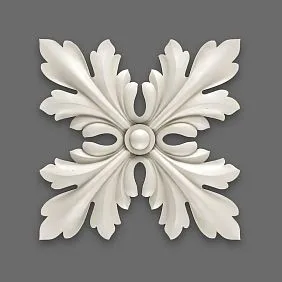
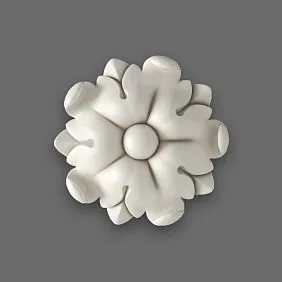
Radial symmetry — repetition of elements around a central point — is used in ceiling compositions.Ceiling rosettewith radial ornamentation, from which rays of molding extend to the corners of the room. Or a square frame in the center of the ceiling, from whose corners diagonal moldings extend to the room's corners. Radial symmetry creates dynamism, movement from the center to the periphery or vice versa.
Bilateral symmetry — mirror reflection not only relative to one axis but also relative to a perpendicular one, creating fourfold repetition. The central element, with vertical and horizontal axes from it, has identical compositions in each of the four quadrants. This creates maximum order, but may be excessive, too rigid for residential space. Bilateral symmetry is characteristic of grand halls and lobbies, where solemnity is required.
Broken symmetry — intentional deviation from mirror repetition to create liveliness. The main structure remains symmetrical, but details differ. Two identical frames beside a fireplace, one with a painting, the other with a mirror. Two identical pilasters, one with a capital, the other without. Such deviations attract attention, encourage closer inspection, and create individuality while preserving overall order.
Get Consultation
Composition center: focal point
Any composition requires a center — a point toward which the gaze is directed, where meaning is concentrated, around which everything else is organized. Without a center, the composition disintegrates into separate elements that do not form a whole. Moldings allow creating compositional centers, making them obvious and indisputable.
moldings and pilasterscreate a focal point. Vertical elements on the sides, a horizontal fireplace mantel, possibly a pediment above — all of this frames the hearth, making it the center. Furniture is arranged facing the fireplace, and the gaze of someone entering the room is directed toward it. The composition is organized.creates a focal point. Vertical elements on the sides, a horizontal fireplace mantel, possibly a pediment above — all of this frames the fireplace, making it the center. Furniture is arranged facing the fireplace, and the view of someone entering the room is directed toward it. The composition is organized.
A TV wall as a modern hearth requires the same framing. A wide molding frame around the TV transforms it from household equipment into an architectural element. Additional shelves, niches, and panel-covered sections on the sides create a symmetrical composition. All of this is unified by a continuous frame running from floor to ceiling. The TV becomes the center not because it shouts, but because the architecture directs attention to it.
or lights. Side pilasters complete the composition. The mirror reflects space, visually doubling it, but the portal holds this reflection, preventing it from dissolving.decorative insertThe dining area is distinguished by ceiling decoration. A rectangular or oval molding frame above the table marks the zone. Within the frame — a chandelier socket, hanging low over the table. This creates a vertical axis organizing the space. The table under the chandelier — the center, around it — chairs, and further — the rest of the dining or living-dining space. Without the ceiling frame, the table would simply be furniture; with it — an architectural center.
The dining area is distinguished by ceiling decoration. A rectangular or oval frame of molding on the ceiling above the table marks the zone. Within the frame — a chandelier hanging low over the table. This creates a vertical axis organizing the space. The table under the chandelier — the center, around it — chairs, further — the rest of the dining or dining-living room space. Without the ceiling frame, the table would simply be a piece of furniture; with it — it becomes an architectural center.
The bed in the bedroom is framed by wall panels. The headboard is highlighted by a molding frame, possibly with a soft inset. The side walls are symmetrical — bedside tables, lamps, paintings in identical frames. The ceiling above the bed may be highlighted by a frame or a chandelier socket. The bed becomes a center not only functionally — a place for sleeping — but visually — a point toward which compositional lines converge.
Accent wall behind the sofa in the living room is created by a molding system. A large central frame, possibly with contrasting color wallpaper or textured plaster inside. Narrow side panels create symmetry. All of this extends from floor to frieze or cornice height. The sofa faces away from this wall; it is not for those sitting on the sofa — they do not see it — but for those looking at the sofa, for those entering the room. The accent wall — a backdrop, theatrical decoration, against which life unfolds.
Stylization: choice of language
Classical stylization uses the full arsenal.
Classic styling uses the full arsenal., with modillions or dentils. Moldings with ornament — acanthus leaves, Ionic, beads. Pilasters with bases, fluted shafts, Corinthian capitals. Rosettes with radial petal ornament. Portals with complex entablatures. Colors — white, ivory, possible gilding on capitals and friezes. This is the language of palaces, requiring space, height, and readiness for opulence.Neoclassical stylization preserves classical logic but simplifies forms. Two- or three-level cornices, 8–12 cm high, without ornament. Moldings smooth or with simple profile — one rounded edge, one bevel. Pilasters without fluting, with simplified capitals or without them. Rosettes small, with geometric ornament. Colors — white, cream, light gray, possible wall-color painting. This is the language of modern apartments, where one desires classicism but lacks space for its fullness.
Modern classicism minimizes ornament. Thin cornices, 3–7 cm, simplest profile. Moldings flat, 2–5 cm wide. Pilasters replaced by simple vertical strips. Rosettes absent or replaced by simple square or round frames. Colors — monochromatic, molding in surface color or thin contrast. This is a language speaking softly, creating structure without drawing attention to the molding itself.
Minimalist stylization uses molding sparingly. One thin cornice around the ceiling perimeter, creating shadow. Several vertical moldings dividing the wall. No ornament, no capitals, no rosettes. Profiles as simple as possible — rectangular section with bevel. Color — strictly matching surface tone, no contrast. Molding works as a fine line indicating boundary, not as decoration. This is for those who value structure but do not accept ornamentation.
Minimalist styling uses molding sparingly. One thin cornice around the perimeter of the ceiling, creating shadow. A few vertical moldings dividing the walls. No ornamentation, no capitals, no rosettes. Profiles are maximally simple — rectangular cross-section with bevel. Color — strictly matching the surface tone, without contrast. Molding works as a thin line, indicating a boundary, but not as decoration. This is for those who appreciate structure but do not accept ornamentation.
Eclectic styling mixes elements of different styles. A classic cornice with modern geometric frames on walls. A baroque rosette on the ceiling in a minimalist interior. Neoclassical moldings painted in bright modern colors. This requires a sense of proportion and artistic taste to prevent the mixture from becoming chaos. But with a proper approach, eclecticism creates uniqueness unattainable within a single style.
Scale: correspondence to space
Scale — the ratio of element sizes to the size of the space. Incorrect scale is a common mistake when using moldings. Too large elements in a small room create a feeling of confinement. Too small elements in a large space disappear, become unreadable, and the composition falls apart. Correct scale creates harmony, a feeling that everything is in its place.
Ceiling height — the first parameter determining scale. For ceilings 250–270 cm, cornices should be thin, 3–7 cm high. Moldings are narrow, 2–5 cm. Larger elements visually lower the ceiling, making the room appear low. For ceilings 280–320 cm, medium sizes are suitable — cornices 8–12 cm, moldings 6–10 cm. For high ceilings from 350 cm, large elements can be used — cornices 15–25 cm, moldings 10–15 cm.
Room area — the second parameter. In a 15 m² room, large molding will be excessive, even with a high ceiling. In a 50 m² hall, small molding will disappear. Rule: the larger the area, the larger the elements can be. But this is not a linear relationship — doubling the area does not mean doubling the molding size, rather an increase of 30–50 percent.
Room proportions influence the choice of elements. A narrow, elongated room needs vertical divisions that visually expand it. Vertical moldings, pilasters, tall narrow frames. A square room is good with any proportions. A very wide and low room requires horizontal accents that visually raise the ceiling — horizontal friezes, wide low frames.
The number of elements should correspond to the complexity of the space. A simple rectangular room with one window and one door does not need many decorative accents. A cornice around the perimeter, a few frames on the walls — that’s enough. A complex room with an oriel, niches, several windows and doors requires a more developed molding system to organize all these elements into a single composition.
Detailing — the level of complexity of profiles and ornamentation. In a large space, you can use complex multi-level cornices, ornamented friezes, carved capitals — detail is visible from a distance. In a small space, complex detailing is not readable, becomes visual noise. Better simple profiles, clear lines, minimal ornament — this is readable even up close.
Balance of molding and other interior elements — the final check of scale. If molding dominates, suppresses furniture, distracts from the room’s function — scale is excessive. If molding is unnoticed, lost against bright wallpaper, large furniture, or abundance of decor — scale is insufficient. Correct scale creates balance, where molding is an important, but not the only part of the composition.
Quick installation: technology of speed
Speed of installing polyurethane molding — its main advantage over plaster. Plaster molding is cast in molds, heavy, fragile, requires professional installation on plaster, reinforcement. This takes weeks, dirt, dust, need to vacate the apartment. Polyurethane molding is light, strong, cut with a hacksaw, glued with mounting glue. One person with a minimal set of tools can install cornices in a room in a day.
Preparation is minimal. Surfaces should be relatively flat — height differences up to 5 mm are acceptable, molding will cover them. Cleaned from dust, degreased. Dry — glue does not stick to wet surfaces. Primed for better adhesion. This is done quickly, does not require special skills. Even in an occupied apartment, you can prepare and install molding with minimal disruption to daily life.
Marking is done with pencil, level, tape measure. For cornices, a horizontal line is drawn at the required height from the ceiling around the room. For moldings, outlines of frames are marked with checking angles and diagonals. Laser level speeds up the process and provides accuracy. Marking is critical — an error at this stage will be visible after installation, but it takes only a little time.
Cutting elements to angles is done in a simple fixture that holds the blank at the required angle. For internal and external angles of the room, elements are cut at 45 degrees. Polyurethane is cut with a standard fine-tooth hacksaw, cleanly, without chips. A table saw with a rotating table speeds up work and provides perfect accuracy, but you can also use hand tools.
Mounting on glue is fast and clean. Glue type "liquid nails" is applied to the back of the element with a zigzag motion. The element is pressed to the surface according to the marking, held for 30 seconds — 2 minutes. Glue sets, element holds. No plaster, dirt, no need for reinforcement. For especially heavy elements, you can add hidden screws, but glue usually provides sufficient strength.
Joint sealing — final operation before painting. Gaps between elements are filled with acrylic sealant or putty, smoothed with a wet finger or trowel. After drying, they are sanded with fine sandpaper. Goal — invisible joints, impression of monolithic molding. This requires care, but is not technically difficult.
Painting is done with a roller or spray gun. Two to three coats of paint with intermediate drying. Deep relief is painted with a brush. The entire process from priming to final coat takes two to three days including drying. Result — professionally looking molding, indistinguishable from plaster, installed in one week instead of a month.
Economics of quick decoration
The cost of transforming the interior with molding depends on the scale of ambitions. Minimal option — cornices around all rooms of a three-room apartment — will cost 30–50 thousand rubles for materials, the same amount for labor if hiring professionals. Total 100 thousand, and the apartment gains completeness it previously lacked. Average option — cornices plus wall moldings creating framed compositions — 150–250 thousand for the entire apartment. Maximum — cornices, moldings, pilasters, rosettes, portals — 300–500 thousand, but the result is comparable to a palace interior.
Comparison with alternatives shows advantages. Creating an architectural structure with plaster or hand-cast plaster will cost several times more. Work time is measured in months. Dirt, dust, need to protect or remove furniture. Polyurethane molding provides 90% visual effect for 20–30% of the cost and 10% of the time.
Self-installation saves half the budget.Polyurethane molding STAVROSis so easy to install that a person without construction experience, after watching a couple of video instructions, can install cornices. Moldings are slightly more complex, require precise marking, but are also accessible. The result may not be perfect from a professional standpoint, but for your own home, where only happy imperfections are visible, it is quite sufficient.
The durability of polyurethane molding is comparable to plaster. It does not crumble, does not crack, does not fear moisture. With careful handling, it serves for decades. You can repaint it, changing the interior’s color scheme without replacing the molding. This is an investment that pays off not only visually, but also with a long service life.
Company STAVROS offers a wide rangemoldings from polyurethane — Crown Molding, Moldings, pilasters, decorative panelsLarge warehouse program allows dispatching orders on the day of request. Delivery across Russia from one piece. Professional consultations help select the right elements, calculate quantities, avoid mistakes. 23 years on the market, thousands of satisfied customers, reputation built on quality and reliability.
Conclusion: architecture in a week
Moldings decorationis a tool for rapid transformation. In one week of active work, a typical apartment acquires architectural structure. Relief creates depth, rhythm organizes planes, symmetry calms, compositional centers focus attention. Styling defines the language, scale creates harmony. Result — a space where you want to live, of which you are proud, reflecting taste and understanding.
You don’t need to wait for new construction, major renovation, or moving. Molding is installed in an occupied apartment with minimal disruption to daily life. Weekends for marking and mounting, evenings for painting — and the room is transformed. Next weekends — next room. In a month, working on weekends, you can decorate the entire apartment.
Professional assistance accelerates the process and guarantees quality. A designer develops a concept, selects elements, creates a visualization. Installers install everything quickly and neatly. But even self-installation with attention and care yields a worthy result.Solid wood products — Moldings, Casings, Decorative Insertscomplement polyurethane molding, creating multi-layered effects, combining textures.
466.75 $