










































































Article Contents:
- Buy ceiling skirting in Moscow: which option to choose for your interior
- What ceiling skirting boards can be bought in Moscow
- Wooden ceiling skirting boards
- Paintable MDF skirting boards
- Polystyrene ceiling cornices
- Polyurethane decorative profiles
- How to choose ceiling skirting by material
- When wood is better
- When MDF is more convenient
- When polystyrene is more cost-effective
- When a decorative polyurethane profile is needed
- How to choose a ceiling skirting board by width and profile
- Narrow profile for low ceilings
- Medium universal profile
- Wide skirting board for high ceilings
- Smooth profile
- Decorative profile
- How to choose a ceiling skirting board by room
- living room
- for the bedroom
- For Kitchen
- For the hallway
- For Apartments
- For Country Houses
- Ceiling skirting for stretch ceilings and regular ceilings
- What to choose for a stretch ceiling
- What to choose for a painted ceiling
- What to choose for high ceilings
- What to choose for low ceilings
- What to combine ceiling skirting with in interior design
- With wall moldings
- With wooden moldings
- With polyurethane molding
- With floor skirting in a unified interior system
- With slatted panels
- Comparative table of ceiling skirting materials
- Where to buy ceiling skirting in Moscow
- Common mistakes when choosing
- Too narrow profile for a high room
- Incorrect material for the task
- Overloaded decor for a simple interior
- Lack of connection with wall and floor decor
- Conclusion
- About the Company STAVROS
- Frequently Asked Questions

Look at any ceiling without skirting. Where the wall meets the ceiling, a joint forms — cold, technically inevitable, visually disturbing. It is the ceiling skirting that transforms this joint into an architectural transition: smooth or sharp, neutral or decorative — depending on what a particular interior needs.
Moscow is a market with a huge selection of ceiling profiles, and it's easy to get lost in this choice. Polystyrene, wood, MDF, polyurethane — each has its own niche, its own advantages and its own limitations. Taking the first thing you come across in a hardware store means risking a result you'll see every day.
If you needBuy Ceiling Skirtingin Moscow and do it precisely — for a specific interior, specific room, specific ceiling type — this article will give you a complete arsenal for the right solution.




Buy ceiling skirting in Moscow: which option to choose for your interior
Ceiling skirting works at the junction of two planes — the vertical wall and the horizontal ceiling. It's a narrow strip of material, but its visual impact on the room is disproportionate to its size. A correctly chosen profile visually raises the ceiling, makes the transition soft and finished. An incorrect one — emphasizes all unevenness, creates a sense of incompleteness or overloads the space with unnecessary decor.
Ceiling skirting in Moscow is chosen according to four main criteria: material, width and profile, interior style, and room type. Add to this the ceiling type — stretch, painted, with decorative plaster — and you get a coordinate system in which the right choice becomes obvious.
Why is this important right now? Because the Moscow renovation market is actively shifting towards conscious decisions: people want not just to 'cover the joint,' but to create a finished interior.Ceiling skirting board— is the final point in the finishing story, and it must be placed precisely.




What ceiling skirting boards can be bought in Moscow
On the Moscow market today, there are four real categories of ceiling skirting, each occupying its niche and covering its scenario. Let's analyze them honestly and without marketing fluff.
Our factory also produces:


Wooden ceiling skirting boards
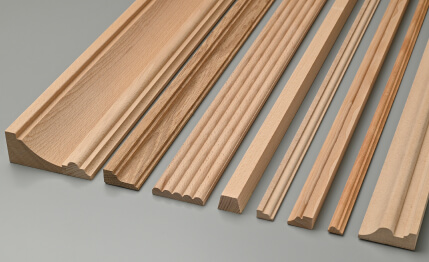
Wooden ceiling skirting board— is the highest category in the hierarchy of ceiling profiles. Natural solid oak or beech at the ceiling creates a sensation that no polymer material imitates: living texture, weight, warmth, character.
Wooden ceiling skirting is not just a decorative profile. It is an element of an architectural system that lives in conjunction with wooden cornices, floor skirting, architraves, and slatted panels. When all these elements are from the same wood species and the same system, the interior acquires that organicity and integrity that cannot be bought piecemeal.
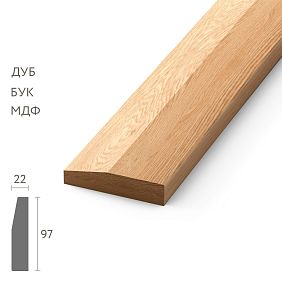
Technical parameters of wooden ceiling molding: flange width from 60 to 120 mm, strip length 2400–2800 mm, surface ready for varnish, oil, or paint. Mounted with adhesive or clips at the wall-ceiling junction.
It's worth buying wooden ceiling skirting when the room has parquet or engineered wood flooring, wooden doors with architraves, wooden or veneered furniture. The natural material at the ceiling continues the theme of natural material at the floor — this is flawless interior logic.
There is one limitation: wood at the ceiling requires a stable microclimate. In rooms with constant fluctuations in humidity and temperature — kitchen, bathroom — wooden molding is not suitable.
Get Consultation
Baseboard — it is a modest detail, often unnoticed, but plays a critical role in creating the completeness of the interior.
MDF ceiling molding is the working standard for Moscow apartments in the above-average segment. Perfectly even cross-section, stable geometry, smooth surface, ready for painting in any color.
White MDF ceiling skirting is the most popular option. It joins with painted walls of any color, creates a clear horizontal line at the ceiling, and, with proper installation, gives the space a sense of completion without decorative overload.
Buying MDF skirting for painting is a sensible decision when you want to precisely match the color to a specific shade of the ceiling or walls. Painting it in tinted white, a complex gray, or a shade matching the door frames — all this is possible after installation.
In the catalogwooden and MDF skirting boardspositions from 60 to 120 mm are presented, straight and shaped profiles, white and for painting — the full range for ceiling installation.
Polystyrene ceiling cornices
Polystyrene is lightweight, cheap, and accessible. This is a material that long occupied the niche of 'budget ceiling skirting' and remains popular in Moscow due to its low price and ease of installation.
Ceiling cornice made of polystyreneIt adheres directly at the junction of the wall and ceiling, is cut with a hand saw or utility knife, and is installed without special tools. This is perhaps the most accessible entry point into the topic of ceiling decor.
However, polystyrene has fundamental limitations: low strength, sensitivity to mechanical impacts, and it can deform under strong heat. For formal rooms with high quality requirements, it is not the best choice. For utility, technical rooms, temporary housing, or budget solutions, it is quite workable.
Polystyrene ceiling skirting boards— detailed analytics on types, profiles, and usage scenarios.
Polyurethane decorative profiles
Polyurethane is a category often called 'wood for wet areas' in the ceiling segment. A dense decorative material that imitates stucco, wood carving, and classic cornice profiles with a high degree of detail.
Buy polyurethane ceiling skirting — for classic, neoclassical, and baroque interiors where decorative relief is important, but there is no possibility or budget for plaster stucco. Polyurethane is lightweight, does not require special skills for installation, and is easy to paint.
An important advantage over polystyrene: significantly higher mechanical strength, better shape retention, and the relief is sharper and more detailed.
How to choose a ceiling skirting board by material
Material is not just about aesthetics. It's about durability, suitability for a specific room, and alignment with the overall decor system.
When wood is better
Wooden ceiling profile is chosen where the naturalness of the material is a principle, not an option. A country house with wooden structures, an apartment with oak parquet, a living room with wooden doors and furniture made of natural veneer — in each of these cases, wood on the ceiling is the only organic solution.
It's worth buying wooden ceiling skirting even when you are building a unified decor system: floor skirting, ceiling cornice, wall moldings — all from the same wood species. This is an interior with architectural integrity that cannot be faked.
Condition: a dry room with normal humidity. Living room, bedroom, study, dining room, children's room — yes. Kitchen by the sink, bathroom, toilet — no.
When MDF is more convenient
MDF excels where precision and scale matter. Long straight spans in open-plan layouts, large living rooms, corridors with perfectly straight geometry—MDF profiles deliver flawless ceiling lines without the slightest deviation.
Buying MDF ceiling skirting is the right choice for those who want a white ceiling profile in a modern minimalist interior. White MDF skirting against a white ceiling creates a smooth transition that 'lifts' the visual height of the room.
When polystyrene is more advantageous
Polystyrene—where the task is simple: neatly close the wall-ceiling joint on a limited budget. Technical rooms, country houses during finishing stages, temporary solutions—polystyrene handles the basic function and doesn't require professional installation.
When a decorative polyurethane profile is needed
Polyurethane—when relief is needed. Classic cornices with ovals, volutes, acanthus leaves, meanders—all reproduced in polyurethane with stunning accuracy. For neoclassical, classical, and any interior with pronounced architectural detailing—polyurethane ceiling profiles are a practical and impressive alternative to plaster.
How to choose a ceiling skirting board by width and profile
Ceiling skirting width is one of the key visual parameters. It directly affects room proportions: a narrow profile 'dissolves' at the ceiling, a wide one creates a substantial architectural accent.
Narrow profile for low ceilings
Ceiling skirting 40–60 mm wide—for rooms with ceilings up to 2.6–2.7 meters. In typical Moscow panel apartments, this is the most common scenario: ceilings are low, and the skirting's task is to close the joint without drawing attention or adding heaviness.
A narrow white profile at the ceiling in a low room works almost invisibly: it's there, the joint is closed, the space isn't cramped. Visually, this creates a sense of lightness—the ceiling seems to 'lift'.
Buying narrow ceiling skirting is the right choice for compact spaces: small bedrooms, children's rooms, kitchens, hallways, bathrooms.
Medium universal profile
60–80 mm—the golden mean that works in most Moscow apartments. Wide enough to be a noticeable architectural element, yet not overwhelming the space with standard ceiling heights of 2.6–2.9 meters.
White ceiling skirting 70–80 mm—the best-selling format. It's equally organic in a modern interior with a straight profile and in neoclassical with moderate molding.
Wide skirting board for high ceilings
100–120 mm and above — for rooms with ceilings from 2.9–3.0 meters and above. Stalin-era buildings, pre-revolutionary housing stock, modern business-class residential complexes with high ceilings — here a wide ceiling skirting board is a norm of proportion, not a luxury.
Buying a wide ceiling skirting board for a living room with 3.2-meter ceilings means setting the right scale. A narrow profile in a tall room looks helpless: the space 'demands' a proportionate horizontal line at the ceiling.
Proportion rule: the width of the ceiling skirting board is approximately 1/40–1/50 of the room's height. With a 3.0-meter ceiling — 60–75 mm. With a 3.3-meter ceiling — 80–100 mm.
Smooth profile
A smooth rectangular profile is modernity. No beads or relief transitions, only a pure cross-section. Next to smooth white walls, minimalist lighting, and wooden slats — a smooth ceiling skirting board creates that 'architectural honesty' valued in contemporary interiors.
A straight profile at the ceiling in an interior with slatted accent walls is a subtle balance: vertical slats and a horizontal smooth skirting board form a system of perpendicular lines that structures the space without unnecessary words.
Decorative Profile
A decorative profile with relief — for classic, neoclassical, art deco, empire, baroque, and any interior where architectural details are a meaningful part of the concept. A cornice with ovals, leaves, geometric inserts, with a smooth body and relief bands — this is the language of architectural ornamentation, existing for millennia.
Buying a decorative ceiling skirting board for a living room in a classic style means incorporating the room into the grand tradition of European interior, where every detail carries semantic weight.
How to choose a ceiling skirting board for the room
The room is the context. The same skirting board width works completely differently in a living room and a bathroom.
For the living room
The living room is the main stage. The ceiling skirting board is always visible here, viewed from different angles and under different lighting. To make a mistake here is to err in the most prominent place.
To buy a ceiling skirting board for a living room, consider three parameters: ceiling height (determines width), interior style (determines profile), and material (determines durability and decorative system).
Wooden ceiling molding for a living room with parquet flooring is an impeccable solution. White paintable MDF for a living room with 2.7–2.9 meter ceilings is a modern and practical pair. A wide polyurethane cornice for a living room in a classic style with high ceilings is for where decorativeness is important.
For the bedroom
In the bedroom, ceiling molding should contribute to an atmosphere of rest and tranquility. Nothing flashy, no excessive decor. A narrow or medium profile 60–80 mm, smooth or with a delicate bead, white or matching the walls.
A special scenario for the bedroom: ceiling molding with lighting — a profile with a protruding shelf behind which an LED strip is laid. Soft diffused lighting near the ceiling turns the bedroom into a space with a controllable atmosphere. This is one of the most popular requests in Moscow design projects in recent years.
For Kitchen
The kitchen is an area with high humidity and active use. Wooden ceiling molding in the kitchen without protective coating risks quickly losing its shape. MDF at the kitchen ceiling is acceptable with good ventilation and no direct contact with steam. Polystyrene and polyurethane are the most practical solutions for the kitchen: they are not afraid of moisture and are easy to clean.
Buying white ceiling molding for the kitchen is the right strategy. White is neutral and goes well with any color of kitchen cabinets and walls.
For the hallway
In the hallway, ceiling molding is an element that creates the first visual impression upon entering the apartment. Narrow or medium profile, white or neutral. Wood — if the hallway is spacious and continues the general wooden decor of the apartment. Polystyrene or MDF — if the hallway is small and the task is minimal.
For apartments
When furnishing an entire apartment, the principle of systematicity works to its full extent: one profile and one color for all rooms, one material or a combination of materials by zones. Woodenbuy skirting for the ceilingfor living rooms and polystyrene or MDF for the kitchen and bathroom — this is a systematic approach that provides both a unified look and a practical result.
For a country house
A country house is a space where natural materials are in their organic environment.wooden cornices and skirting boardsmade of solid oak or beech at the ceiling of a country house is not a claim to luxury, but a natural choice of material that harmonizes with wood, stone, rough textures, and natural fabrics.
In a country house with high ceilings of 2.9–3.2 meters, a 100–120 mm solid oak ceiling skirting board creates a substantial horizontal line that 'holds' the scale of the space.
Ceiling skirting board for a stretch ceiling and a regular ceiling
The type of ceiling directly influences the choice of profile. This is not an obvious nuance, but an error here is immediately visible.
What to choose for a stretch ceiling
A stretch ceiling is a PVC or fabric sheet attached to a batten around the perimeter. The joint between the sheet, batten, and wall often requires masking. For stretch ceilings, special ceiling skirting boards with one flat shelf are used, which covers the batten of the stretch sheet.
Important: a standard ceiling skirting board with two shelves (to the wall and to the ceiling) is not suitable for a stretch ceiling—the second shelf presses against the sheet. A profile with one shelf to the wall is needed.
The width of the shelf should completely cover the mounting batten—usually 30–50 mm. When choosing, confirm with the supplier that the profile is compatible with a stretch ceiling.
What to choose for a painted ceiling
A painted ceiling is a standard scenario in most Moscow apartments. Here, the ceiling skirting board is mounted in the wall-ceiling corner with two support points. The choice of profile is unrestricted: wood, MDF, polystyrene, and polyurethane—all work.
The only requirement: the skirting board must fit tightly to both surfaces. For uneven walls (common in Moscow's Soviet-era buildings)—a soft profile that allows compensating for minor deviations.
What to choose for high ceilings
High ceilings from 2.9 meters require a wide ceiling skirting board—otherwise, a thin profile gets lost in the height and creates a sense of incompleteness. Buy a wide ceiling skirting board for rooms with ceilings of 3.0–3.5 meters: 100–120 mm or more.
A special scenario—3.0-meter ceilings paired with multi-level decor: a ceiling cornice, a molding belt on the wall, and a floor skirting board form a unified vertical architectural system.
What to choose for low ceilings
Low ceilings (up to 2.5–2.6 meters) are a common scenario in Moscow's Khrushchyovka apartments and some panel housing. Here, the skirting board's task is not to add heaviness. A narrow 40–50 mm profile in the color of the ceiling (white on white) — the skirting almost disappears in the corner, the joint is closed, and the space is visually not cramped.
Trick: if you paint the ceiling skirting in the color of the ceiling, and the walls in a more saturated shade, the visual height of the room increases due to a clear horizontal boundary.
What to combine ceiling skirting with in interior design
Ceiling skirting is not a standalone element. Its strength is revealed in a system.
With wall moldings
Moldings and corniceson the walls create architectural belts, frames, and niches. The ceiling skirting closes this system from above. Together they form a full-fledged architectural shell of the room.
Principle: moldings, cornice, and ceiling skirting from the same collection, with coordinated proportions. Choose from a single assortment — this guarantees harmony without the need to guess the ratios yourself.
Where it is especially effective: living rooms with ceilings from 2.9 meters, classic and neoclassical interiors, apartments in Stalin-era buildings with historical stucco.
With wooden trim
Wooden ceiling skirting in a system with woodenmoldings, cornicesand floor skirting boards from the same wood species — this is the most consistent and convincing interior scenario. Wood at the ceiling, wood on the walls, and wood at the floor — three levels of natural material that create a unified, warm, living atmosphere.
With polyurethane molding
Polyurethane ceiling skirting works well in combination with polyurethane rosettes, brackets, corner elements, and moldings. All this 'light stucco' is installed without special skills and creates the impression of a richly decorated room at moderate cost.
Buy polyurethane ceiling skirting in Moscow — and simultaneously order corner inserts and skirting rosettes from the same collection: this is the only way to achieve coordinated decor without gaps and mismatches.
With floor skirting in a unified interior system
Ceiling and floor skirting are the upper and lower horizontal lines of a room. When they are made of the same material, same profile, and same color — the space gains rhythmic completeness. The eye travels from floor to ceiling along coordinated horizontals, encountering no contradictions.
baseboardand an oak ceiling cornice in the same tint — this is not a 'coincidence,' but a deliberate architectural decision. This is exactly how professional designers work: from system to detail, not from detail to system.
With slatted panels
Rafter panelson walls create a vertical wooden texture. The ceiling skirting in this system is the upper boundary of the slatted field: the slats 'end' under the ceiling profile, which visually 'gathers' them.
Wooden ceiling skirting paired with wooden slatted panels and wooden floor skirting — this is an interior system with a complete wooden contour of the room: from below, above, and on the wall. Such interiors look expensive, warm, and professional — despite being based on the simple logic of material unity.
Comparative table of ceiling skirting materials
| Parameter | Wood | MDF | Polystyrene | Polyurethane |
|---|---|---|---|---|
| Naturalness | High | No | No | No |
| Moisture resistance | Low | Medium | High | High |
| Paintability | Yes | Yes | Yes | Yes |
| Mechanical strength | High | Medium | Low | Medium |
| Relief / decor | Limited | Limited | Moderate | High |
| Installation | Professional | Standard | Independent | Standard |
| Profile Width | 60–120 mm | 60–120 mm | 40–120 mm | 50–200+ mm |
| Application | Dry rooms | Any dry | Any | Any |
Where to buy ceiling skirting in Moscow
Practical block. What's important when choosing a supplier — specific and without generalities.
Availability and delivery. In Moscow, renovation doesn't wait. A proper supplier keeps the entire range in a Moscow warehouse: wooden, MDF, polystyrene, polyurethane profiles. Pickup today or delivery tomorrow — this is not a privilege, but a basic standard. Planks 2400 mm long require professional packaging for transportation — clarify this in advance.
Selection by material. All four categories should be presented with samples. A profile on screen and a profile in hand are two different experiences. Only a physical sample shows the actual surface density, precision of relief, and shade of white (which varies from warm milky to cold snowy).
Selection by profile. Comparing profiles of different widths and different reliefs is better done in space, not from a catalog. In the showroom, hold the sample at the wall-ceiling junction — only then can you see how it will work in a real room.
Matching to interior style. A competent supplier helps form a system: ceiling skirting + moldings + floor skirting from a single collection. This is not 'upselling,' but a professional recommendation that saves your money and protects against mistakes.
Go to catalog. Full assortmentof wooden cornices and skirting boardsmade of solid wood, polystyrene and polyurethane solutions — available online for preliminary review.
Common mistakes when choosing
A profile that is too narrow for a high-ceilinged room
They take a narrow profile 40–50 mm for a living room with 3.0-meter ceilings — and get a line at the ceiling that gets lost in the height of the space. The skirting is there, but it's as if it isn't. The proportion is broken.
Solution: before purchasing, determine the ceiling height and use the 1/40–1/50 rule. For a 3.0-meter ceiling — minimum 60–75 mm. For a 3.3-meter ceiling — 80–100 mm.
Incorrect material for the task
Wooden ceiling molding in the kitchen near the stove — darkens and warps from steam within a year. MDF in a poorly ventilated bathroom — swells along the bottom edge.
Solution: kitchen, bathroom, toilet — use polystyrene or polyurethane. No compromises for 'beautiful wood' that will need replacement within a year.
Overly ornate decor for a simple interior
They choose a wide polyurethane cornice with lavish relief for a modern, minimalist interior — and get a visual conflict: an overloaded ceiling molding against smooth white walls and minimalist furniture.
Solution: decorative molding — only with a matching interior context. Classic requires decor. Minimalism requires smooth molding. Mixing is not allowed without a well-thought-out concept.
Lack of coordination with wall and floor decor
They buy ceiling skirting separately from floor skirting, moldings, and architraves. As a result, each element is 'its own,' and together they don't form a system.
Solution: plan the entire system before the first purchase. Ceiling skirting, floor skirting, moldings, cornices — from the same range, same wood species, same profile. This requires one visit to the showroom with samples of all materials — and yields a result that will withstand any living room inspection.
Conclusion
Ceiling skirting is the upper horizontal point of the interior, and it deserves no less attention than any other design decision in the apartment.
Choose the material according to the room conditions: wood — for dry, formal spaces; MDF — for precise white profiles in modern interiors; polystyrene and polyurethane — for wet areas and decorative scenarios. Determine the width by ceiling proportions: narrow — for low rooms, wide — for high ones. Choose the profile by style: smooth — for minimalism and contemporary, decorative — for classic and neoclassical.
Start with the catalog:Wooden ceiling skirting boardmade from oak and beech array — for natural interiors.Ceiling cornice made of polystyrene— for practical and budget-friendly solutions. Pair it withMoldings and cornicesfrom a unified system — and the interior will achieve architectural completeness.
About the company STAVROS
STAVROS is a Russian manufacturer of architectural decor for interiors. The range includes: ceiling skirting boards and cornices made from natural wood (oak, beech), MDF profiles for painting, moisture-resistant polyurethane and polystyrene cornices and skirting boards from the HI WOOD line.
All STAVROS products are developed as a unified architectural system: ceiling skirting boards, moldings, cornices, floor skirting boards, and paneling are created in coordinated proportions and profiles. This allows assembling a complete decorative contour of a room — from floor to ceiling — using products from a single manufacturer.
STAVROS works with private clients, interior designers, and architects. Delivery across Moscow and all of Russia, in-stock availability, showroom with samples.
Frequently asked questions
How does a ceiling skirting board differ from a floor skirting board?
A ceiling skirting board is installed in the wall-ceiling corner and has two shelves — one for the wall and one for the ceiling. A floor skirting board is installed in the wall-floor corner. Technically and in profile, they can be similar, but functionally and in width — they differ. A ceiling skirting board is typically narrower than a floor one and often has thinner walls.
Can the same skirting board be used for the ceiling throughout the entire apartment?
Yes, and this is the correct strategy for visual unity. One profile, one color across all rooms — the interior is perceived as cohesive. The material can vary depending on conditions: wood or MDF in living rooms, polystyrene or polyurethane in the kitchen and bathroom.
How to choose the width of a ceiling skirting board?
Rule: 1/40–1/50 of the ceiling height. For a 2.7-meter ceiling — 55–70 mm. For a 3.0-meter ceiling — 60–75 mm. For a 3.3-meter ceiling — 80–100 mm. For a stretch ceiling, consider the width of the mounting batten: the skirting board must completely cover it.
How to install a wooden ceiling skirting board?
On construction adhesive or mounting silicone — for wood and MDF. Apply adhesive to both shelves, press the profile into the corner, and hold until polymerization. For long spans, additional fixation with finishing nails is recommended. Polystyrene skirting is installed with special adhesive for ceiling skirting boards.
Is it necessary to prime MDF skirting before painting?
Absolutely. MDF has a porous surface that, without primer, absorbs paint unevenly. One coat of acrylic primer — and the surface is ready for even application of paint in 2–3 coats. After installation, joints are filled with acrylic sealant — it remains elastic under minor deformations.
Which ceiling skirting board to choose for a stretch ceiling?
A special ceiling profile with one working shelf — to the wall. The second shelf in standard profiles rests against the stretch ceiling fabric. The width of one shelf must completely cover the mounting batten. Check compatibility with the supplier when purchasing.
How to properly join a ceiling skirting board in an internal corner?
Two methods: cutting at a 45° angle using a miter box or template, or using ready-made corner inserts. Corner inserts are simpler and neater for DIY installation, especially for decorative profiles with relief. Cutting provides more precise results with experience and tools.


