Article Contents:
- Philosophy of choice: understanding needs and possibilities
- Defining stylistic concept
- Budget planning and priorities
- Technical limitations and capabilities
- Materials science: the science of modern moldings
- Polyurethane: technology of the new generation
- Comparative analysis of materials
- Innovative developments and prospects
- Product typology: from simple to complex
- Linear elements: basis of composition
- Framing elements: accents and details
- Central elements: focal points
- Stylistic directions: choosing the character of the interior
- Classic styles: timeless beauty
- Historical styles: national characteristics
- Modern directions: functionality and minimalism
- Selection technology: criteria and methodologies
- Material quality assessment
- Compliance with technical requirements
- Economic calculations
- Purchase process: from planning to delivery
- Preliminary calculations and planning
- Supplier selection and order placement
- Logistics and goods acceptance
- Installation work: from theory to practice
- Preparation stage
- Technology of installing various elements
- Finishing
- Operation and maintenance: longevity of investment
- Rules for caring for polyurethane moldings
- Repair and Renewal
- Warranty service
- Trends in development: the future of decorative moldings
- Technological Innovations
- Ecological requirements
- Integration with smart technologies
Have you ever wondered what distinguishes a bland apartment from a home where you want to spend time? The secret lies in the details — it is precisely they that create the atmosphere of coziness and elegance. When the task arises buy decorative moldingsMany get lost in the variety of options and don't know where to start. The modern market of architectural decoration offers truly limitless creative possibilities, but only a thoughtful approach will allow you to turn dreams of a beautiful interior into reality.
Decorative moldings have long ceased to be a privilege of palaces and mansions. Revolutionary polyurethane manufacturing technologies have made this type of decoration accessible to anyone who strives for beauty and individuality. Today, you can create an atmosphere of classic elegance or modern sophistication in any space — from a modest studio to a spacious country house.
Choosing quality decorative elements is an art that requires understanding of materials, styles, and technical specifics. In this exciting journey through the world of architectural decoration, we will reveal all the nuances of purchasing moldings, share professional secrets, and help you avoid typical mistakes made by beginners.


Philosophy of choice: understanding needs and possibilities




Defining stylistic concept
Before heading out to shop, it is necessary to clearly define the stylistic direction of the future interior. Classicism requires strict proportions and symmetrical compositions. Baroque allows for opulence and theatrical expressiveness. Modern styles favor smooth lines and natural motifs. Contemporary styles lean toward minimalism and functionality.
Each style dictates its own rules for selecting decorative elements. Dimensions, proportions, ornament character — all of this must harmonize with the overall concept. Mixing styles is possible, but requires a deep understanding of their characteristics and a refined sense of proportion.
Analyzing architectural features of the room will help determine the scale of decoration. High ceilings allow for the use of massive elements, while low ceilings require a more delicate approach. Layout influences the choice of compositional solutions — symmetrical or asymmetrical.
Our factory also produces:


Budget planning and priorities
Proper budget planning is the key to successful project implementation. The cost of decorative elements varies widely depending on the material, complexity of execution, and manufacturer. Polyurethane moldings offer an optimal price-to-quality ratio for most projects.
Defining priorities will help rationally distribute funds. Ceiling moldings create maximum visual impact at relatively low cost. Window and door casings dramatically change the perception of openings. Wall panels add nobility and sophistication to the interior.
Phased implementation of the project allows spreading costs over time. You can start with basic elements — moldings and trim — gradually adding to the composition with rosettes, moldings, and decorative appliqués. This approach allows you to evaluate the results and make adjustments to the initial plan.
Get Consultation
Technical limitations and possibilities
Structural features of the building impose certain limitations on the choice of decorative elements. Load-bearing capacity of floors determines the maximum allowable weight of decoration. Modern polyurethane products solve this problem due to their minimal weight and high strength.
The condition of the base affects the choice of mounting method. Smooth, strong surfaces allow for adhesive bonding. Uneven or weak bases may require additional mechanical fastening.
Climate conditions of operation determine material requirements. Rooms with high humidity require elements particularly resistant to moisture. Sudden temperature fluctuations require materials with low thermal expansion coefficients.
Materials science: the science of modern moldings
Polyurethane: technology of the new generation
Polyurethane has brought a true revolution to the industry of decorative materials. This high-tech polymer combines lightness, strength, moisture resistance, and the ability to precisely reproduce the most complex forms. The density of quality polyurethane is 600-800 kg/m³, which is three times lighter than plaster and five times lighter than natural stone.
The molecular structure of polyurethane provides its unique properties. Polymer chains create a flexible yet strong network that resists deformation and cracking. Special additives enhance resistance to ultraviolet radiation, prevent microbial growth, and improve adhesion to various substrates.
The production technology of polyurethane moldings is based on injection molding into high-precision molds. This allows reproducing the finest ornament details with accuracy down to tenths of a millimeter. Modern automated production lines ensure consistent quality and minimal dimensional deviations.
Material comparison analysis
Plaster moldings remain the benchmark of quality for enthusiasts of classical technologies. Natural material possesses a unique energy and incomparable texture. However, its heavy weight, brittleness, and susceptibility to moisture limit its application in modern construction.
Polystyrene is attractive due to its low cost and ease of processing. The lightness of the material allows creating large-scale elements without risking overloading structures. Main drawbacks include flammability, brittleness, and the need for protective coatings to prevent UV degradation.
Wooden moldings remain popular in certain stylistic directions. The natural texture of wood is indispensable for interiors in country, Provence, or eco styles. Limitations are associated with wood’s susceptibility to moisture, insects, and microorganisms.
Innovative developments and prospects
New-generation composite materials combine the advantages of various components. Polyurethane reinforced with fiberglass has increased strength while retaining lightness. Adding mineral fillers improves fire resistance and reduces production costs.
Nanotechnologies open new possibilities for improving decorative material properties. Titanium dioxide nanoparticles impart self-cleaning properties to surfaces. Silver in nanoscale form provides antibacterial effects.
Biodegradable additives make polyurethane more environmentally friendly without compromising performance. After the end of their service life, such materials degrade faster in natural conditions, reducing environmental impact.
Product Typology: from simple to complex
Linear Elements: the basis of composition
Ceiling skirting boards create a finished interior and conceal junctions between walls and ceilings. Simple profiles 50–80 mm wide suit modern interiors. Complex multi-profile skirting boards up to 200 mm wide create a classic atmosphere. Polyurethane skirting boards with a channel for lighting combine decorative and functional components.
Floor skirting boards protect the lower part of walls from mechanical damage and give the room a finished look. Height varies from 80 to 150 mm depending on the interior scale. Modern skirting boards often feature cable channels for concealed wiring.
Wall moldings are universal elements for creating decorative compositions. They can frame paintings and mirrors, create panels, or simply decorate bare walls. The variety of profiles allows moldings to be selected to match any interior style.
Accent and Detail Elements: Framing Elements
Door and window casings dramatically change the perception of openings in a room. Simple rectangular profiles suit minimalist interiors. Ornately decorated casings with vegetal motifs create a classic atmosphere. Polyurethane trim are easy to install and require no special maintenance.
Architectural elements zone space and create architectural logic. Semi-circular arches suit classical interiors. Pointed arches are characteristic of Gothic style. Elliptical arches create a sense of dynamism and modernity.
Columns and pilasters add monumentality and grandeur to interiors. Hollow polyurethane columns with diameters from 200 to 500 mm weigh dozens of times less than stone counterparts. Different types of capitals determine the stylistic affiliation of elements.
Central Elements: Focal Points
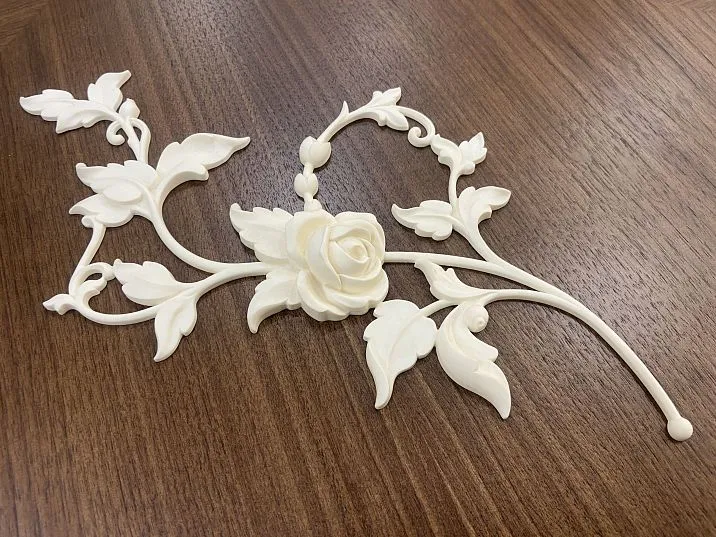
Ceiling rose centers serve as compositional focal points in interiors. Diameter varies from 300 mm for small rooms to 1500 mm for spacious halls. Classical rose centers are adorned with acanthus leaves, roses, grapevines. Modern ones feature geometric strictness and minimalist ornamentation.
Wall medallions create decorative accents and can serve as frames for paintings, mirrors, or other artworks. Sizes are selected according to the scale of the room and surrounding objects.
Corner elements solve complex compositional tasks at intersections of different planes. They can be purely decorative or functional — concealing engineering utilities or reinforcing structures.
Stylistic Directions: Choosing the Character of the Interior
Classical Styles: Time-Tested Beauty
The classical style is based on the canons of ancient Greek and Roman architecture. Characteristic elements include meanders, palmettes, acanthus leaves, and Ionic columns. Proportions are strictly mathematically calculated and based on a modular system. The color palette is restrained — white, cream, gray.
Renaissance introduced greater freedom and variety of ornamentation to the classical foundation. Vegetal motifs become more naturalistic. Images of putti, fantastical creatures, heraldic compositions appear. Proportions retain the classical foundation but allow for some liberties.
Baroque is characterized by opulence and theatricality. Ornaments become three-dimensional and dynamic. Vegetal motifs intertwine into complex compositions. Cartouches, shells, garlands appear. Rococo asymmetry adds elegance and lightness to Baroque grandeur.
Historical Styles: National Characteristics
Gothic style is characterized by vertical compositions and pointed arches. Vegetal ornaments are stylized and symbolic. Images of grapevines as Christian symbols are characteristic. Stone carving serves as a prototype for modern interpretations.
Byzantine style combines Eastern opulence with Christian symbolism. Ornaments are often based on geometric constructions. Vegetal motifs predominate — grapevines, palm branches, lilies. The color palette is rich with gold and purple tones.
Russian style has several directions. Ancient Russian architecture is characterized by vegetal ornaments stylized after wood carving. Russian Empire style of the 19th century combines classical forms with national symbols — double-headed eagles, laurel wreaths.
Modern Directions: Functionality and Minimalism
Modernism abandoned historical canons in favor of natural forms. Vegetal motifs become the basis of ornamental compositions. Popular are images of irises, lilies, dragonflies, butterflies. Lines are smooth and dynamic. Asymmetry becomes a compositional principle.
Art Deco combines luxury with geometric clarity. Ornaments are based on stylized vegetal and animal motifs. Characteristic are zigzag lines, sun rays, fountains. Materials — noble metals, exotic wood species.
Modern minimalism strives for extreme simplification of forms. Decorative elements have clear geometry and minimal relief. The main task — to create a spatial structure without overloading it with details. The color palette is monochromatic.
Visual inspection — the first stage of assessing product quality. The surface should be smooth, free of pits, bubbles, and mechanical damage. The color should be uniform across the entire element area. Edges should be straight, without chips or burrs.
Material Quality Assessment
Tactile inspection complements visual assessment. High-quality polyurethane has a dense, uniform structure. When pressed with a finger, the material should slightly deform and then return to its original shape. Brittleness or excessive softness indicates a violation of the manufacturing process.
Geometric inspection is performed using measuring tools. Deviations from nominal dimensions must not exceed ±1 mm for elements up to 2 meters in length. Profile curvature is unacceptable — the element must lie flat on a level surface along its entire length.
Compliance with technical requirements
Compliance with technical requirements
Product certification confirms compliance with technical regulations and environmental standards. Required documents include a fire safety certificate, a sanitary norms compliance assessment, and a declaration of conformity to technical regulations.
Technical characteristics must match the parameters declared by the manufacturer. Material density determines its strength and durability. Water absorption indicates resistance to moisture. Temperature resistance is crucial for elements subjected to heating.
Manufacturer's warranty obligations indicate confidence in product quality. The minimum warranty period for interior moldings is 10 years, and for facade moldings — 15 years. Serious manufacturers offer extended warranties for premium products.
Economic calculations
Material costs account for 60-70% of total project expenses. Remaining expenses include installation, preparatory work, and finishing materials. Self-installation can save 30-40% of the total cost.
Comparing offers from different suppliers should consider not only price but also delivery terms, warranties, and after-sales service. Cheap products often turn out more expensive in operation due to the need for premature replacement.
Investment return calculation shows the economic efficiency of the project. Quality molding increases property value by 10-15%. For an apartment valued at 10 million rubles, this means an increase in value by 1-1.5 million rubles at a decoration cost of 200-300 thousand rubles.
The purchasing process: from planning to delivery
Preliminary calculations and planning
Material specification preparation begins with detailed room measurements. All dimensions are recorded in drawings or sketches, indicating types and sizes of decorative elements. It is recommended to order material with a 10-15% surplus to compensate for technological losses.
Supply planning must consider the repair schedule. Molding is delivered after plastering is completed but before final finishing. Early delivery creates storage issues, while late delivery delays the entire project.
Storage area preparation requires specific conditions. The room must be dry with a temperature of 15-25°C. Long elements are stored horizontally on a flat surface. Small parts are packed in original packaging.
Supplier selection and order placement
Supplier reputation is a key factor in successful purchasing. Companies with long-standing histories and positive reviews deserve greater trust. Having their own production guarantees stable deliveries and quality control.
Product assortment and availability affect order fulfillment time. Large distributors maintain stock of popular items. Exclusive items may be custom-made within 2-3 weeks.
Delivery and payment terms must be clearly specified in the contract. Advance payment is typically 30-50% of the order amount. The remaining balance is paid upon receipt of goods. Large orders may be paid in stages.
Logistics and goods acceptance
Delivery of large items requires special transport. Long elements are transported in special containers or on open platforms. Fragile parts are packed in protective materials.
Unloading and lifting materials must be done carefully. Long elements are lifted vertically to avoid deformation. Heavy parts require lifting equipment or additional workers.
Goods acceptance is performed in the presence of the supplier's or transport company's representative. All damages and discrepancies are recorded in the acceptance act. This ensures the possibility of making claims if problems are discovered.
Installation work: from theory to practice
Preparation Stage
Foundation diagnosis determines the scope of preparatory work. Surfaces must be flat, strong, and dry. Irregularities exceeding 5 mm are leveled with plaster or putty. Weak areas are reinforced with deep-penetration primers.
Room marking is done using a laser level and tape measure. Horizontal lines are marked at the same height around the entire perimeter. Vertical axes are drawn considering the composition's centering relative to architectural elements.
Tool and material preparation must be completed in advance. Required items include a miter saw for precise cutting, a circular saw for long elements, adhesives, sealants, measuring tools, and fasteners.
Technology for installing various elements
Ceiling cornices are installed starting with the longest straight section. The element is coated with adhesive in zigzag motions and pressed onto the base. Corner joints are made using special corner elements or by precisely cutting at a 45° angle.
Polyurethane Crown Molding are attached using acrylic or polyurethane adhesive depending on operating conditions. Setting time is 15-30 minutes, full polymerization occurs within 24 hours.
Installing moldings requires special precision when creating compositions. First, the outlines of future panels are marked, then the elements are installed. Joints must be perfectly fitted — gaps over 1 mm will be noticeable after painting.
Final finishing
Joint sealing is performed using white acrylic sealant. Excess sealant is removed with a damp cloth before it dries. After drying, joints are sanded with fine-grit sandpaper to create smooth transitions.
Surface priming improves paint adhesion and equalizes absorbency. Water-based acrylic primers are used. Drying time is 4–6 hours depending on temperature and air humidity.
Painting is the final stage of work. For moldings, water-emulsion paints with varying degrees of gloss are used. Matte finishes conceal minor defects, while glossy finishes highlight relief and create light effects.
Operation and maintenance: longevity of investments
Care rules for polyurethane moldings
Regular dust cleaning extends the service life of decorative elements. Use soft cloth or vacuum cleaner with soft attachment. Wet cleaning is done with a mild detergent solution without abrasive particles.
Protection against mechanical damage is especially important for protruding elements. Care should be taken when moving furniture. Children’s toys and sports equipment should be used away from decorative elements.
Controlling the room’s microclimate prevents material deformation. Optimal temperature is 18–24°C, humidity is 40–60%. Sudden temperature and humidity changes are undesirable, especially in the first months after installation.
Repair and Renewal
Minor damage — scratches, chips — are repaired using acrylic sealant or automotive putty. After drying, the damaged area is sanded and painted to match the original finish.
Partial replacement of elements is possible due to the modular construction of most decorative systems. The damaged element is carefully removed, the surface is cleaned of adhesive residue, and a new part is installed.
The coating is renewed every 7–10 years to maintain the fresh appearance. The surface is lightly sanded to improve adhesion, primed, and painted. Changing the color palette is possible to refresh the interior.
Warranty Service
Manufacturer’s warranty covers material defects and manufacturing defects. The warranty does not cover damage caused by improper installation, operation, or mechanical impacts.
Document handling for warranty claims requires keeping purchase documents, photos of defects, and written communication with the supplier. Claim review periods are typically 10–30 days.
Post-warranty service may include care consultations, spare parts supply, and repair work. Serious manufacturers maintain long-term relationships with clients.
Trends in development: the future of decorative moldings
Technological Innovations
3D printing of master models opens up limitless possibilities for creating unique ornaments. Any shape, regardless of complexity, can be realized in material with precision down to tenths of a millimeter. Production times for exclusive items are reduced from weeks to days.
Automation of production processes improves product quality and consistency. Automated lines eliminate human error, ensure precise component dosing, and control temperature regimes.
Digital interior planning technologies allow you to see the result before work begins. VR and AR technologies enable you to "walk through" the future interior and evaluate various decor options.
Ecological Requirements
Transition to biodegradable components reduces the environmental impact of production. New polyurethane formulas retain all performance properties but degrade faster after the end of their service life.
Closed production cycles minimize waste. Scraps and technical defects are recycled into granules for reuse. This reduces cost and environmental footprint.
Certification according to international environmental standards is becoming a mandatory requirement. Products must comply with regulations on emissions of harmful substances, heavy metal content, and radiation safety.
Integration with smart technologies
Built-in lighting transforms decorative elements into functional lighting fixtures. LED strips integrated into cornices and moldings create an eye-catching ceiling and wall illumination.
Sensors in decorative elements open new possibilities for smart homes. Motion sensors activate lighting, air quality sensors control ventilation, temperature sensors regulate heating.
Changeable characteristics allow adapting decor to different conditions. Thermochromic coatings change color depending on temperature, electrochromic coatings — under the influence of electric current.
In the world of modern interior design, decorative moldings occupy a special place, combining centuries-old craftsmanship traditions with innovative production technologies. Choosing quality materials and applying them professionally allows creating spaces that not only delight the eye but also enhance the quality of life for their inhabitants.
Purchasing decorative moldings requires a comprehensive approach — from understanding stylistic features to technical nuances of installation. Investing in quality decor pays off not only in increased property value but also in daily enjoyment of living in a beautiful interior.
Choosing buy decorative moldingsIt is important to remember that these are not just decorative elements, but tools for creating atmosphere, expressing individuality, and realizing the dream of a beautiful home. Every detail matters, and each element contributes to the overall symphony of the interior.
For many years, the company STAVROS has remained a leader in producing high-quality polyurethane moldings, offering its clients not just products, but comprehensive solutions for creating unique interiors. Rich experience, use of advanced technologies, strict quality control, and an individual approach to each project make STAVROS a reliable partner in realizing the most daring design ideas. Choosing STAVROS products means investing in beauty, quality, and durability, creating interiors that will delight not just one generation of your family.