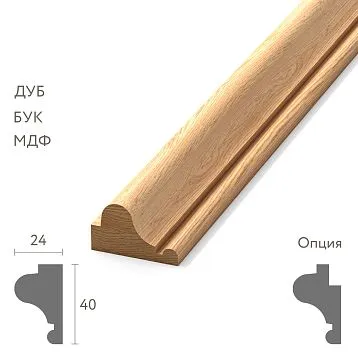
Article Contents:
- Concept of Monolithic Aesthetics in Staircase Architecture
- Catalog of Load-Bearing Elements
- Railing and Safety Systems
- Fastening Systems and Joint Connections
- Finishing Elements and Accent Details
- Material Palette and Textural Consistency
- Standards and Regulatory Requirements
- Installation Technologies for Flawless Results
- Color and Texture Solutions
- Integration of Additional Functions
- Custom Design and Adaptation
- Sustainability and Eco-Friendliness of Solutions
- Operation and Maintenance of Monolithic Composition
- Cost and Economic Logic
- Questions and Answers
- Conclusion

What distinguishes a truly outstanding staircase from a mere functional structure? The answer lies not in the luxury of individual details, but in the flawless harmony of all components. When treads, railings, supports, fasteners, and finishes merge into a single visual flow, a monolithic aesthetic emerges — the sensation that the staircase grew naturally from the space, rather than being mechanically assembled from disparate parts.
staircase componentsThis is not merely a set of functional parts. It is a dictionary of architectural language, through which the entire structure speaks. Each element carries a dual burden: technical and artistic. A baluster not only prevents falls but also sets the rhythm of verticals. A handrail does not merely provide support but guides the viewer along the path of movement. Fasteners not only connect parts but also influence the purity of lines.
Monolithic aesthetics require a deep understanding of principles of visual integrity. This is a philosophy according to which every detail must appear as if it cannot be replaced by anything else. Randomness is excluded. Arbitrary choices are unacceptable. Everything is subject to a single logic of form, material, proportions, and texture.
In this article, we do not merely list types of components — we reveal the system of their interaction, demonstrate how visual and structural harmony is created, teach how to read the architectural code of a staircase, and how to compose your own flawless compositions.


Concept of Monolithic Aesthetics in Staircase Architecture
The term 'monolithic aesthetics' originated in the philosophy of minimalism, where each object strives for maximum integrity. In the context of staircases, this means the structure is perceived as a single artwork, not as a mechanical sum of parts. This effect is achieved through several key principles.
Visual continuity is created by repeating basic forms and lines across all elements. If balusters have a cylindrical profile, the handrail repeats this curvature. If treads emphasize horizontality, the risers do not conflict with this orientation. Each line naturally flows into the next, creating a sense of smoothness.
Material unity implies consistency in textures, shades, densities. Oak treads require oak balusters — not for structural necessity, but for visual honesty. Mixing materials is permissible, but only if it adheres to a unified concept and enhances, rather than undermines, the overall impression.
Proportional harmony dictates the relationships between the sizes of all elements. The thickness of the handrail relates to the diameter of the balusters, the height of the riser aligns with the width of the tread, the cross-section of the posts correlates with the overall massiveness of the structure. Mathematical precision in proportions creates an unconscious sense of correctness.
Stylistic consistency requires that all elements speak the same architectural language. Classical turned balusters are incompatible with industrial metal fasteners. Minimalist rectangular handrails conflict with baroque carved posts. Each style has its own grammar of forms, and violation of this grammar destroys monolithic integrity.
Functional transparency means that the way the structure works is visually understandable. How treads bear weight, how balusters are fastened, how loads are distributed — all of this should be intuitively readable. Hidden paradoxes and visual contradictions disrupt the sense of wholeness.
Detailing and scale influence perception no less than large forms. The chamfer profile on the tread’s edge, the handrail’s rounding radius, the groove depth — these millimeters create or destroy the impression of meticulousness. Monolithic aesthetics arises from attention to details.
Light interaction between elements determines how the structure lives in space. Smooth surfaces reflect light differently than textured ones. Vertical balusters create a shadow play distinct from horizontal railings. Understanding light and shadow is part of working with monolithic aesthetics.




Catalog of Load-Bearing Elements
The load-bearing system of the staircase forms its skeleton, defining not only its strength but also the character of the entire composition.components for wooden staircasesItems in this category require special attention to the alignment of load-bearing characteristics and aesthetic solutions.
Steps are horizontal contact surfaces that bear the weight of a person and transfer it to the load-bearing structure. Their thickness varies from 40 to 60 mm depending on the wood species and span length. Oak steps 40 mm thick withstand the same load as pine steps 50 mm thick, due to differences in fiber density and strength.
Tread width is a critical comfort parameter. The standard 280–300 mm ensures stable foot placement for an adult. Reducing it to 250 mm makes ascent less comfortable, while increasing it to 350 mm slows down movement pace. For monolithic aesthetics, it is not only the absolute value but also its proportion to riser height that matters.
Step overhang — the protrusion of the tread beyond the riser — creates an expressive horizontal shadow and visually lightens the structure. The standard overhang is 30–40 mm, but its profile can vary: rectangular, rounded, beveled, or with a teardrop nose. Each profile creates its own line character and must harmonize with all other elements.
Risers are vertical surfaces covering the space between steps. Their height is calculated: for comfortable ascent, the optimal height is 160–180 mm. Riser thickness may be less than tread thickness — 18–25 mm — since the load here is different. In open staircases, risers may be absent, radically altering visual perception — the structure becomes more transparent, lighter, and airy.
Stringers are inclined load-bearing beams with notches for steps, visible from the side. Their cross-section is calculated based on span, load, and wood species. The minimum cross-section for an oak stringer with a 3-meter span is 60×250 mm. Aesthetically, stringers can be straight or curved, following step contours or creating their own graphics.
Stringers are side load-bearing elements into which step ends are embedded. They create a more enclosed, monumental character for the staircase. Their cross-section is similar to stringers, but precision requirements are higher — notches for steps must be perfectly parallel and evenly distributed.
Central beam — an option for cantilever staircases, where steps are clamped into a massive central element. Such a construction creates a dramatic effect of floating steps and requires a robust central support cross-section — from 150×300 mm and larger.
Balusters — metal rods that clamp steps together in baluster staircases. Diameter 16–24 mm, material — stainless steel. Baluster construction is minimalist and technologically advanced, but requires perfect drilling and assembly precision.
Our factory also produces:


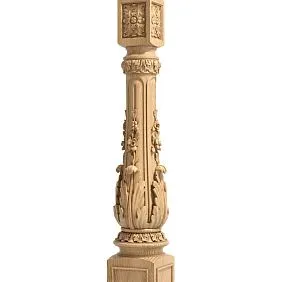
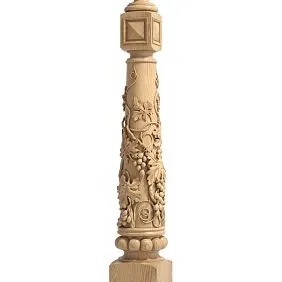

Safety and Guardrail System
Staircase railing performs a dual function: ensuring safety and establishing the primary visual rhythm of the structure.Balusters for staircaseand associated elements form a vertical graphic that dominates perception.
Balusters — vertical railing posts creating fill between steps and handrail. Standard height 900 mm ensures safety, but may vary depending on design. Cross-section is determined by post spacing and style: round turned 40–50 mm, square 40×40 or 50×50 mm, flat 30–40 mm thick with 70–120 mm width.
Turned baluster profiles create the primary rhythmic pattern. Classic shapes — vase, spindle, sphere, cone — have multi-century history and refined proportions. Modern profiles may be more minimalist, but must preserve visual logic: central thickening for visual stability, smooth diameter transitions, and consistency of all balusters in a row.
Flat carved balusters offer a different aesthetic — ornamental, decorative, linked to traditions of wooden architecture. Their thickness 30–40 mm allows creating intricate patterns of any complexity, from geometric to botanical. Monolithic quality here is achieved through repetition of ornamental motifs and harmony with other carved elements.
Posts — larger-section railing support elements installed at key points. Cross-section 80×80 mm or 100×100 mm, height exceeds baluster height by 150–200 mm. Posts accentuate the start and end of a flight, turns, creating compositional points in the baluster rhythm. Their design should be related to balusters but more imposing.
Handrail — element that literally guides along the staircase, creating a continuous guiding line. Its ergonomics are critical: cross-section must be comfortably grasped by hand. Optimal sizes for round handrail — diameter 50–60 mm, oval — 60×45 mm, rectangular with rounded edges — 70×50 mm. Surface is carefully sanded to a silky finish.
Underbaluster — lower guide to which balusters are attached. Not always used, but simplifies installation and adds an additional horizontal line to the composition. Cross-section is usually 40×60 mm or similar. Top edge may be profiled to match overall style.
Glass infill — alternative to wooden balusters, creating transparency and modernity. Uses tempered glass or triplex 10–12 mm thick. Mounting is done with special profiles or point holders. Glass requires framing with wooden posts and handrail to maintain material unity.
Combined systems combine wood with metal, creating a technological aesthetic. Metal cables, rods, forged elements are integrated into wooden frames. Key to monolithic unity — clear division of roles: wood provides warmth and structure, metal adds graphics and lightness.
Get Consultation
Fastening Systems and Joint Connections
Staircase quality is determined not only by visible elements, but also by how they are connected to each other. Fastening systems affect strength, durability, and — importantly for monolithic aesthetics — visual line purity.
Dowel joints — classic joinery, providing maximum strength with complete invisibility of fasteners. Dowel 12–16 mm in diameter at baluster end fits into handrail socket 40–50 mm deep. Joint is glued with wood or polyurethane glue, creating practically monolithic connection. For monolithic aesthetics, this is the ideal solution — no visible elements, absolute line purity.
Shank joints use wooden cylindrical rods 8–12 mm in diameter, inserted on glue into coaxial holes. Strength is slightly lower than dowel, but technology is superior — easier to ensure precision. Shanks are especially good for connecting steps to risers, where long joints are required.
Hidden screw systems use metal rods with threads screwed into end of parts. Modern systems allow complete concealment of fasteners while ensuring disassemblability of joints. Especially valuable for complex joints — connecting handrail to posts, fixing balusters in adjustable positions.
Corner connectors for handrails ensure strong joints at turns. These may be metal plates screwed from ends or special splines with complex profiles. Quality connectors allow creating visually seamless turns, which is critical for the sensation of continuous line.
Anchor fastening of posts to base requires maximum reliability. Uses metal bolts 16–20 mm in diameter, embedded in concrete base or wooden beam with epoxy glue. Embedment depth in each element — at least 80 mm. Post is slipped over bolt and secured from below with a nut concealed by a decorative cover.
Modern polymer adhesive technologies create joints stronger than wood itself. Polyurethane adhesives resist moisture and compensate for thermal deformations. Epoxy compositions provide maximum strength for metal-wood joints. Properly executed adhesive joint — is literally monolithic.
Adjustable fastening allows precise alignment of elements during installation and tightening as needed during operation. Especially important forposts and balusters for wooden staircases, where natural wood deformation may weaken rigid joints.
Decorative overlays and caps conceal mounting points, preserving surface cleanliness. Wooden plugs, flush-mounted and stained to match the main material, make fastening points virtually invisible. Carved newel caps cover handrail-to-post junctions, transforming technical necessities into decorative elements.
Finishing elements and accent details
Finishing elements complete the composition, adding detail and creating transitions between main components.decorative rose outletsand overlays play the role of architectural punctuation marks, setting accents and linking parts into a whole.
Carved newel caps are installed at element junctions, turning technical joints into decorative accents. Round caps with diameters of 80–150 mm and carved ornamentation cover the handrail-to-post joint. Corner caps frame the handrail’s junction with the wall. The carving style must be stylistically consistent with the overall design — botanical motifs for classic styles, geometry for modern styles.
Attached friezes and panels decorate stringers and side surfaces of stringers. Carved or profiled, they add additional rhythm to horizontal lines. It is important not to overload the composition — decoration should be measured, accentuating rather than obscuring the main structure.
Handrail end caps — small but important details, completing the handrail line. The simplest option is a rounded end carved directly into the handrail. More complex options include polished finials in the shape of spheres, vases, or acorns. The key is organic harmony and proportion relative to the overall scale.
Lighting as a finishing element is gaining increasing importance. LED strips embedded under steps or into the handrail create both functional and decorative lighting. For monolithic aesthetics, hidden integration is crucial — light should emanate from the structure, not hang on it as an extraneous element.
Surface texture affects both tactile and visual perception. Polished smooth steps reflect light and create a sense of luxury. Brushed surfaces with emphasized wood grain add tactile quality and naturalness. Sandblasting creates a matte, noble texture.
Decorative brackets for shelvescan be used to strengthen the visual connection between the staircase and the surrounding space. If the interior features open shelves on carved brackets, repeating these elements at staircase joints creates stylistic unity.
Color accents — a delicate tool requiring caution. Monolithic aesthetics lean toward monochromatic schemes, but measured use of contrasts can enhance the composition. Dark treads against light steps emphasize horizontal rhythm. Painted balusters against natural wood create a graphic effect.
Material palette and textural harmony
Material selection determines not only functional characteristics but also the entire atmosphere of the staircase. For monolithic aesthetics, material palette consistency is critical.
Oak — the king of staircase materials, combining strength, expressive texture, and noble color. Density of 650–750 kg/m³ ensures durability, hardness allows for thin profiled elements. Texture with pronounced growth rings creates natural decorativeness. Color palette ranging from light beige to dark brown allows flexible tonal work with interior design.
Ash is similar to oak in strength characteristics but has a lighter tone with a grayish hue and finer, yet contrasting, texture. Ash staircases create a sense of lightness and brightness while maintaining solidity. Particularly suitable for Scandinavian and modern interiors.
Beech features an exceptionally uniform fine-grained structure and a warm pinkish tone. After sanding, it creates a silky surface. Ideal for turned balusters with thin profiles — uniform structure allows for working with minute details. Requires stable environmental conditions due to hygroscopic nature.
Larch — a coniferous species with leafy density, combining strength with natural resistance to biological damage. Texture is expressive, with contrasting growth rings. Color is warm, ranging from light yellow to reddish-brown. High resin content protects against moisture. Optimal for staircases in homes with variable heating or in open spaces.
Spruce — an accessible material with soft wood, requiring cross-sectional increases of 20–30% to achieve the strength of hardwoods. Texture with clear early and late wood boundaries creates an expressive pattern. Easy to work with, accepts stains well. Suitable for budget projects and country-style interiors.
Combining materials expands the palette of expressive means, but requires a refined sense of proportion. Classic combination — oak treads and ash balusters — provides a light tonal contrast while maintaining material kinship. Combining wood with metal creates a technological modernity — steel balusters and glass infill with wooden framing.
Stone combined with wood creates a sense of monumentality. Marble treads with wooden railings — classic for grand staircases. Here, wood softens the coldness of stone, adding tactile warmth. Textures must be coordinated — polished marble requires smooth lacquered wood, while rough stone pairs well with matte oil-based finishes.
Metal is introduced selectively — as accents and structural elements. Stainless steel, brass, and blackened steel — each metal creates its own atmosphere. For monolithic aesthetics, consistency is key: if matte stainless steel is chosen, all metallic elements must be finished in the same manner.
Standards and regulatory requirements
Creating a staircase is not only an art but also an exact science, regulated by construction norms and safety rules. Monolithic aesthetics must be achieved within regulatory requirements, not against them.
Railing height — a basic safety requirement. For internal staircases in residential buildings, the minimum height from step surface to handrail top is 900 mm. For external staircases and balconies above the first floor — 1100 mm. These dimensions are proven by practice and ensure protection against falls for adults and children.
The distance between balusters in clear space should not exceed 100 mm in buildings where children may be present. This prevents a child’s head from slipping between balusters. For public buildings and residences without permanent children, a distance up to 150 mm is permitted. Aesthetics must be designed within these limits.
The width of the stair run determines the staircase’s capacity. Minimum for residential buildings — 900 mm clear space between handrails. Comfortable width for one person — 1000–1100 mm, for two people moving in opposite directions — 1250–1500 mm. Grand staircases may be wider, but then intermediate supports for the handrail are required.
Step height and width are regulated by the formula for comfortable ascent: 2h + b = 600–650 mm, where h is the riser height and b is the tread width. Optimal combinations: 150×300 mm, 160×290 mm, 170×280 mm. Deviations are permissible, but the less optimal the combination, the less comfortable the staircase.
The slope of the stair run is expressed as the ratio of height to horizontal projection and typically is 1:2 or 1:1.75 (26–30°). Gentler staircases are more comfortable but take up more space. Steeper staircases (up to 40°) are more compact but tiring. For monolithic aesthetics, it is important that the slope determines the proportions of the entire structure.
Element strength is calculated based on normative load of 300 kg/m² for residential buildings. Railing must withstand horizontal load of 100 kg applied to the handrail at a height of 900–1100 mm. Calculations are performed for each element, taking into account wood species and structural scheme.
Fire resistance of wooden structures is increased by fire-retardant treatment. For evacuation routes, fire resistance requirements are higher, sometimes wooden staircases are not permitted at all. In private homes, restrictions are fewer, but fire-retardant treatment is still recommended for safety.
Accessibility for people with disabilities requires special attention to ergonomics. The handrail must be continuous, easy to grasp, with tactile markers at the beginning and end of the run. For public buildings, duplicate handrails at 700 mm height may be required for children and wheelchair users.
Installation technologies for flawless results
Highest qualitystaircase componentsWill not yield the desired result without professional installation. Installation technology is part of creating a monolithic aesthetic.
Foundation preparation is the foundation of all work. The load-bearing structure must be absolutely rigid, without deflection or vibration. The concrete foundation is checked for flatness — allowable deviations no more than 2 mm per meter. Wooden beams are checked for deflection and reinforced if necessary. Any defects in the foundation will manifest in the finished staircase as creaking and loosening.
Material acclimatization before installation is mandatory. Wooden elements must be left in future operating conditions for at least one week, preferably two. This allows the wood to absorb or release moisture, reaching equilibrium. Installing non-acclimatized elements will result in gaps or deformations within a month or two.
Marking accuracy determines the visual quality of the result. Even minor deviations in baluster spacing, uneven distances, or deviations from verticality are immediately noticeable to the eye and destroy the sense of monolithism. Laser levels, precise templates, and measuring tools with accuracy no greater than 0.5 mm are used.
Dry assembly is a mandatory stage of professional installation. All elements are installed without glue and final fixation to check geometry and joint tightness. Problems identified at this stage are easy to fix. After final assembly, corrections are expensive or impossible.
Glue joints require care. Gluing surfaces are cleaned of dust, glue is applied evenly to both surfaces, elements are joined with slight rotation to distribute glue. Excess is immediately wiped off with a damp cloth — hardened glue is difficult to remove without damaging the wood. Waiting time until full polymerization — according to manufacturer’s instructions, usually 24 hours.
Mechanical fastening complements gluing. Even with modern polymer adhesives, additional fixation with self-tapping screws or dowels is recommended. This ensures reliability during glue curing and provides additional strength for the future.
Geometry control is performed at every stage. Baluster verticality is checked with a level accurate to 1 mm per meter of height. Step horizontal alignment is controlled across the entire width of the run. Baluster spacing uniformity is measured from axis to axis with accuracy of 1 mm. Only such meticulousness yields a flawless result.
Final finishing after installation includes filling mounting holes, sanding joints, and eliminating minor defects. Wooden plugs are inserted into screw holes, trimmed flush, and sanded so mounting points are practically invisible. Element joints are checked for tightness, and minor gaps are filled with wood-colored putty.
Application of final finish — the concluding touch. Surfaces are carefully cleaned of dust and coated with the chosen finish — oil, wax, or varnish. The first layer is applied generously for deep penetration; after drying, light sanding with fine abrasive removes raised fibers. Subsequent layers are thinner, their number depends on the type of finish and usage conditions.
Color and texture solutions
Monolithic aesthetics does not mean monotony. Skilled work with color and texture creates depth and expressiveness without compromising integrity.
Natural wood color — a basic solution that allows maximum expression of the material’s natural beauty. Transparent oils and varnishes preserve the natural palette, slightly deepening tone and revealing texture. Different species yield different palettes: light beech, warm oak, cool ash, amber pine, rich larch.
Staining with stains allows color change while preserving texture visibility. Water-based stains yield light semi-transparent tones, alcohol-based stains produce more saturated tones, and oil-based stains create deep, even tones. For monolithic aesthetics, uniform staining of all elements is crucial — differences in color intensity between balusters and steps destroy integrity.
Opaque enamel painting completely hides wood texture, creating a pure color surface. White, gray, and black enamels are popular in modern interiors. Classic interiors may use patinated surfaces — when the base tone is complemented by golden or silver wear marks in relief grooves.
Contrasting combinations require refined taste. Dark steps with light balusters create a graphic effect, emphasizing horizontal and vertical rhythms. Natural wood with painted elements combines the warmth of natural material with geometric clarity. It is important that contrast serves the composition, not breaks into disconnected fragments.
Textural treatment adds tactile dimension. Brushed surfaces with mechanically emphasized annual rings create relief and naturalness. Sandblasting produces a matte velvet finish. Thermal treatment (burning) creates contrasting texture with dark charred grooves and light raised areas.
Gloss and matte finishes affect lighting character. Glossy varnish reflects light, creating a sense of luxury and grandeur, but reveals every scratch. Semi-matte finishes are balanced — providing moderate gloss without excessive reflectivity. Matte oil finishes create naturalness and elegance, hiding minor wear defects.
Patination and artificial aging are used to create vintage aesthetics. Wood is stained with dark stain, then lightly sanded on raised areas to create an effect of natural wear. In relief grooves, golden or silver paste is rubbed in. Result — a sense of an old, repeatedly restored staircase.
Integration of additional functions
Modern staircases can integrate various functions while remaining visually cohesive. This is the art of discreetly incorporating technology into aesthetic form.
Built-in lighting creates functionality and atmosphere. LED strips are mounted in special grooves under steps, creating soft illumination outlining each step. Lighting the handrail from within creates a glowing guide effect. It is important that light sources and wiring are completely concealed — only the emitted light line is visible.
Sound insulation of steps prevents noise and creaking. Sound-absorbing material — cork or rubber underlay — is placed between wooden treads and the foundation. Elastic components are added to adhesive compounds. Result — a quiet staircase without acoustic parasites that disrupt the monolithic feel.
Tactile elements for visually impaired are integrated into the handrail. Changes in profile or texture at the beginning and end of the run inform of direction change. Raised markers on the handrail indicate the number of remaining steps. These elements can be so subtle that they do not disrupt overall aesthetics.
Heating system for steps is relevant for staircases in cold zones or outdoors. Thin heating cables are laid in special channels under the tread. A thermostat maintains comfortable temperature. It is important to correctly calculate power and heat distribution to avoid drying out the wood.
Built-in storage under the staircase — rational use of space. Pull-out drawers in the stringers, cabinets in the under-stair space transform the staircase into a multifunctional element. For monolithic aesthetics, it is critical that storage facades are made in the same style and from the same materials as the staircase itself.
Sensory control of lighting and other functions can be integrated into the handrail. Touching a specific zone turns on or adjusts light. The technology is hidden inside, externally — only a small mark indicating the sensor zone.
Individual design and adaptation
The catalog of standard elements is an alphabet from which unique creations are assembled. Individual design allows creating a staircase that precisely matches the architecture of the space and the character of the owner.
Measuring the space is the first step. Not only dimensional sizes are recorded, but also architectural features: window and door placement, wall and ceiling materials, interior style. All of this affects the choice of structural scheme and design solutions.
3D modeling allows you to see the future staircase in the space even before production begins. Modern programs create photorealistic visualizations with proper lighting, materials, and textures. You can virtually walk around the staircase, view it from different angles, assess proportions and details.
Adapting catalog elements to specific dimensions — flexibility without loss of quality. A standard baluster 900 mm high can be manufactured at 950 mm for a non-standard staircase incline. The handrail profile adapts to the customer's hand size. Carved ornament elements are refined to strengthen stylistic harmony with the interior.
Development of unique elements — the highest level of individualization. An original baluster profile, not found in the catalog, is created. A special column shape with original carving is designed. A non-standard mounting system is developed for an unusual structural scheme. This requires time and increases cost, but the result is an absolutely unique piece.
Coordinating all details with the client — an iterative process. Material samples are shown, trial elements are created, color solutions are tested. Each detail is approved before mass production begins. The result must fully meet expectations, without surprises or compromises.
Project documentation includes working drawings, material specifications, installation schematics, and maintenance recommendations. This is not only an instruction for production and installation, but also a staircase passport useful for future repairs or modernization.
Sustainability and eco-friendliness of solutions
Modern understanding of quality includes not only aesthetics and functionality, but also responsibility toward the future. Material sustainability, structural longevity, eco-friendly production — parameters that are becoming increasingly important.
Choosing wood from responsible sources guarantees that the material comes from forests managed with proper stewardship and reforestation of harvested areas. FSC or PEFC certification confirms the wood's origin. This is not only ethical, but also guarantees material quality — in managed forests, wood is more uniform and higher quality.
Local wood species are preferable in terms of carbon footprint. Oak, beech, pine, spruce from Russian forests require no long-distance transportation, reducing environmental impact. Additionally, local wood is better adapted to the climate of the region of use.
Structural longevity is the most important ecological parameter. A staircase serving 50-100 years without major repairs is far more sustainable than a structure requiring replacement every 15-20 years. Quality materials, reliable execution, and proper maintenance ensure longevity.
Water-based finishes or natural oils are preferable from an ecological standpoint. Modern water-based varnishes match traditional alkyd finishes in durability but contain no volatile organic solvents. Natural oils — linseed, tung — are completely safe and create a breathable finish.
Repairability and modularity of the structure allow replacing worn elements without dismantling the entire staircase. Steps subjected to maximum wear can be replaced after 15-20 years of intensive use. A damaged baluster can be replaced without affecting adjacent elements.
Secondary use of elements during dismantling is possible for quality wooden structures. Solid balusters, posts, and steps can be reused in another project or repurposed into furniture or decorative elements. Wood is fully biodegradable and does not create disposal problems.
Certification of finished products according to ecological standards confirms the safety of materials and technologies. Absence of formaldehyde, heavy metals, and toxic components in adhesives and finishes guarantees a healthy microclimate in the home.
Operation and maintenance of monolithic compositions
Creating a monolithic aesthetic is half the job. The other half is preserving this aesthetic during operation through proper care and timely maintenance.
Regular cleaning prevents the accumulation of dirt. Weekly cleaning with a soft dry cloth or slightly damp cloth removes dust without damaging the finish. Avoid excessive moisture — water must not remain on the surface or penetrate the wood. Special wood care products are used once a month.
Controlling the microclimate is critical for wood. Optimal temperature is 18-22°C, humidity 40-60%. Sudden humidity fluctuations cause deformation, cracking, and weakening of joints. In winter, when heating dries the air, humidifiers are recommended. In summer, excess humidity is reduced by air conditioning or ventilation.
Protection from direct sunlight extends the lifespan of the finish and preserves the wood's color. Ultraviolet light destroys finishes and alters wood tone. If the staircase is in an area of intense sunlight, curtains, blinds, or window tinting are recommended.
Finish renewal is performed as needed. Oil-based finishes require renewal every 2-3 years — a fresh layer of oil is applied to a cleaned surface. Lacquer finishes last longer but require complete sanding and reapplication if seriously damaged. Minor damage is repaired with touch-up.
Checking the strength of fasteners — an annual procedure. Guardrails must not sway, balusters must not rotate at connection points. Screwed connections are tightened, weakened adhesive joints are reinforced by injecting additional adhesive through small holes. Creaks are localized and eliminated by lubrication or strengthening connections.
Monitoring the condition of the wood reveals problems early. Appearance of cracks, darkening, or texture changes may indicate issues with humidity or biological damage. Timely detection allows taking action before serious damage occurs.
Professional maintenance is recommended every 3-5 years. A specialist performs thorough diagnostics and carries out complex procedures — resanding steps, replacing worn elements, renewing the entire finish. Such maintenance significantly extends the staircase's service life.
Cost and economic logic
Investment in qualitycomponents for wooden staircasesand professional execution pays off through longevity and aesthetic satisfaction. Let's examine the economic logic.
Direct material cost depends on wood species, processing complexity, and order volume. Pine elements are the most affordable, oak elements are 2-3 times more expensive. Simple square balusters are cheaper than intricately profiled multi-element ones. Catalog standard elements are cheaper than individually designed ones.
Installation cost is comparable to material cost or even exceeds it. Professional installation requires skill, specialized tools, and time. Attempts to save on installation usually result in rework, which ends up costing more than the original professional installation.
Long-term operational costs of a quality staircase are minimal. Updating the finish every 3-5 years and periodic tightening of fasteners are the only current expenses. An inexpensive staircase requires repairs and component replacements, and after 15-20 years, full replacement.
Added property value — often an overlooked factor. A quality staircase with monolithic aesthetics significantly enhances a home’s appeal when selling. Buyers are willing to pay a premium for a home where all elements are executed at a high level.
Emotional value cannot be measured in money, but it determines the quality of life. Enjoyment from daily use of a beautiful and comfortable staircase, pride in one’s home, guest comfort — this is the intangible return on investment in quality.
Comparison with alternatives shows the competitiveness of wooden staircases. A metal staircase of comparable quality costs approximately the same, but creates a cold industrial atmosphere. A concrete staircase with cladding may be cheaper, but loses in acoustic comfort and tactile qualities.
Project financing can be optimized. Phased execution — first the load-bearing structure and treads, then the railing, then the finish — distributes costs over time. Choosing components from a catalog instead of custom design reduces cost without critical loss in aesthetics.
Questions and answers
What does 'monolithic aesthetics' mean in relation to staircases?
Monolithic aesthetics refers to visual and structural integrity, where all staircase elements are perceived as a single artwork, not as a mechanical assembly of separate parts. Achieved through consistency in materials, proportions, stylistics, textures, and colors of all components.
Which wood species are optimal for staircase components?
For interior staircases, optimal species are oak, beech, and ash — hardwoods with high durability. Larch is suitable for staircases in homes with variable heating or outdoors due to its natural moisture resistance. Pine is a budget option, requiring increased cross-sections of components.
Can elements from different materials be combined?
Combining elements is permissible and can enhance the composition. Classic combinations: wooden treads with glass railing infill, wooden frame with metal accents. It is important that the combination is intentional and follows a unified stylistic logic, rather than appearing as a random assortment of disparate elements.
How often should the finish on a staircase be renewed?
The frequency of renewal depends on the type of finish and usage intensity. Oil finishes require renewal every 2-3 years — a fresh layer of oil is applied to a cleaned surface. Lacquer finishes last 5-7 years under normal use, but require full sanding and reapplication after significant damage. Most heavily used zones — handrail and center of treads — may require more frequent local renewal.
Which staircase elements wear out the fastest?
Treads in active movement zones and handrail surfaces subjected to constant hand contact experience maximum wear. Balusters and posts practically do not wear if the structure is correctly assembled. Fasteners may loosen over time and require periodic inspection and tightening. Finish coatings wear unevenly — most in contact areas.
Is special wood treatment required for staircases?
Yes, wood requires protective treatment. Minimum — antiseptic treatment to prevent biological damage and finish coating to protect against moisture and abrasion. For outdoor staircases, deep impregnation with protective compounds is recommended. Fire-retardant treatment increases fire resistance, which is especially important for evacuation routes. All treatments must be compatible with each other and with the finish coating.
Can one install ready-made components themselves?
With basic carpentry skills, proper tools, and careful adherence to instructions — yes, it is possible. System components are designed with ease of installation in mind. However, for complex structures with turns, non-standard geometry, or without experience, professional assistance is recommended. Installation errors are costly to correct.
How to choose the correct railing height?
For residential interior staircases, the standard railing height is 900 mm from tread surface to top of handrail. For exterior staircases and balconies above the first floor — 1100 mm. These dimensions ensure safety for adults and children. For individual comfort, height can be increased by 50-100 mm, but reducing standard values is not permitted.
Does wood species affect staircase style?
Absolutely. Each species has its own texture, color, and character. Oak with expressive grain suits classic and country interiors. Light beech is ideal for Scandinavian and modern styles. Uniform ash is good for minimalist solutions. Expressive larch is perfect for eco-style. Choosing the species is choosing the character of the entire composition.
How to care for a wooden staircase?
Regular dry or slightly damp cleaning with soft cloth removes dust without damaging the finish. Avoid excessive moisture and aggressive cleaning agents. Use specialized wood care products once a month. Monitor microclimate — temperature 18-22°C, humidity 40-60%. Protect from direct sunlight. Annually inspect fastener integrity and renew finish as needed.
What is the lifespan of a quality wooden staircase?
With quality materials, professional installation, and proper use, a wooden staircase lasts 50-100 years without major repairs. Treads may require replacement after 30-40 years of intensive use. Railing, with proper care, lasts even longer. This makes a wooden staircase an excellent long-term investment.
Can an existing staircase be modernized with new components?
Yes, modernization is possible and often performed. Replace outdated balusters with modern ones, update the handrail, add decorative elements, install lighting. It is important that new components are compatible with the existing structure in size and mounting method. Sometimes, complete railing replacement while retaining the load-bearing structure completely transforms the staircase.
How do components for interior and exterior staircases differ?
Exterior staircase components are made from species with enhanced moisture resistance — larch, thermowood. They undergo enhanced protective treatment with antiseptics and water-repellent compounds. Exterior finish coatings contain UV filters. Fasteners are made of stainless steel. Interior components can be from any species with basic protective treatment.
Conclusion
Creating a staircase with monolithic aesthetics is an art of harmonizing multiple elements into a unified, harmonious composition.staircase componentsnot just functional details, but components of an architectural language on which the entire structure speaks.
the key to success is a systemic approach. Each element must be selected not in isolation, but within the context of the entire composition. Steps define scale,balusterscreate rhythm, the handrail guides the gaze, posts establish accents, fasteners ensure strength, finishing completes the picture. Everything must work together, creating the impression that the staircase was not assembled, but grew naturally in space.
Material unity is the foundation of monolithic integrity. Consistency in wood species, finishes, textures, and colors creates visual coherence. Combining materials is permissible, but requires a refined sense of proportion and understanding of compositional laws. Each decision must enhance the overall impression, not undermine it.
Technological excellence is a necessary condition for longevity. Quality connections, reliable fasteners, proper protective treatment ensure that the staircase will serve for decades, preserving its original beauty and strength. Monolithic aesthetics manifest not only in visual perfection but also in structural reliability.
Compliance with safety standards and regulations is mandatory. The height of railings, spacing between balusters, strength of elements must conform to regulations. However, regulatory requirements do not limit creativity — within their framework, an infinite variety of aesthetic solutions is possible.
Individuality of the project is achieved through adapting standard elements to the specific space and character of the owner. Catalogstaircase componentsis an alphabet from which unique stories are formed. No two staircases should be absolutely identical; each should reflect the individuality of the space in which it exists.
Sustainability and eco-friendliness of solutions — responsibility to the future. Choosing wood from managed forests, structural longevity, use of safe finishes — this is not only ethical, but also economically justified. A quality staircase is an investment for generations.
Maintenance and care extend the life of the structure. Regular cleaning, monitoring of microclimate, timely renewal of finishes, checking fasteners — these simple procedures ensure the preservation of monolithic aesthetics for decades. A staircase that is cared for ages gracefully, acquiring a noble patina of time.
The economic logic of quality is obvious. Investing in professional design, quality materials, and skilled installation pays off through longevity, absence of repairs, aesthetic pleasure, and increased property value. Cheap solutions cost more in the long run.
Company STAVROS offers a complete catalog of elements for creating staircases with monolithic aesthetics. The assortment includes various collections — from classic turned to modern minimalist, from carved traditional to technologically combined. All elements are designed with mutual compatibility in mind and are made from select hardwoods.
Balusters for staircaserungs, posts, handrails, treads, fastening systems, decorative elements — everything necessary to realize a project of any complexity. Each element undergoes strict quality control, ensuring compliance with dimensions, strength characteristics, and wood moisture levels.
STAVROS professional consultants will help you select the optimal combination of elements for your project. We will take into account the architectural features of the space, your aesthetic preferences, operational requirements, and budget constraints. We will develop an individual solution or adapt existing collections to your needs.
Technical support at all stages — from design to installation — ensures flawless results. We provide detailed documentation, advise on installation techniques, and assist with non-standard tasks. Our experience and expertise are at your disposal.
STAVROS product quality is proven by thousands of completed projects across Russia. Customer reviews, photo galleries of finished works, quality certificates — all of this is available for review. We are proud of every staircase created using our components.
Choosing STAVROS means choosing not just a set of details, but a system for creating a work of architectural art. Monolithic aesthetics are achievable when each element perfectly complements the others, when materials are coordinated, when technologies are refined, and when professionals are responsible for the outcome.
Create a staircase that will become the soul of your home. A staircase that will delight you and your loved ones every day. A staircase that will serve generations, preserving beauty and reliability. A staircase with monolithic aesthetics — complete, harmonious, perfect. STAVROS makes this possible.