Article Contents:
- Philosophy of quick update: cosmetics instead of surgery
- Surface decorative update: a new paradigm
- Psychology of perception: details define the impression
- Interior skirting board: a tool for quick transformation
- High skirting boards 100-140 mm: the effect of monumentality
- Figurative classical profiles: historicity and status
- Painted skirting boards: color accents
- MDF skirting boards: stability and economy
- Decorative interior batten: structure in two days
- Thin battens 20×40 mm: minimalism and speed
- Medium battens 30×50 mm: balance of expressiveness and speed
- Painted battens: color experiments
- Combined solutions: density and sparsity
- Materials for quick update: selection criteria
- Solid oak: durability and status
- Solid beech: balance of speed and quality
- Solid ash: texture and speed
- MDF: maximum speed
- Accelerated installation technology: from marking to finish
- Day one: preparation and marking
- Day two: installation of skirting boards
- Day three: installation of battens
- Day four: finishing
- Designer strategies for quick update
- Accent wall strategy
- Perimeter update strategy
- Zoning strategy
- Frequently Asked Questions
- Can battens be mounted on wallpaper?
- What installation step for battens is optimal for quick mounting?
- How long does it take to replace baseboards in a three-room apartment?
- Can the battens be removed without damaging the wall?
- What is the cost of a quick refresh for one 16 m² room?
- Is furniture removal required?
- Is final painting needed after installation?
- Can a quick refresh be implemented independently?
- STAVROS Company: materials for quick interior transformation

Tired of an outdated interior but not ready for a full-scale renovation with demolition of finishes, plastering, and painting? There is a method for radically updating a space in just a few days without construction chaos, dust, or weeks of work. Interior baseboard andDecorative interior rail— two elements capable of transforming the visual perception of a room radically and quickly. Installation takes 2-4 days even for spacious apartments, does not require furniture removal, and preserves existing walls and floors. In 2026, the method of surface decorative refresh displaced traditional full-scale renovations—the costs of time, money, and nerves with the traditional approach are too high. Modern materials and installation technologies have made decorative refresh accessible, fast, and impressive. How does the method work? Which materials are optimal for quick transformation? How to avoid typical mistakes? We will examine in detail, based on practical experience from completed projects.


Philosophy of quick refresh: cosmetics instead of surgery
Traditional renovation is surgical intervention in an interior. Removing wallpaper, leveling walls with plaster, priming, painting in several layers. Demolishing old flooring, laying new flooring. Replacing baseboards, door casings, and window reveals. Each stage stretches over days, creates dust, dirt, and construction debris. Living in the apartment is impossible—the family moves in with relatives or rents temporary housing.
The result, of course, is radical—a completely refreshed space. But the price is daunting: 3-6 months of work for a three-room apartment, 1.5-3 million rubles in costs, nervous exhaustion from dealing with builders, quality control, and solving endless problems. For many, the barrier is insurmountable—renovation is postponed for years, and the apartment remains outdated.




Surface decorative refresh: a new paradigm
An alternative approach—do not touch the base surfaces, work only with decorative overlay elements. Walls remain as they are—painted, wallpapered, or paneled. Vertical battens are added to them, creating a new visual structure that overlays the old finish.
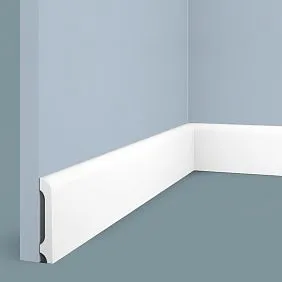
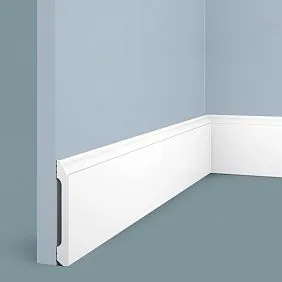
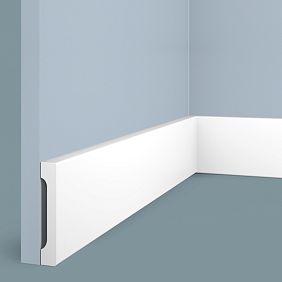
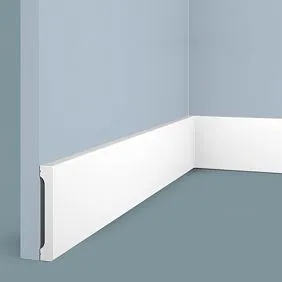
The floor is also left untouched—laminate, parquet, or tile remain in place. Only the baseboard is changed—the old one is removed in 2-3 hours, the new one is installed in half a day. The new baseboard radically changes perception—a tall 100-120 mm one instead of a standard 50-60 mm one visually raises the ceiling and refines the space.
Total work time for a two-room apartment—3-5 days. One day for removing old baseboards and marking. One day for installing new baseboards. Two days for installing vertical battens on an accent wall. One day for final finishing—filling joints, local touch-up painting. We live in the apartment, do not remove furniture, and daily life continues.
Cost is reduced many times over. Materials—baseboards and battens for 70-150 thousand rubles depending on wood species. Labor—40-80 thousand rubles. Total 110-230 thousand rubles versus 1.5-3 million for traditional renovation. Savings of 10-15 times with a visual effect comparable to a full-scale refresh.
Our factory also produces:


Psychology of perception: details define the impression
The human brain evaluates an interior based on key visual markers, not the absolute quality of all surfaces. Markers are expressive elements that attract attention: tall baseboards, vertical battens, decorative moldings, stylish furniture.
If the markers are modern, high-quality, and harmoniously coordinated—the interior is perceived as refreshed, even if the base walls are simply painted white. The brain registers the expressive details, ignoring the background surfaces. This property of perception is used in decorative refresh—we change the markers, leaving the background unchanged.
Vertical battens on an accent wall—the strongest visual marker. The gaze of someone entering latches onto the structured wall, registering modernity and style. The fact that the other three walls are simply painted—is not registered. The accent wall dominates perception, defining the overall impression.
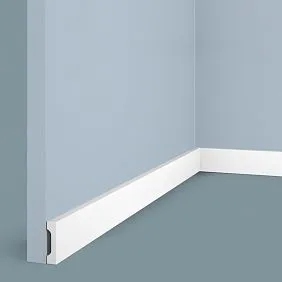
Tall baseboard—the second marker, radically changing the perception of a room. A standard 50-60 mm baseboard is invisible, does not attract attention. A tall 100-120 mm one creates architectural solidity, frames the space, and gives it completeness. Replacing a baseboard—an hour-long operation, the effect—lasting for years.
Get Consultation
Interior baseboard: a tool for quick transformation
Baseboard is perceived as a secondary detail hiding a technical gap. This is a misconception. A properly chosen baseboard is an architectural element defining the character of a space.
Tall baseboards 100-140 mm: effect of monumentality
Replacing a standard 50-60 mm baseboard with a tall 100-140 mm one—the simplest operation with maximum visual effect. Removing the old baseboard takes 10-15 minutes per room—pry it off the wall, discard it. Installing the new one—1-2 hours per room depending on configuration.
The visual effect is radical. The room is perceived as taller—the horizontal base is raised by 5-8 cm, visually increasing wall height. Architectural solidity, characteristic of premium interiors, appears. The space gains scale.
A tall baseboard hides defects in the lower part of walls—unevenness, paint wear, chips. A 10-14 cm high zone is covered—no need to worry about its condition. For a quick refresh without repainting walls, this is critical.
Color solution enhances the effect. A white baseboard on white walls creates monolithic unity, visual height increase. A contrasting dark baseboard on light walls—graphic clarity of boundaries, modern aesthetics. A baseboard matching the floor covering—visual extension of the floor onto the wall, expanding the horizontal.
Cost of replacing baseboards for a 60 m² apartment (perimeter about 45 linear meters)—30-80 thousand rubles turnkey depending on wood species. Oak baseboard 120 mm—1500-2000 rub/linear meter plus labor 400-600 rub/linear meter. Total 85-115 thousand rubles. Beech baseboard 100 mm—800-1200 rub/linear meter plus labor, total 54-81 thousand rubles.
Classical Figurative Profiles: Historicity and Status
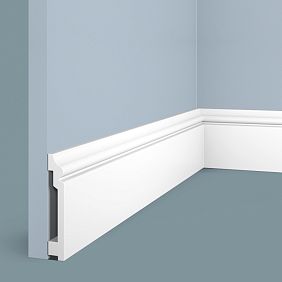
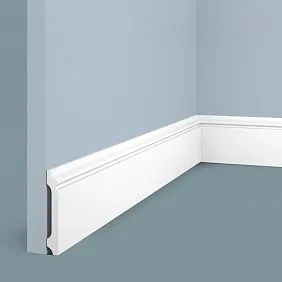
A skirting board with a complex profile featuring fillets, heels, and decorative grooves creates a reference to classical architecture. Visually, such a skirting board is richer than a simple rectangular one and is suitable for interiors where tradition and solidity are valued.
Replacing a simple skirting board with a figurative one instantly adds historicity to the interior. A modern standard apartment acquires features of a classical one, even if the walls are simply painted. A profiled skirting board is a visual code, read as classic, regardless of the rest of the finish.
The production of figurative skirting boards is more complex — milling a multi-stage profile, thorough sanding of transitions. The cost is 40-60% higher than simple rectangular ones. Oak figurative skirting board 120 mm — 2000-2800 rub/linear meter. But for those who value classical aesthetics, the costs are justified.
Installation is more complex due to the need for precise joining of profiles in corners. Corner elements are cut at 45° so that fillets, heels, and grooves align perfectly. Requires a qualified craftsman, precise tools. Installation time is 30-50% longer than for simple profiles.
Painted Skirting Boards: Color Accents
A skirting board painted in a bright or contrasting color becomes an independent decorative element. A black skirting board on white walls is a graphic accent emphasizing geometry. Dark blue or emerald on light gray walls is a color punch, enlivening a neutral space.
Painted skirting boards are made from beech — the species is ideal for painting due to its uniform texture. Colors — standard (white, black, gray, brown) or custom according to RAL. Coating — polyurethane enamels, creating a wear-resistant surface.
Replacing a standard skirting board with a bright colored one is an instant transformation of the interior. A neutral space gains character, individuality. A color accent around the perimeter ties the room into a single composition, even if the rest of the finish is heterogeneous.
The cost of painted skirting boards is 20-30% higher than natural ones due to the additional painting operation. Beech skirting board 100 mm black — 1000-1400 rub/linear meter. For a 60 m² apartment — 45-63 thousand rubles for materials plus 18-27 thousand for labor, total 63-90 thousand.
MDF Skirting Boards: Stability and Economy
Skirting boards made of MDF with a density of 750-850 kg/m³ with veneer or painted — a compromise between stability, cost, and installation speed. MDF does not react to humidity fluctuations, maintains geometry in any conditions. Absence of deformations simplifies installation, speeds up work.
Painted MDF skirting boards are the optimal choice for quick updates on a limited budget. The cost is 40-50% lower than solid oak with visual identity after painting. MDF skirting board 100 mm white — 500-800 rub/linear meter. For a 60 m² apartment — 22-36 thousand rubles for materials plus 18-27 thousand for labor, total 40-63 thousand.
Installation speed is higher due to stable geometry — each plank is perfectly straight, there are no deformations typical of solid wood. Corner joining is simpler, cutting is cleaner. Work time is 20-30% less than for solid wood.
The eco-friendliness of MDF class E1 meets the requirements of residential premises. Modern binders based on urea-formaldehyde resins are safe, emissions are minimal. Certificates confirm suitability for children's rooms, bedrooms.
Decorative Interior Batten: Structure in Two Days
Vertical battens on the wall — a quick operation, but creating a powerful visual effect. An accent wall covered with battens becomes the dominant feature of the interior, defining its character.
Thin Battens 20×40 mm: Minimalism and Speed
Battens of minimal cross-section 20×40 mm are mounted directly on the wall without a frame. A flat painted or wallpapered surface is sufficient. Battens are glued with mounting adhesive — quickly, cleanly, without dust and noise.
The technology is extremely simple. Mark verticals with a laser level at a given pitch — 100, 120, 150 mm. Cut battens to size — usually from floor to ceiling minus a 5 mm technical gap. Apply mounting adhesive to the back of the batten in a zigzag pattern. Place against the wall according to markings, press, secure with painter's tape until the adhesive sets.
Work time for a 4×2.7 m wall with a 120 mm pitch — one working day. Morning: marking and cutting battens, day: installation, evening: removing tape. The next day the wall is ready — adhesive has polymerized, battens hold firmly.
The visual effect is powerful — a monolithic wall turns into a structured vertical surface. The space gains modernity, dynamism. Thin battens do not create a significant projection — 20 mm practically does not affect the room's dimensions.
Material cost for a 4×2.7 m wall with a 120 mm pitch — about 70 linear meters of battens. Beech battens 20×40 mm — 200-300 rub/linear meter, total 14-21 thousand rubles. Adhesive, marking — 2-3 thousand. Labor — 10-15 thousand. Total 26-39 thousand rubles turnkey.
Medium Battens 30×50 mm: Balance of Expressiveness and Speed
Medium cross-section battens create a more pronounced relief but require a frame. Horizontal bars 40×60 mm are attached to the wall with dowels at three levels — bottom, middle, top. Battens are attached to the bars with screws or hidden clips.
Work time for the same 4×2.7 m wall — one and a half days. First day — marking, installation of guide bars, cutting battens. Morning of the second day — attaching battens. Total one and a half days versus one for thin battens. Additional time is justified by greater visual expressiveness.
Battens 30×50 mm protrude from the wall by 50 mm, creating deep shadows between elements. The play of light and shadow enlivens the wall, creates volume. For accent walls in living rooms, bedrooms, medium battens are the optimal balance of effect and labor intensity.
The cost is higher due to the frame and more expensive battens. Battens 30×50 mm from oak — 500-700 rub/linear meter, 70 linear meters — 35-49 thousand. Frame bars — 5-7 thousand. Fasteners — 3-4 thousand. Labor — 15-22 thousand. Total 58-82 thousand rubles turnkey.
Painted Battens: Color Experiments
Battens painted in contrasting or bright colors create bold interior solutions. Black battens on a white wall — minimalist classic. Emerald on a light gray background — a color accent. White on dark gray — an inversion of the usual scheme.
Painted slats are made from beech — this wood species absorbs paint evenly, without stains. The coating is polyurethane enamels, resistant to abrasion and moisture. Basic colors are available in stock, custom colors are made to order with a production cycle of 7-10 days.
Colored slats allow for experimentation without risk. If you don't like the result — we dismantle the slats in a couple of hours, the wall remains undamaged. Try a different color, a different installation spacing. Such flexibility is impossible with traditional finishing — repainting walls takes days.
The cost of painted slats is 30-40% higher than natural ones. Black beech slats 25×40 mm — 350-500 rub/linear meter. For a 4×2.7 m wall — 24-35 thousand for materials, 12-18 thousand for labor, total 36-53 thousand rubles.
Combined solutions: density and sparsity
An interesting effect is created by combining zones with different slat densities. The central part of the wall — a frequent spacing of 80 mm, creating a dense, graphic zone. The side parts — a sparse spacing of 150 mm, airy, light. This results in visual zoning of a single wall.
Or vertical zoning: the lower half of the wall — dense slats, the upper half — sparse. A visual effect of a weighted bottom and a light top. The space is perceived as taller, more stable.
Combined solutions require careful marking and precise calculation. An error in spacing will create visual chaos. But with proper implementation, you get a unique accent wall, unattainable by standard finishing methods.
The cost of combined solutions is 10-20% higher than uniform ones due to more complex marking and increased installation time. But the visual uniqueness justifies the cost for those seeking individuality.
Materials for quick updates: selection criteria
Installation speed depends not only on technology but also on material properties.
Solid oak: durability and status
Oak elements — a choice for those planning long-term use. Density 650-750 kg/m³, hardness 3.7-4.0 kN ensure wear resistance. Oak baseboards and slats last 50-80 years without losing properties.
Installing oak requires quality tools — carbide-tipped saws, powerful fasteners. Density creates resistance when drilling and screwing in self-tapping screws. Work time is 15-20% longer than for beech. But the result compensates for the labor intensity.
The cost of oak elements is 50-70% higher than beech. But for premium projects where durability and status are important, oak is the only choice. The investment pays off with decades of impeccable service.
Solid beech: balance of speed and quality
Beech elements — the optimal choice for quick updates. Density 620-680 kg/m³ is sufficient for interior applications, workability is excellent. Beech cuts quickly, doesn't dull tools, accepts fasteners easily.
Installing beech baseboards and slats is the fastest among solid woods. Corner cuts are clean, without chips. Drilling holes for self-tapping screws is easy. Work time is minimal. For projects where speed is critical, beech is the first choice.
Cost is 30-40% lower than oak with a visually comparable result after painting. For painted systems where the grain is hidden, beech is economically preferable to oak.
Solid ash: grain and speed
Ash elements combine expressive grain with good workability. Density 650-700 kg/m³ is comparable to oak, but the structure is less abrasive. Tools dull slower, cutting is cleaner.
The striped grain of ash creates decorativeness without additional processing. For natural oiled systems, ash is more expressive than uniform beech. The light color suits Scandinavian interiors.
Cost is intermediate — 20-25% higher than beech, 25-30% lower than oak. For projects where grain is important with a limited budget, ash is optimal.
MDF: maximum speed
MDF elements are champions of installation speed. Stable geometry, absence of deformations, ease of processing speed up work by 30-40% compared to solid wood. Cutting is clean, without chips. Fasteners hold firmly.
For painted systems, MDF is visually indistinguishable from solid wood. Veneered MDF with oak or ash veneer creates the illusion of solid wood at half the cost.
Eco-friendliness class E1 allows use in residential premises without restrictions. For quick budget updates, MDF is the first choice.
Accelerated installation technology: from marking to finish
Speed is determined by proper process organization, preparation, and qualification.
Day one: preparation and marking
Morning — removal of old baseboards. Pry with a crowbar, tear off from the wall, discard. Clean the lower part of the wall from adhesive residue, old nails. Time — 2-3 hours for a 60 m² apartment.
Day — marking verticals for slats. A laser level projects lines with the specified spacing. Mark pencil points for attaching guide battens (if slats are on a frame) or lines for gluing slats (if slats are thin without a frame). Time — 3-4 hours for one accent wall.
Evening — cutting slats to size. Measure the height from floor to ceiling minus a 5 mm gap. Cut the required number of slats with a miter saw. Stack them in piles of 10-15 pieces. Time — 2-3 hours for 30-40 slats.
Total for the first day — preparation is complete, demolition is done, marking is ready, slats are cut. Can proceed to installation.
Day two: installing baseboards
Morning — cutting baseboard corners at 45° on a miter saw. A miter box ensures cutting accuracy. Test-fit each piece in place, check the joint. Cut the entire perimeter of one room.
Day — attaching baseboards. Apply polyurethane adhesive in a zigzag pattern to the back side. Press against the wall, hold. Additionally secure with finishing nails 1.2×40 mm spaced 500-600 mm apart. Check level with a spirit level. Time — one room in 2-3 hours.
Evening — finish installing baseboards throughout the apartment. Fill joints with acrylic putty. Sink nail heads, fill holes with putty. Time — 2-3 hours of final finishing.
Total for the second day — baseboards installed throughout the apartment. The lower part of the interior is updated.
Day three: installing slats
Morning — installing guide battens (if slats are on a frame). Mark horizontals at three levels — 300 mm from the floor, middle of the wall, 300 mm from the ceiling. Attach 40×60 mm battens with 6×40 mm dowels spaced 400-500 mm apart. Check level. Time — 2-3 hours.
Day — attaching slats. Place the first slat against the outermost marking line, align vertically, attach with 3.5×40 mm screws to each batten. Move to the next slat, controlling the installation spacing with a tape measure. Methodically cover the entire wall. Time — 4-6 hours depending on the number of slats.
Evening — quality control. Check the verticality of each slat, uniformity of spacing, and fastening strength. Tighten any loose screws. Vacuum the work area.
Total for the third day — the accent wall is ready. The vertical slat structure is installed.
Day four: final finishing
Morning — sanding puttied areas on baseboards. P180 abrasive smooths transitions, makes joints invisible. Wipe with a damp cloth to remove dust.
Day — local touch-up of damage (if elements are pre-painted). Use a fine brush to touch up chips and scratches that occurred during installation. For natural elements with oil finish — wipe the entire surface with an oiled cloth, renewing the protective coating.
Evening — final cleaning. Vacuum the room, wipe the floor, take out construction debris. Put furniture back in place.
Total for the fourth day — project completed. Interior updated in four working days.
Design strategies for quick updates
Choosing the right update zones determines the visual effect with minimal cost.
Accent wall strategy
Update not the entire room, but one main wall — opposite the entrance, behind the bed headboard, behind the sofa in the living room. This wall becomes the visual center, defining the impression of the entire room.
The accent wall is covered with vertical slats, creating texture. The other three walls remain simple — painted or wallpapered. The contrast between the textured accent wall and the smooth others creates visual dynamics.
Costs are minimal — slats only for one wall. For a 4×2.7 m wall — 26-82 thousand rubles depending on the material. Plus replacing baseboards around the perimeter — 40-115 thousand. Total 66-197 thousand rubles for a radical update of one room.
Time — 3-4 days. Visual effect — comparable to a major renovation. Time and money savings — multiple.
Perimeter update strategy
Update only the perimeter of the room — baseboards, ceiling cornices, door trims. The central part of the walls remains unchanged. But the framing creates the impression of a complete update.
Tall 120 mm baseboard, wide 100-150 mm ceiling cornice, massive 80-100 mm door trims — an architectural frame in which the space is inscribed. The brain registers the updated frame, ignoring the simplicity of the fill.
Costs — baseboards, cornices, trims. For a 60 m² apartment — 80-150 thousand rubles for materials and labor. Time — 4-6 days. Effect — completeness, architectural coherence of the space.
Zoning strategy
Use vertical slats not for decorating a wall, but for visual zoning of an open space. Between the living room and dining area, between the bedroom and work area, install a slatted partition from floor to ceiling.
Battens create a visual boundary without blocking light and air. The space remains open, but zones are defined. Psychological comfort — each function gets its own place.
Costs — battens and frame for one partition 2×2.7 m. Materials — 20-60 thousand depending on the wood species. Labor — 10-20 thousand. Total 30-80 thousand rubles. Time — 2 days. Effect — functional zoning without constructing permanent walls.
Frequently asked questions
Can battens be mounted on wallpaper?
Thin battens 20×40 mm can be glued onto durable vinyl or non-woven wallpaper using mounting adhesive. Paper wallpaper will not hold — they will peel off along with the battens. For heavy battens on a frame, wallpaper is not critical — the fasteners go through them into the wall.
What installation spacing is optimal for quick mounting?
Wide spacing of 120-150 mm speeds up installation — fewer battens, fewer operations. Close spacing of 80-100 mm is labor-intensive but creates a dense graphic pattern. For quick updates, 120-130 mm is recommended — a balance of speed and visual effect.
How long does it take to replace baseboards in a three-room apartment?
Removing old ones — 3-4 hours. Installing new ones — 1-1.5 days depending on room configuration. Finishing — 2-3 hours. Total 2 days of work for one master or 1 day for a crew of two.
Can battens be removed without damaging the wall?
Battens glued on are removed with partial damage to paint or wallpaper. Battens on a frame are removed without traces — unscrew the screws, remove the battens, dismantle the battens, fill the holes from the dowels.
What is the cost of a quick update for one 16 m² room?
Replacing baseboards (perimeter 16 m) — 15-30 thousand. Accent wall with battens (wall 4×2.7 m) — 26-82 thousand. Total 41-112 thousand rubles turnkey depending on materials. Time — 3-4 days.
Is it necessary to remove furniture?
No, furniture is moved 1-1.5 meters away from the walls, freeing up the work area. The center of the room remains filled with furniture. You can live in the apartment, even stay overnight — the work is localized, without dust or chemical odors.
Is finishing painting required after installation?
If elements are pre-painted or oiled — not required. Only local touch-up of damage with a fine brush. For elements intended for painting — painting after installation is mandatory, adding 1-2 days to the timeline.
Can a quick update be implemented independently?
With basic skills, having a miter saw, laser level, screwdriver — yes. The main thing is marking accuracy and installation care. For a first experience, it is recommended to start with a small area — one accent wall in a bedroom.
Company STAVROS: materials for quick interior transformation
Company STAVROS is a Russian manufacturer of wooden interior systems since 2002, specializing in solutions for quick space updates. The catalog features over 40 profilesbaseboards with heights from 50 to 160 mm and 35 typesof decorative slats with cross-sections from 15×30 to 50×70 mm.
All elements are made from selected solid oak, beech, ash with 8-12% moisture content after kiln drying. Finishing options: natural wood with oil, painted in basic colors (white, black, gray, brown), brushed with patina, primed for painting. Custom painting in any RAL color for orders from 50 linear meters.
An alternative to solid wood — elements made from MDF with a density of 750-850 kg/m³ with veneer of valuable species or painted. Cost is 40-50% lower than solid wood with visual identity. For budget quick update projects — the optimal choice.
Production facilities are equipped with European CNC equipment — processing accuracy ±0.1 mm. Each batch undergoes multi-stage quality control. Rejection of defective items at the production stage guarantees consistently high quality of supplied products.
Own warehouses in Moscow and St. Petersburg with an area of 1200 m² ensure constant availability of popular items. Shipment on the day of inquiry for standard profiles and colors. For urgent projects, material reservation is possible with guaranteed shipment on the specified date.
Delivery throughout Russia by reliable transport companies. For Moscow and St. Petersburg — own courier service, delivery the day after ordering. For regions — established logistics routes, optimized for timing and cost. Packaging ensures safety during transportation — shrink wrap, cardboard corners, rigid pallets.
Consulting support includes assistance in selecting optimal profiles, calculating the required amount of material considering waste for trimming, recommendations on installation technology. Experienced sales department specialists will answer any questions, help avoid typical mistakes.
For designers, architects, construction companies, a professional partnership program is available. Individual commercial terms, priority production of non-standard profiles, technical project support. Possibility to order samples for client approval.
Over 5000 projects implemented over 23 years of operation — from standard apartments to country residences, from offices to restaurants and hotels. The portfolio includes quick update projects where tight deadlines were critical. Accumulated experience allows for precise recommendations on process optimization.
Exhibition halls in Moscow and St. Petersburg are open for visits. The exhibition includes full-scale ready-made compositions of skirting boards and battens — you can evaluate the visual effect of various combinations, compare wood species, and test color solutions. Experienced consultants will give a tour, help you decide on your choice, and calculate the cost of materials for a specific project.
By choosing STAVROS materials, you choose European-level quality made in Russia. Products that combine the naturalness of wood with the precision of industrial production. Materials that allow you to update your interior in days, not months, with minimal costs and maximum visual effect.
Update your interior quickly and effectively with skirting boards and decorative battens from STAVROS! Quality materials, affordable prices, fast delivery. Call the toll-free number 8 (800) 555-46-75 — specialists will advise, help you choose the optimal solution, calculate the required amount of materials, and place an order with delivery at a convenient time!