Article Contents:
- Carved Wooden Staircases: From Structure to Work of Art
- Anatomy of an Interior Staircase
- Styles of Carved Staircases
- Manufacturing Technologies for Carved Staircases
- Decorative Overlays: Miniature Sculpture in Interior Design
- What Are Carved Overlays
- Interior Butterflies and Other Zoomorphic Motifs
- Application of Overlays in Interior Design
- Manufacturing and Installation Technology for Overlays
- Handcrafted Interior Accents: The Philosophy of Individuality
- Why Handcrafted Work Is Valued
- Types of Handcrafted Interior Accents
- Application of Carved Elements in Modern and Classical Decor
- Classical Interior: Abundance of Carving
- Neoclassical: Restraint and Accents
- Modern Interior: Carving as Contrast
- Materials and Wood Species for Carved Elements
- Oak: The King of Carving
- Beech: Plasticity and Uniformity
- Ash: Strength and Expressiveness
- Frequently Asked Questions About Interior Staircases and Carved Decor
- About STAVROS Company: Mastery of Carving and Traditions of Woodworking Art

A staircase is more than just a functional structure for moving between levels. It is vertical architecture within a home, a wooden sculpture that can dominate the interior or delicately complement it.Interior staircasesSolid wood staircases with carved elements transform space, turning ordinary movement into an aesthetic experience. Each step, each baluster, each curve of the handrail becomes part of an artistic statement.
But staircases are only part of the system of decorative elements capable of transforming an interior.interior butterfliesCarved overlays in the shape of butterflies, plant motifs, and geometric patterns add individuality to furniture, doors, and walls without radical remodeling. These miniature wooden sculptures create accents where standard finishes would appear flat and faceless.


Carved Wooden Staircases: From Structure to Work of Art




Anatomy of an Interior Staircase
A wooden staircase consists of load-bearing and decorative elements, each important for the overall impression. Steps—the horizontal surface for movement—are made from solid wood 40-50 mm thick. Oak steps withstand intensive use for decades without noticeable wear. A step width of 280-320 mm ensures comfort during ascent and descent.
Stringers or stringer boards — load-bearing beams on which the steps rest. A stringer is an inclined beam with cutouts for steps, visible from the side. A stringer board is a beam with grooves where the steps are inserted endwise, creating a more enclosed structure. The choice between a stringer and a stringer board determines the visual massiveness of the staircase.
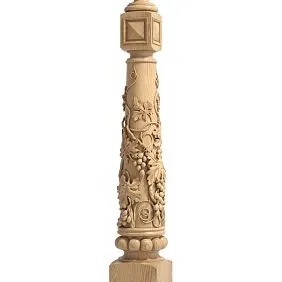
Balusters — vertical posts that support handrails and form the railing. This is the main decorative element of the staircase. Balusters can be turned — with rhythmic alternation of thickenings and waists — or carved with plant, geometric, or sculptural motifs. A distance of 100-150 mm between balusters ensures safety and creates a visual rhythm.
Handrails — horizontal elements held onto while moving. A handrail diameter of 50-60 mm is optimal for hand grip. The handrail can be round, oval, or shaped with facets. The surface is carefully sanded to perfect smoothness — any roughness causes discomfort.
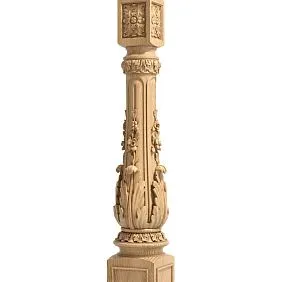
Newel posts — powerful vertical elements at the beginning, end, and turns of the staircase. Newel posts bear the main load from the railing. A post cross-section of 100×100 or 120×120 mm provides sufficient strength. The decoration of posts — capitals, carved panels, overlays — creates compositional accents.
Our factory also produces:




Styles of carved staircases
Classical staircase — symmetry, proportions, orderliness. Balusters are identical, spaced at equal intervals. Carving is strict — flutes, Ionic volutes, acanthus leaves in clear compositions. Newel posts are monumental, with a square base and turned shaft. Color — natural oak or walnut, emphasizing the nobility of the wood.
Baroque — theatricality, dynamism, excess of decoration. Balusters with deep carving, three-dimensional grape clusters, putti, shells. Newel posts are adorned with complex capitals, spiral grooves, gilded details. Handrails have a wavy profile. The color palette is contrasting — dark wood with gold or white enamel with patination.
Victorian style combines carving with geometric structure. Balusters are turned with many small details — rings, beads, waists. Newel posts have faceted sections alternating with carved panels. The railing is complemented by carved panels between balusters. Dark mahogany or stained walnut create an atmosphere of solidity.
Art Deco simplifies forms but uses luxurious materials and contrasts. Balusters are geometric — square or hexagonal in cross-section with clear facets. Carving is minimal — strict linear patterns, zigzags, stepped compositions. The combination of dark and light wood, metal inlays create a graphic effect.
Modern classic takes proportions and rhythm from classicism but minimizes decoration. Balusters are simple turned or flat rectangular. Carving is either absent or reduced to a few accents. Newel posts are strict, sometimes clad with metal or glass. Colors are neutral — whitewashed oak, gray ash, natural beech.
Get Consultation
Manufacturing technologies for carved staircases
Staircase design begins with room measurements and parameter calculation. The rise height, opening area, and type of construction determine the geometry. The number of steps is calculated so that the riser height is 150-180 mm — the optimum for comfortable movement. The flight width is a minimum of 900 mm for convenient passage of one person, 1200 mm for comfortable movement of two people.
3D modeling allows seeing the future staircase in space before production begins. The client evaluates proportions, scale, visual compatibility with the interior. Adjustments are made — the carving pattern, baluster shape, handrail profile are changed. Drawings with exact dimensions of each element are approved.
Production begins with wood selection. Solid oak or beech undergoes inspection for defects — cracks, knots, rot. Wood moisture content of 8-12% ensures dimensional stability. Blanks are cut considering the grain direction for maximum strength.
Turning forms cylindrical elements — balusters, newel posts, sections of handrails. A lathe creates a rhythmic alternation of thickenings and narrowings. Deep carving is performed on CNC milling machines according to a set program. Small details are finished manually by carvers — the human hand creates nuances unattainable by machine.
Sanding is carried out in several stages with abrasives of increasing grit from 80 to 320 grit. The surface becomes perfectly smooth, without the slightest burrs. Particular attention is paid to handrails — they contact hands, any roughness is noticeable.
Finishing protects the wood and emphasizes the texture. Staining with dyes gives the desired shade. Oil coating preserves the tactile feel of wood, creates a matte surface. Varnishing forms a protective film, enhances shine. Patination with wiping emphasizes the relief of the carving.
Staircase installation is performed on-site by professionals. Stringers or stringer boards are fastened to floors via anchors. Steps are fixed with glue and screws. Balusters are installed in baluster shoes — lower planks ensuring railing rigidity. Handrails are laid on the top ends of balusters and newel posts, fastened with hidden screws. Final adjustment ensures perfect verticality of posts and smoothness of the handrail.
Decorative overlays: miniature sculpture in the interior
What are carved overlays
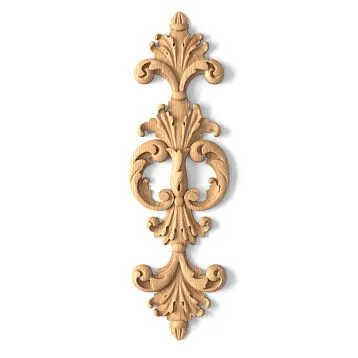
Carved overlays are fragments of wood carving that are attached to flat surfaces of furniture, doors, panels, creating relief decoration. Unlike solid wood carving, where the pattern is cut from a solid piece of wood, overlays are made separately and mounted onto the base. This allows adding decorativeness to standard furniture, updating the appearance without replacement.
The typology of overlays is diverse. Plant motifs — leaves, flowers, grapevines, acanthus scrolls — are most popular in classic interiors. Geometric patterns — rosettes, meanders, lattices — are stricter, suitable for neoclassicism. Sculptural overlays — putti, mascaron, coats of arms — create expressive accents.
Interior craftsHandmade products include not only overlays but also three-dimensional decorative elements. Carved wall panels, decorative consoles, brackets, corner elements form a decorative system where each item complements another.
Interior butterflies and other zoomorphic motifs
Carved overlays in the shape of butterflies — an elegant decorative element symbolizing lightness, transformation, beauty. The size of such overlays ranges from miniature 50×30 mm to large 150×100 mm. Small butterflies are grouped in several pieces, creating a composition on a cabinet door or wall panel. Large ones are used singly as an independent accent.
Butterfly carving can be bas-relief — protruding 3-5 mm above the base — or deep three-dimensional with detailing of each wing part. Bas-relief overlays are lighter, easier to mount, suitable for small surfaces. Three-dimensional ones create a strong visual effect, require a sturdy base.
Other zoomorphic motifs include birds, lion heads, dolphins, griffins. Birds — a symbol of freedom — are organic in bedrooms and children's rooms. Lion masks — a sign of strength and protection — are traditional for studies and libraries. Dolphins and marine motifs are suitable for bathrooms and rooms in a marine style.
Application of overlays in the interior
Furniture — the first area of application for carved overlays. Cabinet doors, dresser drawers, sideboards often look flat, even if made from quality solid wood. An overlay in the center of a door turns it into a panel with relief. Four corner overlays create a framed composition. An overlay on a drawer front instead of a standard handle serves a functional and decorative role.
Interior doors gain character thanks to overlays. A standard panel door is complemented by carved elements in the center or corners of the panels. A flush door with overlays imitating panel structure visually becomes more complex. An entrance door with massive carved overlays creates a grand first impression.
Wall panels are another application area for overlays. A solid wood panel 90-120 cm high covers the lower part of the wall. Vertical pilasters with carved capitals divide the panel into sections. In the center of each section is a carved overlay with a floral or geometric pattern. This solution is characteristic of classic libraries, studies, and dining rooms.
Ceiling rosettes and corner elements decorate the junction of the wall and ceiling. A rosette in the center of the ceiling around the chandelier, 40-80 cm in diameter, creates a focal point. Corner overlays at the intersections of the ceiling cornice with the wall conceal joints and add decorative appeal.
Fireplaces are a traditional place for carved overlays. The fireplace portal is framed by carved pilasters with capitals. The frieze above the firebox is adorned with a horizontal overlay featuring an ornament. The fireplace mantel is supported by carved corbels or brackets. Such a fireplace becomes the centerpiece of the living room.
Manufacturing and installation technology of overlays
Carved overlays are made from solid wood 15-30 mm thick. Thinner overlays are fragile, while thicker ones create excessive relief. The workpiece is milled on a machine according to a specified program. The carving depth is 5-15 mm, depending on the size of the overlay and the complexity of the pattern.
Manual refinement of details is performed by carvers. Small elements—leaf veins, flower petals, bird feathers—are worked out with chisels and carving tools. This work requires experience and artistic flair. Sanding removes burrs and smooths transitions.
Toning and finishing correspond to the base onto which the overlay will be mounted. If the furniture is made of dark walnut, the overlay is toned to the same color. If the door is white, the overlay is painted with white enamel and patinated. Contrasting solutions—a light overlay on a dark base or vice versa—create a strong visual effect.
Overlays are installed using glue and miniature nails or screws. Wood glue is applied to the back of the overlay in dots or a thin layer. The overlay is pressed against the base and clamped until the glue sets. Finish nails are driven into concealed areas—the heads are countersunk and filled. After installation, the joints between the overlay and the base are treated with wax for visual integrity.
Handcrafted interior accents: the philosophy of individuality
Why handcrafted work is valued
Mass production creates identical items—convenient, predictable, impersonal. Handcrafted work is unique—even two carved elements from the same sketch differ in nuances. The hand of the master introduces variability, liveliness, and individuality. Carving done by hand possesses a unique energy.
The quality of handcrafted processing often surpasses machine work. The carver sees the wood grain, feels the hardness of different areas, and adjusts the carving depth. A machine operates according to a program, without considering the characteristics of a specific piece of wood. The result of machine carving is technically precise but may have chips at fiber intersections. Hand carving adapts to the material.
The exclusivity of handcrafted work adds value. When you know that your overlay or baluster exists as a single piece, your attitude towards it changes. It is not a mass-produced item but an author's creation. In an interior, such elements become a point of pride.
Types of handcrafted interior accents
Carved panels—decorative panels with narrative or ornamental carving. Sizes range from compact 40×60 cm to large-scale 150×200 cm. Subjects vary from floral compositions to complex scenes with figures, architecture, and landscapes. The panel is mounted on the wall like a painting, becoming the visual center of the room.
Corbels and brackets—functional decorative elements supporting shelves, cornices, and fireplace mantels. A corbel has the shape of an inverted letter S with carved volutes or leaves. The size of the corbel depends on the load—for a light shelf, a corbel depth of 15-20 cm is sufficient; for a fireplace mantel, 30-40 cm is required.
Capitals of columns and pilasters—decorative tops of vertical elements. Classical orders—Doric, Ionic, Corinthian—have canonical capital forms. The Doric capital is austere, with a simple cushion. The Ionic has side volutes. The Corinthian is adorned with acanthus leaves, the most decorative.
Corner elements and rosettes fill voids in molding and cornice compositions. A corner element is placed at the intersection of two moldings at a 90-degree angle. A rosette—a round or oval element with a radial pattern—accentuates the center of a panel or ceiling.
Finials of stair newel posts—the final element of a support post. The finial can be turned—a sphere, cone, pineapple—or carved with floral motifs. The size of the finial is proportional to the post—typically, the finial height is 1/4-1/3 of the visible part of the post.
Application of carved elements in modern and classic decor
Classic interior: abundance of carving
In a classic interior, carved elements dominate. Wall panels with pilasters and carved overlays occupy the lower third of the walls. Ceiling cornices with modillions and rosettes frame the ceiling plane. Doors with carved panels and overlays create vertical accents. Furniture—chests of drawers, cabinets, tables—is adorned with carved legs, pediments, and overlays.
The staircase in a classic interior is the culmination of carved decor. Balusters with turned and carved elements create a rhythmic vertical structure. Newel posts are massive, adorned with capitals and carved panels. The handrail is thick, rounded, sometimes with carved overlays on the ends. Risers may be faced with carved panels.
The color palette of a classic interior with carving is built on contrasts. Light walls—cream, beige—contrast with dark wood furniture and staircase. Or vice versa—dark walls and light furniture with white enamel and gilding. Carved elements are often patinated—golden, silver, dark patina emphasizes the depth of the relief.
Neoclassical: restraint and accents
Neoclassical interiors use carving in measured doses. Not all surfaces are decorated; carved elements become accents against smooth planes. The staircase has simple turned balusters without complex carving. Newel posts are austere, with minimal or no carving. But the finials of the posts can be decorative—carved or turned with an interesting silhouette.
Furniture in neoclassicism combines smooth facades with carved details. The cabinet door is smooth, but in the center is a carved overlay 15-20 cm in diameter. The legs of armchairs and tables are turned but without excessive detailing. Chair backs have carved inserts but in a restrained manner.
Walls in neoclassicism are often smooth, painted or wallpapered. Carved elements are used locally—moldings divide the wall into panels, but the moldings themselves are simple, without carving. Carved rosettes or overlays can accentuate the center of a panel, but there are few of them.
Modern interior: carving as contrast
In modern minimalist interiors, carving may seem alien, but it is precisely the contrast that makes it effective. One carved overlay on a smooth white wall attracts more attention than ten overlays in a classic interior. A carved staircase in a loft space with concrete walls creates a powerful contrast of textures.
Selecting carved elements for a modern interior requires caution. Excessive decoration will disrupt the minimalist concept. One or two accents are sufficient—a carved wall console, a carved mirror frame, a group of butterfly overlays on one wall. It is important that the carving style is not too ornate. Geometric patterns and stylized plant motifs are more suitable than Baroque curls.
The color of carved elements in a modern interior is often contrasting to the base. A dark carved overlay on a white wall is graphic. Light carving on a dark background creates the opposite effect. Untreated natural wood adds warmth to cold minimalism.
Materials and wood species for carved elements
Oak: the king of carving
Oak is the optimal material for wood carving. A density of 700-800 kg/m³ ensures the strength of even thin carved elements. A flower petal 3-4 mm thick, carved from oak, does not break. The carving retains its shape for decades without the destruction of fine details.
The texture of oak, with its pronounced annual rings, creates an additional visual effect. The carving not only forms relief but also reveals layers of wood with different colors and densities. A tangential cut of oak shows a wavy pattern, while a radial cut reveals medullary rays in the form of shiny ribbons.
Oak holds details well during lathe turning. Balusters with many small elements—rings, beads, collars—remain crisp and do not blur. Carving on posts and finials turns out relief-like, with clear edges.
The finishing of oak is diverse. Natural oak with oil showcases the full beauty of the texture. Stained oak—from light golden to dark wenge—adapts to any color scheme. Bleached oak with white stain and brushing creates a Scandinavian aesthetic.
Beech: plasticity and uniformity
Beech is inferior to oak in hardness but superior in plasticity. For curved elements—such as bent handrails, curved furniture legs—beech is preferable. After steaming at 100-110°C, beech bends with a minimal radius without fiber destruction.
The texture of beech is uniform and fine-pored. This creates a calm surface without an aggressive pattern. In carving, the beech surface appears matte, without glare. For interiors where restraint is important, beech is optimal.
The natural color of beech—light pinkish—is warm and cozy. Beech takes staining excellently, allowing for a wide palette of shades. Steamed beech acquires a uniform pinkish-brown tone without spotting.
The disadvantage of beech is its high hygroscopicity. Without protective treatment, beech products absorb moisture, swell, and warp. Impregnation with antiseptics and a final coating with varnish or oil are mandatory.
Ash: strength and expressiveness
Ash combines the strength of oak and the light color of beech. A density of 680-750 kg/m³ is sufficient for carved elements with medium detail. The texture of ash, with its contrasting annual rings, is expressive. Carving on ash turns out relief-like, with a play of light and shadow.
Ash bends well and is suitable for curved handrails and decorative elements. The elasticity of the wood makes ash optimal for loaded parts—handrails, load-bearing balusters. Ash elements withstand significant bending loads without destruction.
The color of ash is light, yellowish-white. This allows ash to be used in light interiors without staining. Stained ash acquires shades from olive to dark brown.
Frequently asked questions about interior staircases and carved decor
How much does a carved solid wood staircase cost?
The cost depends on size, carving complexity, and wood species. A simple beech staircase with turned balusters for a house of 100-150 sq.m costs 250,000-400,000 rubles. An oak staircase with carved balusters and posts costs 500,000-800,000 rubles. An exclusive staircase with complex carving can cost 1-2 million rubles.
How long does it take to manufacture a custom carved staircase?
Design takes 1-2 weeks. Production takes 6-10 weeks depending on complexity. Installation takes 3-7 days. The total timeframe from measurement to a finished staircase is 2-3 months.
Can carved overlays be installed on finished furniture?
Yes, this is one way to update furniture. Overlays are glued onto doors, side panels, and pediments. It is important that the base is clean and degreased. The color of the overlay should harmonize with the furniture.
Which wood species is best for carved balusters?
Oak is the best choice for strength and durability. Beech offers a good balance of price and quality. Ash is for light interiors. All three species are suitable for carving.
Do carved elements require special care?
Weekly dry wiping with a soft cloth removes dust. Use a soft brush to clean dust from the recesses of the carving. Renew the oil coating or polish with wax once a year. Avoid direct sunlight and humidity fluctuations.
Can a carved staircase be ordered based on a personal sketch?
Yes, custom design allows for the realization of any idea. The client provides sketches and references. The designer adapts the idea to real dimensions and structural requirements. A 3D model is created for approval.
Are carved elements only suitable for classic interiors?
No, carving can be used in any style. In modern interiors, carved elements serve as contrasting accents. The key is moderation and choosing the carving style. Geometric carving fits organically into modern and minimalist designs.
About STAVROS Company: Mastery of Carving and Traditions of Woodworking Art
STAVROS Company combines centuries-old traditions of wood carving with modern production technologies. Specialization in manufacturing carved staircases, decorative overlays, and solid wood furniture makes STAVROS an expert in wooden decor.
The production base includes a turning workshop where balusters and posts are created. CNC milling machines perform complex carving according to specified programs. But STAVROS's main wealth is the team of carvers skilled in hand carving. It is their hands that give the products individuality unattainable by machines.
Materials undergo strict selection. Solid oak, beech, and ash are purchased from trusted suppliers. Chamber drying to 8-12% moisture ensures dimensional stability. Each blank is checked for defects.
STAVROS's assortment includes ready-made collections of carved staircases and custom production. The collections combine dozens of projects in different styles—from classic to modern. The client selects a suitable project and adapts it to their dimensions. Custom design creates a unique staircase from scratch.
Carved overlays are presented in the catalog with hundreds of models. Floral, geometric, and zoomorphic motifs in various sizes. Custom overlay production based on individual sketches is possible. Production time for overlays is 2-4 weeks.
STAVROS installation teams install staircases and decorative elements throughout Russia. The experience of installers guarantees structural reliability. A 12-month warranty on staircases confirms product quality.
Consultation support helps clients make a choice. STAVROS specialists are knowledgeable about styles, structural features, and materials. They will suggest the optimal staircase configuration for a specific space, help select decorative elements, and calculate the budget.
STAVROS is a guarantee of quality, individual approach, respect for traditions, and readiness for innovation.Interior solutionsfrom STAVROS transform a house into a space where functionality combines with beauty, and every element becomes part of a harmonious composition.