
























Article Contents:
- What is a KON partition set
- How KON differs from a regular slatted partition
- All KON models in the STAVROS catalog
- Comparison table of KON-001 to KON-007 models
- How to choose a KON model based on the task
- For a kitchen-living room
- For a studio
- living room
- For Office
- For commercial interiors
- How to calculate the number of KON sets
- How to choose a KON model based on style
- For calm modern interior
- For a more expressive decorative effect
- For a classic or eclectic interior
- Beech or oak: which to choose
- Typical mistakes when buying
- Additional
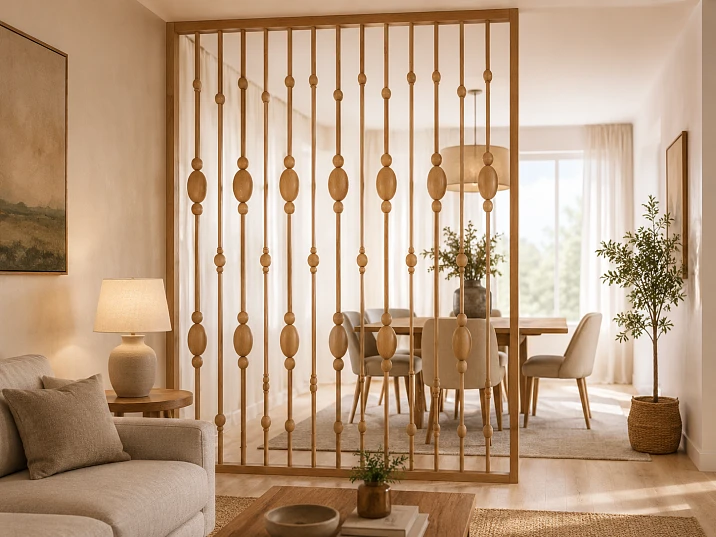
Zoning a space without load-bearing walls is a task that requires not just material, but a well-thought-out system. Ready-made sets of STAVROS KON wooden partitions are exactly such a system: one set provides one vertical decorative post 2800 mm high made of solid beech or oak, and a full-fledged wooden partition for room zoning is assembled from several such posts placed at a given pitch. If you are planning to buy a wooden partition for zoning and want not just a set of slats, but a ready-made turned composition with its own plasticity and rhythm — the KON line is designed for this.
What is the KON partition kit
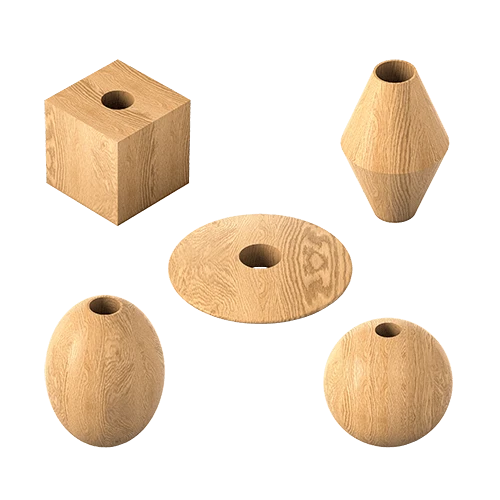
KON partition kit is a fully selected set of wooden elements for assembling one decorative post. Each kit includes turned geometric shapes from the KN series and load-bearing wooden moldings MLD-060, which serve as the vertical axis. Everything is already arranged at the factory: the composition of parts, proportions, quantity, and rhythm. The buyer only needs to choose the model based on visual style, material, and the number of posts for their opening width.
Key points:
-
one KON kit is one vertical decorative post 2800 mm high, not the entire partition;
-
the partition is assembled from several kits placed in a row with a specified spacing;
-
models KON-001 to KON-007 differ in profile width, composition of turned elements, and decorative density;
-
beech is better suited for enamel, oak for natural texture with a transparent coating;
-
the number of kits is calculated based on the width of the opening and the selected step between posts;
-
all kits are made to order from solid wood with 'Prestige' quality sanding.
This formula — one kit equals one post — is key to understanding the entire line. The price on the website is for one kit. The total cost of the partition equals the price of one kit multiplied by the number of posts.
How KON differs from a regular slatted partition
Imagine two approaches to zoning. The first — you buy wooden slats of the same cross-section, attach them vertically to a horizontal crossbar, and get a flat wall of parallel lines. It works, it's popular, and on the STAVROS website there are separate materials about Decorative interior planks и slatted partitions for zoning. But a slatted partition is always a repetition of the same linear element. It is rhythmic but architecturally neutral. It is functional but monotonous in plasticity.
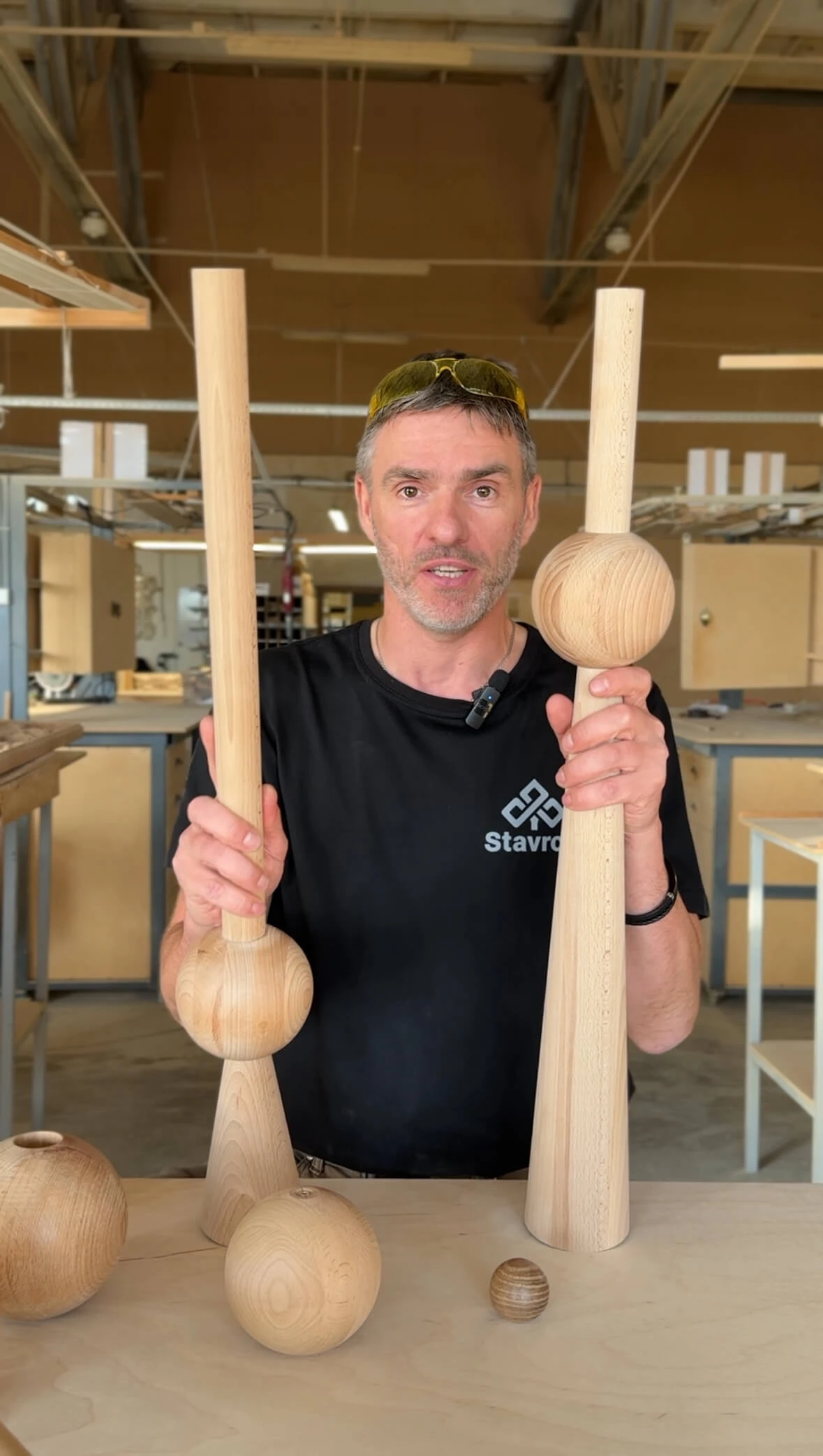
The second approach — you take a KON kit. What changes? Everything changes. Because Partition kit KON-001 — this is not a slat, but a ready-made decorative post made of several types of turned wooden elements strung on a supporting molding. The post has a complex silhouette: large accents alternate with small separators, rounded shapes give way to flat discs, elongated elements create vertical dynamics. When you place several such posts side by side, you get not a fence of slats, but an architectural composition — with rhythm, with pauses, with a play of volumes and chiaroscuro.
A batten is a linear molding element with a constant cross-section along its entire length. It has length, cross-section, and that's it. The KON kit is a three-dimensional decorative structure with its own composition. Each post functions like a miniature column — not for a facade, but for an interior. The difference is roughly like between a picket fence and a balustrade of a classic staircase: both divide space, but one is utilitarian, the other architectural.
When a customer is looking for where Buy wooden partition, they often don't know that an alternative to simple battens exists. They've seen slatted structures in magazines, on design websites — and think that's the only format for a wooden partition. The KON line expands the choice: if you need not just a functional wooden screen, but an expressive decorative object that is itself a work of turning art — Buy a wooden partition for zoning the KON format will be the right solution.
Another important point: the ready-made kit eliminates the need to design the post yourself. You don't have to decide which turned elements to take, how many you need, how long the supporting rod should be, and how it all fits together. In KON, everything is already selected — composition, proportions, quantity, rhythm. You choose a model based on visual character, material, and width, and then determine how many posts you need for your opening.
And if you need exactly a slatted structure — linear molding for a modular partition — the STAVROS website has a separate article about choosing battens, panels, and molding for zoning. But this article is not about battens. It's about ready-made KON kits, where each post is a composed structure, not a linear element.
Our factory also produces:
All KON models in the STAVROS catalog
The KON line includes seven models — from KON-001 to KON-007. They are all built on the same principle: the wooden molding MLD-060 serves as the supporting axis, and turned geometric elements made of solid beech or oak create the decorative pattern. But each model has its own character, profile size, set of elements, and visual density.
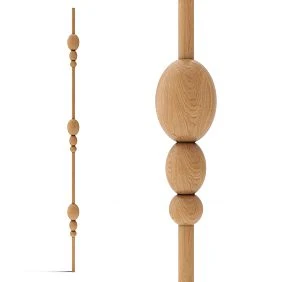
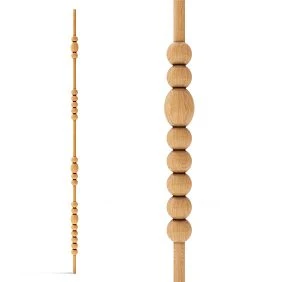
KON-001 — basic model with a maximum decorative element width of 132 mm. It includes three types of turned figures: large spherical accents that set the composition's anchor points, and small separators that create a smooth rhythm. KON-001 is a classic option with rounded shapes, lacking sharp geometric contrasts. Suitable for interiors requiring a decorative post with a soft, plastic silhouette.
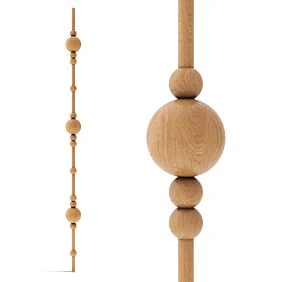
KON-002 — model with the largest round elements in the line. The maximum decorative element width is 170 mm — these are massive spherical parts that immediately catch the eye. The set includes three large KN-004 elements and twelve small KN-005 elements, creating a dense decorative rhythm along the entire height of the post. KON-002 is a choice for interiors where the partition should be a powerful, weighty, status accent. Available in beech.
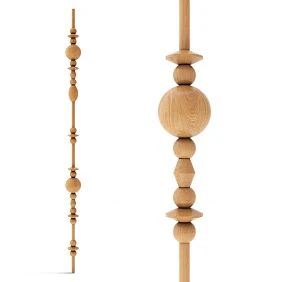
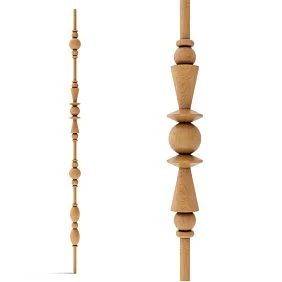
KON-003 — the most compositionally rich set in the series. Five types of turned elements of different shapes and sizes: elongated KN-003, large spherical KN-004, small round KN-005, medium transitional KN-006, and flat disc-shaped KN-007. This variety of shapes creates a complex, multi-level decorative rhythm not found in any other set. KON-003 reads as a sculptural object — with tempo, accents, and pauses. Available in beech or oak.
KON-004 — the most compact profile in the line: the maximum element width is only 88 mm. However, the set includes the largest number of small elements — seventeen KN-005 pieces. This creates a dense, continuous, graphic rhythm. KON-004 looks elegant and concise, does not weigh down the space, and works particularly well in partitions with frequent spacing between posts.
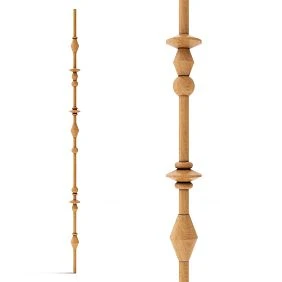
KON-005 — model with expressive geometry. It includes five types of fundamentally different shaped elements: elongated rhomboid, flat disc-shaped, small round, and miniature separator. The combination of vertically elongated and horizontally flat elements creates a complex decorative pattern. KON-005 is a choice for interiors where non-standard geometry and an authorial character are valued.
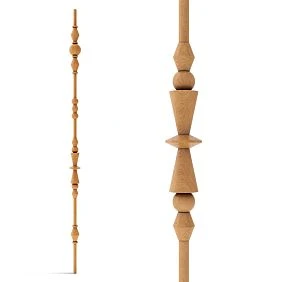
KON-006 — the most compositionally complex model. Nine types of turned elements with different heights, widths, and shapes create a multi-layered decorative rhythm. Elongated parts set vertical dynamics, large nodal elements add massive accents, flat discs work as horizontal separators, and small elements build a fine dotted line. In total — twenty-four turned elements on one post. KON-006 reads as a complex sculptural object. Available in beech or oak.
KON-007 — model with a profile width of 130 mm, combining elements of different shapes: elongated, large geometric, round, flat, and compact. KON-007 occupies an intermediate position between the geometric expressiveness of KON-005 and the complex multi-element composition of KON-006. It is a universal model for decorative zoning for various interior tasks. Available in beech or oak.
All models have a height of 2800 mm — standard for modern rooms with ceilings from 2.8 to 3 meters and higher. All are made from solid natural wood with "Prestige" quality sanding — manual multi-stage processing ensuring a perfectly smooth surface, ready for final coating. All sets are made to order, with an average production time of 5–10 working days.
Get Consultation
Comparative table of models KON-001–KON-007
To choose the right set, it is important to understand the difference between models not only in visual character but also in technical parameters. Below is a comparison of all seven models in the line.
| Model | Size, mm | Material | Visual character | When to choose | Card |
|---|---|---|---|---|---|
| KON-001 | 2800 × 132 × 34 | Beech / Oak | rounded shapes, soft silhouette | basic decorative stand for room, studio, hallway | KON-001 |
| KON-002 | 2800 × 170 × 34 | Beech | large spherical accents, powerful rhythm | status partition, expressive accent in a spacious interior | KON-002 |
| KON-003 | 2800 × 170 × 34 | Beech / Oak | five types of elements, complex plasticity | designer interior where the stand is an independent decorative object | KON-003 |
| KON-004 | 2800 × 88 × 34 | Beech / Oak | compact profile, dense fine rhythm | light partition, narrow rhythm, more air | KON-004 |
| KON-005 | 2800 × 120 × 34 | Beech | geometric shapes, rhombuses and discs | kitchen-living room, studio, geometric accent | KON-005 |
| KON-006 | 2800 × 130 × 34 | Beech / Oak | nine types of elements, complex composition | living room, study, restaurant, expressive modular stand | KON-006 |
| KON-007 | 2800 × 130 × 34 | Beech / Oak | seven types of elements, universal character | room, hallway, commercial, decorative zoning | KON-007 |
Dimensions and product logic are confirmed by STAVROS product cards. KON-001 is specified with dimensions 2800 × 132 × 34 mm, KON-002 and KON-003 — 2800 × 170 × 34 mm, KON-004 — 2800 × 88 × 34 mm, KON-005 — 2800 × 120 × 34 mm, KON-006 and KON-007 are described as kits for assembling one vertical stand 2800 mm high with a profile width of 130 mm.stavros+2
How to choose the KON model for the task
The choice of model depends not only on personal aesthetic preferences, but also on the specific interior where the partition will be placed. Different rooms dictate different requirements for the width of the stand, decorative density, and overall character of the structure.
For a kitchen-living room
For a kitchen-living room, medium-width models are especially suitable —
kitchen-living room, studio, geometric accent KON-005 with a width of 120 mm or KON-001 with a width of 132 mm. They are expressive enough to mark the separation of zones, but not too massive. If the kitchen is made in white with enamel facades, it is logical to choose beech under enamel and paint the posts in the color of the kitchen set — Buy wooden partition for room zoning in a single color scheme with the furniture will create a cohesive ensemble. If the interior is based on natural materials — wood, stone, metal — oak posts under clear oil or varnish will become a natural extension of the kitchen area.
The spacing between posts in a kitchen-living room is usually chosen as medium — 350–500 mm. This provides sufficient visual separation but maintains a sense of openness. With such spacing, an opening 2000 mm wide will require 4–5 sets.
For a studio
A studio apartment is a space where zoning is not a luxury but a necessity. In one room, you need to fit a bedroom, a workspace, a relaxation area, sometimes an entryway and a kitchen. Each zone should be visually defined, but without permanent partitions that would eat up the already limited area.
A wooden partition made of KON posts is an ideal solution for a studio precisely because it does not steal space. The posts have a depth of only 34 mm — this is the cross-section of the supporting molding. They do not protrude into the room like a wall, do not require a foundation, and do not block light. At the same time, the vertical rhythm of the turned elements is clearly readable and psychologically separates the zones.
For a studio, models with a compact profile are recommended — KON-004 with a width of 88 mm. Narrow posts in a small space look lighter and do not create a feeling of clutter. A frequent step (200–300 mm) in a studio creates a denser structure that better separates the sleeping area from the rest of the space. If you want to buy a wooden partition for a room for a studio — this is an investment in comfort and privacy without losing space.
An alternative scenario for a studio is to use the posts not as a solid partition, but as a series of separate vertical accents. For example, three or four posts KON-006 or KON-007, placed with a wide spacing (600–800 mm), create not a wall but a rhythmic row — like columns that mark the boundary symbolically, without physical enclosure.
For the living room
In a spacious living room, a wooden partition made of KON posts works differently than in a studio. Here, the task is not so much to divide (there is already enough space) but to create a decorative vertical rhythm instead of a blank wall. The living room is a representative space, a place where guests are received, and decorative wooden partition must match: be noticeable, expressive, but not overwhelming.
For the living room, models with a rich decorative composition are best suited — KON-006 with nine types of elements or KON-007 with seven types. These posts themselves are decorative objects — sculptural, detailed, with a rich play of volumes. In a living room with a classic or neoclassical interior, they echo carved wooden decor — cornices, rosettes, pilasters — and form a unified architectural ensemble.
In the living room, you can also use bolder color schemes. If the walls are white, the posts can be painted dark graphite, emerald, or deep blue — then the partition becomes an accent element around which the entire room composition is built. With side lighting, the turned elements create expressive shadows and highlights, enhancing the plastic effect.
For an office
A home office or workspace in an apartment requires visual separation from the rest of the space. This does not always mean complete isolation — often a soft visual division is enough, which indicates: the work area begins here. Interior wooden partition made from KON posts creates exactly such a soft boundary.
For an office, models with a calm, not too active decorative rhythm are optimal — KON-001 or KON-004. Large geometric accents like KON-006 or KON-007 in the work area can be distracting. The compact profile of KON-004 with its dense, fine rhythm creates a calm graphic background that does not interfere with concentration but clearly marks the boundary of the work area.
If the office is located in a niche or against a wall, the racks can be installed frontally — as a decorative wall that screens the workspace from the rest of the room. With a step of 200–250 mm, a fairly dense structure is obtained, creating the feeling of a separate mini-office without a permanent partition.
For commercial interiors
Solid wood partitions are not only a residential but also a commercial zoning tool. Restaurants, cafes, beauty salons, showrooms, meeting rooms, hotel lobbies, waiting areas — all these spaces need an expressive zone separation system that is both functional and aesthetically convincing.
In a commercial interior, not only the decorative effect comes to the fore, but also the durability of the material. Beech and oak solid wood are species that withstand intensive use, do not lose their geometry, and maintain their appearance for decades. Natural wood in a commercial space conveys quality, status, and attention to detail — something that cannot be achieved with MDF or plastic.
For commercial interiors, models with a pronounced decorative character are usually chosen — KON-006 or KON-007. In a restaurant, several oak racks under dark varnish create an atmosphere of intimacy and warmth. In a showroom, white enameled racks form a clean, minimalist background for displaying goods. In a beauty salon, beech racks with a tint add natural warmth that contrasts with the technogenic aesthetics of the equipment.
For a restaurant or cafe, models are suitable KON-002 и KON-003 — their large elements and complex plasticity create a feeling of solidity and attention to detail, which is valued in a commercial interior. A commercial space often involves large openings — 3, 4, 5 meters wide or more. Here it is important to understand: wooden decorative partition — this is not one set, but a series. For an opening 4 meters wide with a step of 400 mm, 10 sets will be required. For an opening 5 meters wide with a step of 500 mm, 10 sets are needed. The cost of the partition is calculated as the price of one set multiplied by the number of posts.
How to calculate the number of KON sets
This is perhaps the most important practical question — and the most common source of errors when purchasing. Let's break down the algorithm step by step.
Step 1. Measure the width of the zoning area. Take a tape measure and measure the width of the opening or area where the partition will be placed. This could be the distance between two walls, the width of a doorway, the distance from a wall to the edge of a kitchen island — any format where you plan to install the posts. Record the exact width in millimeters.
Step 2. Determine the nature of the partition. Ask yourself: do you need a dense, almost solid structure with a high level of visual separation, or a light, transparent, airy partition that symbolically marks a boundary? This will determine the step between the posts — a key calculation parameter.
Dense partition — pitch 150–300 mm. Many posts, small distance between them, the structure reads almost like a decorative wall. Suitable for clear zoning when you need to maximally separate one area from another.
Medium partition — step 300–500 mm. A balance between zoning and openness. The most common option for residential interiors.
Light partition — pitch 500–700 mm and more. Minimum posts, maximum air and light. The structure symbolically marks a boundary without creating a physical barrier. Suitable for large spaces and for cases where the partition is needed more as a decorative accent than as a functional division.
Step 3. Choose the KON model. The model is determined by the decorative character and profile width. KON-004 — compact (88 mm), KON-005 — medium (120 mm), KON-001, KON-006 and KON-007 — larger (130–132 mm), KON-002 and KON-003 — the most massive (170 mm). The width of the upright affects the visual density of the partition at the same spacing: the wider the upright, the denser the structure appears.
Step 4. Set the spacing between uprights. Spacing is the distance between the center axes of adjacent uprights. For example, a spacing of 400 mm means the axes of the uprights are 400 mm apart. The gap between the edges of adjacent uprights with an element width of 130 mm and a spacing of 400 mm will be 270 mm — this is enough for free passage of light and air.
Step 5. Calculate the number of uprights. Formula: divide the width of the opening by the selected spacing and add one upright (the outermost). If the result of the division is a fractional number, round up. It is important to consider whether the outermost uprights are placed at the boundaries of the opening or with an offset — this affects the final quantity.
For example: opening 2000 mm, spacing 400 mm → 2000 / 400 = 5, plus 1 = 6 posts. Opening 1600 mm, spacing 400 mm → 1600 / 400 = 4, plus 1 = 5 posts. Opening 3000 mm, spacing 500 mm → 3000 / 500 = 6, plus 1 = 7 posts.
Here are a few calculation examples for different models:
-
Opening 1200 mm, spacing 300 mm, KON-004 → 5 sets
-
Opening 1800 mm, spacing 300 mm, KON-001 → 7 sets
-
Opening 2000 mm, pitch 400 mm, KON-005 → 6 sets
-
Opening 2400 mm, pitch 400 mm, KON-006 → 7 sets
-
Opening 3000 mm, pitch 500 mm, KON-007 → 7 sets
Step 6. Add a margin for composition. Sometimes when placing posts near walls or edges of an opening, an additional post is needed for symmetry or visual completion. Include one extra set as a reserve.
Step 7. Coordinate the calculation with a STAVROS manager. Before placing an order, be sure to contact a specialist — they will check the calculation, clarify the method of attaching the posts to the floor and ceiling, and help select the optimal layout. This will protect you from errors where there are too few or too many posts.
The key point to remember: one KON set is not the entire partition, but one decorative post. The partition is assembled from several posts. The price on the website is for one set. The total cost of the partition = price of one set × number of posts.
How to choose a KON model by style
For a calm contemporary interior
A modern interior with a neutral palette, light surfaces, and minimalist furniture does not require active decorative filling. Here, the partition should function as a subtle structural element, not a flashy accent. For such a context, the best choices are KON-004 и KON-005.
KON-004 with a compact 88 mm profile and a dense rhythm of seventeen small elements is a graphic vertical that does not dominate but structures. Painted in the wall color, it almost dissolves into the space, leaving only a subtle rhythmic pattern. Painted in a contrasting color, it becomes a delicate accent. In a Scandinavian interior with white walls, light wood floors, and linen textiles, KON-004 posts in beech under white enamel look like a natural part of the room's architecture.
KON-005 with geometrically diverse elements — diamond-shaped, disc-shaped, rounded — adds an authorial character to a modern interior without overloading. It is a choice for those who want not just to zone the space, but to do it with individuality. If you need buy a wooden room divider in a modern interior, KON-005 will be one of the best choices.
For a more expressive decorative effect
When the partition should not be a background but an accent — noticeable, memorable, an independent interior object — choose KON-006 or KON-007. These models with the largest number of element types and the most complex decorative composition create a powerful visual effect.
KON-006 features nine types of turned elements on a single post: elongated, large, flat, small, compact. Each element contributes to the overall complex pattern. With side lighting, large elements cast pronounced shadows, while small ones create a fine rhythmic dotted line. Several KON-006 posts arranged in a row form not just a partition but a decorative installation with a repeating complex motif.
KON-007 — seven types of elements combining elongated, geometric, and rounded forms. The maximum width of 130 mm creates a noticeable profile that reads well even from a distance. In an Art Deco interior with dark lacquer or gold tinting, KON-007 achieves a precise stylistic match.
For an expressive decorative effect, not only the choice of model matters but also the finish coating. Dark shades — graphite, wenge, black walnut — create a dramatic contrast against a light background. Gold or brass tinting adds glamour to the interior. Deep rich colors — emerald, burgundy, indigo — turn the decorative wooden partition as a color accent.
For a classic or eclectic interior
In a classic interior, turned wooden posts are not an alien element but a direct reference to architectural tradition. Balustrades, balusters for staircases, columns, pilasters — all these are the predecessors of the modern KON post. In a classic or neoclassical interior, a decorative wooden partition is perceived as an organic part of the architectural decor.
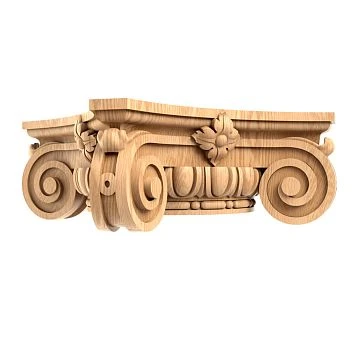
For classic style, models with rounded, smooth shapes are best suited — KON-001 with spherical elements or KON-002 with large round accents 170 mm wide. These details echo classic turned balusters and form a unified stylistic ensemble with carved wooden decor — cornices, rosettes, capitals from the STAVROS collection.
KON-003 with five types of elements and complex multi-level plasticity — a choice for an eclectic interior where layering and decorative richness are valued. Its sculptural character works well in a context where elements of different styles are mixed.
The main rule is to match the posts with other wooden interior elements in material and finish. If the room has oak architraves, Wooden moldings and the cornices and posts should also be oak with a similar finish. If the furniture is painted white, posts under white enamel made of beech will continue this line. Furniture legs made of the same material and with the same finish will complete the stylistic unity.
Beech or oak: what to choose
Choosing a wood species is not a matter of aesthetic preference, but a matter of functional alignment with the finish and interior style. Beech and oak are the two main species available for KON kits, and each has its own optimal application area.
Beech is a dense, uniform species with an almost patternless structure. It has a light pinkish hue, fine straight grain, and closed pores. Density is about 720 kg/m³. Beech is an ideal material for enamel: the surface accepts primer and paint evenly, without showing grain texture, without bleed-through or contrasting tonal spots. If you plan to paint the posts in a solid color — white, black, pastel, or a rich RAL shade — beech is the right choice. A decorative partition post made of beech under white enamel looks like a cast object: the form is perceived clearly, without textural interference. Beech is also well-suited for clear lacquer while preserving its light natural tone — for interiors where a neutral, warm, but unobtrusive surface is needed.
Oak is a species with an expressive, recognizable texture. It features characteristic ray flecks, a warm golden hue, and a porous structure. Density is about 670–720 kg/m³. Oak is chosen when the natural wood grain should be part of the decorative solution — under clear lacquer, oil, stain, or translucent tinting. On large surfaces of turned elements — spheres, cubes, cones — oak texture reveals itself especially expressively. Dark oak with a walnut finish, a cool gray-brown tone, or natural light oak with matte oil — all create the feel of a premium, textured, prestigious product. In an interior with natural stone, metal, leather, and wood, oak posts become a natural extension of the space's material palette.
There is also a practical consideration: oak is more expensive than beech. If the budget is limited and painting under enamel is planned (where the wood texture will not be visible), there is no point in overpaying for oak — beech under enamel will give the same visual result at a lower cost. If a clear or translucent finish is planned, where the wood texture plays a role, oak justifies its price.
For combined solutions — wooden parts in combination with metal tubes or axles — oak works more effectively: the contrast of warm wood and cold metal is one of the most sought-after combinations in modern furniture and interior design.
Typical mistakes when buying
Buying a wooden partition is not an impulsive decision. It is a project that requires calculation, understanding, and coordination. Here are typical mistakes buyers make and ways to avoid them.
Mistake 1: buying one post expecting a full partition. This is the most common and most painful mistake. The buyer sees a visualization of a partition made of several posts on the website, reads the price, and thinks they are paying for the entire partition. Upon receiving one kit, they discover it is one post, not the whole structure. To avoid this: always remember that one KON kit is one decorative post 2800 mm high. A partition is assembled from several posts. Calculate the number of kits based on the width of your opening.
Error 2: not calculating the number of kits. If you haven't measured the opening width and estimated the spacing, you won't know how many kits you need. The result is either a shortage or an excess of posts. Always measure the width of the zoning area and divide by the spacing to get the number of posts.
Error 3: choosing too frequent spacing and darkening the room. A spacing of 100–150 mm creates a very dense structure that barely lets light through. In dark rooms or on the north side, this can make the space gloomy. Consider the lighting: if natural light is insufficient, choose medium or large spacing.
Mistake 4: choosing too wide a spacing and not achieving zoning. A spacing of 800–1000 mm is no longer a partition, but a series of individual posts. Zoning with such spacing is minimal. If you need real visual separation, do not exceed 500–600 mm.
Error 5: mixing KON with regular slats without a unified composition. The KON kit is an independent decorative system with its own rhythm and silhouette. Mixing turned KON posts with simple slats in one partition creates visual chaos. If you use KON, use only KON. If you need a slatted partition, study the material about Designing Wooden Partitions with Stavros Slats.
Error 6: not considering ceiling height. All KON kits have a height of 2800 mm. If your room height is lower, the posts will need to be cut. If higher, there will be a gap between the top of the post and the ceiling. Before ordering, measure the ceiling height and discuss with the manager how the height issue will be resolved.
Error 7: not coordinating the material and finish with the furniture. A wooden partition does not exist in a vacuum—it is part of the interior. If the furniture is oak and the posts are beech under enamel, there is dissonance. If the baseboards and trim are white and the posts are dark, a deliberate contrast is needed, not an accident. Coordinate the material and finish of the partition with other wooden elements in the room— wooden decorative elements, moldings, trim.
Error 8: choosing a sliding intent. The STAVROS KON product group is not sliding partitions. These are stationary decorative posts that are fixed to the floor and ceiling. If you need a sliding structure, that is a different product and a different format.
Error 9: not planning the fastening. A post 2800 mm high is a large structure that requires rigid fixation. Before ordering, you need to understand how the posts will be attached to the floor and ceiling. STAVROS managers can advise on fastening methods, and partner carpentry companies in most regions of Russia can perform measurements and installation.
Error 10: ignoring consultation. STAVROS is not an online store with automatic delivery. It is a production where each kit is made to order. Consulting with a manager before placing an order is not a formality but a necessity. A specialist will help verify the calculation, select the material, finish, and fastening method, and calculate the full cost and timeline.