Article Contents:
- What is a Flexible MDF Panel
- Construction: What's Inside
- Surface: Ready for Finishing
- How This Panel Differs from 'Regular MDF'
- Where Flexible MDF Panels Are Primarily Needed
- Columns
- Arches and Arch Openings
- Niches and TV Zones
- Radius Walls
- Rounded Corners
- Furniture Fronts with Curves
- TV Zones and Accent Walls
- How Flexible MDF Panels Differ from Rigid Ones
- By Backing Construction
- On behavior on curved surfaces
- On geometry accuracy
- On installation
- By visual effect
- Where rigid panels are better, and where flexible ones are irreplaceable
- Why MDF is the ideal material for painting
- Uniform and smooth surface
- High adhesion for finishing coating
- Stable color result
- When MDF Is Better Than Solid Wood
- When the primed option is more cost-effective
- How to choose a flexible MDF panel for a specific task
- For residential interiors
- For Commercial Space
- For furniture
- By width and frequency of battens
- By lighting
- Installation of flexible MDF panel: from preparation to finish
- Foundation Preparation
- Marking
- Dry fitting
- Which adhesive to use
- Fixation
- Module joining
- Corner finishing
- Cutting panels
- Adjacency to other materials
- Mistakes when choosing and installing flexible MDF panels
- Using rigid panel on curved surface
- Choosing flexible panel for perfectly flat wall 'just in case'
- Not considering lighting
- Not planning the direction of battens
- Not planning the color in advance
- Not planning the joints
- Taking different batches without control
- Ignoring surface preparation
- What determines the price of flexible MDF panel
- Primed or without primer
- Module dimensions
- Order volume
- Final Painting
- Surface complexity
- Logistics
- Flexible MDF panel in different interior styles
- Modern minimalism
- Loft and Industrial Style
- Neoclassicism and Modern Classicism
- Scandinavian Style
- FAQ — answers to popular questions about flexible MDF panel
- What is flexible MDF panel?
- How does flexible MDF panel differ from rigid?
- Can flexible MDF panel be used for columns?
- Is flexible MDF panel suitable for arches?
- Can flexible MDF panel be painted?
- What paint to use for flexible MDF panel?
- Is lathing needed under flexible MDF panel?
- Can flexible MDF panel be glued to drywall?
- Can flexible MDF panel be glued to plaster?
- Are joints between panels visible?
- Can flexible MDF panel be used on ceiling?
- Is flexible MDF panel suitable for furniture?
- How to care for painted MDF panel?
- What determines the price of flexible MDF panel for painting?
- Can a radius wall be finished with flexible MDF panel?
- Conclusion: When a Flexible MDF Panel is the Right Choice
- About the Company STAVROS

Some questions seem simple only at first glance. 'Which panel to install on a column?' — and suddenly you're faced with a choice where a mistake will cost you dearly: money, time, and nerves for rework. A flexible MDF wall panel is not just another type of finishing material. It's an architectural tool that provides possibilities where rigid solutions fall short. In this article, we will examine it completely — from construction to price, from selection for the task to typical installation errors.



What is a Flexible MDF Panel
Let's start with the most fundamental aspects. Because if you don't understand how this material is constructed internally, it will be difficult to choose it for a specific task.




Construction: What's Inside
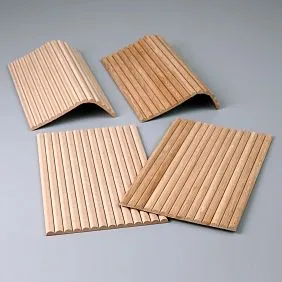
A flexible MDF panel is a module made of parallel battens, manufactured using deep milling of MDF. The battens have a semi-circular profile and are fixed at equal intervals on a dense, elastic fabric base. This fabric backing is the key element of the entire construction. It doesn't just hold the slats in a fixed position: it allows the entire sheet to bend to any radius without breaking or deforming the battens.
This fundamentally distinguishes a flexible MDF panel from conventional rigid slatted solutions on an MDF substrate. In the rigid version, the slats are glued to dense plywood or board — such a construction is ideal for a flat wall but is physically incapable of bending. The flexible one can.
Our factory also produces:


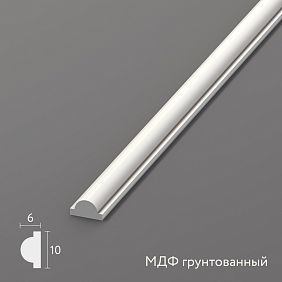
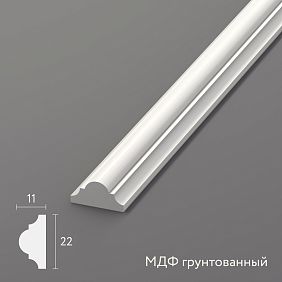
Surface: Readiness for Finish
ModelPAN-002— the flagship primed flexible MDF panel in the STAVROS line — is already supplied with two layers of white polyurethane-based primer-isolator. The surface is carefully sanded: it has a high degree of adhesion and is completely ready for final finishing without additional preparation stages. This is not just convenience — it's a saving of several days of work on site.
Get Consultation
How does this panel differ from 'regular MDF'?
When people say 'MDF panel', they often mean a flat sheet or rigid module with a decorative finish. Flexible MDF panels for painting are a completely different format. There is no rigid backing here. There is relief, rhythm, and freedom of bend. The vertical slat pattern creates a play of light and shadow—that very surface depth which a flat sheet can never provide.
The result is a panel that looks like an expensive architectural solution, accepts any color of finish enamel, and yet wraps a column as easily as it lays on a flat wall.
Where flexible MDF panels are needed first and foremost
The scope of application for this material is significantly wider than it seems at first. Let's examine each scenario—because it's precisely understanding the task that determines the correct choice.
Columns
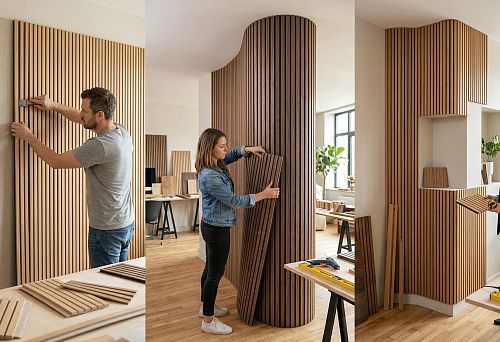
A column is a surface with a constant radius. A rigid panel is fundamentally impossible here: the MDF backing will break if you try to bend it around a circle. Flexible MDF panels for columns wrap the cylindrical surface as a single module—the equal spacing of the slats is maintained around the entire circumference, joints are minimal, and the visual effect is flawless.
The width of the standard PAN-002 module is 1010 mm. This is enough to wrap a column with a diameter of about 32 cm with one panel without joints. For columns of larger diameter, modules are joined edge-to-edge—with precise alignment of the slat pattern.
Arches and arched openings
An arch is a classic of radius finishing. The inner surface of an arch has a smooth curve that cannot be faced with rigid material without serious carpentry fitting.Flexible slatted panels for archesfollow the shape without gaps or joints—the result looks like a monolithic wooden arch that was faced in a workshop.
Niches and TV zones
TV niche, decorative niche in the bedroom, built-in shelf with an accent back wall — wherever the space has a non-standard shape or rounded edges, the flexible MDF panel for niches and TV zones becomes the perfect tool. It wraps around the inner corners of the niche, provides an even slatted pattern on the back wall, and creates volume that looks great in any lighting.
Radius walls
Rounded walls in modern apartments, designer offices, and public spaces are always a challenge for the finisher. A rigid panel leaves gaps or breaks.Flexible MDF panel for radius wallssimply follows the curve — without breaks, without gaps, with a perfect surface for final painting.
Rounded corners
Rounded corners are more common than they seem: in children's rooms, in hallways with non-standard layouts, in restaurants and medical centers. Here, the flexible decorative MDF panel simply wraps around the corner without any additional elements — which is technically elegant and visually flawless.
Furniture fronts with a curve
Flexible MDF panels for furniture and facades are a separate story that is increasingly penetrating furniture production. Bar counters, kitchen islands with a radius front, curved cabinets in the bedroom — the slatted texture on a curved facade creates an effect that was previously only available in expensive ateliers. For such tasks, painting with polyurethane or acrylic enamels is recommended — they provide a durable coating on the MDF surface with a high degree of adhesion.
TV zones and accent walls
Here, the flexible panel works not on a radius, but as an element of the general rhythm of the space. Vertical slats on the wall behind the TV or sofa form an accent that sets the character of the entire room. When painted in a neutral color — the panel 'dissolves' in the interior, preserving the relief. When painted in a contrasting color — it becomes the main focal point.
How flexible MDF panel differs from rigid
This is a question that every second buyer asks. And the correct answer to it is essentially half of a smart choice.
By substrate construction
| Parameter | Rigid MDF panel | Flexible MDF panel |
|---|---|---|
| Backing type | MDF board or plywood | Elastic fabric base |
| Bending capability | No | Yes, with any radius |
| Preservation of slat spacing on bend | — | Yes, complete |
| Application on columns | Impossible | Optimal |
| Application on flat walls | Optimal | Possible |
| Geometric precision | Maximum | High |
| Installation | Battens or adhesive | Adhesive only |
Behavior on curved surfaces
A rigid panel on a curved surface is literally a wrong choice. MDF backing does not bend: when forced to bend, it delaminates or cracks, and the slats lose parallelism. A flexible MDF panel on a fabric base bends smoothly, preserving all surface characteristics.
By geometric accuracy
This is the only parameter where a rigid panel wins on a flat wall. The dense backing provides absolute flatness, which is especially important when installing built-in furniture or working with precision architectural details. For a typical residential interior, this difference is practically unnoticeable.
Installation
A rigid panel typically requires battens or a perfectly flat base for adhesive. A flexible MDF panel is installed directly onto a prepared surface: adhesive is applied to the fabric base, the panel is applied to the shape, and fixed until polymerization. On columns and arches—without battens, without special equipment, without carpentry fitting.
By visual effect
Both types provide an identical slatted pattern: the rhythm of vertical lines, the play of light and shadow, the surface relief. On a flat wall, the difference is unnoticeable. On radiused surfaces—a rigid panel is physically inapplicable, so there is nothing to compare. A flexible MDF panel wraps around the form and creates a solid volumetric pattern—this is not an imitation, it is a full-fledged architectural detail.
Where rigid panels are better and where flexible panels are the only option
Choose a rigid panel if:
-
the surface is perfectly flat;
-
maximum geometric accuracy is important;
-
flat furniture front;
-
installation is done on battens with precise marking.
Choose flexible MDF panel if:
-
the surface has a radius of less than 1.5 meters;
-
the task is a column, arch, radius wall, rounded corner;
-
curved furniture front;
-
seamless cladding of complex geometry is needed;
-
it's important to avoid battens and speed up installation.
Why MDF is the ideal material for painting
This is a block that is especially important for everyone who chooses color in the interior, not the natural texture of wood.
Uniform and smooth surface
MDF is made from fine wood fibers pressed under high pressure. The result is a material without pores, fibers, or knots. The surface is absolutely uniform. This means paint applies evenly, without 'sinking' into pores and without variations in primer absorption across different points of the panel.
High adhesion for the finish coating
PAN-002 comes with two layers of polyurethane-based insulating primer. The primer levels the surface to perfect smoothness and creates an adhesion layer to which the finish enamel adheres with maximum reliability. This eliminates the risk of coating peeling and significantly simplifies the painter's work—the surface is already ready, no additional preparation steps are needed.
Stable color result
On natural wood—oak, beech, ash—the color is always uneven: different areas of the grain absorb paint differently. On MDF, the result is predictable and stable. What you see in the sample is what you get on the finished wall. For design projects with precise color requirements, this is fundamentally important.
When MDF is better than solid wood
Simple algorithm:
-
Need a specific color from the RAL or NCS palette → MDF for painting
-
Need a monochrome accent wall matching the overall concept → MDF
-
Need a white or light gray interior → MDF with primer
-
Need a natural texture, live grain pattern → solid oak or beech
-
Need the ability to repaint after several years → array
When the primed option is more cost-effective
Primed flexible MDF panel, such as PAN-002 fromthe STAVROS slatted panel category, eliminates the need to prime the surface on-site. In practice, this means: no risk of missing a spot, no uneven application, no additional drying between stages. You proceed directly to final painting. This is especially critical on commercial projects where every day of downtime is money.
How to choose a flexible MDF panel for a specific task
Theory is good. But practice requires specific answers: what exactly to take, for which room, for which interior, with what slat parameters.
For a residential interior
In a living space, a paintable flexible MDF panel works in several scenarios:
-
Living room: accent wall behind the sofa or TV area. A vertical slatted rhythm visually raises the ceiling, and painting it to match the wall color gives a deep, refined effect.
-
Bedroom: headboard or niche. The combination of slatted texture with soft furniture works especially well — slats add structure to a space that otherwise risks becoming too 'fabric-heavy'.
-
Hallway: column or rounded corner at the entrance. The first impression of the apartment is formed right here — and slatted cladding immediately signals the class of the interior.
-
Study: one working wall behind the desk. Dark-colored slats create a sense of focus and professional space.
For commercial space
Commercial interiors involve a different load regime and different material requirements.Flexible MDF panel for commercial interiorscovers the needs:
-
reception desk with a radius front;
-
columns in hotel or business center lobbies;
-
bar counter with slatted cladding on the front;
-
office partitions with accent panels;
-
Arch entrance groups in a restaurant.
For all these tasks, the following are important: polyurethane enamel for durability, primed base for quick installation, flexible fabric backing for complex shapes.
For furniture
Flexible MDF panels for furniture and facades are not a furniture designer's fantasy but a quite practical technology. A curved facade of a kitchen island, a radius cabinet door, a cabinet with a slatted front — all of this is implemented on a flexible MDF panel with subsequent painting using acrylic or polyurethane enamel.
Important nuance: for furniture, polyurethane enamel is specifically recommended — it provides the best adhesion to MDF and maximum resistance to mechanical impacts.
By width and frequency of slats
Slat parameters directly affect the visual scale. A simple rule:
-
Narrow slats with small spacing → fractional, light rhythm, suitable for small rooms;
-
Wide slats with large spacing → bold, architectural rhythm, works in spacious areas.
Incorrectly chosen slat scale is one of the most common mistakes. In a small room, large slats create overload; in a large hall, small ones get lost and are not noticeable.
By lighting
Slatted panels are a material that literally comes alive in light. Directional light along the slats accentuates the relief, creates deep chiaroscuro, and gives the panel volume and architectural presence. Diffused general lighting provides a more restrained, uniform effect. If lighting is planned for the project, consider its placement before installing the panels: spot lighting from above along a slatted wall is one of the most advantageous techniques.
Installation of flexible MDF panels: from preparation to finish
One of the main arguments in favor of flexible MDF panels is the simplicity of installation. There is no lathing, no complex fasteners, and no need for a carpentry crew. But there are nuances that are important to know in advance.
Foundation Preparation
The surface must be:
-
dry (moisture content no more than 12–14%);
-
strong (without peeling areas);
-
clean (free of dust, grease, traces of old adhesive);
-
level within the tolerance for the adhesive used.
Plaster and drywall are standard substrates with good adhesion. Concrete, aerated concrete blocks, and brick require deep-penetration primer. Porous and crumbling surfaces are excluded without prior reinforcement. Neglecting this stage is the main reason why panels begin to detach.
Marking
Before installation, apply vertical and horizontal layout lines. The first panel must be set perfectly vertically—it sets the rhythm for all subsequent cladding. This is especially critical on flat walls: the slightest misalignment of the first module will accumulate and become noticeable by the third or fourth panel.
Dry fitting
Do not neglect a dry fit. Place the panel against the surface, ensure the correct direction of the slats, and check how the joints will lie. On columns and arches, dry fitting is especially important: you need to ensure that the panel follows the surface shape without distortions or unwanted tension on the fabric backing.
Which adhesive to use
For installing flexible MDF panels on walls, the following are used:
-
mounting adhesive on a polyurethane or acrylate base (applied with a notched trowel or from a tube with a comb applicator);
-
high-strength double-sided mounting tape — only for lightweight panels on flat surfaces.
The adhesive is applied to the fabric backing of the panel, not to the wall. This ensures even distribution without 'sinking' into the fabric texture.
Fixation
After applying the adhesive, the panel is placed against the surface and pressed over the entire area. On flat walls — rolling with a roller is sufficient. On columns and arches — secure with painter's tape or masking tape at several points until the adhesive polymerizes (usually 20–40 minutes, after which the fixation is reliable).
Module Joining
This is one of the main technical points. Flexible MDF panels are joined butt-to-butt: the slat of one module precisely abuts the slat of the next, the pattern step is uninterrupted. With proper joining, the seam is visually unnoticeable. The rule: the first panel — always level, only then all subsequent ones.
Corner finishing
-
Straight external corner: cut at 45° with a sharp knife or miter saw, joined at an angle;
-
Rounded corner: the panel is simply wrapped around the corner without additional trim elements;
-
Adjacency to ceiling and floor: baseboards or decorative profiles depending on the overall interior style.
Cutting panels
Flexible MDF panel is cut with a regular utility knife (across the slats), a wood saw, a miter saw, or a jigsaw. No special equipment is required. For 45° angled cuts, a miter saw is more convenient.
Adjacency to other materials
If the panel adjoins tile, plaster, or another material, the joint is finished with a decorative profile or sealant matching the paint color. This covers the technical joint and gives the entire connection a neat appearance.
Mistakes when choosing and installing flexible MDF panel
Mistakes in this matter are almost always errors in selection or preparation, not in installation skill. Let's look at the main ones.
Using a rigid panel on a curved surface
This happens more often than one would like. A customer sees a slatted panel, thinks 'we'll bend it somehow' — and ends up with delaminated MDF and a ruined workday. The rule is clear: any surface with a radius of less than 1.5 meters requires a flexible panel on a fabric base.
Choosing a flexible panel for a perfectly flat wall 'just in case'
This is the opposite mistake. A flexible panel costs more than a rigid one, yet provides no additional effect on a flat wall. If all surfaces are straight — choose rigid and save your budget.
Not considering lighting
Slatted texture is about light and shadow. If the room has only diffused ceiling light — the relief will be 'read' weakly. If you want the panel to look exactly as in the catalog photo, directional lighting is needed. Plan it before installation, not after.
Not thinking through the direction of the slats
The standard solution—vertical battens—works in most cases. But it's not the only one. Horizontal arrangement—for visual expansion. Diagonal—for dynamism and a non-standard character of space. The choice of direction is an architectural decision, not a coincidence.
Not planning the color in advance
MDF for painting is an opportunity to choose any color. But this very freedom often leads to problems: the color is chosen at random, without a test sample, and the result on a large surface turns out to be unexpected. Be sure to do a test paint on a sample, look at it in the actual lighting conditions of the object.
Not planning the joints
If panels join in an area that is clearly visible—the joints must be carefully fitted. On invisible ends, you can save time; on visible ones—you cannot. The joint location needs to be planned at the marking stage.
Taking different batches without control
MDF is a stable material, but the shade of the primed surface may vary slightly between batches. If you need a large area—order the entire volume at once. This eliminates the risk of tone discrepancy after painting.
Ignore surface preparation
Adhesive only holds on a strong, clean, primed substrate. Saving here means getting peeling corners in 3–6 months. No material compensates for a poor substrate.
What determines the price of a flexible MDF panel
A question everyone asks—and they're right to do so. Because the price of flexible MDF panels varies, and it's important to understand what it consists of.
Primed or unprimed
An unprimed panel is cheaper. However, the price difference is almost always offset by the cost of priming work on-site—materials and time.Primed MDF slatted panel PAN-002with two layers of polyurethane primer allows you to proceed directly to the finishing stage without additional investment in preparation.
Module dimensions
The standard width of PAN-002 is 1010 mm, length is 2700 mm. Non-standard sizes for a specific project are produced to order—and, as a rule, cost more than the standard due to custom cutting and fitting.
Order volume
A wholesale order from the manufacturer is always more profitable than retail. If you are working with several rooms or a large commercial project—request a quote for the entire volume at once. Savings on large batches are significant.
Final painting
If panels are ordered pre-painted (which is possible when ordering from the manufacturer)—the cost includes the price of paint and labor. For non-standard colors from the RAL/NCS palette, the cost of tinting is added.
Surface complexity
The panel itself costs the same regardless of what it is mounted on. However, the cost of installation work on columns and arches is higher than on flat walls: more time, more precision, sometimes—special fixtures for fastening.
Stavros organizes delivery within Moscow using its own transport or partners with logistics providers for delivery to regions. Packaging ensures the preservation of even delicate carved elements.
For regions outside Moscow and St. Petersburg, the budget must include the cost of delivery. Panels in the 2700 mm format require specialized transportation—this must be taken into account when calculating the project.
Flexible MDF panel in different interior styles
Paint-ready material offers complete stylistic freedom. However, each design direction has its own logic for working with slatted texture.
Modern minimalism
White or light gray slats against a wall of the same color create an almost invisible yet very tangible relief. This technique is called 'tone-on-tone' and adds depth to the surface without visual noise. Primed flexible MDF panels for painting work best for this task—first a white primer, then a matte enamel finish in the desired shade.
Loft and industrial style
Dark gray, anthracite, or black slats on an untreated concrete wall or against brickwork represent pure loft-style contrast. The slatted MDF texture here acts as a counterbalance to the rough industrial texture: geometry versus chaos, rhythm versus randomness.
Neoclassicism and modern classicism
Slats in ivory or 'dusty white,' possibly with a contrasting base, create a finish that reads as expensive wood paneling, though in fact it's MDF with the right enamel. Columns clad with slatted panels in this style are a particularly winning technique.
Scandinavian style
Light neutral shades, minimal decor, emphasis on texture. Paint-ready MDF in light beige or white is the ideal material for Scandinavian aesthetics. Vertical slats on a bed headboard or behind a sofa are one of the most popular solutions in this direction.
FAQ—answers to popular questions about flexible MDF panels
What is a flexible MDF panel?
It is a decorative slatted panel where semi-circular MDF battens, deeply milled, are fixed at equal intervals on an elastic fabric backing. The fabric backing allows the panel to bend to any radius—for cladding columns, arches, curved walls, and curved furniture fronts.
How does a flexible MDF panel differ from a rigid one?
A rigid MDF panel has a solid backing and is only applicable on flat surfaces. A flexible one has a fabric backing that bends without deforming the slats. Visually, they are identical; the difference lies in the construction and possible application surfaces.
Can flexible MDF panels be used for columns?
Yes. This is one of the key applications. The panel wraps around the column as a single module, maintaining an even slat spacing across the entire circumference, with no visible seams when installed correctly.
Is flexible MDF panel suitable for an arch?
Yes. The inner surface of an arch is a classic task for a flexible panel. It follows the smooth curve, does not require carpentry fitting, and provides a unified slatted surface across the entire arch.
Can flexible MDF panels be painted?
Yes, that's exactly what it was created for. The primed version PAN-002 is fully ready for finishing painting with any enamel—acrylic, polyurethane—without additional surface preparation.
What paint should be used for flexible MDF panels?
For interior applications, matte and semi-matte acrylic enamels are suitable. For furniture fronts, polyurethane enamels are recommended as more resistant to mechanical impact.
Is lathing needed under flexible MDF panels?
No. Flexible panels are mounted directly onto a prepared substrate using adhesive. This is one of the key advantages over rigid systems.
Can flexible MDF panels be glued to drywall?
Yes. Drywall is one of the optimal substrates. Pre-priming the surface is recommended to improve adhesion.
Can flexible MDF panels be glued to plaster?
Yes, provided the plaster is strong, dry, and primed. Crumbling or damp plaster requires preliminary reinforcement.
Are the joints between panels visible?
With proper fitting — no. Joining is done tongue-and-groove, with precise pattern pitch matching. The first module is set by level, subsequent ones are joined without gaps.
Can flexible MDF panels be used on ceilings?
Yes, when using reliable mounting adhesive and fixing until polymerization. On arched ceilings — a particularly impressive and technically justified application.
Are flexible MDF panels suitable for furniture?
Yes. For curved furniture fronts, bar counters, and cabinets with a radius front. Painting with polyurethane enamel is recommended for maximum surface durability.
How to care for a painted MDF panel?
Wipe with a soft dry or slightly damp cloth. Abrasive sponges and aggressive cleaning agents are to be avoided. A painted MDF surface, with proper care, lasts for years without losing its appearance.
What determines the price of a flexible MDF panel for painting?
Main factors: presence of primer on the surface, module dimensions, order volume, finish painting, and delivery cost. The primed PAN-002 panel is more expensive than the unprimed version, but compensates for the difference by saving on preparation.
Can a radius wall be finished with a flexible MDF panel?
Yes. This is exactly the task for which the fabric-based flexible MDF panel was designed. With proper installation, you get a solid slatted surface without breaks or visible seams.
Conclusion: when a flexible MDF panel is the right choice
If you want it concisely — here's the final selection logic.
Choose a flexible MDF panel for painting if:
-
the surface has a radius, curve, or non-standard geometry;
-
a specific finish color is needed;
-
installation speed without battens is important;
-
the project is commercial with tight deadlines;
-
the task is a curved furniture facade.
Look towards solid oak or beech if:
-
natural texture and live wood grain pattern are important;
-
coating with oil, wax, or tinting is intended;
-
the interior is built on natural materials.
Stay with a rigid panel if:
-
the surface is perfectly flat;
-
there is not a single radius or curved element;
-
Maximum geometric precision on a plane is required.
Explore the full rangeof slatted panels made of MDF and solid wood— both structural formats are presented there: rigid modules for flat surfaces andFlexible panels on fabric basefor complex geometries. If your task is a column, arch, or radius wall, and you want MDF for painting with a ready-primed surface —PAN-002covers exactly this need.
About the company STAVROS
STAVROS is a manufacturer of decorative products made of MDF and solid wood with production in Russia. The company specializes in slatted panels in rigid and flexible structural designs, products made of natural wood, and decorative solutions for residential and commercial interiors.
The STAVROS line includesslatted panels made of MDF and solid oakin several formats: rigid modules for flat surfaces, furniture fronts, and ceilings, as well as flexible panels on a fabric base for radius walls, columns, arches, niches, and curved furniture fronts. The flagship models are PAN-001 (solid oak, beech, or MDF) andPAN-002— primed slatted MDF panel with two layers of polyurethane primer-insulator.
STAVROS works with designers, architects, furniture manufacturers, and private clients across Russia. Panels are produced for specific projects — with a choice of material, slat profile, width, spacing, and finish. Learn more about the range and ordering conditions on the company's official website.