Article Contents:
- What is textured wooden molding
- How textured profile differs from smooth slat
- How it differs from carved baguette
- Why 60 mm height is convenient
- Where fluting looks most convincing
- Which styles MLD-031 suits
- When fluting may be unnecessary
- Why the wave looks more modern
- Where MLD-032 performs best
- When the wavy pattern is not suitable
- Furniture fronts
- Kitchen fronts
- Commodes and cabinets
- Door panels
- Wall frames and boiserie
- Mirror framing
- Niches and decorative panels
- Columns and pilasters
- MDF under enamel
- Beech for even painting and calm wood
- Oak for expressive tinting
- Which material to choose for enamel
- Which material to choose for tinting
- Rectangular frame
- Tall wall panel
- Several furniture fronts
- Allowance for corners and defects
- How to calculate different materials
- 45-degree bevel cut
- Straight joint with vertical priority
- Joint on a long line
- Why a bad joint cannot be fixed with a thick layer of paint
- Preparation before painting
- Brush
- Roller
- Spraying
- How to avoid drips
- Need to make the facade stricter and taller
- Need to soften the rectangular body
- Need to finish the facade with enamel
- Need to preserve natural oak
- Need to design a wall panel without classic stucco
- Need to highlight one furniture section
- Need to design a mirror
- Need to design a column or protrusion
- Need to design a commercial space
- Living Room
- Bedroom
- Kitchen
- Office and Library
- Children's room
- Walk-in closet
- Molding and regular batten
- Molding and casing
- Molding and baseboard
- Molding and cornice
- Textured molding and carved baguette
- MLD-031 and fluted panel
- Choosing only by close-up photo
- Ignore material length
- Consider the difference of 8 and 9 mm as unimportant
- Buy oak for dense enamel without necessity
- Do not make a test paintout
- Flood the relief with paint
- Do not account for cleaning
- Join relief without a test corner
- Use the profile as a structural part
- Order exact length without reserve
- Repeat the texture on all elements
- Evenness of the facade or wall
- Dry layout
- Material acclimatization
- Marking
- Fastening
- Final adjustment
- Number of whole planks
- Material
- Finishing
- Installation and joints
- What is a fluted molding?
- How does a ribbed molding differ from a smooth one?
- Should I choose MLD-031 or MLD-032 for furniture?
- Which profile to choose for a wall panel?
- Can MLD-031 be used as a trim?
- Is MLD-032 suitable for a furniture facade?
- What is better under enamel — MDF or beech?
- What to choose for tinting — oak or beech?
- Can a textured molding be painted with a brush?
- How to join textured molding at corners?
- How much extra should I add when purchasing?
- How to Calculate the Amount of Molding?
- Can textured and smooth profiles be combined?
- Which texture collects less dust?
- Can the profile be installed horizontally?
- Is the molding suitable for the kitchen?
- Can the profile be used in the bathroom?
- Where to buy textured wooden molding?
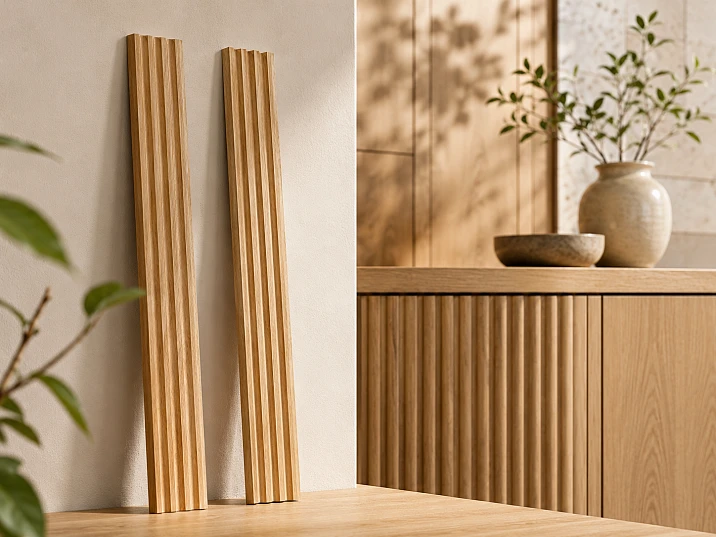
Buy textured wooden molding usually wanted not for a simple frame, but for a surface that itself participates in the design. A smooth profile defines a contour, covers a joint, and assembles the composition. A fluted or wavy molding does more: it breaks up light, creates shadows, adds vertical plasticity to furniture, and helps highlight a panel without carving, overlays, or complex ornament.
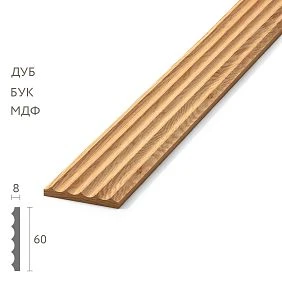
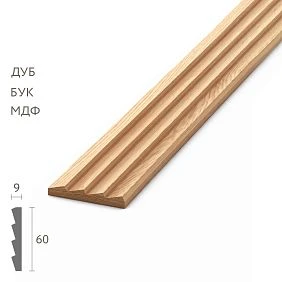
MLD-031 and MLD-032 can easily be mistaken for nearly identical strips: both profiles have a height of 60 mm, the difference in thickness is only one millimeter. But after painting or tinting, they look different. MLD-031 is built on strict longitudinal flutes. It creates a regular ribbed surface and supports classical, neoclassical, and architectural compositions well. MLD-032 has a soft wavy face, so the line looks more plastic and calmer.
The buyer needs to decide not only which pattern looks good in a photo. The scale of the facade, installation direction, material, strip length, future finish, and number of joints matter. On a small door, the frequent flutes of MLD-031 can look collected and graphic. On a wide wall panel, the wave of MLD-032 creates a softer play of light. Under a transparent tint, oak shows wood texture; under opaque enamel, MDF or beech shifts attention to the relief.
In the STAVROS catalog you can buy decorative wooden moldings and compare textured profiles with smooth, framed, and classic models. Below, we will break down how a flute differs from a wave, where MLD-031 and MLD-032 are appropriate, which material to choose, how to calculate linear meters, and what to check before placing an order.
What is a textured wooden molding
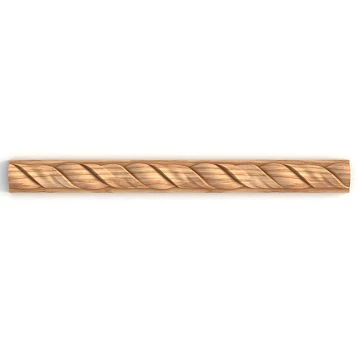
A textured profile is one where the face surface does not remain flat. The relief can consist of grooves, waves, ridges, steps, or repeating geometric transitions. In MLD-031 and MLD-032, the texture runs along the entire strip, so one segment creates a continuous line 2400 or 2600 mm long without needing to assemble the pattern from separate overlays.
Such a molding performs three tasks simultaneously. It frames an edge or border like a regular profile. It hides a technological joint if the project requires it. And it adds expressiveness to the surface through light and shadow. The last function is especially important for monochrome furniture: even a white facade does not look flat because the relief remains noticeable.




How a textured profile differs from a smooth batten
A smooth batten has a calm surface and is suitable for minimalist frames, panel layouts, and straight geometric lines. A textured molding already has a formed pattern. It cannot be considered a simple 60 mm batten: grooves or waves change the appearance, complicate painting, and require careful joining.
On a smooth profile, a slight unevenness in the coating is noticeable as a spot. On a fluted one, paint can collect in the recesses. On a wavy one, a too thick layer smooths out the transitions. Therefore, the choice of texture is related not only to style but also to finishing technology.
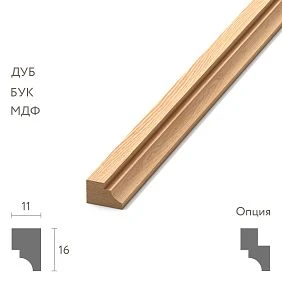
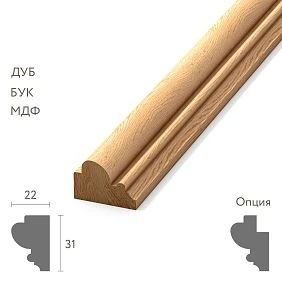
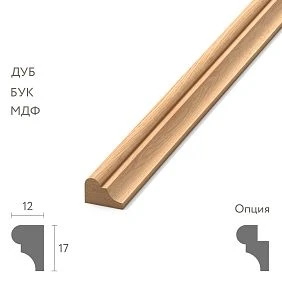
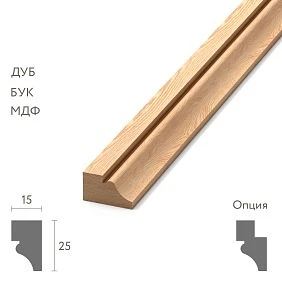
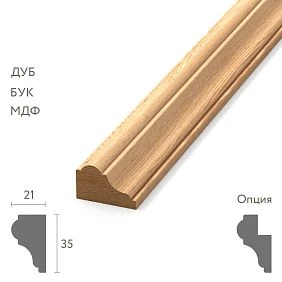
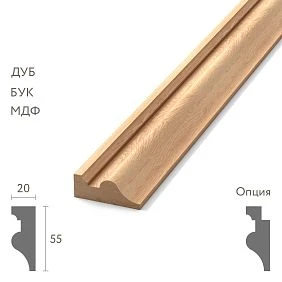
Our factory also produces:
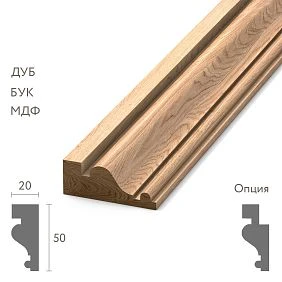
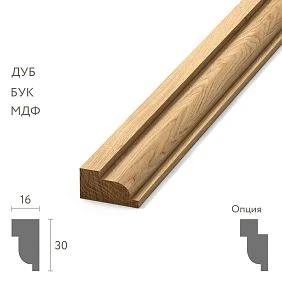
How it differs from a carved baguette
A carved baguette is based on ornament: leaves, beads, scrolls, geometric frieze. MLD-031 and MLD-032 do not contain an independent motif. Their pattern is abstract and repetitive. Thanks to this, the profiles are easier to combine with modern furniture, panels, veneer, smooth walls, and laconic hardware.
A textured molding can look classic or modern depending on the color and surroundings. White MLD-031 next to a panel resembles architectural fluting. Dark oak MLD-032 on a laconic facade is perceived as a modern, plastic line.
Get Consultation
Why is the height of 60 mm convenient
The 60 mm face width makes the profile noticeable but does not turn it into a massive cornice. It is suitable for furniture frames, door panels, niches, mirrors and wall panels. On a narrow facade, 60 mm already creates a pronounced contour. On a large wall, the profile does not get lost and is readable from a distance.
At the same time, the internal size of the frame must be considered. Four planks of 60 mm reduce the open central part of the panel. If the molding is installed on top of the facade, the dimension does not change, but the frame visually becomes wider. If it is built into the structure between parts, the dimensions are calculated in advance.
Confirmed characteristics of MLD-031 and MLD-032
| Parameter | MLD-031 | MLD-032 |
|---|---|---|
| Profile type | Fluted, ribbed | Wavy, shaped |
| Cross-section size | 60 × 9 mm | 60 × 8 mm |
| MDF length | 2600 мм | 2600 мм |
| Array length | 2400 mm for beech and oak | 2400 mm for beech and oak |
| Materials | MDF, beech, oak | MDF, beech, oak |
| Surface preparation | For enamel or tinting depending on the selected finish | For enamel or tinting depending on the selected finish |
| Main visual effect | Strict longitudinal lines and contrasting shadows | Soft plasticity and smooth light transition |
| Main scenarios | Facades, frames, wall panels, columns, doors, boiserie | Furniture, panels, mirrors, niches, modern decorative frames |
The difference in thickness of 9 and 8 mm is small, but when joining with adjacent parts, it cannot be ignored. If the molding must align with a smooth strip, panel, or end plate, the surface height is checked on the drawing. One millimeter may be unnoticeable on a separately glued profile, but can appear as a step in a complex layout.
The length depends on the material. MDF is produced in 2600 mm lengths, beech and oak in 2400 mm. For a tall panel or long vertical strip, this affects the number of joints. On a 2500 mm section, MDF allows a single strip to be used, while solid wood 2400 mm long will require changing the layout, making a joint, or choosing a different design principle.
Fluted MLD-031: strict ribbed geometry
MLD-031 is built on longitudinal grooves. Light hits the protrusions and goes into the recesses, so even a monochrome profile looks multi-layered. The stronger the side lighting, the more contrasting the relief. On a vertical installation, the flutes visually elongate the facade or panel. On a horizontal one, they emphasize the width and can resemble an architectural frieze.
The profile suits a buyer who needs a clear, disciplined texture. It pairs well with paneled facades, columns, pilasters, vertical slats, and turned furniture legs. For a specific project, you can buy fluted molding MLD-031 and choose MDF, beech, or oak in the required preparation.
Where flutes look most convincing
On a tall cabinet or door panel, a vertical pattern makes the surface appear slimmer. On a chest of drawers, fluted molding can be used in a frame or as a vertical accent along the edges of the facade. In a wall panel, the profile forms an architectural line between smooth sections.
On a narrow furniture part, flutes read as texture. On a large wall, as a regular system of shadows. The more repeating strips, the more important the precision of direction: the relief on adjacent parts should continue the overall pattern, not diverge.
Which styles suit MLD-031
In modern classic, it supports columns, panels, and symmetry. In Art Deco, the ribbed surface pairs with brass, dark enamel, and large geometry. In a contemporary interior, the profile is used sparingly: one fluted frame on a smooth facade creates texture without classical ornament.
MLD-031 can also work in natural oak. The wood texture goes along with the machine relief, making the surface more complex. For a calm result, choose a finish close in tone; for contrast, darken the recesses or emphasize with light, but the specific technology must be tested on a sample.
When fluting can be unnecessary
On a facade with an active veneer pattern, carved overlays, and complex hardware, an additional fluted frame overloads the surface. In a small room, frequent repetition of MLD-031 on walls can create too fragmented a play of shadows. Then it is better to leave the texture on one zone and make the other profiles smooth.
Wave-like MLD-032: soft surface plasticity
MLD-032 has the same height of 60 mm, but the front part is not built on strict grooves. The wave rises and falls smoothly, so the light pattern is softer. The profile does not look flat, but it does not create a rigid striping. This is useful in furniture and wall panels where texture is needed without architectural strictness.
The wave-like profile works well next to rounded handles, soft radii, oval mirrors, and smooth furniture lines. For such a scenario, you can buy wave-like wooden molding MLD-032 and choose a material for enamel or tinting.
Why the wave looks more modern
The smooth relief is not tied to a classic column or fluting. It is perceived as an abstract surface. In a solid enamel, MLD-032 suits modern facades, interior panels, niches, and mirror frames. The wooden version for tinting retains its natural character but remains less strict than MLD-031.
Where MLD-032 shines best
On a wide facade, the wave adds movement without breaking the surface into many narrow lines. On a wall frame, the profile softens rectangular geometry. In a mirror frame, it supports reflection and light, especially if the source is located to the side.
MLD-032 is suitable for horizontal and vertical layouts. In vertical orientation, it elongates the surface more softly than fluting. In horizontal orientation, it creates a calm, continuous strip. The wave direction and joints at corners need to be seen on a mockup because the relief at the turn point is not always perceived the same as a smooth profile.
When the wave pattern is not suitable
If the project is based on strict symmetry, straight fluting, and classic pilasters, MLD-032 may look too plastic. On a very small facade, the wave may not have enough length to unfold. In such a case, MLD-031 or a smooth molding will provide a more readable contour.
MLD-031 or MLD-032: which to choose
| Criterion | MLD-031 | MLD-032 |
|---|---|---|
| Drawing | Regular fluting | Smooth wave |
| Perception | Strict, architectural, graphic | Soft, plastic, modern |
| Light and shadow | Contrasting narrow shadows | Smooth wide transitions |
| Furniture | Classic facades, chests of drawers, columns, frames | Modern facades, mirrors, soft geometry |
| Walls | Boiserie, vertical accents, strict panels | Niches, panels, decorative zones without rigid striping |
| For enamel | The relief remains graphic | The surface looks solid and plastic |
| For tinting | The wood texture combines with grooves | The wood pattern follows the smooth profile |
| Main risk | Overload the interior with frequent relief | Lose expressiveness on a too small detail |
The choice is easier to make based on the character of the project. If the furniture or wall is built on symmetry, columns, verticals, and a clear frame system, MLD-031 will support this logic. If the interior has rounded shapes, soft furniture, oval mirrors, and calm color fields, MLD-032 will fit in more naturally.
Both profiles can be used in one object, but not on one small frame without a clear concept. For example, MLD-031 can frame the vertical pilasters of a cabinet, while MLD-032 can be a separate panel in the same room. Color or material ties them together, while the textures perform different tasks.
Where to use textured molding
Furniture facades
On the facade, the molding can form a frame, a vertical strip, a false panel, or a decorative border. MLD-031 makes the facade stricter and taller, especially when placed vertically. MLD-032 softens the geometry and suits furniture with rounded handles, radius ends, and calm enamel.
Before choosing, you need to check the door width. A frame made of 60 mm profile noticeably reduces the central field. On a 400 mm wide facade, two vertical strips take up 120 mm, not counting internal indents. If a panel, glass, or decorative insert should remain inside, its size is calculated before cutting.
Kitchen facades
Ribbed molding for kitchen fronts is not suitable for every cabinet set. In a classic kitchen, MLD-031 can support pilasters, a tall pantry cabinet, and an island. In a modern kitchen, MLD-032 should be used sparingly — for example, on one buffet unit or island front, rather than on every door.
The kitchen places high demands on cleaning. Dust and grease marks are more noticeable in the recesses of the flutes, so the finish should be convenient for regular maintenance. The profile should not be placed close to a high-heat area and should not be left untreated near the sink.
Commodes and cabinets
On a chest of drawers, MLD-031 creates a strict vertical frame around the drawers. MLD-032 helps soften the rectangular body and connect it with rounded legs or handles. The textured profile can be used on side panels if the front needs to remain calm.
A thin body requires thickness verification. MLD-031 protrudes by 9 mm, MLD-032 by 8 mm. If the molding is glued to a door, ensure it does not interfere with the adjacent front, handle, or opening at an angle.
Door panels
Textured profile on doors forms a frame or vertical field. Flutes support tall panels and architectural trims well. The wave is suitable for a modern painted door without a classic panel.
The molding must not be installed so that it falls into the handle, latch, or wall contact area. On a hinged door, check the opening angle. On a sliding door, check the cassette thickness and the gap between panels.
Wall frames and boiserie
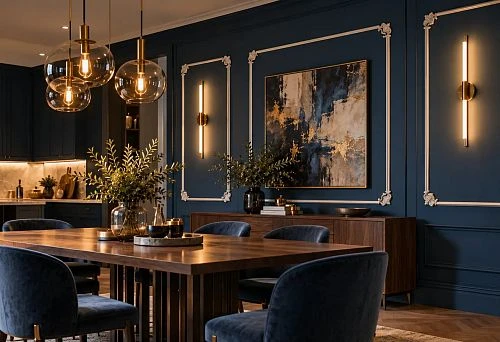
For a wall panel, a 60 mm profile provides a noticeable contour. MLD-031 turns the frame into an architectural element. MLD-032 creates a softer line and suits plain modern walls. At a great height, a 2600 mm MDF molding can run vertically without a joint if the finished size does not exceed the length of the plank.
In boiserie, the textured profile is best combined with smooth moldings. A ribbed frame around each panel can overload the wall. A calmer approach is to use MLD-031 on pilasters and make the inner frames smooth.
Mirror framing
MLD-032 looks especially good next to a reflection: the soft wave supports the light and does not create an overly strict frame. MLD-031 is suitable for a rectangular mirror in an office, hallway, or classic bathroom area, but the material and coating must be matched to the humidity.
The profile does not replace the load-bearing frame and mirror attachment. First, design a safe base, then add decorative framing. The inner edge of the molding should not overlap the usable area more than specified in the sketch.
Niches and decorative panels
In a niche, a textured molding emphasizes depth. MLD-031 creates contrasting shadows around the perimeter, MLD-032 makes the transition softer. If there is already a fluted panel inside the niche, a fluted profile can duplicate the texture. Then it is better to choose a wave or a smooth contour.
Columns and pilasters
MLD-031 is suitable for imitating a fluted pilaster. Several vertical profiles are assembled on a flat base, maintaining an equal spacing. MLD-032 is used for a more decorative modern column. Both options require precise alignment because the longitudinal relief emphasizes any misalignment.
How to choose material: MDF, beech or oak
The material affects length, finish, edge appearance, and texture perception. MDF is convenient for opaque enamel and is produced in lengths of 2600 mm. Beech and oak have a length of 2400 mm and retain the natural wood structure if a preparation for tinting is chosen. You cannot choose material only by price: first determine the finish and installation location.
MDF under enamel
MDF provides a smooth surface and stable color. On MLD-031, enamel emphasizes the geometry of flutes; on MLD-032, a smooth wave. The 2600 mm length is useful for tall wall panels, door verticals, and long furniture parts.
MDF does not show natural fibers, so texture is created only by relief and light. This is an advantage if the project is based on monochrome facades. But the ends and cut areas must be prepared for the chosen painting system.
Beech for even painting and calm wood
Beech is suitable for enamel and tinting. Its pattern is usually calmer than oak, so the profile looks more uniform. On MLD-032, this helps maintain softness. On MLD-031, flutes remain the main decorative technique.
A beech molding 2400 mm long is convenient for furniture and panels of standard scale. If the vertical is higher, the joint is planned in an area where it will be less noticeable, or the layout is changed.
Oak for expressive tinting
Oak is chosen when the texture should remain visible. On a fluted profile, the fibers intersect with the strict relief, creating a complex surface. On the wavy MLD-032, the wood grain softly follows the light transitions.
If a fluted oak molding for furniture is required, it's important not only that the species matches. The shade, grade, and grain direction must align with the facade. A test is done before finishing because the recesses may absorb the tinting compound darker.
Which material to choose for enamel coating
For opaque painting, MDF or beech is often rational. MDF provides a smooth base and increased length; beech is needed when the entire project is made of solid wood or a wooden base is important. Oak under dense enamel may be excessive if its texture is completely covered.
Which material to choose for tinting
Oak reveals itself more expressively, beech gives a calmer pattern. For transparent varnish or oil, solid wood is chosen. MDF is not used to showcase natural texture. The specific finishing option is checked in the card of the selected execution.
To compare materials on the same relief, you can buy MLD-031 in oak, beech, or MDF and select the row for the desired finish. On one article, it is especially clear how the material changes the perception of fluting.
| Material | Strong point | Best scenario | What to Check |
|---|---|---|---|
| MDF | Smooth painted surface and length 2600 mm | Enamel, wall panels, long verticals | Preparation of ends and operating conditions |
| Beech | Calm texture and versatility of finish | Furniture, enamel, soft tinting | Length 2400 mm and alignment with adjacent parts |
| Oak | Pronounced natural pattern | Tinting, natural facades, accent frames | Shade sample and behavior of the composition in relief |
How to calculate the amount of molding
The calculation is based on the length of all sides, not the panel area. For a frame, add two heights and two widths. For multiple facades, each contour is calculated separately. Then the result is divided by the length of one strip and rounded up, considering cutting, corners, and reserve.
Rectangular frame
For a panel 1200 × 800 mm, the perimeter is 4000 mm. Theoretically, two strips of 2400 mm each are sufficient in total length. But cutting may be inefficient: from one strip you get 1200 + 800 = 2000 mm, leaving 400 mm. The second gives the same set. In this example, two strips are indeed suitable.
Tall wall panel
A panel 2500 × 900 mm has a perimeter of 6800 mm. From MDF 2600 mm long, the vertical sides can be made whole. For beech or oak of 2400 mm, a joint, size change, or different layout principle will be required. Therefore, the material affects the project even before price calculation.
Several furniture fronts
If a chest has four identical fronts, it is advantageous to create a common cutting plan. Short horizontal parts are cut from leftovers after verticals. Buying 'per perimeter of each front plus separate allowance' often leads to extra strips.
Allowance for corners and defects
For simple straight joints, a small reserve is needed. For frames with a 45-degree miter cut, the allowance is increased because an error at one end can ruin the entire part. On a textured profile, you cannot simply flip the segment: the direction of the relief must match.
How to calculate different materials
You cannot combine strips of 2400 and 2600 mm in one calculation. First, choose the material, then build the cutting plan. For a mixed project — for example, MDF on walls and oak on furniture — calculations are done separately.
| Object | What to measure | What to add to the calculation |
|---|---|---|
| One frame | Two heights and two widths | Margin for four corners and adjustment |
| Facade series | Size of each contour and quantity | General cutting for using leftovers |
| Vertical panel | Finished height after floor and ceiling finishing | Comparison with length 2400 or 2600 mm |
| Niche | Actual dimensions at multiple points | Correction of irregularities and corners |
| Column or pilaster | Height and number of vertical stripes | Same pattern and allowance for alignment |
How to join textured molding in corners
A smooth profile forgives a slight difference in pattern. On MLD-031 and MLD-032, the joint immediately shows the texture direction. In a 45-degree frame, flutes or waves meet at an angle, and this should be evaluated on a sample.
45-degree miter cut
Such a joint creates a continuous outline and is suitable for frames. The cut must be clean, without chips. On MLD-031, it is especially noticeable if a groove ends at one corner differently than at the adjacent one. Before serial cutting, a test pair is made.
Butt joint with vertical priority
Vertical planks are left intact, horizontal ones are butted between them. This method is simpler and emphasizes height. It suits modern furniture and panels. The end of the horizontal part must be carefully prepared and covered with trim.
Joint on a long line
If one plank is not enough, the connection is placed in a less noticeable area. MLD-031 flutes must continue without offset. For MLD-032, the wave also requires matching the phase of the relief. A random joint creates a break in light.
Why a bad joint cannot be fixed with a thick layer of paint
Enamel can fill a small gap, but at the same time it will smooth out the texture and create a sag. The joint must be precise before the final finish. Puttying is allowed only within the chosen technology and should not clog the flutes.
How to paint ribbed and wavy surfaces
The main task is to cover the protrusions and recesses evenly, without turning the relief into a flat surface. A thick layer of paint collects in the grooves, while too dry application leaves unpainted areas. Therefore, a textured profile requires a test sample and more careful control than a smooth strip.
Preparation before painting
The planks are first trimmed and fitted. Then the ends are treated, dust is removed, and the relief is checked under side lighting. If the paint is applied before installation, the areas of the future adhesive joint are prepared according to the requirements of the composition.
Brush
A brush can paint the flutes, but there is a risk of drips and streaks. The composition is applied thinly, monitoring the recesses. After each pass, the profile is inspected along its length, not just from the front.
Roller
A roller quickly covers the protrusions, but may not reach deep areas. It is used in combination with a brush or for a softer wave MLD-032. Too thick material fills the relief.
Spraying
Spraying provides an even layer but requires professional setup and control of application angles. On flutes, the stream must hit both sides of the recess. Several thin layers are safer than one thick one.
How to avoid runs
The profile is positioned so that the craftsman can see the lower edges of the relief. Excess is removed before drying. Special attention is paid to the corners of the frame, where paint accumulates more. A test section helps select the viscosity and number of layers.
Care for textured molding
The ribbed surface collects more dust than a smooth one. On the vertical MLD-031, dirt gets trapped in the grooves; on the horizontal one, on the ridges. MLD-032 is easier to clean due to smooth transitions, but still requires a soft attachment or cloth.
Care depends on the coating. Enamel is wiped with a product compatible with the finish. Oak under oil or varnish is maintained according to recommendations for the specific composition. Abrasives and hard brushes can damage protrusions and alter the sheen.
In the kitchen and hallway, cleaning is done more often. If the molding is located low, check the bottom edge after wet cleaning. On a wall panel at height, the profile mainly needs dust removal.
Combining textured molding with other trim
Texture looks more convincing next to calm elements. A fluted profile can be combined with a smooth baseboard, a straight batten, and a laconic cornice. A wavy one — with rounded moldings and soft furniture details. In one room, it is not necessary to repeat the relief on every contour.
For a unified system, you can Buy wooden millwork for furniture and interior and match smooth profiles, slats, baseboards, and cornices to MLD-031 or MLD-032. A link to a specific related product is placed only after checking the size and purpose.
Practical choice for different tasks
The facade needs to be made stricter and taller
For a tall door, tall cabinet, or wardrobe, MLD-031 is suitable. Longitudinal fluting enhances the vertical and helps visually gather a long plane. It is better to use the profile along the edges or in a frame, rather than covering the entire surface. Then the relief works as an architectural line and does not turn the facade into a solid "striped" panel.
Before cutting, check if the facade height matches the length of the chosen material. For a 2500 mm panel, MDF 2600 mm allows for a solid vertical, while beech or oak 2400 mm will require a different scheme. On a furniture door, a joint in the middle is almost always noticeable.
The rectangular body needs to be softened
MLD-032 helps remove excessive rigidity of straight lines. The wave is especially appropriate next to a rounded handle, radius edge, soft armchair, or oval mirror. The profile can be placed only on the vertical sides of the frame, leaving the top and bottom smooth. This technique provides texture without excessive repetition.
The facade needs to be finished for enamel
For solid-color painting, choose MDF or beech in a confirmed preparation for enamel. MLD-031 gives a more graphic result, MLD-032 a more integral and plastic one. The color is tested on a small piece because the relief changes perception: the same shade appears darker in the grooves and lighter on the protrusions.
Need to preserve natural oak
Oak molding is chosen for tinting or transparent coating. On MLD-031, the wood texture and fluting create a complex pattern that suits a study, library, dining room, and furniture with natural veneer. MLD-032 looks calmer and is easier to combine with modern facades.
You cannot expect an exact match with already tinted furniture without a sample. The old coating changes color over time, and the relief absorbs and reflects light differently than a flat surface.
Need to design a wall panel without classic molding
Both profiles are suitable for a modern panel. MLD-031 creates a clear architectural grid. MLD-032 softens the frame and avoids the feel of traditional boiserie. The molding can be painted the wall color so it appears only through shadows, or made contrasting.
Need to highlight one furniture section
The textured profile does not have to be repeated on the entire set. One sideboard, central cabinet, or island facade can have a fluted frame, while the other doors remain smooth. This approach reduces cost and simplifies maintenance while maintaining expressiveness.
Need to design a mirror
For a strict rectangular mirror in the hallway or study, choose MLD-031. For the bedroom, bathroom area, or living room with upholstered furniture, choose MLD-032. Be sure to check the moisture resistance of the base and coating, as well as the safe fastening of the mirror itself. The molding remains a decorative frame, not a load-bearing element.
Need to design a column or protrusion
The fluted profile creates convincing vertical plasticity. Several MLD-031 can be placed at equal distances across the width of the pilaster. MLD-032 is suitable for a more modern column. Before ordering, create a layout to scale because a 60 mm wide profile quickly fills a narrow surface.
Need to design a commercial space
In a restaurant, salon, hotel, or showroom, a textured molding helps replicate the brand line on the reception desk, panels, doors, and furniture. MLD-031 is readable from a distance and supports strict geometry. MLD-032 creates a softer and more welcoming surface.
With intensive use, not only design and price matter. Cleanability, coating durability, and repairability of individual slats are checked. It's better to keep a color sample and spare material from the same batch.
How to use molding in different rooms
Living room
In the living room, the profile frames the TV area, panel behind the sofa, built-in wardrobe, or console. MLD-031 works well in a symmetrical composition with two vertical frames. MLD-032 suits a panel behind a rounded sofa or mirror. Avoid using active relief on the wall, facades, and ceiling simultaneously: one main zone is enough.
Bedroom
Textured molding can be used at the headboard, on wardrobe doors, and bedside.
Kitchen
Textured profile is used on facades, sideboards, and panels away from the sink and cooking surface. Grooves collect more dirt, so MLD-031 requires a particularly easy-to-clean coating. MLD-032 is easier to wipe, but smooth depressions also cannot be left untreated.
Study and library
Oak MLD-031 for tinting supports bookcases, panels, and a desk. Fluting creates a cohesive architectural environment. MLD-032 suits a modern study with minimalist furniture and a soft armchair when texture without classical strictness is needed.
Children's room
The profile is placed where a child will not catch on protruding edges. All corners and joints must be carefully finished. A certified finishing system is chosen for painting. On small facades, molding should be used sparingly so the furniture does not look heavy.
Wardrobe
A fluted frame helps highlight central doors or an island. A wavy profile suits a light walk-in closet with modern facades. In a narrow passage, check how much the molding increases the door thickness and whether it interferes with adjacent elements.
What to buy together with textured molding
Molding does not form a complete composition without a base, adjacent profiles, and finishing. For a furniture frame, you will need a prepared facade, a suitable adhesive or mounting assembly, and finishing materials. For a wall panel, you will need markings, smooth profiles, and a baseboard or cornice if specified in the project.
Related items are selected not on the principle of "everything ribbed." A textured molding is best combined with calmer details. A smooth batten provides a visual pause, a baseboard completes the bottom of the wall, a cornice completes the top. The color and material may match, but the profile may differ.
| What to add to the purchase | Why this is needed | For which scenario | What to Check |
|---|---|---|---|
| Smooth wooden profile | Balance the active relief and design calm areas | Boiserie, furniture frames, door panels | Height, thickness, and alignment of the surface level |
| Straight slat | Create layout, inner contour, or divide textured zones | Wall panel, column, modern facade | Cross-section and method of joining with 60 mm molding |
| Baseboard or cornice | Complete the wall composition from top or bottom | Panels and boiserie | Style, material, and scale relative to MLD-031 or MLD-032 |
| Finishing materials | Emphasize relief and protect the surface | Enamel, tinting, varnish, or oil according to the chosen technology | Compatibility with MDF, beech, or oak |
| Installation materials | Secure the profile to furniture or wall base | Frames, panels, niches | Base, load, and requirements for hidden fastening |
| Spare plank | Compensate for cutting error or save material for repair | Complex angles, large series of facades, tinted oak | Same material, length and finish |
How not to confuse a textured molding with similar products
Molding and a regular batten
A batten has a constant smooth cross-section. MLD-031 and MLD-032 contain a ready-made face relief. If the task is a simple minimalist layout, a textured profile may be unnecessary. If a light-and-shadow pattern is needed, a regular batten will not provide the same effect without additional processing.
Molding and a casing
MLD-031 can be used in frame or door design, but does not automatically become a universal casing. The casing must cover the installation joint, match the wall thickness, and connect to the door frame. Before using the molding in this role, the entire assembly is designed.
Molding and baseboard
A baseboard is designed for the lower adjoining area of the wall and floor, often having special geometry on the back side. Textured molding is a decorative face strip. It cannot be used without verification as a floor baseboard solely because of its 60 mm height.
Molding and cornice
The cornice finishes the top of a wall, furniture, or ceiling and may have a protruding profile. MLD-031 and MLD-032 are thinner and are primarily intended for flat frames and decorative lines. On the top finish of furniture, they can function as a frieze, but do not replace the cornice in function.
Textured molding and carved baguette
Carved baguette contains ornamentation and creates a more classic character. Fluting and wave are abstract, so they are easier to combine with modern furniture. For a buyer who needs a floral pattern, beads, or a complex frieze, MLD-031 and MLD-032 will not replace a carved profile.
MLD-031 and fluted panel
A fluted panel covers a significant area with a repeating pattern. MLD-031 is a separate strip 60 mm wide. It is suitable for a frame and accent, but does not create a solid panel without repeated repetition. The cost and installation of such a solution are calculated separately.
Mistakes when choosing and buying
Choosing only by close-up photo
In an enlarged photo, both reliefs look expressive. On a real facade, MLD-031 may be too frequent, and MLD-032 too soft. Make a paper template 60 mm wide and evaluate the frame in full scale.
Ignoring material length
MDF 2600 mm and solid wood 2400 mm offer different cutting possibilities. The buyer chooses oak for a 2500 mm vertical, then encounters a joint. The length is checked before approving the material and finish.
Considering the difference between 8 and 9 mm unimportant
On a separate overlay, one millimeter is almost unnoticeable. In a joint with a smooth profile or panel, it creates a step. If MLD-031 and MLD-032 are used in the same system, the surface level must be aligned by design.
Buying oak for dense enamel without necessity
If the texture is completely covered, the advantages of oak are not revealed. MDF or beech may be more rational. Oak is chosen for visible wood or when all furniture is made from the corresponding solid wood.
Do not make a test paintout
Fluting and waves change color due to shadows. On a smooth sample, the enamel looks different. The test is done on the same profile, not on a flat board.
Filling the relief with paint
A thick layer smooths out grooves and collects in corners. The buyer gets an expensive textured molding, but after painting the surface becomes almost flat. Several thin layers and control with side light preserve the pattern.
Do not account for cleaning
MLD-031 requires more attention due to narrow grooves. In the kitchen, hallway, and commercial space, the profile should have a coating that is easy to clean. If regular maintenance is undesirable, MLD-032 or a smooth molding may be more practical.
Join relief without a test corner
A 45-degree cut may look different than expected. This is especially noticeable on fluted profiles. A test joint allows you to choose the direction and connection method before cutting the entire batch.
Use the profile as a structural part
Molding decorates the surface but does not replace a load-bearing frame, mirror mount, door frame, or panel base. If it bears a load, the joint must be calculated separately.
Ordering exact footage without reserve
One mistake in a corner cut may require a new long strip. Re-purchasing increases delivery costs and may differ in wood shade. A reasonable reserve is included in the initial calculation.
Repeat texture on all elements
A fluted facade, ribbed wall, textured baseboard, and active cornice in one room create noise. Molding should have a role: main frame, vertical accent, or separate panel. Keep other profiles calmer.
Who is MLD-031 suitable for
MLD-031 is suitable for a buyer who needs a strict fluted surface, vertical plastic, and architectural character. It is appropriate for classic and neoclassical furniture, boiserie, pilasters, door panels, and cabinets. The profile is particularly convincing under side lighting.
It may not suit an interior that already has a lot of fine texture, complex veneer, and active decor. On a surface requiring frequent quick cleaning, fluting will require more maintenance.
Who MLD-032 is suitable for
MLD-032 is chosen for a soft wave-like texture, modern facades, mirrors, niches, and panels. It combines more easily with rounded shapes and does not create rigid striping. The profile suits solid enamel and natural oak.
It may be too calm for a project that requires a pronounced classical fluting. On a very small detail, the wave does not always reveal itself, and in a strict pilaster, MLD-031 looks more logical.
How to prepare the base and profile for installation
A textured molding emphasizes not only the design but also the quality of the base. Longitudinal flutes show misalignment, a wave shows an uneven joint line. Therefore, installation begins not with glue or fasteners, but with checking the surface, marking, and dry fitting.
Evenness of the facade or wall
The base must be stable, dry, and level. If the profile is pressed against a convex panel, it may come off at the edges or become stressed. On a wall, first check the verticals and corners. On a furniture facade, check the plane, gaps, and opening.
Dry layout
All strips are laid out in their future order. For a frame, align four sides, check the relief and direction. For a series of facades, label the parts so that top and bottom are not confused after painting. For MLD-031, it is especially important that the flutes run parallel.
Material acclimatization
Solid wood is kept in room conditions before installation according to the manufacturer's and craftsman's recommendations. A sharp change in temperature and humidity affects the wood. MDF should also not be installed immediately after storage in unsuitable conditions.
Marking
On the wall, a level and control lines are used. On furniture, a template is used that is repeated on all facades. Marking along one edge is insufficient: a 60 mm wide profile must occupy the same position along its entire length.
Mounting
The fixing method depends on the base material, weight, installation location, and future use. Adhesive, hidden pins, or other solutions are chosen by the craftsman. It is impossible to prescribe a single method for an MDF facade, an oak panel, and a plastered wall — these are different bases.
Final adjustment
After dry assembly, check the joints, edges, and overall contour. Only then perform the final finishing or installation according to the chosen technology. A length error cannot be compensated for with a thick layer of putty without losing the relief.
How to calculate the cost of a finished composition
The price of a linear strip is only part of the budget. For a finished frame or panel, consider the number of whole products, material, finishing, cutting, corner joints, and installation. Two profiles of the same height can result in different final costs due to the length and complexity of the chosen project.
Number of whole strips
The product is purchased in strips of 2400 or 2600 mm length, not by fractional mathematical footage. A frame may require 4.8 linear meters, but the actual order depends on the cutting. Sometimes two strips of 2400 mm are enough, sometimes a third is needed due to long verticals.
Material
MDF, beech, and oak have different prices and different purposes. There is no need to overpay for oak if the profile is fully painted and the wood is not visible. But you should not choose MDF just to save money if the project relies on the natural texture of solid wood.
Finishing
Ribbed and wavy relief requires more attention than a smooth plank. The estimate includes end preparation, test painting, interlayer treatment, and groove control. With a large number of facades, the cost of painting may be comparable to the difference in materials.
Installation and joints
Simple vertical strips are installed faster than frames with four corners. On a large wall panel, precise marking and repeatability are important. The complexity of the work is assessed before ordering, so that textured molding does not become an unexpectedly expensive part of the project.
| Budget item | How to count | What is often forgotten |
|---|---|---|
| Planks | Based on the actual cutting of whole lengths of 2400 or 2600 mm | Unprofitable leftovers and grain direction |
| Material | Based on the selected MDF, beech or oak row | That the material determines both the length and the finish |
| Finish | Trial sample, materials and work | Painting of recesses and ends |
| Installation | By number of parts, corners and base type | Marking, template and temporary fixation |
| Reserve | By the complexity of cutting and the scale of the object | Stock for future local repair |
How to store and transport molding
A long plank can get bent or edge damage before installation. Profiles are transported with support along the length and are not used as support for other loads. Flutes and waves are protected from contact with metal tools and hard packaging corners.
Before cutting, molding is stored horizontally on level supports. Solid wood is not left near a strong heat source, and MDF is not left in a damp room. Each plank is inspected before cutting: length, material, relief and end condition are checked.
For a large order, products are sorted by facades or rooms. If some planks are intended for tinting, they are laid out according to the wood grain pattern. This order helps achieve a more uniform composition and saves time on rearranging after painting.
How to buy MLD-031 and MLD-032 on the STAVROS website
First, determine the texture type. For a strict ribbed geometry, open MLD-031. For a soft wave, open MLD-032. Then choose the material, length, and surface preparation. The cross-section size should be checked against adjacent parts, and the length against the cutting drawing.
For a wall panel, compare the height with strips of 2400 and 2600 mm. For furniture, measure each facade, check the protrusion of 8 or 9 mm and the gaps when opening. For tinted oak, request or prepare a sample. For enamel, choose the appropriate base and painting technology.
In the wooden moldings category, it is convenient to evaluate other profiles and understand whether a textured option is needed for the entire composition or only for one accent area. In the MLD-031 and MLD-032 cards, before ordering, check the current price, available execution, and delivery conditions.
If the project includes several facades or a large wall, send the dimensions and layout to the STAVROS manager. Such a request is more useful than a general question "how much molding to buy": the specialist sees the lengths, material, number of corners, and helps verify the order against available strips.
What to check before payment
- article — MLD-031 or MLD-032;
- pattern — flutes or wave;
- size — 60 × 9 or 60 × 8 mm;
- material — MDF, beech or oak;
- length — 2600 mm for MDF or 2400 mm for solid wood;
- preparation for enamel or tinting;
- number of whole planks per cut;
- allowance for corners and possible defects;
- joining with smooth profiles and adjacent parts;
- molding protrusion relative to the facade;
- installation method for a specific base;
- relief painting technology;
- care conditions in the selected room;
- availability of a spare plank for a large project.
How to save accurate project data for reordering
After approving the material and cutting, save a small specification. Include the article number, section, length, material, surface preparation option, number of planks, and layout diagram. For MLD-031, it is especially useful to note the direction of flutes; for MLD-032, the wave orientation and corner joining method.
Separately, save a finish sample. For oak, this should be a real tinting test, not just the color name. For enamel, record the shade, gloss level, and layer sequence. Such a data set will help replace a damaged slat, replicate a frame on new furniture, or continue a wall composition without starting the selection from scratch.
If the project includes multiple rooms, do not mix leftovers without labeling. MDF 2600 mm long, beech and oak 2400 mm long may have the same width but differ in material, preparation, and purpose. A labeled reserve retains value only when it is clear which zone and finish it belongs to.
Photos of finished corners and hidden installation areas will also be useful. They show how the reliefs were joined and where the fixation occurred. During local repairs, this reduces the risk of damaging an adjacent panel or repeating a molding with a different pattern direction.
How to approve a sample before a large order
For a series of facades or an extended wall panel, it is reasonable to first assemble a small fragment. It shows how deeply the relief is read, how the chosen color behaves in flutes or waves, whether the thickness matches adjacent profiles, and whether the texture overloads the surface.
The sample is evaluated in daylight and evening light, from the front and from the side. After approval, the entire batch is checked against it. This helps avoid a situation where a correctly sized molding turns out to be too active in pattern or the finish hides the texture for which the profile was chosen.
Frequently asked questions
What is a fluted molding?
This is a profile with longitudinal grooves. They create regular lines of light and shadow. MLD-031 has a fluted surface and dimensions of 60 × 9 mm.
How does a ribbed molding differ from a smooth one?
The ribbed profile has a ready-made relief and looks more expressive even in a single color. The smooth one is easier to maintain and suits calmer frames.
Should I choose MLD-031 or MLD-032 for furniture?
MLD-031 suits strict facades, classics, and vertical accents. MLD-032 pairs better with soft geometry and modern monochrome surfaces.
Which profile should I choose for a wall panel?
For an architectural grid and boiserie, MLD-031 is suitable. For a soft modern frame, MLD-032. Also consider the length of the strip and the number of joints.
Can MLD-031 be used as a trim?
Only after designing the door unit. The molding must cover the seam, match the thickness, and not interfere with opening. It is not automatically a universal trim.
Is MLD-032 suitable for a furniture facade?
Yes, the profile is used for decorative frames and panels. You need to check the facade size, the 8 mm protrusion, and compatibility with opening.
What is better for enamel — MDF or beech?
MDF provides a smooth painted surface and a length of 2600 mm. Beech is chosen when a wooden base is needed or the entire project is made of solid wood.
What to choose for tinting — oak or beech?
Oak gives a more pronounced pattern, beech gives a calm one. For an accent natural texture, oak is often chosen, but the shade is checked on a sample.
Can a fluted molding be painted with a brush?
Yes, but you need to control the layer in the grooves and avoid drips. For large series, professional spraying often gives a more uniform result.
How to join textured molding at corners?
A 45-degree miter cut or a straight joint with priority on verticals is used. The method is first tested on trial pieces because the relief changes the appearance of the corner.
What allowance should be added when purchasing?
The margin depends on the number of corners and the complexity of cutting. For simple strips it is smaller, for frames and a series of facades it is larger. The calculation is done based on whole planks.
How to calculate the amount of molding?
Add up the lengths of all sides, create a cut pattern for 2400 or 2600 mm, and round up the number of planks. Account for corners and reserve separately.
Can you combine textured and smooth profiles?
Yes. This often creates a more balanced composition: the textured molding acts as an accent, while the smooth one serves as a calm frame or divider.
Which texture collects less dust?
The wavy MLD-032 is usually easier to clean due to its smooth transitions. Narrow flutes of MLD-031 require more thorough maintenance.
Can the profile be installed horizontally?
Yes. Horizontal MLD-031 creates a strict frieze, MLD-032 creates a soft strip. The direction should be evaluated on a mockup and coordinated with the joints.
Is the molding suitable for the kitchen?
Suitable for areas away from water and strong heat with proper coating. Care for the relief must be planned in advance.
Can the profile be used in the bathroom?
Only after checking the material, coating, base, and humidity conditions. Not all versions can be automatically considered moisture-resistant.
Where to buy textured wooden molding?
In the STAVROS catalog, you can compare MLD-031 and MLD-032, choose MDF, beech, or oak, check the length, finish, and current ordering conditions.
Conclusion: the texture should solve the problem, not just fill the surface
MLD-031 and MLD-032 have the same height of 60 mm but create a different impression. The fluted MLD-031 forms a strict ribbed line, emphasizes the vertical, and supports architectural furniture. The wavy MLD-032 makes the frame softer, suitable for modern facades, mirrors, and wall panels.
Before ordering, you need to choose not only the pattern, but also the material, length and finish. MDF is convenient for enamel and long verticals of 2600 mm. Beech and oak are produced in 2400 mm lengths; oak is especially expressive under tinting. Cutting, joints and test painting are calculated before installation.
STAVROS offers both profiles in real product cards and a separate category of wooden moldings. An informed choice helps you get not a random fluted strip, but a coordinated element of furniture or a wall system that matches in scale, material, color, and installation technology.