Article Contents:
- Short answer for ordering: one door — one independent overlay
- Why a beautiful sketch may turn out to be non-installable
- Doors must move independently
- The gap is needed not only for appearance
- The carved overlay has volume
- Glue does not create a movable joint
- Cutting N-182.1 in the center does not mean getting a pair
- Center of the cabinet body
- Center of each door
- Center of the overall decorative composition
- Scenario 1. Two identical N-182.1 — one on each door
- Scenario 2. One N-182.1 on one wide door
- Scenario 3. One overlay on a fixed panel
- Scenario 4. Two paired elements of a different article number
- Initial facade dimensions
- Allowable width formula
- Allowable height formula
- Why thickness needs to be considered
- Size 400 × 276 × 17 mm
- Size 500 × 345 × 21 mm
- Size 600 × 414 × 26 mm
- Size 740 × 511 × 31 mm
- Door 450 mm wide
- Door 550 mm wide
- Door 650 mm wide
- Door 800 mm wide
- Two doors 500 mm each
- Two doors 650 mm each
- Two doors of different widths: 700 and 500 mm
- Scheme 1. Handles at the central joint, overlays shifted outward
- Scheme 2. Overlays at the top, handles below
- Scheme 3. Overlays at the centers of the leaves, handles under them
- Scheme 4. Handle inside the frame zone, overlay above it
- Scheme 5. Handles extended to the outer edges
- Center-to-center distance is not the full size of the handle
- A knob handle also takes up space
- A profile handle changes the top or side edge
- Two identical parts
- Left and right parts
- Different sizes of the same article
- Rotation by 180 degrees
- The frame must belong to one door
- Fields inside the frame are recalculated
- Thicknesses must match
- The handle is included in the same composition
- Finishing joints are planned in advance
- Beech for opaque enamel
- Oak for visible texture
- Can an oak overlay be installed on painted MDF
- Can oak be painted with opaque enamel
- "Standard"
- "Prestige"
- What is more profitable
- Check the flatness
- Clarify the door material
- Inspect the old coating
- Find the internal parts
- Check the door deflection
- Installation before the final finish
- Installation of an already finished overlay onto a ready facade
- Double-door cabinet with equal doors
- Cabinet with two doors of different widths
- Three-door wardrobe
- Mistake 5. Ignoring the gap between facades
- Mistake 6. Measuring only the flat facade without the handle
- Mistake 7. Counting mounting holes as the handle size
- Error 8. Buying two overlays of different sizes for equal doors
- Error 9. Flipping a symmetrical overlay as a paired L/R
- Error 10. Not accounting for the 31 mm thickness
- Error 11. Placing large decor on a sliding door without a cut
- Error 12. Using an overlay as a means to straighten the facade
- Error 13. Gluing onto peeling coating
- Error 14. Choosing universal glue based on advice without testing
- Error 15. Painting the relief with too thick a layer
- Error 16. Not treating the side edges
- Error 17. Ordering one piece for two doors to save money
- Error 18. Not checking the opening direction
- Error 19. Shifting the overlays outward by different distances
- Error 20. Marking from the sides of the body
- Error 21. Not accounting for the frame
- Error 22. Ordering the molding after the overlay
- Error 23. Mixing beech and oak without a concept
- Error 24. Taking "under enamel" as a finished coating
- Error 25. Choosing "Standard" without allowing for manual preparation
- Error 26. Painting two overlays in different batches
- Error 27. Not ordering two parts of the same configuration
- Error 28. Start installation without a dry fit
- Error 29. Do not mark left and right positions
- Error 30. Choose size only by price
- Error 31. Do not check old holes
- Error 32. Cover a defect at the joint itself with a trim
- Error 33. Install the handle on threads
- Error 34. Make the decor too low
- Error 35. Move a large trim behind a thin protrusion
- Error 36. Store the pair in different conditions
- Error 37. Order four trims without a control sample
- Error 38. Using an article instead of a working drawing
- Error 39. Not checking the main product URL
- Error 40. Buying decor separately from the entire facade
- Can one N-182.1 be glued to two doors at once?
- Can glue be applied to only one half?
- Can the overlay be cut in the center?
- How many overlays are needed for two identical doors?
- What size should be chosen for a door 500 mm wide?
- Can N-182.1 with a size of 740 mm be installed on a cabinet 1200 mm wide?
- What sizes are available?
- What materials is the overlay made from?
- What sanding options are available?
- Is N-182.1 produced to order?
- Is beech suitable under enamel?
- Can oak be tinted?
- Do I need to order two overlays in one batch?
- Can two overlays of different sizes be installed?
- Is N-182.1 left or right?
- Can one overlay be mirrored?
- Where to look for mirrored overlays?
- How to combine N-182.1 with handles at the central joint?
- Can a handle be installed over the overlay?
- Do I need to consider the hand zone?
- Can the overlay be installed on a frame facade?
- Can it be installed on a mirror?
- Is N-182.1 suitable for a sliding wardrobe?
- Can one overlay be used on a fixed frieze?
- How to determine the allowable width?
- Is there a mandatory minimum offset from the edge?
- Do hinges need to be considered?
- What adhesive should be used for N-182.1?
- Can it be glued onto ready enamel?
- Is it better to paint before or after installation?
- Is it necessary to paint the back side?
- What is the difference between "Standard" and "Prestige"?
- Does "Prestige" mean the overlay is ready for installation without finishing?
- Can I order one N-182.1 as a sample?
- Do I need to make a paper template?
- How to check the symmetry of two overlays?
- Can the overlays be centered only by the handles?
- What to do if the handles are already installed?
- Can an overlay cover old holes?
- Do I need to buy molding along with the overlay?
- Can two doors be connected with a frame?
- What to check before payment?
- How do I specify the quantity in an order?
- Why can't you save money by buying one overlay for two doors?
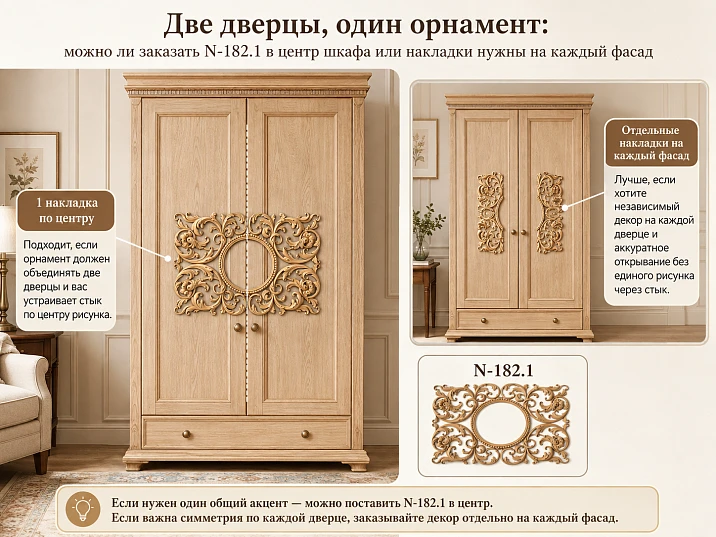
In the sketch, everything looks flawless: a two-door cabinet, calm symmetry, one large carved ornament exactly in the center. When a buyer plans to purchase decorative overlays for furniture facades, this composition seems the most convincing. But after the facades are made, a detail that is easy to miss in the visualization is revealed: the geometric center of the cabinet passes through the gap between two independently opening doors. A practical question arises — can one wooden overlay be attached to both doors at once, or should the order be recalculated?
The answer is direct: one rigid carved overlay N-182.1 cannot be installed on two independently opening doors at the same time. The part will cover the working gap, connect the facades to each other, and prevent normal opening. Even if the overlay is only partially glued, the free edge will protrude over the adjacent door, catch during movement, and create a risk of damage to the decor and coating.
Therefore, a buyer who wants to order carved overlay N-182.1First, you need to choose not the size, but the compositional scenario. For a two-door wardrobe, four solutions actually work:
-
two identical N-182.1 — one on each door;
-
one N-182.1 — on one wide door;
-
one N-182.1 — on a fixed central panel, frieze, or cornice area;
-
two separate left and right elements of another article, if the project requires a mirrored directional composition.
It is the number of movable facades that determines the number of independent overlays. The overall width of the wardrobe is secondary here. First, measure each door separately, maintain the working gap, account for the handle, hinges, frame, and visual fields. Only then choose one of the four sizes of N-182.1: 400 × 276 × 17, 500 × 345 × 21, 600 × 414 × 26, or 740 × 511 × 31 mm.
Short answer for ordering: one door — one independent overlay
When two doors open separately, any overlay wooden decor must be entirely within the boundaries of the door to which it is attached. You cannot connect two movable bases with one piece.
This rule remains regardless of:
-
swing doors open outward or one toward the other;
-
handles are centered or offset toward the edges;
-
the gap between facades is a few millimeters or looks almost invisible;
-
the cabinet is new or being restored;
-
the overlay is made of beech or oak;
-
the decor will be painted with enamel or finished with a transparent compound;
-
size N-182.1 is 400 or 740 mm.
Installation through the central joint does not become permissible just because the ornament is symmetrical. Symmetry of the pattern relates to composition, not turning a wooden part into a hinge.
If a single central motif is needed, it is created differently: with two separate overlays, a pair of special L/R elements, decor on the fixed part of the cabinet, or a frame composition that visually unites the doors but does not mechanically connect them.




Why a beautiful sketch may turn out to be non-installable
The designer looks at the facade from the front. The cabinetmaker must also look from above, from the side, from inside, and in motion. In the frontal view, two doors are often perceived as one large plane. The joint line may be thin, coincide with the axis of the ornament, and almost disappear under the color of the future enamel.
But in real furniture, the central gap does the work.
Our factory also produces:
Doors must move independently
Each leaf has its own hinges, trajectory, and opening angle. When moving, its edge changes position relative to the adjacent door. Even a small protrusion of the overlay beyond the facade boundary can fall into this trajectory.
Get Consultation
The gap is needed not only for appearance
The inter-facade distance compensates for real assembly and movement features: body geometry, hinge adjustment, coating thickness, and permissible door positions. The decor must not extend into this zone.
The carved overlay has volume
N-182.1 is not a printed pattern or a thin film. The thickness depends on the size and is 17, 21, 26, or 31 mm. The larger the variant, the more noticeable the relief protrudes above the facade. When opening, this volume must be considered along with handles, adjacent doors, and the body.
Glue does not create a movable joint
Sometimes it is suggested to apply glue only to one half of the overlay, leaving the other half free above the adjacent door. Such a solution does not preserve the composition safely. The unattached section remains cantilevered, receives random impacts, may vibrate, catch, and damage the coating.
Cutting N-182.1 in half does not mean getting a pair
Sawing a finished carved overlay along the seam line changes the pattern, creates two new ends, and does not guarantee that the halves will look like finished left and right pieces. Such modification cannot be considered standard. If a paired motif is needed, it is better to select separate items designed as L/R.
What exactly is N-182.1
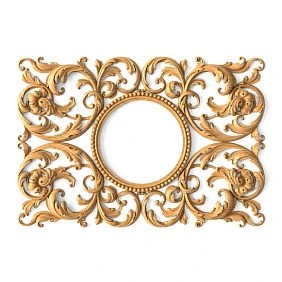
N-182.1 is a separate carved wooden overlay for decorative finishing of furniture and other suitable surfaces. In the context of this article, its installation on cabinet fronts is considered.
The product is made to order in four sizes, from beech or oak, with sanding quality "Standard" or "Prestige". The page provides re-gluing under enamel. Before ordering, you need to select the exact configuration and add the required number of items to the cart.
| Parameter | Confirmed data | What this means for the cabinet |
|---|---|---|
| Article number | N-182.1 | The invoice must specify the exact designation |
| Product type | Carved wooden overlay | This is a separate decorative element, not a set of two halves |
| Size 1 | 400 × 276 × 17 mm | Suitable only after checking one door |
| Size 2 | 500 × 345 × 21 mm | Requires a larger free area on the front |
| Size 3 | 600 × 414 × 26 mm | More noticeable effect on handles and frame composition |
| Size 4 | 740 × 511 × 31 mm | Cannot be selected based on the total width of two doors |
| Material | Beech or oak | The wood species is coordinated with the finish and other details |
| Sanding | "Standard" or "Prestige" | Determines the scope of further preparation |
| Re-gluing | A version for enamel is provided | Opaque finish is planned before installation |
| Production | Custom Order | Quantity and size are checked before launch |
| Completeness | One overlay of the selected configuration | For two doors, two separate pieces are usually ordered |
| Mounting | The specific method needs to be agreed upon | You cannot invent a universal glue or fastener |
| Main check | Full placement within the boundaries of one facade | The decor must not overlap the working joint |
Three numbers in the size indicate the full dimension of the product. They cannot be read as the size of the decorative zone without protrusions. For marking, the full contour of the overlay is used, not just the central part of the ornament.
The cabinet has not one center, but three at once
The error with one overlay occurs because different axes are mixed in the project.
Center of the cabinet body
This is the geometric middle of the entire piece of furniture. For a symmetrical two-door cabinet, it most often coincides with the central joint.
Center of each door
The left and right doors have their own vertical and horizontal axes. It is relative to these that individual overlays are usually placed.
Center of the overall decorative composition
It may coincide with the center of the cabinet body, but it is not necessarily created by a single piece. Two independent N-182.1, positioned mirror-symmetrically relative to the central line of the cabinet, form a common symmetrical pattern without crossing the joint.
This is a key design technique: unity of composition does not require unity of the physical piece.
Two doors can be perceived as one whole thanks to the same height of the overlays, equal offsets, a common molding frame, coordinated handles, and a single color. At the same time, each door retains its independence.
Four working scenarios instead of one overlay across the joint
The buyer does not necessarily have to give up the central carved accent. One only needs to choose a design that respects the movement of the facades.
Scenario 1. Two identical N-182.1 — one on each door
This is the main option for two equal swing facades. The overlays are placed at the same height, have the same size, material, sanding quality, and finish.
The composition looks cohesive if the following match:
-
distance from the outer side edge of each door;
-
distance from the central joint;
-
height relative to the top and bottom edges;
-
position relative to the frame;
-
relation to the handles;
-
direction and intensity of the finish;
-
visual field around the relief.
Two identical parts do not need to be turned "face to face" if the N-182.1 ornament is symmetrical within its own shape. Each overlay is installed in one consistent orientation. Before gluing, it is useful to lay out both parts on templates and look at the cabinet from the distance from which the furniture is usually seen in the room.
Scenario 2. One N-182.1 on one wide door
This option suits an asymmetrical cabinet where one door is noticeably wider than the other, or a composition where the decor is intentionally concentrated on one facade.
A single overlay should not look randomly forgotten on half of a cabinet. Its position is linked to the internal contents, handles, frame, or adjacent sections. For example, the decor can highlight the central wide door in a three-door composition.
Scenario 3. One overlay on a fixed panel
If there is a fixed frieze, cornice board, or central panel of sufficient size above the doors, a single ornament can be placed there. The main thing is to ensure that this part truly does not participate in opening and can withstand the chosen mounting method.
This technique allows preserving one center of the cabinet without mechanically linking the doors. But the size of the overlay is still chosen based on the actual panel, not the full width of the furniture.
Scenario 4. Two paired elements of a different article
When the sketch requires directed branches, curls, or wings diverging from the central joint, two identical symmetrical N-182.1 may not reproduce the desired pattern. Then in the category it is better buy wooden decor for furniture with designations for left and right elements.
Paired L/R articles are created as two independent parts with coordinated direction. They are suitable for a composition where the left part should visually continue into the right, but each remains on its own door.
One or two N-182.1: comparative table
| Situation | Quantity of N-182.1 | Why |
|---|---|---|
| Two identical swing doors | 2 pcs. | Each overlay is entirely on its own facade |
| One wide and one narrow door | 1 or 2 pcs. after the layout | Cabinet symmetry does not equal door symmetry |
| One fixed central panel | 1 pc. | Decor does not cross the movable joint |
| Need a directional mirrored pattern | Other paired articles | N-182.1 should not be arbitrarily turned into L/R |
| Four-door wardrobe | 2 or 4 pcs. per project | Quantity depends on the rhythm of sections |
| Cabinet with drawers in the center | One piece per independent front | The overlay must not connect the drawer and the door |
| Sliding fronts | Only after system check | Relief thickness may interfere with panel movement |
| Fixed frieze above doors | 1 pc. | The common center can be moved above the opening line |
The size is chosen based on one door, not the overall width of the cabinet.
The most dangerous arithmetic looks convincing: two doors together have a width of 1000 mm, so a 740 mm overlay definitely fits. By the overall plane — yes. By one leaf about 500 mm wide — no.
For ordering, you need to build an allowable zone on each door.
Initial facade dimensions
Measure separately:
-
full width of one door;
-
full height;
-
width of the visible flat zone;
-
distance to the inner edge;
-
distance to the outer edge;
-
handle position;
-
dimensions of the frame or panel;
-
old holes;
-
zones of hinges and cups on the reverse side;
-
protrusion of adjacent parts;
-
opening trajectory.
One common width is not enough.
Formula for allowable width
For a preliminary calculation, you can use the principle:
Wadd = Wf − Zc − Zh − Zr − Zm
Where:
-
Wadd — allowable overlay width;
-
Wf — width of one door;
-
Zc — zone left at the central joint;
-
Zв — field at the outer edge;
-
Zр — handle zone;
-
Zм — space occupied by a frame, molding, or other part.
The formula does not assign universal margins. It shows which zones must not be forgotten. Values are taken from the drawing and the full-size mockup.
Formula for allowable height
Hдоп = Hф − Zверх − Zниз − Zруч − Zпроч
where the top and bottom fields, handle, frame, lock, ventilation grille, or other hardware are taken into account.
Why thickness must be considered
Even if the width and height fit, the relief may conflict with the handle, adjacent door, or protruding body. For each size N-182.1, a third dimension is checked:
-
17 mm;
-
21 mm;
-
26 mm;
-
31 mm.
On a swing facade, thickness more often affects the handle grip and adjacent parts. On a sliding one, it can make installation impossible without changing the system.
Four sizes of N-182.1: what changes besides width
The size range scales the overlay in three directions at once.
| Size N-182.1, mm | Width-to-height ratio | Thickness | Typical check task |
|---|---|---|---|
| 400 × 276 × 17 | about 1.45 | 17 мм | Narrow or medium door, compact composition |
| 500 × 345 × 21 | about 1.45 | 21 мм | Wider facade with preserved margins |
| 600 × 414 × 26 | about 1.45 | 26 мм | Large leaf or pronounced central accent |
| 740 × 511 × 31 | about 1.45 | 31 мм | Very wide door or fixed panel |
The ornament proportion remains roughly the same, but the visual mass grows. A large overlay not only takes up more area: it protrudes more above the facade and requires a larger free margin.
Size 400 × 276 × 17 mm
This option is first checked on a relatively narrow door. However, even 400 mm cannot be automatically placed on a facade 400 or 420 mm wide: the overlay needs margins, and the central gap must remain free.
On two identical doors, two 400 mm pieces can create a dense decorative pair. Before ordering, draw the full outline and check whether the cabinet turns into a solid carved field.
Size 500 × 345 × 21 mm
The 500 mm overlay requires a larger flat area. It suits medium and wide leaves if the handle does not cross the pattern.
On a facade with a width of 600 mm, after placing the part, a total of 100 mm remains horizontally. How to distribute these 100 mm between the central and outer margins depends on the composition. If part of the space is occupied by a handle or frame, the option may not be suitable.
Size 600 × 414 × 26 mm
A width of 600 mm is already comparable to the size of many doors. Such an overlay cannot be chosen for two doors just because the overall cabinet is wider than 1200 mm. Each individual door must have a sufficient surface.
The thickness of 26 mm is noticeable from the side. Check whether the handle is comfortable to use and whether excessive relief appears near the frame.
Size 740 × 511 × 31 mm
The largest option requires a very wide single door, a fixed panel, or another spacious base. On a typical pair of equal doors, the total width of the cabinet easily exceeds 740 mm, but each door can be significantly narrower.
A thickness of 31 mm turns the overlay into a pronounced volume. On the facade, you need to evaluate not only the frontal silhouette but also the side view.
Examples of calculation without invented universal margins
The numbers below show the method. They do not establish mandatory margins for all cabinets.
Door with a width of 450 mm
If we consider N-182.1 with a width of 400 mm, the total remainder is:
450 − 400 = 50 mm.
These 50 mm need to be distributed between the central and outer fields. If there is a frame or handle on the facade, the usable area will become smaller. Therefore, matching "formally fits" does not yet mean a successful composition.
Door width 550 mm
For a size of 400 mm, 150 mm remains. For a size of 500 mm, 50 mm remains.
Two 400 mm overlays can provide a calmer field. Two 500 mm ones will create a dense composition and require very precise handle placement.
Door width 650 mm
Remainder:
-
with a 400 mm overlay — 250 mm;
-
with 500 mm — 150 mm;
-
at 600 mm — 50 mm.
A 600 mm size is only suitable after checking the frame and handle. Bigger is not always better: the ornament may visually press against the edges.
Door width 800 mm
Remainder:
-
400 mm — 400 mm;
-
500 mm — 300 mm;
-
600 mm — 200 mm;
-
740 mm — 60 mm.
On a wide door, a real choice appears. It is made based on the facade height, handle size, overall style, and the number of adjacent sections.
Two doors of 500 mm each
The total width of the pair is 1000 mm. N-182.1 with a width of 740 mm formally fits into the overall contour, but does not fit on one door. Consequently, one large piece across the joint is prohibited, and two of 740 mm are impossible in width.
Need to consider two overlays of 400 mm or another article and a different composition.
Two doors of 650 mm each
Total width is 1300 mm. One overlay of 740 mm through the center still does not fit. For each leaf, you can pre-check sizes 400, 500, and 600 mm. The choice is determined by free fields.
Two doors of different widths: 700 and 500 mm
Two identical large overlays may not fit on the smaller leaf. Possible options:
-
two identical N-182.1 of 400 mm size;
-
one overlay on the wide door;
-
different sizes, if asymmetry is deliberately shown in the project;
-
another set of decor.
Using 600 mm on the left and 400 mm on the right without visualization is risky: ornaments of the same article will have different scales.
A 1:1 mockup solves more than a reduced visualization
Before ordering, cut out paper or cardboard outlines of all sizes under consideration. For two doors, you need two templates.
On each, indicate:
-
full size;
-
central axis;
-
thickness;
-
the top;
-
bottom;
-
the intended position of the handle;
-
the frame boundary;
-
the central joint.
Attach the templates with removable tape and open each door. Look at the cabinet:
-
straight on;
-
at an angle;
-
from a distance of 1–2 m;
-
at eye level;
-
in side light;
-
with the left door open;
-
with the right door open;
-
with both doors closed.
This makes it visible that two separate trims can create a single center without intersecting the joint.
Handles and trims compete for the same zone of the facade
On a double-door cabinet, handles are often placed near the central joint. That is exactly where the designer aims to place the common ornament. If you order N-182.1 first and then choose the hardware, it may turn out that the hand cannot reach the handle, the fasteners fall under the thread, or the handle visually cuts the pattern.
Hardware and decor should be laid out simultaneously.
Scheme 1. Handles at the central joint, trims shifted outward
Each handle remains in its usual zone near the inner edge of the door. N-182.1 is placed closer to the center of its door or slightly outward, so that there is free space around the handle.
Advantage — clear opening. Limitation — the decorative pair may be perceived as wider than intended in the initial sketch.
Scheme 2. Overlays at the top, handles below
The ornament creates a common upper rhythm, and the handles work in the lower or middle zone of the facades. The scheme suits tall doors where there is enough vertical space.
Need to check whether the top of the cabinet looks overloaded and whether it is convenient to use handles at the chosen height.
Scheme 3. Overlays at the centers of the doors, handles below them
Each N-182.1 occupies the compositional center of its door, the handle is installed below. This option well separates the decorative and functional zones.
On low facades there may not be enough space. The large size of 740 × 511 mm can take up too much height.
Scheme 4. Handle inside the frame zone, overlay above it
If the facade is decorated with a molding, the handle and carved detail can be inside one panel. This requires a precise drawing: the distance between elements should look deliberate.
Scheme 5. Handles placed on the outer edges
This technique frees up the center, but changes the familiar opening mechanics and visual balance. It is tested on a real cabinet, especially if the doors are wide.
Before choosing hardware, you can buy furniture handles for cabinets after matching the handle base size, center-to-center distance, grip zone, and full contour of N-182.1.
Why the handle must be drawn on the blueprint in full size
On the sketch, the handle is often shown as a thin line. In reality, it has:
-
length;
-
width;
-
height above the facade;
-
mounting base;
-
mounting points;
-
space for fingers;
-
hand trajectory;
-
possible rosettes or decorative bases.
If the overlay is 26 or 31 mm thick and located too close, a person will touch the threads every time they open it. The decor will start to get dirty and receive accidental load.
Center distance is not the full size of the handle
Holes may be located next to the overlay, and the outer ends of the handle may cross its contour. Therefore, the template marks not only the fasteners but also all the hardware.
A knob handle also takes up space
A compact knob may seem safe, but the hand needs a grip area. If the relief surrounds the handle too tightly, using the cabinet is inconvenient.
A profile handle changes the top or side edge
This option can free the front surface from hardware. But it affects the facade design and must be chosen before the doors are manufactured.
Two identical overlays or a mirrored pair
N-182.1 is described as an independent symmetrical ornament. This means that the part itself has its own complete composition. Two identical overlays can be placed on two doors to create a repeating rhythm.
But repetition and mirroring are not the same thing.
Two identical parts
They create two equivalent centers. This approach is suitable when each door leaf is designed as an independent panel.
Left and right parts
They form a single directional pattern around the central axis. In the article numbers of such elements, the designations L and R are often used.
If the project requires branches diverging from the joint, or two halves of a common motif, you need to to buy carved wooden decor and select a confirmed paired model, rather than arbitrarily rotating N-182.1.
Different sizes of the same article
A pair of N-182.1 with sizes 400 mm and 500 mm does not become mirrored. These are two versions of the same pattern at different scales. On equal doors, such a combination looks like an error if asymmetry is not part of the project.
Rotation by 180 degrees
A symmetrical element may look similar after rotation, but the orientation is still checked against the product image and drawing. You cannot consider any side to be the top just because the overall outline seems uniform.
A molding frame helps to unite two doors without a common wooden bridge
One way to preserve the overall look of the cabinet is to frame each door with its own molding, and place N-182.1 inside it. The frames repeat each other and create a unified architecture, but a working gap remains between the fronts.
For such a solution, you can buy wooden moldings for furniture after selecting the profile, wood species, and dimensions.
The frame must belong to a single door.
No horizontal or vertical molding should cross the central joint of two opening fronts.
The fields inside the frame are recalculated.
N-182.1 is selected not by the full width of the door, but by the inner clear field after installing the molding.
The thicknesses must complement each other.
A large overlay 31 mm thick next to a very thin frame can look heavy. Conversely, a too massive molding will compress the ornament.
The handle is included in the same composition.
It can be located inside the frame, on the molding only with a specially calculated design, or outside it. Random crossing is not allowed.
Finishing joints are planned in advance
If the overlay, molding, and facade are painted in one color, the order of installation and coating must be determined. With contrasting tinting, the boundaries should be especially neat.
Beech or oak for N-182.1
Both wood species are available in all four sizes and with "Standard" or "Prestige" sanding. The choice is primarily related to the future finish and the material of other visible parts.
Beech for opaque enamel
The card provides for re-gluing under enamel. A beech overlay is reasonable to consider when the cabinet will be painted opaquely and the wood texture should not become the main effect.
This scenario is suitable for:
-
white facades;
-
colored enamel;
-
matte or semi-matte opaque coating;
-
combinations with painted moldings;
-
furniture restoration where the base wood is hidden.
The phrase "under enamel" does not mean a ready-made finish. The overlay requires coordinated preparation and finishing.
Oak for visible texture
Oak is chosen when the ornament must preserve the natural grain and such a finish is confirmed by a technologist. It can be combined with oak fronts, frames, handles, and other elements.
Before ordering, check:
-
wood species match;
-
texture direction;
-
tone sample;
-
gloss level;
-
method of processing the ends;
-
the difference between new oak and old furniture.
Can an oak overlay be placed on painted MDF
A deliberate contrast can be created: a smooth front and a natural oak relief. But such a project needs to be seen on a sample. The wood should not look randomly glued to a foreign surface.
Can oak be painted with opaque enamel
The technical feasibility depends on the finishing system. However, the buyer must understand why a more expressive material is chosen if its texture is completely covered. Compare the estimate and the result with beech under enamel.
'Standard' or 'Prestige'
Both options are available for beech and oak in all sizes N-182.1.
"Standard"
This level involves a smaller volume of manual preparation compared to "Prestige". It suits a workshop that can independently refine carved decor before finishing.
The estimate should include:
-
inspection of the relief;
-
manual processing of accessible areas;
-
dust removal;
-
test primer;
-
interlayer preparation;
-
work with end grains.
"Prestige"
This option is chosen when more detailed manual sanding is required before transfer to finishing. This is especially noticeable on large N-182.1 sizes of 600 or 740 mm: the area and depth of the relief are greater, and side lighting highlights traces of preparation.
"Prestige" does not mean ready-made paint and does not cancel the finishing technology.
What is more profitable
They compare not only the price of the overlay, but the full cycle:
product cost + manual finishing + primer + finish + workshop time + risk of corrections.
For a serial cabinet with two or four doors, the difference in labor costs is multiplied by the number of parts.
Preparing the facade before ordering overlays
Decor cannot be chosen separately from the base.
Check the flatness
N-182.1 must fit the surface within the designated mounting zone. A wavy facade, deep panel, or protruding profile may interfere.
Specify the door material
The facade can be made from:
-
of the array;
-
MDF;
-
of plywood;
-
of panel material with coating;
-
of frame construction;
-
of combined base.
The installation method depends on the surface. The article does not prescribe a universal adhesive for all options.
Inspect the old coating
During restoration, it is important to understand whether the paint, varnish, or film is holding. Gluing to a peeling layer will not create a reliable bond with the base itself.
Find the internal parts
On the reverse side, there may be hinge cups, ties, reinforcements, and handle fasteners. If the project involves mechanical fixation, these areas need to be taken into account.
Check the door deflection
A large overlay should not be used as a means to straighten a deformed facade. First, solve the structural problem.
The assembly mock-up is more important than choosing glue by name
The customer needs not a list of random compositions, but a confirmed scheme for a specific pair of materials.
Before installation, determine:
-
facade material;
-
the material of the overlay;
-
surface condition;
-
presence of finish;
-
contact area;
-
possibility of temporary fixation;
-
permissibility of mechanical fasteners;
-
painting order;
-
conditioning conditions;
-
method of removing excess;
-
protection of the relief.
After approval, you can to buy materials for furniture installation and finishingYou cannot choose a material based solely on the word "wood": the second surface may be painted MDF, lacquer, veneer, or another coating.
Before painting or after: two different scenarios
Installation before the final finish
The overlay is fixed on the prepared facade, then the entire composition is primed and painted.
Advantages:
-
a uniform color surface;
-
less risk of damaging the finished finish during fixing;
-
easier to hide technological transitions, if the system allows it.
Limitations:
-
paint may accumulate in recesses;
-
the boundary between the overlay and the facade needs to be processed carefully;
-
it will be difficult to remove the decor without damage.
Installation of an already finished overlay onto a ready facade
This method suits contrasting compositions or projects with visible oak texture.
Advantages:
-
different materials are finished separately;
-
the relief can be processed from all sides before installation;
-
a clear boundary of colors is preserved.
Limitations:
-
ready coatings need to be protected;
-
excess glue is especially dangerous;
-
marking accuracy must be maximum;
-
correction of position is limited.
The choice is made by the technologist, not by the craftsman at the last moment.
What to order together with N-182.1
| Position | What it's for | What to Check |
|---|---|---|
| N-182.1 | Creates a carved accent on a separate door | Size, quantity, material, sanding |
| Second N-182.1 | Forms a symmetrical pair | Full configuration match |
| Paired overlays L/R | Needed for directional mirror composition | That the articles actually form a pair |
| Furniture handles | Ensure opening of facades | Full dimension, grip, and position |
| Wooden molding | Creates a frame around the decor | Inner field and thickness |
| Mounting compound | Fixes the overlay according to the project | Compatibility with both surfaces |
| Finishing materials | Form the color and protective layer | Enamel, tinting, varnish per system |
| Paper templates | Allow checking the scale | Full size of each item |
| Facade drawing | Fixes the joint, handles, and fields | Each door separately |
| Control part | Needed for trial finishing | Wood species and quality of preparation |
Practical scenarios for different wardrobes
Wardrobe with two equal doors
This is the clearest case. First, measure one door, then check two identical N-182.1. The marking is mirrored onto the second door relative to the central joint.
If one overlay turns out to be too large, it cannot be transferred across the gap. Choose a smaller size or a different article.
Wardrobe with two doors of different widths
Identical overlays are selected based on the smaller leaf. If the suitable size looks too small on a wide door, an asymmetric composition or another decor is considered.
Two N-182.1 of different scales are possible only after visualization. In practice, the difference between 400 and 500 mm will be noticeable not as a minor adjustment, but as a change in the weight of the ornament.
Three-door wardrobe
The central door can receive one N-182.1 if it is wide enough.
Mistake 5. Ignoring the inter-facade gap.
The decor edge falls into the work area.
Solution: leave the joint completely free.
Mistake 6. Measuring only the flat facade without the handle.
After installation, the hardware crosses the ornament.
Solution: apply the handle in full size.
Mistake 7. Counting mounting holes as the handle size.
The ends and grip zone turn out to be wider.
Solution: use a physical template of the hardware.
Mistake 8. Buying two overlays of different sizes for equal doors
Symmetry is broken.
Solution: identical configuration on identical facades.
Mistake 9. Flipping a symmetrical overlay as a paired L/R
The pattern does not become a directional pair.
Solution: select special left and right article numbers.
Mistake 10. Not taking into account the 31 mm thickness
The relief interferes with the handle or an adjacent part.
Solution: check the side view.
Mistake 11. Placing large decor on a sliding door without cutting it
The panels collide.
Solution: check the movement of the system.
Mistake 12. Using an overlay as a means to straighten the facade
The deformation of the base persists.
Solution: first repair the door.
Mistake 13. Gluing onto peeling coating
The decor comes off along with the old paint.
Solution: prepare a solid base.
Error 14. Choosing a universal adhesive based on advice without testing
The composition is not suitable for one of the surfaces.
Solution: agree on the mounting system.
Error 15. Painting the relief with too thick a layer
Small details lose clarity.
Solution: perform a test finish.
Error 16. Not treating the side edges
The unfinished material is visible from the side.
Solution: include the entire volume in the finish map.
Error 17. Ordering one part for two doors to save money
Installation becomes impossible.
Solution: compare the cost of the correct pair with reworking the facades.
Error 18. Not checking the opening direction
The overlay or handle catches on adjacent furniture.
Solution: open the doors on the mockup.
Error 19. Shifting the overlays outward by different distances
The pair looks skewed.
Solution: use a unified coordinate system.
Error 20. Marking from the sides of the cabinet
Actual doors may have a slight difference.
Solution: mark each leaf and check the overall axis.
Error 21. Not accounting for the frame
The useful field is smaller than the full width.
Solution: choose the molding first.
Error 22. Ordering the molding after the overlay
The inner area turns out to be cramped.
Solution: design the set simultaneously.
Error 23. Mixing beech and oak without a concept
After tinting, the parts differ.
Solution: agree on the wood species and sample.
Error 24. Taking "under enamel" for a finished coating
Overlays arrive without the expected color.
Solution: order or perform the finish separately.
Error 25. Choosing "Standard" without accounting for manual preparation
The finishing time increases.
Solution: compare the full cycle with "Prestige".
Error 26. Painting two overlays in different batches
The tone or gloss differs.
Solution: finish the pair simultaneously.
Error 27. Not ordering two parts of the same configuration
The invoice contains different sizes or species.
Solution: specify each characteristic.
Error 28. Start installation without a dry fit
The center error is noticed after applying the glue.
Solution: secure the templates and check the doors in motion.
Error 29. Do not mark left and right positions
After finishing, the parts are swapped.
Solution: assign numbers to the facades.
Error 30. Choose the size only by price
The proportion does not match the furniture.
Solution: make a decision based on the layout.
Error 31. Not checking old holes
They remain visible next to the overlay.
Solution: mark all damages on the drawing.
Error 32. Covering a defect at the joint itself with an overlay
The decor is too close to the moving edge.
Solution: first restore the facade.
Error 33. Installing the handle on a thread
The base does not fit flush against the surface.
Solution: separate the functional and decorative zones.
Error 34. Making the decor too low
When opening it, it is constantly hit by a foot or clothing.
Solution: check the real usage scenario.
Error 35. Moving a large overlay behind a thin protrusion
The thread is damaged.
Solution: hold the product by safe zones.
Error 36. Storing a pair in different conditions
Parts arrive for finishing in different states.
Solution: store and process the set together.
Error 37. Ordering four overlays without a control sample
The scale error repeats across the entire cabinet.
Solution: first check one size with a template.
Error 38. Use an article instead of a working drawing
Specific indents remain unconfirmed.
Solution: create a dimensional diagram of the facade.
Error 39. Not checking the main product URL
The order is formed via a duplicate branch.
Solution: use the card in the carved decor section.
Error 40. Buying decor separately from the entire facade
Handles, moldings, and trim conflict.
Solution: gather one specification.
When N-182.1 is truly suitable
This model is worth considering if:
- there is a sufficient free plane on the facade;
- the ornament fits entirely on one door;
- for two identical doors, two identical parts are ordered;
- the size is selected according to the 1:1 layout;
- handles and frames are already applied to the drawing;
- the material is coordinated with the finish;
- the sanding quality is chosen considering the workshop's work;
- the central joint remains free;
- the mounting method is confirmed for a specific surface;
- the product is ordered before the start of the overall finish.
When a different article number or a different composition is needed
N-182.1 is better not to use if:
- the project requires a single piece across two doors;
- none of the four sizes fits on a single leaf;
- directional left and right branches are needed;
- the sliding system does not allow relief with a thickness of 17–31 mm;
- the handle inevitably crosses the ornament;
- the facade has a deep panel without sufficient flatness;
- the decor should cover a structural defect at the edge;
- the overall style requires a lighter or more geometric pattern;
- the base does not allow reliable attachment of the wooden part;
- the client is not ready to approve the finishing and installation.
In such cases, it is better to choose a different element than to reduce the margins to a few random millimeters or to connect two doors with a single overlay.
Checklist before payment
Before placing the order, prepare one table for all facades.
| Data | What to record |
| Number of doors | ___ pcs. |
| Width of each door | ___ mm |
| Height of each door | ___ mm |
| Central gap | ___ mm |
| Useful field inside the frame | ___ × ___ mm |
| Handle position | Coordinates and full size |
| Opening direction | Left / right |
| Selected size N-182.1 | 400 / 500 / 600 / 740 mm |
| Number of rosettes | ___ pcs. |
| Material | Beech / Oak |
| Sanding | "Standard" / "Prestige" |
| Finishing | Enamel / transparent or other agreed system |
| Molding | Article and profile, if used |
| Installation | According to confirmed technology |
| Control mockup | Checked / not checked |
How to place order N-182.1
Example of a precise specification:
Carved overlay N-182.1 — 2 pcs.
- size: 500 × 345 × 21 mm;
- material: beech;
- sanding quality: "Prestige";
- gluing: for enamel;
- purpose: one overlay on each door of a two-door wardrobe;
- facades: equal, dimensions attached;
- central joint: do not overlap;
- orientation: identical to the approved layout;
- finish: unified with the facades;
- handles: article number and coordinates attached;
- installation method: to be agreed based on the facade material;
- delivery: in one batch.
If the configuration is different, all lines are rewritten to match the actual project. You cannot leave only "N-182.1, two pieces" in the order: size, wood species, and sanding affect the price and result.
How to order on STAVROS
First, open the N-182.1 card and select the size. Then compare it with one door, not with the entire cabinet.
Further route:
- make two paper templates;
- mark the central joint;
- add handles;
- check opening;
- choose beech or oak;
- choose "Standard" or "Prestige";
- determine quantity;
- add moldings and mounting materials if necessary;
- send the drawing to the manager;
- only launch the order after checking.
Thus, the buyer purchases not just decorative overlays for furniture fronts, but a set calculated for specific doors. After checking the layout and configuration, you can return to the card and order carved overlay N-182.1 in the required size and quantity.
Frequently asked questions about N-182.1 on a double-door cabinet
Can one N-182.1 be glued to two doors at once?
No. One rigid wooden piece will connect independently opening fronts and block the working joint.
Can glue be applied to only one half?
No. The free part will protrude above the adjacent door, catch on things, and receive random load.
Can the overlay be cut in half?
The standard size range does not describe N-182.1 as a blank for sawing into left and right halves. For a paired composition, it is better to choose two whole pieces or L/R articles.
How many overlays are needed for two identical doors?
Usually two — one for each door, if the selected size fits entirely within the front boundaries.
What size should be chosen for a door 500 mm wide?
First, the 400 mm option is checked. The 500 mm size leaves no horizontal margins and therefore should not be selected automatically.
Can N-182.1 with a size of 740 mm be installed on a cabinet 1200 mm wide?
Only if the overlay fits entirely on one fixed or movable panel. The total width of the cabinet does not allow overlapping the joint.
What sizes are available?
400 × 276 × 17, 500 × 345 × 21, 600 × 414 × 26, and 740 × 511 × 31 mm.
What materials is the overlay made of?
made of beech and oak.
What sanding options are available?
"Standard" and "Prestige" for each confirmed size and both wood species.
Is N-182.1 produced to order?
Yes. Therefore, the size and quantity need to be checked before production.
Is beech suitable for enamel?
The card provides for re-lamination under enamel. The final finish coating is agreed upon separately.
Can oak be tinted?
This option is only possible within a confirmed finishing technology. Before ordering, the surface, sample, and finish must be approved.
Do I need to order two overlays in the same batch?
Yes, this helps to match the material, sanding, and subsequent finishing.
Can I install two overlays of different sizes?
Only as deliberate asymmetry. On identical doors, this usually looks like a mistake.
Is N-182.1 left or right?
This is an independent symmetrical ornament, not a designated L/R pair.
Can I flip one overlay mirror-wise?
Physically flipping it does not turn the item into a special left or right part. Orientation is checked against the layout.
Where can I find mirror overlays?
In the carved decor category among products with confirmed L and R markings.
How to combine N-182.1 with handles at the central joint?
Overlays are shifted within their own doors or placed above the handles. All elements are first checked with templates.
Can a handle be installed over an overlay?
Only if such a solution is specially designed. On a relief surface, the handle base may not fit properly.
Should the hand zone be considered?
Yes. Fingers should not constantly touch the carving when opening.
Can an overlay be placed on a framed facade?
Yes, if there is a sufficient flat mounting area. The size is calculated by the inner field.
Can it be installed on a mirror?
Only after developing suitable technology for the glass surface.
Is N-182.1 suitable for a sliding wardrobe?
The possibility depends on the system's gaps. A thickness of 17–31 mm may interfere with the overlap of the panels.
Can one overlay be used on a fixed frieze?
Yes, if the frieze has a suitable size, a solid base, and is not involved in the movement of the doors.
How to determine the allowable width?
From the width of one door, subtract the joint zones, outer field, handle, frame, and other parts.
Is there a mandatory minimum offset from the edge?
A universal value is not confirmed. The offset is determined by the drawing, composition, and installation technology.
Do hinges need to be taken into account?
Yes. Especially if mechanical fastening or drilling of the facade is intended.
What should I use to glue N-182.1?
The composition is selected based on the material of the overlay, the facade, and their coatings. A universal name cannot be given without this data.
Can it be glued onto ready enamel?
The possibility depends on the compatibility of the composition with the coating and the strength of the enamel itself.
Is it better to paint before or after installation?
Both scenarios are possible. The choice depends on a uniform or contrasting finish and the workshop's technology.
Is it necessary to paint the back side?
The finishing map is determined by the technologist. All visible and operationally significant surfaces must be accounted for.
What is the difference between "Standard" and "Prestige"?
The amount of surface preparation differs. "Prestige" involves more detailed manual sanding.
Does "Prestige" mean the overlay is ready for installation without finishing?
No. Sanding does not replace the finish coating and installation preparation.
Can I order one N-182.1 as a sample?
Yes, the item is selected individually. For a symmetrical pair, after checking, the configuration must match.
Do I need to make a paper template?
Yes. The 1:1 template helps evaluate gaps, handles, frame, and door movement.
How to check the symmetry of two overlays?
Use one horizontal base, measure the offsets from the central joint and outer edges, then open both doors.
Can the overlays be centered only by the handles?
No. Handles may be offset. The geometry of each door and the overall composition must be considered.
What to do if the handles are already installed?
Remove their full outline and select size N-182.1 based on the remaining free area.
Can old holes be covered with an overlay?
Only when it completely covers the damaged area and remains within the permissible mounting zone. First, the base needs to be restored.
Do I need to buy the molding together with the overlay?
Not necessarily. The molding is needed if the project includes frame design.
Can two doors be connected with a frame?
No. Each movable facade must have its own independent frame.
What should I check before payment?
The size of each door, joint, handles, opening, selected configuration N-182.1, material, sanding, quantity, and finish.
How to specify the quantity in the order?
Specify the exact number of individual overlays. For two doors — 2 pcs., if the project provides for one piece per door.
Why can't you save money by buying one overlay for two doors?
Because such a piece will not allow the facades to work independently. Redoing it will cost more than the correct pair.
The center of the cabinet can be preserved without linking the doors
The main mistake comes from a beautiful but flat picture: the designer sees one cabinet and one center, but the furniture works as a system of independent moving parts. The carved overlay N-182.1 must belong to a specific facade. It cannot simultaneously belong to two doors that open independently.
Before ordering, do three things:
- divide the overall composition by the actual doors;
- choose the size based on the useful field of one door;
- mark the handles, frames, and joint on a 1:1 mockup.
If you need two identical decorative panels, order two N-182.1 of the same configuration. If a single directional motif is required, choose special paired elements. If one large ornament is essential, transfer it to a fixed frieze or panel.
STAVROS company allows you to assemble such a composition without random details: choose N-182.1 from beech or oak, compare four sizes, determine the quality of sanding, select furniture handles, moldings, and materials for installation and finishing. A correct order starts not with the number of beautiful pictures, but with the number of independent facades. This preserves both the ornament and the normal operation of the cabinet.