










































































Article Contents:
- What are wooden door trims and what tasks do they solve
- Where are wooden door trims used
- How does a trim differ from a door jamb extension and other millwork elements
- Why wooden trims are a special choice
- Natural material with a living texture
- Noble appearance and durability
- Combination with solid wood doors
- Consistent style with baseboards, cornices, and moldings
- Types of wooden door trims
- Smooth window trims
- Profiled architraves
- Shaped trims
- Carved architraves
- Classic and modern profiles: comparison
- Materials: oak, beech, pine, and MDF
- Oak
- Oak
- Spruce
- Solid wood vs MDF: key differences
- How to choose the width and profile of a wooden trim
- Standards and proportions
- For a narrow door opening
- For a wide and tall opening
- For a classic paneled door
- For modern smooth panels
- How to account for the frame, wall thickness, and extension
- Wooden architraves for interior doors: specifics by room
- Apartment in a multi-story building
- Country house
- Classic Interior
- Neoclassicism
- How not to overload the doorway
- How to combine wooden architraves with the frame and extensions
- When one architrave is enough
- When a set with an extension is needed
- How to achieve matching in tone and profile
- Why it's important to assemble the door unit in one system
- How to choose a wooden casing to match your interior style
- Classic
- Neoclassicism
- Modern interior with wooden accents
- Interiors with solid wood furniture
- Consistent style with baseboards and cornices
- Typical mistakes when choosing wooden casings
- Calculating the quantity: how many meters of wooden casing are needed for one door
- Coating for wooden casings: what to choose
- Painting
- Clear varnish
- Oil or Wax
- Toning
- Where to buy wooden door architraves
- Ready-made models
- Catalog solutions with complete sets
- Selection by style
- Order in the system with other wooden decor
- Care for Wooden Mouldings
- FAQ: Answers to the Most Popular Questions
- STAVROS: natural wood for every doorway

A door without a casing is an unfinished sentence. You can spend significant money on a beautiful panel, quality hardware, a good frame — and still end up with an opening that looks like rough work. Because it is the casing that closes the last technical gap between the frame and the wall, it is what forms that very "frame" that makes the door a complete architectural detail of the interior.
Wooden architraves for doors — this is not just useful millwork. It is a material with character. Natural wood brings warmth, depth, and naturalness to the interior — something no synthetic substitute can provide. An oak casing with fine-cut fiber, a beech profile with a silky surface, a pine element with a living resin texture — each speaks its own language, and that language is instantly heard in the interior.
In this article — everything you need to know about wooden door casings: what types exist, what width and profile to choose, how to match them to the frame and extension, what works in which interior style, and where to buy a set that will last without issues.


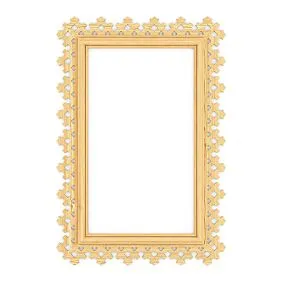
What are wooden door casings and what tasks do they solve
To put it briefly: a wooden casing is a profiled strip made of natural wood, mounted around the perimeter of the doorway over the joint between the door frame and the wall. Its main technical task is to cover the installation gap that inevitably remains after the frame is installed.
But considering the casing only as a "plug" would be a serious oversimplification. Wooden door casings perform several tasks simultaneously:
-
Cover the installation gap — that strip between the end of the frame and the wall surface, which is filled with mounting foam or putty when installing the door;
-
Form a decorative frame — visually design the opening as a complete architectural element;
-
They enhance the style of the door and interior — the profile of the casing can support or emphasize the stylistic concept of the space;
-
They protect the slopes and edges of the wall — from mechanical impacts and dirt along the perimeter of the opening;
-
They unify the door unit into a system — together with the frame, extension, baseboard, and moldings, the casing creates a cohesive, coordinated ensemble.




Where are wooden door casings used
The main area of application is interior doors in residential and commercial spaces. But it is not limited to this: wooden casings for door openings are also installed in decorative arches without a door leaf, in openings between halls, on built-in cabinets and niches.
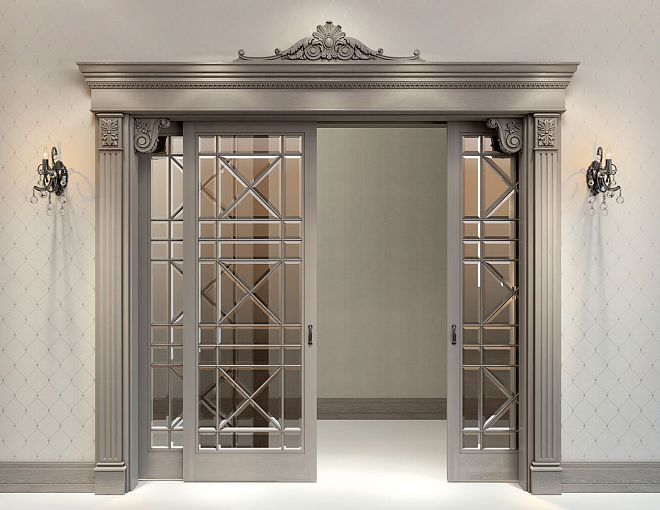
They look especially organicSolid wood door architraveswhere the door leaf itself is made of natural wood — veneer, solid wood, MDF with wood cladding. The unity of the door and casing material is an architectural consistency that the eye perceives as harmony.
Our factory also produces:


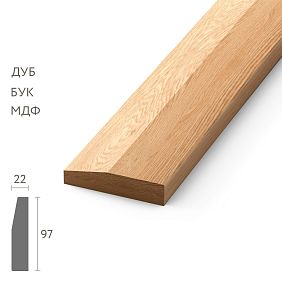


How a casing differs from an extension and other trim elements
This is a question that regularly causes confusion. Let's break down the differences:
Casing — a trim strip that covers the joint between the frame and the wall. It is mounted on the front side over the wall surface.
An extension is a flat strip installed on the end of a wall in an opening when the wall thickness is greater than the width of the frame. The extension "extends" the frame to the wall thickness — and only then is the casing mounted over the extension.
A molding is a decorative profiled strip used for decorating walls, ceilings, and furniture facades. A molding can frame an opening — but as an additional decorative element, not as a functional gap cover.
A baseboard is a lower horizontal profile that covers the joint between the wall and the floor. It is ideologically related to the casing but performs a different task.
Door molding is a system that includes all the listed elements. It is the consistency of the entire system that produces the result called a "solid door unit."
Get Consultation
Why wooden casings are a special choice
There are many alternatives on the market: PVC casings, aluminum profiles, MDF for painting, composite solutions. Each has its own audience. But why do so many people choose wood for serious renovations?
Natural material with a living texture
Wood is the only finishing material that has no two identical units. Each board, each strip is unique in its fiber pattern, tone, and knot distribution. This is what makes a wooden casing a living element of the interior, not a mass-produced industrial part.
Under transparent oil or varnish, the natural fiber of oak with a shimmering silky sheen or ash with pronounced dark veins — this is an aesthetic that cannot be reproduced synthetically.
Noble appearance and durability
Wood is a material that does not lose its value over the years. With proper care, a wooden architrave lasts for decades. It can be sanded, repainted, and tinted — unlike PVC or laminated MDF, which cannot be restored if the coating is damaged.
Combination with solid wood doors
If the door leaf is made of solid wood, an architrave made of the same material or a related species creates perfect stylistic consistency. This is the principle of "material unity": when all elements of the door unit are made of the same material, they are perceived as a single whole, rather than a set of randomly selected parts.
Consistent style with baseboards, cornices, and moldings
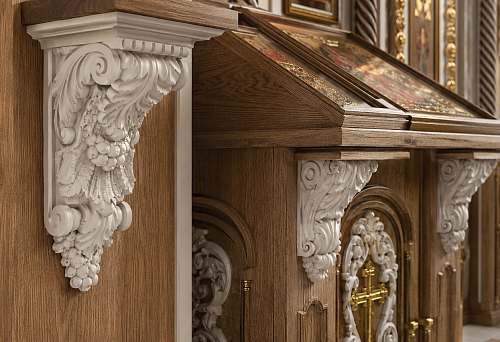
Wooden cornices and casingsSTAVROS products are selected within a unified system of materials and profiles. This allows you to create an interior where the architrave, baseboard, cornice, and moldings are connected by a single logic — the same wood, the same finish, the same profile character. This is exactly how real classic and neoclassical interiors, sought after by designers, look.
Types of wooden architraves for doors
Before buying, you need to understand what exactly you are choosing. Types of wooden door architraves differ in profile, decorative richness, and stylistic affiliation.
Smooth trim
A rectangular strip with a minimal profile: a flat front surface, sometimes with a small chamfer or rounded edges. This is the most laconic option — neutral, not claiming a decorative role.
A smooth wooden architrave is ideal for modern interiors: Scandinavian style, minimalism, hi-tech, japandi. It covers the gap without distracting attention from the door. The wood adds warmth — without unnecessary words.
Profiled casings
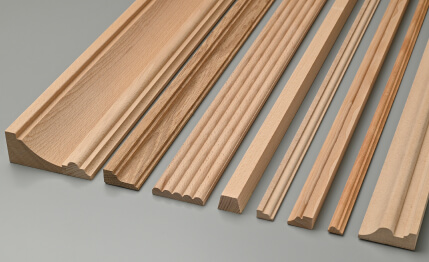
A strip with one or several relief transitions: a shelf, a step, a radius curve, a fillet. This is the most popular type — universal, suitable for most interiors from moderate classic to modern style.
A profiled architrave gives the doorway volume and expressiveness without requiring a specific style concept.Wooden door casingswith a profiled section is the most sought-after category in the segment of wooden moldings.
Figural architraves
A complex, multi-element profile with alternating convex and concave shapes: ogee, cyma recta, astragal, oval. Such architraves carry the architectural tradition of European classicism — they are appropriate in interiors with a pronounced historical character or in well-developed neoclassicism.
A figural wooden architrave for doors is no longer just molding, but an architectural detail with character. It requires an appropriate context: a classic paneled door, an interior with stucco cornices, furniture with carved decor.
Carved casings
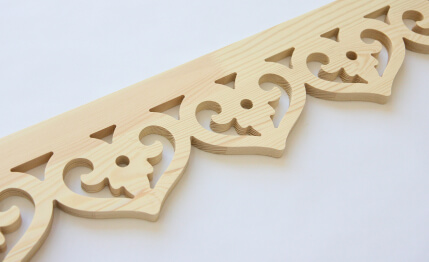
A separate and very interesting category iscarved door casingswith an ornament applied by milling or hand tools. The carving can be geometric, floral, historical — depending on the interior style.
In a city apartment, a carved wooden door architrave is an accent element, a designer statement. In a country house or cottage, it is an organic part of the architectural image. Carved wooden architraves for doors require the right context, but when present, they create an unforgettable impression.
Classic and modern profiles: a comparison
| Profile type | Character | Interior style | Width |
|---|---|---|---|
| smooth | Neutral, concise | Minimalism, Scandinavian, Japandi | 40–60 mm |
| Profiled | Universal | Classic, Modern, Neoclassical | 55–80 mm |
| Decorative | Decorative, Prestigious | Classic, Empire, Baroque | 70–100 mm |
| Carved | Designer, Accent | Russian style, Eclectic, Designer | 80–150 mm |
Materials: oak, beech, pine and MDF
Wooden door casing is a broad concept. It encompasses several completely different materials, each with its own characteristics, applications, and price.
Oak
Oak is the benchmark among wood species for wooden moldings. High hardness (almost twice as hard as pine), exceptional wear resistance, and a distinct beautiful grain pattern with shimmering "mirrors" on a radial cut.
Solid oak door casings — a choice for interiors where quality is a priority. An oak casing looks great under clear oil or varnish — the natural texture is fully revealed. Painting oak is possible but hides its main advantage.
One nuance: oak is a heavy wood, and its cost is higher than other species. But with proper care, an oak trim lasts 30–50 years without loss of quality.
Beech
Beech is close to oak in hardness, but has a more uniform, less pronounced texture. This makes it an excellent material for painting: the surface is smooth, and the paint lays perfectly flat.
Solid beech door trimswork well in classic interiors with painted white trims — the surface is free of pores and knots, resulting in a flawless finish.
An important nuance: beech is sensitive to humidity — with sharp fluctuations, it can behave unstably. In rooms with a constant climate, it's an excellent choice. In bathrooms and kitchens without forced ventilation, it's not recommended.
Spruce
The most affordable and most common material for wooden trims. Soft, easy to work with, and accepts any coating well. Most standard trims for interior doors in the mid-price range are made from pine.
Pine is inferior to oak and beech in hardness — in heavily used rooms, dents may remain on the soft surface. But with proper treatment and painting, a pine trim looks decent and lasts for many years.
An additional advantage of pine is its lively resinous texture, which looks good under clear varnish in Scandinavian or hunting-style interiors.
Solid wood vs MDF: key differences
The question "which is better — solid wood or MDF?" has no universal answer. The correct answer is "it depends on the task."
| Parameter | Solid wood | MDF |
|---|---|---|
| Naturalness | Complete | No (wood pulp) |
| Stability | Depends on wood species | High, does not warp |
| Painting | Good, with primer | Excellent, perfectly smooth |
| Restoration | Possible (sanding, tinting) | Limited |
| Price | Higher | More affordable |
| Durability | Very High | High |
| Wet areas | With protective coating | Preferable |
MDF door casings— the optimal choice for city apartments with central heating, where the air is very dry in winter: MDF does not crack or create gaps where solid wood might warp. Solid wood is for country houses, high-end interiors, and projects emphasizing naturalness.
How to choose the width and profile of a wooden casing
The width of the casing is not a matter of taste, but a matter of geometry and proportion. An incorrectly chosen width leads to one of two problems: either the casing does not cover the installation gap (and the edge of foam or putty remains visible), or it is too wide and "eats up" the wall next to the opening.
Standards and proportions
According to professional installers' practice, the optimal width of a wooden architrave is calculated from the ratio of room height to the opening itself. A simple working rule: architrave width in millimeters ≈ room height (mm) / 35.
-
With a ceiling of 2,700 mm: 2700 / 35 ≈ 77 mm → choose an architrave of 70–80 mm.
-
With a ceiling of 3,000 mm: 3000 / 35 ≈ 86 mm → choose an architrave of 80–90 mm.
-
With a ceiling of 3,200 mm: 3200 / 35 ≈ 91 mm → choose an architrave of 100 mm.
This is not an absolute standard, but a good starting point.
Standard sections:
| Width | Thickness | Application |
|---|---|---|
| 50 мм | 10 мм | Narrow openings, niches, door junctions |
| 70 мм | 12 мм | Standard apartments, ceiling 2,400–2,700 mm |
| 80 мм | 14 мм | High rooms, country houses |
| 100 мм | 14–16 mm | Formal interiors, ceiling from 3,000 mm |
For a narrow door opening
A narrow opening — up to 700 mm — requires special attention. A too-wide trim will look disproportionate, visually narrowing an already small opening. Recommended width: 50–60 mm.
For wide and tall openings
A wide opening — from 900 mm and above, especially double doors — requires a more "substantial" trim. A narrow strip will look out of place. Width from 80 mm and above, often with a shaped or profiled cross-section.
For classic paneled doors
A classic door already carries a decorative language: horizontal and vertical panels set a rhythm. The trim should support this rhythm: profiled, shaped, with a cove or ogee. Minimum width — 65 mm.
For modern smooth door leaves
A smooth leaf without decoration is a neutral surface that can easily be overloaded with a complex trim. The best choice: a smooth or minimally profiled wooden trim. Width — 50–70 mm. The natural wood texture provides the needed warmth without excessive decoration.
How to account for the frame, wall thickness, and extension
Before purchasing, you must measure: the wall thickness in the opening and the width of the door frame. If the wall is wider than the frame, an extension is needed.door casings and extensionsmust be coordinated in material, color, and style — this is critically important for the quality of the result.
Wooden architraves for interior doors: specifics by room
Apartment in a multi-story building
A city apartment is the most common scenario. Here, unity is key: all doors in the apartment should have a single series of architraves, one profile, one color. Mismatch instantly devalues even high-quality renovation.
For an apartment with standard ceiling height (2,500–2,700 mm), the optimal choice is a wooden architrave 65–75 mm wide, smooth or with a moderate profile. Material: beech for painting or oak with oil finish, depending on the interior style.
Country house
A country house offers more freedom: high ceilings, large openings, natural materials on walls and floors. Here, the scale of the architrave can be increased — 80–100 mm and wider.Solid wood door solutions— architraves, baseboards, moldings from the same wood — create the ensemble that is commonly called a 'true wooden interior.'
For a wooden house made of timber or logs, choose architraves from larch or oak — these species better withstand humidity fluctuations typical of country housing.
Classic interior
Classic style requires precision. A profiled or shaped architrave 70–90 mm wide, white or cream color, smooth flawless surface. Corner joints at 45° must be perfect: any gap in the corner destroys the classic look.
For classic interiors, beech for painting is recommended: a hard species, perfectly smooth surface, paint applies without pores or unevenness.
Neoclassicism
A modern interpretation of classics — more restrained, but no less demanding. A medium-width casing (65–80 mm), a profile with one or two relief transitions, a neutral color. It's important not to overdo it: in neoclassicism, the principle of "enough, but not excessive" applies.
How to avoid overloading a doorway
Three rules that always work:
-
One series of casings for all doors in one space;
-
One width — or a deliberate contrast (wider for the main door, narrower for passage doors);
-
Consistency with the baseboard: same material, related profile, unified finish.
How to combine wooden casings with the frame and extensions
This is a topic often ignored when purchasing — and then you get a result that causes disappointment.
When one casing is enough
If the width of the door frame exactly matches the thickness of the wall — no extension is needed. The casing is installed directly over the joint of the frame and the wall on both sides. This is the ideal scenario.
When a kit with an extension is needed
If the wall is thicker than the frame, an open section ("runout") remains between the end of the frame and the wall plane. It is covered by the extension. Only after installing the extension is the casing mounted.What is a door extension— this issue is covered in detail in a separate STAVROS article, and it should be studied before starting the purchase.
How to achieve a match in tone and profile
The main rule: buy the casing and extension in the same series, from the same manufacturer, at the same time. Even a slight difference in the shade of white (and there are dozens of shades) is noticeable in daylight. Different manufacturers almost guarantee a mismatch.
Why it is important to assemble the door unit in one system
How to assemble a complete door unit— this is not just a matter of aesthetics. It is a matter of the quality of the final result. The frame, extension, casing, and baseboard from the same material and same series form a system where each element supports the other. Attempting to assemble it from parts from different manufacturers, different materials, and different tones almost always yields a mediocre result.
How to choose a wooden casing to match the interior style
Classic
White casing 75–90 mm wide with a profiled section: scotia, ogee, one or two steps. Material — beech or oak for painting. Door with vertical panels, high skirting board, wall moldings — all in a unified style. It is in such a system that a wooden casing for a classic door fully reveals itself.
Neoclassicism
Moderate profile, width 65–75 mm, neutral color. Here, a small profiled casing made of oiled oak with a warm natural tone works well — it adds naturalness to the modern interior without falling into historical stylization.
Modern interior with wooden accents
Smooth casing 50–65 mm made of oak or ash under clear varnish. No complex profiles — only the pure wood texture as an accent against neutral walls. This solution works in Scandinavian interiors, Japandi, and modern classic.
Interiors with solid wood furniture
When the interior features natural wood furniture, the wooden door casing should be made of the same or related species. Oak furniture + oak casing, walnut panels + walnut casing — this is the principle of material unity that professional designers call the "glue of the interior."
Unified style with skirting boards and cornices
Materials for finishing and millwork — a full catalog of products that helps assemble a coordinated set from one source. Casing, skirting board, cornice, molding — in one material, with one finish, with coordinated profiles. This is what turns an interior from a set of details into a meaningful space.
Typical mistakes when choosing wooden casings
Too narrow casing. The desire to "not overload" the opening often leads to the casing barely covering the installation gap. At the slightest deviation in wall geometry, foam or putty becomes visible.
Too complex profile for a simple door. A shaped casing with a heel and ogee on a smooth ultra-modern door is a dissonance that everyone notices. The style of the casing and the style of the door must match.
Mismatch in frame tone. White casing and a "milky" colored frame are different things. When buying a casing separately from the frame, the risk of mismatch is very high. Buy from the same series.
Mixing materials. An MDF casing over an oak wooden frame is not a disaster if they are the same color. But with different coatings and different surface textures, the difference is visible.
Choosing a casing without considering the extension. Bought the casing, brought it, started installation — and discovered that the wall is 40 mm wider than the frame. An extension is needed. Going to buy more — risking a tone mismatch again.
Ignoring the baseboard. The wooden casing was selected, purchased, installed — but the baseboard was bought separately later from a different series. At the corner joint — a conflict of profiles, different thicknesses, different colors.
Calculating the quantity: how many meters of wooden casing are needed for one door
The calculation is simple but important — a mistake here is frustrating.
For one door on both sides (front and back):
-
Two side uprights × 2 sides = 4 strips. Length of each — opening height + 50–70 mm allowance = approximately 2,150–2,200 mm;
-
Two horizontal elements × 2 sides = 4 strips. Length — opening width + 2 × casing width + allowance for trimming = for an 800 mm door approximately 1,000–1,050 mm.
Total per door: about 10–12 linear meters. Add 10–15% reserve to the calculated quantity.
Important: standard length of a wooden casing is 2,100 or 2,200 mm. With ceilings above 2,400 mm, the side posts fit tightly — you need to calculate more precisely.
Coating for wooden casings: what to choose
Painting
Classic option for beech, pine, MDF. Color — any according to RAL or NCS. Result: a smooth, uniform surface without visible wood texture. Good for classic and neoclassical interiors with white casings. Technology: primer + 2–3 coats of facade paint with fine abrasive sanding between coats.
Clear varnish
Reveals the natural wood grain. Good for oak, ash, walnut — species with expressive texture. Varnish can be matte, semi-matte, or glossy. Matte is more modern and softer. Glossy is more classic and 'richer'.
Oil or wax
The most natural coating: penetrates the wood structure, does not form a film, preserves the natural surface texture. The wood 'breathes', the feeling of naturalness is maximum. Requires periodic renewal (every 2–5 years), but is easy to restore — without complete repainting.
Toning
Glaze or tinted oil changes the wood shade while preserving the texture. Allows you to age light oak to dark, add a cool or warm tone, imitate valuable species. A good tool for matching the casing to the door or furniture color.
Where to buy wooden door casings
Ready-made models
The fastest way: choose from the catalog in stock.New wooden architraves for doors and windowsThe STAVROS assortment is a regularly updated selection of current profiles and models. Suitable when the project is standard and there is no time for waiting.
Catalog solutions with complete sets
For a complete apartment or house design, it is more convenient to order a set: architraves, baseboards, moldings from the same series.wood trim itemsSTAVROS is exactly this format: a wide selection of series, the ability to assemble a coordinated set for the entire property.
Selection by style
For custom design projects, consultation is important: which profile will support the concept, which material will match the wall finish and furniture.Wooden architrave 2026— current trends and architectural solutions that will help guide your choice.
Order in the system with other wooden decor
The best result is when all wooden interior elements are ordered from one manufacturer.where to buy wooden items — detailed STAVROS material describing order formats and configuration options.
Care for wooden casings
A wooden casing does not require complex care, but a few rules are worth following.
Regular wiping. A damp cloth is sufficient. Aggressive cleaning agents — only as a last resort and only on painted surfaces, not on oiled ones.
Coating inspection. Once a year, inspect the casings: check for chips, cracks in the paint, or darkening. At the first signs of coating damage, restore immediately without delay.
Renewing the oil coating. If the casing is treated with oil, apply a fresh layer every 2–3 years. The procedure is simple: wipe, sand with fine sandpaper, apply oil with a cloth.
Humidity control in the room. For solid wooden casings, optimal humidity is 40–60%. At lower humidity (typical in winter with central heating), the wood may develop microcracks. A humidifier solves this problem.
FAQ: answers to the most popular questions
Which wooden casings are best for interior doors?
Depends on the interior. For modern style — smooth or minimally profiled ones made of oak or pine. For classic style — profiled or shaped ones made of beech for painting. For a country house — solid oak or larch with oil treatment.
What to choose: smooth or shaped?
Smooth — for modern interiors, minimalism, Scandinavian style. Shaped — for classic and neoclassical. Profiled — a versatile option for most interiors.
Is an extension needed?
Needed if the wall in the opening is thicker than the door frame. Measure the wall thickness and compare with the frame width. If the wall is wider, an extension is mandatory. The extension and casing must be from the same series.
Which wood species are best?
Oak — the most durable and prestigious. Beech — ideal for painting. Pine — an affordable and practical choice with proper treatment. Larch — for rooms with possible humidity fluctuations.
How to choose the width of a wooden casing?
Follow the rule: width in mm ≈ room height in mm / 35. Minimum — 50 mm for standard openings. For high rooms (from 3 m) — 90–100 mm.
Can casings be matched in style with the baseboard?
Yes, and this is the right approach. Buy the casing and baseboard in the same series from the same manufacturer — same material, same finish, coordinated profiles.
Can I order a custom profile?
Yes. For a custom order, the manufacturer makes the trim according to any drawing or sample.Oak and beech trims and strips — here you can choose a base model to discuss a custom order.
Which wooden trims should I choose for white interior doors?
White wooden trim for painting is a classic. The best material is beech: a smooth surface, excellent results when painting. A contrasting solution also works well: a natural oak trim on a white door.
How to combine a wooden trim with a baseboard?
A single rule: one material, one finish, a similar profile character. The baseboard does not have to exactly match the trim profile, but they should be "from the same family" — not conflicting in style and color.
Where to buy wooden door trims without making a mistake?
From a manufacturer with a full range of moldings — so that the trim, extension, baseboard, and cornice are from the same system.Door moldingSTAVROS is exactly that approach: everything for the door unit in one place.
STAVROS: natural wood for every doorway
When choosing a wooden door casing becomes part of a serious design project or quality renovation, the manufacturer who understands that trim is a system, not a set of planks, matters.
STAVROS is a full-fledged production of wooden trim products with a wide range of ready-made solutions and the possibility of ordering according to individual requirements. Wooden casings for interior doors, extensions, baseboards, moldings, cornices — everything is made from proven wood species: oak, beech, pine, ash, larch.
In the STAVROS catalog, you can choose a ready-made model in stock or order a specific profile and size for your project. The ability to buy the entire set of door trim in one place — from the same material, same series, with matching profiles — is exactly what distinguishes a professional approach from chaotic purchases in several places.
A wooden casing from STAVROS is not just a strip on the wall. It is the finishing touch that makes the doorway complete, the interior cohesive, and the renovation truly high-quality.