












































































Article Contents:
- Philosophy of wholeness: how unity is born
- Ceiling moldings: horizontal architecture
- Wall moldings: vertical architecture
- Moldings as connecting elements
- Complex compositions: systemic approach
- Stylistic solutions: from antiquity to modernism
- Color strategies: connection through color
- Lighting: light as the fourth dimension
- Practical recommendations: from project to implementation

Space ceases to be a collection of disconnected surfaces and transforms into an architectural ensemble when walls and ceilings begin to speak the same language. Verticals flow into horizontals, ornaments echo, profiles repeat, colors harmonize — creating that very sense of wholeness which distinguishes a professionally designed interior from a random collection of beautiful elements. Moldings — the oldest tool of architectural decoration — are precisely the language on which walls and ceilings can converse, creating a unified spatial composition. Whenceiling moldings and moldingsare coordinated with each other in style, scale, ornamentation, when the cornice visually continues the pilaster, when the ceiling rose is proportionate to the wall panels — space acquires architectural logic, completeness, nobility.
Why is a comprehensive approach so critically important? Because human perception does not divide a room into isolated surfaces — we perceive it as a single volume, where all planes are interconnected. If the ceiling is decorated in a classical style with rich moldings, while the walls are minimally smooth — a dissonance arises, a sense of incompleteness, as if the ceiling was brought from another room. If the walls have lavish baroque moldings, while the ceiling is simply white without decoration — the composition collapses, loses its wholeness.Comprehensive space finishingsolves this problem systematically: each element is designed as part of a whole, where walls are the vertical component, ceiling is the horizontal, cornices are transitional zones connecting verticals with horizontals. Moreover, such an approach allows visually correcting the proportions of the room, increasing or decreasing the perceived height of the ceiling, creating zoning without physical partitions, masking architectural flaws, integrating lighting.Architectural decorationbecomes not just decoration, but a tool for spatial organization.




Philosophy of wholeness: how unity is born
Harmony between walls and ceilings does not arise by chance — it is the result of intentional design, where the laws of composition, proportions, and visual balance are considered. Three fundamental principles create this unity: repetition, proportional correspondence, stylistic consistency.
The principle of repetition means that certain elements, forms, ornaments appear both on walls and ceilings, creating visual rhymes. The profile of the ceiling cornice may repeat or echo the profile of wall moldings — not necessarily identical, but recognizable. The ornament of the ceiling rose may contain the same motifs as decorative wall appliqués — acanthus leaves, rosettes, egg-shaped ornament. These repetitions work like a visual rhyme in poetry — they create rhythm, cohesion, a sense of thoughtfulness.
The principle of proportional correspondence requires that the size of decorative elements on the ceiling and walls be proportional to each other and to the scale of the room. If walls have massive moldings 150 mm high, while the ceiling cornice is thin 50 mm — proportions are broken, the composition collapses. Conversely, if wall decoration is delicate, while the ceiling has a huge rose 1 meter in diameter — imbalance is obvious. In a room with 2.7-meter ceilings and 20 square meters — cornices 70-100 mm, roses 400-500 mm, wall moldings 50-80 mm. In a spacious living room with 3.5-meter ceilings and 40 square meters — cornices 150-200 mm, roses 700-900 mm, wall moldings 100-150 mm.
The principle of stylistic consistency means that all elements belong to one style or harmoniously compatible styles. It is impossible to install a classical baroque cornice with lavish scrolls and floral ornaments on the ceiling if the walls are decorated with minimalist, simple geometric moldings. It is impossible to combine an empire rose with laurel wreaths on the ceiling and modern curved moldings on the walls. The stylistic language must be unified or intentionally eclectic, where mixing styles is the result of artistic intent, not chance.
Color unity strengthens the connection between surfaces. The simplest approach — paint all moldings one color: white, cream, ivory. If walls are painted or covered with wallpaper in a color different from the ceiling, moldings work as neutral framing, visually connecting different color zones. A more complex approach — tonal gradations: ceiling moldings are lighter than wall moldings by one or two tones, creating a smooth color transition from ceiling to walls. Contrasting approach — all moldings contrast with background surfaces: white on colored walls and ceilings, or gilded on a white background.




Ceiling moldings: horizontal architecture
Ceiling — the fifth wall of the room, often unjustly forgotten, simply painted white. But it is precisely the ceiling that defines the sense of height, volume, and completeness of space.Ceiling moldingtransforms a neutral horizontal plane into an architectural element participating in the overall composition.
Ceiling cornices — the first and main element of ceiling decoration, installed at the junction of wall and ceiling. Cornices perform multiple functions simultaneously. Visual — creates a transition between vertical and horizontal surfaces, frames the ceiling around the perimeter. Concealing — hides irregularities at the junction, technological gaps, boundaries of different materials. Functional — serves as a base for hidden lighting. Architectural — sets the scale and style of the ceiling composition.
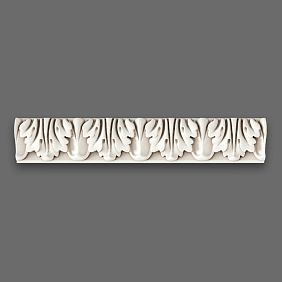
Cornice profiles vary from the simplest flat strips to complex multi-tiered compositions with rich ornamentation. Simple cornices with one or two rounded edges without ornament — for modern minimalist interiors, where a delicate boundary without visual overload is needed. Classical cornices with order elements — coves, beads, rosettes, egg-shaped ornament — for classical and neoclassical interiors. Baroque cornices with lavish floral motifs, acanthus leaves, scrolls, flowers — for luxurious palace interiors. Cornice height is determined by ceiling height: 50-80 mm for 2.5-2.7 m ceilings, 100-150 mm for 3-3.2 m, 150-250 mm for ceilings above 3.5 m.
Cornices with a shelf for lighting — a modern modification of the classical element. A special profile has a horizontal shelf on which an LED strip is laid. Light is directed upward onto the ceiling, creating soft diffused illumination around the perimeter of the room, visually increasing height, creating a floating ceiling effect. Shelf width of 30-50 mm allows hiding the strip from direct view — only reflected light is visible.
Ceiling rose fixtures are central decorative elements installed at the points where chandeliers are mounted, creating a visual focal point on the ceiling. The rose fixture performs several tasks: conceals the chandelier’s mounting hardware and wiring, provides a decorative frame for the light fixture, visually unifies the ceiling composition around a central point, and balances the perimeter decor of the cornice.
Rose fixture shapes are diverse: round — the most traditional and versatile, oval — for elongated rectangular rooms, square and octagonal — for corresponding room shapes, and ornate — complex multi-petal forms for luxurious interiors. Rose fixture ornamentation repeats the overall style: concentric circles of simple geometric profiles for minimalism, classical ornamentation with acanthus and rosettes for classicism, lavish baroque compositions with cherubs and garlands for baroque, radial geometric compositions for art deco.
The size of the rose fixture should correspond to the size of the chandelier and the room. For a small room of 12-15 square meters with a compact chandelier, a rose fixture with a diameter of 300-400 millimeters is suitable. For a living room of 25-30 square meters with a medium-sized chandelier — a rose fixture of 500-700 millimeters. For a grand hall of 40-50 square meters with a large chandelier — a rose fixture of 800-1000 millimeters or even larger.
Ceiling coffers are recessed panels in the ceiling, framed by moldings or beams, creating a complex relief composition. Coffers visually structure the ceiling, dividing it into sections, create play of light and shadow, and add architectural monumentality. Classical coffers — square or rectangular recesses divided by intersecting beams. Complex coffers — octagonal, circular, curved forms for unique compositions. Rose fixtures, ornamental appliqués, or spotlights can be placed inside coffers.
Ceiling moldings — decorative strips that create architectural divisions, frames, and geometric compositions on the ceiling. Straight moldings create rectangular or square frames, dividing the ceiling into zones. Curved moldings form ovals, circles, and arches for more complex compositions. Ceiling moldings visually lower an overly high ceiling, add interest to a standard flat ceiling, and create a basis for zonal lighting.
Corner elements — special decorative appliqués for corners where walls meet the ceiling. They can be simple triangular inserts filling a right angle, or complex three-dimensional elements — consoles, brackets, rose fixtures, imitating load-bearing structures. Corner elements enhance the sense of structural integrity and architectural logic, especially characteristic of Gothic, Baroque, and Neoclassical styles.
Our factory also produces:


Wall molding: vertical architecture
If the ceiling is horizontal, then walls are the vertical elements of space that require no less attention. Wall molding creates architectural divisions, structures planes, adds depth, and forms frames for other decorative elements.
Wall moldings — a universal tool for decorating vertical surfaces. Horizontal moldings at a height of 70-100 centimeters from the floor create a classic division of the wall into base and main sections, visually lowering overly high walls, and protecting the lower part from mechanical damage. Vertical moldings imitate pilasters, create rhythmic vertical accents, and visually increase the height of the room.
Framing moldings create rectangular, square, or oval panels — pilasters — within which contrasting colors, wallpaper, decorative plaster, fabric inserts, or mirrors are placed. A classic approach — symmetrical panels on both sides of a fireplace, sofa, bed, or door. Panels create a visual structure, transforming a flat wall into an architectural element with depth, rhythm, and logic.
Pilasters — vertical elements that imitate flat columns, protruding from the wall by 20-50 millimeters. A pilaster consists of three parts: base (foundation at floor level), shaft (central part), and capital (top finish). Pilasters create vertical accents, divide walls into sections, frame doors and windows, and create architectural logic — the impression that they support the ceiling cornice.
The order system determines the character of pilasters: Doric — simple, masculine, with minimal decoration; Ionic — more elegant, with volutes on capitals; Corinthian — ornate, with acanthus leaves on capitals; Composite — a combination of Ionic and Corinthian, maximally decorative. The size of pilasters corresponds to the height of the room: in a standard apartment with 2.7-meter ceilings — pilasters 2.4-2.5 meters high, in rooms with 3-4-meter ceilings — pilasters from floor to cornice.
Door and window openings' frames — special sets of decorative elements that transform utilitarian openings into architectural portals. Vertical casings on the sides of the opening, horizontal pediment or sash above, sometimes pilasters or half-columns on the sides. Framed doors or windows become compositional accents, solemn elements, rather than mere technological openings.
Wall rose fixtures and medallions — circular, oval, or shaped appliqués smaller than ceiling rose fixtures, used as decorative accents. A rose fixture above a wall-mounted light fixture creates a frame, transforming a wall sconce into a compositional center. Medallions in the center of wall panels add an additional decorative layer. Paired rose fixtures on either side of a mirror or painting create a symmetrical composition.
Decorative appliqués — elongated carved elements with floral, geometric, or shaped ornamentation. Vertical appliqués in the center of wall panels create an axis of symmetry. Horizontal appliqués above doors, fireplaces, or built-in cabinets add completeness. Corner appliqués at the corners of panels enhance the framing structure.
Baseboards — the finishing element of the wall at the bottom, covering the junction with the floor. In classical interiors, baseboards can be tall — 120-200 millimeters — with a profile that matches or complements the ceiling cornice. This creates a visual framing of the wall from top to bottom, enhancing the sense of architectural integrity.
Get Consultation
Moldings as connecting elements
Moldings — a key element connecting walls and ceilings into a unified system. They are present on both surfaces, creating visual correspondences, rhythms, and patterns.
A ceiling cornice and wall molding with identical or similar profiles create a direct visual connection. The eye perceives the repetition of form and interprets it as a system, order, and thoughtfulness. Complete coincidence is not necessary — it is sufficient that the profiles share common elements: rounded corners of a specific radius, coves at the same angle, identical ornamentation.
Molding as a transition from wall to ceiling — this is precisely the role of the ceiling cornice. It simultaneously belongs to both surfaces: the lower part of the profile abuts the wall, while the upper part meets the ceiling. The cornice is literally the physical link between vertical and horizontal elements, an architectural bridge between them.
Moldings of different scales on walls and ceilings must maintain proportional relationships. If the ceiling cornice is 100 millimeters high, wall moldings are appropriately 60-80 millimeters — smaller but proportionally matched. If the cornice is narrow at 50 millimeters, wall moldings should be 30-40 millimeters. Violating proportions creates visual dissonance.
Color solutions for moldings enhance or weaken their connecting role. If all moldings — ceiling and wall — are painted in one color different from the background surfaces, they are perceived as a unified system of white or gilded lines structuring the space. If ceiling molding is white and wall molding is gold — the connection is weaker, but the visual hierarchy is more obvious.
Complex compositions: a systemic approach
The true power of decorative molding is revealed through a systemic, comprehensive approach, when each element is designed as part of a unified ensemble.
A classic scheme of full decoration includes: a ceiling cornice around the perimeter, a central rose fixture under the chandelier, wall moldings creating panels, pilasters at corners or framing doors, tall baseboards at the bottom. All elements from one collection, with a unified ornament, coordinated profiles. Color is unified — usually white or cream, possibly gilded details.
An accent decoration scheme focuses the decor on the main wall and ceiling. The main wall is the one the eye falls upon upon entering, or the wall behind the key piece of furniture (sofa, bed, fireplace). This wall is decorated maximally: pilasters, molding panels, rose fixtures, appliqués. The ceiling is decorated in accordance with the main wall: cornice, rose fixture, possibly coffers or molding frames. Other walls are more restrained — baseboards, possibly simple moldings, door and window frames.
A perimeter decoration scheme uses decor along the boundaries of the room: ceiling cornice, baseboards, door and window frames. Central areas of walls and ceilings remain smooth. This creates a clear architectural frame for the space, defining its boundaries, while leaving central zones free for other design elements — paintings, furniture, textiles.
A zonal decoration scheme uses molding to visually divide space into functional zones without physical partitions. In a studio or living-dining room, ceiling moldings create frames above different zones. The living room zone is marked by a rectangular molding frame with a rose fixture and chandelier inside. The dining room zone — another frame with a separate rose fixture and light fixture. Zones on walls are divided by vertical moldings or pilasters. This clear zoning while preserving a unified space.
A coffered decoration scheme creates a maximally rich ceiling and wall composition. The ceiling is divided by beams or moldings into rectangular or square coffers — recessed panels. Each coffer may contain a rose fixture or ornamental appliqué. Walls are decorated with multiple panels framed by moldings, with pilasters creating a vertical rhythm. This is a monumental, palace-like aesthetic for large rooms with high ceilings.
Stylistic solutions: from antiquity to modern
Classicism requires strict symmetry, clear proportions, an order system. Ceiling cornices with classic profiles — with acanthus leaves, rosettes, egg-shaped ornamentation. Central rosettes with concentric circles of classical ornamentation. On walls — pilasters with Ionic or Corinthian capitals, molding panels of strict rectangular forms, symmetrically arranged. Colors: white, cream, possibly gilded capitals and cornices. This is strict, noble beauty, based on classical proportions.
Baroque and Rococo — maximum ornamentation, opulence, asymmetry. Ceiling cornices with rich vegetal ornamentation, scrolls, flowers. Rosettes large and complex, with cherubs, garlands, molded clouds. On walls — numerous decorative elements: curved moldings create oval and curved panels, abundant applied moldings with vegetal motifs, pilasters with ornate capitals. Colors: white with abundant gilding or pastel (blue, pink, mint) with gold. This is theatrical luxury, palace excess, visual abundance.
Empire — grand, monumental, with elements of military symbolism and Egyptian motifs. Cornices with clear profiles, strict rosettes with radial compositions or military trophies. On walls — pilasters, molding panels, applied moldings with laurel wreaths, Roman swords, torches. Colors: white with gold, possible red and blue accents. This is imperial aesthetics, embodiment of power and grandeur.
Neoclassicism — a simplified, adapted version of classicism for modern life. Cornices and moldings with simplified classical profiles without excessive ornamentation. Rosettes small and delicate. Pilasters simplified, sometimes without distinct capitals. Wall panels minimalist, with minimal decoration. Colors: light, neutral, delicate or absent gilding. This is modern elegance with classical references, suitable for modern city apartments.
Art Deco — geometric, graphic, glamorous. Cornices with stepped profiles, zigzags. Rosettes with radial, sun-like compositions, geometric ornamentation. Moldings create geometric compositions — stepped frames, trapezoids, octagons. Colors: contrasting — black with gold, white with silver, graphite with copper. This is the glamour of the 1920s-30s, the jazz era, the Great Gatsby.
Modern Classicism — minimalist use of molding in modern interiors. Simple, unadorned cornices creating a clear boundary between wall and ceiling. Wall moldings with simple geometric profiles, creating architectural divisions without ornamentation. No rosettes, pilasters, ornamentation — only pure geometric lines. Colors: monochromatic. This is an architectural approach, where molding is a tool for structuring space, not decoration.
Color Strategies: Connection Through Color
Monochromatic Strategy — everything in one color. Walls, ceiling, all molding painted in one color — white, gray, beige. Boundaries between surfaces are erased, space is perceived as a single volume. Relief of molding is read only through light and shadow. This creates maximum unity, visual coherence, characteristic of Scandinavian and minimalist interiors.
Contrast Strategy — molding contrasts with background surfaces. Walls and ceiling painted in color (gray, blue, green, terracotta), all molding white. Or vice versa — dark walls and ceiling, gilded or silver molding. Contrast highlights each molding element, makes architectural decoration the main focus, creates graphic clarity and compositional readability.
Tonal Strategy — ceiling is lighter than walls by several tones, molding creates a smooth transition. Walls dark gray, ceiling light gray, ceiling cornice medium gray — intermediate tone. Wall moldings same medium tone as cornice. This creates tonal depth, gradient transition from dark lower part to light upper part, visually increasing height.
Accent Strategy — main molding neutral (white, cream), individual elements accent (gold, silver, colored). Cornices and moldings white, rosettes and pilaster capitals gilded. Or all moldings white, decorative applied moldings within panels contrasting. This creates visual hierarchy, highlights key elements, adds luxury without overload.
Two-color Strategy — ceiling molding one color, wall molding another. Ceiling white, wall molding cream or light gray. This is a delicate surface division while maintaining overall light palette. Or ceiling white, wall molding gilded — more contrasting solution for luxurious interiors.
Lighting: Light as the Fourth Dimension
Molding exists thanks to light — it reveals relief, creates shadows, emphasizes volume. Proper lighting greatly enhances the effect of molded decoration.
Hidden backlighting behind cornices — LED strip on cornice shelf, directing light upward onto ceiling. Creates soft diffused glow around perimeter, visually increasing ceiling height, creating floating effect. Light color affects perception: warm white (2700-3000K) creates coziness, neutral white (4000K) — modernity, cool white (5000-6000K) — museum-like. RGB strip allows changing color and mood.
Accent lighting for rosettes and decorative elements — directional spotlights illuminating ceiling rosettes, creating dramatic chiaroscuro on their relief. Wall spotlights directed at pilasters or wall panels, emphasizing their volume. This is a museum technique, transforming architectural decoration into exhibits worthy of special lighting.
Chandeliers and wall sconces in harmony with molding — lighting fixtures must match the style of molded decoration. Classical crystal chandelier — for classical and baroque interiors with appropriate molding. Modern minimalist chandelier — for modern interiors with minimalist molding. Stylistic dissonance between chandelier and molding destroys overall unity.
Natural lighting and molding — large windows create natural play of light on relief throughout the day. Morning side light creates long shadows, emphasizing volume. Midday overhead light is more neutral. Evening side light is again dramatic. Consider window orientation when designing molded decoration — place most prominent elements where natural light will accentuate them effectively.
Practical Recommendations: From Project to Implementation
Start with a sketch — create visualization before purchasing and installation. Photograph the room, then in graphic editors or specialized programs overlay images of molding elements. Assess scale, proportions, visual balance. This protects against errors — too large or small molding, stylistic mismatches.
Choose elements from one collection — molding manufacturers form collections where all elements are coordinated in style, profiles, ornamentation. Cornices, rosettes, moldings, pilasters from one collection will definitely match. Mixing elements from different collections is risky — scales, ornamentation, proportions may not align.
Use quality materials — polyurethane molding offers optimal price-to-quality-to-practicality ratio. It is lightweight, strong, moisture-resistant, easy to install and paint. Gypsum molding is more noble but heavier, more expensive, requires professional installation. Foam molding is cheap but looks cheap, easily damaged, short-lived. Do not economize on molding — quality elements last decades.
Correctly calculate quantity — measure perimeters, heights, areas. Order 10% more for trimming, possible defects, future repairs. Especially for moldings and cornices — better to have a reserve than to buy a missing meter from another batch, where color may differ.
Trust professionals for installation — if unsure of skills, hire experienced installers. Curved joints, uneven lines, gaps between elements will ruin even expensive molding. Professional installation guarantees perfect results — invisible seams, clean lines, secure fixation.
Plan painting in advance — it’s better to paint molding after installation to hide seams and adhesive residue. Use quality acrylic paints, apply in 2-3 thin layers for even coverage. If planning gilding or patination, entrust it to decorators — these techniques require experience.
Integrate lighting during installation — if planning hidden backlighting, lay wiring and install LED strips during cornice installation. Retrofitted lighting is more complex and may damage already installed molding.
Decorative finishing of the room through unity of walls and ceilings usingmoldings— is the path to creating a space that possesses architectural integrity, visual harmony, the nobility of classical interiors. When ceiling cornices harmonize with wall moldings, when rosettes match panels, when pilasters visually support cornices, when color and style of all elements are coordinated — the room ceases to be a collection of separate surfaces and transforms into an architectural ensemble, where every detail is in its place, where verticals naturally flow into horizontals, where beauty is not based on chance but on a carefully composed arrangement, tested by centuries of classical proportions.


