Article Contents:
- The Philosophy of Transformation: From a Smooth Plane to an Architectural Object
- Why Doors Deserve Decoration
- The Psychology of Symmetry and Rhythm
- Materials for Door Decor: Choosing Based on Task and Budget
- Wooden Molding: The Nobility of Solid Wood
- MDF Molding: Technological and Affordable
- Polyurethane Elements: The Versatility of Synthetics
- Molding Layout Schemes: Classic and Modern
- Two-Panel Scheme: Strict Elegance
- Four-Panel Scheme: The Classic Canon
- Three-Panel Vertical: Dynamics and Rhythm
- Asymmetric Compositions: An Author's Approach
- Choosing Overlays and Ornaments: Stylistic Consistency
- Classic: Acanthus, Rosettes, Symmetrical Ornaments
- Neoclassical: Restrained Forms and Minimal Ornamentation
- Modern and Art Deco: Geometry and Stylization
- Minimalism and Scandinavian Style: Rejecting Ornamentation
- Step-by-Step Instructions: From Marking to Final Painting
- Door Preparation and Layout Planning
- Marking on the Door: Accuracy is Key to Success
- Molding Preparation: Cutting and Joining Corners
- Molding Installation: Glue and Patience
- Installing Carved Overlays: Composition Accents
- Preparation for Painting: Putty and Primer
- Painting: technique of flawless finish
- Frequently Asked Questions
- Conclusion: From Standard to Uniqueness in One Move

Do your interior doors look dull? Does the smooth, bland panel remind you of an office partition rather than a living space element? Want a classic paneled door, but replacing all the doors in your apartment would cost a fortune? There's a solution that designers have used for decades, yet ordinary people often overlook:door decoration by handusing molding and carved overlays. Over a weekend and for a few thousand rubles, you can turn a cheap smooth door into an elegant paneled door that looks like expensive classic craftsmanship. No dismantling of frames, no builders, no mess—just you, glue, molding, and a bit of patience. The result will exceed expectations: guests will ask where you found such beautiful doors, and you'll smile, keeping the true cost of the transformation to yourself.
Moderndecorative door ornamentsWood, MDF, and polyurethane open up limitless creative possibilities. From strict neoclassicism to lush baroque, from minimalist geometry to carved floral ornaments — choose a style that matches your interior. The main thing is to understand the principles of composition, know the installation technology, and not be afraid to experiment. Today, we will go through the entire journey from concept to final painting, turning theory into a practical guide to action.




The Philosophy of Transformation: From a Smooth Plane to an Architectural Object




Why Doors Deserve Decoration
A door is not just a functional partition between rooms. It is a vertical plane with an area of about two square meters that constantly falls within the field of vision. A person living in an apartment sees each door dozens of times a day. Guests evaluate the interior upon entering a room, and the first thing that catches their eye after the threshold is the door leaf. A bland, smooth surface creates a sense of budget renovation, incompleteness, and temporariness.
A panel door with relief, interplay of light and shadow, and architectural detailing is perceived completely differently. It signals: people live here who value details, understand interior aesthetics, and do not spare time to create beauty. The psychology of space perception is based on details. The same interior with smooth and paneled doors produces diametrically opposite impressions.
Economic logic also favors decoration. A new, high-quality solid wood panel door costs 25-40 thousand rubles. A setmolding for paintingfor one door — 1500-3000 rubles. Add a can of paint for 800 rubles, glue for 500 — a total of about 5000 rubles versus 30000. A sixfold difference. At the same time, the visual result is practically identical if the work is done neatly.
Our factory also produces:



The Psychology of Symmetry and Rhythm
A panel door works on a subconscious level through the principles of classical architecture: symmetry, proportion, rhythm. The human brain is tuned to perceive symmetrical objects as more attractive, safe, and harmonious. This is an evolutionary mechanism — a symmetrical face, a symmetrical body are associated with health. The same principle works in architecture and design.
A door divided by moldings into two vertical panels creates a central axis of symmetry. The eye automatically reads this as correct, ordered. A door with four panels — two upper, two lower — creates a two-level symmetry vertically and horizontally. This is already a classical canon used in door constructions for centuries.
Rhythm — the repetition of elements at equal intervals — also creates visual comfort. Three identical panels running vertically create a rhythmic pattern. Alternating wide and narrow panels adds dynamism. The designer consciously operates with these tools, while an ordinary person intuitively perceives the result as beautiful or ugly.
When you start planningdoor decoration by hand, rely on these fundamental principles. Symmetry, proportion, rhythm — these are the three pillars on which visual harmony stands.
Get Consultation
Materials for Door Decoration: Choosing for the Task and Budget
Wooden Moldings: The Nobility of Solid Wood
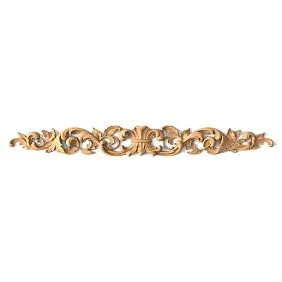
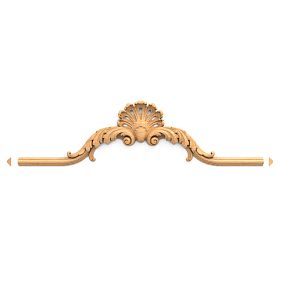
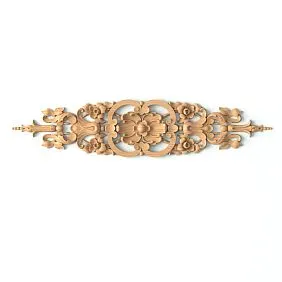
Wooden carved appliqués— a premium choice for those who value the authenticity of the material. Oak, beech, ash have expressive texture, tactile warmth, and a nobility that cannot be fully imitated by synthetics. A wooden overlay with a carved floral ornament on a solid wood door creates a monolithic impression — as if the door was originally carved.
Advantages of wood: the ability to tint to any color while preserving the visible texture, high strength, durability of 50-80 years, the possibility of local repair of scratches and dents. Wooden elements can be repainted multiple times, updating the interior without replacing the decor.
Disadvantages: high price — a wooden molding costs 2-4 times more than an MDF molding of a similar profile. Wood reacts to humidity changes — sharp fluctuations can cause slight deformations. More complex processing is required — sanding, priming, multi-layer coating.
For which doors is wood suitable? If you have a solid wood or veneered door, wooden decor will create material unity. If the door is painted with enamel in a color, wooden elements are also painted to match — the texture is hidden under the paint, but the quality of the material remains.
MDF Moldings: Technological and Affordable
MDF — fine wood fiber, pressed into dense boards.Paintable wall moldingfrom MDF combines affordable price with good performance characteristics. The homogeneous structure of the material ensures geometric stability — the molding will not warp from humidity, it retains its dimensions for years.
Advantages of MDF: price 2-3 times lower than wood, a perfect surface for painting without visible pores and fibers, ease of processing — cuts with a regular handsaw, adheres with any mounting adhesive. MDF forgives beginners' mistakes — if you ruin an element when cutting, replacement will not be expensive.
Disadvantages: less strength compared to solid wood — a strong impact can create a chip. MDF does not have wood texture — under clear varnish, it looks like a composite material. But under opaque enamel, MDF is visually indistinguishable from wood.
MDF is ideal for doors that are planned to be painted in a solid color — white, gray, colored. The smooth surface of MDF under enamel creates an even, salon-quality coating. This is the optimal choice for budget projects where results are important with limited funds.
Polyurethane Elements: The Versatility of Synthetics
Polyurethane — a polymer material molded by casting into silicone molds. This allows creating elements of any complexity — from simple rectangular strips to baroque rosettes with the finest detailing. Polyurethane overlays are completely moisture-resistant, not afraid of temperature fluctuations, and do not deform over time.
Advantages of polyurethane: low weight — an element measuring 50×20 cm weighs 100-150 grams versus 400-500 grams for a wooden one. This simplifies installation — adhesive is sufficient, no additional fasteners are needed. Polyurethane is cut with a fine-toothed metal saw or a utility knife. The ability to create the most complex reliefs, unattainable for wood and MDF.
Disadvantages: artificiality of the material — upon close inspection, polyurethane reveals its synthetic nature. Less tactile pleasantness compared to wood. Polyurethane is softer than wood and MDF, easier to scratch.
Polyurethane is optimal for doors in wet areas — bathrooms, kitchens, where wood and MDF risk damage from water splashes. Also, polyurethane is indispensable for creating complex decor — carved rosettes, ornamental panels, which would cost exorbitant amounts if made from wood.
Molding Layout Schemes: Classic and Contemporary
Two-Panel Scheme: Strict Elegance
The simplest and most universal scheme is two vertical panels occupying the full height of the door. The door is conditionally divided vertically in half, with a rectangular molding frame placed in the center of each half. The distance from the edge of the door to the frame is 8-12 centimeters, and the distance between the frames is 10-15 centimeters.
This scheme works for doors 70-90 centimeters wide. The panel proportions should be vertically elongated—with a height-to-width ratio of approximately 4:1 or 5:1. For example, a panel 180 centimeters high and 25 centimeters wide creates the correct elongated proportion, visually raising the ceilings.
The molding for the frames is chosen with a width of 3-5 centimeters; the profile can be simple rectangular or shaped with a fillet. For classic interiors, a shaped profile is used; for contemporary ones, a concise rectangular one.
The two-panel scheme suits any style: classic, neoclassic, minimalism, Scandinavian style. Its universality and strictness make it a foolproof choice for those decorating for the first time.
Four-Panel Scheme: The Classic Canon
A classic scheme used in door constructions since the 18th century. The door is divided horizontally into two parts—upper and lower—each containing two vertical panels. The horizontal division is usually shifted upward—the upper part occupies 55-60 percent of the height, the lower part 40-45 percent.
This asymmetrical division creates dynamics, avoiding monotony. The upper panels are vertically elongated, while the lower ones are less elongated or even close to square. This corresponds to classical proportions, where the top is always lighter and more graceful than the bottom—a principle of architectural orders.
The horizontal strip separating the top and bottom can be wider than the vertical and side ones—for example, 6-7 centimeters versus 4 centimeters. This further emphasizes the horizontal division, creating a sense of stability and solidity.
The four-panel scheme is appropriate in classic, neoclassic, and traditional interiors. It requires more careful execution—more corners, more joints, and a higher risk of errors. But the result gives the impression of expensive joinery work.
Three-Panel Vertical Scheme: Dynamics and Rhythm
A less common but very expressive scheme—three vertical panels of equal width running the full height of the door. The door is divided vertically into three equal parts, with a molding frame placed in the center of each. The distances between elements are equal—creating a clear rhythm.
This scheme visually elongates the door vertically, making it slimmer and taller. It suits narrow doors 60-70 centimeters wide, where two panels would look too wide and four too fragmented. Three panels create balance.
For the three-panel scheme, it's better to choose narrow molding, 2-3 centimeters, to avoid overloading the composition. The profile should be concise, without excessive curves. The overall impression is a contemporary interpretation of classicism, a fresh take on traditional forms.
The three-panel scheme works well in eclectic interiors where classicism combines with modernity. It is traditional enough not to look avant-garde, yet unconventional enough to stand out.
Asymmetrical Compositions: An Authorial Approach
For bold and creative individuals—asymmetrical schemes where panels of different sizes are arranged non-mirroringly, creating a non-standard composition. For example, one large vertical panel on the left occupying 60 percent of the door width, and two narrow ones on the right. Or four panels of different sizes arranged according to the golden ratio proportion principle.
Asymmetry requires a developed sense of composition. If executed incorrectly, it looks like a mistake, like an accident. If properly designed, it creates dynamics, uniqueness, and an authorial touch. If you are unsure of your design intuition, it's better to stick to symmetrical schemes.
Asymmetrical doors are appropriate in contemporary interiors—loft, high-tech, minimalism, eclecticism. In classic interiors, they look alien. Moldings for asymmetrical compositions are chosen to contrast—for example, black on a white door, creating a graphic effect.
Choosing Overlays and Ornaments: Stylistic Correspondence
Classic: Acanthus, Rosettes, Symmetrical Ornaments
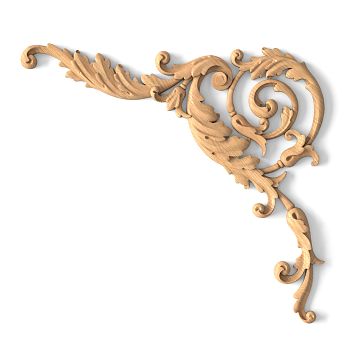
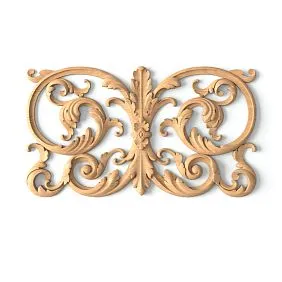
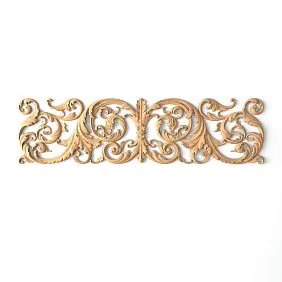
The classic style requiresdecorative embellishments for doorswith plant motifs: acanthus leaves, laurel branches, floral garlands. Carved overlays are placed in the corners of the panels or in the center of the horizontal strip. Symmetry is mandatory—if an overlay is in the upper left corner of a panel, a mirror one must be in the upper right corner.
Round or oval rosettes with relief ornamentation are placed in the center of panels or at the intersection of moldings. The rosette diameter is chosen proportionally to the panel size—for a 60×20 centimeter panel, a rosette 8-12 centimeters in diameter is optimal.
Classic overlays are usually painted to match the door color but can be highlighted with contrast—gold or silver patina in the recesses of the carving. This creates a luxurious effect, emphasizes detailing, and adds solemnity.
Neoclassic: Restrained Forms and Minimal Ornament
The neoclassic style uses simplified versions of classic motifs. The ornament is more geometric, less lush. Instead of dense carving—concise lines, strict rosettes with minimal detailing, geometric overlays in the shape of diamonds, ovals.
Neoclassicism leans toward symmetry and proportion but avoids excess. Overlays are used sparingly—one central one in each panel or only in the upper panels. The overall impression is restrained elegance, noble simplicity.
The color palette of neoclassicism consists of calm, noble tones: gray-blue, dusty green, gray-beige, light gray, white. Contrast accents are rare, preference is given to tonal transitions within a single color.
Modern and Art Deco: Geometry and Stylization
The Art Nouveau style uses stylized plant motifs — winding stems, curved lines, asymmetrical compositions. Overlays often have an elongated vertical shape, mimicking the growth movement of plants.
Art Deco prefers geometry — zigzags, rays, stepped forms, stylized suns. Overlays are symmetrical, but not in a classical way, rather with the graphic quality characteristic of Art Deco. Color contrasts are welcome — black with gold, silver on a dark background.
These styles require specific overlays that are difficult to find in mass production. Often, custom manufacturing based on sketches or adapting existing elements to the style is necessary.
Minimalism and Scandinavian style: Rejection of ornament
Modern styles like minimalism and Scandinavian generally avoid carved overlays. Door decoration is limited to the geometry of moldings — rectangular or square panels created by narrow strips of rectangular profile.
No rosettes, no carvings — only the pure geometry of lines. Molding 2-3 centimeters wide, 8-10 millimeters thick, painted the same color as the door or in a contrasting color. For example, white moldings on a gray door create a graphic composition in the spirit of Scandinavian minimalism.
This is the simplest decoration to execute, requiring minimal materials and skills. But simplicity does not mean primitiveness — a properly designed geometric composition looks stylish, modern, and expensive.
Step-by-step instructions: from marking to final painting
Door preparation and layout planning
The first stage is removing the door from its hinges. Working with the door hanging is inconvenient and imprecise. Lay the door horizontally on two stools or sawhorses, placing a soft cloth underneath to avoid scratching the surface. If the door remains on its hinges, cover the floor with plastic and work carefully — drops of glue and paint are inevitable.
The second stage is cleaning and degreasing the surface. The door must be clean, dry, free of dust and grease stains. Wipe the surface with a damp cloth, let it dry, then wipe with a degreaser (alcohol, acetone, special compounds). Glue only adheres to a clean surface.
The third stage is planning the layout on paper. Measure the exact dimensions of the door leaf. Draw the door to scale on a sheet of paper. Sketch layout options for the panels, experimenting with sizes and proportions. This is cheaper than making mistakes on the actual material.
Optimal indents from the edge of the door to the outer boundary of the panel are 8-12 centimeters at the top and bottom, 6-10 centimeters on the sides. The distance between panels is 8-15 centimeters. These numbers are proven by practice and create balanced proportions.
Marking on the door: precision is the key to success
After approving the paper plan, transfer the markings to the door. You will need: a tape measure, a long metal ruler (100-150 centimeters), a square, a pencil, painter's tape.
Start by determining the central vertical axis of the door. Measure the door's width, divide it in half, draw a vertical line down the center from top to bottom. This is the reference line from which all other dimensions are set.
Measure the planned indents from the door edges, draw vertical and horizontal lines defining the panel zones. Use a square to check right angles — all frame corners must be strictly 90 degrees. The slightest misalignment will be noticeable after installation.
After drawing the main lines, apply painter's tape along the outside of each line. The tape will serve as a guide when gluing the moldings and protect the door surface from glue. After installation, the tape is removed, leaving a clean surface.
Preparing moldings: cutting and joining corners
Moldings are cut with a miter saw at a 45-degree angle for corner joints. If you don't have a miter saw, use a miter box — a tool for cutting at a set angle. A quality miter box provides cutting accuracy within plus or minus 1 degree, which is sufficient for invisible joints.
Cutting order: measure the internal length of the frame side (distance between internal corners). Mark this length on the molding, considering the cutting direction — left and right corners are cut in opposite directions. Secure the molding in the miter box, cut with a confident motion without pressure — the saw should cut, not break the material.
MDF is cut with a fine-toothed hacksaw for metal or a miter saw with a clean-cut blade. Wood requires a sharp saw and care — chips are unacceptable. Polyurethane is cut with a hacksaw for metal or a sharp knife — the material is soft and yields easily.
After cutting, check the corner joints dry, without glue. Assemble the four frame strips on a flat surface, check the tightness of the corner joints. A gap larger than 0.5 millimeters requires adjustment — trimming the angle or sanding the end.
Installing moldings: glue and patience
Glue is chosen depending on the molding and door material. For MDF and wood on a wooden or MDF door — mounting adhesive like liquid nails or specialized wood glue. For polyurethane — polyurethane adhesive like Tytan or Moment.
Apply a thin layer of glue to the back of the molding using a gun or spatula. Don't overdo it — excess glue will squeeze out when pressed and stain the surface. It's better to apply less than more.
Place the molding on the door strictly along the marked line, press evenly along its entire length. Hold for 30-60 seconds — modern adhesives set quickly. To secure long strips, use painter's tape — tape the molding to the door every 20-30 centimeters, remove the tape 2-3 hours after the glue sets.
Corner joints are the most critical spot. Apply a small drop of glue to the end of one strip, connect it to the end of the second strip, press. If a microscopic gap forms, fill it with acrylic sealant using a fine nozzle, smooth it with a wet finger. After drying, the sealant is sanded and becomes invisible under paint.
Installation of carved overlays: composition accents
After installing all frame moldings, proceed to install the carved overlays. Overlays are significantly lighter than moldings; a drop of glue in the center and at the corners is sufficient for their attachment. Apply glue, place the overlay exactly in the center of the panel or in the planned location, press for a minute.
If the overlay is heavy (large wooden carving), reinforce the adhesive attachment with finishing nails with a countersunk head. Nails 15-20 millimeters long are driven into inconspicuous places — in the recesses of the carving. The nail head is countersunk by 1-2 millimeters, and the hole is filled with wood putty.
Polyurethane overlays are held only by glue — they are so light that additional fastening is not required. It is important to observe the glue setting time — usually 24 hours for full curing. During this time, it is better to leave the door horizontally, do not flip it, and do not touch the overlays.
Preparation for painting: putty and primer
After the glue has completely dried, inspect all joints, attachment points, and corner connections. Micro-gaps, nail marks, and unevenness are filled with acrylic putty. Putty is applied with a rubber spatula, smoothed flush with the surface, and after drying, sanded with fine sandpaper of 180-220 grit.
If the door and moldings are made of different materials (e.g., laminated door and MDF moldings), the entire surface is primed with an adhesion primer. This ensures uniform paint adhesion to different surfaces. Primer is applied with a roller in one or two coats, each coat dries for 2-4 hours.
MDF moldings are factory-primed, but an additional coat of primer will improve the final result. Wooden elements require mandatory priming — wood has a porous structure; without primer, paint absorbs unevenly and creates stains.
Painting: technique for flawless coverage
Paint is chosen depending on the desired effect and operating conditions. For living spaces, water-based acrylic enamel is optimal — it is odorless, dries quickly, and creates a durable coating. For wet rooms (bathroom, kitchen), use alkyd or polyurethane enamel — more resistant to moisture.
Painting is done in several coats — at least two, optimally three. The first coat is the base, applied with a roller on flat surfaces and a brush in corners, joints, and relief. The roller creates an even coating without brush marks, the brush paints hard-to-reach places.
Each coat of paint dries for 4-8 hours depending on the type of paint and temperature. After the first coat dries, the surface is lightly sanded with fine sandpaper to remove raised fibers (especially relevant for wood and MDF). Sanding dust is removed with a damp cloth.
The second coat is applied perpendicular to the first — if the first coat was applied vertically with a roller, the second is applied horizontally. This ensures coating uniformity and absence of bare spots. The third coat is the final one, applied in the same direction as the first.
To create a patina (aging) effect, a two-color technique is used: the base color is applied to the entire surface, after drying, the relief of moldings and overlays is painted with a contrasting color (gold, silver, dark), excess paint is wiped off with a cloth, leaving contrast only in the recesses. The result is a noble aging effect.
Frequently asked questions
Is it possible to decorate an interior door without removing it from its hinges?
Technically possible, but significantly more difficult. The vertical position of the door complicates precise marking, glue may drip, and it is hard to press moldings evenly. Painting a vertical door is also more difficult — drips, uneven coating. It is recommended to remove the door and work horizontally. Removing the door takes 5 minutes and saves hours of installation hassle.
What glue holds moldings best on a laminated door?
Laminated surface is smooth and non-absorbent. Regular PVA or wood glue will not provide reliable adhesion. Use polymer mounting adhesives like liquid nails, Titebond, or two-component epoxy adhesives. Before applying glue, lightly sand the door surface with fine sandpaper in the gluing areas — this improves adhesion.
Should the door and moldings be painted separately before installation or better after?
Depends on the desired result. Painting before installation allows painting all surfaces perfectly, including the back sides of moldings. But joints and gluing areas will remain unpainted and will require touch-up after installation. Painting after installation creates a monolithic coating, hides joints, but requires care when working with a brush in the relief. Optimal — base painting before installation, final painting after.
How to calculate the required amount of molding for one door?
For a two-panel scheme on a standard door 200×80 centimeters, approximately 10-12 linear meters of molding are required, including allowance for cutting corners. Formula: perimeter of all frames plus 20 percent for cutting. For a four-panel scheme — 14-16 meters. It is better to buy with a surplus — an element ruined during cutting will need to be replaced.
Can a regular white plastic corner be used instead of wooden molding?
Technically possible, but the result looks cheap. Plastic corner lacks relief, profile, volume — it is a flat strip. A door with plastic corners looks like a budget craft. Invest in quality MDF or polyurethane molding — the price difference is 500-1000 rubles, the difference in visual result is colossal.
How to achieve perfectly even 45-degree angles without special tools?
Use a miter box — a plastic or wooden device with slots at 45 and 90-degree angles. Costs 300-500 rubles, sold in any hardware store. The molding is placed in the miter box, the saw follows the slot, ensuring an exact angle. For thin moldings, a utility knife and metal ruler can be used, but a steady hand is required.
How long does the full cycle of decorating one door take?
With tools and materials available: marking — 1 hour, cutting and fitting moldings — 2 hours, installation — 2 hours, glue setting time — 24 hours, putty and sanding — 1 hour, priming (with drying) — 4 hours, painting in three coats (with drying of each) — 24 hours. Total stretched over 3-4 days, pure working time — 6-8 hours.
Can glass inserts in doors be decorated?
Moldings are glued only to solid surfaces — wood, MDF, metal. Glue does not hold reliably on glass. If the door has glass inserts, bypass them with moldings, creating a frame around the glass. This is even more interesting compositionally — alternating solid panels and glazed sections.
Conclusion: from standard to uniqueness with one move
Transforming a plain smooth door into a paneled one using moldings and carved overlays is one of the most impressive and cost-effective ways to enhance your interior. For a modest amount of money and a couple of weekends, you get a result visually indistinguishable from an expensive custom-made door. Guests won't guess that the magnificent classic door in your living room is a decorated smooth panel costing 3000 rubles.
The key to success is planning, precision, and care. Think through the layout scheme on paper, double-check the proportions. Perform marking with millimeter accuracy—a mistake in marking becomes a mistake in the finished product. Cut moldings with a sharp tool without rushing. Apply glue in measured amounts, press elements evenly. Apply paint in several thin layers, not one thick one.
Materials are accessible, the technology is simple, the result is impressive.door decoration by hand— this is not the domain of professionals, it's accessible creativity for everyone willing to spend time creating beauty. Start with one door—the most noticeable one in the apartment. Evaluate the result. Experience the pleasure of creation. And you'll want to continue—the next door, then another, until the entire interior achieves visual unity and completeness.
The company STAVROS manufactures the full range of elements for door decor—MDF moldings for painting, wooden profiles from oak and beech, polyurethane strips of various widths and profiles,carved appliqués hundreds of designs from classic to modern. Own production in Saint Petersburg ensures quality control, stable supply, competitive prices.
The extensive STAVROS assortment allows for the realization of any designer idea. Classic moldings with a cove, modern rectangular profiles, complex multi-step profiles for Baroque and Empire styles. Carved overlays with floral ornaments, geometric rosettes, asymmetrical elements for avant-garde projects. Everything is in stock, delivery across Russia.
Professional consultation from STAVROS specialists helps select elements for a specific task. Which molding profile suits a door in a neoclassical style? What size carved overlay to choose for a 60×25 centimeter panel? How many linear meters of molding are needed for a four-panel scheme on a 210×90 centimeter door? Call, we consult for free, help calculate materials accurately.
The quality of STAVROS products is verified by thousands of completed projects. High-density MDF with perfectly milled profiles, kiln-dried wood without knots and resin pockets, European-quality polyurethane with clear relief detailing. Product warranty, possibility of return within 14 days, technical support after purchase.
With STAVROSdoor decoration by hand transforms from a complex task into an exciting creative process with a guaranteed result. Quality materials, professional consultations, fair prices—the foundation of your project's success. Transform your doors, transform your interior, discover the designer in yourself.