








































Article Contents:
- Ceiling and walls — either a system or chaos
- Why walls and ceiling cannot be designed separately
- Vertical axis of the interior
- Polyurethane wall decor as the foundation of the entire composition
- Moldings as an architectural grid of the wall
- Stucco on walls: where accent is appropriate
- Painting: polyurethane decor in the color of the wall
- Ceiling rosette for chandelier: why it is needed and how to choose correctly
- What is a chandelier outlet and why is it needed
- Outlet size: how to calculate
- Outlet style and its connection to wall decor
- How to combine ceiling stucco and wall moldings
- The balancing rule
- Shape: echoing without copying
- Neoclassical: strict geometry on all surfaces
- Versailles Light: classic as the main narrative
- Neoclassical Light: delicate classic for small apartments
- Cornice: the transition that changes everything
- Polyurethane cornice: lightness and precision of profile
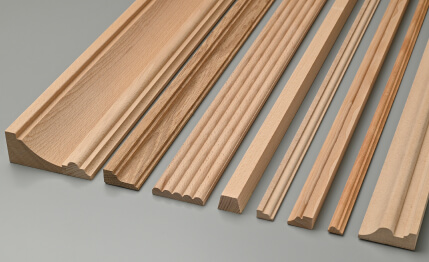
- Wooden cornice: when naturalness matters
- Hidden cornice: a modern technique
- Wooden baguette and paintings next to stucco
- Wooden baguette profile: how to coordinate
- Wooden baguette for mirrors: between furniture and decor
- Baguette rail as a decorative element
- How to connect ceiling stucco with furniture decor
- Furniture legs, handles and supports
- Fittings and decor as the finishing touch
- Wood color and molding color
- Where to apply the 'walls + ceiling + decor' scheme in different rooms
- Mistakes when combining moldings on walls and ceiling
- Too large rosette for a small chandelier
- Active moldings on both walls and ceiling simultaneously
- Cornice does not match the style of moldings
- Baguette stands out from the overall composition
- Furniture decor does not support the style
- Too many different wood textures
- Molding exists separately from furniture and lighting
- Step-by-step scheme for selecting decor for walls and ceiling
- How to select all decor in STAVROS
- FAQ: Answers to Popular Questions


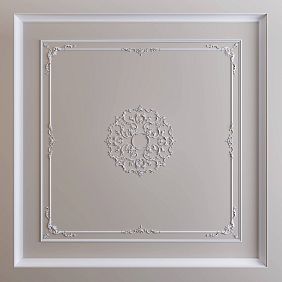

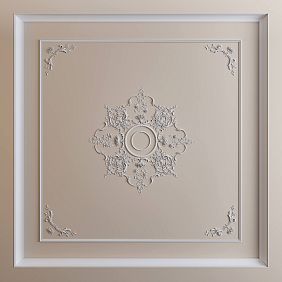
Ceiling and walls — either a system or chaos
There is one sign that unmistakably distinguishes a professionally designed interior from an amateur one. It is not the price of furniture, not the quality of flooring, and not the brand of lighting. It is the consistency of decor on the walls and ceiling.
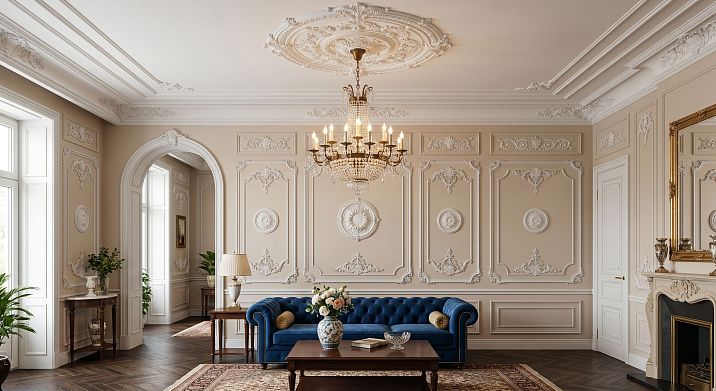
Enter a living room where molding frames on the walls end at the cornice — and above the cornice the ceiling is bare, with only an expensive chandelier hanging in the center without a ceiling rosette. Beautiful? No. Because the lower part of the room is architecturally complete, but the upper part is not. The eye catches on the transition. The interior falls apart horizontally.
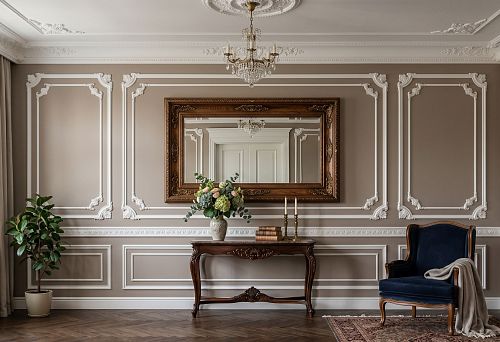
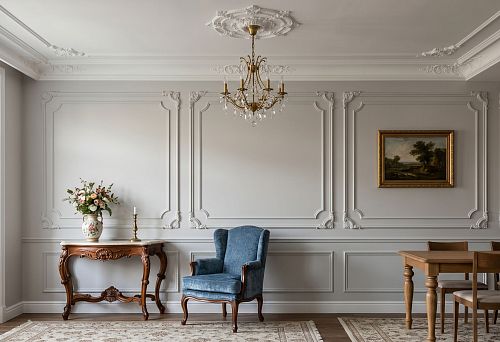
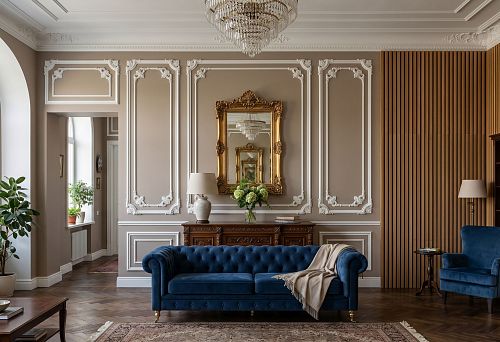
Polyurethane wall decor — this is a powerful tool for working with vertical planes. Moldings, frames, stucco accents, friezes — all of this creates the architectural logic of the walls. But this logic must be continued above. Ceiling stucco under the chandelier, a cornice at the wall-ceiling transition, a properly selected wooden baguette, and decorative furniture elements — this is what turns a set of beautiful details into a unified decorative system.
This article is about how to build this system competently and without mistakes.




Why walls and ceiling cannot be decorated separately
Architecturally, a room is a closed space where six planes (four walls, floor, and ceiling) create an envelope. Any decor on these planes is perceived not in isolation, but as a whole. The human eye constantly moves across all surfaces — and where transitions are sharp and inconsistent, discomfort arises, which is hard to explain in words but is well felt.
Decorative stucco applied only to the walls creates a strong lower tier. The ceiling remains empty and heavy. Visually, it "presses down" on the architecturally expressive walls. The reverse situation: rich ceiling molding in the form of complex stucco rosettes, ornamental fields, and large cornices — while the walls are completely neutral. The ceiling becomes an independent decorative object that "floats" above the space without support. Beautiful in itself, but the room still doesn't feel cohesive.
The principle of consistency does not mean "make everything the same everywhere." It means: choose the main element, define the secondary ones, and establish relationships between them. Stucco decoration for walls and ceilings works as a system precisely when one element dominates, others support, and there is a conscious dialogue between them.
Our factory also produces:


Vertical axis of the interior
There is a concept of the "vertical axis of the interior" — an imaginary line from floor to ceiling that sets the hierarchy of decor. At the bottom — the baseboard. Slightly higher — the lower frame of the molding panel. In the middle of the wall — the main decorative plane. At the top of the wall — the cornice. On the ceiling — the cornice zone and the central accent in the form of a rosette under the chandelier.
When all this is built sequentially, the eye travels along this axis easily, like through a good book. When some element is missing — a void forms that cannot be filled with furniture or color.
Get Consultation
Polyurethane wall decor as the basis of the entire composition
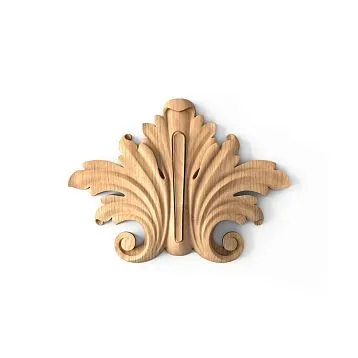
Let's start with what happens on the vertical planes. Polyurethane wall decor — this is not an additional element, but an architectural tool. Moldings create a frame system — it sets the proportions of the wall, divides it into parts, and forms a rhythm. Stucco on the walls creates accents — rosettes, corner overlays, central medallions.
Moldings as an architectural grid of the wall
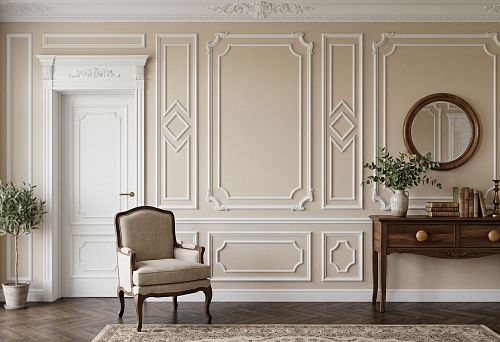
Moldings made of polyurethane — these are profile strips from which rectangular frames, horizontal belts, and vertical posts are built. The molding grid on the wall is visual order. Three identical frames in a row — symmetry, calm, classic. Frames of different scales — dynamics, accent, eye movement.
The most important parameter when selecting moldings is the frame proportion. The optimal width-to-height ratio for vertical wall frames is 1:1.4 to 1:1.8. This is close to the golden ratio and is perceived as harmonious. Frames that are too wide (square) look heavy, while those that are too tall look unstable.
Stucco on walls: where an accent is appropriate
decorative wall molding creates focal points: a central niche above the fireplace, a headboard in the bedroom, a wall between windows, a symmetrical field above the sofa. These points should be consistent in style with what is happening on the ceiling.
A gross mistake is to place a rosette or medallion on the wall, and a laconic cornice without a ceiling accent on the ceiling. Then the rosette on the wall looks like a random detail, not part of the system. A decorative element on the wall should have a "response" on the ceiling — perhaps not as large-scale, but in the same stylistic range.
Painting: polyurethane decor in the tone of the wall
polyurethane decor accepts acrylic and water-based paints without prior priming. This opens up a powerful technique: moldings painted in the same tone as the wall create relief without color noise. The wall surface becomes textured and architectural — but not variegated.
This approach works especially well in neoclassical and modern classical interiors, where stucco is perceived as an architectural rather than a decorative detail.
Stucco under a chandelier: why it is needed and how to choose correctly
A ceiling rosette under a chandelier is perhaps the most underestimated interior element. It goes unnoticed as long as it is there. But remove it, and the chandelier suddenly starts to "dangle" from the ceiling without a base, like a nail in an empty wall.
What is a rosette under a chandelier and why is it needed
Stucco under a chandelier is a decorative ceiling medallion located at the chandelier's mounting point. Historically, it solved two tasks: it concealed technical holes in the ceiling (hook, cable, putty around the installation spot) and visually "accepted" the chandelier into the interior.
In the modern sense, a ceiling rosette does even more. It highlights the center of the room — architecturally, not by color or furniture size, but precisely by decor. In a living room, the center is a place for dialogue: around the sofa, around the coffee table. The rosette above this center fixes it in space. The gaze, moving around the room, always returns to this point.
Rosette size: how to calculate
The diameter of the ceiling stucco under a chandelier is calculated through the chandelier's diameter and the room's area. Approximate formula: rosette diameter = 0.5–0.7 of the chandelier's diameter. For a standard chandelier with a diameter of 80 cm, a rosette of 40–55 cm is the optimal option.
For a room up to 20 sq. m — a rosette of 30–45 cm. From 20 to 35 sq. m — 45–65 cm. Over 35 sq. m — 65–100 cm and above, considering ceiling height.
A rosette that is too small under a large chandelier creates a comical effect. One that is too large creates a heavy, unsettling center on the ceiling. Proportion is everything here.
Rosette style and its connection with wall decor
The design of ceiling stucco should come from the same stylistic family as the wall moldings. This does not mean literal repetition: a classic rosette with acanthus — and moldings with similar leaf plasticity. But in no case — a geometric modernist rosette on the ceiling and baroque ornamental frames on the walls.
Types of stucco for ceiling rosettes are divided into:
-
Round flat — minimal relief, suitable for neoclassicism and modern classic
-
Round with ornamentation — acanthus, leaf scrolls, relief petals — classic, Renaissance, Empire
-
Complex multi-tiered — rich compositions with several ornament rings — formal classic
-
Geometric — rectangular, square, with a laconic profile — neoclassical, Art Deco
The types of ceiling stucco in the STAVROS catalog cover all these categories — from delicate profiles for apartments to formal solutions for country houses.
How to combine ceiling stucco and wall moldings
This is the central question of the topic. And it has several practical answers.
The balancing rule
The richer the wall decor, the calmer the ceiling stucco should be. And vice versa. The ceiling and walls do not compete — they distribute the decorative weight.
If the living room has rich molding frames with applied corner elements and ornamental details — the ceiling rosette should be relatively restrained: one or two decorative rings, an elegant profile without excessive relief. If the walls are laconic — simple frames or even without moldings — the ceiling can take on the decorative load: a multi-tiered rosette, a stucco frieze around the perimeter.
Shape: echoing without copying
Decorative stucco on walls creates certain geometric motifs: rectangular frames, rounded elements, vertical rhythms. The ceiling rosette can "respond" to these motifs without reproducing them literally. Rectangular frames on the walls — a round rosette on the ceiling. This is a classic pair: rectangle and circle, square and ellipse. They do not compete but create visual balance.
Stucco elements in the transition zone — between the wall and ceiling — can be part of the cornice. A cornice with a profile ornament creates a smooth transition from vertical to horizontal.
Neoclassical: strict geometry on all surfaces
The Neoclassic collection for walls features clear rectangular frames, horizontal bands, minimal ornament. For such decor on the ceiling, a geometric rosette is suitable: round with a thin ornamental ring, without pronounced relief. The cornice — with a medium-width profile, without overload.
Versailles Light: classic as the main narrative
The Versailles Light collection on walls suggests rich molding frames with decor for moldings — corner overlays and central accents. On the ceiling, a more expressive rosette is acceptable here: ornamental, with leaf relief, 55–75 cm in diameter for a room of 25–35 sq. m. The cornice — wide, with a profile. The transition is monumental but harmonious.
Neoclassic Light: delicate classic for small apartments
A lightweight option for apartments with ceilings of 2.5–2.8 m. Wall frames with thin molding, minimal ornament. Ceiling rosette — small, 30–40 cm, with an elegant profile. Cornice — narrow, 50–70 mm. Everything works in one palette: delicate, architectural, without Baroque heaviness.
Cornice: the transition that changes everything
Ceiling cornice is an element that most people underestimate or completely ignore. "Why do I need it? I have a stretch ceiling." That's exactly why.
A stretch ceiling without a cornice is a sharp transition from a vertical wall to a horizontal film. The eye stumbles over this transition. The cornice hides this joint and creates a smooth, architectural transition between the two planes.
Polyurethane cornice: lightness and precision of profile
Polyurethane cornices and moldings are mounted with liquid nails, do not require a wooden lathing, and weigh significantly less than gypsum counterparts. This is practical for apartments where ceiling slabs are not designed for additional load.
A cornice 70–100 mm wide is suitable for most apartments with ceilings of 2.5–2.8 m. For country houses with ceilings of 3.0–3.5 m — 100–150 mm. In formal rooms with a height of 3.5 m and above, a cornice of 150–200 mm creates a monumental transition.
Wooden cornice: when naturalness matters
A wooden cornice is appropriate where there are enough wooden elements in the interior: wooden doors, solid wood furniture, wooden baseboard, wooden baguette. In such a space, a wooden cornice becomes an organic completion of the wooden system along the upper perimeter of the room.
A wooden cornice requires precise installation in corners — mismatches in the cutting angle of wood are harder to mask than with polyurethane. Therefore, it is more often used in straight, regular rooms without non-standard angles. In other cases — a polyurethane analog with the same profile plasticity.
Hidden cornice: a modern technique
In modern classic interiors, a hidden cornice is often used — a niche from which light directed at the ceiling emerges. This creates a soft glow around the perimeter of the ceiling and visually lifts it. From above, such a niche can be complemented with a thin polyurethane molding — it will create a decorative edge without a heavy cornice profile.
Wooden frame and paintings next to stucco
When walls are decorated with molding frames, paintings and mirrors in wooden frames become part of this framing system. The task is not to disrupt it with a randomly chosen profile.
Wooden frame profile: how to coordinate
The wooden frame for paintings should be stylistically close to the moldings on the walls. This does not mean identical — it means 'from the same era'. If the moldings the Neoclassic collection are strict rectangular profiles — a wooden frame with a simple chamfer or stepped profile will be appropriate. If the wall moldings have ornamentation in the classic style — the wooden frame can be more decorative: with a relief pattern, patination, or tinting.
It is better to buy wooden frames for several paintings in one room from the same series: unity of profile creates unity of perception. Different profiles for each painting — even if they are all 'classic' — create chaos.
Wooden frame for mirrors: between furniture and decor
A mirror in a wooden frame on the wall is an object on the border of two systems: wall decor and furniture environment. Its profile should 'befriend' both the moldings and the furniture. If the furniture has light wooden details in a neutral tone — the wooden frame in the same tone. If the furniture has gilded details — a wooden frame with fine gilding or patina.
A wooden picture frame baguette next to active stucco on walls is best chosen delicately: a narrow profile, a neutral tone. Let the painting "live" in the space of the frames, without being pushed out of it.
Baguette strip as a decorative element
A baguette strip is not only material for frames. A thin wooden strip can be used as a horizontal belt above a console or chest of drawers — a "picture baseboard" at a height of 160–180 cm. Pictures are hung on it without nails, changing the arrangement as desired. This is an elegant functional technique that also creates an additional horizontal line on the wall — a visual reference for furniture.
How to connect ceiling stucco with furniture decor
An interior becomes cohesive when the plasticity of the decor on the walls and ceiling is "reflected" in the furniture. This is not direct imitation — it is stylistic kinship.
Furniture legs, handles, and supports
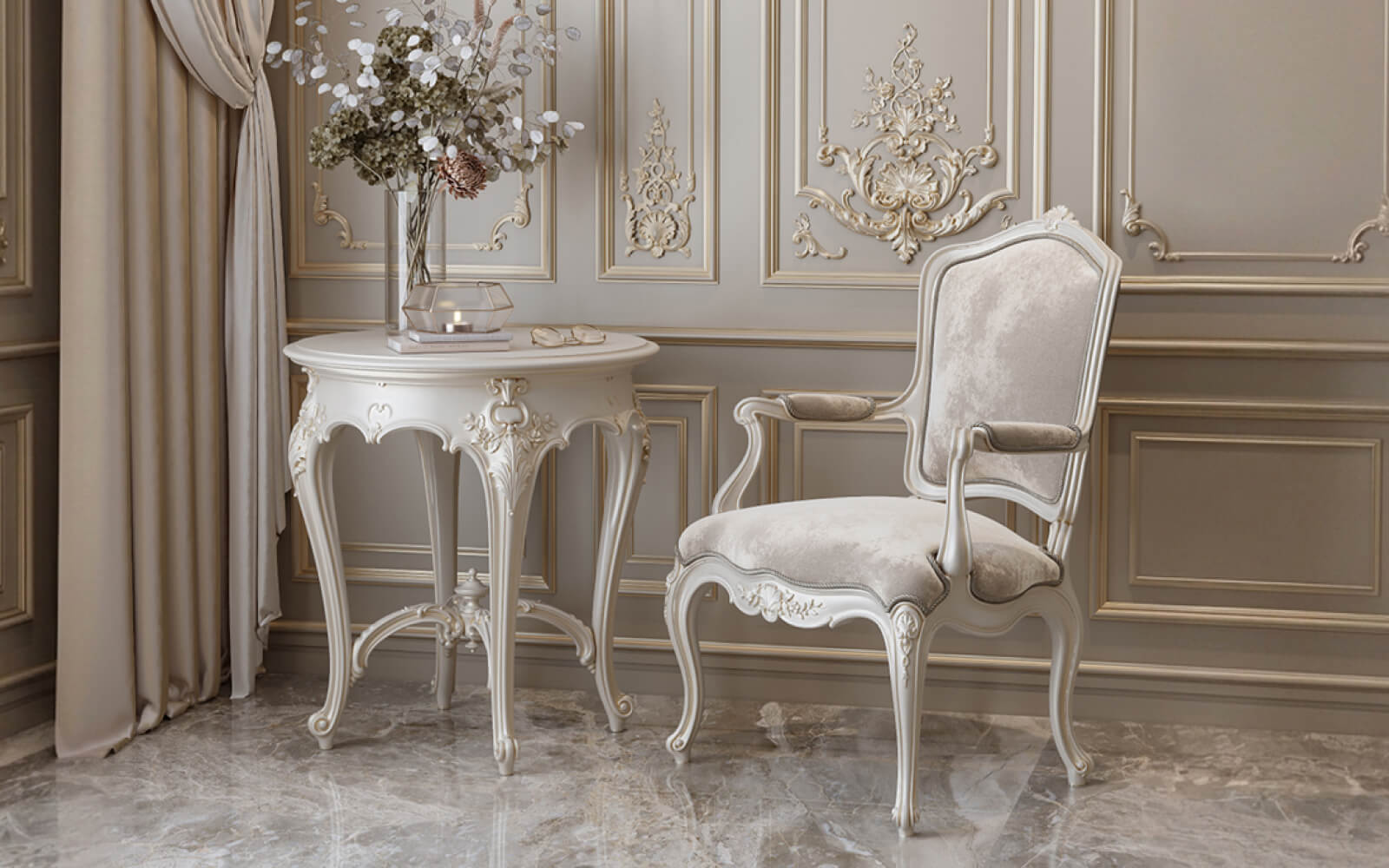
If the living room has classic stucco under a chandelier with an acanthus leaf ornament and molding frames in the same spirit — vase-shaped furniture legs will create a visual rhyme. Rounded, elongated leg shapes echo the rounded elements of the stucco decor.
Wooden furniture legs, decorative furniture supports, wooden handles — all these are details that are chosen not at the last moment, but as part of the overall concept. Furniture decor in a classic interior should be consistent with the character of the stucco and moldings — in style, plasticity, and tone.
decorative elements for furniture Made of polyurethane — overlays, corner elements, central medallions — allow transferring the plasticity of wall decor to furniture facades. An overlay on a cabinet door with the same profile as the corner element in a molding frame on the wall is a powerful technique that creates a sense of unity without intrusive sameness.
Fittings and decor as the final touch
Decorative hardware — handles, hinges, overlays — in a classic interior should match the tone of the wooden decor or metal accents of the room. A brass wooden handle in a room with gold-beige stucco and a warm wooden cornice is a deliberate choice, not a coincidence.
Furniture decoration is a process that completes the interior. It does not start it. First comes the architecture of walls and ceiling: Polyurethane moldings, moldings, cornice, rosette. Then comes furniture, its shape and color. And only at the end — hardware, handles, legs, supports. It is in this hierarchy that an interior that looks like a cohesive whole is built.
Wood color and stucco color
An important nuance that is often overlooked: if the stucco is painted in ivory or cream, the wooden decor of the furniture and the wooden cornice should be in a warm tone. Cold white wood next to cream stucco creates tension. Warm wood — walnut, oak with warm tinting, beech — fits organically in this palette.
If the stucco is pure white, the wood can be neutral: natural light ash, bleached oak. In such a room, the contrast of white stucco and light wood creates a Scandinavian version of classic — fresh and modern.
Where to apply the 'walls + ceiling + decor' scheme in different rooms
| Room | Ceiling | Walls | Additional decor |
|---|---|---|---|
| Living room | Rosette under the chandelier, cornice | Neoclassical molding frames or Versailles Light | Wooden baguette, furniture supports, decorative legs |
| Dining room | Ceiling molding around the chandelier | Symmetrical frames, horizontal belt | Wooden cornice, wooden baguette, baseboard |
| Bedroom | Plain rosette, narrow cornice | Neoclassic Light, accent at the headboard | Drawer handles, bed legs, mirror in wooden baguette |
| Hall | Cornice, ceiling rosette | Vertical moldings | Mirror in wooden baguette, decorative overlays |
| Office | Strict cornice without ornament | Panels, moldings | Dark wooden cornice, wooden baguette, furniture parts |
| Spa bathroom | Light cornice, without rosette | Thin frames, moisture-resistant decor | Wooden accessories, mirror in a laconic baguette |
Mistakes when combining moldings on walls and ceiling
This is not theory — it's practice. Each of the listed mistakes occurs in real interiors.
Too large rosette under a small chandelier
A rosette with a diameter of 80 cm and a chandelier with a diameter of 40 cm is a visual imbalance. The rosette 'swallows' the chandelier, it seems lost in a large medallion. The design of the molding under the chandelier should match its scale.
Active molding on both walls and ceiling simultaneously
Rich molded frames with ornamental overlays Versailles Light collections on the walls — and a complex multi-tiered rosette with a frieze along the ceiling perimeter. Result: decorative overload that creates a sense of anxiety. One thing should be dominant.
The cornice does not match the style of the moldings
Classic moldings with ornament — and a straightforward geometric cornice. This is eclecticism without a concept. The cornice should be chosen from the same style family as the moldings: if the moldings have a leaf relief, the cornice can also have a light plant motif in its profile.
The baguette stands out from the overall composition
A wooden baguette with gold patina next to strict white moldings Neoclassic Light — this is a style conflict. Gold in light neoclassicism works only in doses: a thin rim, delicate presence. A massive gilded baguette draws all the attention to itself.
Furniture decor does not support the style
Classic stucco on walls and ceiling — and modern furniture without any decor, with matte black metal. This is not 'modern classic', this is a style gap. Decorating furniture in a classic interior is not an option, but a necessity. At least a few details: handles, legs, a mirror in a suitable baguette.
Too many different wood textures
A dark oak wooden cornice, a light pine wooden baguette, reddish beech wooden legs — three different woods in one room with no logic. Maximum two wood tones: main and accent.
Stucco molding exists separately from furniture and lighting.
You can install all the right elements: moldings, rosette, cornice — and still feel that the stucco "doesn't belong." This happens when furniture and lighting don't support the decor style. A high-tech chandelier against classic stucco underneath is a visual oxymoron that doesn't work.
Step-by-step guide for selecting wall and ceiling decor
Many find it hard to start. Here's a specific sequence of actions.
Step 1. Determine the interior style and ceiling height. These are primary parameters that determine the scale of all decor.
Step 2. Choose a wall decor collection. Start with the visual: which style is closer — strict geometry or ornamental classic?
Step 3. Select a ceiling rosette for the chandelier. Calculate the diameter — 0.5–0.7 of the chandelier's diameter. Choose a style in the same family as the wall moldings.
Step 4. Choose the cornice. Width — based on ceiling height. Profile — consistent with moldings. Material — polyurethane or wood, depending on the concept.
Step 5. Select a wooden baguette for paintings and mirrors. Profile — similar to moldings. Tone — in the range of wooden furniture details.
Step 6. Select furniture decor — legs, handles, supports, overlays. Based on the style and tone of the stucco and moldings.
Step 7. Coordinate the color of all elements — walls, moldings, cornice, rosette, wood. One or two wood tones, a single tone for the stucco.
Technical installation details — in the article about installing polyurethane moldings: clean corners, hidden joints, painting rules. Working with ceiling stucco — in practical guide to installing polyurethane stucco.
How to choose all decor in STAVROS
STAVROS produces polyurethane decor from European raw materials with a density of 150–420 kg/m³. Precise profile detailing, stable dimensions, excellent adhesion to paints — these are not just words, but characteristics verified in practice.
To solve the "walls + ceiling + cornice + furniture" task, the STAVROS catalog has everything:
-
Polyurethane wall decor — 15 collections for classic, neoclassical, and modern interiors
-
moldings, cornices, and baseboards — a wide selection of profiles for any room format
-
Polyurethane moldings — ceiling rosettes, friezes, transition elements, corner pieces
-
Decor for Molding — corner and center overlays to enhance frame decor
-
decorative elements for furniture — to transfer wall style code to furniture facades
STAVROS is a manufacturer that understands the logic of interior design. Not just products, but a system. Not just molding, but part of a room's architecture. That's why STAVROS works with designers, architects, and private clients who want a result, not just to buy parts.
Delivery across all of Russia. In-house production. Free consultation on selecting decor for a specific project.
FAQ: Answers to popular questions
Can you combine polyurethane wall decor with a chandelier ceiling rosette?
Yes, this is exactly the combination that creates a classic, finished interior. Wall decor shapes the vertical planes, the chandelier rosette shapes the ceiling. The key is consistency in style and scale.
How to choose a chandelier ceiling rosette?
Calculate the diameter: 0.5–0.7 of the chandelier's diameter. Determine the style: the rosette should belong to the same stylistic family as the wall moldings. For neoclassicism — geometric with a light ornament. For classicism — ornamental with a leaf relief.
Is a cornice needed between the wall and ceiling?
Highly recommended — especially where there are molding frames and ceiling stucco. The cornice creates a smooth transition, hides technical joints, and completes the top line of the wall.
Can wooden baguette be used next to polyurethane stucco molding?
Yes. Wood and polyurethane occupy different niches: polyurethane is lightweight architectural decor on walls and ceilings, wooden baguette is for framing paintings and mirrors, wooden furniture details. They complement each other if coordinated in style and tone.
What is more important: wall stucco or the chandelier rosette?
They perform different tasks. Wall decor creates the architecture of vertical planes. A ceiling rosette fixes the center of the room and completes the ceiling. Remove one, and the system loses part of its strength. Ideally, both elements work together.
How to avoid overloading the interior with decor?
Follow the balancing principle: active walls — calm ceiling, and vice versa. Never apply maximum decor on all surfaces simultaneously. Determine the dominant element — and let the others support it, not compete with it.
Which collection to choose for a small apartment?
For apartments with a ceiling height of 2.5–2.7 m, the optimal collection is Neoclassic Light: delicate frames, light profile, without baroque heaviness. The ceiling rosette is small, the cornice is narrow. The interior becomes architectural but not overloaded.