Article Contents:
- What is a baluster and why are newel posts needed?
- Baluster: vertical base of safety
- Newel post: support and accent
- From what beauty is born: choosing wood species
- Oak: monumentality of centuries
- Beech: warm strength
- Ash: elastic strength
- Birch: accessible elegance
- Technologies of creation: from log to masterpiece
- Turning: classic lathe work
- Carving: when a baluster becomes a sculpture
- Flat balusters: Slavic tradition
- Styles: language of forms
- Classicism: Strict Harmony
- Baroque: opulence of forms
- Modern: natural lines
- Modern Minimalism: Purity of Lines
- Newel posts: supports on which beauty rests
- Support newel post: beginning of the staircase
- Turning newel post: change of direction
- Final newel post: final chord
- Installation: where reliability is born
- Preparation: precision — foundation
- Mounting methods
- Handrail Installation
- Finishing: from natural to artistic
- Transparent finishes: beauty of wood
- Staining: new color, preserved texture
- Painting: covering paints
- Coordination with other elements
- Balusters and handrails
- Balusters and treads
- Balusters and other interior details
- Practical questions: what is important to know
- How many balusters are needed?
- Can it be installed by yourself?
- How to care for it?
- What to do in case of damage?
- Questions and Answers: The Essentials
- Conclusion: The Supports on Which the House Stands

Staircase. At first glance — merely a functional structure connecting floors. But look closer. Every staircase tells a story. About the taste of its owners. About their understanding of architecture. About how seriously they treat details. And the main storytellers of this story —Balusters and Posts for Staircases. Vertical posts supporting the handrail. Elements that could have been made extremely simple — straight metal tubes. But no. Masters transform them into works of art.
Why? Because a staircase is not just a path upward. It’s the first thing visitors see upon entering the house. It’s an element passed by dozens of times daily. It’s a structure that must be safe, strong, and yet beautiful. And the beauty of a staircase — above all — is the beauty of its balusters. Polished, carved, minimalist, or ornate — they define the character of the entire structure.
Wood plays the main role here. Metal is cold and rational. Glass is modern and transparent. But only wood carries warmth, history, a connection to nature. A wooden baluster — it’s not just a support for the handrail. It’s a piece of forest, transformed by skilled hands into an architectural element. It preserves the memory of the tree — its texture, the pattern of growth rings, its ability to breathe alongside the house.




What is a baluster and why are posts needed?
Let’s start with definitions. Not because it’s boring, but because understanding terminology helps properly design a staircase.




Baluster: vertical safety base
A baluster is a vertical post supporting the handrail. There are many — usually one or two per step, sometimes more. Together they form a railing that performs three functions.
The first — safety. Without balusters, a staircase is simply a row of steps in the void. Dangerous, especially for children, elderly people, or in darkness. Balusters create a physical barrier preventing falls. Building codes regulate their spacing — no more than 10-15 centimeters between axes, so a child cannot squeeze between them.
The second — structural rigidity. The handrail alone is not strong enough — it can be bent or shifted. Balusters turn it into a rigid structure capable of withstanding significant lateral loads. A person can lean their full weight or grab during a fall — balusters will withstand it, distributing the load onto the steps.
The third — aesthetics. And this is no less important than the first two. Balusters define the visual character of the staircase. Elegant, polished ones create lightness and airiness. Heavy, carved ones — monumentality and solidity. Simple rectangular ones — modern austerity.
Our factory also produces:



Post: support and accent
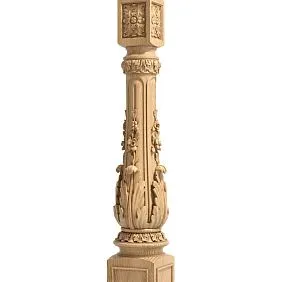
A post is an enlarged baluster installed at key points of the staircase. At the start of the run, at the end, at turns. A post is significantly thicker than a baluster — if a baluster is 40-60 millimeters in diameter, then a post is 80-120 millimeters.
Structurally, a post is the main support. It bears the main loads. The handrail is attached to the posts, and balusters between them create the filling. If balusters can be compared to soldiers in formation, then posts — are officers around whom the formation is built.
Aesthetically, a post is an accent. A point that attracts attention. Posts are often more decorated than balusters. They can be adorned with carvings, finished with decorative caps — spheres, pikes, ornamental elements. A post at the beginning of the staircase — it’s a business card, a statement of the style of the entire structure.
Get Consultation
How beauty is born: choice of species
Not every wood is suitable for balusters. Special qualities are needed — strength, stability, ability to retain shape for decades. And, of course, beauty.
Oak: monumentality of centuries
When thinking about reliability, oak is the first species that comes to mind. Oak — king among trees. Density 700-800 kilograms per cubic meter. Hardness by Brinell 3.7-4.0. This means exceptional strength, resistance to mechanical damage, scratches, impacts.
Oak balusters serve for centuries. Literally. In old estates, palaces, castles — where original staircases from the 18th-19th centuries have been preserved — balusters are often oak. They darken over time, acquiring a noble patina of antiquity, but do not lose strength.
Oak’s texture is expressive. On radial cuts, characteristic silver stripes — medullary rays — are visible. On tangential cuts — clear annual rings. Color varies from light honey-colored in young oak to dark brown in seasoned oak. Oak that has been submerged for decades has a unique gray-black hue.
Oak is easy to turn and cut, though it requires a sharp tool and the skill of a master. Details come out sharp, edges — crisp. An oak baluster with carving retains every minute detail of the ornament for decades without fading.
Oak’s stability is legendary. Its wood reacts less to humidity changes than other woods. Oak balusters do not crack, warp, and maintain geometry even under significant microclimate fluctuations. For staircases where constant loads act on the structure, this is critically important.
Beech: warm strength
Beech is often underestimated, overshadowed by oak. But connoisseurs value it for its unique qualities. In terms of density, beech does not fall short of oak, sometimes even exceeds it — up to 720 kilograms per cubic meter. Hardness is comparable. But there are differences.
Beech’s structure is uniform. There are no sharp transitions between early and late wood, as in oak. This creates a smooth, calm texture. Beech balusters look elegant, without excessive ornamentation.
Beech’s color — pink-beige, warm, cozy. It is ideal for interiors where a light palette without cold tones is needed. Beech accepts staining beautifully — from bleached wood to dark wenge, while preserving the visibility of the texture.
Beech wood is more elastic than oak. This is important for elements subjected to dynamic loads. A baluster may slightly bend under load and return to its original state without cracking. Oak is stiffer and less flexible.
Beech turns out exceptionally well. On a lathe, it produces balusters with a perfectly smooth surface, smooth transitions, and clear details. Carving on beech is also expressive, though it requires a sharp tool.
Ash: elastic strength
Ash is a species that deserves greater recognition. In terms of mechanical properties, it surpasses oak. Ash has 15-20% higher bending strength. Its elasticity is exceptional. It’s no wonder ash is used for sports equipment and tool handles — where flexibility and the ability to bend without breaking are required.
For balusters, this means reliability. An ash baluster withstands impact and load without cracking or breaking. This is especially valuable for staircases in homes with children — active, energetic, and not always careful.
Ash’s texture resembles oak but is lighter and softer in contrast. Clear annual rings create an expressive pattern, but not as sharp. Color ranges from light gray to light brown. Ash lightens well and takes light tones, which is suitable for Scandinavian and modern interiors.
Ash is easy to work with. Turning, milling, and carving all yield clear results. The surface is smooth and pleasant to the touch. Ash balusters do not require prolonged sanding — the wood is naturally smooth.
Birch: accessible elegance
Birch is a species unfairly considered inferior. Yes, it is softer than oak. Its density is 600-650 kg/m³, and hardness is lower. But for balusters that do not experience extreme loads, birch is quite sufficient.
Birch wood is light, almost white, with a slight yellow or pinkish tint. The texture is unobtrusive and uniform. This makes it an ideal base for painting. Birch balusters are often coated with enamel — white, black, or colored. The wood holds paint exceptionally well, does not bleed through, and does not create stains.
Birch turns and cuts well. The tool does not dull quickly, and work proceeds rapidly. Complex profiles and numerous details can be created. Birch balusters appear elegant and light.
Birch is significantly cheaper than oak or ash. This allows creating beautiful staircases within a limited budget. With proper processing and finishing, birch balusters can last for decades.
Manufacturing technologies: from log to masterpiece
A baluster does not grow on a tree ready-made. The path from trunk to elegant baluster is long, requiring skill, precise equipment, and understanding of the material.
Turning: the classic lathe technique
Most balusters are turned. This means they are made on a lathe. The blank — square or octagonal stock — is secured in the lathe, rotated, and the tool removes excess wood, forming a cylindrical shape with various swellings, shoulders, and grooves.
Turning is an art requiring experience. The master guides the tool, feeling the wood, controlling the cut depth, and monitoring symmetry. The slightest mistake — and the baluster will be curved, asymmetrical, and defective.
Modern CNC machines automate the process. The program sets the tool’s path, and the machine executes it precisely. This ensures identical balusters — all are absolutely identical. For staircases where 30-50-100 balusters may be installed, uniformity is critical.
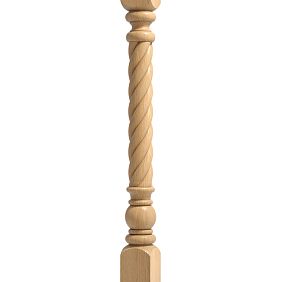
Turned balusters can be simple — cylindrical with minimal details — or complex, with numerous elements. A classic turned baluster includes a base (swelling at the bottom), body (central part with alternating swellings and shoulders), and neck (upper thin section). Each element carries both function and aesthetic meaning.
Carving: when a baluster becomes a sculpture
Carved balusters are the next level. Here, lathe work is supplemented or replaced by carving — manual or machine. Carving allows creating shapes impossible on a lathe. Non-circular cross-sections, complex, asymmetrical forms. Ornaments, reliefs, figures.
Manual carving is the domain of highly skilled masters. The carver works with a set of chisels, gradually removing wood and shaping volume. It is slow, labor-intensive, and requires talent. Yet the result is unique — each baluster is slightly different, bearing the mark of the master’s hand.
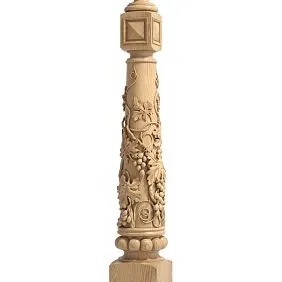
Machine carving uses CNC milling machines. A 3D model of the baluster is loaded into the program, and the multi-axis controlled machine reproduces it in wood. Precision is extremely high, and detail is fantastic. It is possible to create balusters with the most intricate ornaments — acanthus leaves, grapevines, geometric patterns.
Carved balusters are characteristic of historical styles — Baroque, Rococo, Classicism. They transform a staircase into a work of art, demonstrating the owner’s taste and status. Suchbuy wooden balusters for the staircasemeans investing in beauty.
Flat balusters: Slavic tradition
A separate category —Flat balustersThey are not round in cross-section but rectangular or shaped. They are cut from boards and decorated with open or blind carving. This is a Slavic architectural tradition, where flat balusters adorned the porches of wooden houses and balconies of cottages.
Flat balusters are made on milling machines or hand-cut. The ornament can be simple — geometric — or complex — plant-based, with symbolic imagery. Open carving creates a lace-like effect, and the baluster resembles lace.
In modern interiors, flat balusters are used less frequently, but where one wishes to emphasize a connection to tradition and roots, they are indispensable. Especially in wooden houses, where flat carved balusters fit organically into the concept.
Styles: the language of forms
A baluster is not an abstract element. It speaks the language of architectural styles, and this language must be understood.
Classicism: strict harmony
Classical balusters are symmetry, proportions, repetition of forms. Base, body, neck are maintained in strict proportion. Ornament is minimal or absent. The main thing — purity of lines, smooth transitions.
Neoclassicism values not ornamentation, but perfection of form. A baluster may be extremely simple — a cylinder with slight thickening in the middle — but proportions will be ideal. Or slightly more complex — with grooves, bosses — but everything is subordinate to logic, rhythm, mathematical harmony.
Classical balusters are universal. They suit any interior, do not conflict with furniture or decor. This is a safe choice for those who do not want to risk or experiment, but want to achieve an elegant result.
Baroque: abundance of forms
Baroque baluster — the opposite of classical restraint. Here, abundance of decoration, complexity of forms, desire to impress, astonish. The baluster transforms into sculpture, where every centimeter is covered with ornament.
Acanthus leaves, volutes, shells, mascarons — all of this is present in a baroque baluster. Forms curve, twist, creating dynamism. There are no flat surfaces — everything is relief, volumetric, alive in the play of light and shadow.
Baroque balusters require space. In a small house, they will be excessive, overload the interior. But in a spacious country mansion, where ceilings are high, rooms are large, a baroque staircase with ornate balusters becomes a central element, demonstrating luxury and taste.
Modern: natural lines
Modernist baluster rejects classical symmetry. Forms become asymmetrical, smooth, flowing. Straight lines are replaced by curves that mimic natural forms — plant stems, waves, flames.
Modern ornament — stylized flowers, leaves, insects. Irises, lilies, dragonflies, butterflies. Everything is depicted not realistically, but generalized, decorative. Lines flow into one another, creating a continuous pattern.
Modern requires special craftsmanship. Forms are complex, non-trivial, difficult to manufacture. But the result is unique — a staircase with modern balusters does not resemble any other.
Modern Minimalism: Clean Lines
Modern baluster — maximum simplicity. Often it is simply a rectangular block, without turning, without decoration. Or a cylinder of minimal diameter. Or simply a metal rod.
But even a wooden baluster in a modern style retains the advantages of wood — warmth, tactile quality, naturalness. A simple rectangular baluster made ofoak solid woodwith an open texture looks modern, but not cold.
Minimalism requires flawless finish. When there is no decoration to distract attention, every detail is visible — quality of sanding, precision of geometry, smoothness of surface. Errors are unacceptable.
Posts: supports on which beauty rests
If balusters are rhythm, then posts are accents. They are larger, heavier, often more decorated.
Support post: beginning of the staircase
The post at the beginning of the staircase — it is a statement. The first thing a person sees when ascending or descending. It must be imposing, beautiful, matching the overall concept.
Support post is usually the most massive — 100-120 millimeters in cross-section. It is deeply anchored to the floor, sometimes reinforced with a metal pin passing through the entire post and extending into the floor by 15-20 centimeters. This ensures absolute stability.
Decor of the support post may be complex. Carving, fluting, applied elements. The top of the post is often crowned with a ball, spike, vase — an element that attracts attention. In classical interiors, a ball symbolizes completion, perfection. In modern interiors, it may be replaced by an abstract form.
Turning post: change of direction
On staircase landings, at places where the staircase turns, turning posts are installed. They may be slightly thinner than support posts — 80-100 millimeters — but still significantly heavier than balusters.
Turning post performs a structural function — it changes the direction of the handrail. Technically, this is a complex joint requiring precise fitting. The handrail must smoothly transition from one direction to another, without sharp angles or steps.
Decor of the turning post usually corresponds to the support post, but may be slightly simpler. Visual connection is important — posts should look like a family, belonging to the same style.
Finishing post: final chord
At the end of the staircase, on the upper landing, a finishing post is often installed. It may be similar to the support post or differ — for example, be taller, have a more complex capital.
Finishing post creates symmetry. The staircase begins with a post and ends with it. This creates visual completeness, framing the composition. Especially effective in grand staircases, where solemnity is important.
Installation: where reliability is born
Buying beautiful balusters — half the job. The other half — installing them correctly, so the staircase is safe and serves for decades.
Preparation: accuracy — the foundation
Before installing balusters, the staircase must be prepared. Steps are securely fastened, the surface is flat, without unevenness. Each step is checked with a level — horizontal alignment is critical.
Balusters must acclimate before installation. Wood must adjust to the room's humidity and temperature. If installed immediately after delivery from a cold warehouse, they may deform — shrink or, conversely, swell.
Marking is a key stage. On the steps, locations for baluster installation are marked. The distance between baluster centers is usually 100–150 millimeters — this ensures safety and rhythm. Marking must be identical on all steps so that balusters align in a straight line.
Methods of mounting
There are several methods, each with its own advantages.
Installation with dowels — a classic method. A hole is drilled in the end of the baluster, into which a wooden dowel — a round rod — is inserted. On the step, a corresponding hole is drilled at the marked location. The baluster is mounted onto the dowel using glue. This method ensures strength, invisibility of fasteners, and the possibility of disassembly if needed.
Installation with screws — a modern method. A hole is drilled in the end of the baluster for the screw, and the baluster is screwed onto the step from below or at an angle. The screw head is countersunk, and the hole is sealed with a wooden plug or cap. This method is fast, reliable, but requires precision — the screw must enter strictly along the baluster’s axis.
Installation on a bolt — for heavy posts. A metal bolt — a threaded rod — is screwed into the end of the post, passes through the step, and is tightened from below with a nut. This ensures maximum strength but requires access to the underside of the step.
Handrail installation
After installing balusters, the handrail is mounted. It is laid onto the top ends of the balusters, which are previously cut at the required angle. The angle depends on the staircase’s steepness — usually 30–45 degrees.
The handrail is fastened to each baluster with a screw from above. The screw head is countersunk, and the hole is filled with wood putty or sealed with a cap. An alternative method — mounting from below, through the baluster into the handrail. More complex, but the fastening is completely invisible.
At joints — at turns, where straight sections meet — the handrail is cut at the required angle. The joint is glued and reinforced with a dowel or biscuit. A properly executed joint is almost invisible, making the staircase appear monolithic.
Finishing: from natural to artistic
Balusters can be left natural or transformed into decorative elements. The choice depends on interior style, wood species, and personal preferences.
Transparent finishes: the beauty of wood
Lacquer, oil, wax — finishes that protect wood without hiding its texture. Instead, they emphasize the grain pattern, deepening the color.
Oil absorbs into the wood, creating protection from within. Balusters treated with oil look natural, with a matte, velvety surface that feels pleasant to the touch. Oil allows wood to breathe and regulate humidity. For solid wood, this is important — wood remains alive.staircase componentsIt's important to note that from the array — the tree remains alive.
Lacquer creates a film on the surface. Modern water-based lacquers are safe, odorless, and dry quickly. They can be matte, satin, or glossy. Matte preserves the natural look, glossy highlights the texture and creates a shine. Lacquer lasts longer than oil — 5–7 years without renewal.
Wax is applied over oil, providing additional protection and a silky finish. Wax-treated balusters have a pleasant scent and create a sense of warmth and naturalness.
Staining: new color, preserved texture
Stains allow you to change the color of wood while keeping the texture visible. You can turn light beech into dark walnut, give oak a gray tone, or create a whitewashed wood effect.
Staining opens up possibilities. Balusters can be matched exactly to the floor’s color — parquet, solid planks. Or they can be contrasting — dark balusters against light steps, light ones against dark. Contrast emphasizes shape, making balusters more noticeable.
The staining process begins with sanding — this opens the pores. Stain is applied along the grain with even strokes. It’s important to work quickly without stopping — otherwise, spots will form. After drying, the surface is coated with lacquer or oil for protection.
Painting: covering paints
Sometimes the texture needs to be hidden — when a uniform color is desired, when the wood has defects, when the concept requires painted surfaces. In such cases, acrylic enamels are used.
White balusters — classic, never going out of style. They expand space, making the staircase lighter and airier. White is universal — it matches any step or wall color. In Scandinavian and Provencal interiors, white balusters are a mandatory element.
Black balusters — a bold choice. They create a graphic effect, contrast with light steps, and emphasize the staircase’s architecture. Black is elegant, strict, and modern.
Colored balusters — for experimenters. Dark blue, emerald, burgundy — balusters can become color accents supporting the interior palette.
Combining with other elements
Balusters do not live in isolation. They are part of the system of wooden interior elements.
Balusters and handrails
The handrail must match the balusters in species, style, and finish. If the balusters are oak, the handrail should also be oak. If the balusters are stained dark, the handrail should match that tone.
The shape of the handrail is also important. Classic balusters require a classic handrail — with smooth curves and a thoughtfully designed profile. Modern minimalist balusters look great with a simple rectangular or round handrail.
Newels and treads can be made of the same wood or contrast. Oak treads and oak newels — harmony, unity. Light beech treads and dark walnut newels — contrast, expressiveness.
For the stairwell space, newels should be made of the same wood — this creates a visual connection between elements.
buy wooden skirting boardNewels and other interior details
All wooden elements must harmonize. It’s not necessary for colors to match exactly, but tones should be within the same palette. Then the interior looks thoughtfully designed and cohesive.
Furniture legs, Buy decorative elements, wooden planks on the wallAll wooden elements should harmonize. It's not necessary for the colors to match exactly, but the tones should be within the same color range. Then the interior appears thoughtfully designed and cohesive.
Practical questions: what to know
How many newels do you need?
It depends on the length of the staircase and the chosen spacing. Standardly — one to two newels per tread. If there are 15 treads, you’ll need 15–30 newels plus 2–4 posts. Precise calculation is done during the design phase.
Can it be installed by yourself?
Yes, if you have the tools and skills. You’ll need a drill for making holes for dowels or screws. A miter saw for trimming newels and handrails at an angle. A level to check vertical alignment. And hands that come from the right place.
But installing newels is a job where mistakes cost dearly. A poorly installed newel may break under load, creating a hazard. If you’re unsure — it’s better to hire a professional.
How to care for it?
Wooden newels require minimal maintenance. Wipe with a dry cloth to remove dust once a week. Every few months — with a damp, well-wrung cloth. No abrasives or aggressive chemicals.
The handrail wears from use — this is natural. Every few years, it can be refreshed — lightly sand it with fine-grit sandpaper, then reapply oil or varnish. This will restore its original appearance.
What to do if damaged?
Minor scratches on newels are sanded down, and the area is touched up. Deep chips are filled with wood putty, sanded, and toned. If a newel breaks — it’s easier to replace it entirely. Fortunately, they are installed individually, so replacing one doesn’t require dismantling the entire structure.
Questions and answers: briefly on the main points
Which wood is better for newels?
Oak — if maximum strength and longevity are needed. Beech — if a warm, light texture is important. Ash — if elasticity is required. Birch — if budget is limited, but quality matters.
How much do newels cost?
It depends on the wood species, processing complexity, and size. Simple turned birch newels — from 500 rubles each. Complex carved oak newels — up to 5000–10000 rubles.Wooden balusters priceIt depends on many factors.
Can newels be made to order according to your sketch?
Yes, manufacturers with CNC lathes and milling machines can produce newels of any shape. You’ll need a 3D model or clear drawing. Cost will be higher than for mass-produced items, but the result will be unique.
What distance should be between balusters?
According to building codes — no more than 100–150 millimeters between axes, so a child cannot squeeze through. For safety, this is critical.
Do balusters need protective treatments?
Absolutely. Even indoors, wood needs protection from moisture, dirt, and wear. Minimum — varnish or oil. For outdoor staircases — special formulations with UV protection and antiseptics.
How to choose the style of newels?
Align with the house’s style. Classic interior — classic newels. Modern — minimalist. Rural wooden house — carved or flat in folk style. The key — harmony with surroundings.
Newels only for staircases?
No. They are used in balcony, terrace, and porch railings.balusters for terraceThey are made from wood species more resistant to moisture and treated with special compounds.
Which matters more — beauty or strength?
Both qualities are equally important. Beautiful but fragile balusters are dangerous. Strong but unattractive ones spoil the interior. Good balusters combine both qualities.
Conclusion: the supports on which the house stands
The staircase is more than just a way to get to the second floor. It is an architectural element that defines the character of the house. It is the first impression of the interior. It is a structure that is passed by daily, which must be safe, convenient, and beautiful.
And the beauty of the staircase is primarilyBalusters and Posts for StaircasesVertical posts, transformed by craftsmanship into works of art. They support the handrails, ensure safety, create rhythm, and define style.
Choosing balusters is choosing between functionality and aesthetics. Although in reality there is no choice — both qualities are needed. Strong, reliable balusters made of quality wood, installed correctly, will serve for decades. Beautiful, matching the interior style, will delight the eye every day.
Company STAVROS has been creatingWooden balustersand staircase components. The in-house production in Saint Petersburg is equipped with modern equipment — CNC turning and milling machines, allowing to create balusters of any complexity with precision down to tenths of a millimeter.
The STAVROS masters are professionals with years of experience. Many have dedicated decades to carpentry, working on the restoration of palaces, churches, and historical buildings. These are people for whom wood is not just a material, but a living substance requiring understanding, respect, and craftsmanship.
The assortment includes more than 50 baluster models — from simple turned to complex carved. Classical with smooth forms and baroque with ornate decoration. Modern minimalist and traditional flat carved. From oak, beech, ash, birch — to any requirements and budgets.
Each baluster undergoes careful quality control. The wood moisture is checked — it must be 8-12%, no more. Geometry is controlled — diameters, lengths, angles must match the drawing. Surface quality is assessed — smoothness, absence of defects.
Custom manufacturing according to individual sketches is possible. If you have a unique idea — STAVROS designers will help realize it. They will create a 3D model, calculate production, make a prototype sample for approval. Technicians will develop the optimal manufacturing process. Masters will bring it to life in wood.
Delivery is organized throughout Russia. Balusters are carefully packaged — in corrugated cardboard, air bubble wrap, stretch film. Fragile carved elements are additionally secured on rigid inserts. This guarantees preservation during transport over any distance.
Self-pickup is available from warehouses in Moscow and Saint Petersburg. You can come, see samples, talk to specialists, get consultation. Experienced managers will help calculate the required number of balusters, select suitable posts, and advise on finishing options.
STAVROS showrooms demonstrate more than 60 staircase design options with different balusters. 3D visualizations and photos of completed projects help visualize how certain balusters will look in the interior. You can compare styles, evaluate proportions, and make a well-considered decision.
STAVROS prices are competitive. Direct work with the manufacturer eliminates intermediary markups. At the same time, quality remains high — tested materials, refined technologies, strict control. The price-to-quality ratio is optimal.
Technical support is available at all stages. Before purchase — consultations on selection, quantity calculation, installation recommendations. After purchase — assistance with questions, care recommendations, option to purchase missing elements.
buy balustersChoosing from STAVROS means selecting proven quality, professional service, and wide possibilities. The company helps create staircases that serve for decades without losing strength or beauty. Staircases that become the pride of the house, its calling card, an element that inspires admiration.
Balusters and posts are not just structural elements. They are supports on which the beauty of the staircase rests. They are verticals that set the rhythm of space. They are details that transform a functional structure into a work of carpentry art. Choosing quality balusters from STAVROS means choosing reliability, aesthetics, and longevity. You create a staircase that is pleasant to ascend, pleasing to the eye, safe and long-lasting. A staircase worthy of your home.