












































































Article Contents:
- Anatomy of a decorative arch: system elements
- Flexible moldings: framing the arc
- Keystones: The Apex of the Arch
- Corbels: visual support
- Columns and pilasters: side framing
- Half-arches and arch kits: ready-made solutions
- Stylistic typology of arches: from Rome to Art Nouveau
- Roman arches: semicircular classics
- Gothic arches: pointed ascents
- Moorish arches: horseshoe-shaped exoticism
- Elliptical and segmental arches: Renaissance and Art Nouveau
- Mounting decoration on an arch: flexibility technology
- Opening preparation
- Installation of vertical elements
- Bending and installation of flexible molding
- Installation of keystone and corbels
- Sealing Joints and Final Finishing
- Compositional strategies: from minimalism to Baroque
- Minimalist framing
- Classic Framing
- Monumental portal
- Frequently asked questions about arches made of polyurethane molding
- Can decoration be installed on an already finished arch?
- How to determine the bending radius of my arch?
- Will flexible molding peel off over time?
- Can polyurethane arch decoration be painted a dark color?
- How much does professional installation of arch decoration cost?
- Is polyurethane decoration suitable for outdoor arches?
- Conclusion: the arch — a symbol of transition and grandeur

Arch. You say the word — and images arise before your eyes: ancient triumphal arches of Rome, pointed vaults of Gothic cathedrals, horseshoe-shaped openings of Alhambra palaces, elegant portals of Italian palazzos. The arch is an architectural form that for millennia has symbolized transition, the boundary between spaces, a ceremonial entrance. In modern interiors, the arch performs the same functions: it divides zones (living room-dining room, hallway-living room, kitchen-corridor) without isolating them with a wall (openness is preserved, light penetrates, the space breathes), creates an architectural accent (instead of a banal rectangular opening — an expressive form with history).
But a bare arch is just an arc in the wall. Without decoration, it is functional but faceless.Arches made of polyurethane moldingtransform a technical element into a work of architectural art: flexible moldings frame the arch (creating a clear boundary, relief, play of light and shadow), keystones crown the apex of the arch (a symbol of strength, a central decorative accent), columns or pilasters on the sides form a portal (the arch becomes part of the order system — base, shaft, capital, arch, entablature), consoles provide visual support (brackets under the arch — imitation of structural elements, the aesthetics of honest architecture).
Polyurethane revolutionized arch decor. Previously, framing an arched opening meant plaster (heavy, fragile, expensive — a plaster molding along the arch curve weighs 8-15 kg, installation is complex, risk of chipping is high) or stone (natural or artificial — even heavier, even more expensive, work takes months). Polyurethane is lightweight (flexible molding for an arch weighs 0.4-0.9 kg/meter — 10-20 times lighter than plaster), flexible (special elastic profiles bend to the arch radius without heating, without risk of breaking), moisture-resistant (arches in kitchens, bathrooms — polyurethane is not afraid of moisture, does not swell, does not mold), inexpensive (flexible molding 520-1200 rubles/meter, plaster equivalent 1500-4500 rubles/meter), durable (30-50 years without cracks, without peeling, without yellowing).
This article is a complete guide to creating decorative arches using polyurethane moldings. We will analyze the typology of elements (flexible moldings, arch kits, keystones, consoles, columns — what is for what, how they combine), stylistic archetypes of arches (Roman semicircular, Gothic pointed, Moorish horseshoe-shaped, Renaissance elliptical — historical forms and their modern interpretation), installation technology (how to bend molding along a curve, how to attach to the radial part, how to join vertical and curved sections without gaps), compositional strategies (minimalist framing with thin molding, classical portal with columns, Baroque opulence with consoles and keystones). The goal is to provide a tool for transforming a utilitarian opening into an architectural event, where each passage through the arch becomes a micro-ceremony of transition from one space to another.




Anatomy of a Decorative Arch: System Elements
Arches Made of Polyurethane Moldingsare assembled from several types of elements, each with its own function and symbolism.




Flexible Moldings: Framing the Arch
A flexible molding is a profiled strip (width 30-120 mm, thickness 12-25 mm, section length 200-240 cm), made of elastic polyurethane with a density of 180-250 kg/m³. It bends by hand to a radius from 300 mm (narrow moldings 30-50 mm) to 800 mm (wide moldings 90-120 mm) without heating, without risk of breaking.
Function: framing the arch curve (the molding is glued along the inner perimeter of the arched opening or along the outer perimeter — creates a relief frame, visually highlights the arch from the wall plane).
Profiles of Flexible Moldings:
Simple geometric — one or two ogees or beads, minimal relief (depth 5-10 mm). Width 30-70 mm, price 380-620 rubles/meter. For modern and minimalist interiors (the molding frames the arch delicately, without overloading).
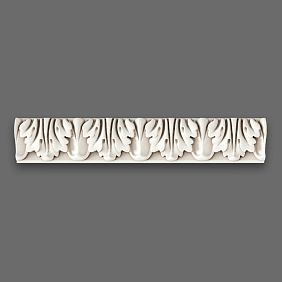
Classical ornamental — egg-and-dart, dentils, meander, stylized leaves (relief 10-20 mm). Width 60-110 mm, price 580-1100 rubles/meter. For classical interiors (Neoclassical, Empire, Classicism — the molding aligns with the order system).
Floral — acanthus leaves, grapevines, garlands (relief 15-25 mm, ornament is picturesque, Baroque). Width 70-120 mm, price 750-1350 rubles/meter. For Baroque and luxurious interiors.
Number of moldings per arch:
Minimum — one molding along the inner perimeter of the arch curve (curve length depends on radius and angle: semicircle with a radius of 1 meter = π×1 = 3.14 meters, one piece of molding 320 cm or two 160 cm pieces joined is needed).
Optimum — two moldings (one along the inner, the second along the outer perimeter of the arch curve — a double frame is created, relief is enhanced).
Maximum — three to four moldings of different widths (multi-layered framing, monumentality, characteristic of Baroque portals).
Our factory also produces:



Keystones: the top of the arch
Keystone — a decorative element installed at the apex of the arch (center of the curve, highest point). Historically, a keystone is indeed a stone, the last one inserted during arch construction, spreading the side stones, holding the entire structure (symbol of strength, completion). In decorative arches, the keystone is non-load-bearing (the arch made of drywall or brick holds itself), but retains its symbolic and aesthetic function.
Shapes of Keystones:
Trapezoidal — widening downwards (top narrow 50-80 mm, bottom wide 100-150 mm), height 100-180 mm. Classic shape (Renaissance, Baroque, Neoclassical). Relief: smooth (with rustication — imitation of stone masonry), ornamental (rosette, cartouche, coat of arms, mascaron — face of a human or lion).
Wedge-shaped — wedge shape (triangle with apex up), height 120-200 mm. Gothic and Neo-Gothic style. Relief: stylized leaves, crosses, geometric ornaments.
Sculptural — three-dimensional images (lion's head, angel, mask of an ancient god, garland), size 150×200 mm to 300×400 mm. Baroque, Rococo, 19th-century Eclecticism. Relief is deep (30-50 mm), dramatic.
Price of keystones: 850-6500 rubles depending on size and complexity (simple smooth trapezoidal 850-1500 rubles, ornamental 1800-3500 rubles, sculptural 3500-6500 rubles).
Installation: the keystone is glued to the wall above the arch apex (center of the stone aligns with the arch's axis of symmetry, the lower edge of the stone touches or slightly overlaps the arch curve molding). Fixed with polyurethane adhesive; if heavy (over 2 kg), additionally with screws (two screws through the stone into the wall, screw heads are filled, painted over).
Get Consultation
Consoles: Visual Support
Console (bracket) — a vertical or inclined element installed under the arch curve on the sides (at the level of the arch springing — points where the curve transitions into the vertical part of the opening). Shape: S-shaped volute, L-shaped angle with decor, straight block with rustication.
Function: visual support of the arch curve (creates the illusion that the consoles hold the arch, although structurally the arch is self-supporting — aesthetics of honest architecture). Consoles also hide the transition point of the molding from the curve to the vertical part (the joint of moldings at the arch springing point is often complex — the console covers it, simplifying installation).
Dimensions: height 80-250 mm, width 60-180 mm, projection from wall 30-80 mm. Large consoles (height 180-250 mm) for wide arches (opening width 2+ meters, height 2.5+ meters), small consoles (80-120 mm) for narrow arches and minimalist interiors.
Ornament: smooth (with rustication or fluting), acanthus leaves (stylized, curled into spirals), volutes (S-shaped scrolls), cartouches (oval frames with ornament inside).
Price: 650-3200 rubles per pair (two consoles — left and right, mirror-symmetrical).
Installation: consoles are glued to the wall on the sides of the arch at the level of the springing (the lower edge of the console is at the level where the arc begins, the upper edge is under the arch molding — the console seems to support the molding from below). Orientation: vertical (the console stands upright, height greater than width) or inclined (the console is tilted outward at an angle of 10-20°, more dynamic).
Columns and Pilasters: Side Framing
Columns (round, three-dimensional) or pilasters (flat, attached to the wall) are installed on the sides of the arched opening, forming a portal. The height of the column/pilaster is equal to the height of the vertical part of the opening (from the floor to the springing of the arch) or slightly greater (protrudes above the springing, the column capital is at the level of the keystone or consoles).
Structure: base (lower part, stands on the floor), shaft (cylindrical or flat middle part), capital (upper decorated part, on which the arch visually rests).
Orders: Doric (simple, massive, capital with echinus and abacus), Ionic (elegant, capital with volutes — scrolls), Corinthian (luxurious, capital with acanthus leaves in two or three tiers).
Application: classical and neoclassical interiors (where order architecture is valued), ceremonial portals (entrance to the living room from the hall, to the dining room from the living room — an arch with columns enhances the solemnity of the transition), country houses and mansions (ceiling height 3+ meters, room area allows columns not to overload the space).
Set price (two columns or two pilasters): 15000-55000 rubles depending on height and order (Doric 15000-25000 rubles, Ionic 20000-35000 rubles, Corinthian 28000-55000 rubles).
Half-arches and Arch Kits: Ready-made Solutions
Half-arch — a ready-made semicircular or elliptical element (one half of an arch, cast as a single piece), which is mounted on an opening. Two half-arches (left and right) form a complete arch. Advantage: no need to bend molding, trim joints — the half-arch is ready, simply glue it. Disadvantage: limited to standard sizes (manufacturer produces half-arches for openings 80, 100, 120, 140, 160 cm wide — if your opening is 110 cm, a 100 cm half-arch is too small, 120 cm is too large).
Arch kit — a set of elements for decorating an arch (two half-arches or flexible molding of the required length + keystone + two consoles + two vertical moldings for the sides of the opening, all stylistically coordinated, ornaments echo). Kit price 8500-28000 rubles (cheaper than buying elements separately, plus guaranteed stylistic unity).
Popular Arch Kits:
Minimalist — smooth flexible molding 50 mm wide without ornament + two vertical moldings 50 mm for the sides, without keystone and consoles. Price 4500-7500 rubles. For modern interiors (Scandinavian, minimalism, contemporary).
Classical — molding with egg-and-dart and dentils 80 mm wide + trapezoidal keystone with rosette + vertical moldings. Price 12000-18000 rubles. For neoclassicism and classicism.
Baroque — molding with acanthus leaves and garlands 100 mm wide + sculptural keystone (mascaron) + two consoles with volutes + vertical moldings. Price 22000-35000 rubles. For Baroque, Rococo, palace interiors.
Stylistic Typology of Arches: From Rome to Art Nouveau
Arch made of polyurethane stuccoreproduces any historical archetype. The shape of the arch and the decor determine the style.
Roman Arches: Semicircular Classics
Roman arch (semicircular) — an arch in the shape of a semicircle (arc radius = half the width of the opening; opening 2 meters wide → radius 1 meter → arc of a semicircle with a radius of 1 meter). The most common arch shape (simple geometry, structurally rational, aesthetically harmonious).
Historical examples: triumphal arches of Ancient Rome (Arch of Titus, Arch of Constantine), aqueducts (Pont du Gard in France), basilicas and temples.
Decor of Roman arches in interiors:
Minimal — one flexible molding along the arc (width 40-60 mm, smooth or with dentils), without keystone, without consoles. For interiors where the arch is functional (space zoning) but should not dominate.
Moderate — molding along the arc (width 70-90 mm, with egg-and-dart) + trapezoidal keystone (height 120-150 mm, rosette or cartouche) + vertical moldings on the sides of the opening. Classic option for neoclassical living rooms, dining rooms.
Full portal — molding + keystone + two consoles under the arch + two pilasters (or half-columns) on the sides of the opening from floor to capital. Monumental option for ceremonial rooms (hall, main living room of a country house).
Color scheme: white monochrome (arch and walls white, decor revealed by relief), contrast (arch white, walls gray/beige/colored — arch highlighted), gilding (molding and keystone with gold accents — protruding parts of the ornament gilded with gold leaf or paint).
Gothic Arches: Pointed Soars
Gothic arch (pointed, lancet) — the arc is formed by two arcs of circles intersecting at the apex at an acute angle (shape of an arrow pointing upward). The centers of the circles are located at the points of the arch springing or beyond them (the farther the centers, the sharper the apex angle).
Effect: visual elongation of space upward (a pointed arch is perceived as taller, more soaring than a semicircular one of the same width), Gothic symbolism (spirituality, transcendence, medieval mysticism).
Historical examples: Gothic cathedrals of the 12th-15th centuries (Notre-Dame de Paris, Cologne Cathedral, Milan Cathedral), monasteries, castles.
Decor of Gothic arches:
Molding — narrow (40-60 mm), geometric profile (angular recesses, ribs — no smooth plant ornaments of classicism; Gothic loves geometry and vertical lines). Price 420-750 rub./meter.
Keystone — wedge-shaped (triangular form with apex upward, height 150-220 mm), Gothic relief (stylized Gothic leaves — trefoil, quatrefoil, crosses, coats of arms). Price 1800-4200 rub.
Vertical elements — not columns, but bundles of thin pilasters (3-5 thin vertical projections running side by side, imitation of Gothic buttresses). Or a single pilaster with vertical grooves (Gothic fluting — deep, sharp).
Application: Neo-Gothic interiors (stylization of the Middle Ages — libraries, studies, wine cellars in country houses), eclectic interiors (combination of a Gothic arch with modern furniture — contrast of eras, intellectual play), commercial objects (medieval-themed restaurants, museums, galleries).
Color: dark stone (gray, graphite, granite imitation — paint moldings and keystone dark gray, add stone texture with a sponge), black (maximum Gothicness, drama), natural stone (if budget allows, clad the arch with artificial stone — polyurethane decor is replaced with stone).
Moorish arches: horseshoe-shaped exoticism
Moorish arch (horseshoe-shaped, Arabic) — an arc in the shape of a horseshoe (not a semicircle, but larger — the arc encompasses 220-240° of a circle, the side parts curl inward, creating a horseshoe). The width of the arc at its widest part is greater than the width of the opening (opening 1.5 meters, arc at its widest point 1.7-1.8 meters).
Origin: Islamic architecture of Spain (Alhambra in Granada, Mezquita in Córdoba), North Africa (Moroccan palaces), Central Asia (Samarkand mausoleums).
Effect: exoticism, orientalism, luxury of the East (Moorish arch is associated with Eastern fairy tales, harems, caravanserais).
Moorish arch decor:
Molding — geometric ornament (arabesques, meanders, broken lines, eight-pointed stars, six-pointed stars), no plant forms (Islam avoids depicting living beings and realistic plants — ornament is stylized, abstract). Width 60-90 mm, price 550-980 rub./meter.
Keystone — absent or replaced by a decorative rosette (round or polygonal medallion with geometric ornament, diameter 120-200 mm). Price 1500-3500 rub.
Columns — thin, twisted or with relief ornament (imitation of marble columns of Moorish palaces). Capitals are not order-based (not Ionic, not Corinthian), but abstract (stalactite — overhanging forms resembling cave stalactites).
Application: interiors in Eastern style (Moroccan, Arabic, Turkish — spa areas, hammams, hookah lounges in restaurants), eclectic interiors (where the Moorish arch is an unexpected accent, contrasting with European furniture).
Color: rich tones (terracotta, ochre, gold, turquoise, cobalt blue — traditional colors of Islamic architecture), mosaic (if budget allows, clad the arch with mosaic tiles — imitation of zellij, traditional Moroccan mosaic).
Elliptical and segmental arches: Renaissance and Art Nouveau
Elliptical arch — an arc in the shape of part of an ellipse (oval). Gentle (rise of the arc is less than that of a semicircular arch of the same width), wide, elegant.
Application: Renaissance and Neo-Renaissance architecture (Italian palazzi of the 15th-16th centuries, French châteaux), Art Nouveau of the early 20th century (smooth lines, rejection of right angles — elliptical arches are characteristic of the Art Nouveau style).
Decor: plant moldings (grapevines, stylized irises and lilies — Art Nouveau motifs) or simple classical ones (egg-and-dart, meander). Keystone moderate (not monumental, but elegant — rosette, cartouche). Consoles rounded (S-shaped volutes).
Segmental arch — an arc of a circle segment (less than a semicircle, gentle). Visually more modest than a semicircular one, but wider than the opening (suitable for low rooms — arc height only 20-40 cm with an opening width of 1.5-2 meters).
Application: modern interiors (minimalism, contemporary — where an expressive arch is not needed, but you want to soften a rectangular opening), rooms with low ceilings (height 2.4-2.5 m — a semicircular arch will consume another 50-100 cm of height, a segmental one only 20-30 cm).
Mounting decor on an arch: flexibility technology
Polyurethane arch stuccois mounted in stages: first vertical elements (columns, pilasters, vertical moldings on the sides of the opening), then flexible molding along the arc, then keystone and consoles.
Opening preparation
The wall surface around the opening must be clean (no dust, grease, peeling paint), even (irregularities no more than 3-5 mm — molding fits tightly), primed (acrylic deep-penetration primer improves adhesive adhesion).
If the arch is in a drywall construction (arc cut from drywall, puttied, sanded), check the strength of the edges (press your finger on the edge of the arc — if the drywall bends, reinforce: apply fiberglass mesh or glass cloth along the edge of the arc, putty, sand — the edge will become rigid).
If the arch is brick (arc laid out of brick), plaster (level the surface with plaster, finish with putty, sand — you'll get a smooth base for molding).
Installation of vertical elements
If the project includes columns or pilasters, install them before mounting the molding along the arc.
Column bases: glue the bases to the floor on the sides of the opening (distance between inner edges of bases equals opening width). Use polyurethane or acrylic mounting adhesive, fix until dry with weights or painter's tape.
Column shafts/pilasters: Install the shafts on the bases, glue them to the wall (if it's a pilaster — glue the entire back surface; if it's a column — only part of the circumference adheres to the wall, the rest is suspended — use glue plus additional screws through the shaft into the wall at 2-3 points, screw heads are filled with putty).
Capitals: Install the capitals on top of the shafts. The upper edge of the capital should be at the level of the springing point of the arch (the point where the arc begins) or slightly higher (if you want the arch arc to visually rest on the capital).
Vertical moldings (if you are using just moldings instead of columns) are glued to the wall on the sides of the opening from the floor to the springing point of the arch (or from any height — you can start the molding not from the floor, but at a height of 50-100 cm, creating a composition with the baseboard).
Bending and installing flexible molding
Calculating molding length: Measure the length of the arch arc with a tape measure (stretch the tape along the inner perimeter of the arc from one springing point to the other — you get length L). Cut the molding to length L + 5-10 cm extra (it's better to cut off excess after fitting than to have too little).
Bending: Flexible polyurethane molding bends by hand without heating. Take the molding with both hands, slowly bend it along the arc (start from one end, gradually move to the other, forming the arc). If the molding resists (the arc radius is close to the minimum for this molding), heat the molding with a construction heat gun (temperature 100-150°C, do not overheat — polyurethane softens, bends easier; after cooling, it retains its shape).
Fitting: Place the bent molding against the arch arc (check if the molding follows the shape of the arc, if there are any gaps larger than 2-3 mm). If the radius of the molding does not match the radius of the arch (the molding is bent too sharply or not enough), adjust it (bend it more or release it — the molding is elastic, it can be corrected).
Applying glue: Place the molding on the table with the back side up (the side that will adhere to the wall). Apply glue in a zigzag pattern (a continuous line of glue 5-8 mm wide along the center of the back side) or in dots (drops of glue 10 mm in diameter every 10-15 cm). Use polyurethane glue (Cosmofen Plus, European Plus — fast setting, high strength) or acrylic mounting adhesive (Moment Montazh, Tytan — cheaper, but slower setting).
Installation: Place the molding against the arch arc, align it with the markings (if marked with a pencil), press evenly along the entire length (press with your palms, moving from the center to the edges or from one edge to the other — the main thing is that the glue is distributed evenly, the molding adheres without gaps). Hold for 2-3 minutes (for polyurethane glue) or 5-10 minutes (for acrylic).
Fixation during drying time: The molding is forcibly bent; after gluing, it tends to straighten (the elasticity of the material creates a peeling force). Secure the molding for 24 hours (the time for the glue to fully dry):
Painter's tape — apply strips of tape from the molding onto the wall every 30-40 cm (the tape holds the molding pressed against the wall). Remove the tape after 24 hours.
Finish nails — drive thin nails (diameter 1-1.5 mm, length 15-20 mm) through the molding into the wall every 40-50 cm (the nails press the molding). After the glue dries, pull out the nails with pliers, fill the holes with acrylic putty, sand, paint (from a distance of 1+ meter, the holes are unnoticeable).
Trimming the ends of the molding: After the glue dries (the molding is firmly attached), trim the ends of the molding (if there is excess beyond the arc). Cut with a fine-toothed saw or a sharp knife at an angle (if the molding joins with a vertical molding — trim at 45° or according to the profile of the vertical molding so that the joint is tight).
Installing the keystone and consoles
Keystone: Find the center of the arch arc (the midpoint of the arc length, the highest point). Place the keystone against the wall above the arc (the lower edge of the keystone touches or slightly overlaps the molding, the center of the stone is on the axis of symmetry of the arch — check verticality with a plumb line or level). Trace the contour of the stone with a pencil (for control during installation). Apply glue to the back of the stone (around the perimeter + crosswise through the center), place it against the wall according to the markings, press for 3-5 minutes. If the stone is heavy (more than 1.5-2 kg), additionally secure with screws (two screws through the stone into the wall — in the upper and lower parts of the stone, countersink the screw heads, fill with putty, paint).
Consoles: Install the consoles on the sides of the arc at the level of the springing points of the arch (points where the arc transitions into the vertical part of the opening). Left console on the left, right console on the right (mirror symmetrical). The lower edge of the console is at the level of the springing point, the upper edge under the arc molding (the console seems to support the molding). Glue with adhesive, press for 2-3 minutes, secure with tape for 24 hours. If the console is heavy (more than 1 kg), use screws (1-2 screws through the console into the wall).
Joint sealing and final finishing
Fill the joints of the moldings (arc+vertical, arc+keystone, arc+consoles) with white acrylic sealant (squeeze a thin strip into the gap, smooth with a wet finger or rubber spatula). Drying time 4-6 hours. If the joints are wide (more than 1 mm), use acrylic putty (harder than sealant, after drying it can be sanded with P180-P240 sandpaper).
Painting (optional): If the moldings, keystone, consoles are white and the walls are colored — you can leave the contrast (white arch on a colored wall). If you want the arch to match the wall color — paint with acrylic paint (tint the paint to match the wall color, paint the ornament of the molding and keystone with a brush, smooth parts with a roller). Two coats of paint, 4-hour interval. If you want gilding — apply gold paint or gold leaf to the protruding parts of the ornament (dry brush technique — the paint only adheres to the upper planes).
Compositional strategies: from minimalism to baroque
Polyurethane stucco archesallow creating compositions of varying complexity — from a modest framing with a thin molding to a monumental portal with columns, a keystone, consoles, and a frieze.
Minimalist framing
One thin flexible molding (width 40-60 mm, profile smooth or with one groove) along the inner perimeter of the arch arc. No keystone, no consoles, no columns. The molding is painted to match the wall color (blends in, only revealed by the shadow from the relief) or in contrast (white on a gray wall, black on white — a graphic line).
Effect: Delicacy, modernity, the arch is indicated (the boundary is readable), but does not shout. Suitable for minimalism, Scandinavian style, contemporary, lofts (where restraint in decor is valued).
Material cost: Molding 380-520 rubles/meter, arc length 3 meters → 1140-1560 rubles + glue 300 rubles = 1440-1860 rubles per arch.
Classical framing
Medium-width flexible molding (70-90 mm, profile with egg-and-dart or dentils) along the arc + trapezoidal keystone with a rosette (height 120-150 mm) at the top + two vertical moldings on the sides of the opening (from the floor or from a height of 50-80 cm to the springing points of the arch).
Effect: Classical architectural literacy, the arch as a portal (highlighted, framed, but not overloaded). Suitable for neoclassicism, classicism, traditional interiors (living rooms, dining rooms, studies in apartments and houses).
Material cost: Arc molding 580 rubles/meter × 3 meters = 1740 rubles, keystone 1800 rubles, vertical moldings 480 rubles/meter × 4 meters (2 meters on each side) = 1920 rubles, glue 400 rubles = 5860 rubles per arch.
Monumental portal
Flexible wide molding (100-120 mm, profile with acanthus leaves or garlands) along the arch + sculptural keystone (mascaron, height 180-250 mm) + two volute consoles (height 180-220 mm) under the arch at the springing points + two Corinthian pilasters (height from floor to capital 2.2-2.8 meters) on the sides of the opening + horizontal frieze above the arch (optional, if ceiling height allows).
Effect: palatial monumentality, ceremonial grandeur, the arch as an architectural event (dominates the room, sets the tone for the entire interior). Suitable for Baroque, Empire, and palace-style interiors in country houses and mansions (ceiling height 3.2+ meters, room area 40+ m²).
Material cost: arch molding 750 rub./meter × 3 meters = 2250 rub., keystone 4500 rub., consoles 2800 rub. (pair), pilasters 28000 rub. (pair, Corinthian, height 2.5 m), frieze (optional) 15000 rub., adhesive 600 rub. = 53150 rub. (38150 rub. without frieze) per arch.
Frequently Asked Questions about Polyurethane Molding Arches
Can the decor be installed on an existing arch?
Yes, polyurethane decor can be mounted on any existing arch (drywall, brick, concrete). The main thing is that the surface must be level, clean, and primed. If the arch is old (paint peeling, plaster falling off in places), prepare the surface: remove peeling layers, fill defects, sand, prime — you'll get a perfect base for installation.
How to determine the bend radius of my arch?
Method 1: Geometric (if the arch is semicircular). Measure the opening width W (distance between the arch springing points horizontally). Radius R = W/2. A 2-meter opening → radius 1 meter.
Method 2: Using a compass (universal). Mark three points on the arch curve (left springing point, vertex, right springing point). Draw a circle on a sheet of paper passing through these three points (adjust the compass radius until the circle passes through all three points). Measure the compass radius — this is your arch radius.
Method 3: Approximate. Stretch a string along the arch curve (apply to the surface, run from springing point to springing point), measure the string length L. Measure the opening width W. Radius approximately R ≈ (L² / (8×rise)) + (rise/2), where rise = height of the curve from the line connecting the springing points to the vertex. For a semicircle, rise = W/2, then R = W/2.
Will the flexible molding peel off over time?
No, if properly glued (adhesive applied along the entire length, surface prepared, fixation ensured during drying time). Polyurethane adhesive holds 10-20 kg/cm², flexible molding weighs 0.4-0.9 kg/meter, contact area 30-50 cm² per meter → load-bearing capacity 300-1000 kg per meter, actual load less than 1 kg — safety margin is a hundredfold. Problems arise if: the surface is dirty (dust, grease — adhesive sticks to dirt, dirt peels off), insufficient adhesive (applied only in sparse dots — molding peeled off between dots), no fixation (molding straightened due to elasticity before adhesive dried — partially peeled off).
Can polyurethane arch decor be painted a dark color?
Yes, polyurethane can be painted with acrylic paints of any color (white, black, gray, brown, even blue or red — any tintable shade). Dark colors (black, graphite, dark brown) look great in contemporary, lofts, minimalism (dark arch on a light wall — graphic quality, drama). Technique: prime the polyurethane with white acrylic primer (one coat), then paint with dark acrylic paint (two coats, 4-hour interval). Dark paints require two coats for evenness (one coat may show through, brush strokes visible).
How much does professional installation of arch decor cost?
Master's work: 3500-8000 rub. per arch depending on complexity (minimalist framing with one molding 3500-4500 rub., classic with keystone and consoles 5500-7000 rub., monumental portal with pilasters 8000-15000 rub.). Installation time: minimalist arch 2-3 hours, classic 4-6 hours, portal 8-12 hours (including preparation, cutting, gluing, joint sealing, painting if necessary). If you do it yourself, you save labor costs but spend time (plus risk of error — glued unevenly, joints with gaps — will have to redo).
Is polyurethane decor suitable for outdoor arches?
Polyurethane is moisture-resistant (does not absorb water, does not rot), but ultraviolet light gradually degrades it (10-15 years in direct sunlight — yellowing, loss of strength, cracking). For outdoor arches (house entrance, gazebo, terrace) use polyurethane, but with protection: paint with acrylic facade paint with UV filters (two-three coats), renew painting every 5-7 years. Or use polymer concrete (artificial stone on polymer base — heavier than polyurethane, but UV-stable) or natural stone (granite, marble — eternal, but expensive, 15000-50000 rub./meter vs. 500-1200 rub. for polyurethane).
Conclusion: the arch — a symbol of transition and grandeur
Polyurethane arch moldingtransforms a utilitarian opening into an architectural work carrying millennia of symbolism and aesthetics. The arch is a transition (physical from room to room and metaphysical from one state to another — from an ordinary hallway to a formal living room, from kitchen bustle to dining room coziness), it is a boundary (visually separates spaces without isolating them with a wall — openness, light, air are preserved), it is an accent (expressive curve shape plus relief decor create a focal point organizing interior perception).
Polyurethane is ideal for arch decor: flexible moldings bend to any radius from 300 mm (narrow profiles) to 1000 mm (wide) without heating, precisely follow the curve shape (Roman semicircular, Gothic pointed, Moorish horseshoe, elliptical, segmental — any shape is achievable), lightweight (weight 0.4-0.9 kg/meter, installation by one person without helpers, adhesive holds without dowels), moisture-resistant (arches in kitchens, bathrooms, pools — polyurethane is 100% moisture-proof, lasts 30-50 years), paintable to any color (classic white, contrasting black/graphite for modern, gilded for Baroque, imitation wood or stone — acrylic paints and decorating techniques offer endless variations).
The range of elements for arch decor is comprehensive: flexible moldings (280+ models width 30 to 120 mm, profiles from smooth minimalist to lush Baroque with acanthus and garlands, prices 380-1350 rub./meter), keystones (65 models height 100 to 300 mm, shapes trapezoidal classic, wedge-shaped Gothic, sculptural Baroque with mascaron and cartouches, prices 850-6500 rub.), consoles (40 models height 80 to 250 mm, S-shaped volutes, acanthus leaves, rusticated blocks, prices 650-3200 rub. per pair), columns and pilasters (85 sets of all orders — Doric, Ionic, Corinthian — height 180 to 400 cm, prices 8000-55000 rub. per pair), ready-made arch kits (35 kits for openings width 80 to 200 cm, include molding + keystone + consoles + vertical moldings, stylistically coordinated, prices 8500-35000 rub.).
Company STAVROS has been producing polyurethane decor for arches since 2002 at its own factory in the Moscow region, using European equipment (injection molding machines Hennecke, Germany) and raw materials (polyurethane compositions BASF, Huntsman — density of flexible moldings 200-240 kg/m³, rigid elements 320-380 kg/m³, property consistency batch to batch, no shrinkage or deformation). STAVROS decor quality: relief detailing up to 0.5 mm (each acanthus leaf, each dentil, each pearl bead reproduced clearly, symmetrically — master models hand-sculpted by sculptors, silicone molds high-precision), three-layer snow-white primer (thickness 0.12-0.18 mm, acrylic, applied by robotic sprayers, perfect uniformity, ready for painting without additional preparation), flexibility of flexible moldings guaranteed (minimum bend radius specified for each model, testing on each batch — molding bent to minimum radius 100 times, does not break, does not crack — only then batch released for sale).
STAVROS service: consultations by architects and designers (help select elements for your arch shape and size, interior style, budget — send photos of the arch and dimensions, designer will propose 3-5 compositional options with visualization and estimate), material calculation (measure arch curve, opening width and height, inform designer — they calculate how many meters of molding needed, which keystone fits, if consoles and columns needed, final material cost), sample molding fragments (sent for 300-500 rub. — piece of molding 30-40 cm, see profile, density, flexibility, primer quality physically), installation instructions (text manuals and videos on website — step-by-step technique for bending molding, applying adhesive, fixation during drying, installing keystone and consoles, sealing joints, painting), delivery (own courier service in Moscow and region — delivery on order day or next, moldings packed in shrink wrap + cardboard corners, keystones and consoles in bubble wrap + boxes, damage excluded; to regions — transport companies, timeframe 3-7 days), 24-month warranty (if element deformed, yellowed, primer peeled, cracked when bent within stated minimum radius — free replacement, but in 24 years of operation STAVROS claims less than 0.05% of shipments).
Choose STAVROS — choose arch decor that transforms an opening into a portal, a technical element into an architectural event, a modern box into a space with history and symbolism. STAVROS polyurethane molding is lightweight (installation without specialists, 2-6 hours per arch), affordable (prices 380-1350 rub./meter for moldings, 850-6500 rub. for keystones — 3-5 times cheaper than gypsum and stone analogs), high-quality (European polyurethane, detailing up to 0.5 mm, durability 30-50 years), diverse (280+ molding models, 65 keystones, 40 consoles, 85 column sets — find elements for any arch shape, any style, any budget). Your interior deserves arches worthy of palaces — STAVROS molding creates them, framing transitions between spaces with grandeur, turning each passage into a micro-ceremony, each opening into a work of architectural art.


