












































































Article Contents:
- Sound in a Room: Why Acoustics is Architecture
- Construction of an Acoustic Slatted Decorative Panel: What's Inside
- Decorative battens
- Perforated Load-Bearing Base
- Sound-Absorbing Filler
- Air Gap
- Acoustics in Numbers: How to Read Technical Specifications of Panels
- Sound Absorption Coefficient (α)
- Reverberation Time (RT60)
- Sound absorption class (A–E)
- Where acoustic slatted decorative panels work: spaces and applications
- Home Theater
- Meeting room and office
- Recording studio and rehearsal space
- Restaurant and cafe
- Home office and library
- Living room with audio system
- Materials for acoustic slatted panels: what to choose
- Painting-grade perforated MDF
- Veneered perforated MDF
- Solid wood
- Acoustic slatted decorative panel vs. regular slatted panel: what's the difference
- Acoustic slat panel for ceiling: zone of maximum efficiency
- Installation of acoustic slat decorative panels: step by step
- Coverage calculation
- Creating an air gap
- Laying sound-absorbing material
- Installation of acoustic panel
- Finishing elements
- Acoustic slat panels in interior: aesthetics without compromise
- Slat facade panels and acoustics: an unexpected but real connection
- Soft slat panels and acoustics: a new wave
- Acoustic slat panels DIY: is it possible?
- Parametric table for selecting acoustic slat panels
- Acoustic slat panels and related interior elements
- FAQ: answers to key questions about acoustic slat panels
- About the Company STAVROS
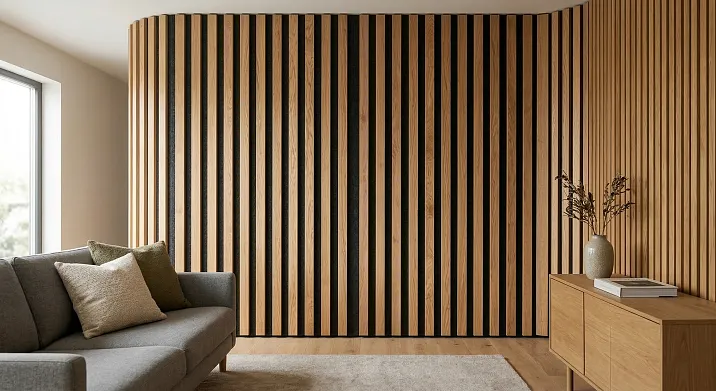
There are things we don't notice until they disappear. Silence is one of them. The booming echo in an empty room, the blurred sound of conversation in a restaurant, the endless reverberation in a home theater — these are not fatal architectural flaws, but solvable acoustic problems. And the solution that simultaneously works with sound and creates an expressive interior is the acoustic slat decorative panel.
This product stands apart in the line of finishing materials. Most acoustic solutions are either functional but ugly (foam pyramids in recording studios) or decorative but acoustically passive (regular slat panels). The acoustic slat decorative panel is a rare exception to this rule: it functions as a full-fledged acoustic absorber and simultaneously serves as an architectural interior element worthy of the most demanding design projects.
Let's examine this solution in detail: the physics of sound, panel construction, selection parameters, areas of application, and installation technology. Without oversimplification — with respect for the reader's intellect.

Sound in a room: why acoustics is architecture
Before discussing panels — we need to understand the task. What happens to sound in an enclosed space and why is it important?
Sound is mechanical vibrations of air that propagate from a source in all directions. In open space, the sound wave travels away and dissipates. In an enclosed room — it reflects off walls, ceiling, floor, furniture and returns to the listener with a delay. This delay is called reverberation.
Moderate reverberation is good. It is precisely what gives sound 'warmth' and 'volume': a concert hall sounds richer than a street precisely due to proper reverberation. But excessive reverberation is an acoustic catastrophe. Words lose intelligibility, music turns into mush, conversation requires raising one's voice. In residential spaces with smooth walls, laminate flooring, and minimal furniture — reverberation is typically excessive.
Hard surfaces (concrete, drywall, glass, laminate) reflect sound with virtually no loss. Soft and porous materials (textiles, porous acoustic foam, mineral wool) absorb it, converting the energy of sound vibrations into heat. A slatted decorative structure with acoustic filler is a system that allows sound to pass through a perforated base to the absorbing filler and returns significantly less acoustic energy to the room.
Result: speech becomes more intelligible, music becomes clearer, the space becomes quieter and more comfortable. This is not a subjective feeling—it is a measurable physical result described by the sound absorption coefficient (αw) from 0 (absolute reflection) to 1 (absolute absorption).




Construction of the acoustic slatted decorative panel: what's inside
Acoustic slatted decorative panel— is a multi-layer structure, each element of which performs a specific function.
Our factory also produces:


Decorative battens
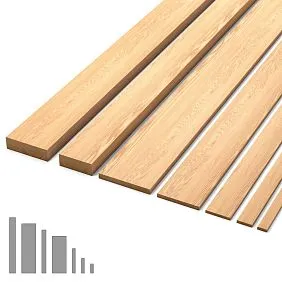
Face layer — slats made of MDF, solid wood, or veneered MDF. They form the visual appearance of the panel: width, rhythm, tone, texture. Slat width — from 25 to 100 mm; gap between slats — from 5 to 30 mm. The gap is a key parameter from an acoustic perspective: it is through it that the sound wave penetrates to the absorbing layer. The wider the gap relative to the slat width, the higher the acoustic efficiency. Typical ratio in acoustic panels: the gap constitutes 30–40% of the total pitch width (slat + gap).
Get Consultation
Perforated load-bearing base
The load-bearing panel under the slats is MDF or HDF with perforation. Perforation consists of holes 3–8 mm in diameter, evenly distributed across the panel surface. The holes act as acoustic channels: sound that has penetrated through the gaps between the slats continues its path through the perforation to the sound-absorbing layer. The percentage of perforation (ratio of hole area to total panel area) is a critical parameter: 15–25% is the optimal range for residential spaces.
Without perforation, the load-bearing panel would reflect sound back, and the acoustic function of the structure would be negated. It is the perforation that turns an ordinarydecorative slatted panelinto acoustic.
Sound-absorbing filler
Behind the load-bearing slab is a layer of material with a high sound absorption coefficient. Two main options:
Melamine foam — an open-cell polymer material with a sound absorption coefficient αw = 0.80–0.95 in the mid and high frequency range (500 Hz – 4 kHz). Lightweight, non-combustible (flammability group NG), contains no fibrous components. Layer thickness — 20–50 mm. This is the most modern and technologically advanced sound-absorbing material.
Mineral wool (basalt) — a classic absorber with high efficiency across a wide frequency range. Heavier than melamine foam, requires a protective non-woven material to prevent fiber dusting. Absorption coefficient αw = 0.75–0.90. Layer thickness — 25–50 mm.
Acoustic felt — natural or synthetic. Used as an additional layer or as a standalone absorber for the high-frequency range. Lighter weight and thinner compared to mineral wool.
Air gap
Between the absorbing filler and the load-bearing wall is an air cavity. This gap increases the acoustic efficiency of the system in the low-frequency range: an air cavity with a depth of 50–100 mm shifts the absorption peak to the 100–300 Hz region. For rooms with issues in the low-frequency range (bass hum, 'booming' in a room with an audio system) — the air gap is essential.
Acoustics in numbers: how to read the technical specifications of panels
Acoustic panel manufacturers use a number of parameters that are important to understand when making a selection.
Sound absorption coefficient (α)
Value from 0 to 1. Shows the proportion of incident acoustic energy absorbed by the material. α = 0.80 means 80% of sound is absorbed and only 20% is reflected. Measured at different frequencies; the summary value αw (weighted coefficient) is a convenient single indicator.
Guidelines:
-
α < 0.20 — low absorption (drywall, concrete, glass)
-
α = 0.20–0.50 — moderate absorption (wooden panels without filler)
-
α = 0.50–0.80 — good absorption (acoustic slat panels with foam)
-
α > 0.80 — high absorption (specialized studio panels)
Reverberation time (RT60)
Time for the sound level in a room to decrease by 60 dB after the source stops. Standard values:
-
Living rooms and offices: 0.4–0.6 s
-
Negotiation and conference rooms: 0.3–0.5 s
-
Restaurants: 0.6–0.9 s
-
Home theater: 0.2–0.4 s
-
Concert halls: 1.5–2.5 s
If the normative RT60 is exceeded by more than 1.5 times, acoustic treatment of the room is mandatory. This is exactly what acoustic slatted decorative panels are used for.
Sound absorption class (A–E)
European classification according to EN ISO 11654:
-
Class A: αw ≥ 0.90 — highest, studio level
-
Class B: αw = 0.80–0.85 — high level, professional audio rooms
-
Class C: αw = 0.60–0.75 — good level, meeting rooms, offices
-
Class D: αw = 0.30–0.55 — base level, residential premises
-
Class E: αw = 0.15–0.25 — minimum
acoustic slat panelswith melamine or mineral wool filler typically achieve class B–C — sufficient for most residential and commercial applications.
Where acoustic slatted decorative panels work: spaces and applications
This is not a universal product 'for everyone and everywhere'. Each application has its own acoustic logic.
Home theater
This is perhaps the most obvious application area. A residential space requiring both high sound quality and worthy interior design.slatted panels for wallsin a home theater — this is a solution that addresses both requirements with a single product.
Home theater acoustic design requires absorption on side walls (to reduce early reflections) and on the rear wall (to prevent echo). The front wall is typically a screen or acoustically transparent fabric with a sound system behind it. The ceiling — partial absorption with diffusion.
Dark tones of acoustic slatted panels (anthracite, dark brown, graphite) on side and rear walls create a cinematic atmosphere while maximizing sound absorption.MDF Slatted Wall Paneldark tone with melamine foam filler — an ideal construction for this task.
Meeting room and office
Acoustic requirements for meeting rooms are defined by corporate standards: speech intelligibility at noise levels up to 45–50 dB. An echoey meeting room, where the words of negotiators scatter as echoes throughout the room, is not just uncomfortable; it reduces communication effectiveness.
decorative slatted panelswith acoustic filler on two adjacent walls of the meeting room provide a target RT60 = 0.3–0.5 s for a room area of 20–40 m². Simultaneously, they create a representative image suitable for a business environment: a strict rhythm of slats, neutral or dark tones, a high-quality surface for painting or oak veneer.
Recording studio and rehearsal room
Here, acoustic requirements are strict: a vocal recording studio requires RT60 = 0.15–0.25 s; a rehearsal room for a band — 0.3–0.4 s. Standard Class B–C acoustic slat panels provide these values in combination with other acoustic measures (corner traps, diffusers).
Important nuance: for studio applications, panels with documented acoustic characteristics across frequency ranges are needed — not just a summary αw. A panel may have αw = 0.80 but poorly absorb low frequencies (below 250 Hz) — these are precisely the most problematic in studios.
Restaurant and cafe
Acoustic comfort in a restaurant is a competitive advantage. An establishment where one can speak in a normal voice and hear the interlocutor without effort is perceived as higher quality. This is not a subjective conclusion: research in the restaurant business shows a direct link between the level of acoustic comfort and the average bill and frequency of repeat visits.
slatted panels for wall finishingin warm tones (oak veneer, tinted MDF in warm beige or terracotta) create an atmosphere of coziness and simultaneously reduce reverberation to the normative 0.6–0.9 s. A restaurant with proper acoustics does not require raising one's voice — and the guest spends significantly more time there.
Home office and library
A quiet space for work and reading is not a luxury, but a physiological need. Research shows that a high level of reverberation in a workspace increases cognitive load and reduces productivity by 15–25%. Acoustic slat panels in a home office are an investment in the quality of thinking.
slatted MDF panelA dark, rich tone on the wall behind the desk creates a psychological backdrop for concentration while simultaneously reducing echo in the office. One accent wall with an area of 6–8 m² is sufficient for a noticeable improvement in acoustics in a room of 15–20 m².
Living room with an audio system
A living room equipped with a high-quality stereo system requires acoustic correction no less than a professional studio. Hard parallel walls create standing waves—resonant frequencies at which sound is unnaturally amplified or, conversely, suppressed. The uneven frequency response in an untreated room is precisely what no amplifiers or speaker systems can correct, regardless of their cost.
Acoustic slatted decorative panels on the side walls of the living room are the first and most effective step toward improving the reproduction of music and movies.
Materials for acoustic slatted panels: what to choose
MDF for painting with perforation
The most common option for commercial and residential spaces.Paintable lath panelsWith a perforated load-bearing base, they offer complete color freedom: any RAL shade, the possibility of repainting without dismantling when changing the interior. MDF density—780–850 kg/m³; emission class—E0 for residential premises, E1 for commercial.
The geometric precision of MDF allows maintaining a uniform gap between slats of ±0.1 mm—this is important for acoustic structures, where the uniformity of the gap directly affects the homogeneity of sound absorption across the wall area.
Veneered MDF with perforation
For spaces that require the authenticity of natural wood combined with acoustic function. Oak, walnut, or ash veneer on an MDF base with perforation — a high-class product. The texture of living wood on an acoustic panel is a material luxury unattainable in standard acoustic solutions.
Oak Slat PanelWith acoustic filler in an office or meeting room — this is a product that simultaneously speaks of the owner's high taste and ensures a professional acoustic result.
Solid wood
Solid oak or ash slats on a perforated base — this is the premium segment of acoustic panels. Each slat carries a unique grain pattern. The side edge of the slat is a cross-section of living wood, which creates a tactilely perceptible visual effect under side lighting. The acoustic function here is the expected base; the main thing is the incomparable material quality.
Acoustic slatted decorative panel vs. ordinary slatted panel: what's the difference
A question often asked when choosing: is the acoustic version really necessary? Maybe a regular oneSlatted wall panelalso absorbs sound?
Yes — it absorbs. But significantly weaker. Let's break down the difference in numbers.
| Construction | αw (mid frequencies) | αw (low frequencies) | Class |
|---|---|---|---|
| Solid MDF Wall | 0,05–0,10 | 0,03–0,05 | — |
| Slat Panel Without Filler | 0,15–0,30 | 0,05–0,12 | E–D |
| Slat Panel with 20 mm Felt | 0,35–0,55 | 0,10–0,20 | D–C |
| Acoustic Slat Panel with 40 mm Foam | 0,65–0,80 | 0,30–0,50 | C–B |
| Acoustic Panel with 50 mm Foam + 100 mm Air Gap | 0,75–0,90 | 0,55–0,75 | B–A |
A standard slat panel provides a moderate decorative effect of sound diffusion—not absorption. The slatted surface scatters reflected waves in different directions, reducing the intensity of individual reflections. This improves sound quality but does not significantly reduce the overall reverberation level.
An acoustic decorative slat panel with a perforated base and sound-absorbing filler works fundamentally differently: it does not diffuse, it absorbs. Sound energy is converted into heat—and does not return to the room. This is the only way to actually reduce RT60.
Acoustic Slat Panel for Ceiling: Zone of Maximum Effectiveness
Slatted panels for the ceiling— a separate and very effective strategy for acoustic correction. The ceiling is the surface that is at an equal distance from all sound source points in the room and from all listener positions. Acoustic absorption from the ceiling is the most uniform across the entire area of the room.
Suspended acoustic slatted ceiling panels are a solution used in offices, restaurants, meeting rooms, and residential living rooms. The slats on the ceiling also create a striking visual effect: a rhythmic wooden surface overhead gives the space a cozy, 'wrapped' character.
Technically, installing acoustic slatted panels on the ceiling requires a reinforced supporting structure: the weight of a panel with filler can reach 12–18 kg/m². When mounted on a metal suspended frame, this is a perfectly acceptable load. When usinga slatted modular wall panelin a ceiling application, the weight is distributed across several mounting points, with a load of 15–25 kg on each.
Installation of acoustic slatted decorative panels: step by step
installation of slatted panelsof the acoustic type has a number of specific requirements that distinguish it from the installation of ordinary decorative panels.
Coverage calculation
Acoustic effectiveness depends on the total area of panels in the room. The normative calculation is performed using Sabine's formula: RT60 = 0.161 × V / A, where V is the room volume (m³), A is the total sound absorption (m², the product of surface area and αw). For a 20 m² living room with 2.8 m ceilings (volume 56 m³), to achieve RT60 = 0.5 s, total absorption A ≈ 18 m² is required. With a panel αw = 0.75, 24 m² of panels are needed. This is approximately 40–50% of the wall and ceiling area.
A practical rule for residential spaces: covering 25–35% of walls with acoustic slatted panels provides a noticeable improvement in acoustics. For studios and cinemas, 50–75%.
Creating an air gap
An air gap is created between the load-bearing wall and the acoustic panel filler using metal battens. The gap depth is 50–100 mm for maximum low-frequency effectiveness. Battens are 60×27 mm metal profiles secured to the wall with mushroom dowels at 500 mm intervals.
Important: the air gap must be continuous across the entire area. Partial obstruction of the gap—for example, by vertical batten ribs without breaks—reduces the acoustic effectiveness of the system.
Installation of sound-absorbing material
Melamine foam boards or mineral wool are placed tightly into the batten cells, without gaps. Joints between boards are sealed with acoustic tape or special adhesive compounds. For mineral wool—a non-woven acoustically transparent screen on the room side (in front of the panel's load-bearing board) to prevent fiber dusting.
Installation of acoustic panel
The acoustic slatted panel is attached to the battens via hidden fasteners—cleats or finishing nails into the side edge of the load-bearing board. The perforated load-bearing board must not be covered by any decorative layer—even paint—without verifying the acoustic transparency of the coating. Standard matte water-based enamels applied in one thin layer do not block the perforation—this is acceptable. Multiple layers of thick paint may partially clog the perforation holes and reduce acoustic effectiveness.
Finishing Elements
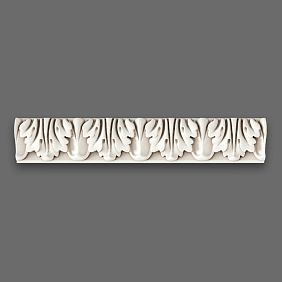
Wooden baseboardat the base of acoustic panels—in the same tone as the slats.Ceiling moldingsat the top edge—to complete the structure and conceal expansion gaps. For acoustic ceiling constructions—perimeter molding around the entire ceiling perimeter.
Acoustic slatted panels in interior design: aesthetics without compromise
A separate discussion concerns the visual aspect of acoustic slatted panels. A functional product does not have to look like a functional product—and the best examples of acoustic slatted decorative panels prove this.
In the home theater — deep anthracite and dark gray. Narrow slats 30–40 mm with a 12–16 mm gap. Integrated LED strip behind the slats at the lower tier — warm 2700 K. This is a cinematic space where you want to spend your evenings.
In the meeting room — natural oak veneer, slats 50–60 mm, gap 14–18 mm, matte oil finish. The material warmth of wood in a business space is a communicative signal: here they value quality and attention to detail.
In the living room — a light soft tone (powdery beige, warm white, soft gray). Slats 40–50 mm, moderate gap, delicate rhythm. The acoustics work imperceptibly — the space simply feels quiet and cozy.
Slatted panels in interior designAcoustic-type panels do not lag behind decorative ones in visual expressiveness — with the correct choice of parameters and finish. The rhythm of the slats, contrast of tones, texture of the finish work just as in ordinary decorative constructions. Only one dimension is added — silence.
Slatted facade panels and acoustics: an unexpected but real connection
Slatted Façade PanelsWith acoustic filler — this is already a different area: facade noise protection. External slatted panels with mineral wool filler on a building's facade reduce the penetration of street noise through the enclosing structure. Effectiveness depends on the mass of the structure and the density of the filler.
The principle is the same as in internal acoustic constructions: a sound wave, passing through a perforated or gapped outer surface, encounters an absorbing material that takes away a significant portion of the acoustic energy. For residential buildings near noisy transport arteries — this is a real and effective measure.
Soft slatted panels and acoustics: a new wave
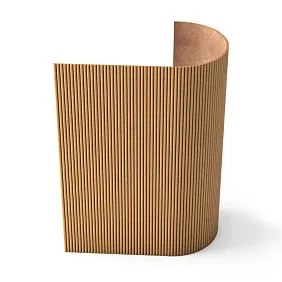
soft slat panelsOpen a special niche in the acoustic treatment of rooms with non-standard geometry. Arches, columns, cylindrical surfaces, rounded niches — where a rigid construction requires complex carpentry preparation, a soft panel is mounted directly, following the geometry of the surface.
Acoustic potential of soft slatted panels: a flexible supporting base combined with acoustic felt or foam filler. For rooms with curved surfaces (halls, receptions, arched corridors) — this is a solution combining mounting flexibility and acoustic function.
Acoustic slat panels DIY: is it possible?
Theoretically — yes. Practically — you need to understand the limitations.
DIY manufacturing of an acoustic slat decorative panel requires: perforated MDF board (it can be ordered from a CNC production facility or purchased ready-made), MDF or wood slats, acoustic filler (melamine foam is sold in sheets), glue, and fasteners.
Limitations: without professional milling equipment, achieving slat geometry accuracy of ±0.1 mm is impossible. Homemade MDF slats cut with a circular saw have a tolerance of ±0.5–1.0 mm — visible during assembly as uneven gaps. Perforation of the load-bearing board cannot be made uniform with hand tools.
DIY Batten Panels— is a reasonable choice for installation, but not for panel production. Buy the product from a manufacturer — install it yourself. This is the optimal task distribution.
Parametric table for selecting acoustic slat panels
| Parameter | Range | Influence |
|---|---|---|
| Slat width | 25–100 mm | Visual rhythm, open area ratio |
| Gap between slats | 5–30 mm | Acoustic efficiency (wider = better) |
| Base perforation percentage | 10–30% | Sound transmission to filler |
| Filler type | Melamine foam / mineral wool / felt | Absorption frequency range |
| Filler thickness | 20–50 mm | Effectiveness in mid and high range |
| Air gap | 0–100 mm | Effectiveness in low-frequency range |
| αw (overall) | 0,30–0,90 | Total acoustic efficiency |
| Sound absorption class | E–A | Summary classification |
Acoustic slatted panels and related interior elements
An acoustic slatted wall requires the right environment—both functionally and aesthetically.
buy slatted panelsfor acoustic treatment—is a solution that works in ensemble with other elements:soft slat panelson curved surfaces complement the acoustic picture;Slatted panels for the ceilingcover the most important surface from an acoustic perspective;Wooden baseboardmade of solid wood completes the construction at the floor;Furniture Handlesmade of the same wood as the slats create a cohesive material language.
In a space with a staircase —balusters for staircases— made from solid oak in the same finish as the acoustic slatted panels — is an architectural gesture that unifies the space vertically.Pogonazh iz massiva— baseboards, moldings, cornices — completes the acoustic structure, turning it into part of a cohesive interior statement.
FAQ: answers to the main questions about acoustic slatted panels
What is an acoustic slatted decorative panel?
It is a structure of decorative slats on a perforated load-bearing base with sound-absorbing filler (melamine foam, mineral wool, or acoustic felt). The decorative component creates an aesthetic interior effect; the acoustic one absorbs sound energy and reduces reverberation in the room.
How does an acoustic slatted panel differ from a regular decorative one?
By the presence of a perforated load-bearing base and sound-absorbing filler. A regular slatted panel scatters sound, slightly reducing reverberation. An acoustic one absorbs it, significantly reducing RT60.
In which rooms are acoustic slatted panels used?
Home theaters, meeting rooms, open-space offices, restaurants, recording studios, rehearsal rooms, living rooms with audio systems, home offices, conference halls.
What material is best for acoustic panel slats?
From an acoustic perspective, the slat material does not affect absorption—the filler absorbs sound. Aesthetically, MDF for painting offers maximum color freedom; oak veneer provides the authenticity of natural wood; solid wood offers premium materiality.
Can acoustic panels be installed independently?
Installation—yes, with basic construction skills and a laser level. Producing panels yourself is impractical without professional equipment. Install ready-made panels from the manufacturer.
How many acoustic panels are needed for a noticeable effect?
For a living room of 20–25 m²—cover 25–35% of the total wall and ceiling area. This is approximately 15–20 m² of acoustic panels. For a home theater—40–60%.
How are acoustic slatted panels attached?
To a metal frame with an air gap of 50–100 mm. Fastening is hidden, using clips or finish nails into the side edge of the load-bearing panel.
Does painting affect the acoustic properties of the panel?
A thin layer of matte water-based paint—no. Several layers of thick paint may partially block the perforation and reduce effectiveness. Check with the manufacturer for painting recommendations for the specific model.
How to combine acoustic slatted panels with other interior elements?
Choose the tone of the slats based on the overall color concept. Natural materials in adjacent elements (wooden baseboard, furniture with wooden details) emphasize the materiality of acoustic panels. It is important to ensure tonal unity: slats, baseboard, moldings — one material world.
Where to buy decorative acoustic slatted panels?
From specialized manufacturers of wooden architectural elements who offer documented product technical specifications, finish samples, and professional consultation on parameter selection.
About the company STAVROS
STAVROS is a Russian manufacturer of wooden architectural elements for interiors. If you are looking foracoustic slat panelsandDecorative slatted wall panelswith impeccable execution quality — STAVROS offers a full range for any acoustic and design task. In the catalog:slatted panels for wallsmade of MDF and solid oak with perforated bases for acoustic structures;modular slat wall panelsfor quick installation;soft slat panelsfor curved surfaces;Pogonazh iz massivafor finishing structures;Wooden baseboardandwooden skirting board purchasemade of solid oak;Furniture Handlesmade from natural wood;balusters for staircaseshandcrafted andClassic Furniturehigh level.
STAVROS is a manufacturer backed by real production, precise equipment, strict quality control, and responsibility for results. A space that is both quiet and beautiful at the same time is not a luxury. That's what STAVROS creates.


