












































































Article Contents:
- 3D Panels: Architecture of Vertical Surfaces
- 3D Panel Materials: From Gypsum to Polymers
- Decorative Brackets: Function Becomes Art
- Synergy of 3D Cladding and Brackets
- Stylistic solutions: from classic to high-tech
- Acoustic Properties: Beauty That Can Be Heard
- Installation: From Preparation to Finishing
- Practical Applications: From Residential to Commercial
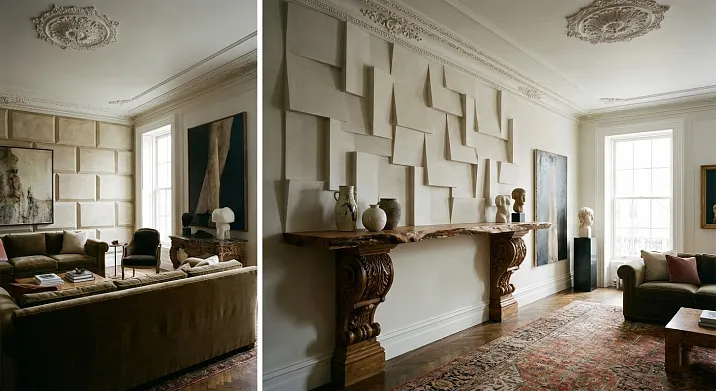
Flat walls are a thing of the past in interior design. Modern spaces require volume, depth, play of light and shadow, multi-layered perception. When a vertical surface acquires the third dimension, when relief creates movement of shadows throughout the day, when functional elements such as brackets become sculptural accents — the interior transforms from a set of utilitarian surfaces into a work of spatial art.3D Wall Decorationandshelf bracketsThey operate on different levels of space — the first structures verticality, creating a background, the second adds functional accents, linking walls with furniture, horizontal planes with vertical ones.
Why exactly three-dimensionality transforms space so beautifully? Because human perception is evolutionarily tuned to perceive the world in three dimensions. A flat surface is perceived as background, neutral base. A relief surface becomes an active participant in space, attracts attention, creates visual interest. When light falls on relief at different angles throughout the day, the wall changes, lives, never looks the same. This is dynamics in stillness, movement in immobility.3D Interior ElementsThey turn space into cinematic — with dramatic chiaroscuro, visual depth, multi-planar composition. Moreover, volumetric elements solve practical problems: they mask defects of base surfaces, improve acoustics, create a basis for integrating backlighting, zone space without partitions. This is beauty that is functional, and functionality that is beautiful.


3D Panels: Architecture of Vertical Surfaces
3D Wall PanelsThese are modular decorative elements with pronounced relief on the front surface. Standard panel sizes — 500x500, 600x600 mm squares or 1000x500 mm rectangles — allow covering large wall areas quickly and with predictable results. Relief depth varies from delicate 10–15 mm for minimalist interiors to expressive 40–60 mm for dramatic, sculptural compositions.
Geometric reliefs — the most popular type of 3D panels for modern interiors. Squares protruding from or recessed into the plane create a checkerboard pattern with clear play of light. Honeycombs — hexagons forming an organic, natural pattern reminiscent of bee hives. Waves — smooth sine waves creating a sense of movement, flow, fluidity. Cubes — complex multi-level compositions with protruding edges, creating maximum shadow play. Pyramids — pointed elements directed outward from the wall, creating an aggressive, dynamic texture. Rhombuses and zigzags — diagonal patterns adding energy and visual movement.
Organic reliefs imitate natural textures. Ocean waves — smooth curves creating a calming, meditative effect. Fabric folds — drapery creating a soft, textile character for walls. Tree bark — rough, textured surface for eco styles. Stone slabs — imitation of natural stone with cracks, chips, natural irregularities. Botanical motifs — stylized leaves, bamboo, vines for tropical and ethnic interiors.
Abstract reliefs — arbitrary, artistic compositions where forms do not conform to geometric or natural logic. This is pure art, where relief is created for visual effect, play of light, emotional impact. Such panels transform a wall into a sculptural installation, a work of contemporary art.
Application of 3D panels on accent walls — the most common scenario. One wall in the living room behind the sofa, clad in volumetric panels, becomes the visual center of the room. A wall behind the TV with relief creates an architectural frame for the screen. A wall behind the headboard in the bedroom transforms the sleeping zone into a luxurious alcove. A wall in the hallway or corridor with 3D decor creates a memorable first impression, setting the tone for the entire interior.
Full cladding of a room with 3D panels — a bold solution for creating a maximally sculptural, immersive space. All walls in relief transform the room into an architectural cocoon, where every surface is active and expressive. This works well in small specialized spaces — home theaters, where relief improves acoustics, meditation rooms, where texture creates an atmosphere, restaurants and bars, where dramatic ambiance is needed.
Partial cladding — inserts of 3D panels framed by moldings create decorative panels, murals. A rectangular relief on a smooth painted wall, framed bydecorative moldingsacts as a painting, but volumetric, changing depending on lighting.
Columns and niches — 3D panels are ideal for cladding columns, creating expressive textured pillars. Niches clad with relief panels acquire depth, becoming architectural accents. This is especially effective with integrated backlighting, when light from within the niche highlights every curve of the relief.




3D Panel Materials: From Gypsum to Polymers
Gypsum 3D panels — a classic option, providing maximum relief detail, eco-friendliness, and the ability to paint in any color. Gypsum is a natural material, breathable, regulating humidity. However, gypsum is heavy, fragile during transport and installation, and afraid of moisture. Gypsum panels are suitable for dry rooms where eco-friendliness and willingness to pay for the material and complex installation are important.
Polyurethane 3D panels combine lightness, strength, and moisture resistance. Polyurethane is 3–4 times lighter than gypsum, simplifying installation and reducing wall load. It is absolutely moisture-resistant — suitable for bathrooms, kitchens, even facades. Polyurethane is impact-resistant — accidental impacts won’t crack the panel. It is easy to cut, paint, and install on adhesive without complex fastening.polyurethane panels— optimal choice for most projects in terms of price-quality-practicality.
MDF panels with carved relief — wooden base with mechanically cut 3D pattern. MDF is a dense, stable material that holds its shape well. MDF panels are usually painted or covered with natural wood veneer. This is a choice for interiors where the naturalness of the material and the warmth of wood are important. However, MDF is afraid of moisture — only suitable for dry rooms.
PVC panels — plastic, the lightest and most moisture-resistant. PVC is completely unaffected by water, does not rot or mold. PVC panels are inexpensive, easy to install, and easy to clean. However, plastic looks less noble than plaster or wood, may yellow over time, and is less eco-friendly. This is a budget option for humid areas and auxiliary zones.
Wooden 3D panels — solid wood or veneer with relief created by milling, carving, or assembly from separate elements. Wood is the most noble, warm, and alive material.wooden wall panelsRelief creates the most prestigious, natural interior. However, wood is expensive, requires special care, and is afraid of humidity and temperature fluctuations. This is a choice for prestigious projects with a corresponding budget.
Hybrid panels combine materials — for example, MDF base with polyurethane relief, offering the strength of MDF and the detail of polyurethane. Or wooden frame with plaster relief inside, combining the warmth of wood and the expressiveness of plaster.
Our factory also produces:

Decorative brackets: function becomes art
If 3D panels create an architectural backdrop, thenDecorative brackets for shelves— functional sculptural accents. A bracket is a supporting element that holds a shelf, beam, or protruding windowsill. In utilitarian form, a bracket is unnoticed — hidden mounting or simple metal console. But when a bracket becomes decorative, it transforms into a standalone design element that decorates the interior no less than the shelf it supports.
Decorative bracket shapes are diverse and define the style. Classical consoles — curved S-shaped or volute forms, inspired by Baroque and Renaissance architecture. They imitate structural elements of old buildings, where consoles actually supported balconies and cornices. In interiors, such brackets create an atmosphere of classical architecture and palace grandeur.
Triangular brackets — the simplest geometric form, where a horizontal shelf and vertical wall are connected by a diagonal brace. This is a honest construction, where the logic of load transfer is visible. Triangular brackets suit minimalist, modern, and loft interiors, where functional straightforwardness is valued.
Carved wooden brackets — artistic elements with ornaments, plant motifs, scrolls.Carved wooden bracketstransform a shelf into a decorative object. Such brackets are characteristic of classical, Victorian, and Provencal interiors, where handcrafted beauty and artisan craftsmanship are important.
Wrought metal brackets — from black metal with patina or brass, bronze. Wrought scrolls, interweavings, plant motifs create an airy, lightweight structure that supports a shelf but does not visually overload. Wrought metal brackets are ideal for interiors with wrought iron elements — railings, chandeliers, grilles.
Minimalist brackets — concise metal or wooden elements of simple geometric forms without ornamentation. Rectangular cross-section, rounded corners, matte finish. Such brackets are almost unnoticed, performing their function without drawing extra attention. This is a choice for Scandinavian, Japanese, and modern minimalist interiors.
Sculptural brackets — unique original forms, where the bracket becomes a work of art. Abstract organic forms, figurative elements — animals, plants, geometric sculptures. Such brackets transform a shelf into an art object, requiring appropriate context — gallery, museum, or artist interiors.
Bracket sizes are determined by shelf size and load. For a light decorative shelf 200-300 mm deep with several books, a bracket with 150-200 mm overhang is sufficient. For a deeper shelf 400-500 mm with heavy load, brackets with 300-400 mm overhang are needed. For cantilevered countertops and bar stands, strong brackets 500-700 mm overhang made from strong materials are required.
Bracket materials — wood, metal, polyurethane. Wooden brackets — the warmest, most natural, noble.Solid wood bracketsOak, ash, walnut combine with wooden shelves, creating a unified composition. Metal brackets — the strongest, capable of holding heavy loads, have an industrial or classic character depending on finish. Polyurethane brackets — lightweight, moisture-resistant, paintable in any color, suitable for decorative shelves with light load.
Get Consultation
Synergy of 3D finishing and brackets
The magic of the interior arises when different 3D elements start working together, creating a multi-layered, rich spatial composition.3D panels on the wallcreate a relief background,decorative brackets with shelvesadd functional accents on this background. This creates depth, multi-layeredness, and interplay between background and objects.
Texture contrast — a smooth wooden shelf on carved brackets against a geometric relief of 3D panels creates a play between wood’s organic texture, relief’s geometry, and shelf’s functionality. Each element is readable individually, but together they create a harmonious composition.
Color solutions can be monochromatic — all elements in one color, where volume is perceived only through light and shadow. White 3D panels, white brackets, white shelf — pure form play without color distractions. Or contrasting — dark panels, light brackets and shelf or vice versa. Contrast highlights each element, making the composition more graphic and dramatic.
Material unity — when panels and brackets are made of the same material, it creates cohesion. Wooden 3D panels from oak and oak brackets — monolithic wooden composition. Polyurethane panels and polyurethane brackets, painted in one color — unified plastic environment, characteristic of modern interiors.
Thematic correspondences — ornament on brackets can repeat or echo the pattern of 3D panels. If panels have plant relief, brackets can also feature plant motifs. If panels are geometric, brackets can also have geometric forms. This creates thematic unity, visual rhyme.
Lighting — a critical element for revealing 3D decor. Relief of 3D panels is most pronounced under side lighting, when light glides along the wall, creating long shadows. LED strip installed at the bottom or top of the wall with panels, directing light along the relief — classic technique. Spotlights aimed at the wall at a sharp angle create dramatic light and shadow. For brackets and shelves, use directional lights from above or below, highlighting bracket shapes, creating shadows, adding volume.
Stylistic Solutions: From Classic to High-Tech
Classic style uses 3D panels with classic ornaments — rosettes, acanthus, meanders, woven patterns.石膏 panels in white or with gilded details.Classic decorative bracketsCarved from wood or wrought from metal with scrolls and volutes. Shelves made of solid oak or walnut. This is palace aesthetics, requiring appropriate context — moldings, quality furniture, rich textiles.
Neoclassicism — a more restrained version of classicism. 3D panels with delicate relief — shallow geometric patterns, stylized plant motifs. Colors are light — white, cream, light gray. Brackets in simplified classical forms without excessive decoration. Shelves made of light wood or painted. This is modern elegance with classical references.
Loft uses 3D panels as a contrast to rough industrial surfaces. Concrete walls in the main part of the room, one accent wall with wooden 3D panels or brickwork relief imitation. Brackets made of black metal, rough and brutal, with large bolts. Shelves made of untreated wood, old planks. This is industrial aesthetics with decorative elements.
Scandinavian style — minimalist use of volumetric decor. 3D panels with simple geometric relief — waves, honeycombs, parallel lines. Colors white or light gray.Plank wall cladding— a variant of creating a 3D effect through vertical or horizontal slats. Brackets made of light-colored birch, pine, or light oak in minimalist forms. Shelves also made of light wood. This is northern simplicity with delicate volume.
Japanese minimalism uses volumetric decor even more restrainedly. 3D panels with organic, natural relief — bamboo imitation, water ripple, stone masonry. Colors natural — beige, gray, dark brown. Brackets minimalist, almost invisible, or absent — shelves on hidden mounting. Wood dark or light, but always matte, without gloss. This is Zen aesthetics, where volume is delicate and unobtrusive.
Modern eclectic — free mixing of elements. 3D panels with modern abstract forms can combine with vintage wrought iron brackets. Geometric relief — with classic carved elements. Colors bold, unexpected — graphite, emerald, terracotta, copper. This is a play with forms, textures, meanings, creating unique, original combinations.
High-tech uses 3D panels as technological surfaces. Metallic coatings, imitation of technical textures — perforation, corrugation, industrial patterns. Colors cold — silver, graphite, white. Brackets made of polished stainless steel or chrome metal in simple geometric forms. Shelves made of glass or glossy plastic. Integration of LED backlighting into the relief of panels and under shelves. This is technological, futuristic aesthetics.
Acoustic properties: beauty that can be heard
Volumetric surfaces affect not only visual, but also acoustic perception of space. Flat smooth walls reflect sound mirror-like, creating echo, reverberation, making room acoustics unpleasant and noisy. Relief 3D panels scatter sound waves, break their trajectories, reduce echo.
Relief depth determines acoustic effect. Panels with 20-40 mm relief effectively scatter mid and high frequencies — human speech, music. Panels with deep relief 50-80 mm affect even low frequencies, improving bass component of acoustics.
Panel material is also important. Soft, porous materials (special acoustic gypsum panels, fabric-covered panels) absorb sound. Hard materials (polyurethane, wood, plastic) reflect sound, but scatter it due to relief. For home theaters, music rooms, recording studios, special acoustic 3D panels are used, where relief is designed specifically for optimal acoustics.
Placement of acoustic panels — on the wall opposite the sound source (behind home theater seats, opposite speakers), on side walls to control reflections, on ceiling to prevent reverberation. Combination of absorbing and scattering panels allows creating ideal acoustic environment.
Installation: from preparation to finish
Installation of 3D panels begins with wall preparation. Surface must be flat — panels replicate the relief of the base wall, and unevenness will be noticeable. If the wall is curved, it is leveled with plaster or panels are mounted on a framing set to level. Wall must be clean, dry, and strong — peeling paint, wallpaper must be removed.
Marking — panels are usually started from the corner or center of the wall, depending on the pattern. If the pattern is symmetrical, it is reasonable to start from the center to ensure balanced composition. If the pattern is random, start from the corner, moving row by row.
Adhesive is selected based on panel material. For gypsum — gypsum or polymer adhesive. For polyurethane — polyurethane adhesive like liquid nails. For wooden MDF — carpentry or construction adhesive. Adhesive is applied to the back of the panel with a notched trowel, ensuring even layer.
Installation — panel is applied to the wall according to marking, pressed, held for a minute. Heavy panels are additionally secured with self-tapping screws until adhesive dries, then screws are removed or left if covered by the next panel. Panels must fit tightly, gaps are not allowed — they will disrupt the continuity of relief.
Trimming panels at corners and edges of walls is done with a saw (for gypsum, polyurethane, MDF) or electric jigsaw. Precision of cut is important for tight joints.
Final finishing — joints between panels are filled with joint compound (for gypsum) or sealant (for polyurethane), smoothed out. After drying, panels are painted to desired color or left as-is (if they are painted or veneered panels).
Mounting brackets requires precision and strong mounting. Brackets for shelves carry real load, so mounting must be to a strong wall — brick, concrete, wood. Gypsum board without reinforcement is not suitable for heavy shelves.
Marking — brackets must be level, strictly horizontal. Use laser or water level. Distance between brackets depends on shelf length and load — for 600-800 mm shelves, two brackets are sufficient, for 1200-1500 mm, three are needed.
Mounting — holes are drilled in the wall through bracket holes, anchors inserted, bracket screwed or bolted on. For heavy shelves, use anchor bolts. Bracket must sit tightly, without play.
Shelf installation — shelf is placed on brackets, leveled. If rigid fixation is needed, shelf is screwed to brackets from below. If mobility is needed, shelf remains freely lying.
Practical applications: from residential to commercial
In residential interiors, 3D panels and decorative brackets create individuality, character. Living room — accent wall behind sofa with geometric relief, open shelves on carved brackets on sides with books and decor. Bedroom — wall behind headboard with soft organic relief, bedside shelves on minimalist brackets. Office — wall with classic panels, library shelves on solid wooden brackets. Children's room — panels with playful, cheerful relief, bright shelves on brackets of unusual shapes.
In commercial interiors, volumetric decor creates memorable atmosphere, supports branding. Restaurants — 3D panels on walls create intimacy, improve acoustics. Shelves and bar counters on decorative brackets add character. Hotels — lobbies and halls with volumetric walls create impressive first impression. Offices — meeting rooms and waiting areas with 3D panels look modern, technological. Stores — volumetric walls as background for products, shelves on beautiful brackets as merchandising elements.
In exhibition spaces, galleries, 3D panels create neutral yet expressive background for art. Relief adds visual interest without competing with exhibits. Shelves on brackets for placing sculptures, installations.
In entertainment venues — cinemas, clubs, bars — volumetric decor creates an atmosphere and mood. Dark 3D panels with dramatic lighting, metallic brackets with bottle and decor shelves — this creates a memorable, photogenic environment.
Start creating a volumetric interior with one accent wall. Choose3D panels of the appropriate style, mount them on the key wall of the room. Add one or two shelves ondecorative brackets, harmonizing with the panels in style and material. Plan the lighting that highlights the relief. Feel how the space acquires depth, character, individuality. And move forward — adding volumetric elements, creating a multi-layered, rich, unique space, where every surface speaks, every element matters, where flatness has become volume, and function — art.


