


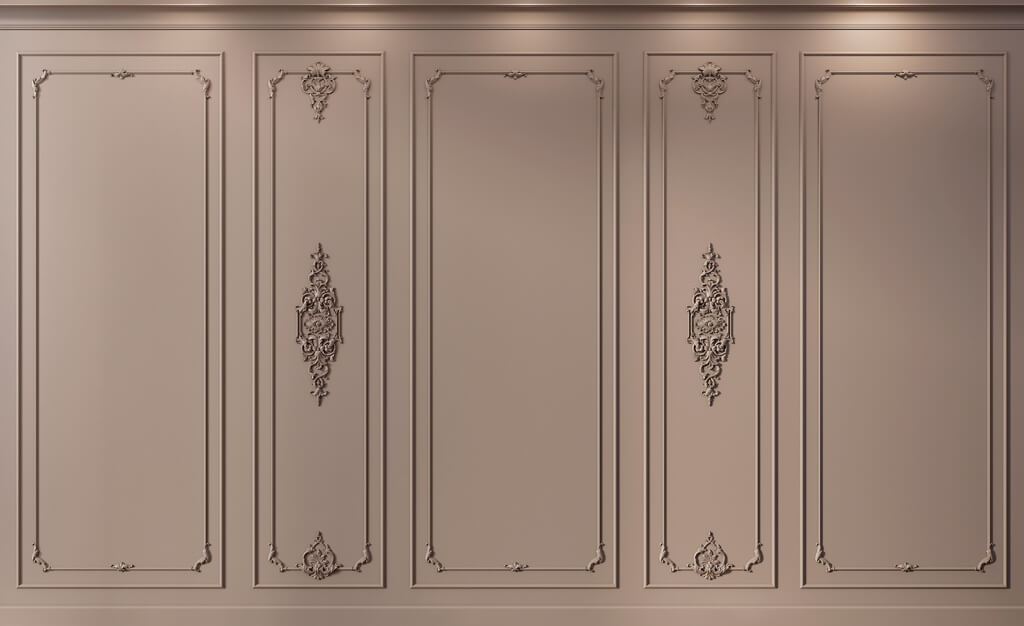
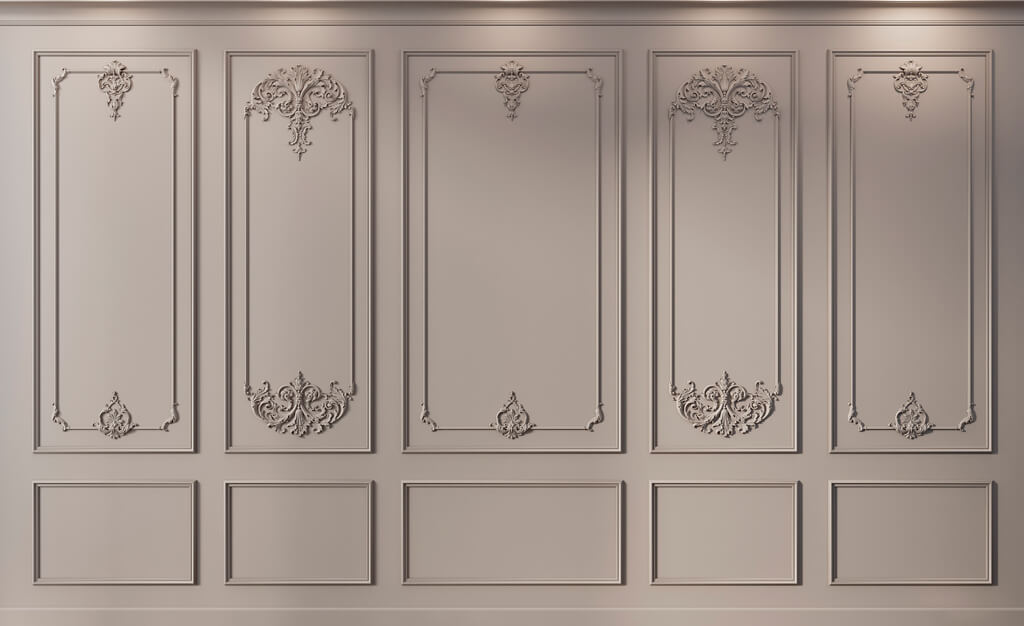
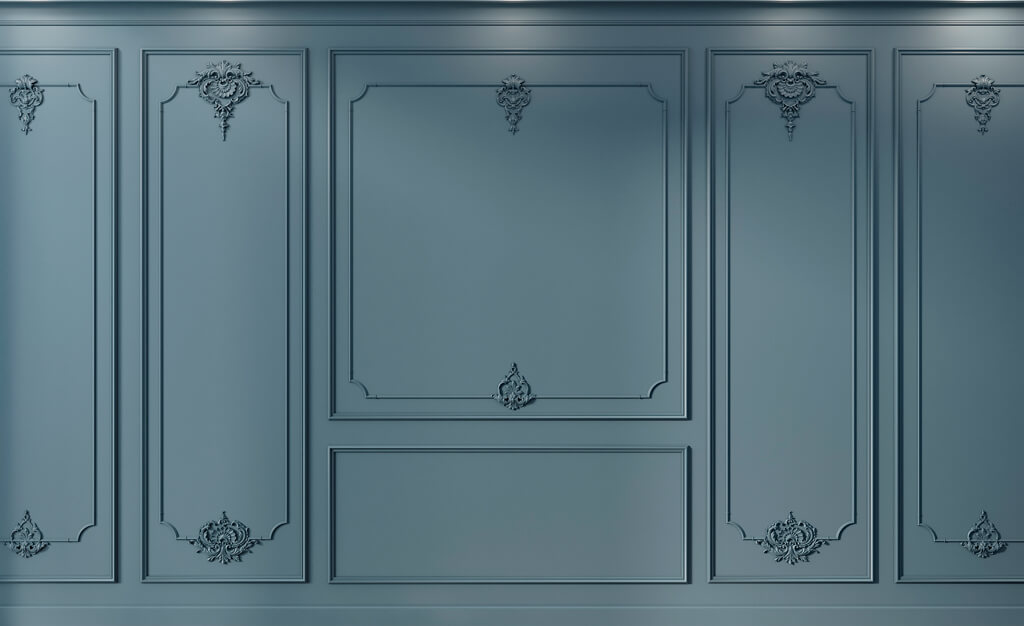
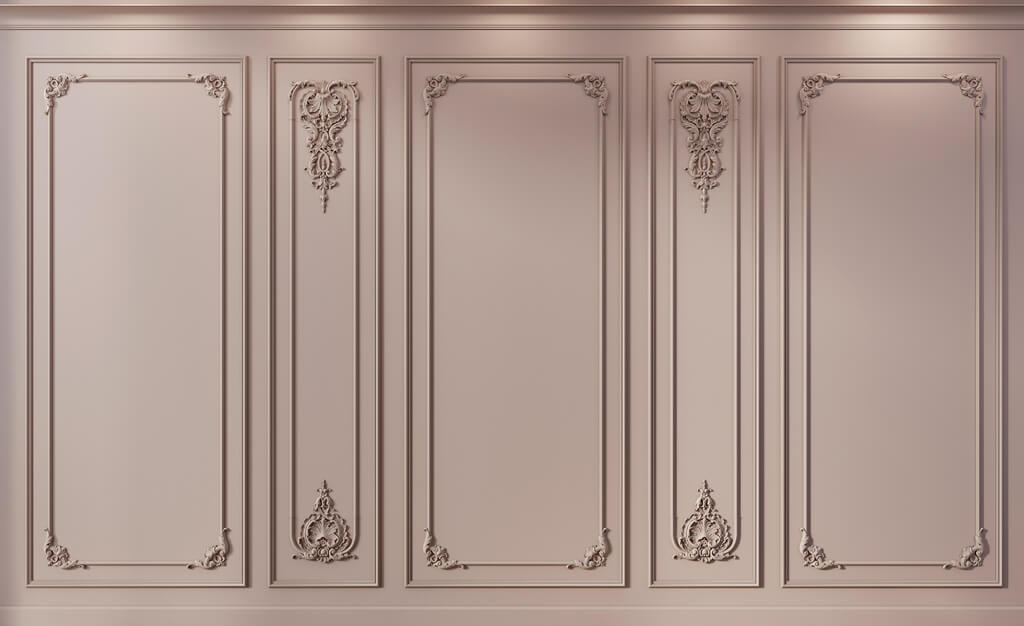

























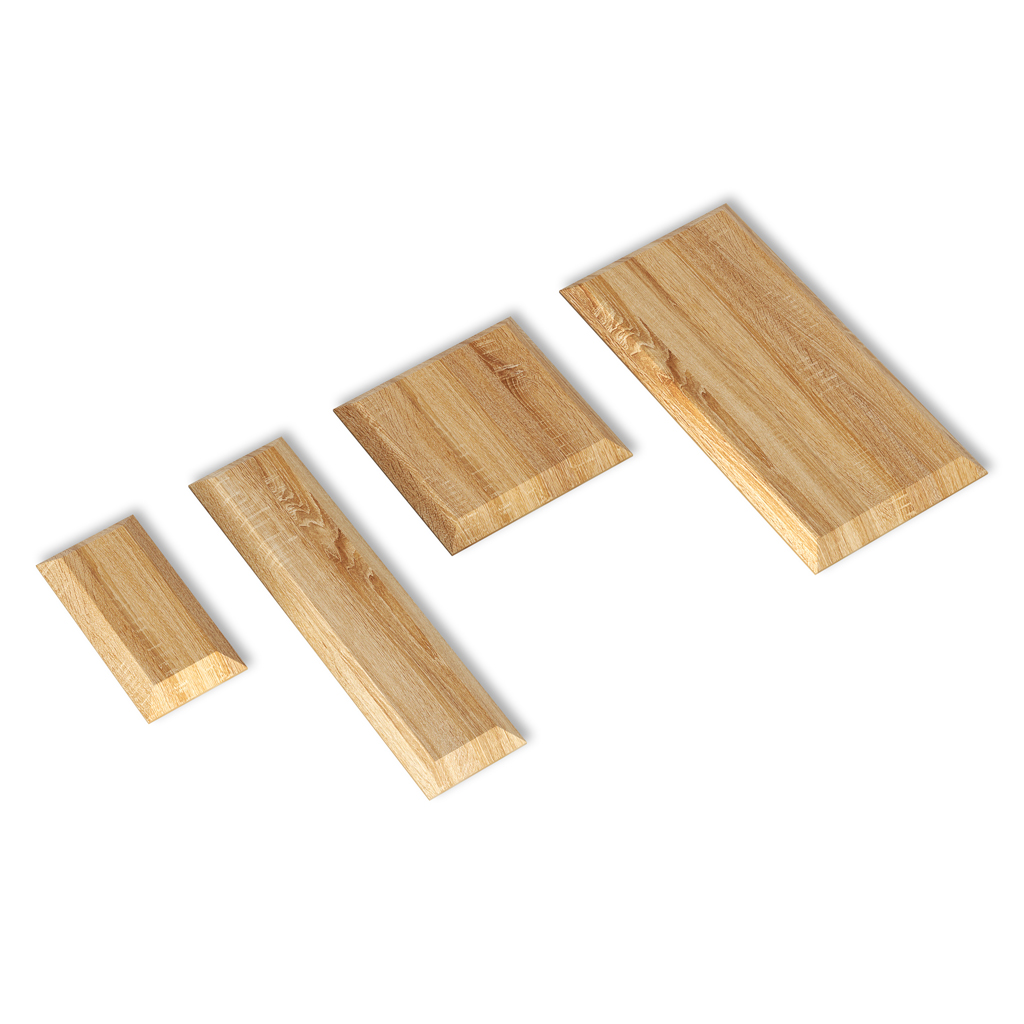

Dimensions and Options
Description
Wooden panel DP-004 — geometric wall panels made of oak and beech for decorative interior finishing
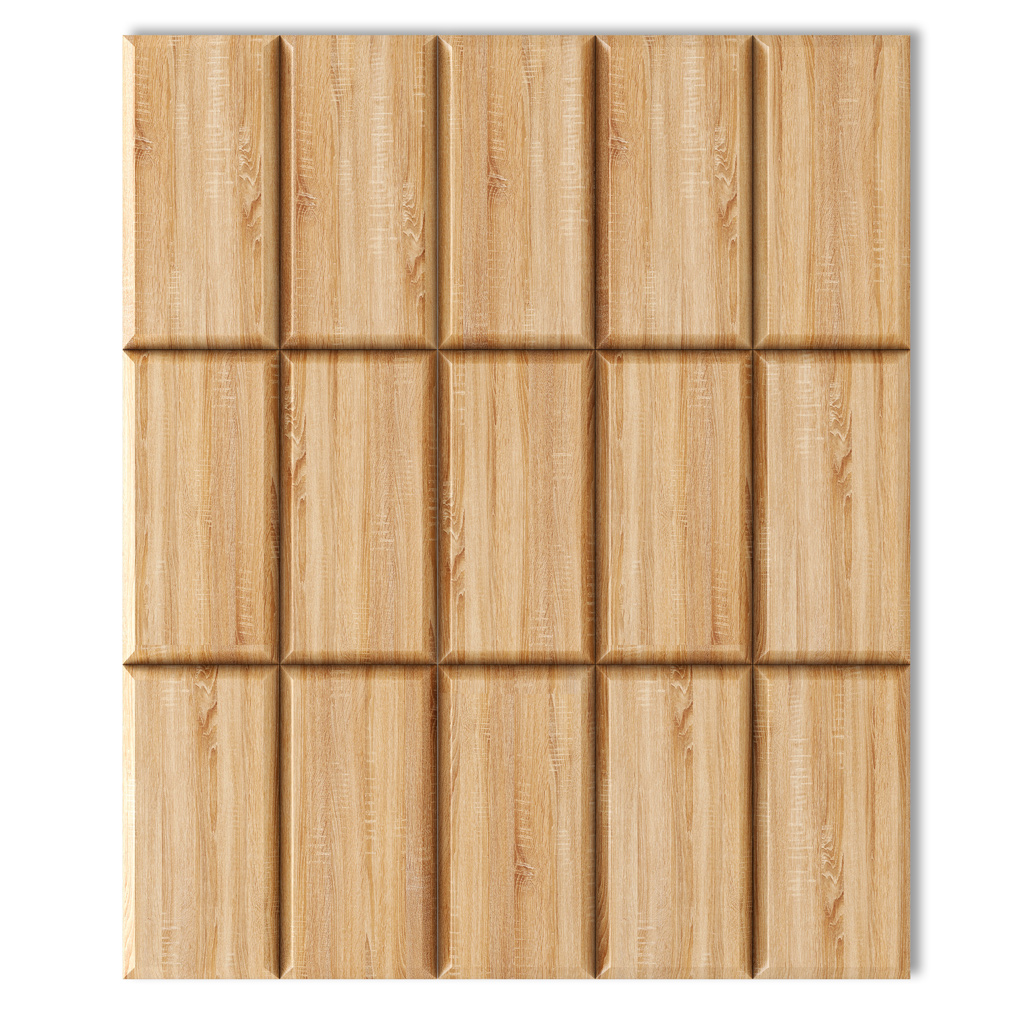
Wooden panel DP-004 — a decorative finishing element with expressive geometry, natural wood texture and a relief surface, designed to create original interior compositions. The model combines a concise rectangular shape, neat chamfered edges and a natural wood grain. Thanks to this solution, an ordinary wall plane gains volume, depth and an individual architectural character.
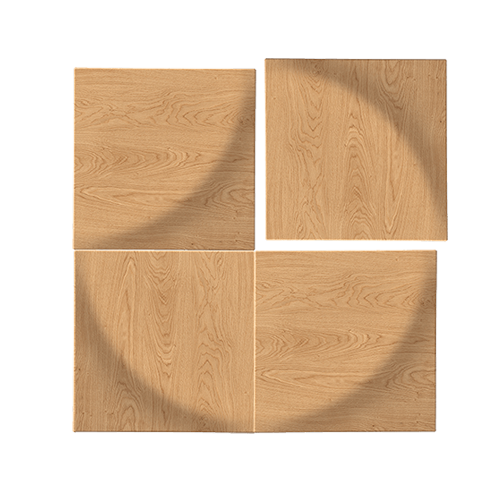
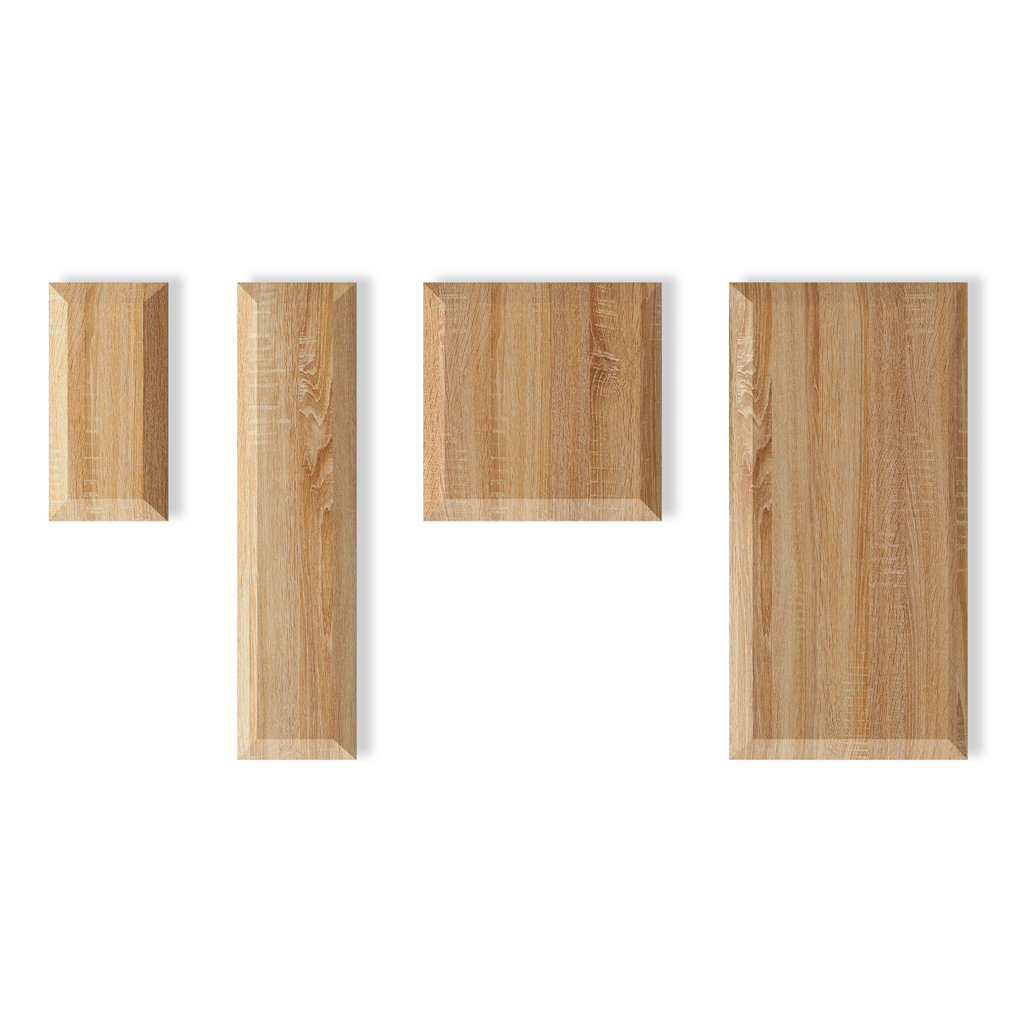
Decorative wooden panels DP-004 allow you to create a variety of design options: from strict symmetrical compositions to complex modular surfaces in which vertical, horizontal, square and rectangular elements alternate. The special feature of the model lies in the ability to combine four standard sizes, forming continuous decorative panels, accent zones and geometric ornaments.
Two wood species are provided for manufacturing — oak and beech. Each of them has a characteristic natural texture and its own aesthetic features. Oak attracts with an expressive grain pattern and a noble texture, while beech is distinguished by a calmer, more uniform perception of the surface. This allows you to choose a material taking into account the overall interior concept, lighting conditions and the desired decorative effect.
Wooden wall panels DP-004 are suitable for decorating living rooms, bedrooms, studies, hallways, public spaces and individual interior zones. They can be used as a standalone decorative accent or become part of a comprehensive solution that combines wood, painted surfaces, stone, metal, glass and other finishing materials.
Design features of the wooden panel DP-004
The design of DP-004 is based on a simple geometric shape, complemented by processing of the front surface along the perimeter. The central part of the panel is a flat plane framed by chamfered edges. This treatment forms a smooth visual transition between the main surface of the element and its outer boundaries.
Unlike conventional flat wooden cladding, the decorative panel DP-004 creates a pronounced interplay of light and shadow. Light interacts differently with the central part and the inclined sections of the surface, so that each detail is perceived as a separate three-dimensional module.
The geometric relief is especially well revealed under side lighting. Light areas emphasize the wood texture, while the darkened lines between adjacent elements make the cladding pattern more distinct. Even a composition of identical panels can look dynamic due to the repetition of edges, the direction of the grain and the natural variations of the wood pattern.
The rectangular geometry of DP-004 is universal from a design perspective. It is not tied exclusively to classical or modern styling, so it can be used in various interior directions.
Key decorative features of the model:
-
Geometric form with clear proportions and expressive beveled edges.
-
Natural wood texture, giving each piece an individual pattern.
-
Four formats, allowing for various modular layout options.
-
Ability to place rectangular elements vertically and horizontally.
-
Compatibility with modern and traditional finishing materials.
-
Suitable for both small accent areas and large wall surfaces.
-
Relief pattern that is perceived differently depending on the direction of lighting.
Thanks to the combination of a simple form and the natural texture of wood, the model remains visually relevant regardless of changing interior trends. Here, the decorative effect is created not by a complex ornament, but by proportions, material, rhythm, and the interaction of individual elements.
Natural wood: oak and beech
The choice of wood significantly affects the appearance of the finished decorative composition. Even with identical geometry, wooden wall panels made from different species can be perceived differently.
DP-004 wooden panels made of oak
Oak has traditionally been used in furniture manufacturing, joinery and interior finishing thanks to its expressive texture and characteristic natural pattern.
Oak wood has a pronounced fiber structure, which may contain straight and wavy lines, areas of varying tonality and characteristic natural transitions of shades. It is these features that make it possible to obtain a complex, visually rich surface without the need to use additional decorative patterns.
Oak wooden wall panels look especially expressive in interiors where natural wood becomes one of the main finishing materials. They combine well with wooden furniture, natural stone, metal, textured fabrics and solid-colored walls.
When using DP-004 oak elements, you can create compositions with an emphasis on the wood pattern. Depending on the direction of the fibers and the arrangement of the parts, the cladding will look calmer or, conversely, emphatically dynamic.
Oak texture is appropriate in modern living rooms, studies, libraries, meeting rooms and representative public interiors. It is especially harmonious in combination with warm lighting, muted wall shades and furniture with laconic shapes.
When choosing panels, it should be taken into account that natural wood does not have an absolutely uniform pattern. Differences in the arrangement of fibers, shades and natural features of the structure form the character of the surface and are part of the aesthetics of the material.
DP-004 wooden panels made of beech
Beech is distinguished by its characteristic wood structure and, as a rule, a more even visual pattern compared to the expressive texture of oak.
Beech wood can have soft tonal transitions, fine grain lines and a calm natural texture. These characteristics make it a suitable material for interior solutions in which the main decorative role should be played by the shape of the panels rather than by a contrasting wood pattern.
Beech wall panels are suitable for bright modern spaces, minimalist interiors, bedrooms, home offices and lounge areas. They allow you to create geometric compositions that preserve a sense of visual order and harmony.
DP-004 beech panels look good in a regular layout, when elements of the same size repeat in a certain sequence. The even rhythm of rectangles and squares makes the surface architecturally expressive without overloading it with additional details.
Another interesting use of beech is interior design in a natural color palette. The wood texture can be combined with beige, milky, sandy, gray and other neutral shades.
When choosing between oak and beech, it is important to focus not only on color. It is necessary to take into account the character of the wood pattern, neighboring materials, the dimensions of the surface to be faced and the overall degree of decorative richness of the room.
Which wood should you choose?
If the task is to create an accent wall with a pronounced natural texture, oak is worth considering. Its pattern can become an independent part of the decorative composition.
If a more restrained surface is required, in which the rhythm of geometric elements comes to the fore, beech can be chosen.
At the same time, the final shade depends on the characteristics of the specific wood, the processing method and the selected finish coating. Therefore, when developing an interior project, it is advisable to evaluate real material samples under the intended lighting conditions.
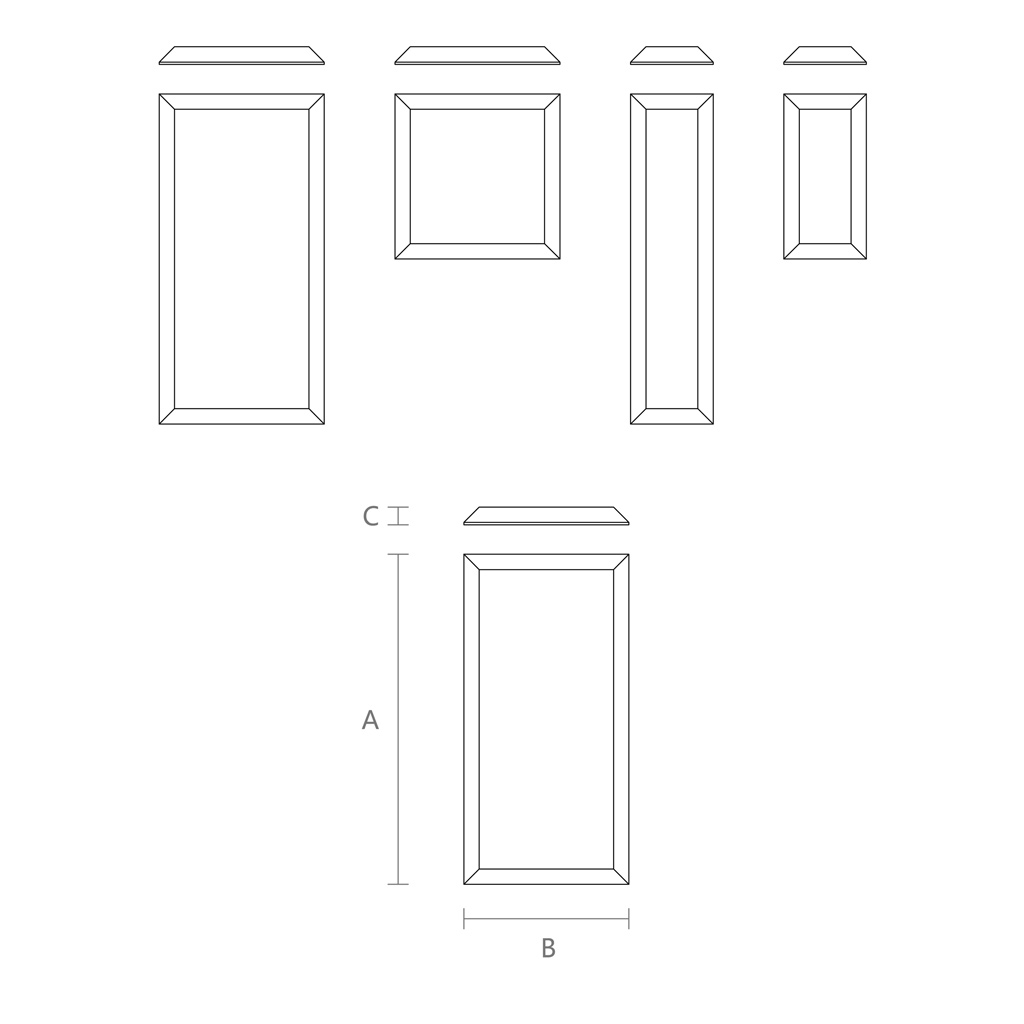
Dimensions and geometry of DP-004 decorative panels
One of the main advantages of the model is the availability of four sizes, which can be used both individually and as part of a single modular composition.
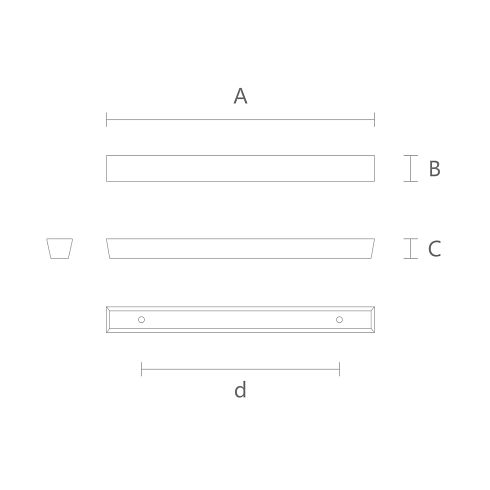
| Height A, mm | Width B, mm | Thickness C, mm | Wood |
|---|---|---|---|
| 140 | 70 | 15 | Beech, oak |
| 280 | 70 | 15 | Beech, oak |
| 140 | 140 | 15 | Beech, oak |
| 280 | 140 | 15 | Beech, oak |
The specified dimensions allow for different geometric proportions without changing the nominal thickness of the product. When planning the layout, it is necessary to take into account the orientation of the rectangular panels, the dimensions of the surface to be clad, and the expected width of the installation joints.
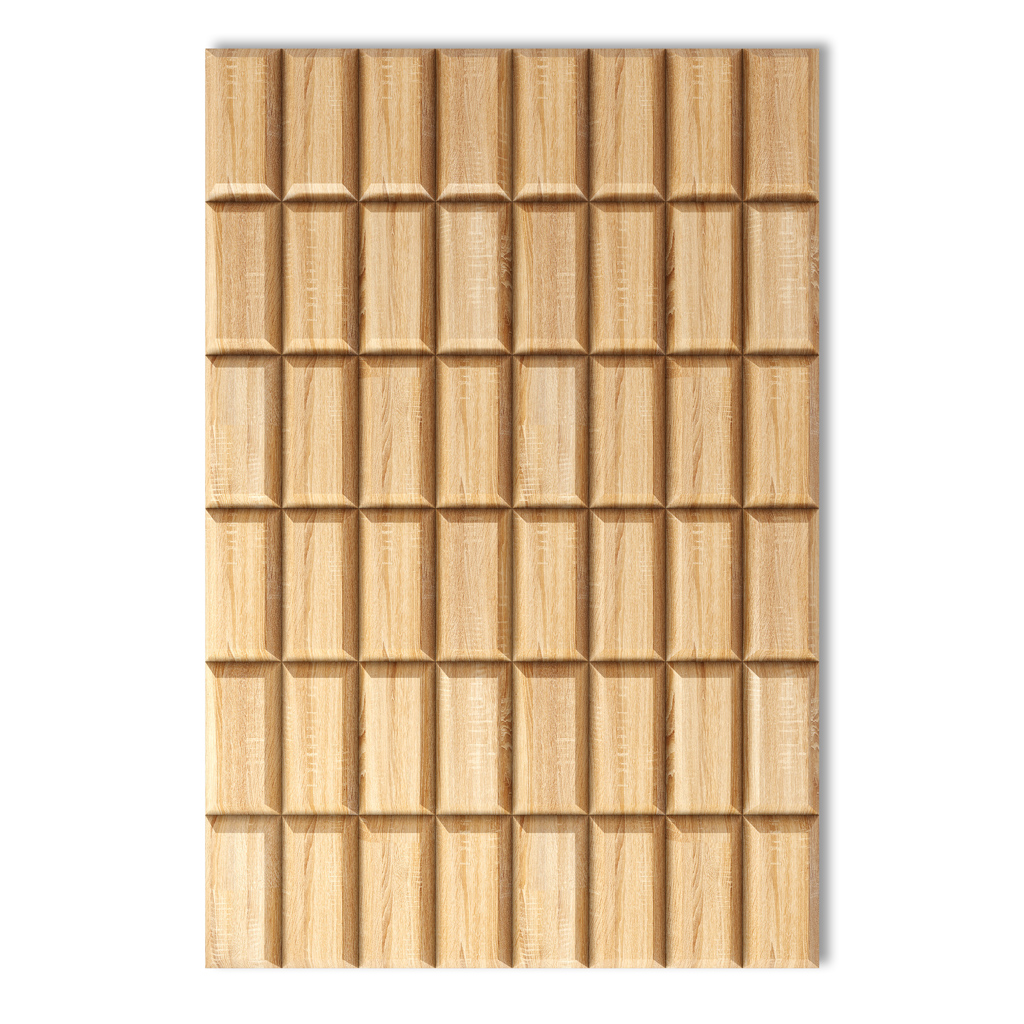
Panel 140 × 70 × 15 mm
The compact rectangular format is suitable for creating a fine, regular rhythm. Such elements make it possible to form a surface with a large number of repeating facets.
With a vertical layout, the composition takes on an elongated pattern. A horizontal orientation makes the surface calmer and more extended.
The small dimensions are also convenient when developing complex decorative schemes that require alternating modules of different shapes.
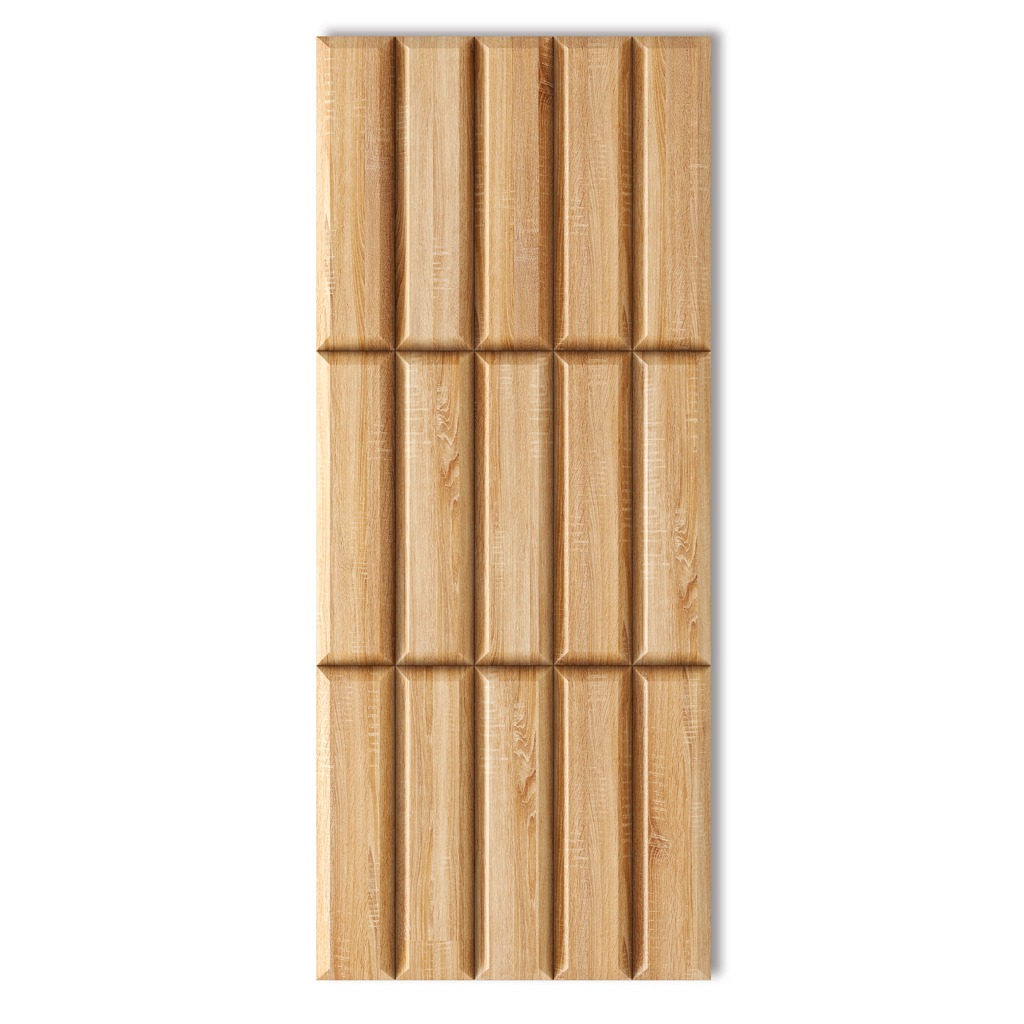
Panel 280 × 70 × 15 mm
The elongated rectangular format features expressive proportions. It is suitable for creating vertical decorative stripes, elongated geometric patterns, and sequential modular compositions.
When placed vertically, such wooden panels visually emphasize the height of the surface. When positioned horizontally, they enhance the sense of the wall's extent.
This format can be used on its own or combined with shorter elements.
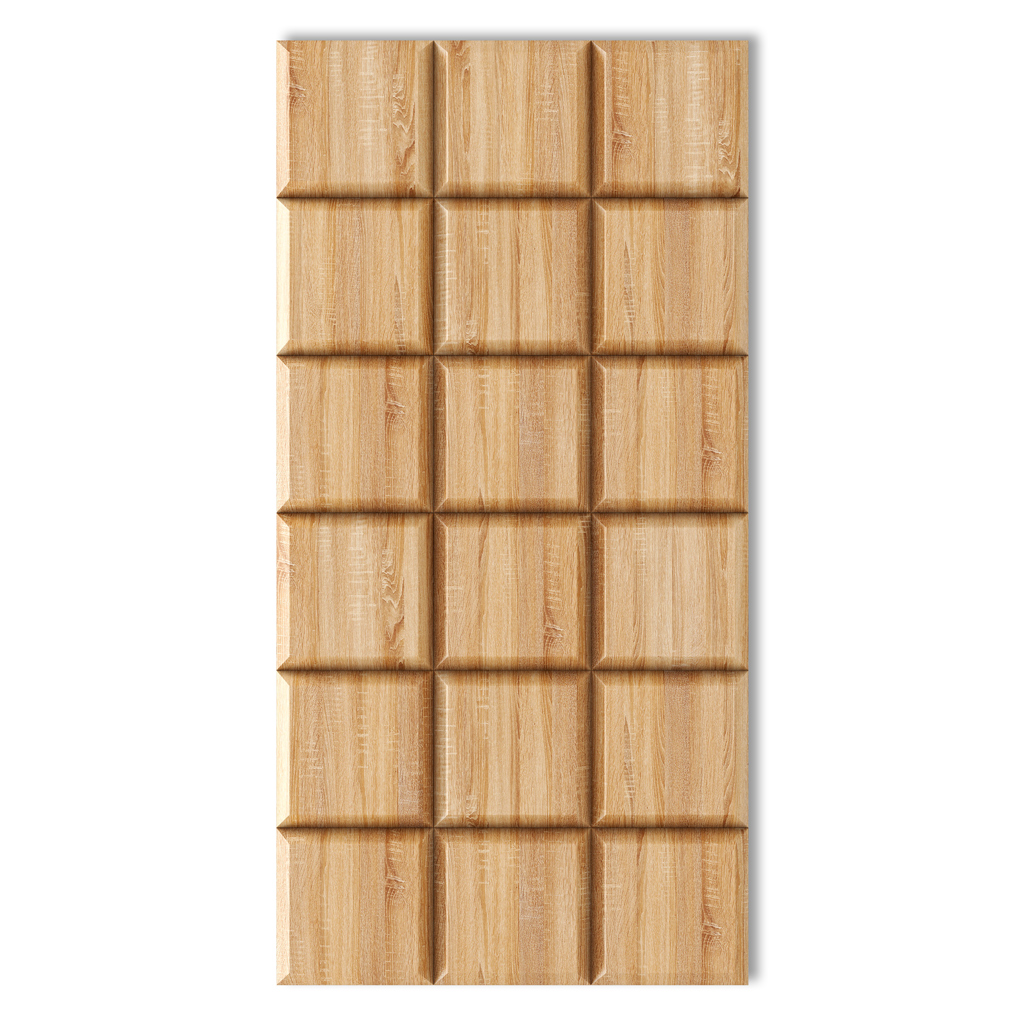
Panel 140 × 140 × 15 mm
The square decorative panel allows you to create compositions with an even geometric pattern.
Square elements form a visually stable structure. They can be arranged in strict rows, combined with rectangular pieces, or used to highlight individual sections of the decorative surface.
The square format looks especially striking under directional lighting, when the angled facets of each piece create distinct light-and-shadow transitions.
Panel 280 × 140 × 15 mm
The large rectangular format is suitable for finishing substantial wall areas and creating compositions with a larger decorative rhythm.
Thanks to the increased area of each individual element, the surface feels calmer than when using a large number of small modules.
The 280 × 140 mm panels can be positioned vertically and horizontally, creating architectural accents of various kinds.
Advantages of the modular size system
All four formats are based on interrelated geometric dimensions that are multiples of 70 mm. This provides extensive possibilities for designing combined layouts.
For example, a square module of 140 × 140 mm by nominal dimensions corresponds to two elements of 140 × 70 mm, and a large rectangle of 280 × 140 mm corresponds to two square panels of 140 × 140 mm.
This dimensional consistency allows for the development of compositions with alternating large and small details. However, when calculating the actual layout, it is necessary to additionally take into account technological gaps, manufacturing tolerances, and installation specifics.
Layout options for wooden panels DP-004
The DP-004 model reveals its decorative potential precisely in composition. The shape of an individual element is quite laconic, but the repetition and combination of panels allow for the creation of complex surfaces with a characteristic rhythm.
Vertical layout
The vertical orientation of rectangular panels is suitable for interiors in which it is necessary to emphasize the height of the wall.
The elements are arranged in parallel rows, forming repeating vertical lines. The beveled edges create intermediate light-and-shadow transitions that enhance the sense of relief.
Vertical compositions are especially appropriate behind a sofa, in the headboard area of a bed, on an accent wall of a study, or in the decoration of a narrow wall section.
For such a scheme, you can use identical long elements or combine two rectangular formats. Depending on the chosen rhythm, the surface will look more strict or more dynamic.
Horizontal layout
The horizontal arrangement of wooden panels helps to emphasize the width of the surface being finished.
This technique is suitable for extended walls, decorative inserts, decorating lounge areas, and creating horizontal architectural accents.
Using elongated modules allows you to create a regular linear pattern. Alternating short and long panels makes the composition more complex while maintaining the overall geometric order.
A horizontal layout can be especially interesting in rooms with high ceilings, where the vertical proportions of the space need to be visually balanced.
Square modular composition
Panels measuring 140 × 140 mm are suitable for creating a regular grid.
Repeating square elements form a surface with a pronounced structure that can be used in modern, minimalist, and architectural interiors.
Beveled edges emphasize the boundaries of each module, while the natural wood grain keeps the composition from looking mechanically monotonous.
A particularly expressive result is achieved with a sufficient cladding area, when the repetition of square elements forms a cohesive decorative rhythm.
Combined layout of different sizes
Combining several formats is one of the most interesting ways to use DP-004.
Square and rectangular panels can be combined into repeating blocks, forming a complex geometric pattern. Large modules set the main structure of the composition, while compact elements help to diversify it.
When designing such a surface, it is important to maintain visual balance. If predominantly long pieces are used in one area, adjacent zones can be balanced with square or short rectangular modules.
A well-thought-out combined layout should not look like a random collection of parts. Even an asymmetrical pattern is perceived as more harmonious if it contains repetition, a certain scale, and a unified compositional logic.
A rhythmic composition with alternating elements
Another design option is the sequential alternation of modules of different lengths.
For example, short rectangular elements can be used in one vertical strip, and longer ones in the adjacent strip. This solution creates an expressive rhythm and allows you to control the visual perception of the surface.
Such compositions are suitable for modern interiors, where the decorative wall is treated as an independent architectural object.
Particular attention should be paid to the direction of the grain. Different orientations of the natural pattern can enhance the alternation effect, whereas a single direction of the wood texture makes the cladding calmer.
DP-004 wooden wall panels in a living room interior
The living room is one of the most suitable spaces for decorative wall finishing with natural wood.
Here, wooden panels can become the main accent of the interior, emphasize the relaxation area, or form an expressive backdrop for furniture and lighting.
One popular solution is decorating the wall behind the sofa. In such a composition, DP-004 panels create a textured surface that is perceived as an independent design element. At the same time, neutral furniture and minimalist accessories help maintain visual balance.
Another option is a decorative wall in the TV area. Wood panels allow you to highlight a section of the room without using contrasting colors or complex graphic patterns.
When designing the TV area, it is necessary to plan in advance the placement of equipment, cables, sockets, and possible mounts. The cladding layout must account for these technical elements so that the decorative panels do not hinder equipment maintenance.
In spacious living rooms, DP-004 can be used to clad a significant portion of the wall. In smaller spaces, a local insert framed by painted surfaces or other finishing materials may look more interesting.
For interiors with wooden floors, it is advisable to coordinate the shades of different wood surfaces. However, an exact match of pattern and color is not necessary: a deliberate combination of similar or contrasting tones often looks more expressive.
Decorative wood panels for the bedroom
In the bedroom, finishing materials should support a sense of calm, comfort, and visual harmony.
DP-004 panels can be used to decorate the wall behind the headboard, create an accent composition opposite the bed, or highlight a separate area of the room.
Wood cladding at the headboard becomes a particularly interesting solution. The geometric relief adds depth to the surface, while the natural wood pattern makes the interior feel warmer.
For the bedroom, regular compositions with repeating modules are suitable. They create an orderly pattern that does not overload the space.
In small rooms, panels can be used only on the section behind the bed. This technique helps create a clear compositional focal point without the need to clad the entire wall.
Depending on the overall color palette, you can choose oak with a more expressive grain or beech with a relatively calm texture.
Lighting also plays an important role. Soft side light directed along the decorative surface emphasizes the beveled edges and creates a delicate play of shadows.
At the same time, it is advisable to avoid excessively contrasting lighting directly in the relaxation area if it disrupts the calm character of the interior.
Using DP-004 in the study and workspace
Decorative wooden panels are well suited for designing home studies, work areas, meeting rooms, and representative interiors.
The natural wood texture allows you to give the room architectural expressiveness without resorting to complex decorative techniques.
In a home study, DP-004 panels can be placed behind the desk, on the wall opposite the work area, or as a niche finish.
For strict interiors, a symmetrical layout of rectangular elements is suitable. If the space is designed in a modern style, more complex combined compositions can be used.
Oak panels blend harmoniously with metal details, dark furniture, leather, and stone surfaces. Beech elements fit well into bright workspaces with neutral walls and minimalist furniture.
In office interiors, wooden cladding can be used in meeting rooms, reception areas, executive offices and representative zones.
When designing public spaces, it is necessary to take into account the requirements for finishing materials, fire safety and operation. The possibility of using a specific version of DP-004 is determined by its confirmed technical characteristics and the requirements of the project.
Wooden panels for the hallway and corridor
The hallway forms the first impression of the interior, so decorative finishing is especially noticeable here.
DP-004 panels allow you to highlight the entrance area, decorate a wall section, emphasize an architectural niche or create a decorative backdrop for a mirror.
In a narrow corridor, a vertical layout can visually emphasize the height of the wall, while a horizontal composition helps to emphasize its length.
In a room with limited space, it is worth avoiding an excessive number of competing decorative elements. If the wooden cladding has a pronounced relief, the surrounding surfaces can remain more subdued.
An interesting solution is the combination of DP-004 with monochrome wall painting, built-in lighting and furniture of simple geometric shape.
When placing panels in passage areas, it is important to take into account the likelihood of mechanical impacts. Areas that may regularly come into contact with bags, shoes, furniture or other objects require especially careful selection of protective finishing.
Decorative wood finishing for commercial interiors
Geometric wooden panels can be used not only in residential spaces but also in commercial interiors, provided that the relevant operational and regulatory requirements are met.
In reception areas, showrooms, offices, boutiques and certain zones of hotel spaces, wooden cladding helps create a distinctive visual identity.
DP-004 panels can be used to finish the wall behind the reception desk, create a background composition in a meeting room or highlight a specific functional area.
The modular format makes it possible to adapt the geometric pattern to the scale of the room. Compact elements are suitable for small decorative inserts, while combinations of several sizes can be used on large surfaces.
When developing a commercial interior, it is advisable to take into account in advance the intensity of use, cleaning requirements, humidity conditions and the characteristics of the protective coating.
Particular attention should be paid to regulatory restrictions, since the use of wood-based materials in public spaces may depend on the purpose of the space, the characteristics of the structure and fire safety requirements.
Which interior styles does DP-004 complement?
Modern minimalism
In a minimalist interior, proportions, texture and the quality of the visual composition play the main role.
The DP-004 wooden panel matches this aesthetic well thanks to its simple geometric shape. Its relief is expressive enough to become a decorative accent, yet with a well-planned layout it does not overload the space.
Regular patterns, a limited color palette and a combination of wood with smooth surfaces look best in such interiors.
Scandinavian style
Scandinavian interiors traditionally place great emphasis on natural materials, light, and a calm color palette.
Wooden panels made of beech or oak can be used as a textured complement to light walls, textiles, minimalist furniture, and natural shades.
For this kind of design, moderate decorative richness is appropriate: a small accent surface or geometric insert often looks more harmonious than continuous relief cladding on all walls.
Japandi
The Japandi direction combines Japanese restraint with Scandinavian attention to natural materials.
In such interiors, simple forms, natural texture, and thoughtful use of open space become especially valuable.
DP-004 panels make it possible to create wooden surfaces with a regular pattern and a clear architectural rhythm. Calm compositions without excessive alternation of formats are especially suited to this style.
Modern Classic
In modern classics, wood can serve as a connecting element between traditional architectural techniques and concise contemporary design.
DP-004 panels are suitable for creating decorative inserts, symmetrical compositions, and expressive accent areas.
The geometric pattern can be combined with solid-color walls, stone, furniture with classic proportions, and restrained metal details.
Loft and modern industrial interior
Industrial spaces are characterized by a combination of materials with different textures: wood, metal, concrete, brick, and glass.
Decorative panels DP-004 allow you to add a natural material to such an environment while maintaining a strict geometry.
The contrast between the warm wood grain and the cold texture of concrete or metal looks especially expressive.
Here you can use large rectangular modules, vertical compositions, and accent areas with directional lighting.
Light and relief: how to emphasize the texture of wooden panels
Lighting significantly affects the perception of three-dimensional wooden cladding.
With uniform frontal lighting, the central planes of the panels look relatively calm, while the beveled edges form soft tonal transitions.
Side lighting makes the relief more noticeable. The inclined areas begin to reflect light differently, emphasizing the geometry of each element.
One possible technique is to position a linear light fixture so that the light spreads along the wall surface. This solution allows you to enhance the graphic quality of the relief and highlight the structure of the modular composition.
However, a light source placed too close can emphasize not only the decorative profile but also possible differences in the mounting plane. Therefore, it is advisable to coordinate the placement of lighting with the features of the cladding at the design stage.
The color temperature of light sources should also be taken into account. Warm lighting can visually enhance the golden and honey tones of the wood, while more neutral lighting will render its color differently.
The final result depends on the wood species, the presence and type of finish, the orientation of the grain, and the characteristics of the light fixtures used.
Combining DP-004 with other finishing materials
Wooden decorative panels do not necessarily have to cover the entire wall area. In modern interiors, compositions built on the combination of different materials are especially interesting.
With painted walls. A smooth painted surface creates a calm background against which the geometric relief of DP-004 becomes more prominent. This combination is suitable for living rooms, bedrooms, and studies.
With decorative plaster. The contrast between the uneven texture of the plaster and the ordered geometry of the wooden modules helps create a visually complex yet harmonious composition.
With stone and porcelain stoneware. Stone surfaces have their own expressive pattern. When combined with wooden panels, it is important to determine which material will be the main accent to avoid decorative competition.
With metal. Thin metal lines, furniture hardware, and light fixtures can emphasize the clear geometry of DP-004. Combinations with black, graphite, and muted metallic shades are especially interesting.
With glass. Glass partitions and reflective surfaces create a visual contrast with the natural wood texture. This combination is suitable for modern residential and office interiors.
With solid wood furniture. Here it is important to consider the consistency of color temperatures and the character of the pattern. Different wooden surfaces do not necessarily have to be made of the same species, but their combination should look intentional.
How to choose the size and layout of wooden panels for a specific room
Before choosing decorative wall panels, it is necessary to determine not only the total cladding area, but also its compositional purpose.
A small wooden insert and a fully clad wall are perceived completely differently. Therefore, the choice of module size should begin with an analysis of the space.
For a compact accent area, small-format panels can be used, which will allow you to create a detailed geometric pattern.
On a large surface, small elements form a rich decorative rhythm. If you need to achieve a calmer impression, it is worth considering large modules or a combination of several formats with a predominance of large details.
The vertical orientation of rectangles helps to emphasize the height of the surface, while the horizontal orientation emphasizes its width. At the same time, such visual effects depend on the proportions of the room, furniture, lighting and overall design.
Equally important is the location of the future composition relative to interior items. For example, if the decorative wall is behind a sofa, the width of the cladding can be correlated with the dimensions of the furniture. If the panels are placed behind the headboard of a bed, it is important to take into account the location of bedside lamps, sockets and other details.
For complex combined schemes, it is advisable to first make a scaled sketch or digital layout. This will allow you to check the proportions, determine the number of elements of each format and identify in advance the areas that require cutting.
Preparing the base for installing decorative wooden panels
The quality of the finished wooden cladding depends not only on the panels themselves, but also on the condition of the base.
Before installation, it is necessary to assess the evenness of the wall, the strength of the surface, the humidity conditions of the room and the specifics of the chosen fastening method.
The substrate must meet the requirements of the installation system. Irregularities can lead to differences in the position of adjacent elements, which are especially noticeable on a geometric surface with chamfered edges.
When developing the installation solution, the weight of the cladding, the specifics of the substrate, the characteristics of the fastening or adhesive materials and the operating conditions should be taken into account.
Different substrates — concrete, brick, plaster, sheet structures and other surfaces — may require different installation technologies.
The choice of fastening method must be made taking into account the recommendations of the panel manufacturer and the installation system used. Any universal construction adhesive cannot be considered suitable for natural wood without checking compatibility.
If the project provides for lighting, concealed wiring or integration of the decorative cladding with furniture, the location of the relevant elements must be determined before installation begins.
Installation specifics of DP-004 panels
Installing geometric wooden panels requires careful preliminary marking.
Since the composition is built on the repetition of rectangular and square modules, even small deviations in the initial rows can affect the perception of the entire surface.
Before installation, it is recommended to carry out a test layout, determine the main axes of the composition and check the dimensions of the area to be finished.
It is advisable to organize the work in the following sequence:
-
Inspection of the base. Its condition, evenness and suitability for the selected fastening system are checked.
-
Preparation of the layout. The arrangement of elements is developed taking into account the wall dimensions and the selected pattern.
-
Checking the products. The panels are inspected, and the wood pattern, fiber orientation and compliance with the design are assessed.
-
Marking the surface. The main horizontal and vertical lines from which the composition will be built are determined.
-
Selection of the mounting system. A fastening method compatible with the wood, the base and the operating conditions is used.
-
Sequential installation. The elements are placed in accordance with the prepared layout, monitoring the geometry of the cladding.
-
Final check. The overall plane, the arrangement of modules, the joints and the appearance of the finished composition are assessed.
Natural wood reacts to changes in temperature and air humidity. For this reason, the conditions of storage, acclimatization and possible dimensional changes of the material must be taken into account.
The need for technological gaps, their location and permissible values must be determined taking into account the specific product version and the installation instructions.
Particular attention should be paid to the areas where panels meet the floor, ceiling, doorways, furniture and other structures.
When designing decorative wooden cladding, the need for access to utilities and serviceable equipment should also be taken into account.
If installation is carried out over a large area or involves a complex combined layout, it is advisable to engage specialists with experience working with wooden finishing materials.
Sanding and Surface Preparation
The specifications of model DP-004 include a "Prestige" sanding quality option.
The quality of the wood surface preparation is of great importance for the visual perception of a decorative product. This applies especially to panels with bevelled edges, since directional lighting can reveal the characteristics of the material's processing.
Sanding helps prepare the wood for subsequent finishing operations and affects the tactile perception of the surface.
When evaluating a decorative panel, it is important to pay attention not only to its central part, but also to the condition of the edges, transitions and corners.
At the same time, sanding quality and the presence of a final protective coating are different characteristics. Before ordering, you should separately clarify whether the panels are supplied without a coating or with a specific type of decorative and protective treatment.
If the project involves painting, tinting or the use of a clear coating, the characteristics of the wood of the selected species and the compatibility of the finishing materials must be taken into account.
Finishing of wooden panels: how to preserve the natural texture
The appearance of wooden wall panels is largely determined by the chosen decorative finish.
Transparent finishes preserve the visibility of the wood's natural grain. Depending on the characteristics of the finish, the surface may acquire a matte, semi-matte, or more pronounced sheen.
Tinting products make it possible to change the visual shade of the wood, emphasize its texture, or coordinate the color of the panels with other wooden interior elements.
For modern-style interiors, restrained matte surfaces are often considered, as they allow attention to be focused on form and natural texture.
In classic interiors, richer wood tones that harmonize with furniture, doors, and flooring may be appropriate.
Before choosing a finish, it is recommended to perform a test application on a sample of the corresponding wood species. Oak and beech can respond differently to tinting products, so the same product will not necessarily give an identical result.
It is also necessary to consider that treatment may change the original shade of the wood. Some finishes make the natural grain more contrasting, while others preserve a more neutral visual impression.
The type of protective finish should be selected taking into account the purpose of the room, the expected loads, and the requirements of the manufacturer of the product used.
Care of decorative wooden wall panels
Natural wood requires operating conditions that correspond to its properties.
To preserve the appearance of DP-004 decorative panels, it is advisable to avoid prolonged exposure to excess moisture, sharp fluctuations in the indoor climate, and direct contact with sources of intense heat.
Under normal use in dry interior spaces, care for wooden cladding generally consists of gently removing dust.
For this, you can use a soft dry cloth or other accessories that do not damage the surface and are compatible with the existing finish.
The use of wet cleaning, cleaning agents, and special formulations depends on the type of finish. If the coating is unknown, aggressive detergents, abrasive sponges, and solvents should not be used.
Particular attention should be paid to beveled areas and joints between elements, where dust can accumulate.
Prolonged exposure to direct sunlight can also affect the appearance of natural wood and certain coatings. Therefore, in rooms with intense insolation, it is advisable to take into account the location of windows and surface protection features.
Maintaining a suitable temperature and humidity regime, careful cleaning, and the correct choice of protective treatment help preserve the decorative qualities of wooden cladding.
What should be considered when designing a wall made of DP-004?
Creating a high-quality modular composition begins with a precise understanding of its scale and purpose.
First of all, it is necessary to determine what role the wooden cladding will play: whether it will become the central element of the interior or will complement other architectural details.
If the panels are used as the main focal point, you can choose a large surface and an expressive layout of the modules. If the goal is merely to add wood texture, a local area is sufficient.
Next, the character of the pattern should be determined. A strict, regular layout suits interiors with pronounced symmetry, while combining formats allows for a more dynamic structure.
The third important aspect is the scale of the details relative to the room. On a small wall, large panels can create a clear graphic pattern. Small modules provide greater detail but at the same time increase the number of visible boundaries.
The fourth factor is the direction of the wood grain. With a uniform orientation of the pattern, the surface looks more orderly, while alternating directions can give it additional visual dynamism.
The fifth aspect is the lighting conditions. It is advisable to evaluate the sketch of the decorative composition taking into account the location of windows, light fixtures, and typical scenarios of use of the room.
Finally, the finishing of the cladding at the edges must be thought through. The junction with adjacent materials, doorways, niches, and furniture should look architecturally justified rather than accidental.
It is precisely this attention to such details that distinguishes a carefully designed decorative wooden wall from a simple sequential installation of individual elements.
Advantages of using the DP-004 wooden panel
The DP-004 decorative panel combines several features that make it an interesting material for interior design.
Geometric expressiveness. Beveled edges and clear proportions create a three-dimensional pattern without complex ornamentation. Thanks to this, the model is easy to adapt to interiors with varying degrees of decorative richness.
Natural texture. Natural fibers, shades, and the distinctive grain patterns of oak or beech give each composition its individual character.
Variety of sizes. Four formats allow you to change the scale of the decorative pattern and develop your own modular layout options.
Flexibility of composition. The panels can be used for regular vertical and horizontal schemes, square surfaces, and combined geometric solutions.
Compatibility with different styles. The concise form allows DP-004 to be used in minimalism, modern classics, Scandinavian interiors, Japandi, and other directions.
Possibility of local application. To achieve an expressive result, it is not necessary to clad the entire wall. Even a small decorative area can change the perception of a room.
Architectural depth. The surface relief creates additional light-and-shadow transitions, especially noticeable under directional lighting.
Variability of finish. Depending on the product version and the selected compatible finishing materials, you can emphasize the natural wood grain or adapt its shade to the interior palette.
Frequently asked questions about DP-004 wooden panels
What is the DP-004 wooden panel intended for?
DP-004 is intended for the decorative finishing of interior surfaces. It can be used to create accent walls, geometric wooden compositions, decorative inserts, and cladding for individual architectural elements.
The specific scope of application is determined by the product's characteristics, the selected installation method, and the operating conditions.
What wood is the DP-004 panel made from?
Two wood options are available for this model: oak and beech.
Oak is distinguished by its characteristic, expressive grain pattern. Beech is generally perceived as a material with a calmer natural texture. The choice depends on aesthetic preferences and the design project.
What sizes are available to order?
The model is available in four formats: 140 × 70 mm, 280 × 70 mm, 140 × 140 mm, and 280 × 140 mm. The nominal thickness of each option is 15 mm.
All dimensions are given in millimeters. When selecting the quantity of products, it is necessary to take into account the cladding area and the design layout plan.
Can panels of different sizes be combined?
Yes, the geometry of DP-004 allows for compositions using various formats.
A combined layout is suitable for creating complex rectangular patterns, alternating rows, and individual decorative compositions.
Before installation, it is recommended to prepare an accurate layout plan taking into account the dimensions of the elements, tolerances and required clearances.
Are DP-004 panels suitable for finishing an entire wall?
A decorative composition can be designed both for a local accent area and for a significant wall area.
At the same time, it is necessary to take into account the condition of the substrate, the specifics of fastening, operating conditions and the requirements for wooden cladding.
For large surfaces, the accuracy of marking and the correct design of the mounting system are especially important.
Can wooden panels be used in a bedroom?
Yes, under suitable operating conditions, wooden decorative panels can be used in bedrooms.
One design option is to create an accent wall behind the head of the bed. For such a solution, you can choose a regular layout or a combination of several formats.
Are wooden panels suitable for the kitchen?
The possibility of using DP-004 in a kitchen space depends on the placement area, humidity level, temperature conditions and the availability of an appropriate protective coating.
Solutions in which wood cladding unsuitable for such conditions is exposed directly to water, steam, or intense heat should be avoided.
For a specific project, the permissible operating conditions of the product must be clarified.
Can DP-004 be installed in a bathroom?
Natural wood is sensitive to moisture changes. Therefore, the use of such panels in rooms with high humidity cannot be recommended without confirmation of the relevant performance characteristics and a special structural design.
For a bathroom, the suitability of the material, protective treatment, and mounting system must be assessed separately.
Can wooden panels be painted?
The possibility of painting or tinting depends on the condition of the surface, the presence of a factory finish, and the compatibility of the selected finishing materials.
If independent finishing is planned, the product version must first be clarified and the coating tested on a wood sample.
What is the difference between DP-004 and conventional wooden cladding?
The main visual feature of DP-004 is the combination of a flat central surface and beveled edges around the perimeter.
Unlike a completely flat cladding, this geometry creates a textured pattern and more pronounced light-and-shadow transitions.
Additional variability is provided by the ability to combine four sizes.
How to calculate the number of panels for wall finishing?
First, it is necessary to determine the exact dimensions of the surface to be clad and prepare a layout plan.
If panels of a single format are used, the calculation is performed based on their nominal dimensions, taking into account installation joints and the specifics of finishing the rows.
For a combined composition, it is advisable to count the number of elements of each size directly according to the design plan.
It is also necessary to take into account possible cutting, waste, and the need for spare elements.
How to choose between oak and beech?
When choosing, one should focus on the character of the texture and the overall color concept of the interior.
Oak is suitable for solutions where it is important to emphasize an expressive natural pattern. Beech can be considered for compositions that require a calmer perception of the wood surface.
The best way to evaluate the differences is to compare real samples under the intended lighting conditions.
Why DP-004 is suited to bespoke interior projects
Modern interiors are increasingly built not on the quantity of decorative details, but on the expressiveness of individual materials and architectural solutions.
The DP-004 wooden panel aligns with this approach. Its form is simple enough to remain independent of short-lived decorative trends, while at the same time possessing distinctive characteristics that make it possible to create bespoke compositions.
The model is suitable both for repeating regular patterns and for more complex modular combinations. At the same time, the decorative result is determined not only by the chosen size, but also by the direction of the elements, the wood texture, the lighting and the surrounding materials.
Four formats make it possible to work with different surface scales. Compact rectangles are suited to detailed geometry, square elements form a clear grid, and large modules allow you to create a calm architectural composition.
The natural material plays a special role. Unlike a surface with a fully repeating printed pattern, wood has natural variations in shade and grain direction. As a result, even a regular layout acquires visual individuality.
The choice between oak and beech expands the options for stylistic design. The same geometric composition can look different depending on the character of the wood grain and the chosen finish.
DP-004 can be used in interiors where wood is the main expressive material, as well as in projects where it serves as a local accent among painted, stone or other surfaces.
Importantly, the model gives the designer the ability to control the wall pattern without changing the basic shape of the element. This makes it possible to develop different compositions while preserving the overall logic of the finish.
The DP-004 wooden panel — an expressive finish for the modern interior
The DP-004 decorative wooden panel is a solution for those who value natural texture, precise geometry, and the possibility of individual space design.
The combination of rectangular and square formats allows for creating diverse wall compositions: from a calm symmetrical layout to complex modular patterns. Beveled edges give the surface visual depth, while the natural texture of oak or beech emphasizes the character of the material.
The panels are suitable for developing decorative solutions in living rooms, bedrooms, studies, hallways, and other interior spaces with appropriate operating conditions.
The DP-004 model is particularly interesting for projects in which wall finishing is regarded as a full-fledged part of interior architecture. Here the pattern is created not by additional ornaments, but by the very structure of the surface — a combination of wood, proportions, lines, light, and shadow.
By choosing DP-004 wooden wall panels made of oak or beech, you can create an individual geometric composition that will emphasize the architecture of the room, add natural texture to the space, and become an expressive element of interior design.
Have questions?
Customers also buy







Ekaterina Y.
October 5, 2026
An excellent team! A huge selection of products! I recommend that craftsmen, designers, decorators, and home stagers take a tour of the production facility to immerse themselves and be inspired.
Alexander U.
October 2, 2026
I have been working with Stavros since 2024, and the quality of the products is top-notch. Customers are happy!!!
Elena G.
September 29, 2026
Daria is a very competent specialist; she provided consultation and helped us select items. They were sent promptly.
More than 20 years on the market
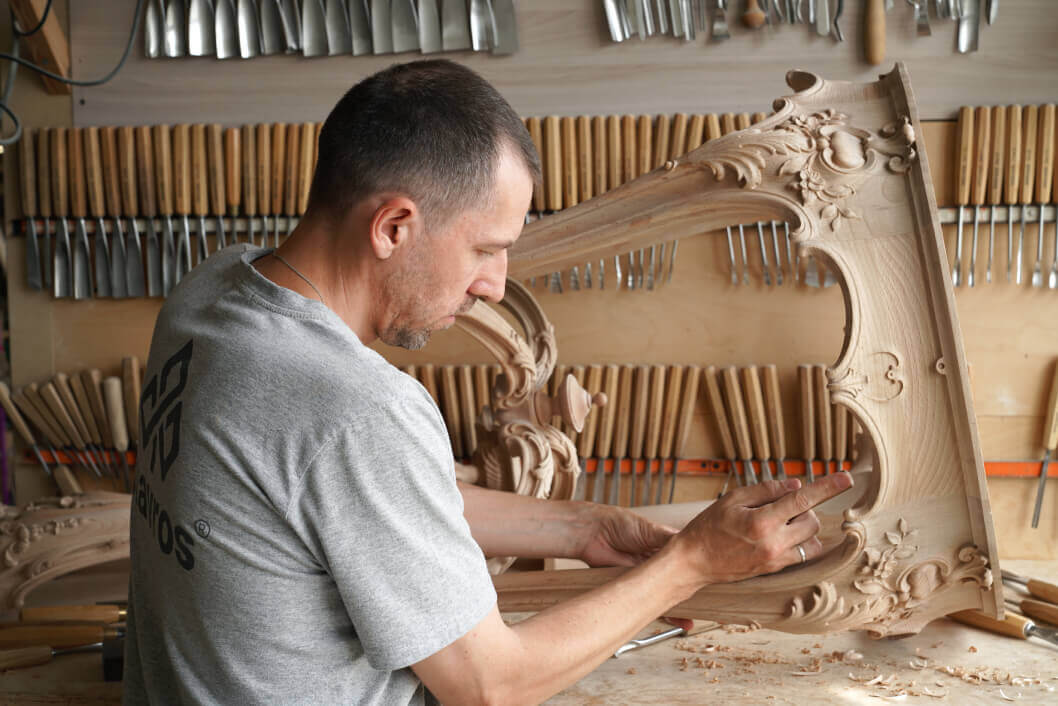
The company's success began in 2002, when two artists — Andrey Ragozin and Evgeny Tsapko — created a small creative workshop for producing wooden carved items. The masters' work was quickly noticed, and within a year they were invited to participate in the reconstruction of the Konstantinovskiy Palace in Strelna.
After the success of this project, the company focused on recreating palace interiors, furniture, church furnishings, and carved decorations in various artistic styles. They worked with cultural heritage sites: The Hermitage, the Alexandrovsky Palace, the Troitsko-Izmaylovsky Cathedral, the Sheremetyevsky Mansion, and many others.
The masters' task — and still is — to create wooden items with the highest level of detail and understanding of every element, based on impeccable knowledge of artistic laws and interior styles.

STAVROS Guarantees
Quality of products without complaints
We save your time, peace of mind, and budget
Large warehouse program
We solve your tasks with maximum speed
Adherence to production deadlines
Streamlined process reduces all risks
Contact us for shipping options
Quality service regardless of order volume
Your positive business reputation
Reliable partner — the foundation of your business
More products in the wood and MDF panel category


Frequently asked questions
Our showrooms are located in Saint Petersburg and Moscow. Production is located in Saint Petersburg.
Moscow contacts: /contacts_all/
Contacts of Saint Petersburg: /contacts_all/
Send us the product codes, quantities and delivery destination. Contact our team to confirm availability and order details.
Please contact us to confirm shipping availability, costs and delivery times for your destination.
Delivery cost depends on the size, weight of the item, and delivery address.
Please ask our team to confirm shipping costs and delivery arrangements for your destination before placing an order.
Prices and availability of items on the website are always current. Data is updated daily.
Note: items in stock are stored on the warehouse in unpolished form and shipped within 3 working days.
If the item is not in stock, average production time: 5–10 working days.
This is the quality of polishing of the items.
Standard — machine polishing, at a more attractive price.
Prestige — detailed hand polishing, items do not require further work.
More details: /information/kachestvo/
This is the type of veneer of the items.
Under enamel: produced by gluing wooden laminates without color and texture matching. Contrast tonal and textural differences are noticeable. This blank should be chosen if the item is intended for opaque coating.
Under tinting: produced by gluing wooden laminates with color and texture matching. Tonal and textural differences may occur. This blank should be chosen if the item is intended for semi-transparent finish.
More details: /information/kachestvo/
Beech — dense, non-porous wood, most often used for items covered with enamel.
Oak — dense, porous wood with clearly visible natural grain. Due to its strength and decorative properties, it is often used in items with semi-transparent coating, highlighting the wood pattern.
Custom-made, if non-standard items are required, we can produce products from other types of wood, including blanks provided by the customer, manufactured according to our technical specifications.
All our furniture legs can withstand a vertical load of at least 100 kg.
Average production time for custom-made items: 5–10 working days.
Most items are stored on the warehouse in unpolished form. We need time to polish and pack orders.
Yes, we manufacture non-standard items according to individual projects, but we only accept orders with a minimum quantity.
We can manufacture items of the desired size, but we only work with bulk orders. For details, please consult the sales department manager.
Yes, some of our products can be used outdoors. For example, polyurethane items, as well as carved door casings made of pine.
Other items are produced to order using PUR glue, if minimum quantity is available. No warranty is provided for such products, as outdoor conditions are considered aggressive.
Please contact our team to confirm available finishes, minimum quantities and a quotation for your order.
- Dust removal. After sanding, the surface must be dusted.
- Priming. Apply primer in an even layer.
- Matting. After the primer has fully dried, the surface should be matted (lightly sanded for better adhesion).
- Finish coating. Apply finish coating: lacquer or enamel, in 2 layers, with interlayer drying.
More details: /information/sovety/
Apply adhesive to the decor. Place it on the surface and press briefly. Then, lift the decor from the surface and leave it open for 3–5 minutes. Press the decor firmly onto the surface and hold for 5–10 seconds.
More details: /information/sovety/
Ideally, you should prepare a design project before placing an order.
You can do this yourself by downloading drawings of our products from our website, or you can order a project from us.
If the number of decorative elements and fittings is small, our company's manager can assist you with selection.
Unfortunately, this service is not provided.
The packaging method depends on the type of items, but in each case, we ensure sufficient protection for safe transportation.
We most often use corrugated cardboard and stretch film. Fragile items are additionally secured on a rigid base to prevent damage during transport.
Please confirm the minimum order quantity for your selected products and finishes with our team.
Please contact our team to discuss measurement and installation requirements for your project and destination before ordering.
Often searched in category Wall Panels
Your request has been sent!
Our manager will contact you within 5 minutes