Article Contents:
- Problem: a bare wall with a TV looks poor
- TV as a technical object
- Large-scale inconsistency
- Cables and technical aspects
- Emotional perception
- Solution: form a panel around the TV with moldings and mirror inserts
- What is a molding panel
- Panel construction
- Mirror inserts on the sides
- Baseboard sets the width and boundaries of the composition
- High baseboard: the foundation of the composition
- Baseboard sets the width
- Baseboard material and color
- Mirrors in narrow frames on the sides of the TV: visually expand the plane
- Narrow vertical mirrors: proportions
- Mirror frames: coordination with moldings
- Mirror placement: symmetry and balance
- Reflections: what is visible in the mirrors
- Color solution: walls and baseboard in the same tone, frames — contrast
- Monochromatic scheme: walls and baseboard in the same tone
- Contrast: molding and mirror frames stand out
- Inner part of the panel: accent color
- Balance: so that reflections do not interfere with viewing, but only expand the space
- Rule 1: Mirrors outside the line of sight
- Rule 2: Matte or tinted mirrors
- Rule 3: Lighting takes mirrors into account
- Rule 4: Mirrors not opposite the screen
- Option for classic and neoclassical styles
- Classic: carved frames and stucco
- Neoclassicism: Simplified Elegance
- Option for modern minimalism
- Minimalism: hidden moldings and inconspicuous frames
- Minimalism with a wooden accent
- Frequently Asked Questions
- Conclusion: when technology becomes architecture
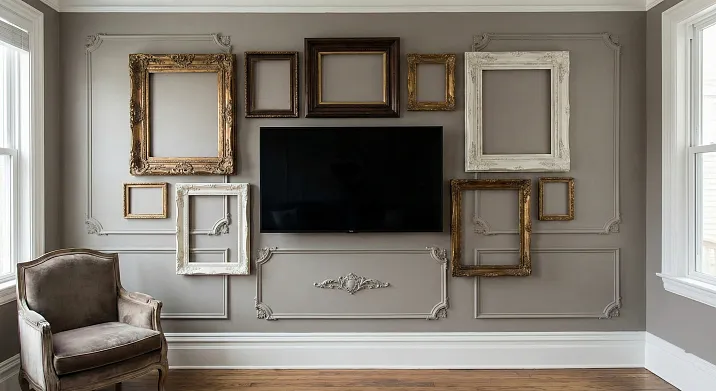
A TV hangs on the wall. Around it—emptiness. Cables stick out, the mount is visible, the wall is bare. Functionally, everything works: it shows movies, there's sound. But visually? Poor. Like a painting without a frame, like a diamond without a cut. Potential unrealized, value unappreciated, opportunity missed.
The TV area can be a composition—a thoughtful architectural structure where the TV isn't just hanging but is integrated into a system of elements.Moldings form a panel around the screen, creating a frame, context, boundaries. Mirrors in narrow frames on the sides of the TV visually expand the plane, reflect light, add depth.The baseboard sets the width of the composition, forms the foundation from which the vertical structure rises. Color, material, proportions—everything is coordinated, everything works toward a single idea: to transform the TV area from a technical element into an architectural accent of the living room.
This works in classic interiors and neoclassicism (where moldings are natural, expected, appropriate) and in modern minimalism (where simple profiles create structure without decorative excess). The key is understanding the principles of composition, proportions, balance. And the willingness to invest in details, because it's precisely the details that turn an ordinary interior into an outstanding one.


Problem: a bare wall with a TV looks poor
Why does a TV on an empty wall create a sense of incompleteness, cheapness, even if it's an expensive latest-generation model?




TV as a technical object
A TV is a black rectangle made of plastic and glass. Modern TV design strives for minimalism: thin bezels, flat housing, absence of decorative elements. This makes the TV functional but visually cold, faceless.
When such an object hangs on an empty wall—it doesn't integrate into the interior but contrasts with it. The wall is warm (painted, wallpapered, textured), the TV is cold (technological, plastic, electronic). No connection, no dialogue, no harmony.
Our factory also produces:


Scale inconsistency
Modern TVs are large: 55, 65, 75 inches diagonally (140, 165, 190 cm). These are big objects occupying a significant part of the wall. But at the same time, they are thin—5–10 cm thick. This inconsistency (large area + minimal thickness) creates visual flatness, two-dimensionality.
The wall behind the TV remains empty. Around the TV—nothing. The eye sees a huge black rectangle floating in emptiness, lacking context, boundaries, architectural support. This looks random, temporary, as if the TV was hung but finishing touches were never completed.
Get Consultation
Cables and technical aspects
Even if cables are hidden inside the wall (and often they're just run down and go along the floor behind furniture), the mounting bracket is visible. A metal or plastic bracket, bolts, the gap between the wall and the TV's back panel. All this reminds: this is technology, this is a temporary installation, this is not architecture.
In expensive interiors, technical aspects are hidden, masked, integrated. The TV should look like a built-in element, not like an appliance hung on a wall.
Emotional Perception
The living room is the central space of the home, where the family gathers, guests are received, most time is spent. This space should be cozy, beautiful, thoughtful. A bare wall with a TV creates a sense of incompleteness, cost-cutting, lack of taste.
Guests come, see a TV on an empty wall—and read: details aren't a priority here, function is more important than beauty here, they didn't invest in the interior here. Even if everything else in the apartment is wonderful, this detail spoils the impression.
Solution: form a panel around the TV with moldings and mirror inserts
A panel of moldings is an architectural frame that transforms a wall with a TV into a composition, into a structured space with boundaries, hierarchy, visual logic.
What is a panel of moldings
Molding—a decorative strip of rectangular, shaped, or complex profile that is attached to the wall, creating volume, relief, structure. A panel of moldings is a rectangular (or other shaped) frame composed of moldings, inside which the TV is placed.
Panel dimensions:
The panel should be 30–50 cm wider and taller than the TV on each side. For a TV 140 cm wide — panel 200–240 cm. For a TV 80 cm tall — panel 140–180 cm. This creates a visual pause, a transition from the TV to the wall, and gives the TV an architectural context.
Molding Profile:
Depends on the interior style. Classic — moldings with a decorative profile (beads, chamfers, carved elements). Neoclassical — simplified classical profiles (one or two beads, roundings, no carving). Minimalism —simple rectangular moldingswithout decorative elements, 40–80 mm wide.
Panel construction
Option 1: Flat panel
Moldings are attached directly to the wall, forming a rectangular frame around the TV. Inside the frame is the same wall, possibly painted in a contrasting color (dark if the walls are light, or vice versa). The TV hangs on the wall inside this frame.
Advantage: easy installation, minimal thickness (moldings protrude 10–20 mm from the wall). Disadvantage: cables still need to be hidden inside the wall, no niche for equipment (TV set-top box, router) is provided.
Option 2: Panel with a false wall
First, a false wall is built from drywall or plywood, protruding 10–15 cm from the main wall. Cables are routed inside the false wall, niches for equipment and ventilation openings are created. Moldings are attached to the false wall, forming the panel. The TV is mounted to the false wall.
Advantage: all cables and equipment are hidden, the TV area looks perfectly clean and built-in. Disadvantage: complex construction, reduces room space by 10–15 cm in depth.
Mirror inserts on the sides
Narrow vertical framed mirrors are placed on the sides of the TV (inside the molding panel or separately). Each mirror is 30–50 cm wide, with a height matching the panel height or slightly less.
Functions of mirror inserts:
-
Visual expansion: mirrors reflect the room, creating an illusion of a wider wall and additional space
-
Light enhancement: mirrors reflect light (from windows, from fixtures), making the TV area brighter and more voluminous
-
Symmetry: side mirrors create a symmetrical composition where the TV is the central element and the mirrors are the flanks
-
Decorative:mirrors in beautiful framesadd luxury, detail, and interest
Mirror placement:
Mirrors should be placed so that the TV screen is not reflected in them while watching (sitting on the sofa). Otherwise, the reflection will be distracting and create visual noise. Typically, mirrors are positioned slightly off the central axis or at a slight angle (if the mirrors are not flat but protruding).
The baseboard sets the width and boundaries of the composition
The baseboard is an element usually perceived as purely functional: it covers the wall-floor joint and protects wallpaper from damage. But in the context of the TV zone as a composition, the baseboard becomes an architectural element that forms the base, width, and horizontal boundaries.
Tall baseboard: the base of the composition
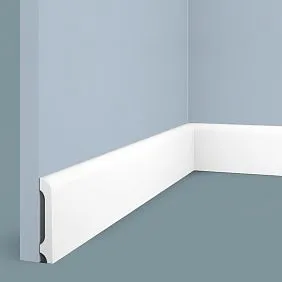
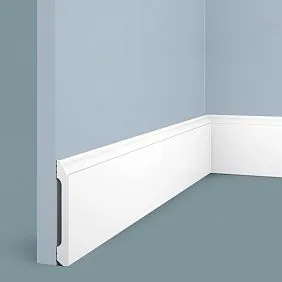
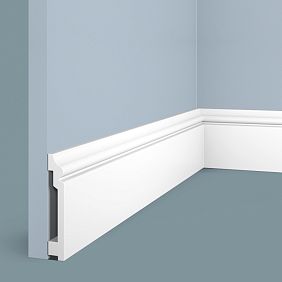
A standard baseboard 50–70 mm tall gets lost visually and does not create a sufficient base for a large composition (molding panel + TV + mirrors). For a TV zone, a tall baseboard is needed: 100–120 mm, and in classic interiors even 150–180 mm.
Visual function of a tall baseboard:
A tall baseboard creates a visual base from which the vertical composition (panel, TV, mirrors) rises. This works on the principle of architecture: a building stands on a foundation, a column stands on a base, a composition stands on a baseboard.
Without a sufficient baseboard, the composition looks like it's floating in the air, without support. With a tall baseboard — as if standing on a solid foundation, grounded, stable.
The baseboard sets the width
If a panel made of moldings is 220 cm wide, and the baseboard on the same wall runs the entire length (300 cm) — a visual inconsistency arises. The panel appears random, disconnected from the overall wall architecture.
Solution 1: Baseboard the same width as the panel
The baseboard is installed not along the entire wall length, but only under the panel (220 cm). The rest of the wall is either without a baseboard (if it's an accent wall where a baseboard is not mandatory), or with a thin baseboard (50 mm), contrasting with the thick one under the panel.
This creates a visual connection: the panel and the baseboard beneath it are a single composition with clear width boundaries.
Solution 2: Reinforced baseboard under the panel
The baseboard runs along the entire wall (standard 70 mm), but a second layer is added under the panel — an overlay baseboard or decorative panel, increasing the height to 120–150 mm. This creates a visual highlight of the area under the panel, emphasizing it.
Baseboard material and color
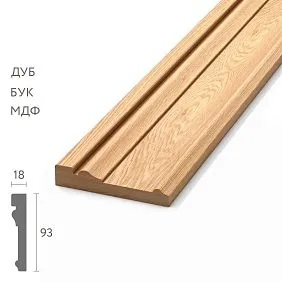
For the TV zone as a compositionthe baseboard must be coordinated with the moldingsof the panel in material, color, and profile.
Classic/Neoclassical:
Baseboard made of solid wood (oak, beech), painted white or the color of the moldings. The baseboard profile echoes the molding profile (if the moldings have beads — the baseboard does too; if the moldings have a chamfer — the baseboard similarly).
Minimalism:
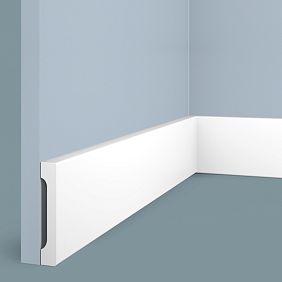
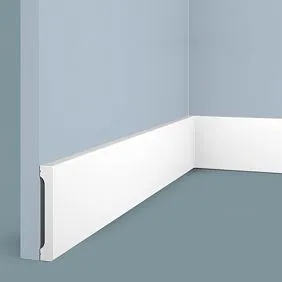
Baseboardof a simple rectangular profile, painted the color of the wall (creates a monolithic effect, the wall appears taller) or in a contrasting color (white on gray walls, black on white).
Mirrors in narrow frames on the sides of the TV: visually expand the plane
Mirrors in the TV zone are not just a decorative element. They are a functional tool that solves several tasks simultaneously: expands the space, enhances light, creates symmetry, adds luxury.
Narrow vertical mirrors: proportions
The width of the mirrors should be significantly less than the width of the television. A television 140 cm wide — mirrors 30–40 cm each. This creates proportional balance: the television dominates as the central element, the mirrors support as side accents but do not compete.
The height of the mirrors can be equal to the height of the panel (140–180 cm) or slightly less (120–150 cm, if the mirrors are placed not from the floor, but from the height of the TV console). The vertical orientation of the mirrors creates a visual upward thrust, making the composition more dynamic and slender.
Mirror frames: coordination with moldings
Mirror frames should echo the profile of the panel moldings. If the panel moldings are classic (with carving, ornament) —the mirror frames are also classic, made of solid wood with carved elements. If the panel moldings are minimalist (simple rectangular strips) — the mirror frames are simple, without decoration.
Frame width:
Frames can be narrow (30–50 mm) — then the mirrors appear light, modern, and do not overload the composition. Or wide (80–120 mm) — then the mirrors become more noticeable accents, adding massiveness and solidity.
For classic interiors, wide frames with decoration are better. For contemporary ones — narrow, simple, possibly metal (brass, bronze, black metal).
Mirror placement: symmetry and balance
Symmetrical placement:
Mirrors are placed strictly symmetrically on the sides of the television, at an equal distance from the central axis. The distance from the edge of the television to the edge of the mirror is 20–40 cm (depends on the overall panel width). This creates a classic symmetrical composition where the television is the center, and the mirrors are mirror-reflected side elements.
Asymmetric arrangement:
One mirror on the left, two mirrors on the right (or vice versa), of different widths or heights. Asymmetry creates dynamism, visual interest, and a modern feel. But it requires a more refined sense of balance: the asymmetry must be visually balanced, otherwise the composition looks random, mistaken.
Reflections: what is visible in the mirrors
Mirrors reflect what is opposite them. If opposite is a window, the mirrors reflect natural light, the view outside, which visually expands the space and adds depth. If opposite is a wall with decor (paintings, shelves), the mirrors duplicate this decor, creating an effect of richness, fullness.
Important: mirrors should not reflect the TV screen during viewing. Viewers sit on the sofa opposite the TV. Mirrors on the sides of the TV, if they are flat and parallel to the wall, will reflect the side walls, not the screen. If the mirrors are protruding or at an angle — it is necessary to check whether the screen is visible in them from the viewer's position.
Color scheme: walls and baseboard in the same tone, frames — contrast
Color in the TV zone composition plays a critical role. The correct color scheme enhances the architecture, the incorrect one — destroys it.
Monochromatic scheme: walls and baseboard in the same tone
When walls andbaseboard are painted the same color— it creates an effect of solidity, visual height, seamlessness. The wall appears taller because there is no horizontal boundary (contrasting baseboard) dividing the wall into parts.
Light monochromatic scheme:
Walls light gray (RAL 7035), baseboard light gray, panel moldings light gray. Everything merges into a single surface. Against this background, the dark TV stands out contrastingly, but not aggressively. Mirrors in frames add accents.
Dark monochromatic scheme:
Walls dark gray (RAL 7016) or graphite, baseboard the same color, moldings the same. The TV blends with the background (black screen on a dark wall is almost invisible when turned off). Mirrors in light or metal frames create contrast, break the monotony.
Contrast: moldings and mirror frames stand out
Alternative approach: walls and baseboard neutral (white, beige, light gray), but panel moldings and mirror frames are contrasting (dark wood, black, metallic shades).
White walls + dark frames:
Walls white, baseboard white. Panel moldings and mirror frames — oak with dark tint or painted black. Contrast creates graphics, clarity, modernity. The TV (black) is visually supported by the dark frames, the composition is cohesive.
Gray walls + gold/bronze frames:
Walls gray, baseboard gray. Moldings and mirror frames — with gilding or bronze coating. This is a luxurious option for classic and art deco interiors. The TV looks like a work of art framed by precious metal.
Inner part of the panel: accent color
Inside the molding panel (the background on which the TV hangs) you can use an accent color, different from the main walls.
Dark background inside the panel:
Main walls light (white, beige), inside the panel — dark (graphite, dark blue, dark green). The TV on a dark background is less noticeable when turned off, creating an effect of a niche, depth.Light moldings frame the dark center— a classic contrast technique.
Textured background inside the panel:
Instead of paint — wallpaper with texture (fabric, with pattern), wooden panels, stone veneer, marble. This adds materiality, richness, tactility. Moldings frame this texture, emphasizing its value.
Balance: so that reflections do not interfere with viewing, but only expand the space
Mirrors in the TV zone are a double-edged sword. Properly placed, they expand space, enhance light, and add luxury. Improperly placed — they distract, create glare, reflect the screen, and hinder viewing.
Rule 1: Mirrors outside the line of sight
When a viewer sits on the sofa and watches TV, their gaze is focused on the screen. Mirrors on the sides are in the peripheral vision. If the mirrors are flat, parallel to the wall, and at a sufficient distance from the TV (20+ cm) — they don't come into focus and don't distract.
A problem arises if the mirrors are too close to the TV (less than 15 cm) or if the viewer is not sitting directly opposite but to the side (then the mirrors fall into the direct line of sight, and reflections become distracting).
Solution:
Place mirrors at a minimum distance of 20 cm from the edge of the TV. If the sofa is wide (several people sitting), check the visibility of the mirrors from the extreme positions on the sofa, possibly increasing the distance to 30–40 cm.
Rule 2: Matte or tinted mirrors
Ordinary mirrors with perfectly transparent amalgam reflect brightly and clearly. This can create glare, especially if the room has bright lighting (chandelier, floor lamps). Glare from mirrors entering the peripheral vision distracts from viewing.
Solution:
Use mirrors with a matte finish (partially matte, with a matte pattern along the edges) ortinted mirrors(bronze, gray, smoky). They reflect more softly, delicately, and do not create harsh glare.
Rule 3: Lighting takes mirrors into account
Light fixtures should not be directed at mirrors in such a way that the reflected light hits the viewers' eyes. If there are wall sconces or spotlights in the TV zone — their direction should be checked: turn on the light, sit on the sofa, and see if light from the mirrors reflects directly into the eyes.
Solution:
Use diffused lighting (light directed at the ceiling or along the wall, not directly at the mirrors). Or position light fixtures so that the mirrors reflect light to the side, not toward the viewers.
Rule 4: Mirrors not opposite the screen
If there is a mirror on the opposite wall (facing the TV zone) — it will reflect the screen. A viewer sitting on the sofa will see a reflection of the screen (inverted) in this mirror. This is highly distracting, creates visual noise, and makes viewing uncomfortable.
Solution:
Do not place large mirrors on the wall opposite the TV. If a mirror is already there (e.g., a built-in wardrobe with mirrored doors) — cover it during viewing or replace the mirrored doors with matte or tinted ones.
Option for classic and neoclassical styles
Classical and neoclassical interiors naturally involve the use of moldings, baseboards, and decorative elements. The TV zone in such interiors is created with maximum detail, richness of forms, and materials.
Classic: carved frames and stucco
Panel of stucco moldings:
Moldings with carved elements (acanthus, rosettes, egg-and-dart), wide (80–120 mm), made of polyurethane orsolid wood with hand carving. The panel forms a rectangle around the TV, inside which the background is contrasting (if the walls are light — the background is dark; if the walls are dark — the background has texture or wallpaper).
Mirrors in carved frames:
Mirrors in massive frames of oak or beech with carving, with gilding or patina. Frame width 100–150 mm, carved corners, ornament around the perimeter. The mirrors look antique, like elements of a palace interior.
High baseboard:
Height 150–180 mm, made of solid wood, with a decorative profile (beads, fluting), painted white or the color of the walls, possibly with gilding on the top edge.
Color palette:
Walls light (cream, ivory), moldings and baseboards white with gold accents, mirror frames dark wood with gilding, background inside the panel dark green or burgundy (classic colors). The TV on a dark background is less noticeable and does not disrupt the classical harmony.
Neoclassicism: simplified elegance
Panel of simple moldings:
Moldings with a rectangular profile with one or two beads, without carving, width 60–80 mm. The panel creates clear geometry but without the decorative excess of classic style.
Mirrors in simple frames:
Solid wood frames (oak, ash) with a simple profile (single bevel or rounding), painted white, gray, or light natural wood tones. Frame width 50–70 mm, no carving, gilding, or patina.
Medium-height baseboard:
Height 100–120 mm, simple profile (rectangle with bevel), painted white or wall color.
Color palette:
Walls light gray or beige, moldings and baseboards white, mirror frames light wood or white, panel background slightly darker than main walls (medium gray). TV stands out but doesn't clash, composition is restrained, elegant.
Option for contemporary minimalism
Minimalist interiors require a different approach: no decorative excess, only clean lines, simple shapes, functionality. But this doesn't mean abandoning structure—structure is simply created with minimal means.
Minimalism: hidden moldings and inconspicuous frames
Panel made of hidden moldings:
Instead of surface-mounted moldings—recessed profiles, forming indentations in the wall (shadow joints). The panel is created not by protruding elements, but by recessed ones. A drywall construction with slots forming a rectangle around the TV. Inside the rectangle—a background (possibly contrasting), the TV hangs flush with the background.
Frameless mirrors or mirrors in hidden frames:
Mirrors are mounted without visible frames (on hidden fasteners) or in minimal-thickness metal frames (10–15 mm) made of black aluminum, stainless steel. Mirrors appear floating, weightless, not overloading the composition.
Recessed baseboard:
Baseboard height 80–100 mm, but not surface-mounted, rather recessed: the wall has an indentation at the bottom, the baseboard is set into this indentation, creating a shadow joint effect. The wall appears to float above the floor.
Color palette:
Monochrome. Walls, baseboard, panel—all in one color (white, gray, graphite). Moldings (if present) the same color, inconspicuous, creating only geometry. Mirrors in black metal frames add the sole contrast. TV (black) on a light background or blends with a dark background.
Minimalism with a wooden accent
Wooden panel instead of moldings:
Instead of forming a panel with moldings—install a wooden panel (plywood, MDF, solid wood) on the wall. Panel size 220×160 cm, natural wood (oak, ash) with oil finish highlighting the texture. TV is mounted to the panel. On the sides of the panel—narrow vertical frameless mirrors or in minimalist metal frames.
Baseboard made of the same wood:
Baseboard height 100 mm made of the same wood as the panel, with the same finish. Visual connection: panel and baseboard—a unified system of natural wood.
Color palette:
Walls white or light gray, wooden panel in a natural shade (light oak, ash), baseboard the same, mirrors frameless or in black metal. TV stands out against the wood background, but the wood softens the TV's technological feel, adds warmth, naturalness.
Frequently asked questions
Won't a molding panel look old-fashioned?
Depends on the molding profile. Carved Baroque moldings—yes, that's classic, not for everyone. But simple rectangular moldings with a minimalist profile look contemporary, creating structure without old-fashionedness.
How much does creating a TV zone with a molding panel cost?
From 30,000 to 150,000 rubles depending on complexity, materials, size. A simple panel made of polyurethane moldings with painting—30–50 thousand. A panel with a false wall, wooden moldings, mirrors in carved frames, lighting—100–150 thousand.
Can you create a panel yourself?
Theoretically yes, if you have skills in working with drywall, moldings, painting. But for a perfect result (straight lines, neat joints, even painting) it's better to involve professionals.
Won't mirrors on the sides of the TV collect dust?
They will be, like any mirrors. But wiping mirrors once a week is minimal effort. In return, you get visual expansion of space, light enhancement, luxury.
What to do if the TV needs to be replaced with a larger one?
If the panel is created for a specific TV size (55 inches), and a 65-inch TV is purchased after 3 years — the panel will become too small. Therefore, when designing, plan for a margin: if it's 55 inches now, make the panel for 65. The TV will look slightly smaller than the panel, but in a few years, when the TV is replaced with a larger one, the panel will remain relevant.
Can LED backlighting be used behind the TV?
Yes, an LED strip behind the TV (Ambilight effect) creates a soft halo of light, reduces the contrast between the bright screen and the dark wall, and lessens eye strain. The backlight color is neutral white or synchronized with the screen colors (smart LED systems).
Will mirrors visually not reduce the TV?
No, if the mirrors are narrow (30–40 cm) and the TV is wide (140+ cm). The TV remains the dominant element. Mirrors complement but do not compete.
Is a TV stand needed if a panel is created?
Desirable, but not mandatory. A TV stand (width 150–200 cm, height 40–60 cm) completes the composition from below, provides storage space (TV set-top box, discs, remotes), visually grounds the TV. But if the panel and baseboard are substantial enough — the TV can hang without a stand, this is a modern minimalist approach.
How often should the TV zone be updated?
A well-made TV zone lasts 10–15 years without updates. Moldings, baseboards, mirrors do not become morally outdated (if classic or minimalist profiles are chosen). The TV is replaced every 5–7 years, but the panel remains relevant.
Conclusion: When technology becomes architecture
The TV is an object of the 21st century, technological, functional, cold. But the interior is a space where there should be warmth, coziness, beauty. How to reconcile technology and beauty? Through architecture. Through creating a context in which technology ceases to be just technology and becomes part of a thoughtful composition.
A panel of moldings around the TVtransforms the black rectangle into a framed element, into a painting, into an architectural object. Mirrors on the sides add symmetry, expand the space, enhance light.A high baseboard forms the foundationfrom which the entire composition rises. Color, material, proportions are coordinated — and the result exceeds the sum of its parts.
This works in classic interiors (where moldings, carvings, gilding are natural) and in modern ones (where simple profiles, clean lines, minimalism create structure without pretentiousness). The main thing is understanding the principles of composition, attention to detail, willingness to invest in quality. Because the TV zone is not just a place where the TV hangs. It is the visual center of the living room, the place where eyes are directed, where the family spends evenings, where guests form an impression of the home.
The company STAVROS has been creating interior elements for over two decades that transform ordinary spaces into architectural compositions.Moldings, Baseboards, Mirror Framesmade of solid wood (oak, beech, ash), polyurethane, duropolymer — the entire assortment for creating a TV zone of any complexity and style.
For classic interiors, STAVROS offers moldings with hand carving, gilding, patina. Carved mirror frames reproducing Baroque, Empire, Renaissance styles. High baseboards made of solid oak with decorative profiles, fluting, ornaments. All this creates a TV zone that looks not like modern technology, but like a palace portal framing a moving picture.
For neoclassical interiors, STAVROS produces moldings with simplified profiles: without carving, but with elegant bevels, chamfers, roundings. Mirror frames made of light wood with a simple profile, painted in white, gray, pastel tones. Baseboards 100–120 mm high with restrained decor, creating a foundation without heaviness.
For modern minimalist interiors, STAVROS offers moldings with a rectangular profile without decor, baseboards for concealed installation with shadow gaps, mirror frames made of metal (aluminum, stainless steel, brass) with minimal thickness. Everything is aimed at creating structure, geometry, purity of lines without visual overload.
The STAVROS consulting service helps design a TV zone for a specific space: measures the wall, determines the optimal panel size (taking into account the TV size and margin for the future), selects molding and baseboard profiles coordinated in style, calculates the material quantity, creates a project visualization.
STAVROS production manufactures elements precisely according to project dimensions: moldings are cut to the required length, corners are mitered at 45° for perfect joints, baseboards are supplied with corner elements, mirror frames are produced for specific mirror sizes. Everything is supplied ready for installation, with fasteners, instructions.
The STAVROS finishing department paints elements in any RAL color, applies patina for an aged effect, gilds or silvers carved elements, coats wooden products with oil, wax, varnish. All finishing is done with professional compounds in paint booths, ensuring uniformity, durability, eco-friendliness.
STAVROS logistics delivers elements throughout Russia in packaging that protects against damage: each molding in film and corrugated cardboard, baseboards in packs with spacers, mirrors in rigid boxes with cushioning. Damage during transportation is excluded.
The STAVROS installation service (or recommended partners in the regions) installs the elements: mounts the false wall (if provided), attaches moldings with perfectly even joints, installs baseboards, hangs mirrors, connects the backlighting. The result is a TV zone that looks like a single built-in structure, not a set of elements.
STAVROS works not just as a supplier of moldings and baseboards. It is a partner in creating interiors where technology is integrated into architecture, where the TV ceases to be an alien object and becomes part of a thoughtful composition. Where the living room has a visual center — not just a wall with a TV, but an architectural structure with panels, mirrors, symmetry, balance, beauty.
Contact STAVROS — and we will help createTV zone, which will transform the living room from an ordinary space into one with character, where every detail is thoughtfully considered, where technology and beauty coexist harmoniously, whereMoldings, Baseboardsandmirrors made of natural wood work towards one goal — to turn the wall with the TV into a composition worthy of admiration.