Article Contents:
- What is a Baget Frame
- History of Baget: From Paintings to Mirrors
- Baget Profiles: Simple and Complex
- Width: From Narrow 2-3 cm to Wide 15+ cm
- Museum Quality at Home
- Types of Baget Profiles
- Flat: Minimalism
- With Bevel: Elegance
- Multi-level: Complex Architecture
- With Molding: Classic
- Molding materials
- Solid Wood: Premium Quality
- MDF with Coating: Affordability
- Polyurethane: Imitation of Carving
- Plastic: Budget Solutions
- Finishing of Baget Frames
- Gilding: Museum Luxury
- Silver Plating: Cold Elegance
- Patina: effect of antiquity
- Painting: Any Colors
- Natural Wood: Eco-friendliness
- Baget Mirror in Interior
- Living Room: Decoration Like Paintings
- Dining Room: Between Windows
- Bedroom: Above the Headboard
- Study: Respectability
- Baget Width: How to Choose
- Narrow 2-5 cm: Modernity, Emphasis on the Mirror
- Medium 6-10 cm: Versatility
- Wide 12-20 cm: Monumentality, Classic
- Advantages of a baguette mirror
- Questions and Answers
- How does a baguette frame differ from a regular one?
- What baguette width is suitable for an 80×100 cm mirror?
- What material is best to order a baguette from?
- Can a custom baguette be made for a non-standard size?
- How to care for a gilded baguette?
- Is a baguette frame suitable for the bathroom?
- How much does a custom mirror in a baguette frame cost?
- How to choose the color of a baguette?
- Can a mirror be inserted into a ready-made baguette frame for a painting?
- Where to buy a quality mirror in a baguette frame?
- Conclusion
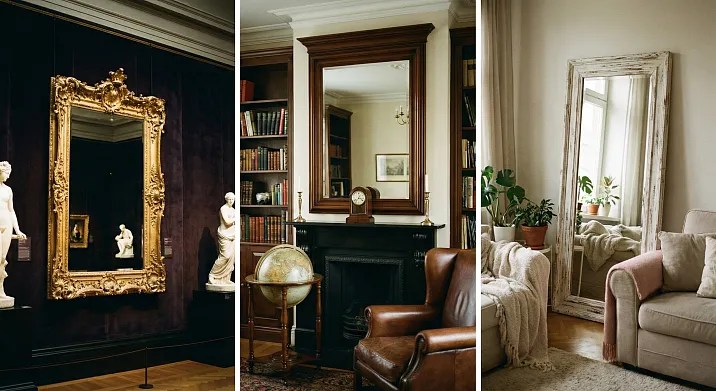
There is a special magic in how a properly chosen frame can transform a mirror from a utilitarian object into a work of art. Baguette is the language spoken by museums, galleries, and homes that value beauty. When a mirror surface is framed by a professionally crafted baguette, a miracle occurs: the mirror begins to live like a painting, only its canvas is the constantly changing reflection of reality.
Mirror in a baguette frame— is a sign of taste, an understanding of the subtleties of interior design, and respect for the traditions of framing art. It is the choice of those who do not simply buy a mirror from a store but create a thoughtful composition where every element matters, where the shape, color, and texture of the frame contribute to the overall visual effect. A baguette mirror is a bridge between utility and art, between necessity and luxury, between function and aesthetics.


What is a baguette frame
Baguette is a French word denoting a profiled strip used for framing paintings, mirrors, and photographs. Unlike a simple frame with a flat profile, a baguette has complex geometry: protrusions, recesses, bevels, and steps. This architectural complexity creates a play of light and shadow, visual richness, and three-dimensionality.
Originally, baguette was used exclusively for paintings—it created a transition between the image and the wall, separated the artwork from the surrounding space, and gave it completeness and significance. Over time, this technology began to be applied to mirrors as well, creatingmirrors in baguette frames, which are perceived not as household items but as high-level decorative objects.




History of baguette: from paintings to mirrors
Baguette art originated during the Renaissance, when artists and their patrons began to understand that a painting deserved a worthy frame. The first baguettes were massive, carved, and gilded—true works of decorative art. Master framers were valued on par with painters.
The 17th–18th centuries—the flourishing of Baroque and Rococo—brought incredibly complex, lavish baguettes with an abundance of carving, scrolls, and gilding. The frame sometimes cost more than the painting itself. This tradition spread to mirrors as well: palace mirrors in gilded baguette frames became central elements of interiors.
The 19th century simplified the baguette but did not abandon it. New materials, technologies, and styles emerged. The 20th century brought minimalism, but even a minimalist mirror needed a frame—albeit thin, concise, but profiled, meaning baguette. Today, the baguette industry offers thousands of profile options for every taste and budget.
Our factory also produces:


Baguette profiles: simple and complex
A baguette profile is its cross-section. The profile determines the visual effect, manufacturing complexity, and price.
Simple profiles have 1–2 planes:
-
Flat strip with a beveled edge (bevel)
-
Convex strip (roll)
-
Concave strip (groove)
Complex profiles consist of several elements:
-
Multi-level: combination of protrusions and recesses
-
With molding: carved or cast decorative elements added
-
Combined: mix of different shapes and textures
The more complex the profile, the richer the play of light on the frame, and the more voluminous and significant the mirror appears. A simple profile creates restraint and minimalist elegance. A complex one creates luxury, classical pomp, museum quality.
Get Consultation
Width: from narrow 2-3 cm to wide 15+ cm
The width of the frame is measured from the inner edge (where the mirror begins) to the outer edge of the frame. It critically influences the perception of the entire composition.
Narrow frame (2-5 cm):
-
Modern, minimalist look
-
Focus on the mirror, not the frame
-
Suitable for small mirrors and modern interiors
-
Lightweight, doesn't overload the wall
Medium frame (6-10 cm):
-
Universal, suitable for most situations
-
Balanced ratio of frame and mirror
-
Sufficient width for complex profiles
-
Classic choice for residential interiors
Wide frame (12-20 cm and more):
-
Monumental, imposing appearance
-
The frame becomes an independent decorative element
-
Suitable for large mirrors in spacious rooms
-
Classical, palatial style
Rule: the width of the frame should be proportional to the size of the mirror. A small mirror in a wide frame looks overwhelmed. A large mirror in a narrow frame looks unfinished.
Museum quality at home
What does 'museum quality' mean? It is flawless execution: perfectly joined corners, smooth surface without defects, even coating, reliable mirror fastening. Museums don't use cheap frames — they understand that framing influences the perception of the exhibit.
By bringing museum standards into your home, you get not just a beautiful mirror, but an item that will last for decades without losing relevance or going out of style.Buy a wall-mounted framed mirrorMuseum quality means investing in beauty that won't depreciate over time.
Types of frame profiles
The variety of frame profiles is enormous. Each type creates its own visual effect, corresponds to a certain style, and solves specific design tasks.
Flat: minimalism
A flat frame is a strip with a rectangular cross-section without protrusions or recesses. Maximum simplicity of form, emphasis on material and color, not on profile architecture.
Characteristics of flat molding:
-
Rectangular cross-section without relief
-
Width is typically small (3-7 cm)
-
Suitable for modern, minimalist interiors
-
Focus on the mirror, not the frame
-
Easily fits into any color scheme
Flat molding can be painted any color, have a matte or glossy surface, and be made of wood or MDF. Its simplicity is not a sign of cheapness but a conscious stylistic choice that values conciseness, clean lines, and the absence of visual noise.
With bevel: elegance
A bevel is a slanted edge of the molding that creates a transition from the flat surface to the end. It is the simplest way to add volume, play of light, and visual interest to the profile.
Beveled molding:
-
One or several slanted planes
-
Creates a soft transition, does not weigh down
-
Suitable for classical and modern styles
-
Bevel width varies: from narrow (0.5 cm) to wide (3 cm)
-
Versatile, easily pairs with various interiors
The bevel can be external (the outer edge of the frame is slanted), internal (the edge near the mirror is slanted), or both. An internal bevel creates an illusion of depth, as if the mirror is recessed into the frame. An external one softly connects the frame to the wall.
Multi-level: complex architecture
Multi-level molding consists of several protruding and recessed elements, creating a complex profile architecture. It is a play of volumes, light and shadow, and visual richness.
Characteristics of multi-level molding:
-
Combination of protrusions (rolls), recesses (grooves), flat sections
-
Creates pronounced relief, three-dimensionality
-
Suitable for classical, baroque, eclectic interiors
-
Width is typically medium or large (8-15 cm)
-
Requires quality execution: all levels must be clearly defined
A multi-level profile visually weighs down the frame, making it more significant. This is a choice for those who want the framed mirror to be not just a functional item, but a decorative focal point.
With molding: classic
Ornamental molding is the pinnacle of decorativeness. In addition to the profiled base, it is adorned with carved or cast elements: floral patterns, scrolls, rosettes, geometric designs.
Ornamental molding:
-
Hand-carved wood or polyurethane casting
-
Complex, detailed ornaments
-
Often with gilding, silvering, patination
-
Large width (10-20 cm)
-
Suitable for classical, baroque, palace interiors
Carved Mirror Frameswith stucco are works of decorative art. Each carving element is created by a master by hand or milled on high-precision equipment, then sanded, primed, painted, patinated. This is a labor-intensive process, but the result is worth it: a mirror in such a frame looks like a museum exhibit.
Picture Frame Materials
What are picture frame moldings made of? The material determines quality, durability, price, and visual possibilities.
Solid wood: premium quality
Natural wood is a traditional, noble, eco-friendly material for moldings.Solid wood framespossess natural beauty, warmth, and tactile pleasantness.
Wood species for moldings:
-
Oak — durable, with expressive texture. Ideal for classical, massive frames.
-
Beech — homogeneous structure, pinkish hue. Good for painting.
-
Ash — light, contrasting texture. Modern look.
-
Linden — soft, easy to cut. Used for carved elements.
-
Pine — budget option, light-colored. Requires quality processing.
Wooden molding is milled from a solid plank, sanded, primed, painted, or varnished. Toning, patination, and gilding are possible. Solid wood is durable, can be restored, and acquires a patina over the years, becoming even more expressive.
MDF with coating: affordability
MDF (medium-density fiberboard) — a wood-fiber board, easily milled, has no texture, ideal for painting. A budget alternative to solid wood.
Advantages of MDF molding:
-
Affordable price (1.5-2 times cheaper than solid wood)
-
Perfectly smooth surface after painting
-
Does not warp from humidity
-
Ability to create complex profiles
-
Dimensional stability
Disadvantages:
-
Lacks the natural warmth of wood
-
Harder to restore
-
Shorter service life
-
Not always eco-friendly (depends on the binder)
MDF is painted with enamel, covered with film, or veneered. High-quality painted MDF molding is visually indistinguishable from wooden, especially if texture is not important (e.g., with solid painting).
Polyurethane: imitation of carving
Polyurethane molding — a modern technology that allows creating complex stucco profiles by casting. It is an imitation of wood carving but significantly cheaper and faster to produce.
Characteristics of polyurethane molding:
-
Complex stucco profiles, indistinguishable from carved ones
-
Lightweight
-
Moisture-resistant (suitable for bathrooms)
-
Affordable price
-
Ready for painting, gilding, patination
Polyurethane allows for a visually luxurious frame at a reasonable price. It's a compromise between the aesthetics of classic carved molding and a limited budget. For bathroom mirrors or damp areas, polyurethane molding is even preferable to wooden ones.
Plastic: budget solutions
Plastic (PVC) molding is the most affordable option. Lightweight, moisture-resistant, inexpensive. Used in mass-produced ready-made mirrors.
Pros of plastic molding:
-
Low price
-
Moisture resistance
-
Lightweight
-
Ease of maintenance
Disadvantages:
-
Cheap appearance (especially up close)
-
Limited visual possibilities
-
Not eco-friendly
-
Not durable
Plastic molding is the choice for utilitarian mirrors in bathrooms, hallways, where functionality and price are important, not decorativeness.
Finishing of molding frames
Material is the foundation, but it's the finish that creates the final visual effect. The finish determines how the frame will look, what style it will fit into, and what mood it will create.
Gilding: museum luxury
Gilding is the application of a thin layer of gold (gold leaf) or gold imitation onto the frame's surface. This is a classic, palatial, museum-quality finish.
Types of gilding:
-
Gold leaf — the thinnest sheets of real gold (24 karat or alloy). The most expensive and prestigious technique.
-
Metal leaf — gold imitation made from a copper and zinc alloy. Visually similar to gold, significantly cheaper.
-
Gold paint — acrylic or oil paint with gold pigment. A budget option, with a less noble shine.
A gilded frame turnsMirror in a baguette frameinto a luxurious object, worthy of a palace or mansion. Gold reflects light, creates a warm glow, and visually enriches the interior. Suitable for classical, Baroque, Empire, Art Deco styles.
Silver plating: cold elegance
Silver plating is the application of silver or its imitation. Creates a cold, noble shine, less pompous than gold, but no less refined.
Silver finishes:
-
Silver leaf or silver-colored metal leaf
-
Cold metallic shine
-
Suitable for neoclassical, Art Deco, glamorous interiors
-
Pairs well with gray, blue, cool white tones
-
Less traditional than gold, more contemporary
A silver frame looks refined, elegant, without the baroque heaviness of gold. This is a choice for interiors where understated luxury is valued, not ostentatious splendor.
Patina: effect of aging
Patination — artificial aging of a frame, creating an effect of wear, time's patina, faded areas. This is a technique that adds depth, history, vintage charm.
Patination methods:
-
Applying a dark tone into the recesses of the carving
-
Creating wear on protruding areas
-
Craquelure — cracks in the coating
-
Wiping with wax containing dark pigment
A patinated frame looks as if it is decades or even centuries old. A new mirror in such a frame is perceived as antique, vintage, having a history. This is a popular technique for Provence, shabby chic, vintage, country styles.
Painting: any colors
Painting — applying paint to a frame. The color can be anything: from white to black, from pastel tones to bright accent colors.
Popular options for painting a frame:
-
White — universal, suits most interiors, visually expands
-
Black — graphic, modern, creates contrast
-
Gray — neutral, elegant, modern
-
Colored (blue, green, pink) — accent, bold, suits eclectic interiors
-
Tinted — transparent colored composition, preserving the wood texture
Painting allows you to precisely match the frame color to the interior, create harmony or contrast, support the color scheme or add a bright accent.
Natural wood: eco-friendliness
Natural finish — transparent varnish or oil, preserving the natural texture and color of the wood. This is a choice for those who value the natural beauty of the material.
Advantages of a natural finish:
-
The wood texture, its natural grain, is visible
-
Eco-friendliness (minimal chemicals)
-
Warm, natural appearance
-
Suits Scandinavian, eco-, country styles
-
Easy to restore (re-sand and re-coat)
mirror in wooden frameA frame with a natural finish creates a feeling of connection with nature, eco-friendliness, simplicity, and simultaneously the nobility of natural material.
A framed mirror in the interior
Where and how to useMirror in a baguette frame? Placement options are determined by the interior style, functional tasks, and room dimensions.
Living room: decoration like paintings
The living room is a formal space where the most impressive solutions are appropriate.Mirror in a baguette frameis decorated as a work of art, often in a pair or composition with paintings.
Placement options:
-
Above the fireplace or decorative console — a classic position
-
On a free wall as an independent object
-
In a composition with paintings (mirror instead of one of the paintings)
-
Symmetrically: two identical mirrors on either side of the central element
In the living room, wide, massive, decorative frames are appropriate — there is space, high ceilings, and the opportunity to create an impression. Gilded frames, carved molding, wide classic profiles — all of this works in the living room.
Dining room: between windows
The dining room is a place where the mirror serves not only a decorative but also a practical function: it reflects light from windows, candles, and chandeliers, creating an atmosphere of celebration and solemnity.
Classic placement — between two windows on a narrow wall. The mirror reflects light from both windows, visually expands the space, and creates symmetry. The frame should match the style of the dining room: in a classic interior — gilded or dark wooden molding; in a modern one — a laconic frame in a neutral color.
Bedroom: above the headboard
In the bedroom, mirrors are placed with caution (according to feng shui, a mirror opposite the bed is undesirable). But a mirror above the headboard or on a side wall is an excellent solution.
Mirror in a baguette frameabove the headboard creates a vertical accent, visually raises the ceiling, and adds monumentality to the headboard. The frame should be elegant, not too massive, so as not to weigh down on the sleepers. Light, warm tones are suitable: white, cream, natural light wood.
Study: respectability
The study is a place where solidity, respectability, and restrained luxury are appropriate. A mirror in a classic frame of dark wood or with gilding emphasizes status and creates an atmosphere of seriousness and weight.
Placement: above a console with business accessories, on the wall behind the visitor's chair (creates visual depth), as part of a bookcase (mirror insert between shelves). The frame should be of high quality, expensive-looking — this reflects on the perception of the study's owner.
Frame width: how to choose
One of the main questions: how wide should the frame be? The answer depends on the size of the mirror, the style of the interior, and the desired effect.
Narrow 2-5 cm: modernity, emphasis on the mirror
A narrow frame is the choice for modern interiors where minimalism, conciseness, and the absence of visual noise are valued.
When a narrow frame is suitable:
-
Small and medium mirrors (up to 80 cm on the longer side)
-
Modern, minimalist interiors
-
When it's important that the frame does not distract from the mirror
-
In compositions of several mirrors (narrow frames do not compete with each other)
-
Limited budget (less material — lower price)
A narrow frame creates a neat border, protects the edge of the mirror, but does not claim a decorative role. It is a servant frame, not a star frame.
Medium 6-10 cm: versatility
Medium width is the golden mean, suitable for most situations. Such a frame is noticeable enough to create a decorative effect, but not so wide as to overwhelm the mirror.
Medium frame is suitable:
-
For medium and large mirrors (60-150 cm)
-
For classic, neoclassical, eclectic interiors
-
When a balance between the mirror and the frame is needed
-
For standard-sized living spaces
-
As a universal solution without extremes
Medium width allows for the use of complex profiles, adding decorative elements, creating visual richness without overloading the composition.
Wide 12-20 cm: monumentality, classic
Wide frame is for large mirrors in spacious rooms, for classic, palace, baroque interiors. The frame becomes a full-fledged decorative element, often more noticeable than the mirror itself.
When a wide frame is needed:
-
Large mirrors (from 120 cm)
-
Spacious rooms with high ceilings
-
Classic, baroque, palace interiors
-
When the mirror is the main decorative accent of the wall
-
To create an effect of luxury, monumentality
A wide frame allows for creating complex multi-level profiles, abundant carving, gilding — everything that characterizes classic luxury.Luxurious mirrorin a wide gilded frame — a symbol of prosperity, taste, adherence to traditions.
Advantages of a framed mirror
Why chooseMirror in a baguette frameinstead of just a mirror with a flat frame or without one at all?
Visual richness: a profiled frame creates a play of light and shadow, adds volume, makes the mirror visually more interesting.
Protection of the mirror edge: the frame securely covers the mirror's edge, protecting it from chips, moisture, damage.
Decorativeness: the frame turns a utilitarian object into a decorative piece capable of being a compositional center.
Style diversity: from minimalism to baroque, from modernity to classic — the frame allows for the embodiment of any style.
Personalization possibility: the choice of profile, width, material, finish allows for creating a unique mirror that precisely matches your interior.
Durability: a quality solid wood frame lasts for decades without losing its appearance and can be restored.
Questions and answers
How does a framed frame differ from a regular one?
A framed frame has a profiled cross-section (protrusions, recesses, bevels) that creates a play of light and shadow. A regular frame is a flat strip without relief. A frame is visually richer and more interesting.
What frame width is suitable for an 80×100 cm mirror?
For this size, an optimal width is 6-10 cm. A narrow frame will look disproportionate, while a wide one may be overwhelming. For a classic style, 10-12 cm is acceptable.
What material is best to order a frame from?
Solid wood is the best choice for quality, durability, and eco-friendliness. MDF is a good price-quality compromise. Polyurethane is for simulating molding at a reasonable cost. Plastic is a budget option for utilitarian mirrors.
Can a frame be custom-made for a non-standard size?
Yes, professional workshops manufacture frames of any size. STAVROS fulfills orders based on individual dimensions, shapes, and profiles.
How to care for a gilded frame?
Wipe with a dry, soft cloth, avoid moisture, and do not use abrasives or aggressive chemicals. If the gilding is damaged, consult a restorer.
Is a framed mirror suitable for a bathroom?
Yes, but choose moisture-resistant materials: polyurethane, plastic, or wood with special moisture-protective treatment. Regular untreated wood will deteriorate quickly.
How much does a custom-framed mirror cost?
The price depends on size, profile, material, and finish. A simple MDF frame starts from 5000 rubles for a 60×80 cm mirror. A carved solid wood frame with gilding ranges from 30,000 to 150,000+ rubles for a large mirror.
How to choose the color of a frame?
Consider the overall color scheme of the interior. Neutral colors (white, gray, natural wood) are universal. Gold and dark wood are for classic styles. Bright colors are for eclectic styles.
Can a mirror be inserted into a ready-made picture frame?
Technically possible, but consider the weight of the mirror (it is heavier than a painting) and the need for secure fastening. It's better to order a frame specifically for the mirror.
Where to buy a quality framed mirror?
From manufacturers specializing in solid wood products. The company STAVROS offers a wide selection of ready-made frames and custom manufacturing.
Conclusion
Mirror in a baguette frame— is a fusion of functionality and art, utility and aesthetics, necessity and luxury. A framed mirror transforms from a household item into a decorative object capable of defining the character of an interior, creating a mood, and emphasizing the owner's lifestyle.
From museum halls to home living rooms, from palace gilded frames to minimalist modern profiles — the frame has proven its versatility, timelessness, and ability to adapt to any aesthetic requirements. A profiled frame creates interplay of light and shadow, visual depth, and architectural complexity unattainable with a flat strip.
The choice of material — from noble solid oak to practical MDF, from carved wood to cast polyurethane — allows finding a solution for any budget without significant compromises in visual effect. Finishes — gilding, silvering, patination, painting, natural wood — offer endless possibilities for precise customization to the interior.
The width of the frame, complexity of the profile, shape of the mirror, style of carving — all these parameters combine into a unique composition, creating awall mirrorthat reflects not only physical reality but also taste, an understanding of beauty, and respect for the traditions of decorative art.
The company STAVROS has been creating framed mirrors for over twenty years, combining traditions of handcraftsmanship with modern 3D milling technology. The STAVROS assortment features dozens of frame profiles — from laconic modern to luxurious classic, from narrow minimalist to wide monumental.
EachA solid wood frameis made from selected oak or beech — species that ensure strength, durability, and beauty of texture. Profiles are milled on high-precision equipment ensuring perfect geometry, then hand-finished — sanded, primed, painted, patinated by craftsmen who know all the intricacies of working with wood and decorative coatings.
STAVROS offers both ready-made solutions —framed mirrorsin standard sizes from the catalog, as well as custom manufacturing based on client sketches. The ability to choose profile, size, shape (rectangular, oval, round, arched), material, and type of finish allows creating a mirror that perfectly fits a specific interior and addresses specific visual tasks.
Each product undergoes multi-stage quality control: checking the geometry of corners (they must be perfectly straight — 90 degrees), smoothness of the surface, uniformity of coating, and reliability of mirror glass fastening. STAVROS provides a warranty on all products, ensures professional packaging for transportation, and delivers throughout Russia and CIS countries.
Buy a wall-mounted framed mirrorChoosing STAVROS means investing in quality that lasts for decades, in beauty that never goes out of style, in craftsmanship traditions passed down from generation to generation. It's the choice of those who understand the difference between mass production and individual approach, between cheap mass-market goods and professionally crafted items made from natural materials.
Create an interior where every mirror is not just a functional object, but a piece of decorative art, framed with molding worthy of museum exhibits. Where the reflection of reality is enclosed in a frame created with craftsmanship, attention to detail, and an understanding that true beauty lies in the quality of execution, the nobility of materials, and respect for traditions. STAVROS — where the art of framing meets modern functionality requirements, where every frame is created to serve generations, maintaining impeccable quality, relevance, and the ability to delight the eye and create an atmosphere of noble comfort in the home.