Article Contents:
- The role of mirrors in interior: function multiplied by aesthetics
- Reflection: practical necessity
- Space expansion: visual magic
- Light management: reflector and amplifier
- Decorative function: art on the wall
- Wall mirrors in wooden frames: classic and contemporary
- Wood species for frames: from oak to walnut
- Frame finishes: from natural to decorative
- Carving and frame decor: from minimalism to baroque
- Mirror shapes: geometry and symbolism
- Round mirrors: sun in interior
- Oval mirrors: classic elegance
- Rectangular mirrors: architectural strictness
- Arched and shaped mirrors: romance of form
- Frame styles: from classic to loft
- Classic frames: proportions and decor
- Baroque and rococo: theatrical luxury
- Art Nouveau: fluidity and naturalism
- Loft and industrial: material brutality
- Mirrors for different rooms: choosing the right location
- Entryway: First Impression
- Bathroom: moisture resistance and lighting
- Bedroom: intimacy and functionality
- Living room: formality and scale
- Visual space expansion: techniques and methods
- Mirror opposite window: doubling light
- Mirror at end of corridor: illusion of continuation
- Mirror wall: radical doubling
- Mirror compositions: depth and dynamics
- Popular questions about mirrors in interior
- What Size Mirror to Choose for a Hallway?
- Can You Hang a Mirror Opposite the Entrance Door?
- How to care for a mirror in a wooden frame?
- What mirror shape to choose for a classic interior?
- Mirror in the bedroom opposite the bed — yes or no?
- How to choose a mirror frame to match the interior?
- Can a mirror be used as a bed headboard?
- How much does a mirror in a wooden frame cost?
- Where to buy a quality interior mirror?
- Frameless mirror or framed mirror — what to choose?
- Conclusion: mirror as a reflection of style
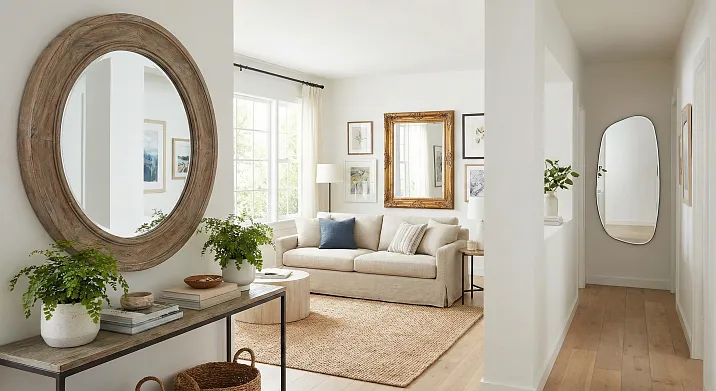
A mirror is not just a reflective surface. It is a tool for managing light, space, and mood.Interior mirrorIn the right frame, it turns a wall into a portal that doubles the depth of a room. It gathers scattered light and returns it as a concentrated stream. It becomes a painting that changes every second, reflecting the life of the space.
Why is the frame important? Because the mirror surface itself is cold, infinite, and lacks boundaries. The frame sets the format, creates context, and turns the mirror into a piece of furniture, a decorative object. A carved oak frame with gilding makes the mirror formal, palatial. A simple black frame turns it into a graphic, modern statement. The frame defines the style, era, and character of the mirror.
Choosing a mirror is a choice between function and decor, between minimalism and luxury, between reflecting reality and creating an illusion. A mirror can be an inconspicuous helper, simply reflecting one's appearance. Or it can be the central object of the interior, around which the entire composition is built. Understanding this role determines the correct choice.


The role of mirrors in interior design: function multiplied by aesthetics
wall-mounted interior mirrorsThey perform many tasks simultaneously. The more functions a mirror combines, the more valuable it is for the interior.




Reflection: a practical necessity
The primary function of a mirror is to show a reflection. In the hallway, a mirror allows you to check your appearance before leaving. In the bathroom — to apply makeup, shave, or style hair. In the bedroom — to evaluate an outfit or try on clothes. Without a mirror, these actions are impossible.
But even in this basic function, there are nuances. The size of the mirror determines what is visible. A small mirror 40×60 cm shows the face and shoulders. A medium one 80×100 cm shows the figure down to the waist. A large one 100×180 cm shows a person in full length. A floor mirror 160-180 cm tall is an option for dressing rooms and bedrooms where a full outfit evaluation is important.
The quality of the reflection is determined by the quality of the mirror glass. A glass thickness of 4-6 mm ensures no distortions. The amalgam — the reflective layer — should be even, without spots or scratches. A protective coating on the back prevents corrosion of the amalgam in humid environments.
Our factory also produces:


Expanding space: visual magic
A mirror doubles the visible area of a room. By hanging a 100×150 cm mirror on a wall, you visually add another 1.5 square meters to the room — illusory, but perceived by the eye. In small spaces, this is critical.
The placement of the mirror enhances the effect. A mirror opposite a window reflects light and the view outside, creating the feeling of a second window. The room appears brighter and more spacious. A mirror in a narrow corridor on a long wall visually expands the space. A mirror in a niche doubles the depth of the niche, turning it into an architectural element.
Mirrored walls are a radical solution. An entire wall is covered with mirror panels. The space is completely doubled. But this is risky: a mirrored wall can create disorientation, visual noise if the space opposite it is chaotic. A mirrored wall works in minimalist interiors with clear lines.
Mirrors on the ceiling — a designer technique for rooms with low ceilings. The mirror visually doubles the height. But this is a specific solution that requires careful lighting design; otherwise, the ceiling mirror reflects unattractive light fixtures.
Get Consultation
Managing light: reflector and amplifier
A mirror is a natural light reflector. It gathers light from windows, light fixtures, candles, and directs it into the space.Mirror with frameA mirror opposite a window makes a room 20-30% brighter. Light passes through the window, reflects off the mirror, and reaches the depths of the room where direct light does not penetrate.
A mirror behind a light fixture doubles the amount of light. A sconce next to a mirror is reflected, creating the illusion of two symmetrical light fixtures. Candles in front of a mirror are doubled, tripled at the right angle, creating a romantic shimmer.
In dark rooms — hallways without windows, interior rooms — a mirror is critical for light distribution. Even if there is little light, the mirror directs it optimally, preventing it from being absorbed by dark surfaces.
A mirror changes the color temperature of light. Warm light from incandescent bulbs, reflected off a mirror, remains warm, enhancing a cozy atmosphere. Cold light from LEDs, when reflected, emphasizes the cleanliness and modernity of the space.
Decorative function: art on the wall
A mirror in itself is a work of art if the frame is worthy. A carved oak frame with botanical ornaments transforms the mirror into a sculptural object. A gilded Baroque-style frame makes the mirror a palatial accent. A laconic dark walnut frame creates a modern graphic.
The shape of a mirror defines its character. A round mirror is soft, organic, reminiscent of the sun or moon. An oval one is classically elegant, reminiscent of a portrait. A rectangular one is strict, architectural, universal. An arched one is romantic, reminiscent of a window or door to another dimension.
Mirror compositions create complex decorative installations. A group of round mirrors of different diameters on a wall creates a constellation. Three vertical mirrors in a row create a triptych. An asymmetrical group of mirrors of different shapes creates a dynamic composition, a visual play.
Mirror as a background for objects. A mirror behind a console table reflects vases, sculptures, creating depth, doubling. A mirror behind a shelf with a collection turns the shelf into a display case. Objects are visible not only from the front but also from behind through the reflection.
Wall mirrors in wooden frames: classic and contemporary
Wall-Mounted Interior Mirror in FrameSolid wood is the choice of those who value naturalness, durability, and the tactile warmth of the material. Wood lives, breathes, ages nobly. A solid oak frame acquires a patina over decades, becoming even more beautiful.
Wood species for frames: from oak to walnut
Oak is the king among species for frames. A density of about 700 kg/m³ makes an oak frame strong, resistant to deformation. Oak grain is expressive: large pores, medullary rays, contrasting annual rings. Under transparent varnish or oil, the oak grain is revealed, creating a living surface.
The color of oak varies from light golden in young wood to dark brown when stained. Popular shades: natural oak, stained oak, whitewashed oak, wenge oak (dark brown, almost black). Each shade creates its own atmosphere.
Beech is an alternative to oak. Density 650 kg/m³, fine-pored, uniform grain. Beech is good for painted frames — the smooth surface does not emphasize pores, paint lays evenly. A beech frame under white enamel looks impeccable, like porcelain.
Walnut — dark nobility. Chocolate-brown color with lighter veins, wavy grain. Walnut frames are prestigious, expensive, associated with studies, libraries, masculine style.
Ash — light contrast. Cream color with dark latewood rings, creating an expressive pattern. Ash frames are good for Scandinavian, eco-interiors. They add light, freshness, do not weigh down the space.
Frame finishes: from natural to decorative
Transparent finish with oil or varnish preserves the wood grain. Oil penetrates the pores, reveals the pattern, creates a matte silky surface. Varnish creates a protective film, can be matte, semi-matte, or glossy. Glossy varnish emphasizes the grain maximally, creates shine.
Staining changes the color of the wood while preserving the grain. Stain penetrates the pores, dyes the wood from within. Shades from light honey to black ebony can be obtained. After staining, varnish or oil is applied for protection.
Enamel painting creates a dense opaque layer. The wood grain is hidden, the surface becomes perfectly smooth, any color. White enamel — a classic, creates lightness, light. Black enamel — drama, contrast, modernity. Colored enamel — gray, blue, green — creates artistic effects.
Gilding — the luxury of classic interiors. Gold leaf or imitation gold (imitation gold from brass) is applied to the frame. Gilding can be solid or partial — only on carved elements. Patinated gilding — the gold is partially worn away, revealing the base underneath — creates an antique effect.
Patination — artificial aging. Dark patina is rubbed into the recesses of the carving, the pores of the wood. The protruding parts are wiped, remaining light. Contrast, depth arise, a feeling that the frame has served for centuries.
Carving and decor of frames: from minimalism to Baroque
Flat frame without decor — a minimalist solution. Rectangular cross-section, clear edges, no decorations. Suitable for modern interiors where purity of lines is important. The frame simply serves as a border for the mirror, not drawing attention to itself.
A profiled frame has a complex cross-section with coves, beads, shelves. The profile creates a play of light and shadow on the frame surface. A classic solution, universal for most styles. Profiled frames are good for traditional and neoclassical interiors.
Carved frame — a work of art. The surface is covered with relief carving: botanical ornaments, geometric patterns, figurative elements. Acanthus leaves, grapevines, rosettes, volutes, cartouches — each element is carved by hand or on a CNC machine, then refined by a carver.
The depth of carving determines the drama. Low-relief carving protrudes 5-10 mm, creates a soft relief. Bas-relief carving protrudes 20-40 mm, elements are voluminous. High-relief carving protrudes 50-80 mm, elements are almost sculptural, cast deep shadows.
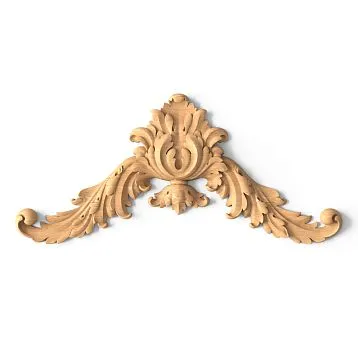
Decorative overlays — separately carved elements attached to the frame. Corner overlays — carved elements at the corners of the frame. Central overlays — in the middle of the sides. Overlays create accents, enrich the frame, without requiring carving of the entire surface.
Mirror shapes: geometry and symbolism
Shapeinterior wall mirrordefines its character, influences the perception of space.
Round mirrors: sun in the interior
A round mirror is a symbol of the sun, infinity, perfection. A circle is a form without beginning or end, closed, self-sufficient. A round mirror creates softness, organicity, relieves the angularity of space.
The diameter of a round mirror determines its scale. A small mirror 40-60 cm in diameter is a decorative accent, an element of a composition. A medium one 80-100 cm is an independent object, noticeable but not dominant. A large one 120-150 cm is a dominant feature, the center of a wall, attracting the eye.
Round mirrors work well in compositions. A group of round mirrors of different sizes on a wall — from 30 cm to 80 cm in diameter — creates a dynamic constellation. Mirrors can be arranged symmetrically or asymmetrically, densely or sparsely.
The frame of a round mirror can be narrow — 3-5 cm, simply framing the circle. Or wide — 10-20 cm, creating a massive decorative object. A wide carved frame of a round mirror resembles the sun with rays, especially if the carving is radial, diverging from the center.
Oval mirrors: classic elegance
An oval mirror is an elongated circle, more dynamic and elegant. An oval is associated with portraits — classic portraits were often painted in oval frames. An oval mirror creates an association with art, museum quality, tradition.
The proportions of an oval influence perception. An elongated oval — vertically oriented — visually raises the ceiling, stretches the space upward. A wide oval — horizontally oriented — widens the wall, makes it broader.
Oval mirrors are traditional for bedrooms, bathrooms, boudoirs. They create intimacy, softness, femininity. An oval mirror above a dressing table is a bedroom classic. An oval mirror in an entryway is a classic for the entrance area.
The frame of an oval mirror is usually profiled or carved. A flat frame on an oval looks boring and doesn't utilize the shape's potential. A profiled frame with coves emphasizes the oval's curve. A carved frame with floral ornaments creates luxury.
Rectangular mirrors: architectural strictness
A rectangular mirror is the most universal shape. A vertically oriented one — portrait — is suitable for entryways, bathrooms, where you need to see the figure from head to waist or full-length. A horizontally oriented one — landscape — is suitable for placement above dressers, consoles, fireplaces.
The proportions of a rectangle determine its character. A square mirror — 1:1 proportions — creates stability, balance. An elongated vertical one — 1:2 or 1:3 — creates upward aspiration, monumentality. An elongated horizontal one — 2:1 or 3:1 — creates panoramic quality, sprawl.
Rectangular mirrors are easy to compose. Three identical mirrors in a row — horizontally or vertically — create rhythm, repetition. Mirrors of different sizes, arranged asymmetrically, create a dynamic composition.
The frame of a rectangular mirror can be anything — from minimalist flat to abundantly carved Baroque. A rectangle is a neutral shape, the frame defines the style. A narrow black frame — modern minimalism. A wide gilded carved one — classic Baroque.
Arched and shaped mirrors: romance of form
An arched mirror is a rectangle with a semicircular top. The shape resembles a window, door, arch. An arched mirror creates romance, architectural quality, an association with history. Works well in classic, Mediterranean, vintage interiors.
The size of the arch determines expressiveness. A tall arch — a large radius of curvature — creates Gothic quality, aspiration. A shallow arch — a small radius — creates softness, coziness. An arched mirror is usually vertically oriented, its height is significantly greater than its width.
Shaped mirrors are non-standard forms created by a designer. A mirror in the shape of a keyhole, a cloud mirror with smooth curves, a polygonal mirror with faceted edges. Shaped mirrors are art objects, suitable for avant-garde, eclectic interiors.
The frame of a shaped mirror should emphasize the shape or contrast with it. If the mirror shape is complex, the frame can be minimalist to avoid overloading. If the mirror shape is simple but unusual, the frame can be decorative, adding complexity.
Frame styles: from classic to loft
The style of the frameinterior mirror buymust match the style of the interior. Dissonance creates visual discomfort.
Classic frames: proportions and decor
A classic frame is wide — 10-20 cm, profiled, with carved elements. The profile is symmetrical, consisting of several elements: shelves, coves, beads. The carving is restrained: laurel wreaths, meanders, rosettes, acanthus leaves in a stylized form.
The color of a classic frame is natural wood under clear varnish or dark staining. Gilding is possible, but not solid—only on carved elements to create accents. Patination adds noble antiquity.
Classic frames are universal. They are suitable for living rooms, dining rooms, studies, bedrooms in classic, neoclassical, traditional style.mirror in a classic framenever goes out of fashion, remains relevant for decades.
Baroque and Rococo: theatrical luxury
A Baroque frame is maximum decor. Carving covers the entire surface. The forms are curved, dynamic. The carving is deep: putti, draperies, floral garlands, shells, volutes. Gilding is abundant, often solid.
Baroque colors are saturated: gold on red, green, blue background. Or ebony with gilded carving — contrasting, dramatic. A Baroque frame is massive, heavy visually and physically.
Baroque mirrors require a corresponding interior. High ceilings, large areas, stucco, rich textiles. In an ordinary apartment, a Baroque mirror can overwhelm the space. But in a mansion, in a formal living room — that is its place.
Rococo is a lighter version of Baroque. The carving is delicate, not massive. The forms are curved, asymmetrical. Characteristic elements include rocailles (scrolls resembling shells), floral garlands. Colors are pastel: pink, blue, mint. Gilding is present, but subdued, patinated.
Art Nouveau: fluidity and naturalism
Art Nouveau frames have smooth, curved lines, stylized plant motifs. The carving is light, relief, depicting irises, lilies, winding stems. The forms are asymmetrical, organic, reminiscent of nature.
Art Nouveau colors are natural: light wood, silvery-gray, greenish. Gilding is rare; if present, it is matte. Art Nouveau frames create a romantic mood, suitable for bedrooms, boudoirs, artistic spaces.
Art Nouveau requires a sense of proportion. An excess of curved lines creates visual overload. An Art Nouveau mirror works best as an accent in a space with more austere lines in the rest of the furniture.
Loft and industrial: the brutality of materials
Loft frames are minimalist or deliberately rough. A frame made of black metal — angle iron, strip — creates industrial chic. A frame made of untreated wood with preserved defects, knots, cracks — creates authenticity, a connection with the material.
Loft colors are contrasting: black, dark gray, rusty, natural untreated wood. No gilding, no carving. Simplicity, functionality, brutality.
A loft mirror works well in spaces with brick walls, exposed utilities, concrete surfaces. In such an interior, a classic carved frame would look alien.
Mirrors for different rooms: choosing the right location
Wall interior mirrorsare chosen considering the function of the room. What works in an entryway may not work in a bedroom.
Entryway: first impression
A mirror in the entryway is a functional necessity. It allows checking one's appearance before leaving. The mirror size — from waist to head at a minimum, preferably full-length. Height 120-180 cm, width 60-80 cm.
The placement of the mirror in the entryway is determined by the layout. Opposite the entrance door — the first thing a person sees upon entering. This creates a space-expanding effect, but according to feng shui, it is not recommended — energy is reflected back. To the side of the door — more practical, convenient for checking one's appearance.
The mirror frame in the entryway should be sturdy. The entryway is a high-traffic area; accidental bumps with bags, umbrellas are possible. A solid oak frame is reliable. A narrow, fragile frame risks being damaged.
Lighting for the mirror in the entryway is important. Often entryways have no windows, only artificial light. Sconces on the sides of the mirror or above it provide even facial illumination without harsh shadows.
Bathroom: moisture resistance and lighting
A mirror in the bathroom is a mandatory element. It is needed for hygiene procedures: shaving, applying makeup, styling hair. The mirror size depends on the bathroom size. In a small bathroom — a 60×80 cm mirror above the sink. In a large one — a 100×120 cm mirror or even a mirrored wall.
Moisture resistance is critical. A bathroom mirror is exposed to steam, moisture, temperature fluctuations. The amalgam must have a protective coating preventing corrosion. The frame must be made of moisture-resistant material or treated with moisture-protective compounds.
A wooden frame in the bathroom requires special protection. Oil with wax or yacht varnish creates a moisture barrier. Without protection, wood in the bathroom will swell, darken, deform. An alternative is an MDF frame with a moisture-resistant coating or plastic that imitates wood.
Bathroom mirror lighting should be close to natural light. Lamps with a color rendering index (CRI) of 90+ show colors as accurately as possible. This is important for makeup — so that foundation, blush colors look the same as in daylight.
Bedroom: intimacy and functionality
A mirror in the bedroom serves several functions. Practical — assessing appearance, trying on clothes. Decorative — wall decoration, creating an accent. Psychological — a mirror opposite the bed can disturb sleep, creating a feeling of constant observation.
Placing a mirror in the bedroom requires caution. According to feng shui, a mirror opposite the bed is undesirable — the reflection of a sleeping person disrupts the energy. From a practical standpoint, waking up at night and seeing one's reflection in the dark can be frightening. It is better to place the mirror to the side of the bed or on a perpendicular wall.
The size of the bedroom mirror depends on its function. For assessing an outfit, a full-length mirror is needed — floor-standing or wall-mounted, 150-180 cm tall. For decoration, a medium-sized mirror 80×100 cm above a dresser or vanity table is sufficient.
The bedroom mirror frame should match the furniture style. If the bed is classic carved, the mirror should also be in a classic carved frame. If the furniture is modern minimalist, a mirror in a simple frame or frameless with a beveled edge.
Living room: formality and scale
A mirror in the living room is primarily a decorative element. It is not mandatory, but adds depth, light, and solemnity to the space.Large mirrorin a massive carved frame becomes the centerpiece of a wall composition.
The size of the living room mirror should be substantial. A small mirror will get lost on a large wall. A mirror 120×150 cm or even 150×180 cm is proportionate to a living room space. A mirror above the fireplace, above a console, on an empty wall — traditional placement locations.
The living room mirror frame can be maximally decorative. The living room is a formal space where luxury is appropriate. A carved gilded frame, a wide profiled oak frame, a mirror in a frame with inlay — all of this works in a living room.
A mirror in the living room can be part of a composition. A mirror above a console with symmetrically placed sconces on the sides creates a classic triad. A mirror surrounded by decorative moldings on the wall creates a frame within a frame, enhancing its significance.
Visual Space Expansion: Techniques and Methods
A mirror is a powerful tool for visually enlarging space. Proper use transforms a small room into a spacious one.
Mirror opposite a window: doubling light
Placing awall interior mirroropposite a window creates the illusion of a second window. Light passes through the real window, reflects off the mirror, and returns to the space. The room becomes 20-30% brighter.
The view from the window, reflected in the mirror, is doubled. If trees, sky, or an urban landscape are visible from the window, all of this is reflected, creating visual depth. It seems as if the room has two windows on opposite walls.
The mirror size should be proportionate to the window. A small mirror won't have the effect. A mirror close to or even larger than the window size will create the maximum doubling effect.
Mirror at the end of a hallway: illusion of continuation
A narrow, long hallway is visually shortened if a mirror is hung at the end. The hallway seems to continue, receding into the distance. It's an optical illusion, but it works.
The mirror should be large enough—from floor to ceiling or at least from waist height to the top of the wall. A small mirror won't create the illusion of the hallway continuing.
Lighting enhances the effect. Lamps in the hallway, reflecting in the mirror, create a sense that the hallway is illuminated deeper than it actually is.
Mirror wall: radical doubling
A mirror wall—where an entire wall is covered with mirror panels—doubles the space completely. The room visually becomes twice as large. This is a radical solution, suitable for small rooms where every square meter is critical.
But a mirror wall requires caution. There should be something visually pleasing opposite it. If there is chaos or clutter opposite, it will be doubled, creating visual noise. A mirror wall works in minimalist interiors with clear organization.
Mirror panels are joined edge-to-edge or with minimal seams. Seams should be vertical, evenly distributed. Horizontal seams cut the space and are undesirable.
Mirror compositions: depth and dynamics
A group of mirrors creates a more complex effect than one large mirror. Several round mirrors of different diameters on a wall create a constellation, multi-level reflection. Each mirror reflects a fragment of the space from its own angle, creating a cubist effect.
Three vertical mirrors in a row on a wall create a triptych, a rhythmic repetition. Mirrors can be the same or different in size, creating symmetry or dynamism.
An asymmetrical group of mirrors of different shapes—round, rectangular, oval—creates a complex composition, an artistic installation. This requires design flair, otherwise it will result in chaos.
Popular questions about mirrors in interior design
What size mirror to choose for the hallway?
For an entryway, a mirror 120-180 cm high and 60-80 cm wide is optimal. This allows you to see yourself from head to waist or full-length. If the entryway area allows, it's better to choose a full-length mirror—160-180 cm high.
Can a mirror be hung opposite the entrance door?
From a design perspective, it's possible—it creates a space-expanding effect. But according to feng shui, it's not recommended—it's believed that energy reflects back and doesn't enter the home. The decision is yours, depending on your beliefs.
How to care for a mirror with a wooden frame?
Wipe the mirror surface with a glass cleaner once every 1-2 weeks. Wipe the frame with a dry, soft cloth to remove dust. Every 2-3 months, wipe the frame with a slightly damp cloth. For a wooden frame with an oil finish, refresh with a thin layer of oil every 2-3 years.
What mirror shape to choose for a classic interior?
For a classic interior, oval, rectangular, and arched mirrors are suitable. Round mirrors are more modern but can work in neoclassical styles. The frame shape is more important—choose profiled or carved frames made of solid wood.
Mirror in the bedroom opposite the bed—yes or no?
From a practical standpoint, it's possible, but many feel discomfort seeing their reflection while sleeping. According to feng shui, it's not recommended. If you want a mirror in the bedroom, place it to the side of the bed or on a perpendicular wall.
How to choose a mirror frame to match the interior?
The frame should match the interior style. Classic interior — profiled or carved oak frame. Modern minimalism — narrow flat frame or frameless. Loft — black metal frame or rough wood. Scandinavian — light wooden frame.
Can a mirror be used as a headboard?
Yes, it's a design technique. A mirror panel behind the headboard creates depth and reflects light. But it requires high-quality mounting — mirrors are heavy and must be securely fastened. Also consider that the reflection may be disturbing at night.
How much does a mirror in a wooden frame cost?
Price depends on size, wood species, and frame complexity. A simple 60×80 cm mirror in a flat pine frame — from 8,000-12,000 rubles. A 100×150 cm mirror in a carved oak frame — from 35,000-60,000 rubles. Exclusive mirrors with gilding and intricate carving — from 100,000 rubles.
Where to buy a quality interior mirror?
Choose manufacturers with experience, portfolio, and quality materials. Company STAVROS has been creatinginterior mirrorsin solid oak and beech frames for over 23 years. Various shapes, sizes, styles. Possibility of custom orders. Showrooms in Moscow and St. Petersburg.
Frameless mirror or framed mirror — what to choose?
Frameless mirror — a modern minimalist solution. Suitable for contemporary interiors. Framed mirror — classic, decorative. Suitable for traditional interiors. The frame turns the mirror into a piece of furniture, a decorative object. The choice depends on interior style and personal preferences.
Conclusion: mirror as a reflection of style
Wall-Mounted Interior Mirror in Frame— is not just a utilitarian object. It is a tool for transforming space, managing light, creating visual illusions. A correctly chosen mirror turns a small room into a spacious one, a dark one into a bright one, an ordinary one into a formal one.
The frame defines the character of the mirror. A carved oak frame with gilding turns the mirror into a work of art, a central element of a classic interior. A simple black frame makes the mirror a graphic modern accent. The absence of a frame creates minimalist purity.
The shape of the mirror affects perception. A round mirror softens space, creates organicity. An oval one adds classic elegance. A rectangular one is universal, architectural. An arched one creates romance, historicity.
Mirror placement requires understanding optical laws and the psychology of space. A mirror opposite a window doubles the light. A mirror at the end of a hallway creates an illusion of depth. A mirror opposite a bed may disturb sleep. Knowing these nuances allows using the mirror most effectively.
The company STAVROS has been creatingmirrors in solid wood frames. Oak and beech are species that ensure strength, durability, and expressive texture. All wood undergoes chamber drying to 8-10% moisture, guaranteeing stability and absence of deformation.
Frames are manufactured on European equipment with millimeter precision. Profiling, carving, sanding — each stage is controlled.Carved Elementsare created in combination: CNC machines cut the basic relief, master carvers refine details by hand.
Mirror glass is supplied from European manufacturers. Glass thickness of 4-6 mm ensures no distortion. Amalgam is uniform, without defects. Protective coating on the back prevents corrosion, especially important for humid rooms.
Frame finishing is done with natural compounds. Linseed oil-based oils reveal wood texture and protect from moisture. Acrylic varnishes are eco-friendly, creating a protective film. Stains allow obtaining shades from light honey to black ebony. Gilding with gold leaf or imitation gold leaf — for premium projects.
STAVROS offers mirrors of various shapes: oval, round, rectangular, arched. Sizes from compact 60×80 cm to large 150×180 cm. Floor mirrors 160-180 cm high for bedrooms and dressing rooms.Classic Furnitureand mirrors in a unified style create a cohesive interior.
Custom orders are executed based on client sketches. Non-standard sizes, unique shapes, exclusive carving — STAVROS production capabilities allow realizing any design concepts. Production time 4-8 weeks depending on complexity.
Consultations with specialists will help choose the optimal mirror. Tell us about room dimensions, interior style, functional tasks. Specialists will recommend shape, size, frame style, calculate cost, and agree on timelines.
Delivery to Moscow, St. Petersburg, all of Russia. Mirrors are packed professionally — protective corners, cushioning materials, sturdy boxes. Fragile cargo requires special care. Delivery by transport companies with insurance option.
STAVROS showrooms in Moscow and St. Petersburg. Here you can see mirrors in person, assess frame quality, carving, finishing. See how the mirror reflects space, how the frame looks under different lighting. Consultants will help with selection and place an order.
Create an interior whereMirrors in wooden framesdo not just reflect reality, but shape it. Where light reflected from a mirror creates additional depth. Where a solid oak frame adds nobility, connection to tradition. Choose quality from STAVROS — and your space will gain that magic that only a correctly chosen mirror can create. The magic of reflections, light, visual expansion, turning an ordinary room into a thoughtful, harmonious, inspiring space.