Article Contents:
- Philosophy of the Approach: Why Many Small Are Better Than One Large
- Dynamics vs. Statics
- Scale and Humanity
- Composition Flexibility
- Thin Baseboard as a Restrained Foundation for Composition
- Why Not a High Baseboard
- Choosing a Thin Baseboard Profile
- Baseboard Color: Neutrality as a Virtue
- Frame Selection Strategy: Diversity in Unity
- Uniform Wood Species, Different Profiles
- Uniform Color, Different Frame Widths
- Mix of Simple and Carved Frames
- Mirror Sizes: Small Format as a Conscious Choice
- Size Range Within a Single Composition
- Vertical vs. Horizontal
- Hanging Rules: How to Avoid Turning Order into Chaos
- Baseline: Invisible Structure
- Vertical Division: Columns or Free Grid
- Intervals Between Mirrors: Air as a Composition Element
- Symmetry or Asymmetry: A Conscious Choice
- Visual Effects: Light, Movement, Depth
- Light Multiplication: Mirrors as Secondary Sources
- Illusion of Movement: Mirrors as a Kinetic Object
- Depth and Multi-layeredness: Mirrors as Portals
- Spaces for a Micro-gallery: Where the Approach Works Best
- Stairwells: Gallery in Motion
- Corridors: Overcoming Monotony
- Above a Long Dresser: Horizontal Gallery
- Bedroom: An Intimate Gallery
- Common Mistakes and How to Avoid Them
- Mistake 1: Too Many Mirrors
- Mistake 2: Lack of a Unifying Factor
- Mistake 3: Ignoring the Baseline
- Mistake 4: Insufficient Air Between Elements
- Mistake 5: Incorrect Proportions of Frames and Mirrors
- Technical Aspects: Mounting and Safety
- Load Calculation
- Methods for Mounting Small Mirrors
- Marking Before Installation
- Frequently Asked Questions About Mirror Micro-Galleries
- How Many Mirrors Are Optimal for a Composition?
- Can Mirrors of Different Shapes Be Combined?
- Where to Buy Small Mirrors in Wooden Frames?
- How to Care for Many Small Mirrors?
- How Much Does Creating a Micro-Gallery Cost?
- Can the Project Be Implemented Independently?
- Does the Technique Work in Small Rooms?
- Can a Micro-Gallery Be Created on a Dark Wall?
- Conclusion: The Art of a Personal Gallery

Imagine a wall where, instead of the usual paintings, there are a dozen small mirrors in wooden frames. Each catches light at its own angle, reflects fragments of the room, creates a play of highlights and depth. This is not a random collection of objects, but a thoughtful composition wherea thin baseboardserves as an invisible baseline, andwooden mirror framesare united by a common wood species despite varying profiles. A micro-gallery of mirrors is a technique that transforms an ordinary wall into a living, dynamic surface, changing throughout the day along with the movement of the sun and people in the space. It is the art of creating volume where there was a plane, adding light where it is lacking, turning decor into a functional element of architecture.


The Philosophy of the Technique: Why Many Small Ones Are Better Than One Large One
One large object on a wall is an accent, a dominant, a focal point. It attracts the gaze, concentrates attention, creates hierarchy. Many small objects work differently—they create a field, texture, rhythm. The gaze does not stop at one point but travels from element to element, reading the composition like a complex musical piece, not a single note.




Dynamics vs. Statics
A large mirror is static. It reflects a fragment of space as a whole, creating a single reflection. Small mirrors are dynamic—each reflects its own fragment at its own angle. One catches the window, another the chandelier, a third a piece of furniture, a fourth a passing person. The result is a kaleidoscope of reflections, a constantly changing picture that depends on the observer's position, time of day, and lighting.
This dynamism creates liveliness in the space. The room ceases to be a static decoration and becomes a changing environment. Morning light creates one picture of reflections, evening artificial light—a completely different one. This is an interior that does not become boring because it is not the same day after day.
Our factory also produces:


Scale and Humanity
Large objects can be overwhelming. A 150×200 cm mirror on the wall creates monumentality and theatricality but may be excessive in a living space. Small mirrors measuring 30×40 cm or 25×35 cm are proportionate to a person, can be viewed up close, and each becomes its own story.
The human eye and brain are tuned to perceive detail, complexity, and variety. A wall with multiple elements holds attention longer than a wall with a single element. We read the composition, compare frames, examine reflections in each mirror, and discover new details upon a second glance. This creates engagement, interest, and an emotional connection with the space.
Get Consultation
Flexibility of composition
A single large object dictates a rigid central axis. It cannot be easily moved, changed, or supplemented. A composition of many small mirrors is flexible—you can add a new mirror, remove one, move a group, or change the configuration. It's a living system that evolves with your tastes and needs.
Purchasing a large mirror in an expensive frame is a significant, one-time investment made for the long term. Collecting small mirrors is a process stretched over time, allowing you to add elements one by one, gradually forming a unique composition. It's the path of a collector, not a one-time purchase.
A thin baseboard as a restrained foundation for the composition
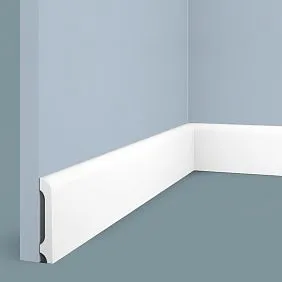
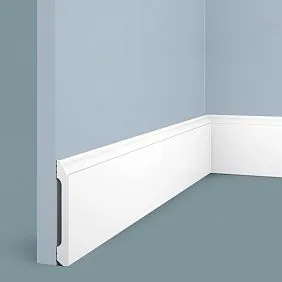
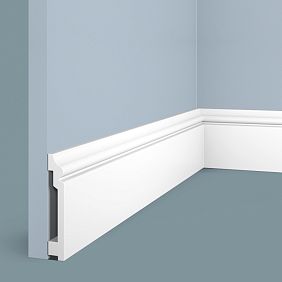
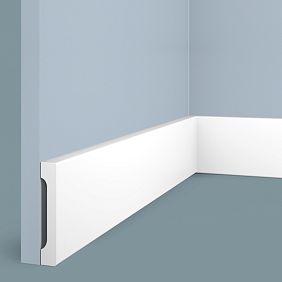
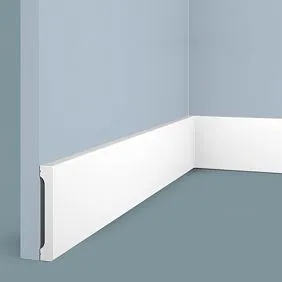
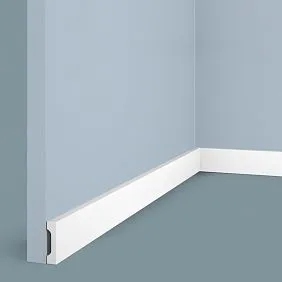
When a wall is saturated with decor—multiple framed mirrors—the lower part of the room should be restrained to avoid visual overload.A thin floor baseboardwith a height of 60-80 mm is an ideal solution, creating a delicate boundary between the floor and wall without competing with the active upper area.
Why not a tall baseboard
A tall baseboard of 120-160 mm is an independent architectural element that attracts attention and creates a horizontal dominance. Combined with multiple mirrors on the wall, it would create competition—the bottom and top would vie for attention. The result is visual restlessness, a lack of hierarchy, and clutter.
A thin baseboard is modest; it serves a technical function (covering the joint between floor and wall, protecting the lower part of the wall from dirt and damage) but does not claim a decorative role. This allows the mirrors to be the stars of the composition without sharing the spotlight with other elements.
Choosing the profile of a thin baseboard
For a micro-gallery of mirrors, a maximally simple baseboard profile is optimal. A rectangular cross-section with a slight rounding of the top edge (radius 2-3 mm), without decorative protrusions, coves, or carvings. The simpler the baseboard, the better it serves as a neutral foundation.
The baseboard material should coordinate with the material of the mirror frames. If the frames are wooden oak, the baseboard can also be oak (or painted MDF in an oak color). If the frames are painted white, the baseboard is white. If the frames are dark wenge, the baseboard is dark. This creates color unity between the bottom and top of the composition while differentiating their roles.
Baseboard color: neutrality as a virtue
A white baseboard is a universal choice for a micro-gallery with multi-colored or multi-toned mirror frames. White is neutral, does not compete with any color, and creates lightness and airiness. A white baseboard visually dissolves against a light wall, becoming invisible—exactly what is needed for a composition where the mirrors are the main focus.
A baseboard matching the floor color is another option, creating a visual extension of the flooring. If the floor is light oak, the baseboard is light oak. If the floor is dark walnut, the baseboard is dark walnut. This visually raises the floor to the height of the baseboard, creating the effect of a plinth zone from which the gallery of mirrors begins.
A contrasting black or graphite baseboard against light walls is a bold solution, creating a clear horizontal line around the perimeter of the room. But it should be used cautiously—a dark baseboard is an accent in itself and, combined with multiple mirrors, can create visual complexity. It's better suited for minimalist interiors where there are few mirrors (5-7 pieces) and they are arranged in a restrained manner.
Frame selection strategy: diversity within unity
The secret to a successful micro-gallery of mirrors is the balance between diversity and unity. If all frames are absolutely identical, the composition is boring, mechanical, and lacks individuality. If all frames are completely different (different wood species, colors, styles), the composition is chaotic, restless, and irritating to the eye. A golden mean is needed.
Uniform wood species, different profiles
The unifying factor is the wood species. All frames are made of oak or all of beech. The color and texture of the wood create a visual kinship, read as a family.Solid oak wooden frameshave a characteristic texture with pronounced annual rings and a recognizable palette ranging from light honey to dark brown (depending on the tint). Beech has a more uniform texture, with a soft pinkish hue of natural wood or a neutral beige after light tinting.
Variability is created through profiles. One frame is a simple flat plank 40 mm wide with a slight bevel on the outer edge. Another is a convex profile with a bead in the center. A third is concave with a recess. A fourth is stepped with two levels. All are oak, all in a natural oil or wax finish, but each has its own character due to the profile shape.
The number of different profiles depends on the total number of mirrors. For a composition of 6-8 mirrors, 3-4 profile types are sufficient. For 12-15 mirrors, 5-6 types can be used. More than that risks excessive diversity, losing the readability of the system.
Uniform color, different frame widths
Another approach is to have all frames painted in one color (white, black, gray, deep blue) but varying in width. Narrow frames of 25-30 mm for small mirrors measuring 20×30 cm. Medium frames of 40-50 mm for mirrors measuring 30×40 cm. Wide frames of 60-80 mm for the largest mirrors measuring 40×60 cm in the composition. A uniform color unifies, while differences in width create visual hierarchy, rhythm, and interest.
A monochrome palette (all white or all black) works for modern interiors—minimalism, Scandinavian style, contemporary. It creates graphic clarity, precision, and strictness. For classic interiors, natural wood is preferable, preserving the warmth and nobility of the material.
Mix of simple and carved frames
For classic and eclectic interiors, you can combine simple frames with carved ones. Most frames (70-80%) are simple smooth profiles made of oak or beech. One or two frames arecarved with floral ornamentation, creating accents in the composition. Carved frames are usually wider and more massive than simple ones, so they frame the most significant mirrors — the central or largest one.
It is important that carved frames do not clash stylistically. If the composition is in classic or Art Nouveau style, the carving should be appropriate — floral motifs, smooth lines, symmetry. For more modern interiors, the carving should be restrained — geometric borders, light fluting, minimal ornamentation.
Mirror sizes: small format as a conscious choice
Small mirrorsup to 60 cm on the longest side — the optimal size for a micro-gallery. They are large enough to create full reflections and be noticeable from a distance, but small enough to be placed in groups, creating complex compositions.
Size range in one composition
Uniformity in sizes is boring, excessive variety is chaotic. It is optimal to use 3-4 standard sizes of mirrors in one composition. For example:
Small: 20×30 cm or 25×35 cm (vertical rectangles) — 30-40% of the total number of mirrors in the gallery.
Medium: 30×40 cm or 35×45 cm — the main bulk, 40-50% of mirrors.
Large: 40×60 cm or 50×70 cm — 1-2 mirrors, focal elements of the composition, usually placed in the center or at key points.
Round or oval: diameter 30-40 cm (for round) or 30×40 cm (for oval) — 1-2 pieces to diversify shapes, create contrast with rectangular geometry.
Such distribution creates a visual hierarchy. The eye catches the large mirrors first, then reads the medium ones, while small ones add detail and rhythm. The composition is readable on several levels — large elements are visible from afar, nuances of small ones are revealed up close.
Vertical vs. Horizontal
Vertical orientation of mirrors (height greater than width) creates an upward aspiration, visually raises the ceiling, adds slenderness to the space. Horizontal (width greater than height) expands, creates calmness, and static quality. Square mirrors are neutral, balanced, and create stability.
For most residential spaces with ceilings of 2.6-2.8 meters, vertical orientation is preferable — it compensates for the limited height. In a composition of 10 mirrors, you can use 6-7 vertical, 2 square, 1 horizontal. Such distribution creates a general upward aspiration while maintaining variability.
Hanging rules: how not to turn order into chaos
A micro-gallery of mirrors requires a system. Without placement rules, the composition falls apart, turning into a random set of objects. Constraints are needed to structure the chaos, create order, allowing variety to exist without turning into disorder.
Base line: invisible structure
The first rule — all mirrors are united by a base line, to which their bottom edges are aligned. This line is located at a certain height from the floor — usually 80-100 cm. The baseboard sets the floor level from which the height of the base line is measured.
Aligning along the bottom edge creates a visual shelf, an invisible horizontal line on which all mirrors 'stand'. This gives the composition stability, order, and readability. Meanwhile, the top edges of the mirrors are at different levels (due to differences in mirror height), creating a picturesque irregularity and dynamism, but the bottom remains ordered.
An alternative option — alignment along the central horizontal axis. All mirrors are aligned by their center at the same height (e.g., 140 cm from the floor). The bottom and top edges are then at different levels, creating a more complex composition that requires greater skill to achieve visual balance.
Vertical division: columns or free grid
The second rule concerns the horizontal distribution of mirrors. You can use a system of vertical columns — mirrors are placed in imaginary vertical strips 60-80 cm wide each. Within each column, there are 1-3 mirrors, placed one above the other with an interval of 10-20 cm. Columns are separated by empty wall spaces of 30-50 cm.
Free grid — a more flexible approach where mirrors are placed on an implicit grid with a step of 40-60 cm horizontally and vertically. Not every grid node needs to be filled with a mirror, but those that are, are placed at nodes or intersections of lines. This creates order with apparent randomness.
Intervals between mirrors: air as a compositional element
Mirrors should not hang right next to each other. The minimum interval between frame edges is 10 cm. Optimal is 15-25 cm. Maximum (between distant groups of mirrors) is 40-60 cm. These gaps are not emptiness to be filled, but an active pause, giving the eye a rest and allowing each mirror to be read separately.
If the interval is less than 10 cm, mirrors visually merge into a single spot, losing individuality. If more than 60 cm, the connection between elements breaks, the composition disintegrates into separate objects, and is not read as a single gallery.
The air around the composition is also important. There should be at least 30-40 cm of empty wall between the outermost mirror and a corner of the room, a doorway, or another element. This creates a frame, a gallery border, preventing it from 'butting up' against the edge or dissolving into the surroundings.
Symmetry or asymmetry: a conscious choice
A symmetrical composition means mirrors are arranged mirror-symmetrically relative to a central vertical axis. The left half repeats the right. This creates solemnity, classicism, and order. Suitable for formal interiors, living rooms, dining rooms, spaces where respectability is important.
An asymmetrical composition means mirrors are arranged freely, without mirror repetition. This creates dynamism, modernity, and lightness. Suitable for eclectic interiors, creative spaces, bedrooms, personal studies, where individuality is important.
You can use balanced asymmetry — the composition is not formally symmetrical but is visually balanced. For example, two large mirrors on the left, four small ones on the right. The number and mass of elements differ, but the visual weight is roughly equal, creating balance without symmetry.
Visual effects: light, movement, depth
The main advantage of a micro-gallery of mirrors over a picture gallery is its ability to actively interact with the space. A painting is static; it shows one image regardless of conditions. A mirror is dynamic — it changes depending on lighting, the observer's position, and movement in the space.
Multiplying light: mirrors as secondary sources
Each mirror reflecting a light source (window, lamp, chandelier) becomes a secondary source, doubling the brightness. In a room with 10 small mirrors, each 30×40 cm. The total reflective area is 1.2 square meters. This is equivalent to an additional window or a large mirror, but distributed across the wall, creating a multiplicity of glints.
This distribution of light is more effective than one large mirror of the same area. A large mirror creates one large reflection of the light source. Ten small ones create ten reflections located at different points on the wall. Light is scattered more evenly throughout the room, the lighting is softer, without harsh contrasts.
Place the micro-gallery on a wall that receives maximum natural light (opposite a window or perpendicular to a window so the mirrors catch oblique light). In the evening, artificial lighting (chandelier, sconces, floor lamps) will reflect in the mirrors, creating the illusion of more light fixtures than there actually are.
Illusion of movement: mirrors as a kinetic object
When you walk past a wall with a micro-gallery of mirrors, the reflections in each mirror change. What reflected a window a second ago now reflects you. What reflected an empty wall now shows a chandelier. An effect of movement, change, and life is created. A static wall turns into a dynamic surface.
This effect is enhanced if there are moving objects in the room — people, pets, curtains swaying in the wind. The mirrors catch these movements, capture moments, create a sense of the space being inhabited even when no one is in the room (reflections from other rooms visible through doorways).
To enhance the kinetic effect, place the mirrors at slight angles to the plane of the wall. Instead of strictly perpendicular mounting (mirror parallel to the wall), mount them with a 2-5 degree tilt in different directions. This creates variation in what each mirror reflects, enhancing the multiplicity of viewing angles.
Depth and layering: mirrors as portals
When mirrors are arranged in a group, some of them may reflect other mirrors. An effect of layering is created, where one mirror shows the reflection of another mirror, which in turn reflects a third. This creates an illusion of depth, an additional dimension, a portal to a parallel space.
Control this effect. If too many mirrors reflect each other, visual complexity and disorientation arise. It's optimal when 2-3 mirrors out of the total create such secondary reflections, while the others reflect the room directly. This creates interest without overload.
To create a deliberate depth effect, place a large mirror in the center of the composition, and a group of small ones around it so that some of the small ones are visible in the reflection of the large one. The result is a matryoshka effect — a mirror within a mirror, an image receding into depth.
Spaces for a micro-gallery: where the technique works best
Not every space is equally suitable for a micro-gallery of mirrors. There are places where this technique unfolds to its maximum, creating not just a decorative effect but solving functional tasks.
Stairwells: a gallery in motion
A staircase is a space of movement, where you never stand in one place for long. You ascend or descend, the viewing angle constantly changes, the eye level shifts. A micro-gallery of mirrors on the wall along the staircase creates a constantly changing spectacle — with each step, the reflections in the mirrors change, new angles open up.
Place the mirrors on the wall along the stair flight at a height of 130-170 cm from the steps (approximately at eye level for a walking person).Staircase space requires a special rhythm— mirrors can be spaced at intervals corresponding to the step of the stairs, creating architectural coordination between the staircase and the wall decor.
Functionally, mirrors on the staircase create additional illumination (especially if the staircase is in the center of the house, without windows). Aesthetically, they turn a utilitarian space into a gallery you visit many times a day, going down and up.
Corridors: overcoming monotony
A long corridor is a monotonous space suffering from uniformity. A micro-gallery of mirrors on one of the long walls breaks this monotony, creates visual stops, focal points. Each mirror is a small event, a point of interest that makes the gaze linger.
Place the mirrors at a height of 100-150 cm from the floor (aligned to a baseline, as described above). The opposite wall should remain calm — painted in a solid color or with minimal decor. This creates a balance between an active and a passive wall, not overloading the narrow space.
Functionally, mirrors in a hallway visually expand the space (they reflect the opposite wall, creating an illusion of additional depth) and add light (especially if there is a window at the end of the hallway—the mirrors will reflect natural light). Practically, one or two mirrors can be placed at a convenient height for use before leaving the house.
Above a long dresser: a horizontal gallery
A console, dresser, or sideboard 180-240 cm long is the perfect base for a horizontally elongated micro-gallery of mirrors. The furniture creates the lower boundary of the composition (the mirrors start 10-15 cm above the top surface of the dresser). The mirrors are arranged in one or two horizontal rows at a height of 100-160 cm from the floor.
Such a composition functionally unites the furniture and the wall decor. Objects (vases, candlesticks, books) can stand on the dresser and will be reflected in the lower row of mirrors, creating a visual doubling. The upper row of mirrors reflects the room, ceiling, and chandelier.
Stylistically, this is a solution for living rooms, dining rooms, bedrooms (a dresser at the foot of the bed or along a wall). It is important thatthe mirror frames coordinate with the material and color of the furniture—oak frames for oak furniture, white for white, dark for dark.
Bedroom: an intimate gallery
In a bedroom, a micro-gallery of mirrors creates a more intimate, cozy atmosphere than one large mirror. Small mirrors are less intrusive, do not dominate, and allow the space to remain relaxed. Place the composition on the wall opposite the bed or to the side (but not directly above the headboard—overhanging objects are psychologically uncomfortable during sleep).
In a bedroom, controlling what the mirrors reflect is especially important. Avoid reflecting the bed in most mirrors (this creates discomfort for many people). It is better for the mirrors to reflect a window, a beautiful piece of furniture, a lamp, or a decorative wall.
Bedroom lighting is usually soft and diffused. Mirrors in such light create gentle highlights and light reflections that are not harsh on the eyes. This creates romance, coziness, and relaxation—exactly what is needed for a restful space.
Common mistakes and how to avoid them
A micro-gallery of mirrors is a complex composition requiring a fine sense of balance. It is easy to slip into chaos, overload, and visual restlessness. Knowing typical mistakes helps avoid them.
Mistake 1: Too many mirrors
More is not always better. If you place 20 small mirrors on a 3×2.5 meter wall, it will be overloaded. The wall will turn into a mirror patch, flickering in the eyes and depriving the composition of air. The optimal density is 1 mirror per 0.4-0.6 square meters of wall. For a 3×2.5 m wall (area 7.5 m²), 12-15 mirrors maximum is optimal, preferably 8-10.
Mistake 2: Lack of a unifying factor
Mirrors in frames made of different types of wood (oak, beech, pine, wenge), different colors (natural, white, black, gold), and different styles (classic, modern, baroque, minimalist)—such a collection cannot be united into a harmonious composition. Chaos is guaranteed. A unifying factor is needed—one type/color of wood, one style (with variation of profiles within the style), one tonal range.
Mistake 3: Ignoring a baseline
Mirrors hung at different heights without a common system create visual confusion. The lower edges are at different levels, the upper edges too; there is no readable structure. The composition looks random, as if the mirrors were hung at different times without a common plan. Always use a baseline (alignment along the bottom, center, or top of all mirrors), creating an invisible structure.
Mistake 4: Insufficient air between elements
Mirrors hang close to each other with a 3-5 cm gap. They visually merge, lose individuality, and the composition reads as a single dense patch. Always leave at least 10-15 cm between frames, preferably 20-25 cm. Air is a full-fledged element of the composition.
Mistake 5: Incorrect proportions of frames and mirrors
A 20×30 cm mirror in an 80 mm wide frame looks overloaded—the frame is heavier than the mirror and dominates. A 50×70 cm mirror in a 25 mm frame looks fragile; the frame is too light for a large mirror. Rule: the frame width should be 10-15% of the smallest mirror dimension. For a 30×40 cm mirror, a 30-45 mm frame is optimal. For 50×70 cm—50-70 mm.
Technical aspects: mounting and safety
Multiple mirrors on a wall mean multiple mounting points and significant total weight, requiring secure fastening. Technical errors can lead to mirrors falling, damage, and injuries.
Load calculation
A 30×40 cm mirror, 4 mm thick in a wooden frame, weighs approximately 2-3 kg. A composition of 10 such mirrors is 20-30 kg of total load on the wall. This is not a critical load for a solid wall (brick, concrete) but requires proper mounting.
For drywall walls (partitions), a distributed load of 20-30 kg is critical. You must either mount in places where metal studs of the frame are behind the drywall or use special drywall fasteners (butterfly anchors, molly anchors) that can hold 5-8 kg each.
Methods for mounting small mirrors
For mirrors weighing up to 2 kg (small 20×30 cm), one mounting point is sufficient—a hook or screw in a wall plug. The mirror hangs on a strong cord (steel cable, nylon cord) attached to the back of the frame.
For mirrors 3-5 kg (medium 30×40 cm, large 40×60 cm), two mounting points are needed—two hooks spaced apart by a distance equal to 2/3 of the frame width. This creates stability and prevents the mirror from tilting on the wall.
Alternative — French cleat (a metal plate attached to the back of the frame that hooks onto a wall-mounted rail). This is a more secure mounting method but requires precise installation — the wall rail must be perfectly horizontal.
Marking before installation
Before drilling into the wall, create a composition template. Draw outlines of all mirrors at full scale on large sheets of paper (taped-together newspapers, wallpaper roll). Secure the sheets to the wall with painter's tape. Evaluate the composition, adjusting the position of individual mirrors if necessary.
When satisfied with the result, mark the mounting points for each mirror on the paper. Puncture the paper at these points with an awl, then make pencil marks on the wall. Remove the paper. Now you have precise markings for all mounting points — you can drill and install.
Frequently Asked Questions about Micro Mirror Galleries
How many mirrors are optimal for a composition?
Depends on wall size. For a 2×2.5 m wall, 6-8 mirrors are optimal. For 3×2.5 m — 10-12 mirrors. For 4×2.5 m — 12-15 mirrors. Fewer — the composition looks sparse, elements lose connection. More — overload, visual clutter. Note that mirrors should occupy about 40-50% of the wall area, the rest is 'air' (negative space).
Can mirrors of different shapes be combined?
Yes, but with limitations. The main mass (70-80%) should be one shape (vertical rectangles). For variety, add 1-2 mirrors of another shape — square, round, oval. More — the composition loses unity, becomes chaotic. The shape should be a deliberate accent, not random.
Where to buy small mirrors in wooden frames?
The company STAVROS produces mirror framesmade from solid oak and beech in various sizes and profiles. Custom sizes can be ordered for specific concepts. Mirrors are inserted into the frames during production, or you can insert your own mirrors (order glass cutting to the frame's inner opening dimensions at a glass workshop).
How to care for multiple small mirrors?
Wipe mirrors with glass cleaner every 2-3 weeks. Use a microfiber cloth that doesn't leave streaks. For frames (wooden), use a slightly damp cloth; for painted frames — any neutral detergent. Avoid excessive moisture at the frame-mirror joints — water should not seep under the frame.
How much does creating a micro-gallery cost?
Depends on the number of mirrors, sizes, and frame materials. Approximate calculation for a composition of 10 mirrors (average size 30×40 cm) in simple oak frames: frames 10 pcs × 4500 rub = 45000 rub, mirrors (glass cutting and silvering) 10 pcs × 1500 rub = 15000 rub, hardware and installation = 8000 rub. Total about 68000 rubles. Using painted MDF frames reduces cost to 35-40 thousand.
Can the project be implemented independently?
Yes, if you have skills with a drill, level, and ability to mark precisely. Critical are marking accuracy (a 5 mm error multiplies by the number of mirrors, creating visible misalignment) and careful installation. A professional creates a perfectly aligned composition in 1 day; a DIYer may spend a weekend and risk errors.
Does the technique work in small rooms?
Yes, and even better than in large ones. A small room needs visual expansion, added light, creation of volume illusion — all provided by mirrors. Important not to overdo quantity — for a 3×3 meter room, 5-7 small mirrors are sufficient to create effect without overload. Place the composition on a wall reflecting a window or a light part of the room.
Can a micro-gallery be created on a dark wall?
Yes, and it creates strong contrast. Light wooden frames or white painted frames on dark gray, blue, or black backgrounds look striking and graphic. Mirrors glow with reflections against the dark background, creating drama. Important to ensure good lighting — a dark wall requires more light than a light one, otherwise the composition gets lost in gloom.
Conclusion: The Art of Personal Gallery
A micro mirror gallery is not just a wall decoration method. It's a philosophy of spatial relationship, where every element matters, where small forms create big impact, where multiplicity creates richness of perception. In a world dominated by the pursuit of the large, bright, and dominant, a gallery of small mirrors is a manifesto of delicacy, attention to detail, and respect for nuance.
Creating such a composition is a process requiring time, taste, and patience. It's not buying a ready-made solution from a store, but an authorial project where you choose every mirror, every frame, plan the arrangement, and adjust the composition until balance is achieved. The result — a unique space unlike any other, bearing the imprint of your personality.
The Art of Mirror Framinghas a centuries-old history. From Venetian Renaissance masters creating exquisite frames for precious mirrors, to modern designers exploring new forms and materials. The micro-gallery is a contemporary interpretation of this tradition, where multiple small mirrors create an effect unattainable with a single large one.
Company STAVROS — your partner in creating unique interior solutions. Since 2002, STAVROS has produced highest-quality solid wood products for the most demanding projects.wooden mirror framesall sizes and profiles, from simple minimalist tocarved with Art Nouveau-style ornamentsare made from selected oak and beech, chamber-dried to a moisture content of 8-10%.
The STAVROS production base is equipped with modern CNC machinery, enabling the creation of profiles of any complexity with jeweler-like precision. Each product undergoes multi-stage quality control—from selecting knot- and crack-free wood to final sanding and coating. This guarantees that the frame you receive is geometrically flawless, perfect in processing quality, and durable.
The wide range of frame profiles in the STAVROS catalog allows you to find a solution for any micro-gallery concept. Simple rectangular strips for minimalist interiors. Classic profiles with beads and coves for traditional spaces.Carved frames with floral ornamentsfor luxurious interiors. All profiles are available in various sizes—width from 30 to 100 mm, allowing the creation of frames for mirrors of any size.
The possibility of custom orders opens limitless prospects. Need a frame of a non-standard size? Want to adapt an existing profile to your concept? Require a unique finish color? STAVROS will manufacture products according to your specifications. Production time for custom orders is from three weeks, with cost calculated after the technical specifications are agreed upon.
The STAVROS consulting service assists at all stages of the project. How to select frame profiles for a composition of 12 mirrors? What frame width is optimal for a 35×45 cm mirror? How to calculate the total material quantity? Experienced specialists, working with interior designers and private clients for over twenty years, will answer all questions and propose optimal solutions.
The partner network of installers allows STAVROS to recommend proven craftsmen skilled in working with wooden frames and mirrors, who understand the specifics of creating complex compositions. Proper installation of a micro-gallery requires precision, care, and experience—qualities possessed by the recommended specialists.
STAVROS logistics ensures delivery to Moscow, the Moscow region, and regions of Russia. Each frame is individually packaged in protective film and a cardboard box that prevents damage during transportation. For large orders, address delivery to the entrance, unloading, and lifting to the floor are organized. The safety of products in transit is the priority of the logistics service.
The warranty on STAVROS products is five years for the absence of manufacturing defects. If a frame has deformed due to improper wood drying, if cracks have appeared due to internal stresses in the material, if the coating has peeled—the product is replaced at the company's expense. The percentage of warranty cases is less than 0.3%—an indicator of the stability of production processes.
Create spaces that reflect your individuality. Turn walls into galleries where every mirror is a work of art, where light and reflections create a living, dynamic environment. Choose quality materials, work with professionals, do not fear complex compositions. STAVROS is your reliable partner in creating interiors where details matter, where the small creates the great, where quality is guaranteed by decades of experience and thousands of completed projects. Start creating your micro-gallery today—a space filled with light and reflections awaits your creativity.